
Life, 1899-10-19 · page 9 of 20
Life — October 19, 1899 — page 9: what you’re looking at
What you’re looking at
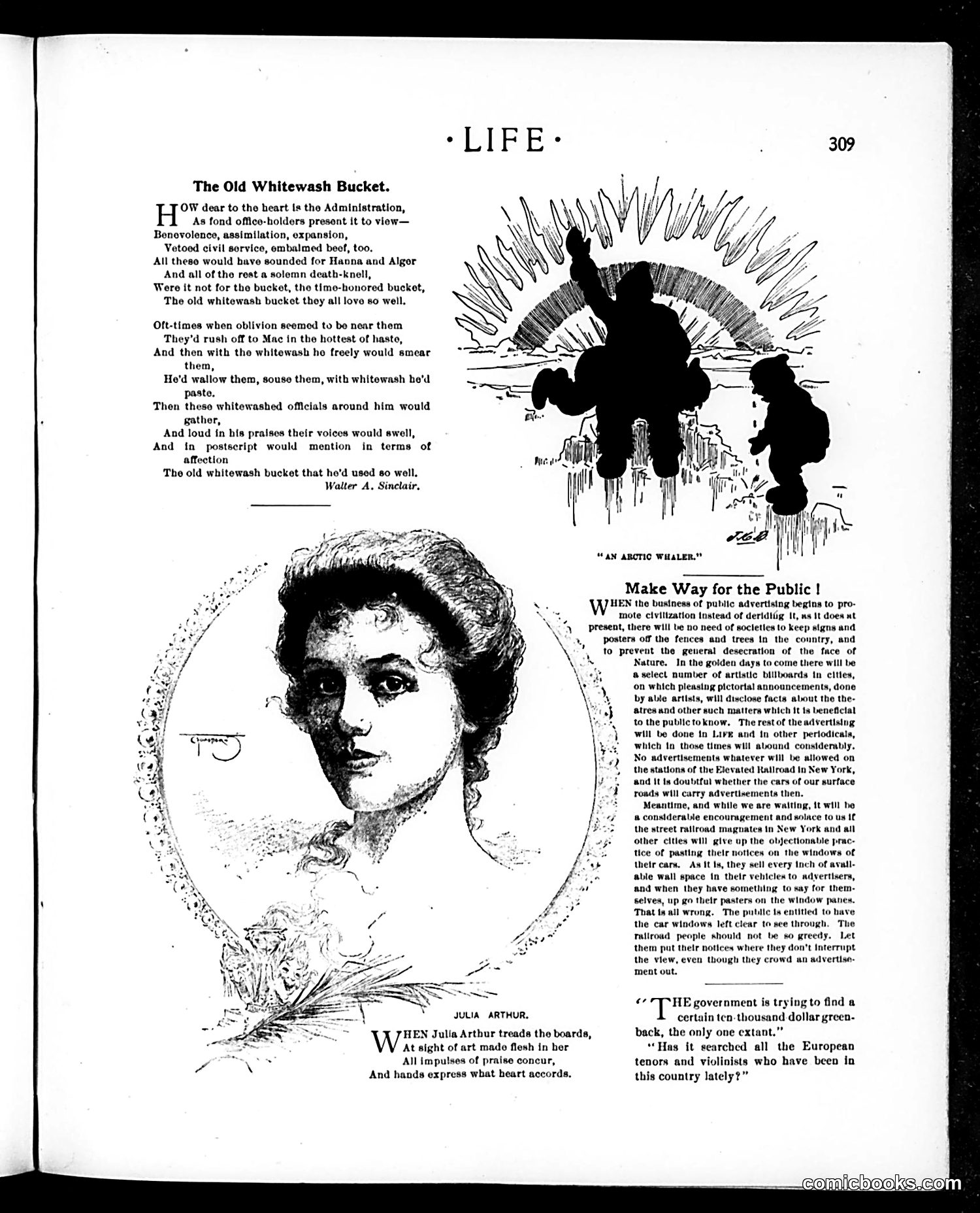
This page contains two distinct pieces: **"The Old Whitewash Bucket"** (poem by Walter A. Sinclair): A satirical poem criticizing the Administration's use of the "whitewash bucket"—a metaphor for covering up scandals and misconduct. It mocks how officials would gather around praising whitewashed (concealed) truths. **"An Arctic Whaler"**: A cartoon showing what appears to be Arctic explorers discovering a whale, with humorous commentary about public perception. **"Make Way for the Public!"**: An editorial arguing against advertising clutter in public spaces (billboards, railroad stations, vehicle advertisements). It advocates for keeping public views clear of commercial signage. **Portrait of Julia Arthur**: A sketch of the actress with accompanying verse about her artistic talent. The page's primary satire targets governmental deception and commercial encroachment on public spaces.
📄 Transcribed text from this page (OCR, searchable)
Machine-transcribed from the original scan — historical spelling and the odd misread are preserved.
The Old Whitewash Bucket. OW dear to tho heart {s the Administration, As fond offico-holders presont it to view— Bonovolence, assimilation, expansion, Votood civil sorvice, embalmed beef, too. All theso would have sounded for Hanna and Algor And all of the rest a solemn death-knell, Were it not for the bucket, tho timo-honored bucket, The old whitewash bucket they all love 80 well. Oft-times when oblivion seemed to be near them They'd rush off to Mac in the hottest of haste, And then with the whitewash ho freely would smear them, He'd wallow them, souse them, with whitewash bo'd paste. Then theso whitewashed officials around him would gather, And loud in his praises their voices would swell, And in postscript would mention in terms of affection The old whitewash bucket that ho'd used 80 woll. Walter A, Sinclair, nn “AN ARCTIC WHALER." Make Way for the Public ! HEN the business of public advertising begins to pro- mote civilization Instead of deridiiig It, ns It does at present, there will be no need of societies to keep signs and posters off the fences and trees in the country, and to prevent the geueral desecration of the face of Nature. In the golden days to come there will be @ select number of artistic billboards tn cities, ‘on which pleasing pictortal announcements, done by able artists, will disclose facts about the the- tres and other such matters which it ts beneficial to the publictoknow, The rest of the advertising will be done in Lire and in other periodicals, which In those times will abound considerably, No advertisements whatever will be allowed on the stations of the Elevated Ratlroad In New York, and It ts doubtful whether the cars of our surface roads will carry advertisements then. Meantime, and while we are waiting, it will he a considerate encouragement and solace to us If the street railroad magnates in New York and all other citles will give up the objectionable prac- tice of pasting their notices on the windows of their cars. As it Is, they sell every Inch of avall- able wall space in their vehicles to advertisers, and when they have something to say for them- selves, up go thelr pasters on the window panes. ‘That is all wrong. The public ts entitled to have the car windows left clear to see through. The Tullroad people should not be so greedy. Let them put thelr notices where they don't Interrupt the view, even though they crowd an advertise- ment out. o HE government is trying to find a JULIA ARTHUR. certain ten-thousand dollar green- HEN Julia Arthur treads tho boards, back, the only one extant.” At sight of art mado flesh in ber “Hag it eearched all the European All impulses of praise concur, tenors and violinists who have been in And hands express what heart accords, this country lately?”