
Life, 1899-10-19 · page 4 of 20
Life — October 19, 1899 — page 4: what you’re looking at
What you’re looking at
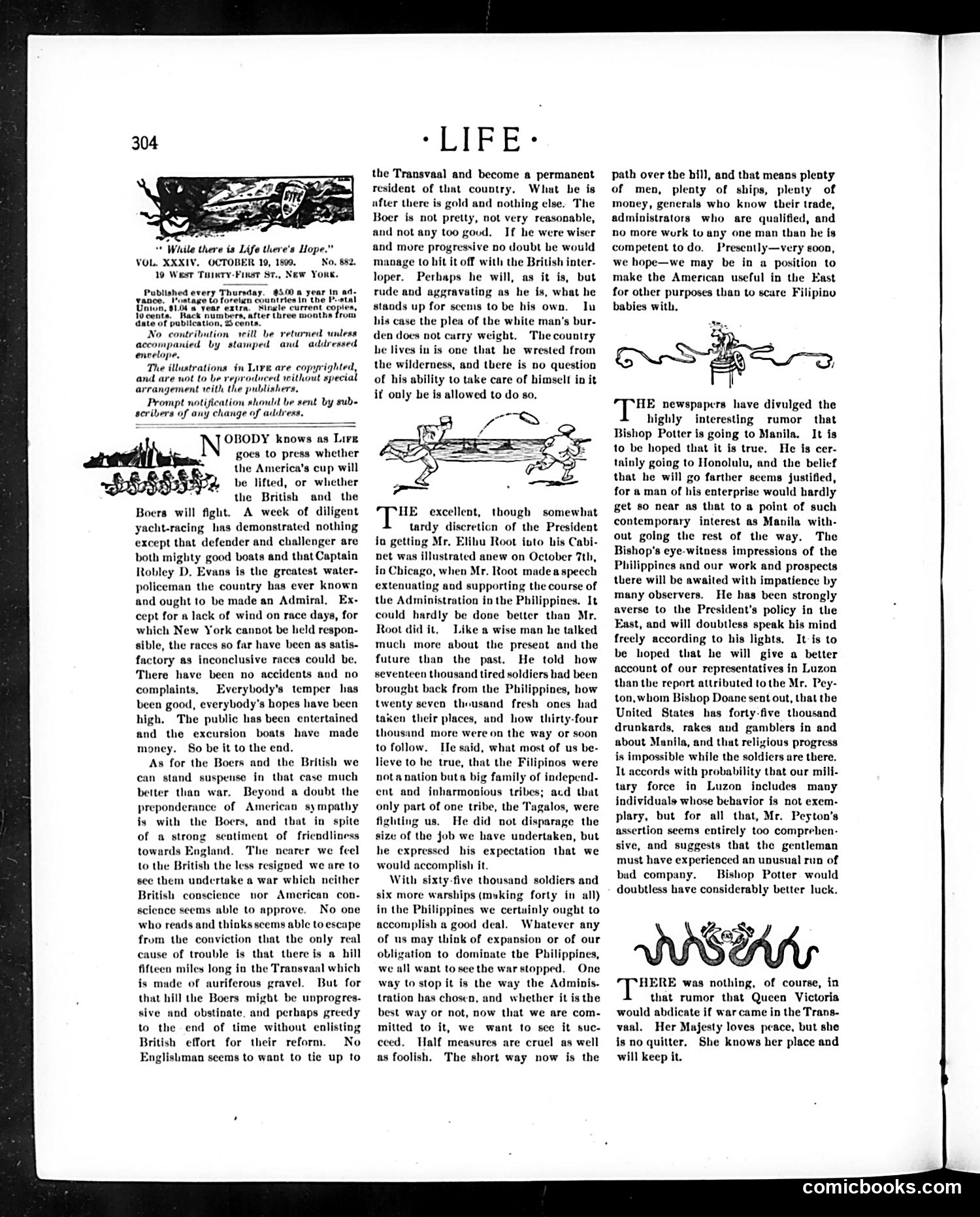
This page contains editorial commentary on the Philippine-American War and colonial administration. The text discusses Elihu Root's October speech in Chicago supporting U.S. administration of the Philippines, praising his articulate defense of American policy there. The small decorative cartoons (appearing as dividers) show exaggerated figures in comic poses—typical of Life's satirical style—though their specific political targets are unclear from this image alone. The editorial defends American military presence while criticizing inefficiency in the occupation. It references Bishop Potter's expected visit to Manila and discusses whether American forces can effectively govern the Philippines, touching on debates about imperial expansion that dominated American politics in 1900.
📄 Transcribed text from this page (OCR, searchable)
Machine-transcribed from the original scan — historical spelling and the odd misread are preserved.
SESESYA “* While there is Life there's Hope.” VOL. XXXIV. OCTOBER 19, 1800. No. 882. 19 West inst St., New Youre. Published every Thursday. $5.00 a year ¥ vatage to forelun epuntries tn the 4 a vear extra. Sinwle current cop! Rack numbers, after three months publication, 2 ‘0 contribution will be returned unless accompanied by stamped and addressed envelope. The illustrations in Live are copyrighted, and are not to be reproduced without special arrangement with the publishers, date Prompt notification should be sent by sub- any change of address. seribers OBODY knows as Lire goes to press whether the America’s cup will be lifted, or whether the British and the Boers will fight. A week of diligent yacht-racing has demonstrated nothing except that defender and challenger are both mighty good boats and that Captain Robley D. Evans is the greatest water- policeman the country has ever known and ought to be made an Admiral, Ex- cept for a lack of wind on race days, for which New York cannot be held respon- sible, the races so far have been as satis- factory as inconclusive races could be. There have been no accidents and no complaints, Everybody's temper has been good, everybody's hopes have been high. The public has becn entertained and the excursion boats have made money. 8o be it to the end. As for the Boers and the British we can stand suspense in that case much better than war. Beyond a doubt the preponderance of American sympathy is with the Boers, and that in spite of a strong sentiment of friendliness towards England. The nearer we feel to the British the less resigned we are to sec them undertake a war which neither British conscience nor American con- science seems able to approve. No one who reads and thinks seems able to escape from the conviction that the only real cause of trouble is that there is a hill fifteen miles long in the Transvaal which is made of auriferous gravel. But for that hill the Boers might be unprogres- sive and obstinate. and perhaps greedy to the end of time without enlisting British effort for their reform. No Englishman seems to want to tie up to LIFE the Transvaal and become a permanent resident of that country. What he is after there is gold and nothing else. The Boer is not pretty, not very reasonable, and not any too goud. If he were wiser and more progressive no doubt be would manage to bit it off with the British inter- loper. Perhaps he will, as it is, but rude and aggravating as he is, what he stands up for scems to be his own. In his case the plea of the white man’s bur- den does not carry weight. Thecountry he lives in is one that he wrested from the wilderness, and there is no question of his ability to take care of himselt in it it only he is allowed to do so. HE excellent, though somewhat tardy discreticn of the President in getting Mr. Elihu Root into bis Cabi- het was illustrated anew on October 7th, in Chicago, when Mr. Root madeaspeech extenuating and supporting the course of the Administration in the Philippines. It could hardly be done better than Mr. Root did it, Like a wise man he talked much more about the present and the future than the past. He told how seventeen thousand tired soldiers had been brought back from the Philippines, how twenty seven thousand fresh ones had taken their places, and how thirty-four thousand more were on the way or soon to follow. Ile said, what most of us be- lieve to he true, that the Filipinos were nota nation buta big family of independ- ent and inharmonious tribes; acd that only part of one tribe, the Tagalos, were fighting us. He did not disparage the size of the job we have undertaken, but he expressed his expectation that we would accomplish it. With sixty-five thousand soldiers and six more warships (muking forty in all) in the Philippines we certainly ought to accomplish a good deal. Whatever any of us may think of expansion or of our obligation to dominate the Philippines, we all want to see the war stopped. One way to stop it is the way the Adminis. tration has chosen, and whether it isthe best way or not, now that we are com- mitted to it, we want to see it suc- eced. Half measures are cruel as well as foolish. The short way now is the Path over the bill, and that means plenty of men, plenty of ships, plenty of money, generals who know their trade, administrators who are qualified, and no more work to any one man than he fs competent todo. Presently—very soon, we hope—we may be in a position to make the American useful in the East for other purposes than to scare Filipino babies with, TE newspapers have divulged the highly interesting rumor that Bishop Potter is going to Manila, It is to be hoped that it is true, He is cer- tainly going to Honolulu, and the belief that he will go farther scems justified, for a man of his enterprise would hardly get so near as that to a point of such contemporary interest as Manila with- out golng the rest of the way. The Bishop's eye-witness impressions of the Philippines and our work and prospects there will be awaited with impatience by many observers. He has been strongly averse to the President's policy in the East, and will doubtless speak his mind freely according to his lights. It-is to be hoped that he will give a better account of our representatives in Luzon than the report attributed tothe Mr. Pey- ton, whom Bishop Doane sent out, that the United States has forty-five thousand drunkards, rakes aud gamblers in and about Manila, and that religious progress is impossible while the soldiers are there. It accords with probability that our mili- tary force in Luzon includes many individuals whose behavior is not exem- plary, but for all that, Mr. Peyton's assertion seems entirely too comprehen- sive, and suggests that the gentleman must have experienced an unusual run of bad company. Bishop Potter would doubtless have considerably better luck. WSAM HERE was nothing, of course, in that rumor that Queen Victoria would abdicate if war came in the Trans- vaal. Her Majesty loves peace, but she is no quitter, She knows her place and will keep it. comicbooks.com