
Life, 1899-10-19 · page 12 of 20
Life — October 19, 1899 — page 12: what you’re looking at
What you’re looking at
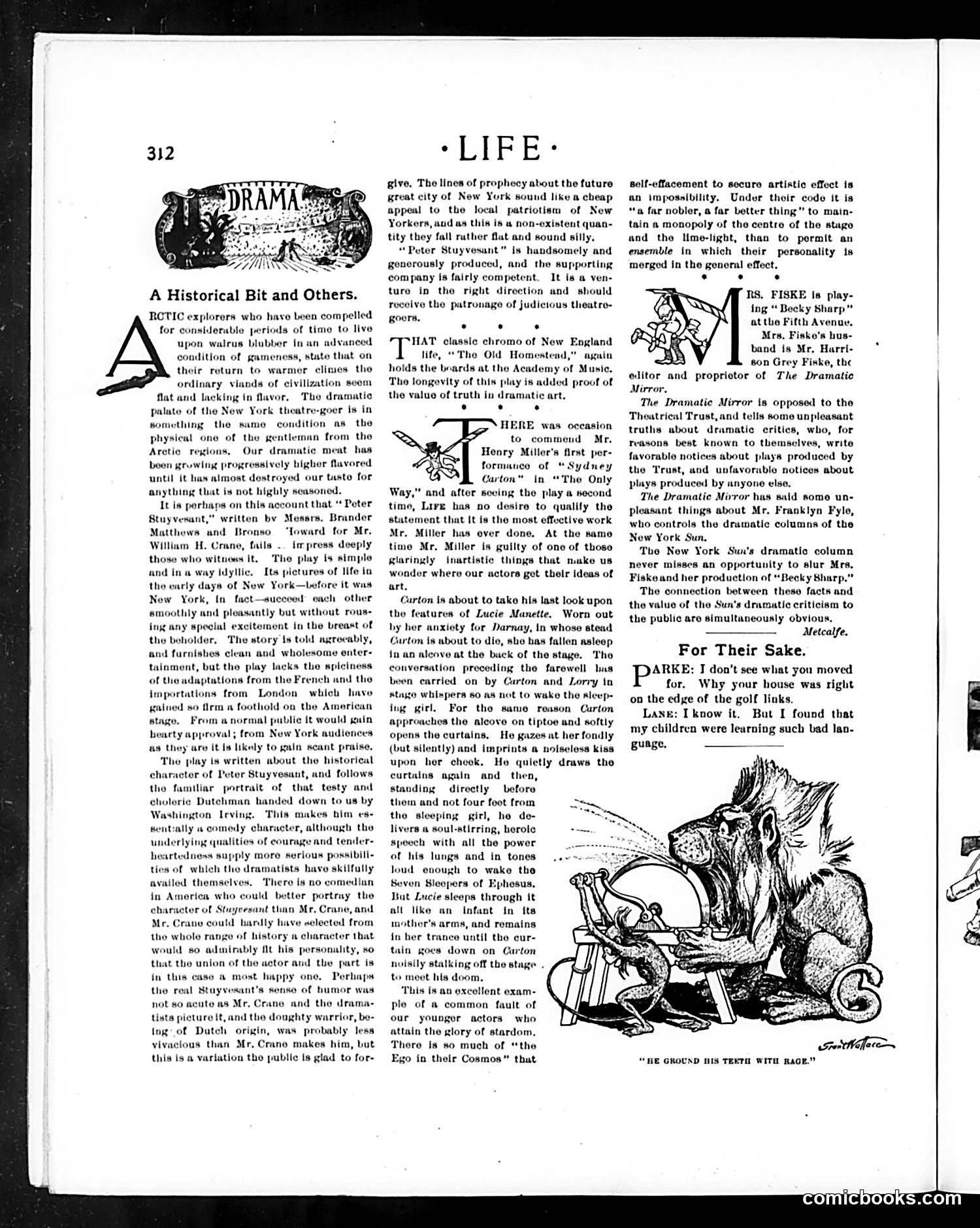
This page contains dramatic criticism and theater commentary rather than political cartoons. The main illustrated feature shows a scene labeled "HE GROUND HIS TEETH WITH RAGE," depicting what appears to be a theatrical moment of emotional intensity. The text discusses Henry Miller's play "Sydney Carton" and critiques both the production and contemporary acting practices. The reviewer praises the play's historical value while criticizing actors' tendency toward excessive ego and self-aggrandizement on stage. A sidebar titled "For Their Sake" humorously addresses parents concerned about children witnessing inappropriate theatrical content, with the illustration showing what appears to be a frustrated audience member. The page primarily serves as arts criticism rather than political satire.
📄 Transcribed text from this page (OCR, searchable)
Machine-transcribed from the original scan — historical spelling and the odd misread are preserved.
A Historical Bit and Others. RCTIC explorers who have Leen compelled for consideruble periods of time to live upon walrus blubber in an advanced condition of gameness, state that on their return to warmer climes the ordinary viands of civilization seem flat and lacking in flavor, Tho dramatic Palate of the New York theatre-goer Is in something the sume condition as the physical one of the gentleman from the Arctic regions, Our dramatic meat has been growing progressively bigher flavored until it has almost destroyed our taste for anything that is not highly seasoned. It is perhaps on this account that “ Peter Stuyvesant,” written by Messrs, Brander Matthews und Bronso ‘foward for Mr. William H. Crane, fails . impress deeply those who witness it, ‘The play is simple and ina way idyllic, Its pictures of life in tho carly days of New York—before it was New York, in fuct—suceood each other smoothly und pleasantly but without rous- ing any speciul excitement in the breast of the beholder, The story ts told agreeably and furnishes clean and wholesome enter- tainment, but tho play lacks the spiciness of the adaptations from the French und the importations from London which have gained so firm a foothold on the American stage, From anormal public it would gain hearty approval; from Now York audiences as they are itis likely to guin scant praise, Tho play is written about the historical charactor of Peter Stuyvesant, and follows tho familiar portrait of that testy and choleric Dutchman handed down to us by Washington Irving. This makes him es- sentially «comedy character, although the underlying qualities of courage and tender- heartedness supply more serious possibili- ties of which tho dramatists have skilfully availed themselves. There is no comediun in America who could better portray the character of Stuyvesant than Mr, Crane, and Mr. Crane could hardly have selected from the whole range of history a character that would so admirably ft his personality, so that the union of the actor aud the part is in this case a most happy Perhaps the Stuyvesant's sense of humor was not 80 acute as Mr, Crane and the drama- tists picture it, and the doughty warrior, be- ingot Dutch origin, was probably less vivacious than Mr. Crano makes him, but this isa varlation tho public Is glad to for- *LIFE- give, The lines of prophecy about the future great city of New York sound like a cheap appeal to the local patriotism of New Yorkers, and as this is w non-existent quan- tity they fall rather flat and sound silly, “Potor Stuyvesant” is handsomely and generously produced, and the supporting com pany is fairly competent. It is a ven- ture in the right direction and should receive the patronage of judicious theatro- goors, . . . HAT classic chromo of New England life, “The Old Homestead,” aguin holds the beards at the Academy of Music. Tho longevity of this play is added proof of the value of truth in dramatic art. . . . HERE was occasion to commend Mr, Henry Miller's first per- formunce of “Sydney Carton” in “The Only Way,” and after soving the play a second time, Lirg has no desire to qualify the statement that it is the most effective work Mr. Miller has ever done, At the same time Mr, Miller is guilty of one of those glaringly inartistic things that muke us wonder where our actors get their ideas of art. Carton is about to take his last look upon the features of Lucie Manette. Worn out by her anxiety for Darnay, In whose stead Carton is about to die, she bas fallen asleep in an alcove at the buck of the stage. Tho conversation preceding the farewell lus been carried on by Carton and Lorry in stuyge whispers so as not to wake the sleep: ing girl, For the same reason Curton Approaches the alcove on tiptoe and softly opens the curtains, He gazes at her fondly (but silently) and imprints a noiseless kiss upon her cheek. He quietly draws the curtains again and then, standing directly before them and not four feet from the sleeping girl, he de- livers a soul-stirring, heroic speech with all the power of his lungs and in tones loud enough to wake the Seven Sleopers of Ephesus. But Lucie sleeps through it all like an infant in its mother’s arms, and remains in ber trance until the cur- tain goes down on Carton noisily stalking off the stage . to meet his doom, ‘This is an excellent exam- ple of a common fault of our youngor actors who attain the glory of stardom. There is so much of “the Ego in thelr Cosmos” thut self-effacement to secure artistic effect is an impossibility. Under their code it is “a far nobler, a far Letter thing” to main- tain a monopoly of tho centre of tho stago and the Ume-light, than to pormit an ensemble in which their personality is morged in the general effect. ee . RS, FISKE is play- ing “ Becky Sharp” at the Fifth Avenu Mrs, Fiske's hu: band is Mr. Harri- eon Grey Fiske, the editor and proprietor of The Dramatic Mirror, The Dramatic Mirror is opposed to the Theatrical Trust, and tells some unpleasant truths about dramatic critics, who, for reasons best known to themselves, write favorable notices about plays produced by the Trust, und unfavorable notices about plays produced by anyone else, The Dramatic Mirror has said some un- pleasant things about Mr. Franklyn Fylo, who controls the dramatic columns of the New York Sun, Tho New York Sun's dramatic column never misses an opportunity to slur Mra, Fiskoand her production of “Becky Sharp.” The connection between these facts and the value of the Sun's dramatic criticism to the public are simultaneously obvious. Metcalfe. For Their Sake. ARKE: I don’t see what you moved for. Why your house was right on the edge of the golf links. Lane: I know it. But [ found that my children were learning such bad lan- guage, ae eee ore “HE GROUND DIS TEETH WITH RAGE.”