
A complete issue · 20 pages · 1899
Life — April 20, 1899
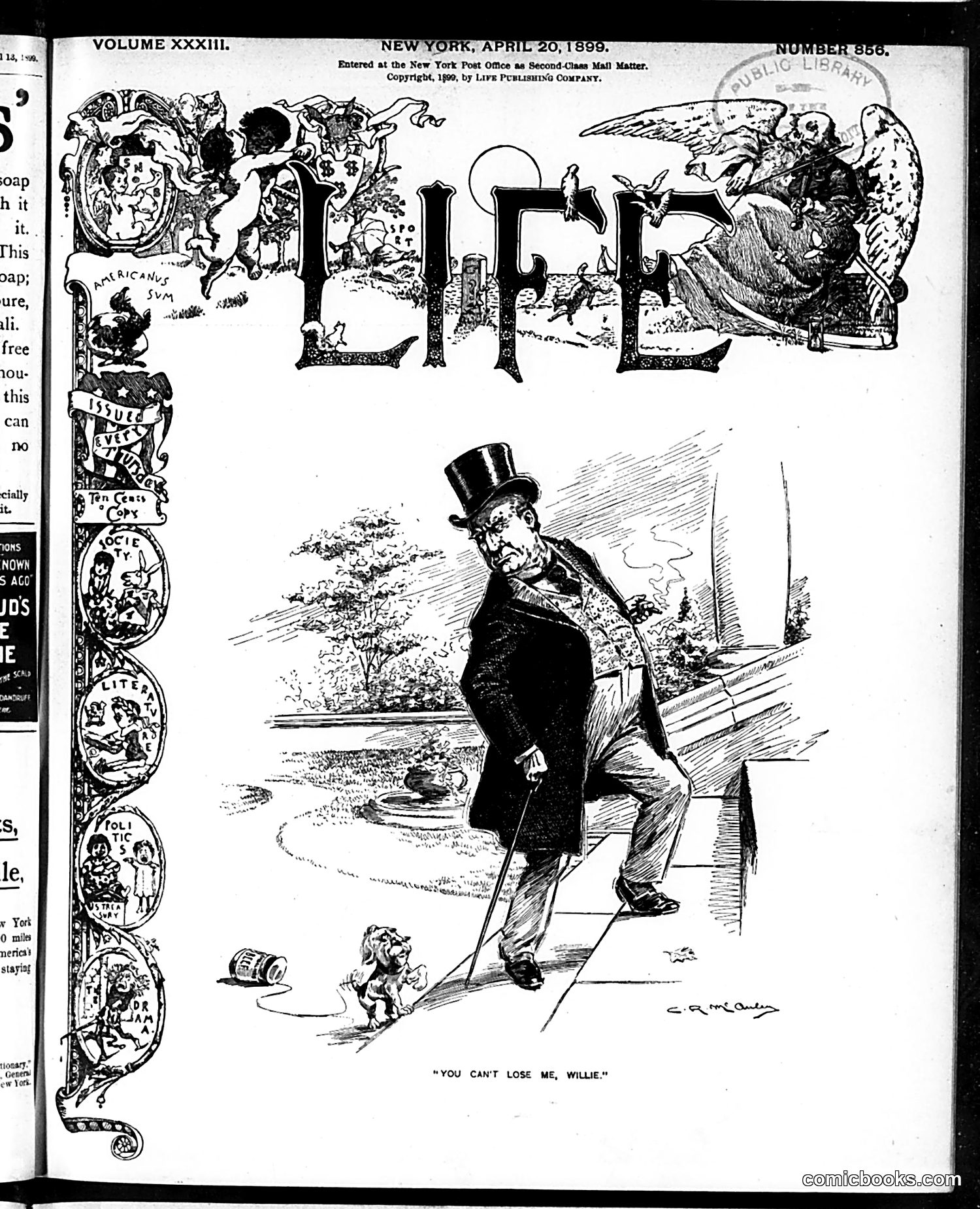
This page features a political cartoon captioned "You Can't Lose Me, Willie." The central figure is a well-dressed man in a top hat using a cane, appearing to guide or control a small dog on a leash. The cartoon likely references a political relationship or power dynamic from 1899, though the specific identities of "Willie" and the controlling figure remain unclear without additional context. The satirical point appears to concern political loyalty or manipulation—the image suggests one politician or public figure maintaining tight control over another ("Willie"), humorously represented through the master-dog relationship. The dog's apparent compliance despite the controlling leash reinforces themes of dominance and dependence typical of Late Victorian-era political satire.
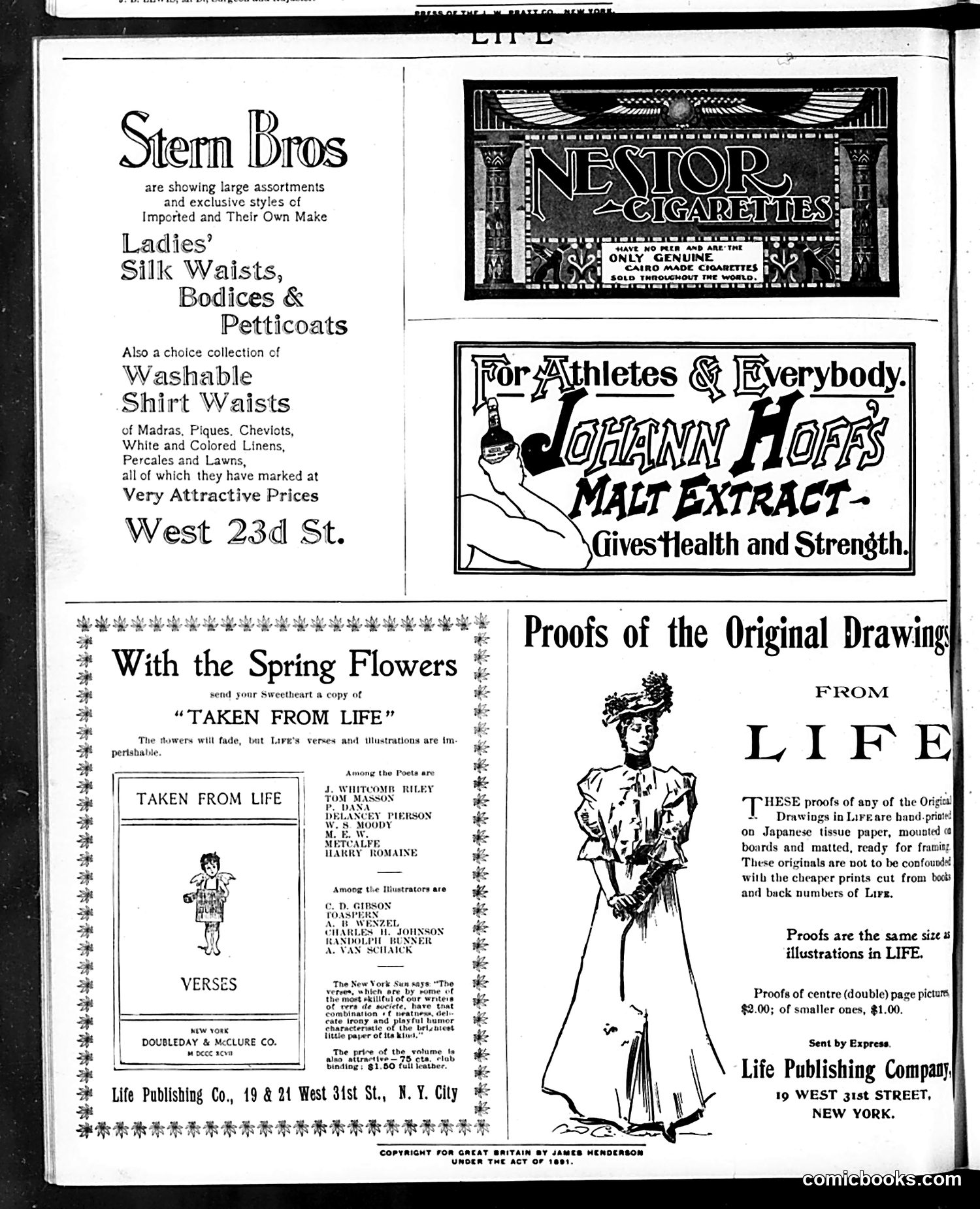
This page is **primarily advertising** rather than editorial content or satirical cartoons. It contains four advertisements: 1. **Stern Bros.** department store promoting ladies' silk clothing on West 23rd Street 2. **Nestor Cigarettes** advertising "only genuine Cairo made cigarettes" 3. **Johnny Hoff's Malt Extract** promoting health and strength for "athletes & everybody" 4. **Life Publishing Company** advertising proofs of original drawings from Life magazine, available for purchase There is no political cartoon or satire visible. The only illustration is a fashion sketch of a woman in period dress promoting the malt extract product. The page demonstrates early 20th-century advertising conventions and product marketing strategies typical of this era's magazines.
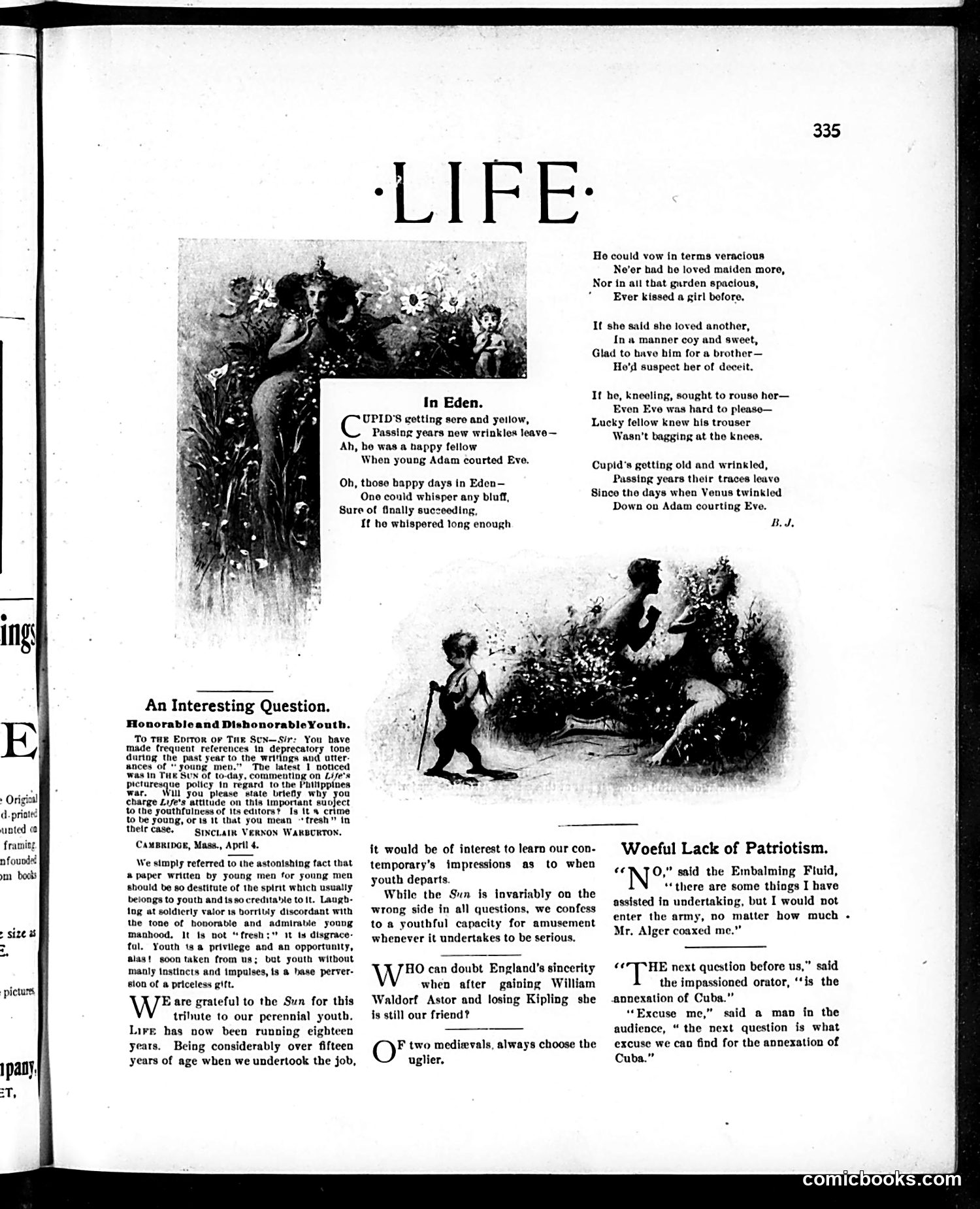
This page contains literary and editorial content rather than political cartoons. The main section titled "In Eden" is a poem about Cupid courting Eve in the Garden of Eden—a humorous take on romantic history. Below are three distinct editorial pieces: "An Interesting Question" debates whether the *Sun* newspaper should publish writings by young men; "Woeful Lack of Patriotism" presents a satirical dialogue about England's loss of William Astor and Rudyard Kipling to America, questioning national loyalty; and a final fragment addressing the "annexation of Cuba." The illustrations are decorative Victorian-style engravings accompanying the poems and essays. This appears to be general satirical commentary on contemporary social and political matters rather than focused on specific events or individuals.
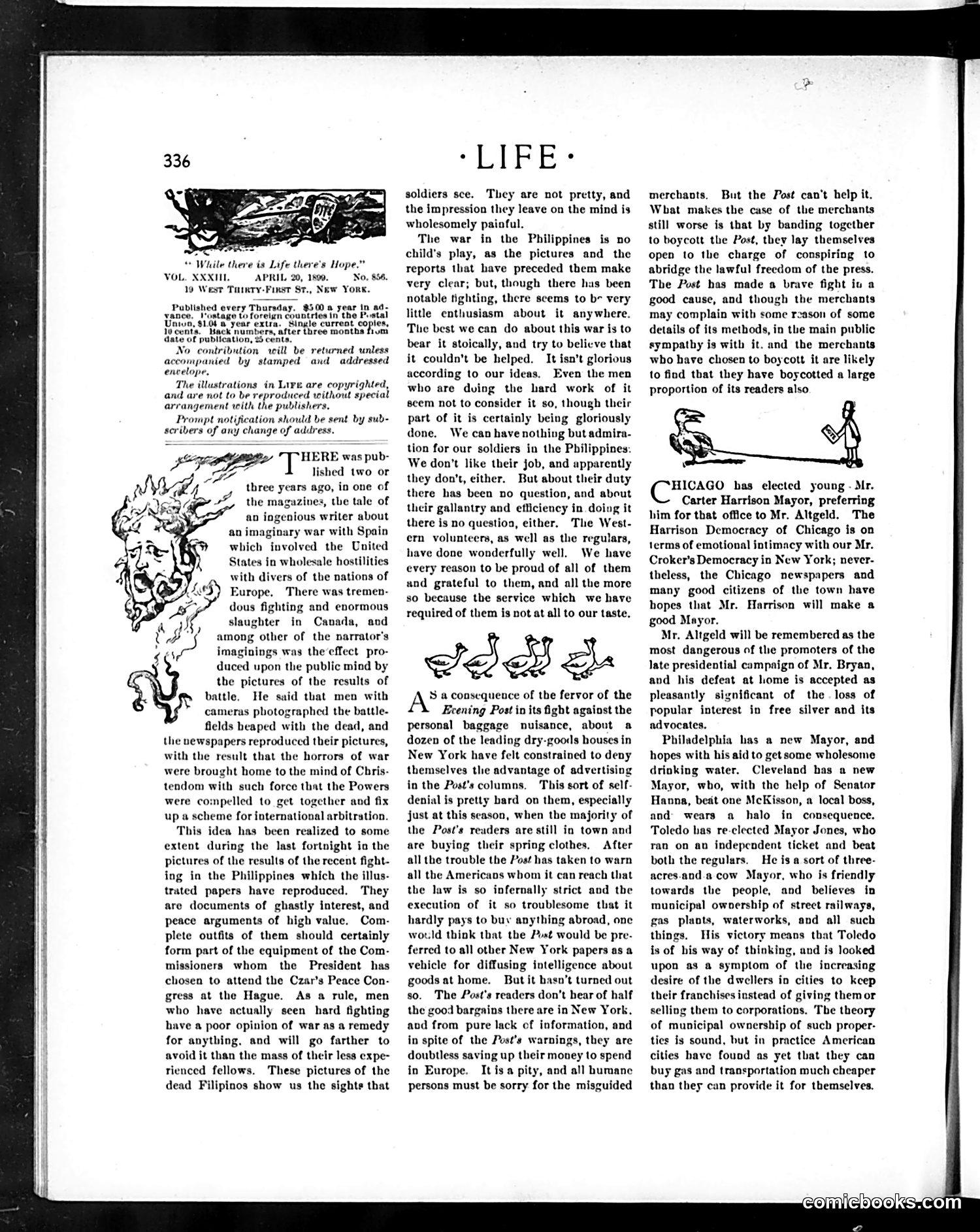
This page contains two editorial cartoons critiquing American newspapers' coverage of international events. The **left cartoon** depicts a grotesque face emerging from chaos, illustrating Life's complaint about sensationalized reporting of the Philippine-American War. The magazine criticizes how papers published battlefield photographs showing dead soldiers, creating public horror and Christian sentiment against the conflict—despite Life's view that soldiers performed their duty competently. The **right section** features small duck-like figures, likely representing **Evening Post** editors. The text attacks the *Evening Post*'s campaign against dry-goods merchants advertising in its columns, calling this self-serving hypocrisy. Life argues the *Post* unfairly restricts merchants' advertising freedom while claiming moral authority. Both cartoons exemplify Life's satirical approach to press criticism and commercial ethics in early 1900s American journalism.
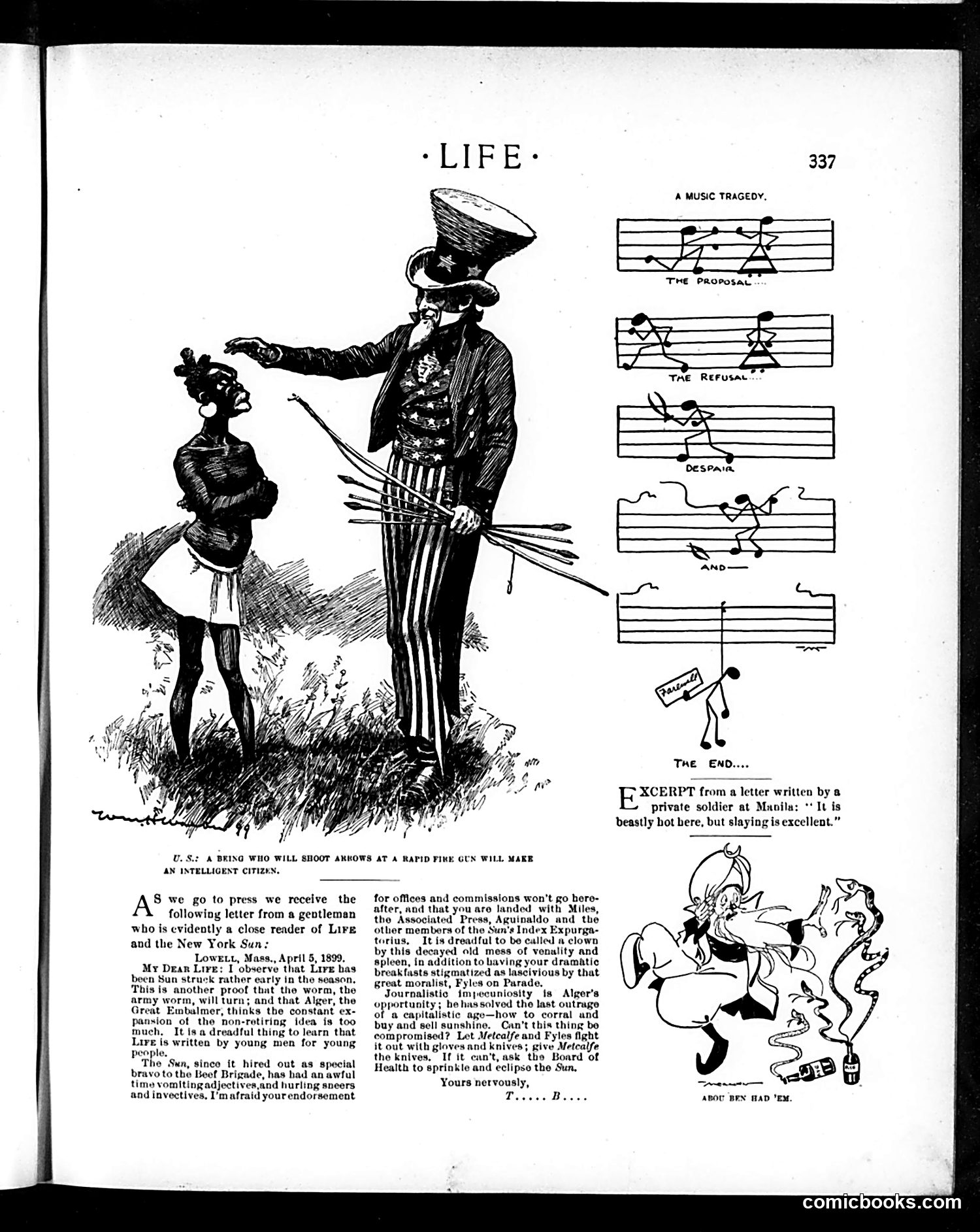
This page satirizes military romance and courtship through a "music tragedy" format. The main illustration shows a tall military officer (likely a recruiter or soldier) proposing to a young woman, with the musical notation on the right depicting the emotional arc: "The Proposal," "The Refusal," "Despair," and "The End." The accompanying letter criticizes the expansion of the U.S. military and its cultural influence. The writer mocks how military service is romanticized for young people, arguing that LIFE magazine (which targets young readers) promotes militarism through dramatic storytelling. The bottom cartoon, "About Ben Had 'Em," appears to be unrelated humor. The satire warns against glorifying military life to impressionable audiences.
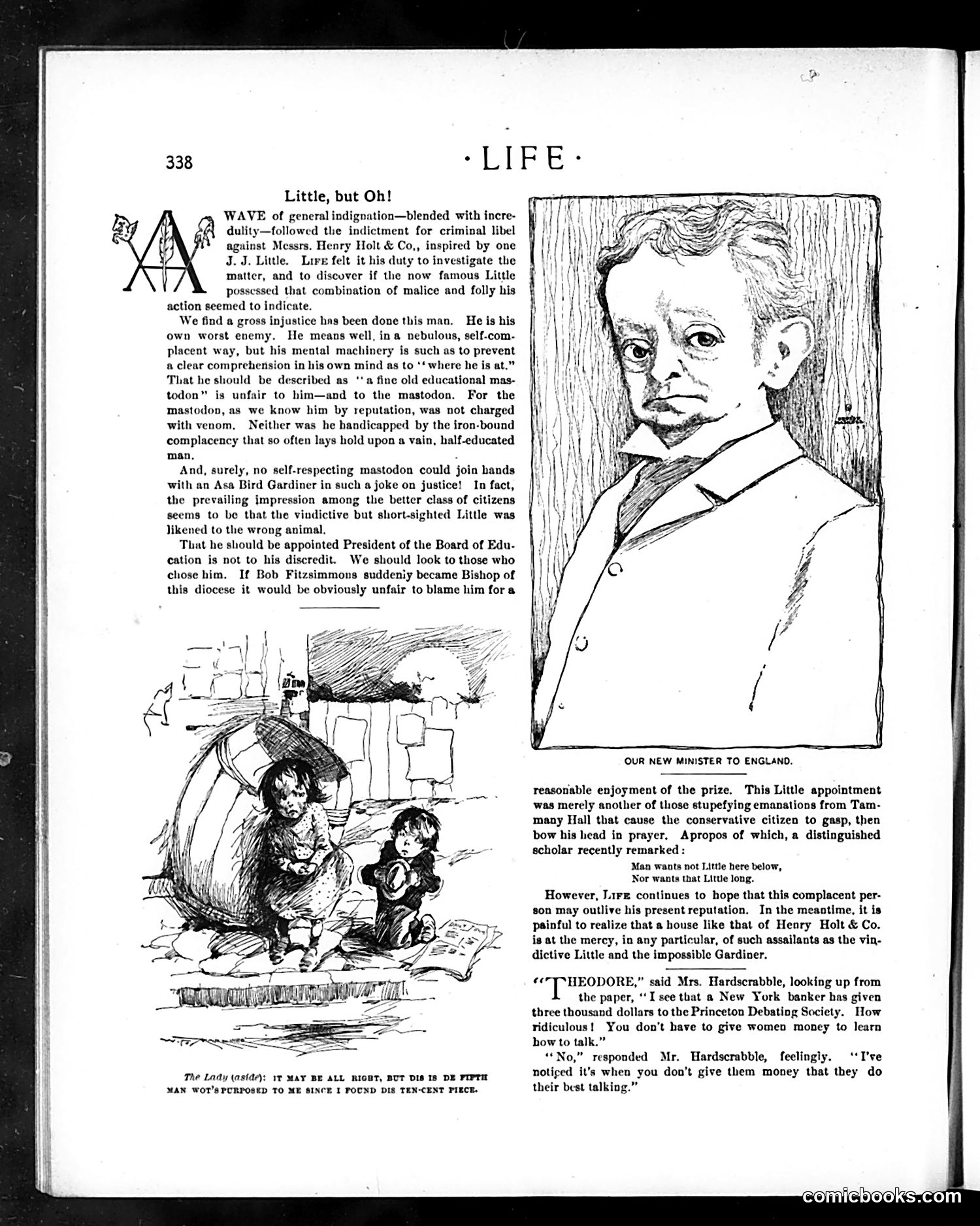
This satirical article criticizes J.J. Little's appointment as President of the Board of Education. The text attacks Little as his "own worst enemy"—someone well-intentioned but intellectually limited, unable to think clearly. The main cartoon depicts a poor woman with children in squalor, captioned about a ten-cent piece, illustrating the gap between Little's educational aspirations and actual social conditions. The page mocks Little's appointment as undeserving and suggests it reflects broader corruption in New York civic institutions. A secondary joke references Theodore's (likely Theodore Roosevelt) wife Mrs. Hardscrabble criticizing wealthy philanthropists' conditional giving to debating societies, implying patronizing charity rather than genuine social improvement.
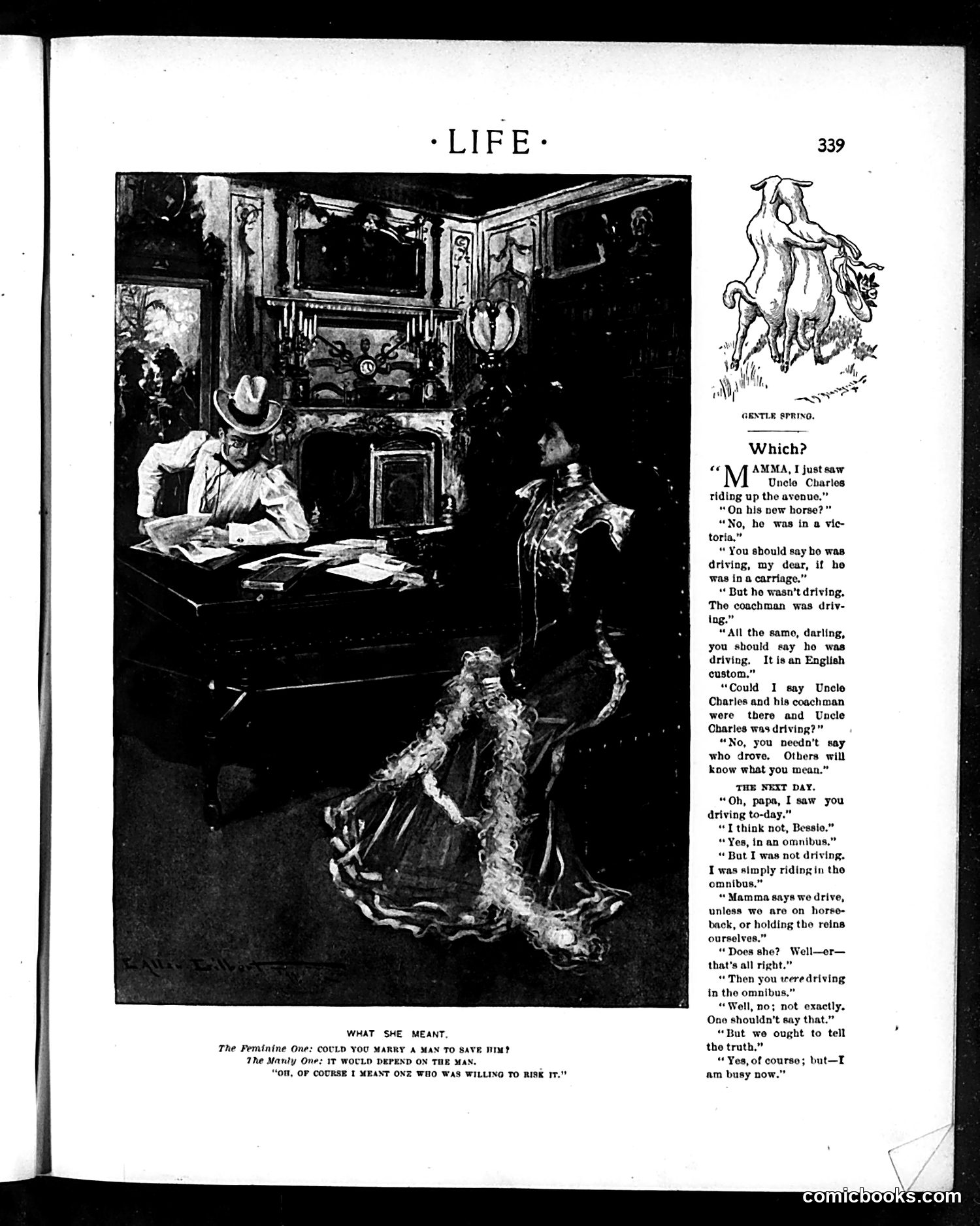
The main illustration depicts a wealthy woman at her desk (likely in her home) conversing with a man in formal attire. The caption reads: "WHAT SHE MEANT: 'Could you marry a man to save him?' / THE MANLY ONE: 'It would depend on the man. / 'Of course I meant one who was willing to rise it.'" The satire targets gender dynamics and marriage expectations of the era. It mocks the "New Woman" attitude—the woman's presumptuous suggestion that she could "save" a man through marriage. The man's pointed response suggests women overestimate their reformative power and should only marry willing participants. The accompanying text story "Which?" continues this theme, examining class distinctions and social propriety regarding who "drives" in carriages—commentary on transportation, status, and domestic authority.
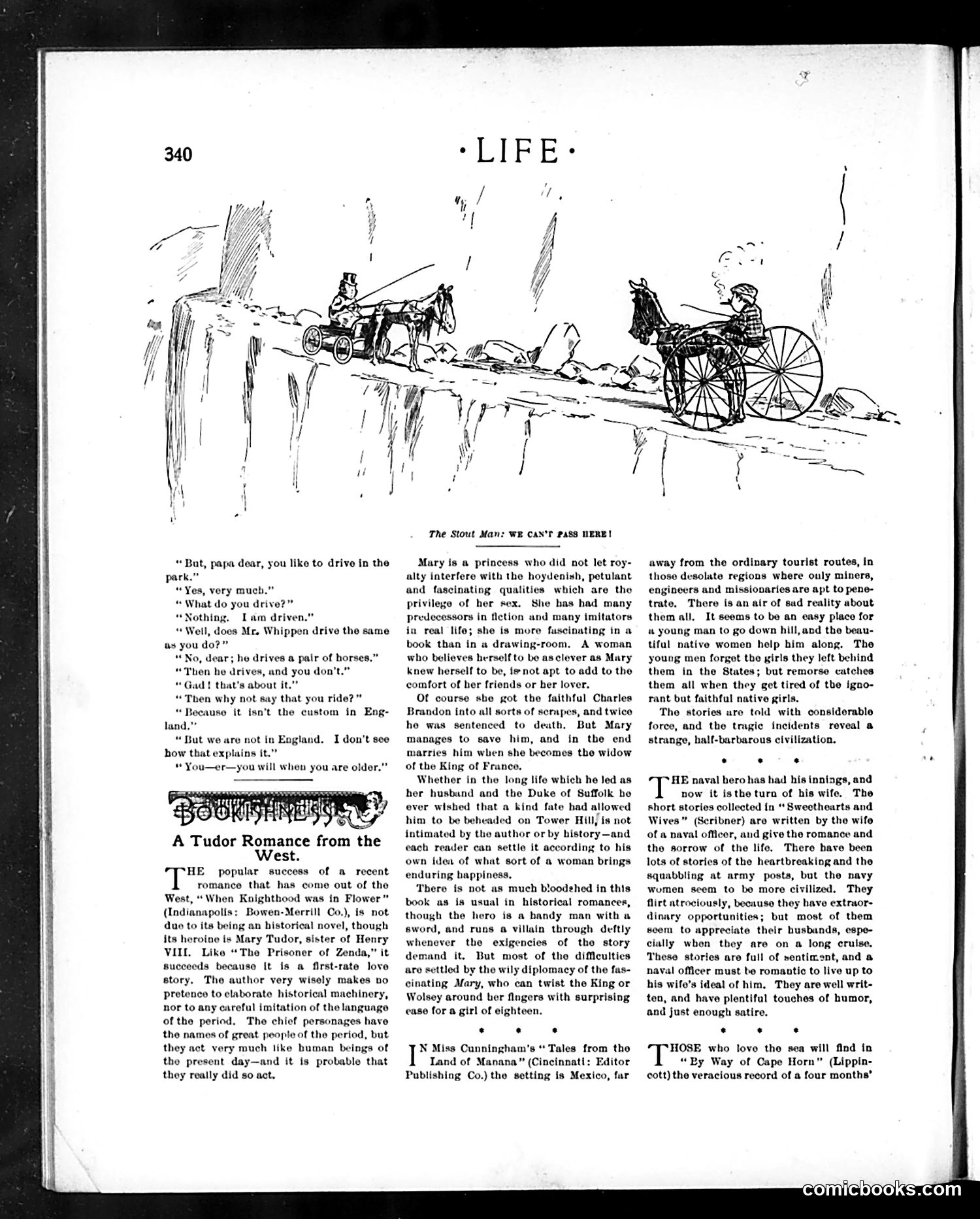
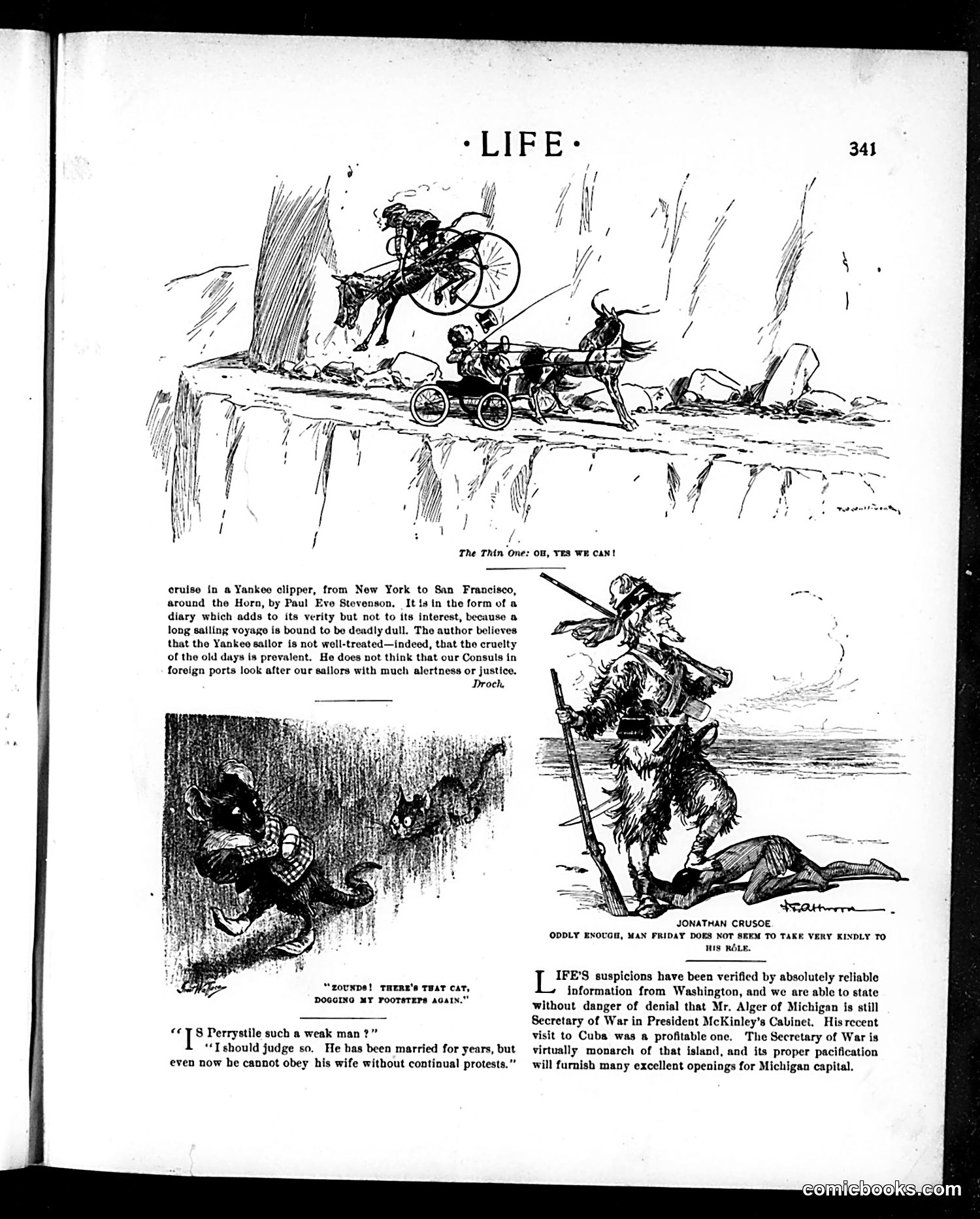
This page contains satirical commentary on contemporary figures and issues: **Top cartoon**: Shows a man on a bicycle and someone in a cart being pulled by goats, apparently illustrating different modes of transportation or social status contrasts. **Middle section**: References a book about a "cruise in a Yankee clipper" by Paul Even Stevenson, with editorial commentary suggesting the author criticizes how American sailors are treated abroad, implying foreign consulates don't adequately protect U.S. sailors. **Bottom cartoons**: Include a domestic humor piece about a weak husband who "cannot obey his wife without continual protests," and a reference to "Jonathan Crusoe" (likely a play on Robinson Crusoe). **Right column**: Notes about Secretary of War Alger and Cuba policy under President McKinley, discussing potential cabinet positions. The page mixes political commentary with domestic humor typical of Life's satirical approach.
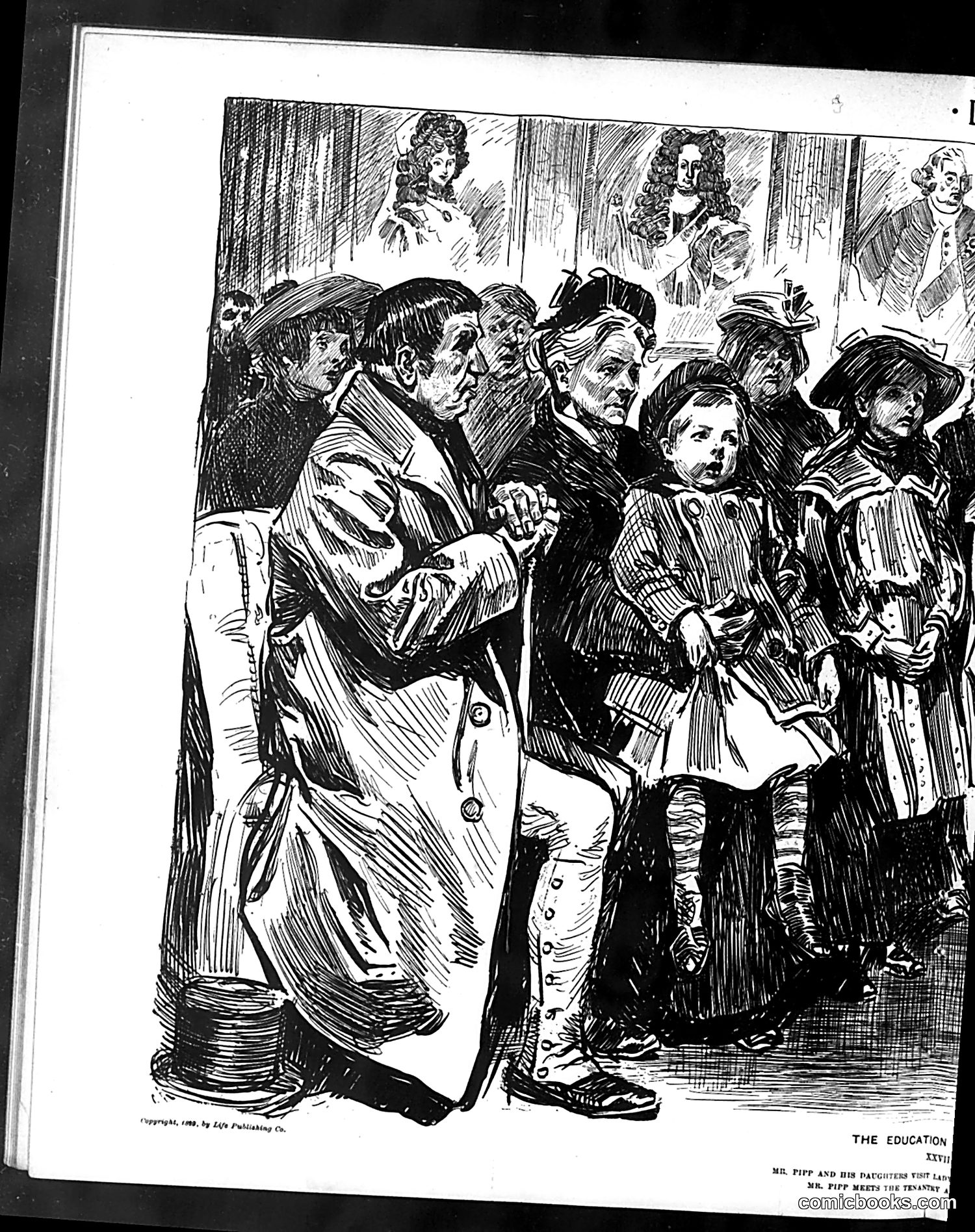
This satirical illustration, titled "The Education," depicts what appears to be a school or institutional scene with multiple figures gathered around two central characters. The caption references "Mr. Piff and his Educated Valet" and mentions "Mr. Piff Meets the Treasury." The cartoon likely satirizes class distinctions and education—showing an interaction between a master figure (Mr. Piff) and his valet, surrounded by onlookers. The "Treasury" reference suggests political or financial satire, possibly mocking how education or refinement operates differently across social classes, or critiquing the relationship between wealth and knowledge. The detailed line work and composition emphasize the contrast between the central figures and the crowd, suggesting commentary on social hierarchy or public spectacle around class differences.
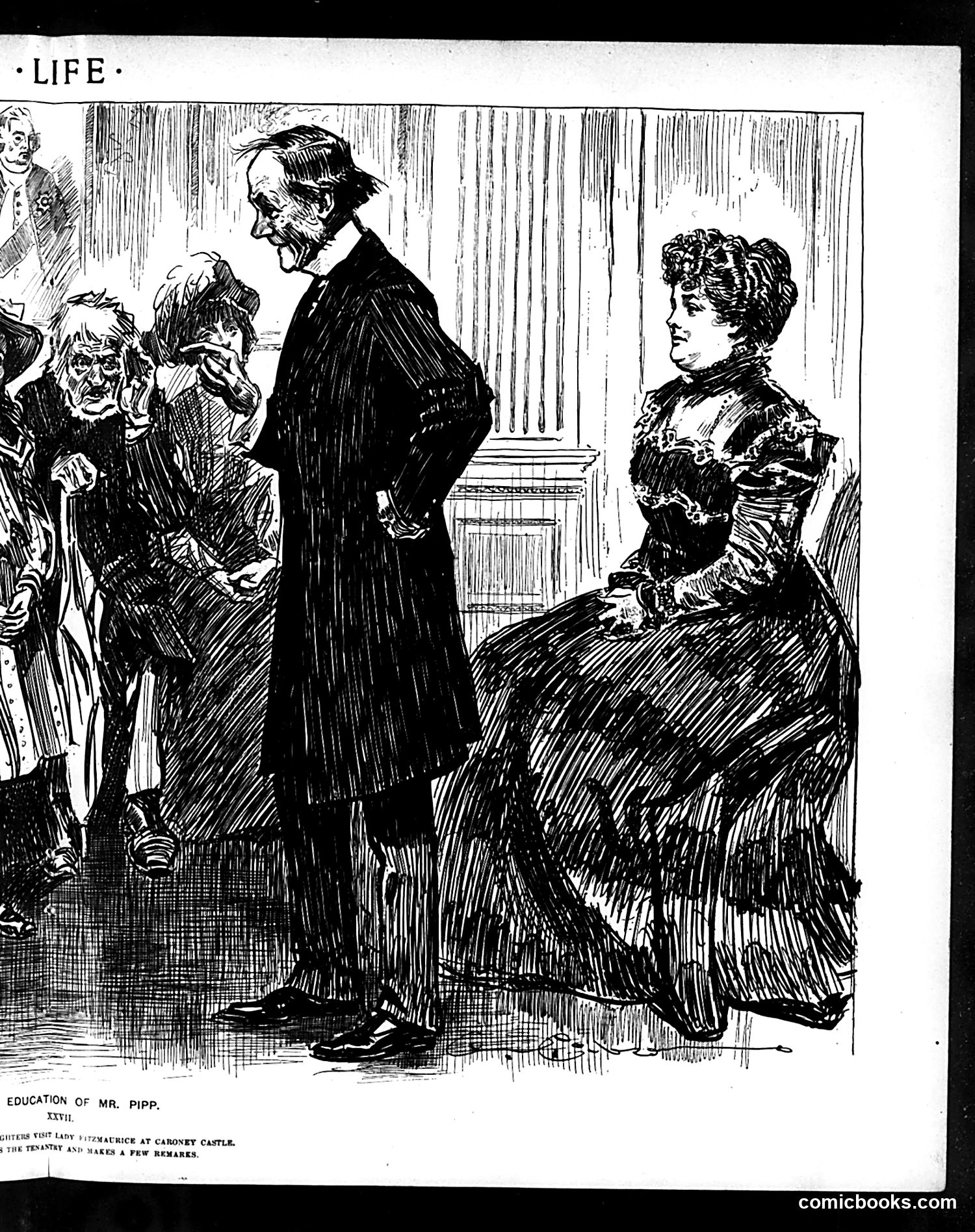
This satirical illustration from *Life* magazine depicts a social scene titled "Education of Mr. Pipp." The caption indicates that "Duchess Fitz-Auberce at Cawdrey Castle" is instructing "the Peasant and Makes a Few Remarks." The cartoon appears to mock class pretension and social climbing. A well-dressed man (Mr. Pipp) stands conversing with an elegantly attired woman identified as a Duchess, while observers watch. The satire likely ridicules either Pipp's attempts to gain aristocratic acceptance or the Duchess's condescending "education" of someone from a lower social class. The formal setting and the gathered onlookers suggest mockery of rigid Victorian-era social hierarchies and the absurdity of attempts to bridge class divisions through superficial instruction in etiquette or manners.
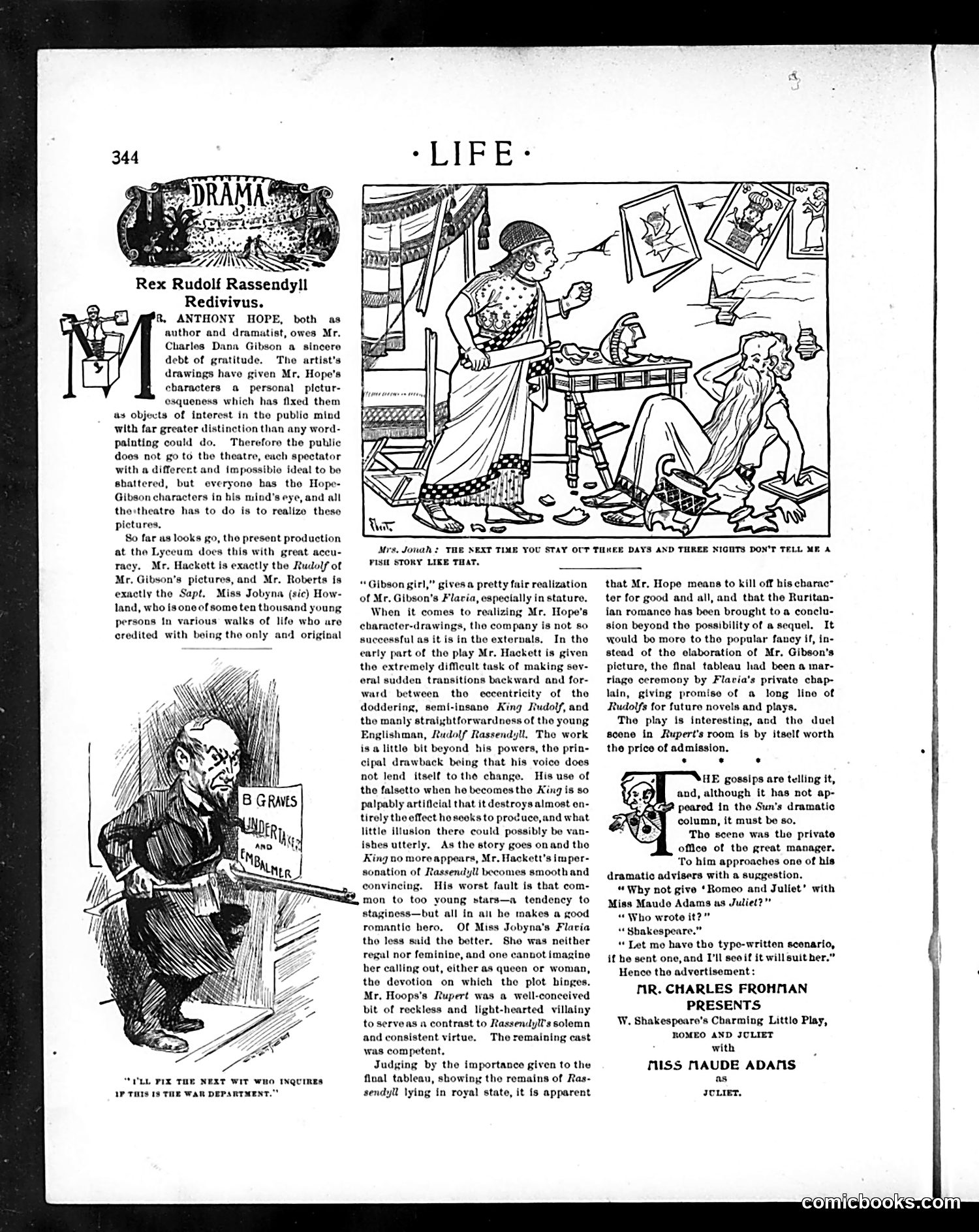
This page reviews a theatrical production of "Romeo and Juliet" featuring actor Anthony Hope and Miss Maude Adams. The main cartoon (lower left) depicts a figure labeled with books including "Grammar," "Rhetoric," and "The Unities"—representing classical dramatic rules. The caption reads "I'LL FIX THE NEXT WIT WHO INQUIRES IF THIS IS THE WAR DEPARTMENT." The satire mocks rigid adherence to dramatic conventions. The figure appears to be a theatrical authority figure threatening to "fix" anyone questioning whether strict classical rules still apply to modern theater. This reflects early 1900s debates about whether Shakespearean plays should be performed according to rigid traditional structures or adapted for contemporary audiences. The joke targets pedantic theatrical gatekeepers enforcing outdated dramatic formalism.
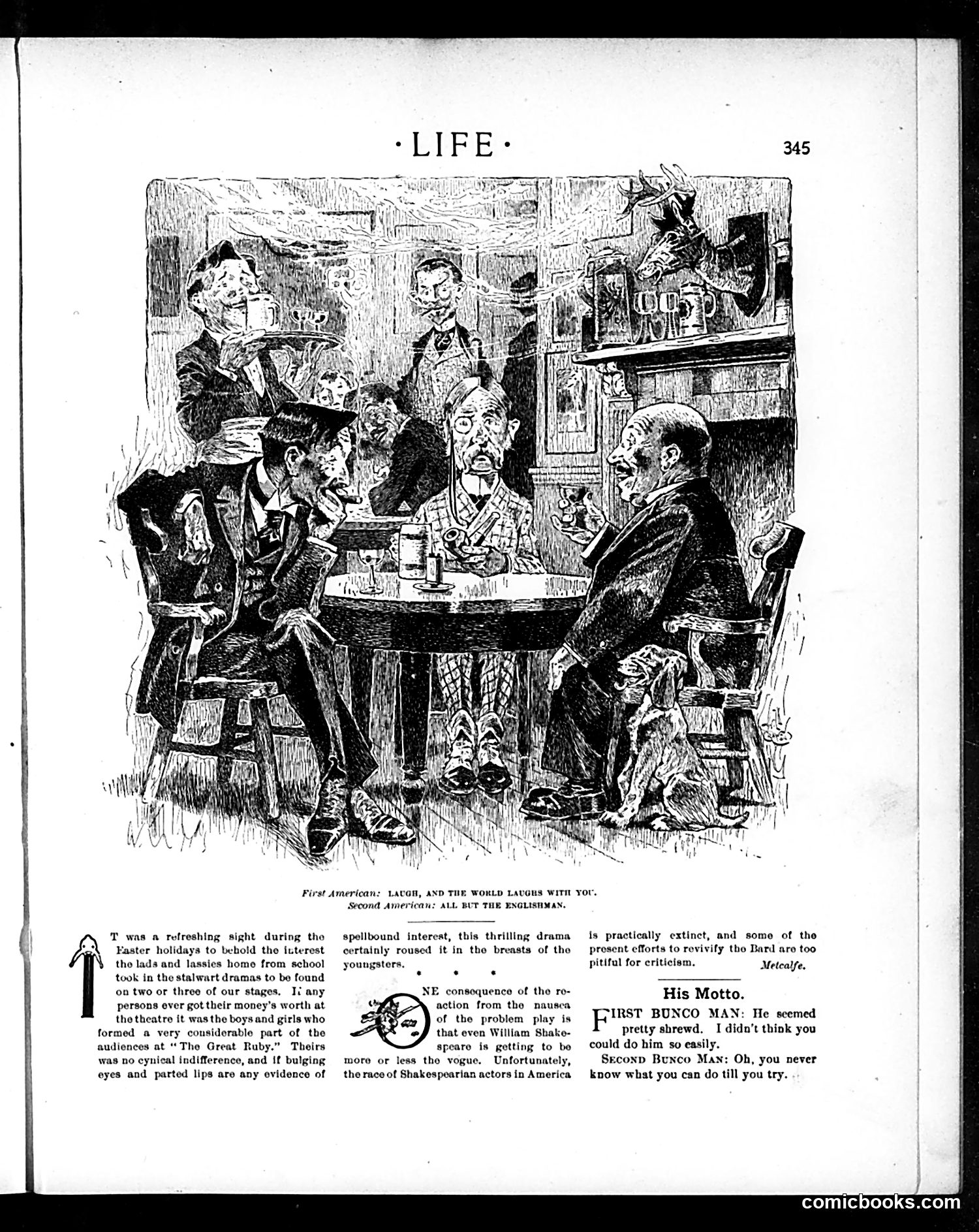
This page from *Life* magazine contains two distinct satirical pieces: ## Main Illustration The large sketch depicts a theatrical scene with men gathered around a table, illustrating the caption: "First American: Laugh and the World Laughs With You; Second American: All But The Englishman." The satire targets American versus English attitudes—suggesting Americans are easily amused by theatrical entertainment while the English maintain cynical detachment. ## Text Commentary The accompanying article discusses the revival of Shakespeare plays in America during the Easter holidays, noting that young audiences showed genuine enthusiasm. However, it criticizes contemporary American actors attempting to revive Shakespeare, calling their efforts "too pitiful for criticism." The piece laments that skilled Shakespearean actors have become "practically extinct" in America. ## Bottom Cartoon "His Motto" presents two con artists discussing a successful swindle, with the punchline suggesting one can accomplish anything through persistence—a dark joke about American opportunism and gullibility. **Overall context:** Early 20th-century satire of American cultural pretensions and susceptibility to theatrical (and literal) deception.
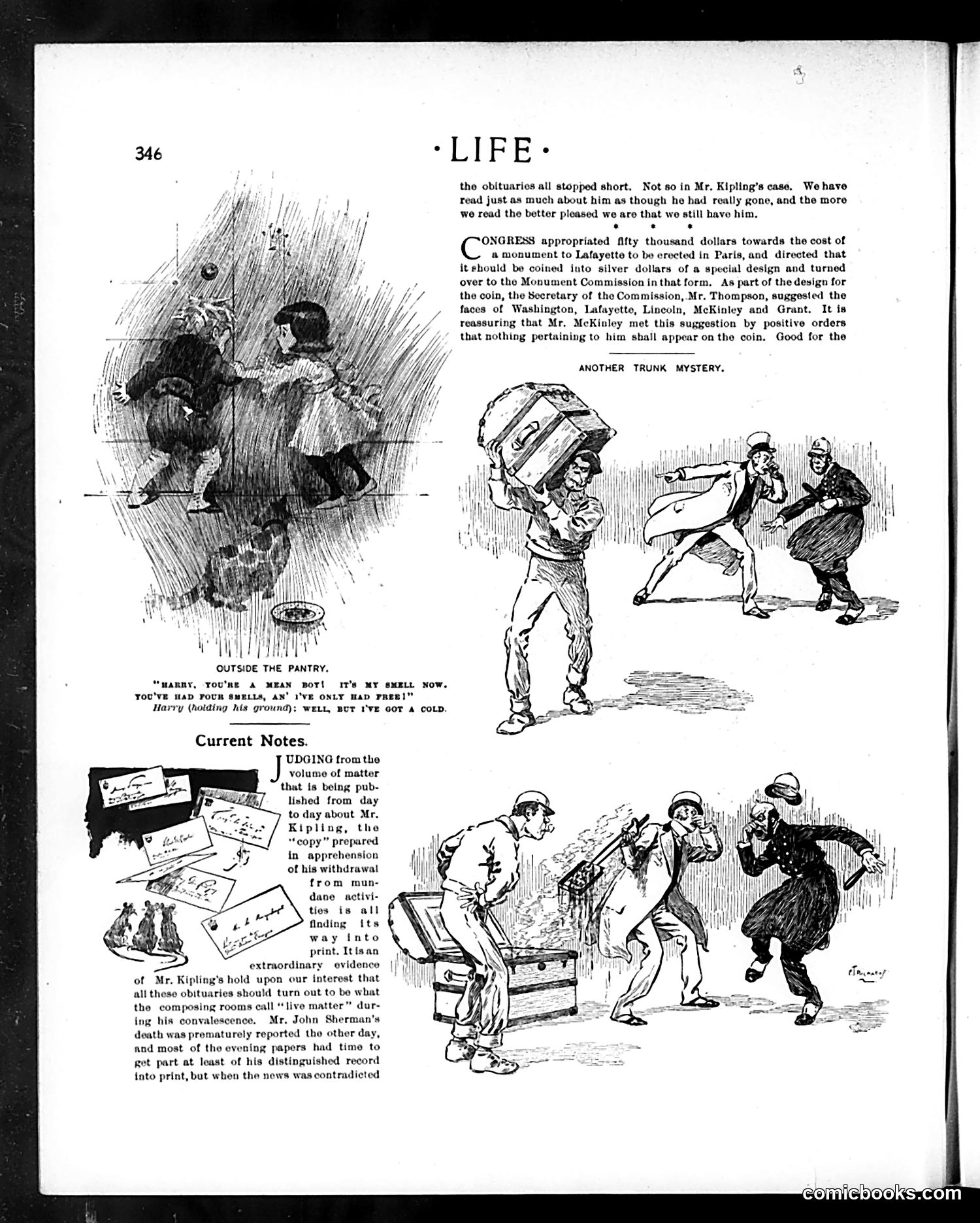
This page contains two distinct elements: **"Outside the Pantry" cartoon**: A humorous domestic scene where children quarrel over stealing food smells from the pantry. "Harry" claims he has a cold to excuse his unfair advantage in this childish game about who's had more "smells." It's gentle humor about sibling rivalry and minor household mischief. **"Current Notes" section**: Commentary on Rudyard Kipling's health crisis. Life observes that publishers prepared Kipling obituaries in anticipation of his death, and these continue circulating even after he survives—contrasting this with John Sherman's falsely-reported death, whose obituary promptly stopped. The passage notes Kipling's extraordinary cultural importance. The section also mentions Congress appropriating funds for a Lafayette monument in Paris, with McKinley notably rejecting inclusion of his own portrait on commemorative coins—praised as honorable restraint. **"Another Trunk Mystery"** (bottom right) appears to be cartoon illustrations related to luggage-based comedy, though context is limited.
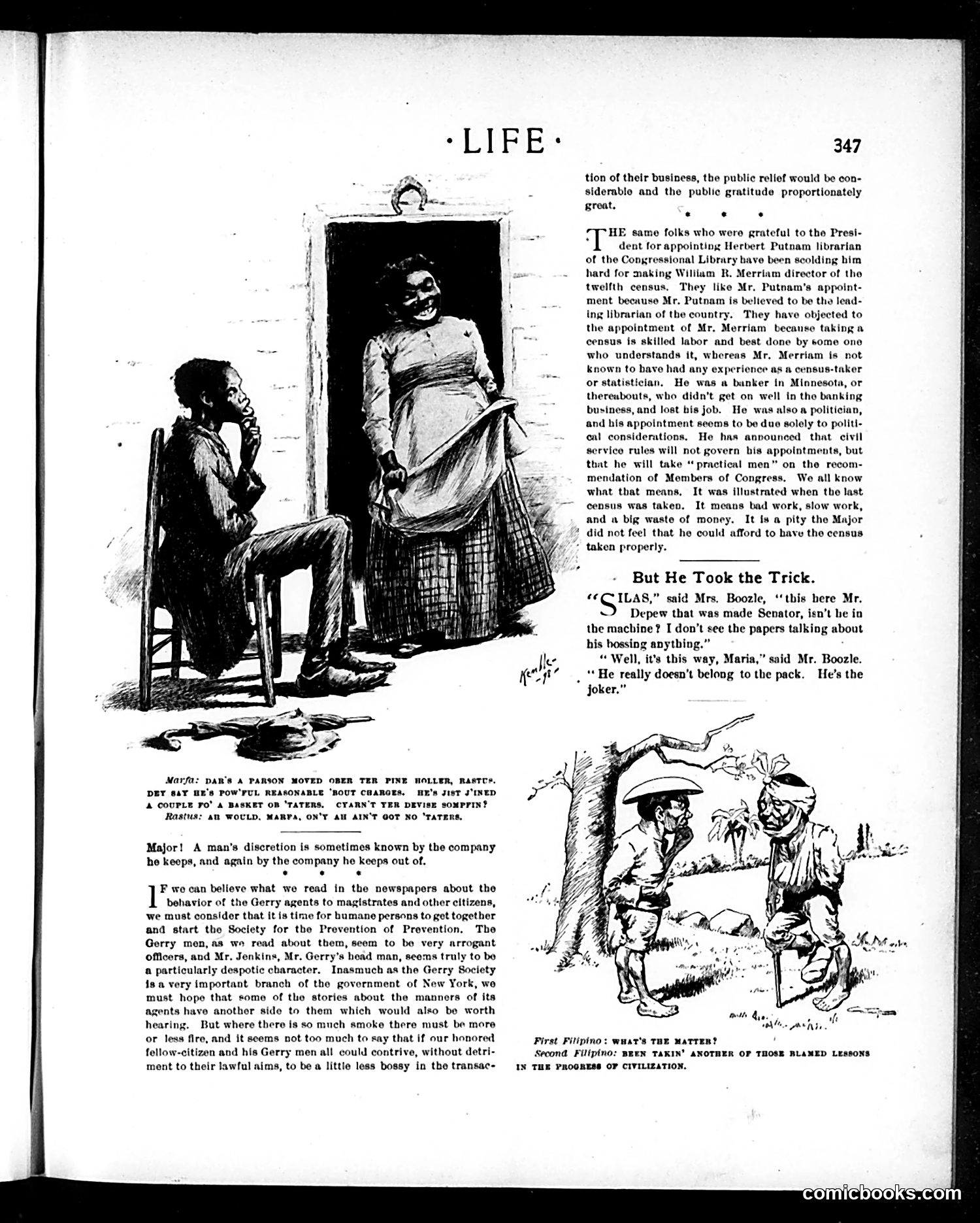
This page combines political satire with social commentary. The main upper cartoon depicts two figures in dialect—likely minstrel-show stereotypes—discussing a parson's arrival in rural Appalachia, with humor centered on poverty and rural life. The bulk of the page critiques the **Gerry Society** (a real New York children's welfare organization), accusing its agents of arrogant, despotic behavior. The author argues their heavy-handed tactics, while well-intentioned, require restraint. A secondary critique targets **President McKinley's appointments**: while praising Herbert Putnam as Librarian, it denounces William R. Merriam's census directorship as political patronage. Merriam, a failed Minnesota banker and politician, supposedly lacks statistical expertise and will staff the census with political appointees rather than qualified workers—wasting public money. The bottom cartoon shows two **Filipino figures**, with one inflicting pain on the other labeled "Progress of Civilization"—satire criticizing American colonial conduct in the Philippines during the early occupation.
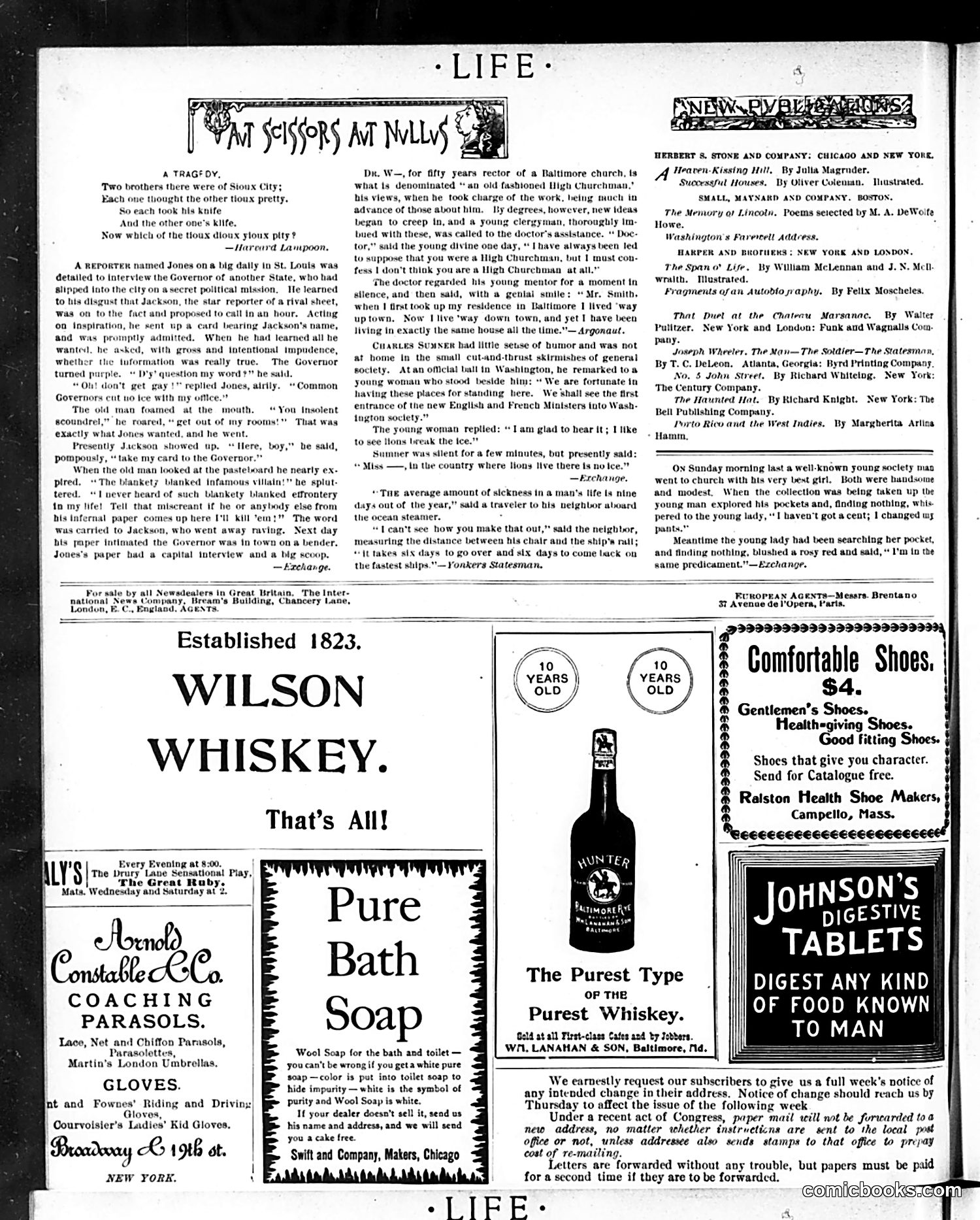
This is primarily an **advertising and humor page** from Life magazine, not a political cartoon. The content includes: **The humor section** features three anecdotes satirizing social pretension and miscommunication: 1. A newspaper reporter tricks a Governor by using a rival's name, obtaining an exclusive interview through deception 2. An elderly High Church rector responds philosophically to a young clergyman's criticism, suggesting perspective changes with circumstance 3. Charles Sumner (likely the 19th-century senator) makes an awkward joke about lions at a diplomatic ball, revealing his social ineptitude **The satire** mocks: journalistic trickery, generational church conflicts, and upper-class social awkwardness. These are genteel humor pieces typical of Life's brand—clever but mild. **The advertisements** (Wilson Whiskey, Pure Bath Soap, shoes, digestive tablets) represent period consumer culture. The page contains **no political cartoons**—it's standard magazine content blending light satirical stories with commercial notices.
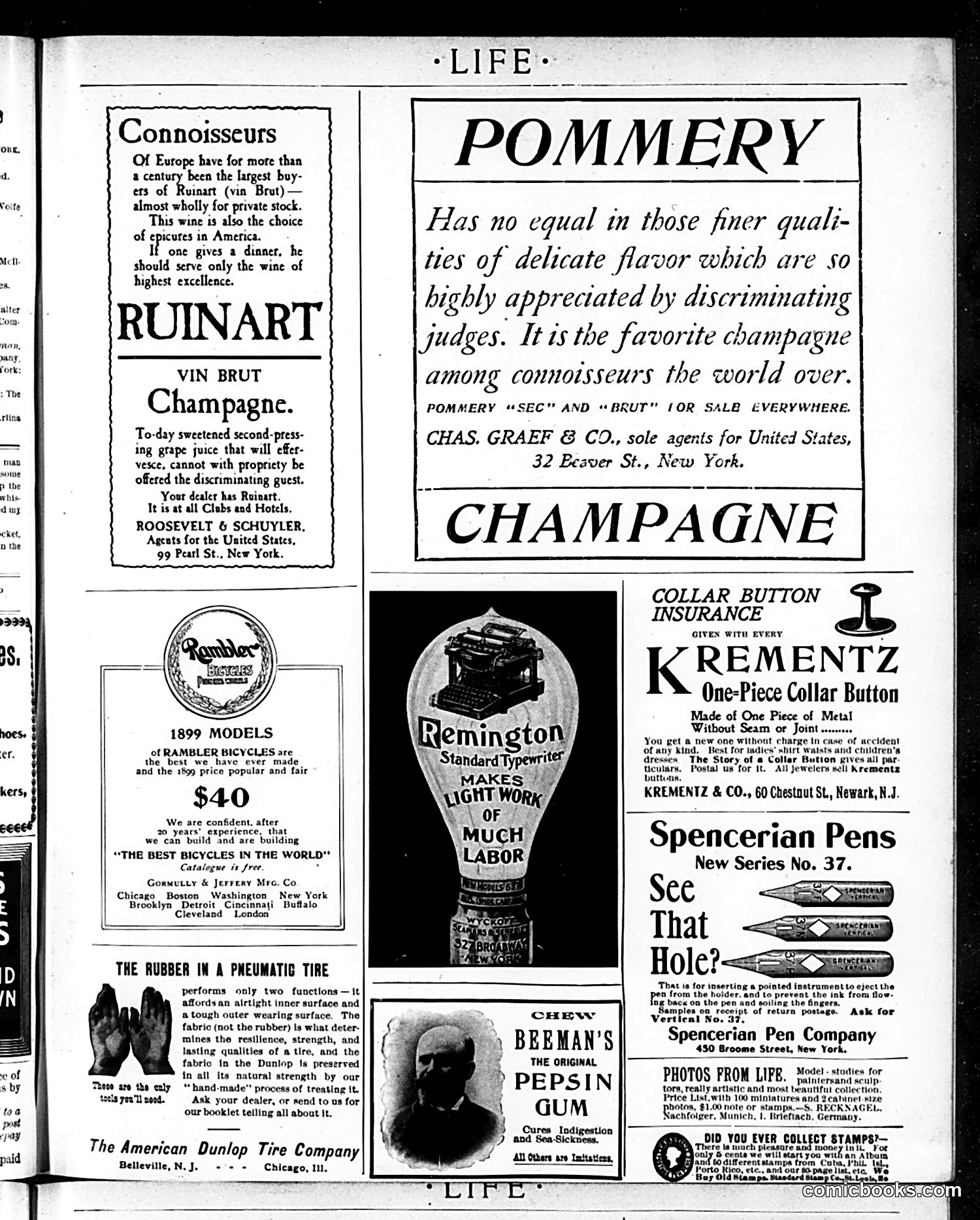
This is primarily an **advertisement page** from Life magazine (circa 1899, based on the "1899 Models" bicycle ad). It contains no political cartoons or satire requiring historical context. The page features luxury and consumer goods marketed to affluent readers: champagne (Ruinart and Pommery), bicycles ($40 Rambler), typewriters (Remington), pneumatic tires (Dunlop), collar buttons, pens, and gum. The ads emphasize **exclusivity and quality for discriminating consumers**—the Ruinart ad explicitly targets "connoisseurs" and those giving dinners, while Pommery claims to be "the favorite champagne among connoisseurs the world over." This reflects the Gilded Age market positioning of luxury goods toward wealthy, educated Americans. The advertising tone assumes readers appreciate fine goods and have disposable income—consistent with Life's audience of upper-class readers during the 1890s prosperity era.
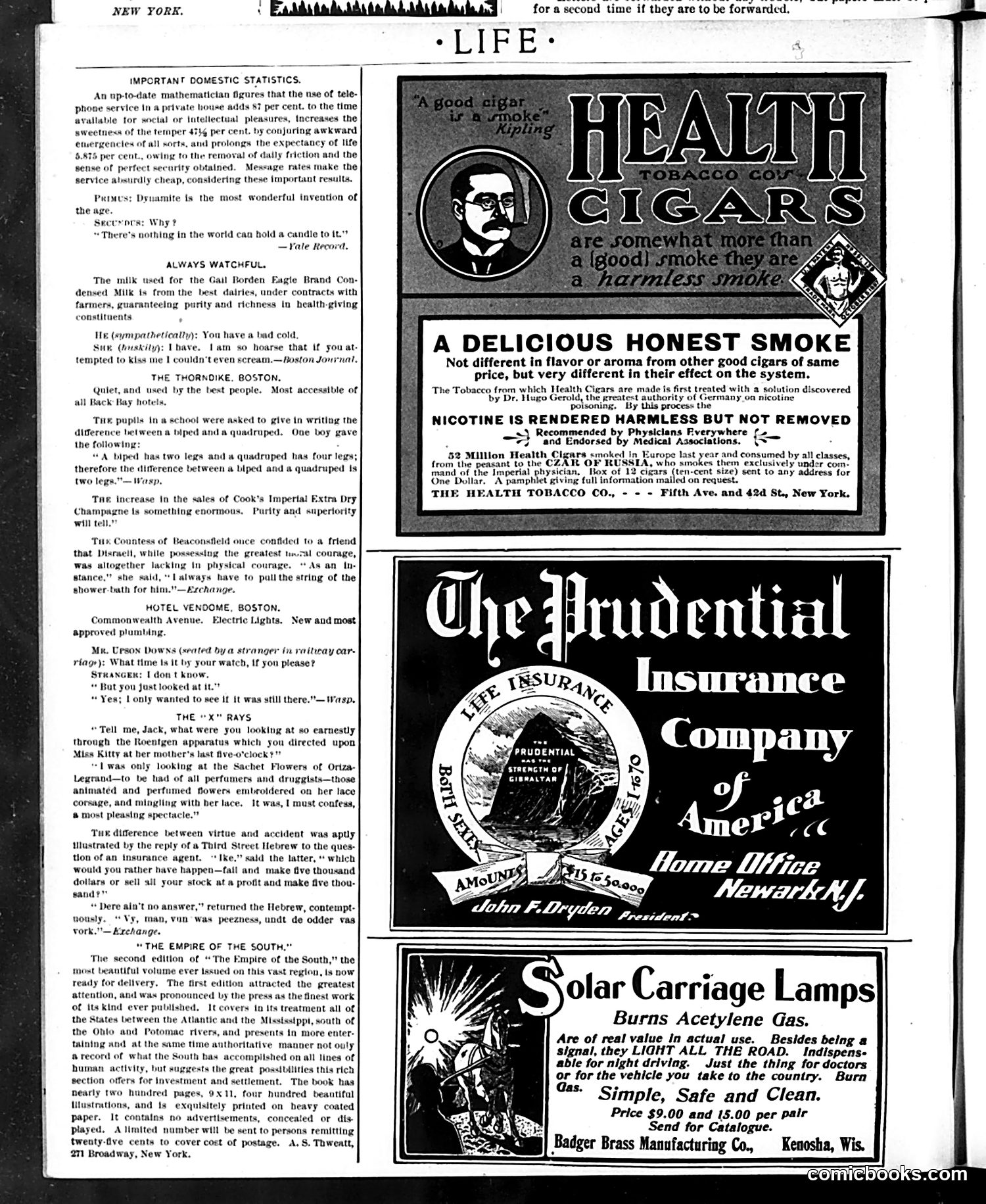
This page is primarily **advertising and humor filler**, not political satire. The content includes: **Main Advertisement**: Health Tobacco Co.'s cigars claim nicotine is "rendered harmless but not removed"—a medically dubious health claim typical of early 20th-century tobacco marketing, before smoking dangers were widely acknowledged. **Humor Sections**: Brief jokes and anecdotes about everyday life—telephone service, colds, school children, X-rays, and insurance. These are lighthearted observations rather than political commentary. **Other Ads**: Prudential Insurance, Hotel Venoome, Solar Carriage Lamps, and Cook's Champagne. The page reflects *Life* magazine's mixed format: satirical commentary alongside practical advertising. The "Important Domestic Statistics" section humorously exaggerates telephone service benefits. No specific political figures or events are caricatured here—it's genteel, domestic humor aimed at middle-class readers.
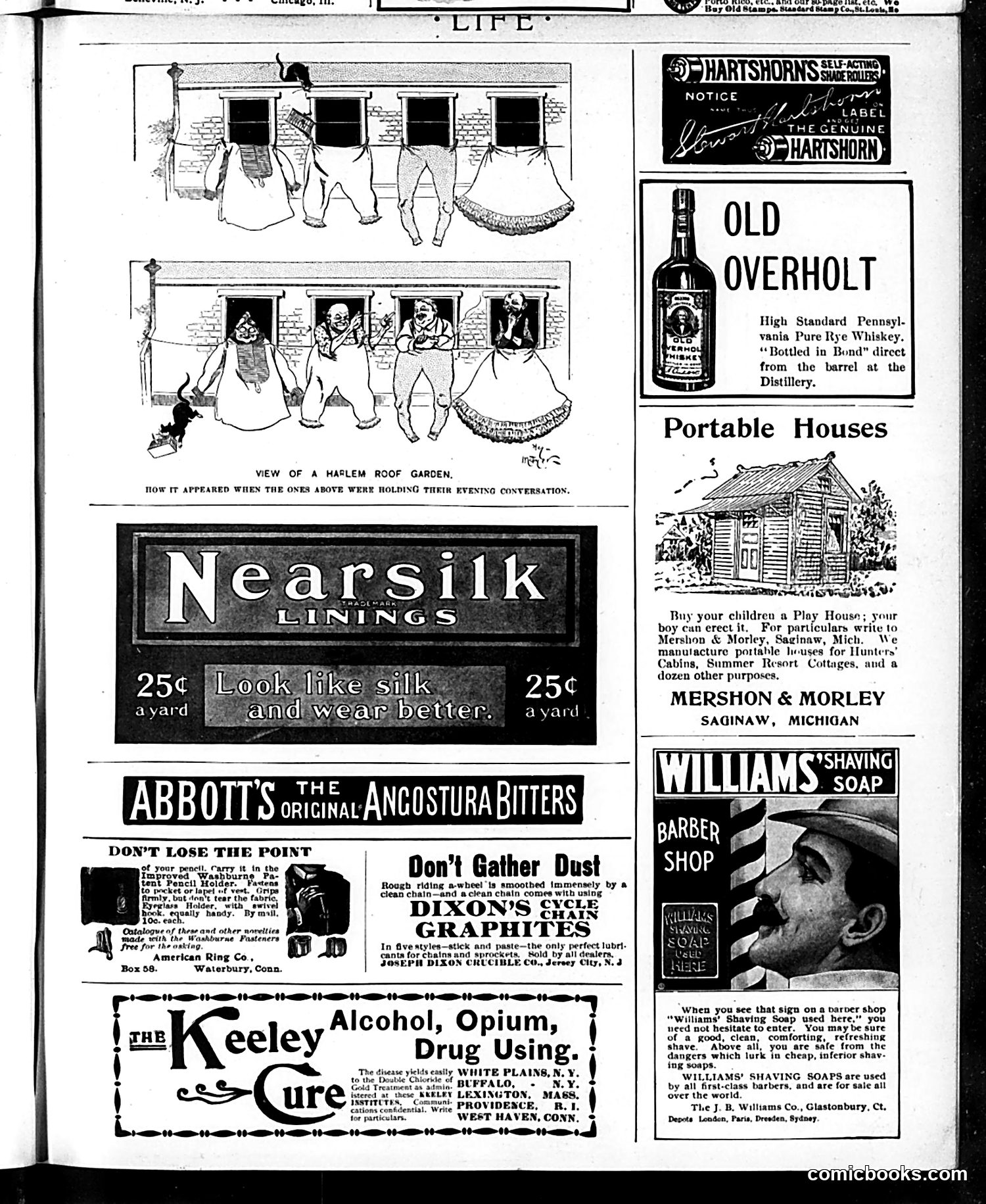
This page is primarily **advertising**, with one satirical cartoon at the top. ## The Cartoon The cartoon depicts a "Harlem Roof Garden" scene showing couples on a rooftop. The caption explains it illustrates how the space "appeared when the ones above were holding their evening conversation"—the figures are drawn with their heads replaced by open windows, suggesting they're eavesdropping on neighbors' conversations below. This is a **joke about apartment living and lack of privacy**: thin walls or open windows in tenement buildings allowed residents to overhear neighbors' activities, a common urban complaint of the era. ## Advertisements The rest of the page contains typical early 20th-century product ads: Nearsilk fabric linings, Abbott's Angostura Bitters, Dixon's Cycle Chain Graphite lubricant, portable play houses, Williams' Shaving Soap, and The Keeley Cure (a treatment for alcohol and drug addiction). These ads reflect period consumer goods and social concerns common to the magazine's readership.
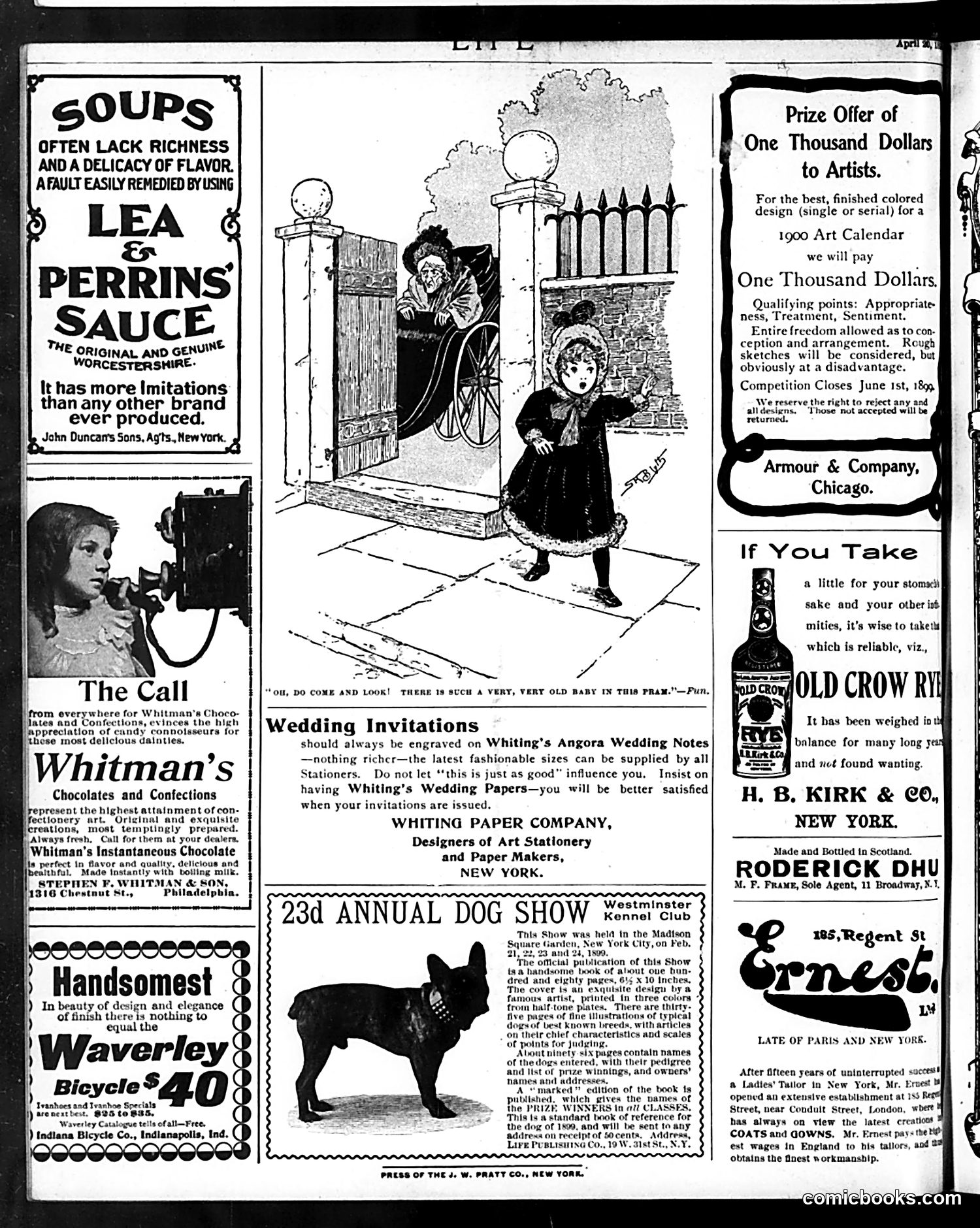
This page is primarily **advertising**, typical of early Life magazine issues. The central cartoon depicts a Victorian-era social scene: two women at a gate, with one exclaiming over a baby carriage ("Oh, do come and look! There is such a very, very old baby in this pram"). The joke appears to be a gentle satire on Victorian social pretension—the absurdity of making a fuss over an elderly person presented as if they were an infant, likely mocking affected upper-class conversation and the era's obsession with formal social rituals. The surrounding advertisements represent period consumer culture: Lea & Perrins sauce, Whitman's chocolates, Waverley bicycles, and wedding stationery. A dog show announcement occupies the lower section. Together, these reflect early 1900s American middle and upper-class consumer interests: refined foods, luxury goods, proper etiquette (wedding invitations), and genteel recreation. The page documents both satirical humor and commercial aspirations of the Edwardian era.