
Life, 1899-04-20 · page 12 of 20
Life — April 20, 1899 — page 12: what you’re looking at
What you’re looking at
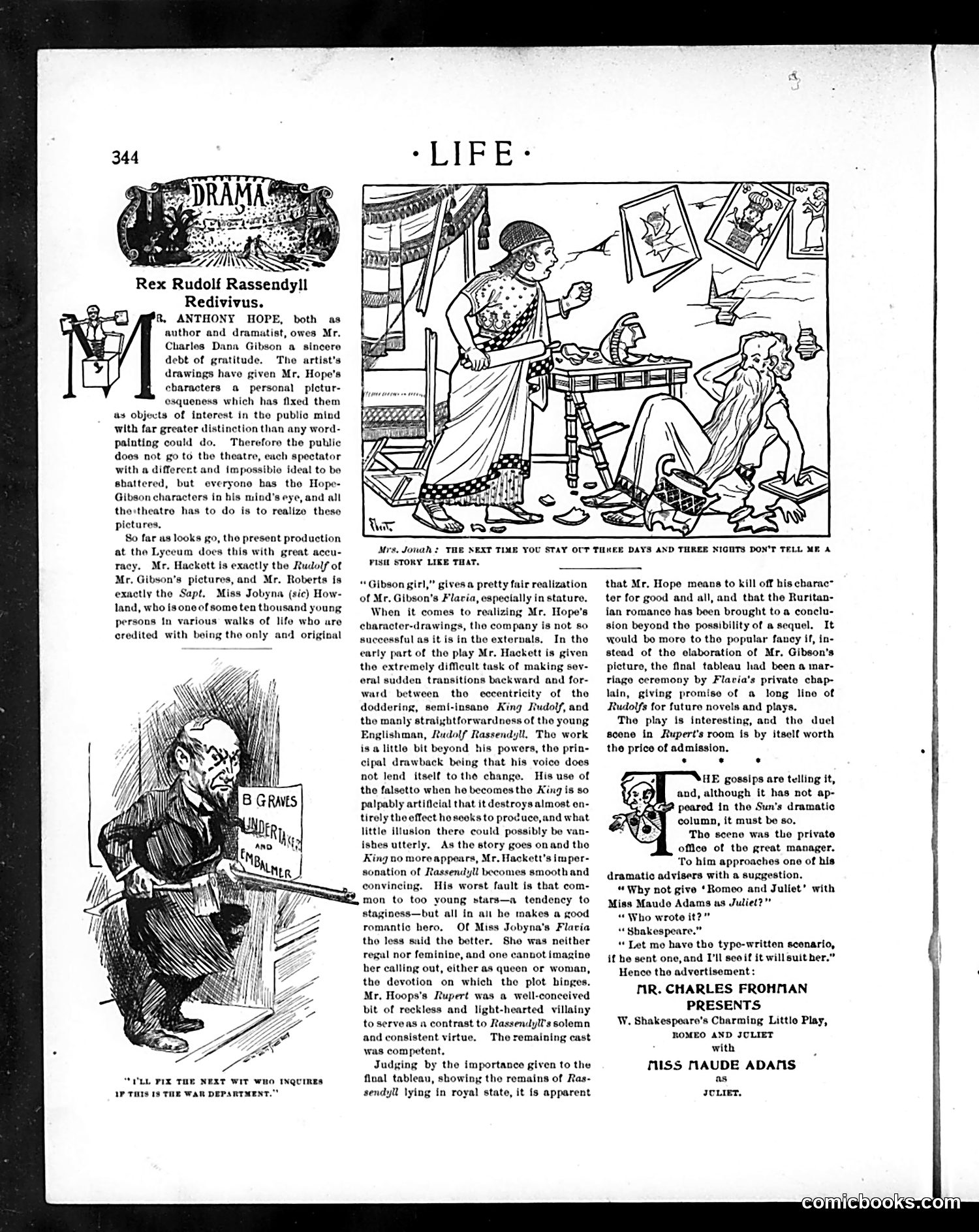
This page reviews a theatrical production of "Romeo and Juliet" featuring actor Anthony Hope and Miss Maude Adams. The main cartoon (lower left) depicts a figure labeled with books including "Grammar," "Rhetoric," and "The Unities"—representing classical dramatic rules. The caption reads "I'LL FIX THE NEXT WIT WHO INQUIRES IF THIS IS THE WAR DEPARTMENT." The satire mocks rigid adherence to dramatic conventions. The figure appears to be a theatrical authority figure threatening to "fix" anyone questioning whether strict classical rules still apply to modern theater. This reflects early 1900s debates about whether Shakespearean plays should be performed according to rigid traditional structures or adapted for contemporary audiences. The joke targets pedantic theatrical gatekeepers enforcing outdated dramatic formalism.
📄 Transcribed text from this page (OCR, searchable)
Machine-transcribed from the original scan — historical spelling and the odd misread are preserved.
SSS Rex Rudolf Rassendyll Redivivus. R, ANTHONY HOPE, both as author and dramatist, owes Mr. Charles Dana Gibson a sincere debt of gratitude. The artist's drawings have given Mr, Hope's characters a personal pictur- esqueness which has flxed them as objects of interest in the public mind with far greater distinction than any word- painting could do. Therefore the public does not go to the theatre, each spectator with a differcet and impossible ideal to bo shattered, but everyone bas the Hope- Gibson charactors in his mind’s eye, and all thertheatro has to do is to realize these pictures, So far as looks go, the present production at the Lyceum does this with great accu- Mr. Hackett is exactly the Rudolf of Gibson's pictures, and Mr. Roberts is exactly the Sapt, Miss Jobyna (sic) How- land, who isoneof some ten thousand young persons tn various walks of life who ure credited with being the only and origival “VLE PIX THE NEXT WIT WHO INQUIRES AP THIS 18 THE WAR DEPARTMENT.” Mrs. Jonah THE NEXT TIME YOU STAY OCT THKEE DAYS AND THREE NIGHTS DON'T TELL ME A PISH STORY LIKE THAT. “Gibson girl,” gives a pretty fair realization of Mr. Gibson's Flavia, especially in stature, When it comes to realizing Mr. Hope's charactor-drawings, the company is not 80 successful as it is in the externals. In tho early part of tho play Mr. Hackett is given the extremely difficult task of making sev- eral sudden transitions backward and for- ward between tho eccentricity of the doddering, semt-insane King Rudolf, and tho manly straightforwardness of the young Englishman, Rudolf Rassendyll, The work is a little bit beyond his powers, tho prin- cipal drawback being that his voice does not lend itself tothe change. His use of the falsetto when he becomes tho King is 80 palpably artificial that it destroys almost en- tirely the effect ho seoks to produce,and what little illusion there could possibly be van- ishes utterly. As the story goes onand tho King no more appears, Mr. Hackett’s imper- sonation of Rassendyll becomes smoothand convincing. His worst fault is that com- mon to too young stars—a tendency to staginess—but all in all he makes a good romantic hero. Of Miss Jobyna’s Flavia the less suid the better. She was neither regal nor feminine, and one cannot imagine her calling out, either as queen or woman, the devotion on which the plot binges. Mr. Hoops's Rupert was a well-conceived bit of reckless and light-hearted villainy to serveas a contrast to Rassendyll’s solemn and consistent virtue. The remaining cast was competent. Judging by the importance given to the final tableau, showing the remains of Ras- sendyll lying in royal state, it is apparent that Mr. Hope means to kill off his charac” ter for good and all, and that the Ruritan- ian romanco has been brought to a conclu- sion beyond tho possibility of a sequel. It would bo moro to tho popular fancy if, in stead of tho olaboration of Mr. Gibson's picturo, the final tableau had been a mai riago ceremony by Flavia's private chap- lain, giving promise of a long lino of Rudolfs for futuro novels and plays. The play {s interesting, and tho duel scone in Rupert's room is by itself worth tho prico of admission. . . . HE gossips are telling it, and, although It has not ap- <A peared in tho Sun's dramatic column, it must be 80. Tho scene was the private office of tho great manager. ‘To him approaches one of his dramatic advisers with a suggestion. “Why not give ‘Romeo and Juliet’ with Miss Maude Adams us Juliet?” “Who wrote it?” “ Shakespeare. “ Let mo have tho typo-writton sconario, if he sent one,and I'll seoif it will suit her.” Hence the advertisement: MR. CHARLES FROHMAN PRESENTS W. Shakespoaro's Charming Littlo Play, ROMEO AND JCLIET with MISS MAUDE ADANS as JCLIET.