
Life, 1899-04-20 · page 7 of 20
Life — April 20, 1899 — page 7: what you’re looking at
What you’re looking at
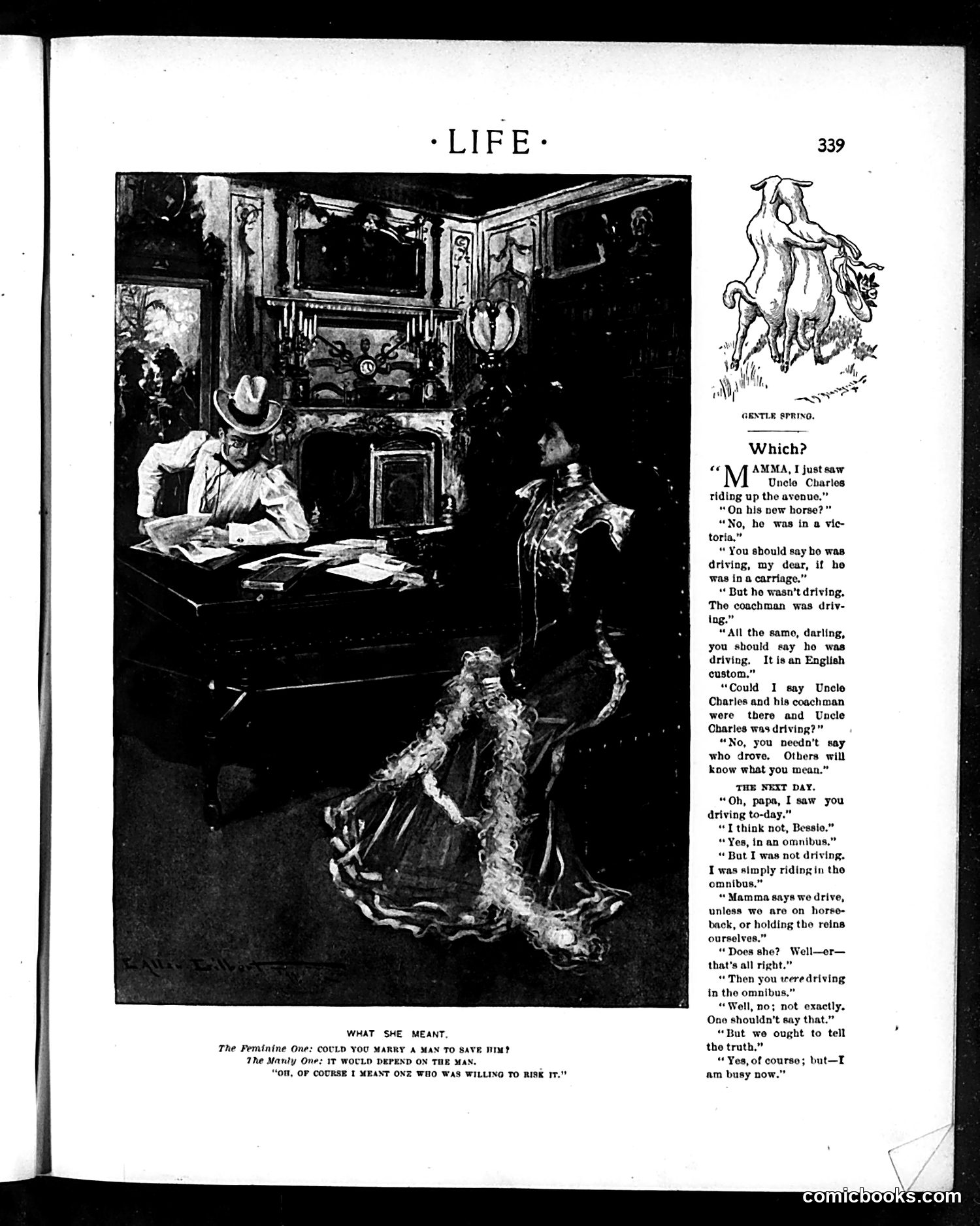
The main illustration depicts a wealthy woman at her desk (likely in her home) conversing with a man in formal attire. The caption reads: "WHAT SHE MEANT: 'Could you marry a man to save him?' / THE MANLY ONE: 'It would depend on the man. / 'Of course I meant one who was willing to rise it.'" The satire targets gender dynamics and marriage expectations of the era. It mocks the "New Woman" attitude—the woman's presumptuous suggestion that she could "save" a man through marriage. The man's pointed response suggests women overestimate their reformative power and should only marry willing participants. The accompanying text story "Which?" continues this theme, examining class distinctions and social propriety regarding who "drives" in carriages—commentary on transportation, status, and domestic authority.
📄 Transcribed text from this page (OCR, searchable)
Machine-transcribed from the original scan — historical spelling and the odd misread are preserved.
WHAT SHE MEANT. The Feminine One: COULD YOU MARRY A MAN TO SAVE NIM? The Manly One: IT WOCLD DEPEND ON THE MAN. “OH, OF COURSE I MEANT ONZ WHO WAS WILLING TO RISK IT." GENTLE SPRING. Which? cia AMMA, I just saw Uncle Charles riding up the avenue.” “On his new horse?” “No, he was in a vic- toria.” “ You should say ho was driving, my dear, if he was in a carriage.” “ But he wasn’t driving, The coachman was driv- ing.” “All the samo, darling, you should say ho was driving. It isan English custom,” “Could I say Uncle Charles and his coachman were there and Uncle Charles was driving?” “No, you needn't say who drove, Others will know what you mean.” THE NEXT DAY. “Oh, papa, I saw you driving to-day.” “T think not, Bessie.” “Yes, in an omnibus.” “ But I was not driving. I was simply ridingin tho omnibus.” “ Mamma says we drive, unless wo are on horse- back, or holding the reins ourselves.” “Does she? Well—er— that’s all right.” “Then you tere driving in the omnibus,” “Well, no; not exactly. Ono shouldn't say that.” “But we ought to tell the truth.” “Yes, of course; but—I am busy now.”