
Life, 1899-04-20 · page 8 of 20
Life — April 20, 1899 — page 8: what you’re looking at
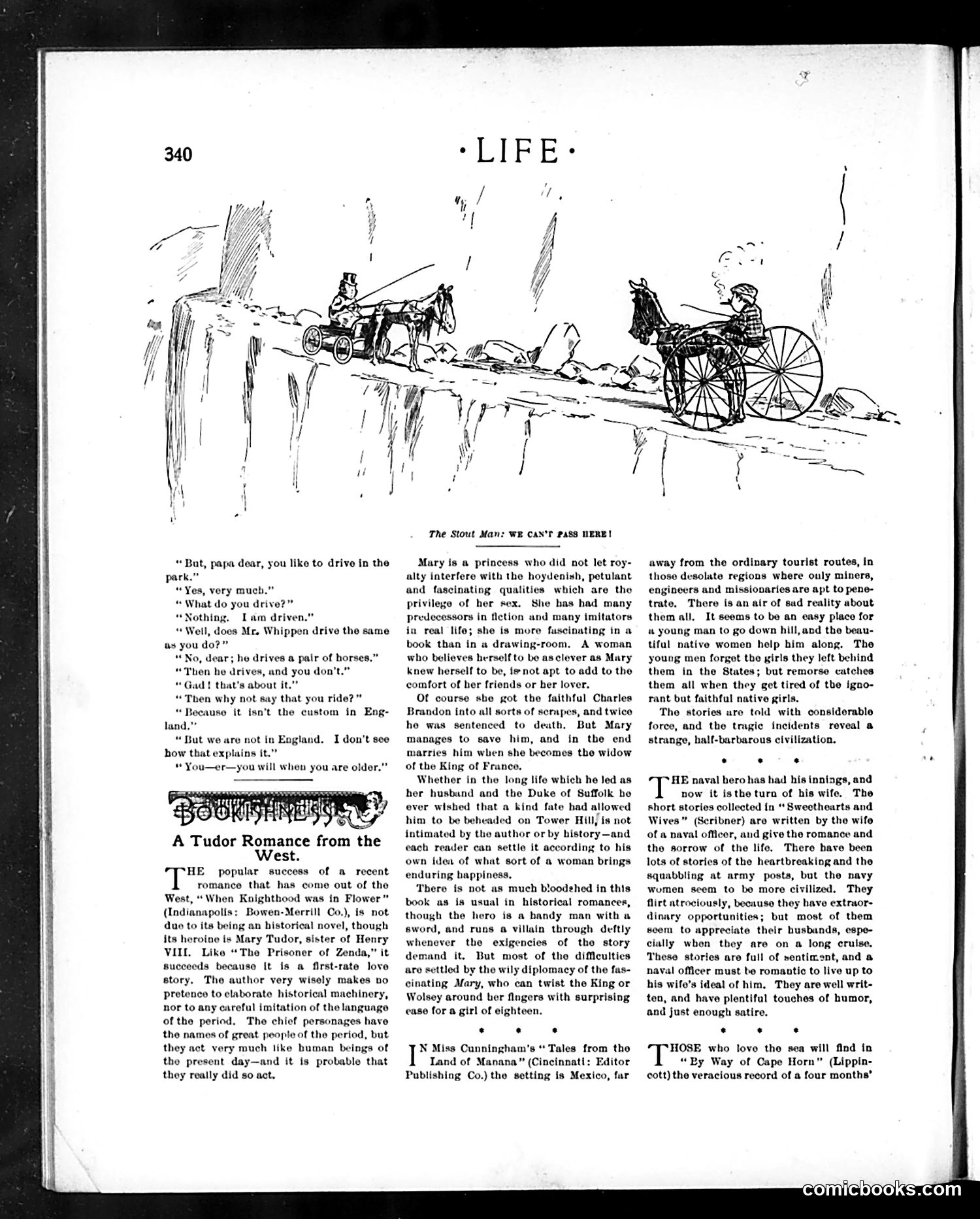
A restored page from Life, 1899-04-20. Page through the whole issue in the reader above.
📄 Transcribed text from this page (OCR, searchable)
Machine-transcribed from the original scan — historical spelling and the odd misread are preserved.
“But, papa dear, you like to drive in the park.” “Yes, very much.” “ What do you drive?” “Nothing. Lam driven,” “Well, doos Mr. Whippen drive the same as you do?” ‘0, dear; he drives a pair of horses.” “Then he drives, and you don’t.” Gad f that’s about it.” “Then why not say that you ride?” “Because it isn’t the custom in Eng- land. But we are not in England. I don't see how that explains it.” “ You—er—you will when you are older.” A Tudor Romance from the est. HE popular success of a recent romance that has come out of the West, “When Knighthood was in Flower” (Indianapolis: Bowen-Merrill Co.), is not duo to its being an historical novel, though its heroine is Mary Tudor, sister of Henry VIII. Like “The Prisoner of Zenda,” it succeeds because It is a first-rate love story. The author very wisely makes no pretence to elaborate historical machinery, nor to any careful imitation of the languago of the period. The chief personages have the namos of great peopte of the period, but they act very much like buman beings of the present day—and it is probable that they really did so act. The Stout Man: WE CAN'T PASS HERE! Mary is a princess who did not let roy- alty interfere with the hoydenish, petulant and fascinating qualities which are the privilege of her sex. She has had many predecessors in fletion and many imitators in real life; she is more fuscinating in a book than in a drawing-room. A woman who believes herself to be as clever as Mary knew herself to be, f not apt to add to the comfort of her friends or ber lover. Of course sbe got the faithful Charles Brandon into all sorts of scrapes, and twice ho was sentenced to death, But Mary manages to save him, and in the end marries him when she becomes the widow of the King of France, Whether in the long life which he led as her husband and the Duke of Suffolk he ever wished that a kind fate bad allowed him to be beheaded on Tower Hill, is not intimated by the author or by bistory—and each reader can settle it according to his own idea of what sort of a woman brings enduring happiness, There is not as much bloodehed in this book as is usual in historical romances, though the hero is a handy man with a sword, and runs a villain through deftly whenever the exigencies of tho story demand it. But most of the diMeultics aro settled by the wily diplomacy of the fas~ cinating Mary, who can twist the King or Wolsey around ber fingers with surprising case for a girl of eighteen. N Miss Cunningham's “ Tales from tho Land of Manana” (Cincinnati: Editor Publishing Co.) the setting is Mexico, far away from the ordinary tourist routes, In those desolate regions where ouly miners, engineers and missionaries are apt to pene- trate, Thore is an air of sad reality about them all. It seems to be an easy place for & young man to go down hill,and the beau- tiful native women help him along. Tho young men forget the girls they left behind them in the States; but remorse catches them all when they get tired of the igno- rant but faithful native girls. Tho stories aro told with considerable force, and the trigic incidents reveal a strange, balf-barbarous civilization. ALE naval hero has had his innings, and now it isthe turo of his wife. Tho short stories collected in “ Sweethearts and Wives” (Scribner) are written by the wife of a naval officer, and give the romance and the sorrow of the life. There have been lots of stories of the heartbreaking and the squabbling at army posts, but the navy women seem to be more civilized. They flirt atrociously, because they have extraor- dinary opportunities; but most of them soem to appreciate their husbands, espe- cially when they are on a long cruise, These stories are full of sentiment, and o naval officer must be romantic to live up to his wifo’s ideal of him, They are well writ- ten, and have plentifal touches of humor, and just enough satire. . . . HOSE who lovo tho sea will find in “By Way of Cape Horn” (Lippin- cott) the veracious record of a four months’