
Life, 1899-04-20 · page 4 of 20
Life — April 20, 1899 — page 4: what you’re looking at
What you’re looking at
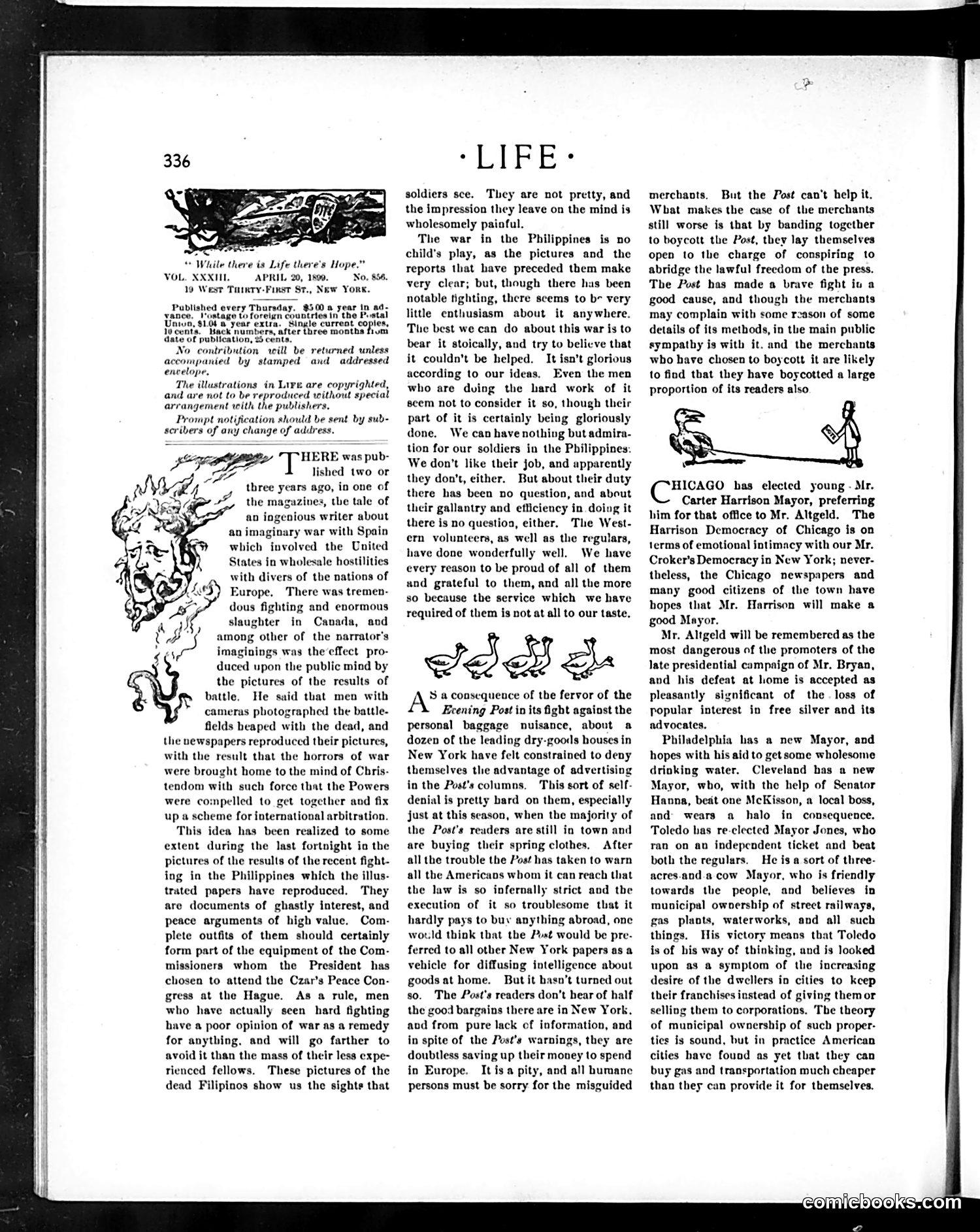
This page contains two editorial cartoons critiquing American newspapers' coverage of international events. The **left cartoon** depicts a grotesque face emerging from chaos, illustrating Life's complaint about sensationalized reporting of the Philippine-American War. The magazine criticizes how papers published battlefield photographs showing dead soldiers, creating public horror and Christian sentiment against the conflict—despite Life's view that soldiers performed their duty competently. The **right section** features small duck-like figures, likely representing **Evening Post** editors. The text attacks the *Evening Post*'s campaign against dry-goods merchants advertising in its columns, calling this self-serving hypocrisy. Life argues the *Post* unfairly restricts merchants' advertising freedom while claiming moral authority. Both cartoons exemplify Life's satirical approach to press criticism and commercial ethics in early 1900s American journalism.
📄 Transcribed text from this page (OCR, searchable)
Machine-transcribed from the original scan — historical spelling and the odd misread are preserved.
le there is Life there's Hope.” i APRIL 20, 1899. No, 856. 19 West Tainty-Finst St., New Yors. Published every Thursday. $500 9 year in ad- vance. age to foreign countries in the Pestal Univo, $1.06 @ year extra. Single curreat copies, lo cents. Back numbers, after three months frum date of publication, 2 ce! No contribution will be returned unless accompanied by stamped and addressed encelope, The illustrations in Live are copyrighted, and are not to be reproduced without special arrangement with the publishers, Prompt notification should be sent by sub- scribers of any change of address, HERE was pub- lished two or three years ago, in one of the magazines, the tale of an ingenious writer about an imaginary war with Spain which involved the United States in wholesale hostilities with divers of the nations of Europe, There was tremen- dous fighting and enormous slaughter in Canada, and among other of the narrator's imaginings was the’effect pro- duced upon the public mind by the pictures of the results of battle. He said that men with cameras photographed the battle. flelds beaped with the dead, and the newspapers reproduced their pictures, with the result that the horrors of war were brought home to the mind of Chris- tendom with such force that the Powers were compelled to get together and fix up a scheme for international arbitration. This idea has been realized to some extent during the last fortnight io the pictures of the results of the recent fight- ing in the Philippines which the illus- trated papers have reproduced. They are documents of ghastly interest, and peace arguments of high value. Com- plete outfits of them should certainly form part of the equipment of the Com- missioners whom the President has chosen to attend the Czar’s Peace Con- gress at the Hague. As a rule, men who have actually seen hard fighting have a poor opinion of war as a remedy for anything, and will go farther to avoid it than the mass of their less expe- rienced fellows. These pictures of the dead Filipinos show us the sights that *LIFE* soldiers sce. They are not pretty, and the impression they leave on the mind is wholesomely painful. The war in the Philippines is no child’s play, as the pictures and the reports that have preceded them make very clear; but, though there has been notable fighting, there scems to b« very little enthusiasm about it anywhere. The best we can do about this war is to bear it stoically, and try to believe that it couldn't be helped. It isn’t glorious according to our ideas, Even the men who are duing the hard work of it seem not to consider it so, though their part of it is certainly being gloriously done, We can have nothing but admira- tion for our soldiers in the Philippines: We don’t like their job, and apparently they don’t, either. But about their duty there has been no question, and about their gallantry and efficiency in doing it there is no question, either, The West- ern volunteers, as well as the regulars, have done wonderfully well. We have every reason to be proud of all of them and grateful to them, and all the more so because the service which we have required of them is not at all to our taste, 3B J. $a consequence of the fervor of the Ecening Post in its fight against the personal baggage nuisance, about a dozen of the leading dry-goords houses in New York have felt constrained to deny themselves the advantage of advertising in the Post's columns. This sort of self- denial is pretty bard on them, especially just at this season, when the majority of the Post's readers are still in town and are buying their spring clothes. After all the trouble the Post has taken to warn all the Americans whom it can reach that the law is so infernally strict and the execution of it so troublesome that it hardly pays to buy anything abroad, one would think that the ust would be pre- ferred to all other New York papers as a vehicle for diffusing intelligence about goods at home. But it basn’t turned out so. The Post's readers don’t hear of half the good bargains there are in New York. avd from pure lack of information, and in spite of the Post’s warnings, they are doubtless saving up their money to spend in Europe. It isa pity, and all humane persons must be sorry for the misguided merchants. But the Post can't help it. What makes the case of the merchants still worse is that by banding together to boycott the Post, they lay themselves open to the charge of conspiring to abridge the lawful freedom of the press. The Post has made a brave fight is a good cause, and though the merchants may complain with some reason of some details of its methods, in the main public sympathy is with it. and the merchants who have chosen to boycott it are likely to find that they have boycotted a large proportion of its readers also t HICAGO has elected young . Mr. Carter Harrison Mayor, preferring him for that office to Mr. Altgeld. The Harrison Democracy of Chicago is on terms of emotional intimacy with our Mr. Croker’s Democracy in New York; never- theless, the Chicago newspapers and many good citizens of the town have hopes that Mr. Harrison will make a good Mayor. Mr, Altgeld will be remembered as the most dangerous of the promoters of the late presidential campaign of Mr. Bryan, and his defeat at home is accepted as pleasantly significant of the. loss of popular interest in free silver and its advocates. Philadelphia has a new Mayor, and hopes with his aid to get some wholesome drinking water. Cleveland has a new Mayor, who, with the help of Senator Hanna, beat one McKisson, a local boss, and wears a halo in consequence. Toledo has re-clected Mayor Jones, who ran on an independent ticket and beat both the regulars. He is a sort of three- acres-and.a.cow Mayor, who is friendly towards the people, and believes in municipal ownership of strect railways, gas plants, waterworks, and all such things. His victory means that Toledo is of his way of thinking, and is looked upon as a symptom of the increasing desire of the dwellers in cities to keep their franchises instead of giving them or selling them to corporations. The theory of municipal ownership of such proper- ties is sound, but in practice American cities have fouod as yet that they can buy gas and transportation much cheaper than they can provide it for themselves.