
A complete issue · 40 pages · 1898
Life — December 3, 1898
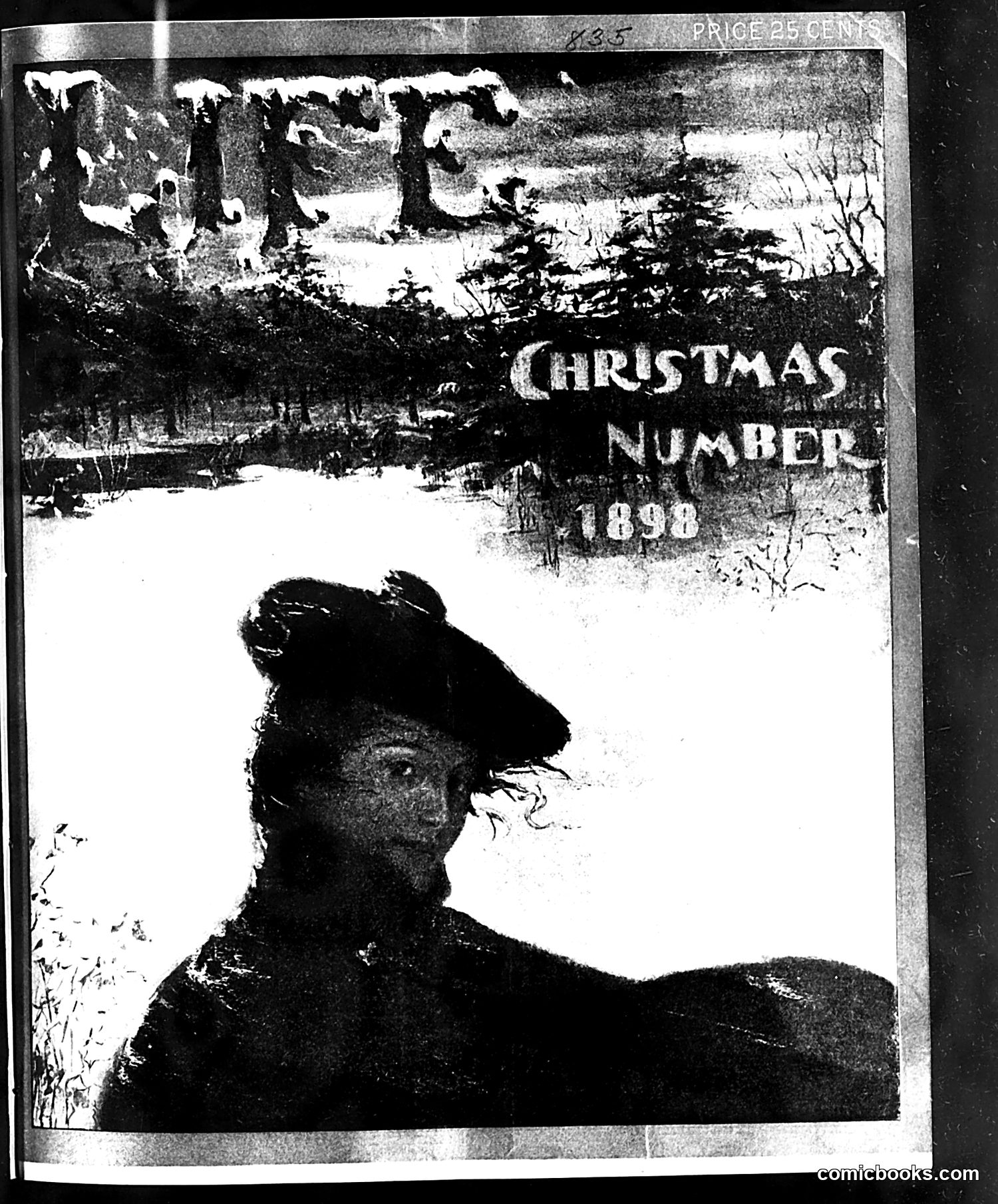
This is the cover of Life's 1898 Christmas issue (price 25 cents). The image shows a silhouetted figure in winter clothing gazing at a snowy forest landscape with tall trees. At the top, large letters spell "LIFE," and the text reads "CHRISTMAS NUMBER 1898." The cover appears to be primarily illustrative rather than overtly satirical—it presents a romantic, wintry holiday scene typical of late-Victorian Christmas imagery. Without additional context from the magazine's interior, the specific satirical or political content is unclear. The silhouetted figure and peaceful winter landscape suggest themes of solitude, reflection, or nostalgic holiday sentiment rather than direct social commentary.
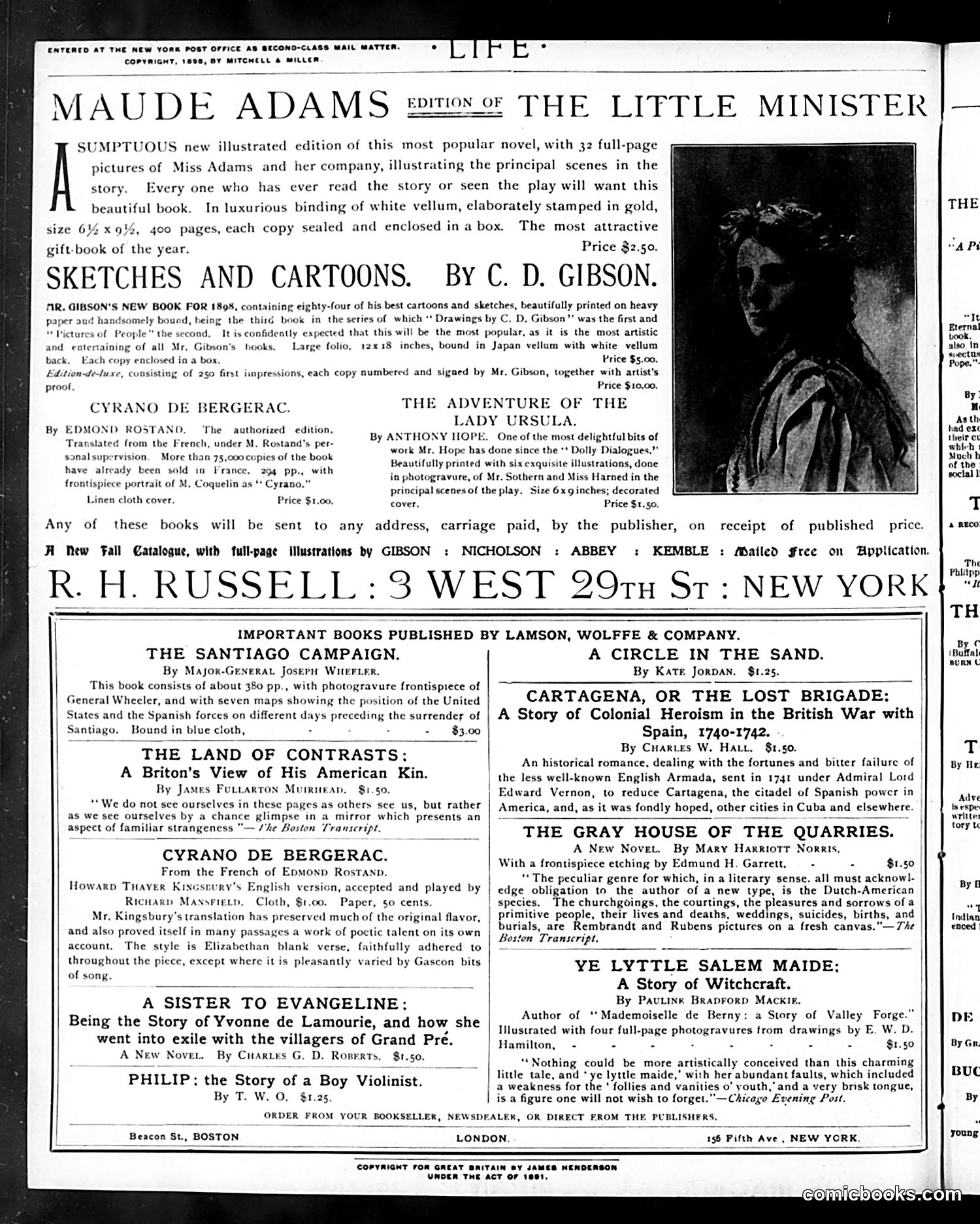
This page is primarily **advertising for books**, not political satire or comics. The dominant content consists of publisher advertisements for literary works, including: - Maude Adams edition of *The Little Minister* - *Sketches and Cartoons* by C.D. Gibson - *Cyrano de Bergerac* - Various historical and romantic novels The two images visible appear to be **book illustrations** rather than editorial cartoons—one shows a figure on horseback (likely from *The Adventure of the Lady Ursula*), and the other appears to be a dramatic scene. There is **no apparent political satire or social commentary** on this page. It represents standard late-19th century magazine content: literary advertisements aimed at educated readers interested in novels, drama adaptations, and illustrated editions.
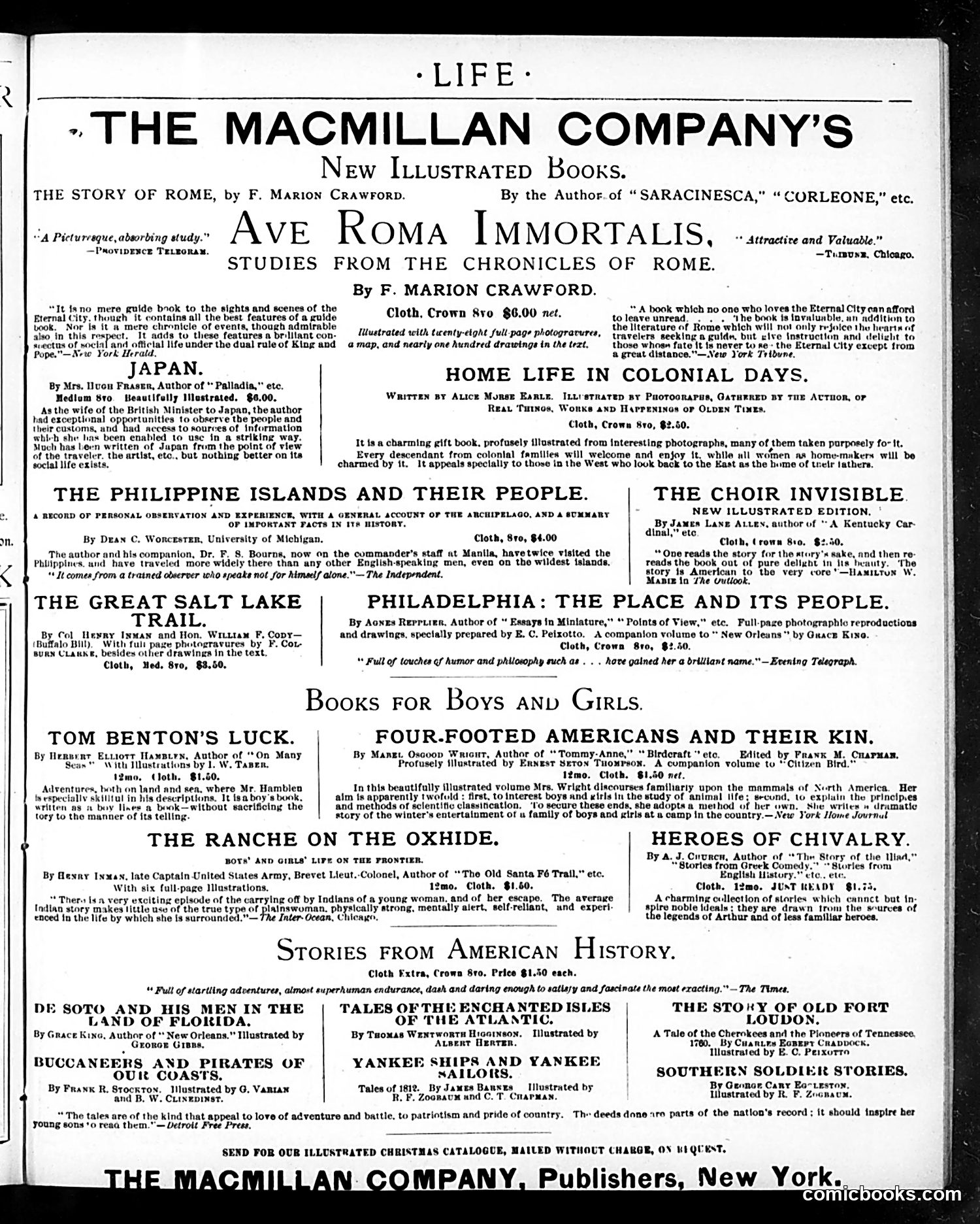
This page is **entirely advertising**, not satire or editorial content. It showcases **The Macmillan Company's new illustrated books** across multiple categories: histories and travel narratives (Rome, Japan, the Philippines, the Great Salt Lake); domestic guides (colonial home life, Philadelphia); and children's literature (Tom Benton's Luck, ranch stories, tales of chivalry). The ads emphasize the books' illustrations and educational value—appealing to turn-of-the-century middle-class readers interested in geography, history, and wholesome children's literature. There are no political cartoons, caricatures, or satirical commentary on this page. It's a straightforward publisher's catalog showcasing their catalog offerings with brief descriptions and prices.
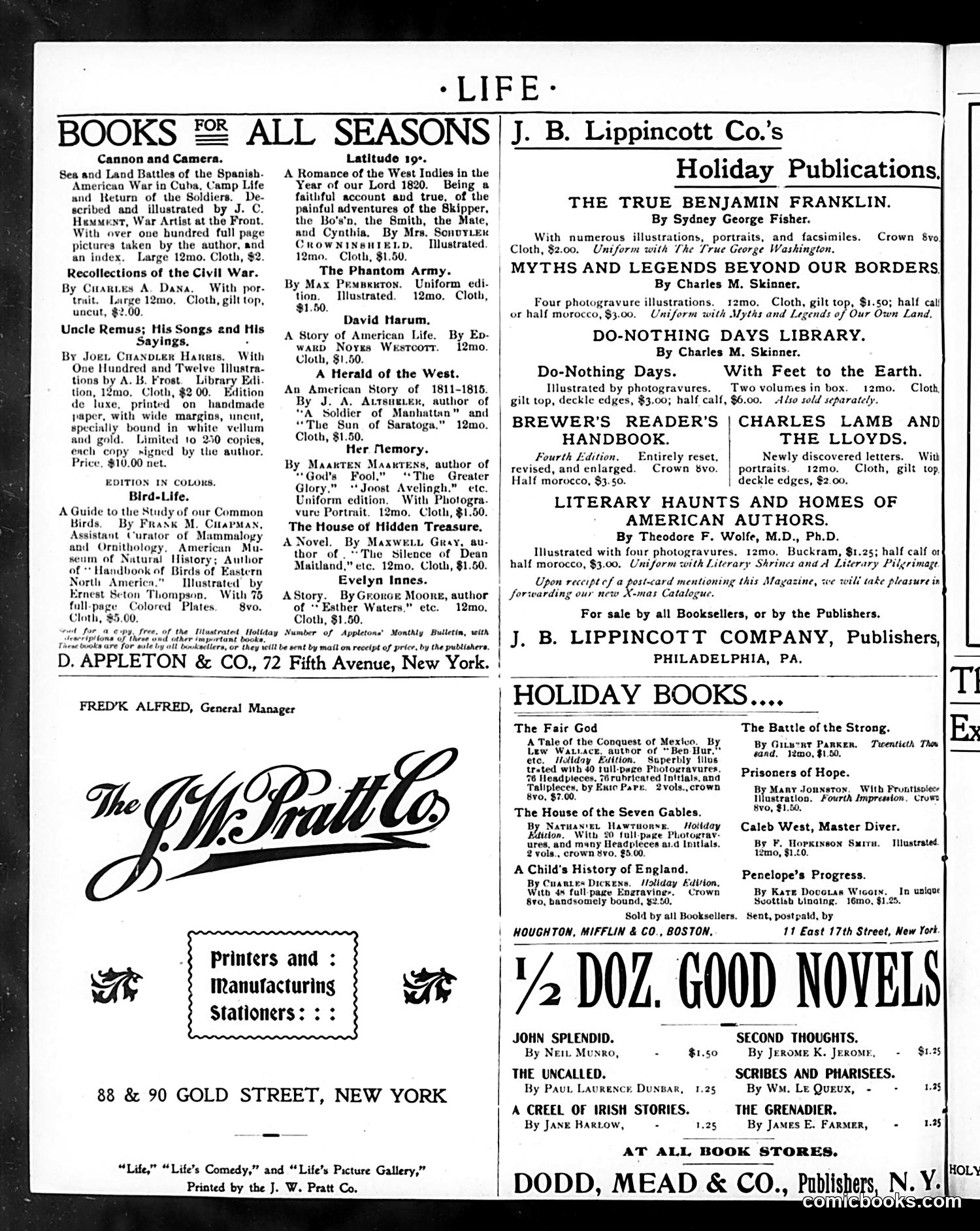
This page is **primarily advertising and book listings**, not political satire or comics. It features: - Book advertisements from major publishers (J.B. Lippincott Co., D. Appleton & Co., Dodd, Mead & Co., Houghton Mifflin) - Holiday gift book recommendations with titles, authors, prices, and descriptions - A decorative publisher's logo for "The J.W. Pratt Co." - Printer/stationer business information The books advertised are mainstream 19th-century titles (Benjamin Franklin biography, children's histories, novels). There are **no political cartoons or satirical illustrations visible** on this page—it's a straightforward commercial section typical of *Life* magazine's back pages, designed to promote seasonal holiday reading and purchasing.
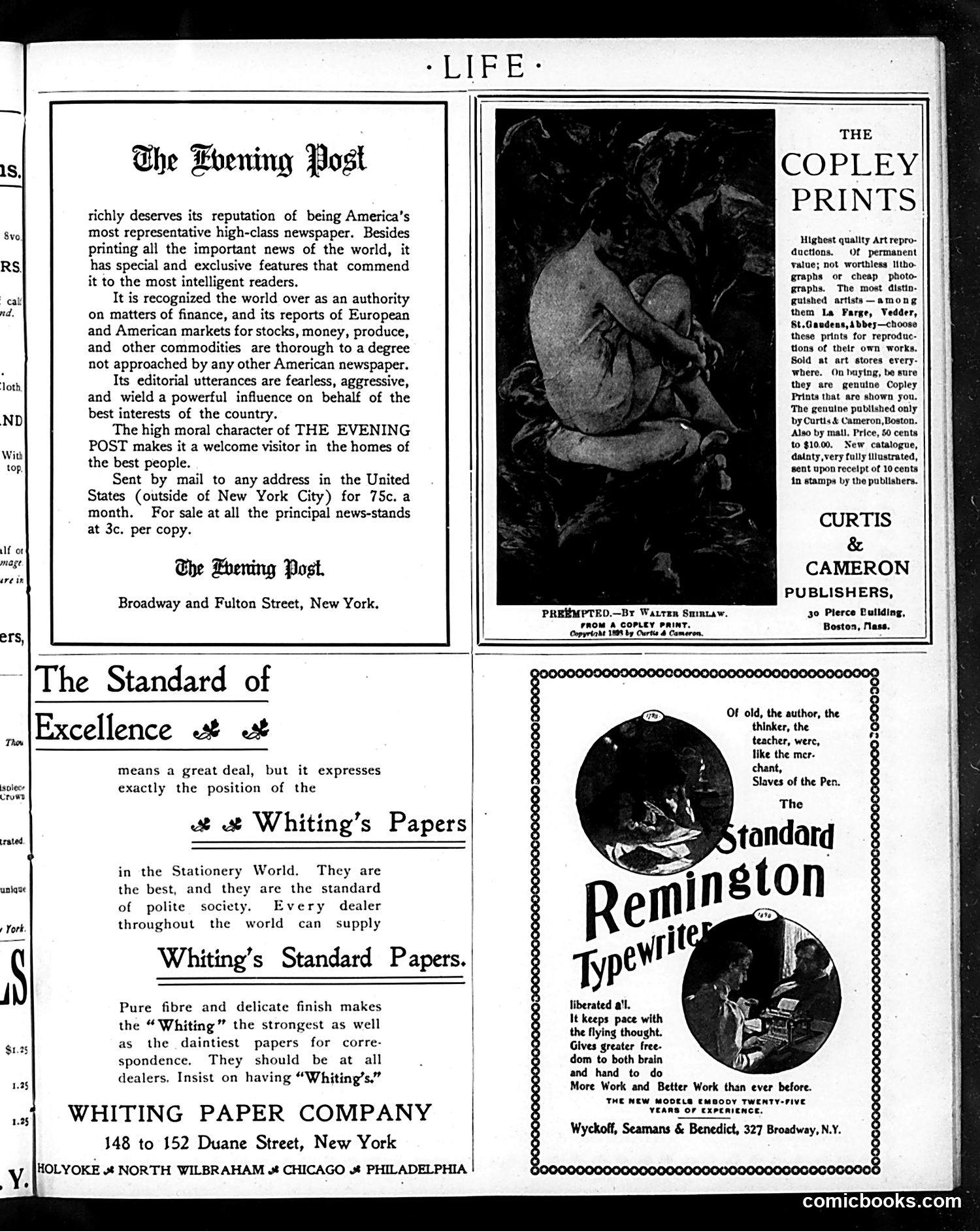
This page is primarily **advertising**, not editorial content or political satire. It contains four advertisements: 1. **The Evening Post** (top left): promotes the newspaper as America's leading high-class publication, emphasizing its financial reporting and editorial influence. 2. **Copley Prints** (top right): advertises art reproductions by distinguished artists, sold through Curtis & Cameron Publishers in Boston. 3. **Whiting's Papers** (bottom left): promotes stationery as the standard of excellence in the stationery world. 4. **Remington Typewriter** (bottom right): advertises the "Standard Remington Typewriter," emphasizing it liberates the mind and increases productivity. There is **no political cartoon or satire** on this page. The content reflects early 20th-century consumer advertising typical of *Life* magazine.
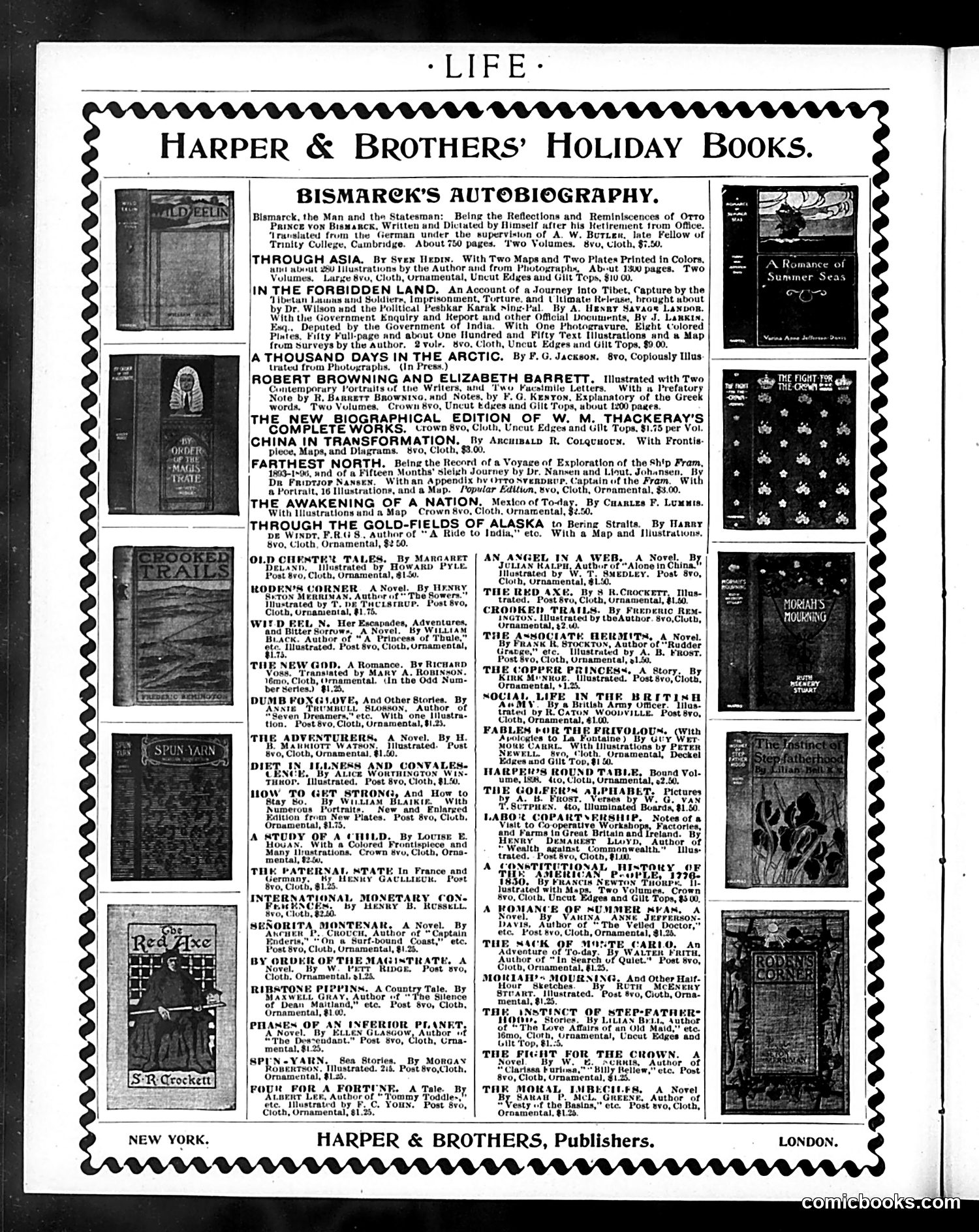
This page is primarily a **book advertisement**, not political satire. It lists Harper & Brothers' publishing catalog for the holiday season, featuring titles like "Bismarck's Autobiography," travel narratives ("Through Asia," "In the Forbidden Land"), adventure novels, and illustrated works. The left side displays book cover images in black and white, while the right column lists additional titles with brief descriptions and prices. Notable entries include works on exploration, fiction, and reference materials typical of late 19th-century publishing. There is **no visible political cartoon or satirical content** on this page—it's a straightforward commercial advertisement designed to promote Harper & Brothers' complete book offerings to holiday shoppers.
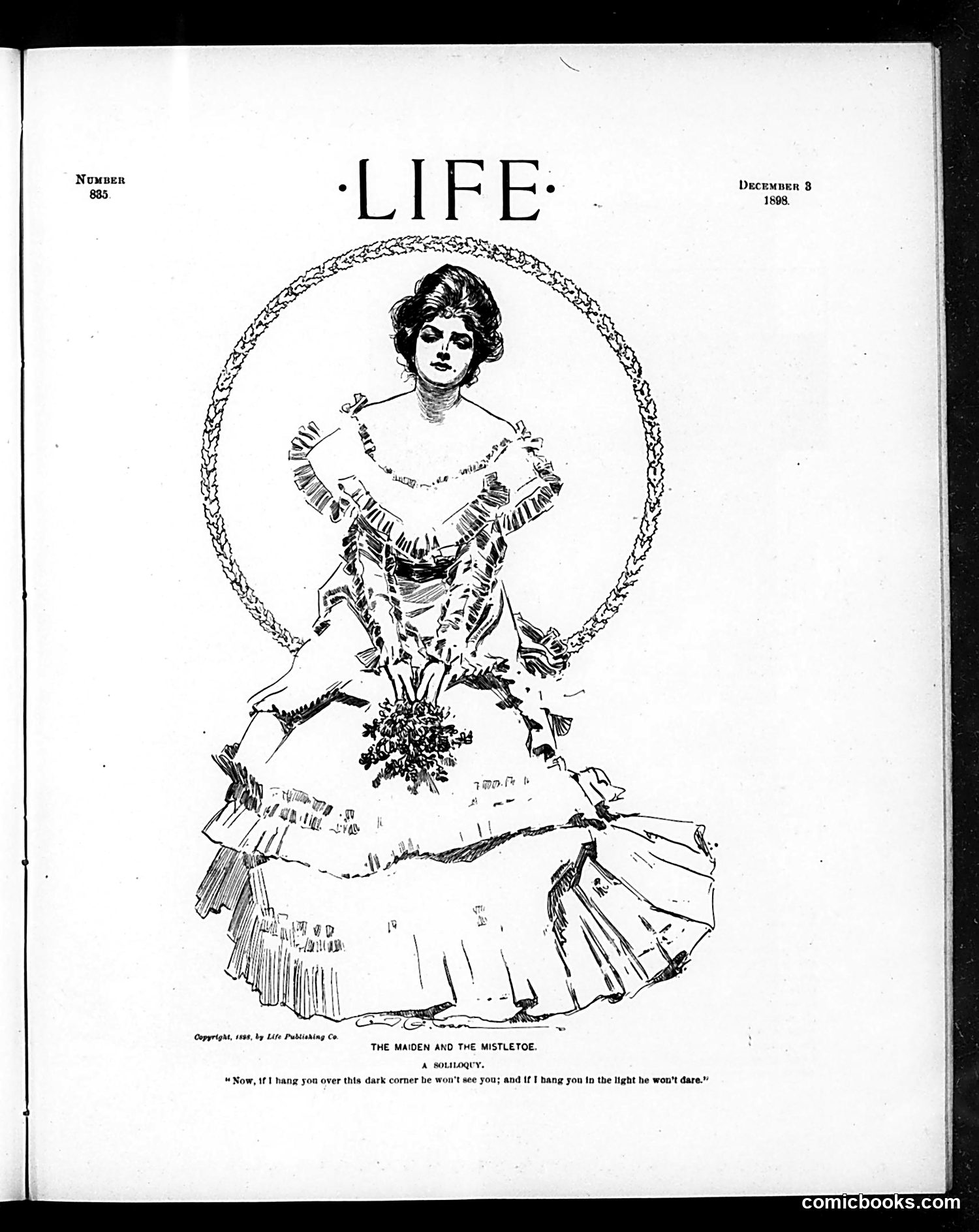
This illustration depicts a young woman in elegant Edwardian dress, framed by a decorative circular mistletoe wreath. The accompanying caption reads: "Now, if I hang you over this dark corner he won't see you; and if I hang you in the light he won't dare." This is a gentle humorous commentary on Victorian courtship conventions. The "joke" involves the mistletoe tradition—which permitted romantic liberties under its branches. The maiden is strategically considering where to position the mistletoe to encourage a gentleman caller's advances, either by hiding in darkness or ensuring sufficient visibility to prevent scandalous behavior. It plays on the tension between Victorian propriety and romantic opportunity during the Christmas season.
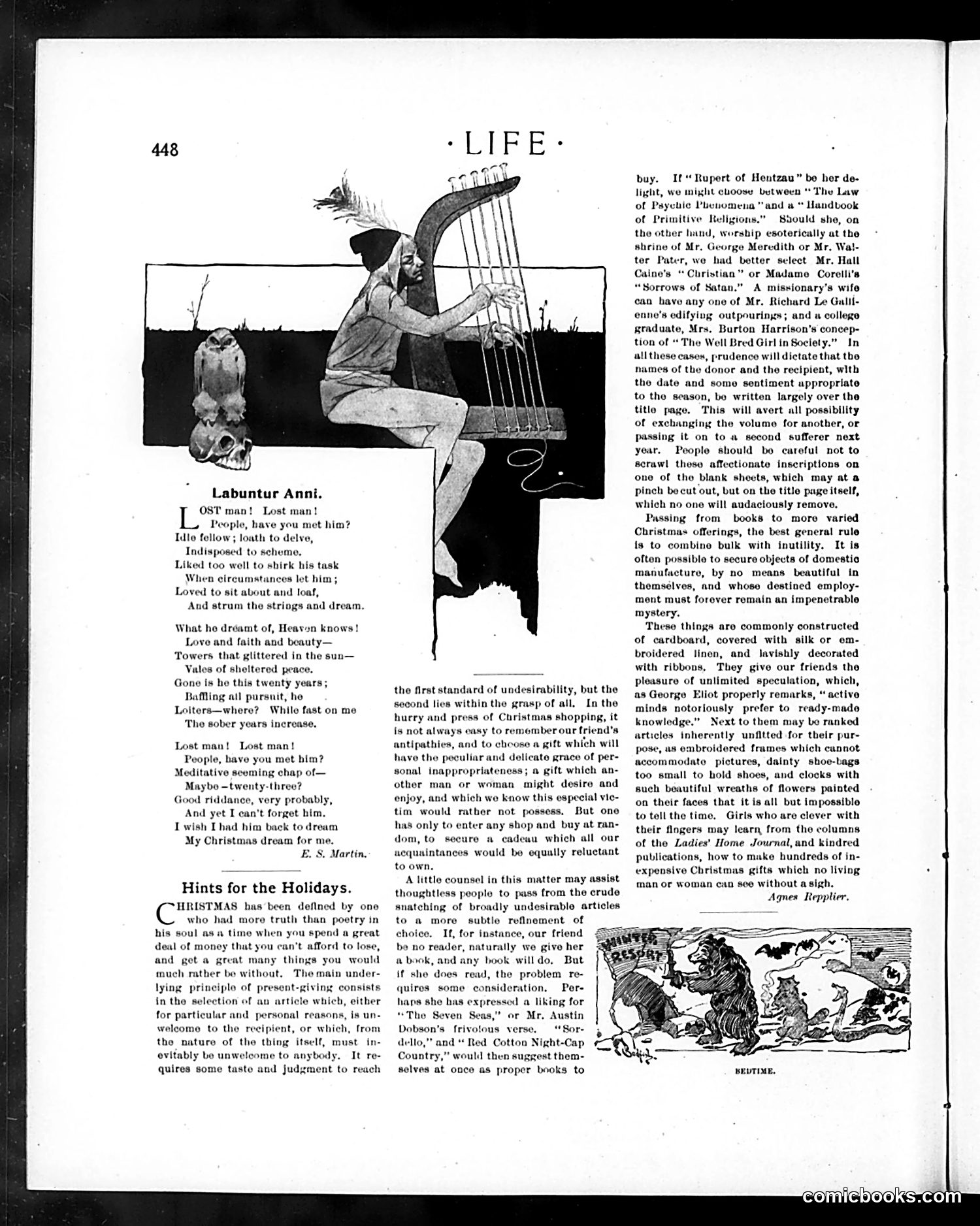
The main illustration shows a melancholic figure seated with a harp, titled "Laburnum Anni" (Latin: "Year of the Laburnum," a flowering shrub). The accompanying poem by F.S. Martin is a sentimental meditation on loss and regret, expressing nostalgia for a lost love or companion. The figure appears to represent a contemplative person reflecting on their 23-year absence from someone. The adjoining "Hints for the Holidays" article addresses Christmas gift-giving etiquette, cautioning readers against giving inappropriate or poorly-chosen presents. It advocates for thoughtful selection—either personal gifts reflecting the recipient's actual interests or practical objects like books. Together, these elements—the melancholic artwork, sentimental verse, and practical holiday advice—represent typical turn-of-the-century *Life* magazine content: blending sentiment, gentle satire, and bourgeois social guidance.
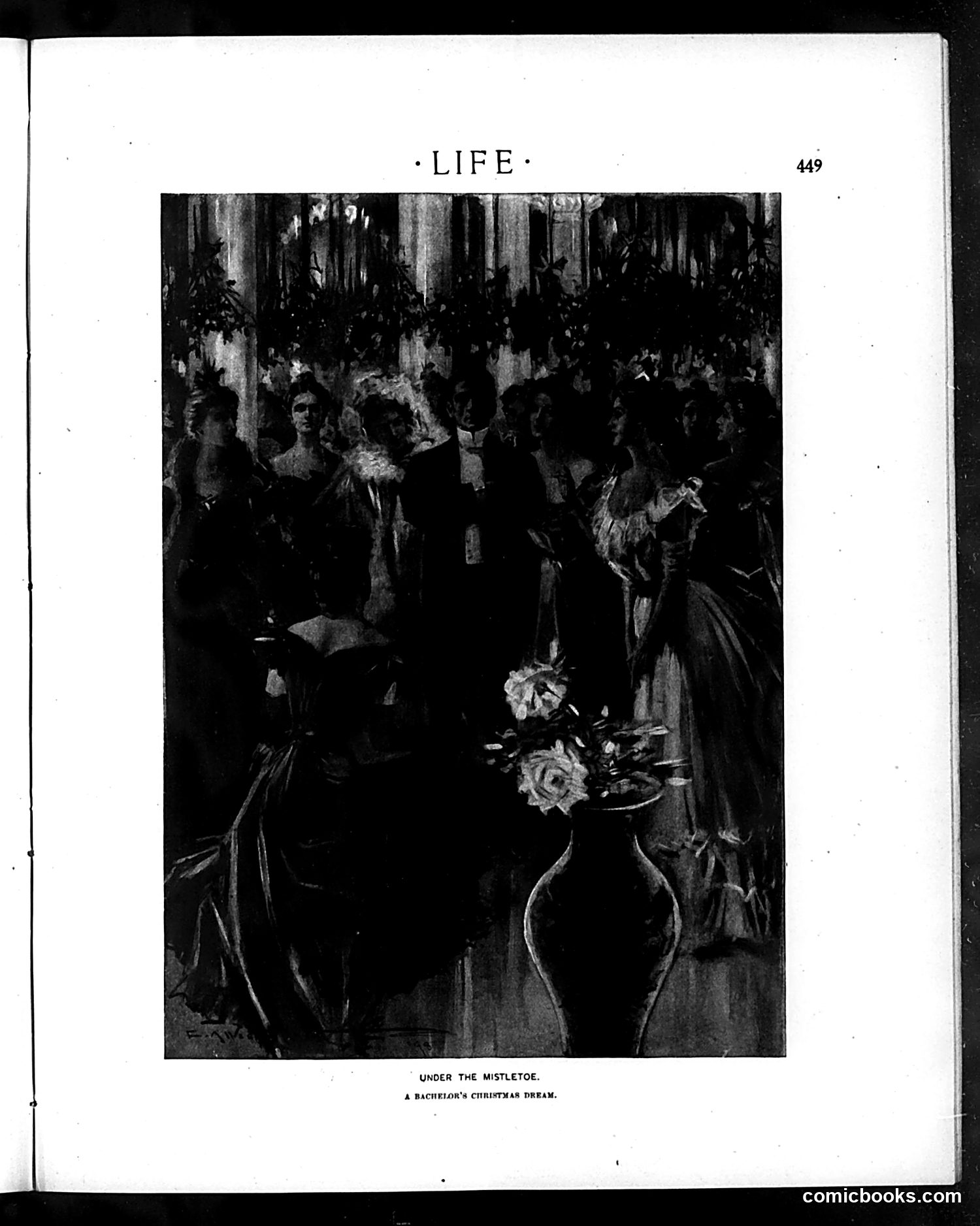
This black-and-white illustration depicts a crowded indoor Christmas scene with multiple figures gathered together. The caption reads "UNDER THE MISTLETOE" with a subtitle "A BACHELOR'S CHRISTMAS DREAM." The satire appears to play on the traditional Christmas custom of kissing under mistletoe. The image shows what seems to be a bachelor's fantasy—surrounded by numerous women at a holiday gathering. The humor likely derives from the contrast between this idealized scenario and a bachelor's actual Christmas experience, or commentary on the social customs around mistletoe-kissing during the holiday season. The specific identities of the figures are unclear from the image alone, though this appears to be a general satirical commentary on holiday romance and bachelor life rather than caricature of particular public figures.
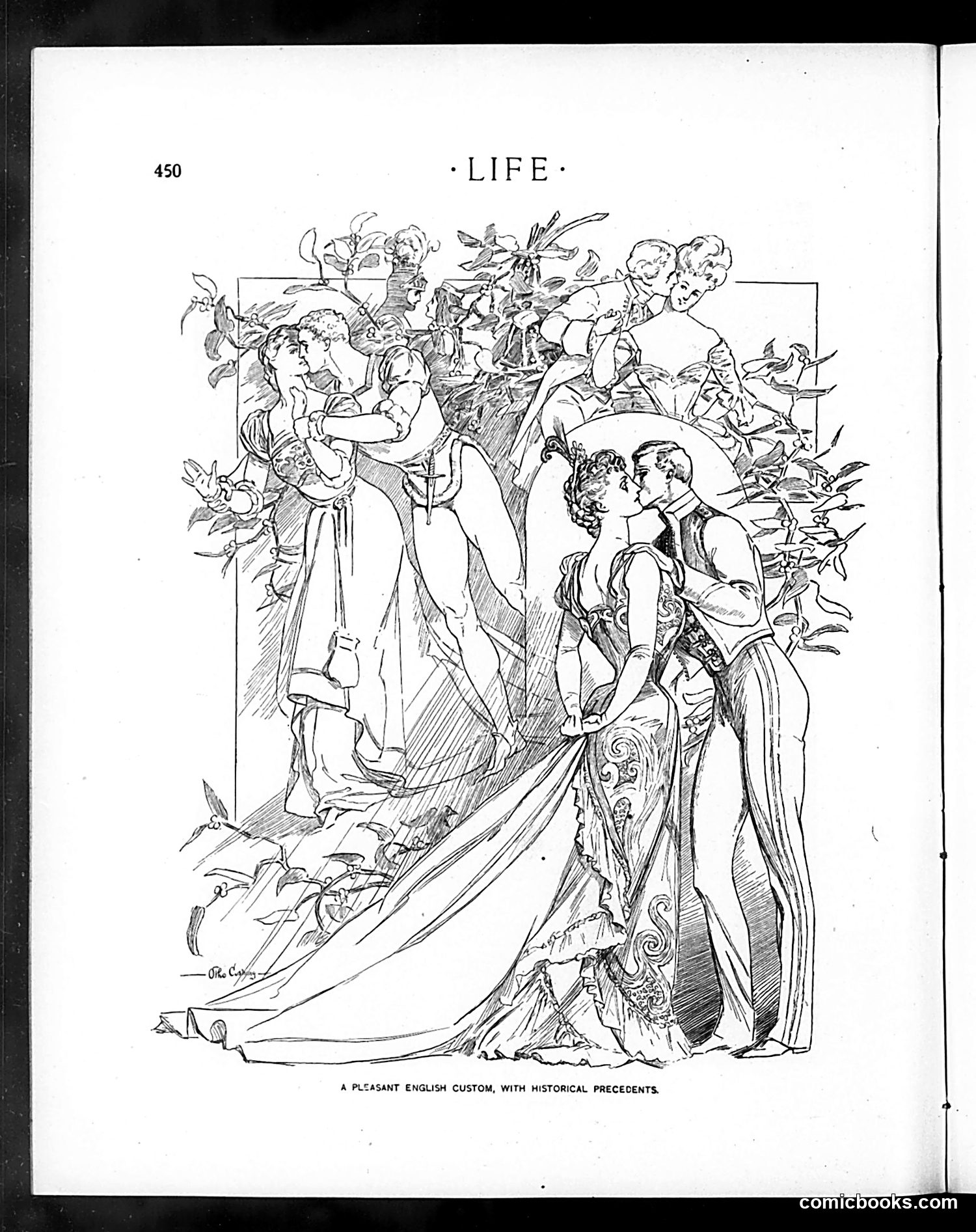
This page from *Life* magazine (page 450) presents a satirical illustration titled "A Pleasant English Custom, with Historical Precedents." The drawing depicts an elaborate wedding scene with a bride in an ornate gown with a long train, attended by a groom and numerous other figures. The composition is crowded and chaotic, with cherubs or putti figures emerging from foliage at the top. The satire appears to mock English wedding traditions and their supposed "historical precedents"—likely critiquing the elaborate pageantry and formality of aristocratic English weddings. The crowded, busy composition suggests the ostentatious nature of such ceremonies. However, without additional context about the specific publication date or contemporary events referenced, the precise political target remains unclear.
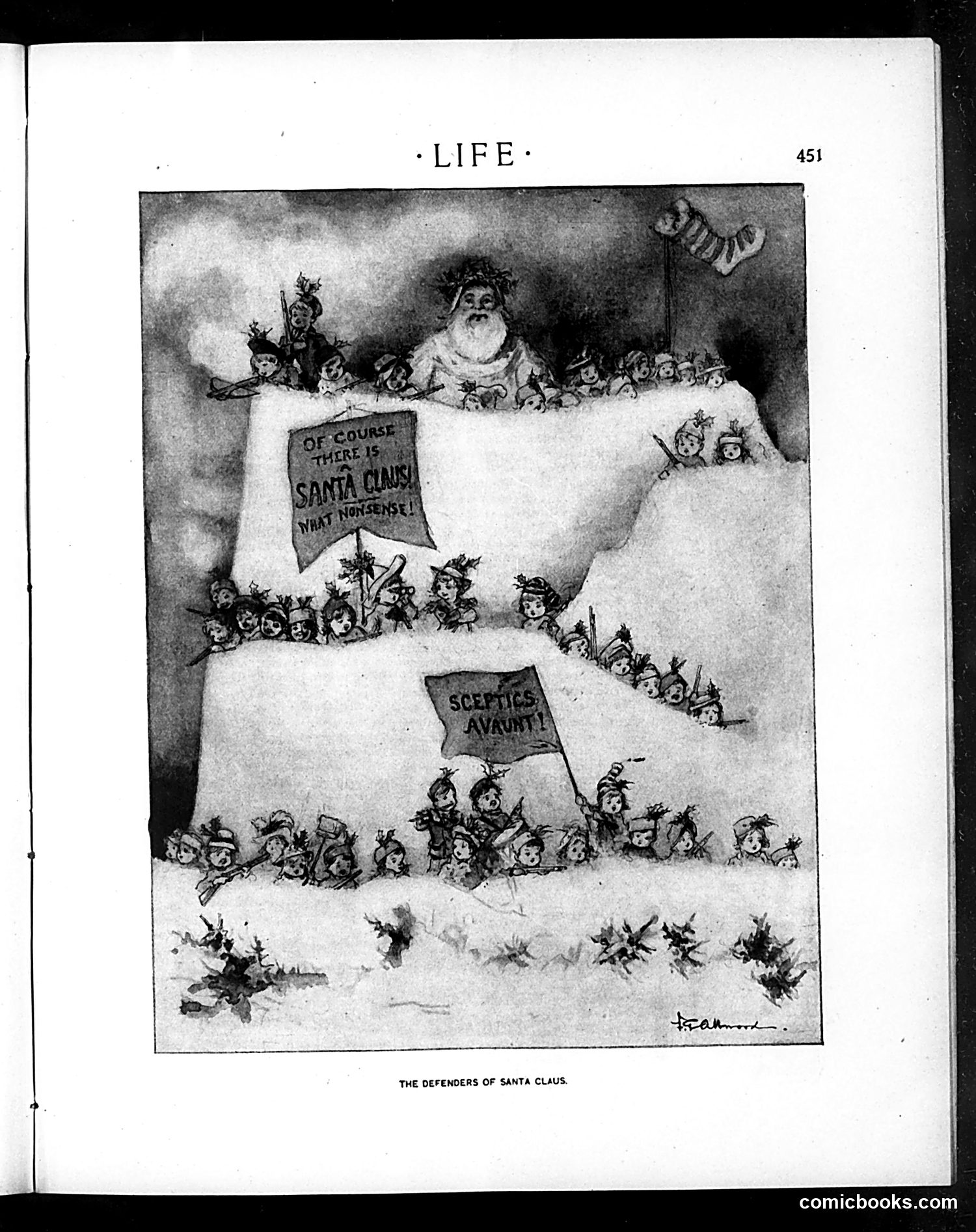
This cartoon depicts Santa Claus at the top of a snow-covered fortress, surrounded by supporters arranged in three tiers. The banner reads "Of course there is Santa Claus! That nonsense!" while below, skeptics display a flag saying "Skeptics Abound!" The satire illustrates the cultural battle over Santa's existence—a debate between believers defending Santa's reality and growing skeptics who questioned the tradition. The fortified, hierarchical arrangement suggests this is an organized defense against doubt and rational criticism threatening childhood belief. This appears to be commentary on early 20th-century tensions between traditional American values and modernist skepticism, using the Santa Claus legend as a metaphor for defending cherished cultural institutions against increasing doubt and cynicism.
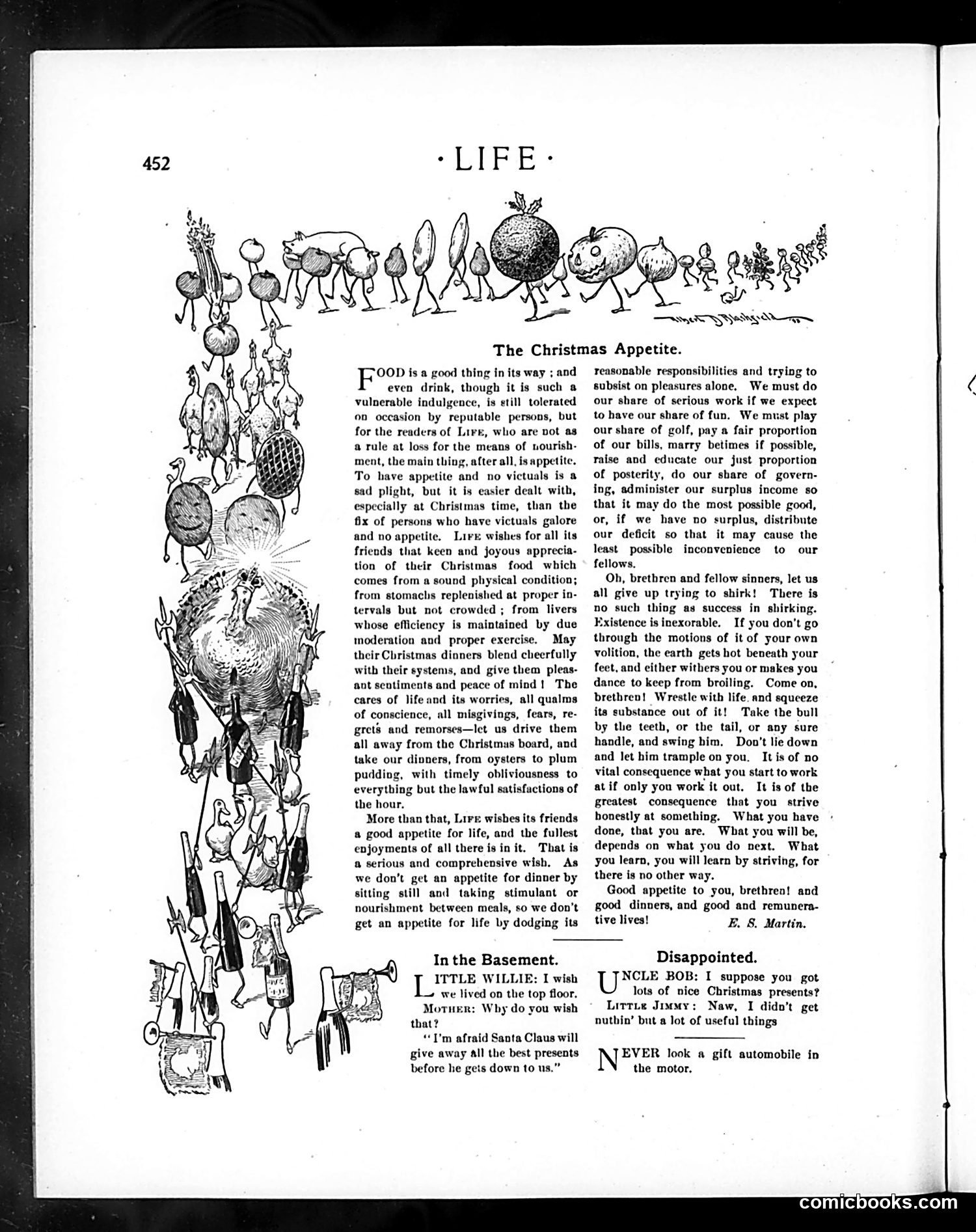
This page satirizes Christmas excess and indulgence. The left illustration depicts anthropomorphized food items (fruits, vegetables, meats, bottles) in a procession, suggesting the abundance of holiday feasting. The accompanying essay by E.S. Martin criticizes those who overeat during Christmas while advocating moderation and responsibility toward "our share of serious work." The humor targets the hypocrisy of Christmas celebration: people indulge heavily in food and drink despite claims of sobriety and work ethic. Martin argues that appetite is natural but should be restrained—that one shouldn't "dodge life" through excess eating. The bottom sections ("In the Basement" and "Disappointed") contain brief comic dialogues about Christmas presents, with a child disappointed by receiving "useful things" rather than toys, and a joke about automobiles in motors.
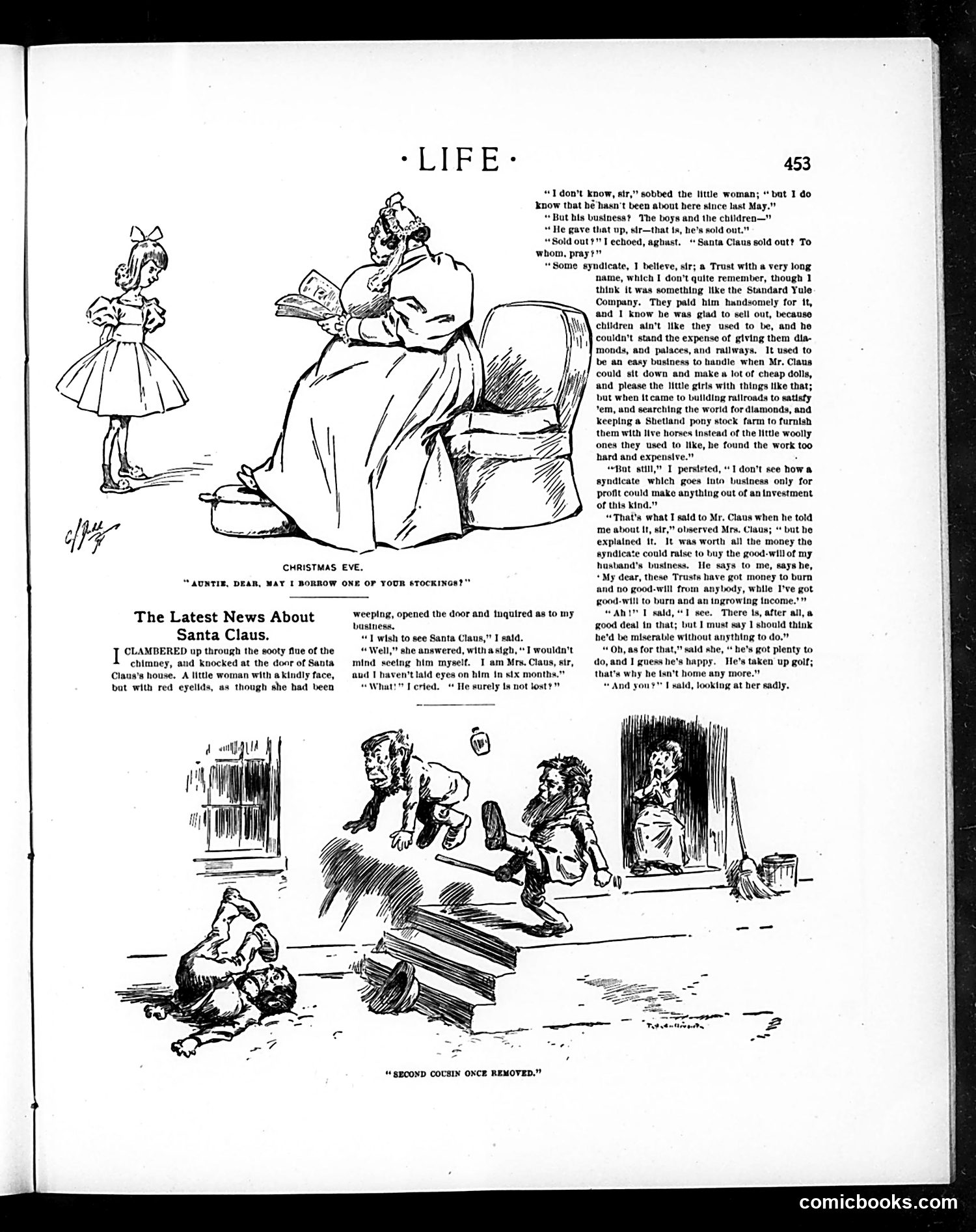
This is a satirical story attacking the rise of corporate trusts and syndicates in the Gilded Age. Santa Claus represents traditional American values and small business; the "Trust" represents the new monopolistic corporations consolidating commerce. The joke: Santa has sold his business to a profit-driven syndicate because modern children's expectations have become impossibly expensive (railroads, diamonds, live ponies instead of cheap toys). The syndicate bought his "good-will"—his reputation and customer loyalty—to exploit it for profit, while Santa himself is now idle, playing golf. The satire critiques both corporate greed and the commercialization of Christmas, lamenting lost simplicity and tradition. Mrs. Claus's sadness suggests the human cost of industrialization and consolidation. The lower cartoons appear to show domestic chaos (possibly depicting the disruption modern life causes to families).
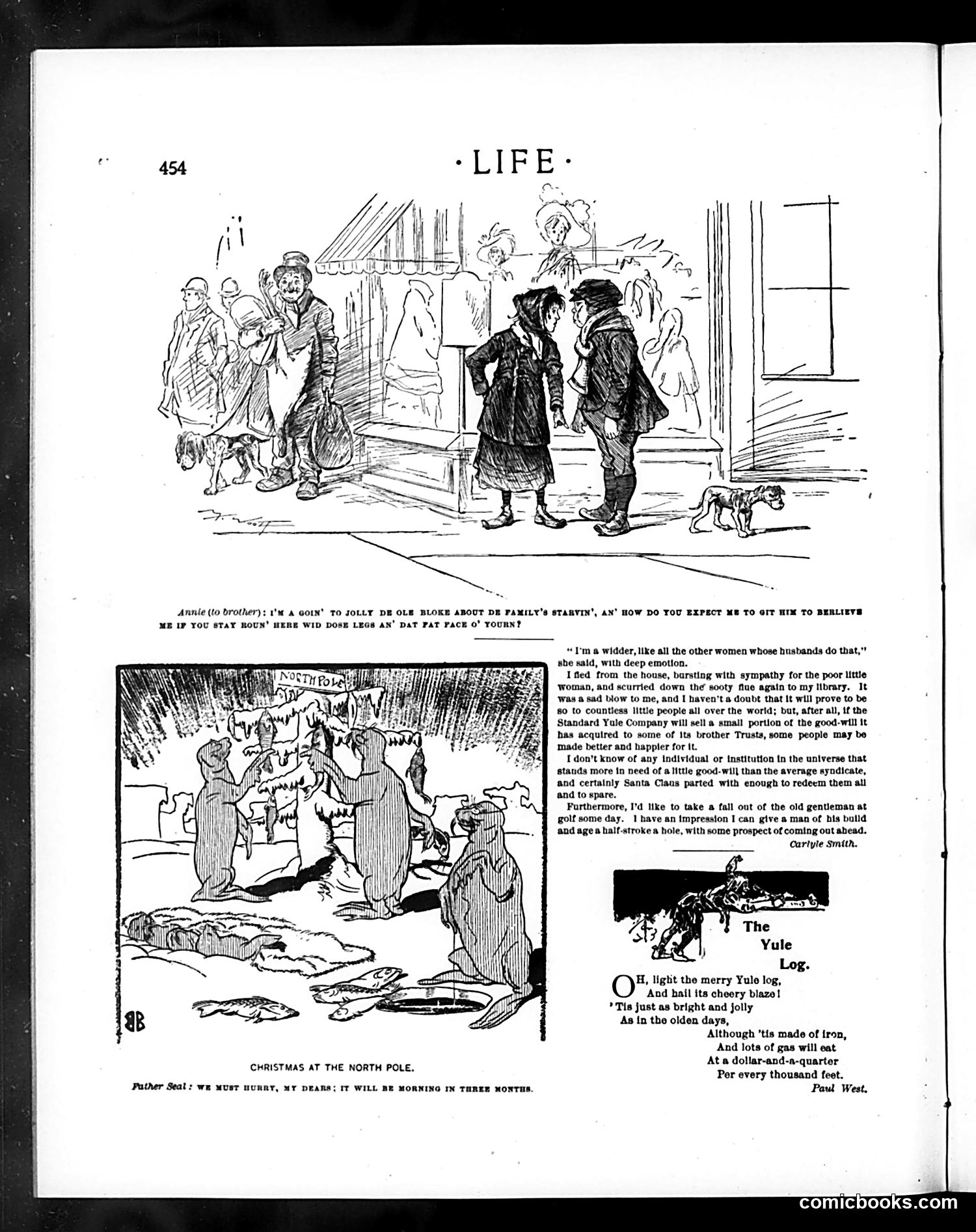
**Top Cartoon**: Shows working-class characters in tenement poverty. Annie tries to persuade her brother to leave so she can convince their father (likely unemployed or struggling) that the family's starvation is temporary. The satire mocks the desperation of poor families and their need to maintain false hope about their circumstances. **Middle Section**: A prose piece by Carlyle Smith satirizes wealthy philanthropists' shallow Christmas charity. He criticizes the "Standard Yule Company" and corporate "Trusts" for their minimal good-will gestures toward the poor, suggesting their charitable efforts are performative and insufficient. **Bottom Cartoon**: "Christmas at the North Pole" mocks commercialization of Christmas. Father appears to light an artificial gas-powered Yule log (expensive at "$1.25 per thousand feet") rather than a traditional wood fire, satirizing how even holiday traditions have been commodified and made expensive for profit. **Overall theme**: The page critiques inequality, corporate greed, and how commercialization hollows out genuine Christmas spirit—concerns relevant across centuries.
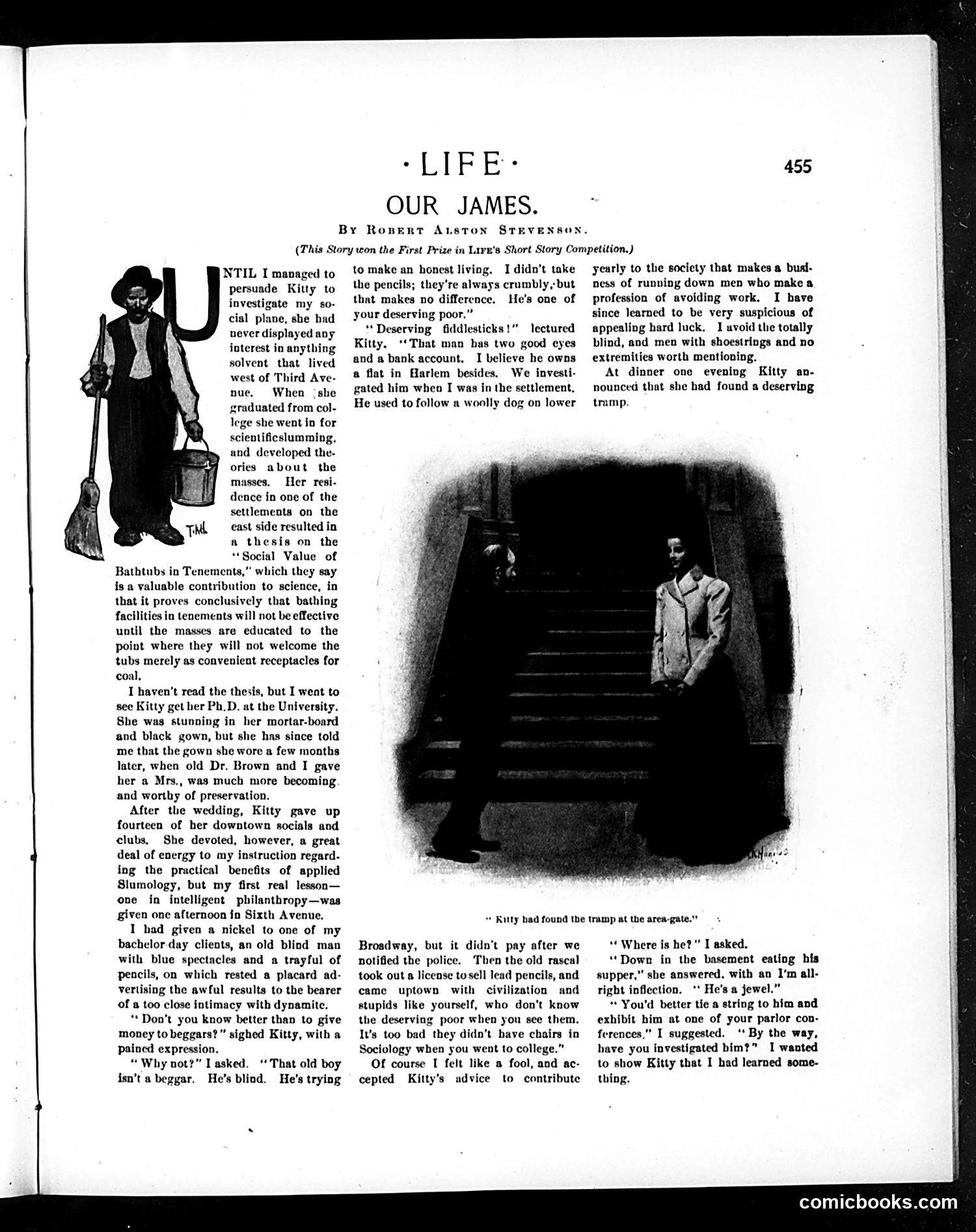
This satirical story mocks **wealthy, educated women engaged in "slumming"** — a Progressive Era trend where privileged urbanites studied poverty as pseudo-scientific philanthropy while feeling morally superior. **The target:** Kitty, a Ph.D. holder who wrote a thesis on "bathtubs in tenements," represents this condescending charity mindset. She lectures the narrator (James) for giving money to a blind pencil-seller, claiming he's a fraud with a Harlem apartment. She later "discovers" a deserving tramp in her basement. **The satire:** The joke is Kitty's self-righteous hypocrisy — she poses as an expert on the poor through academic study and settlement-house work, yet misjudges actual poor people and patronizes her own husband. The illustrations show her "findings" (the tramp at the basement stairs), emphasizing how her sociology is performative rather than genuinely charitable. The text suggests the narrator has learned skepticism about such "intelligent philanthropy," implying Stevenson critiques both the fashion of slumming and its ineffectual moralizing.
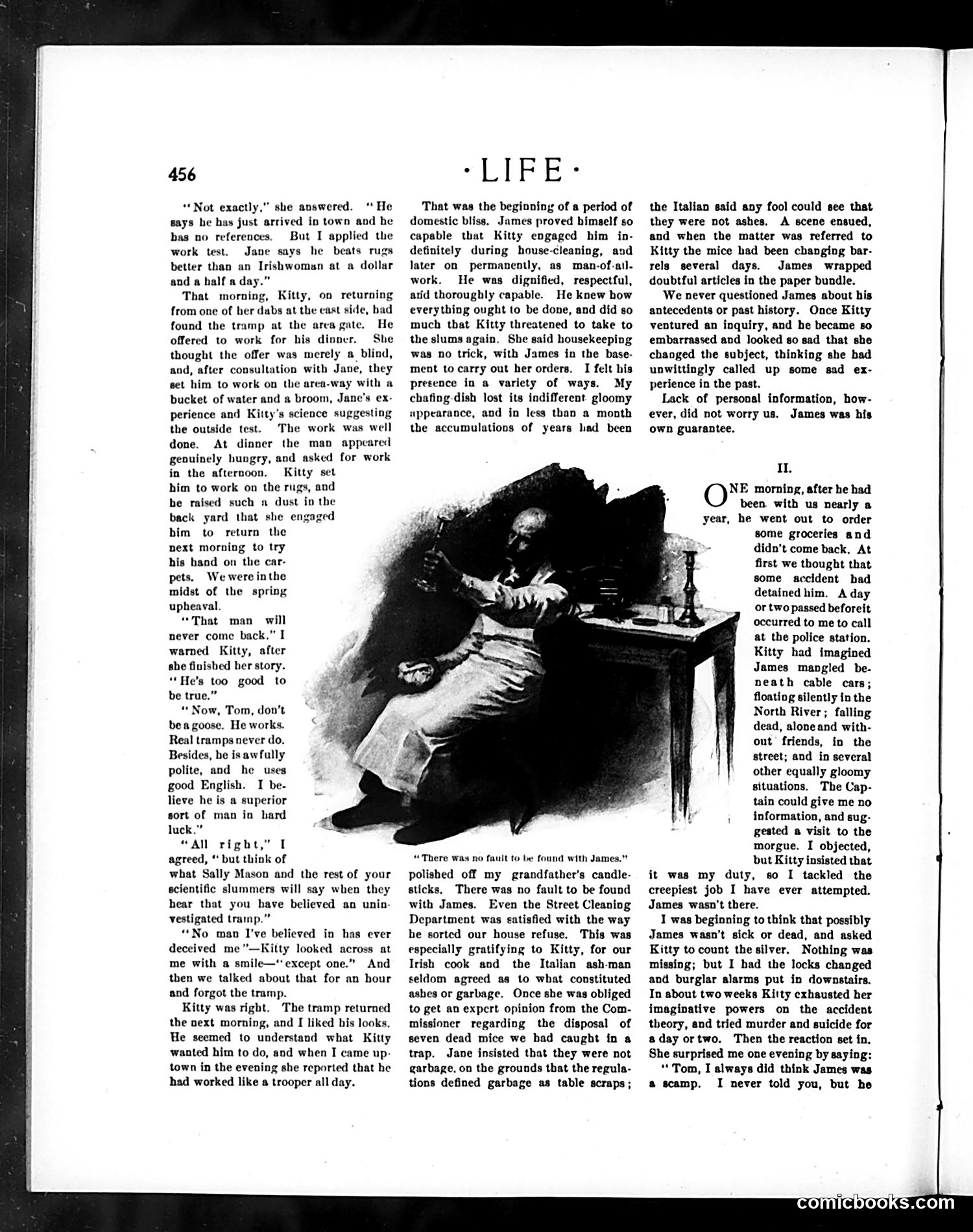
This page satirizes early 20th-century "scientific slumming"—wealthy reformers who studied poverty while employing working-class people. The narrative follows Kitty, an upper-class woman who hires a mysterious tramp named James as a servant. The illustration shows James working diligently, captioned "There was no fault to be found with James." **The satire's point**: Kitty applies pseudo-scientific methods (the "work test") to evaluate the tramp, yet ignores basic due diligence like checking references. She and her friends ("Sally Mason and the rest of your scientific slummers") claim expertise in social problems while remaining willfully ignorant. James's perfection—his politeness, English, and flawless work—is treated as suspicious by the narrator, who predicts he'll disappear. The irony deepens when James proves trustworthy despite their condescension. The humor mocks Progressive-era "scientific" approaches to charity and labor, suggesting that Kitty's class applies investigation to social problems while remaining blind to their own biases and the humanity of working people.
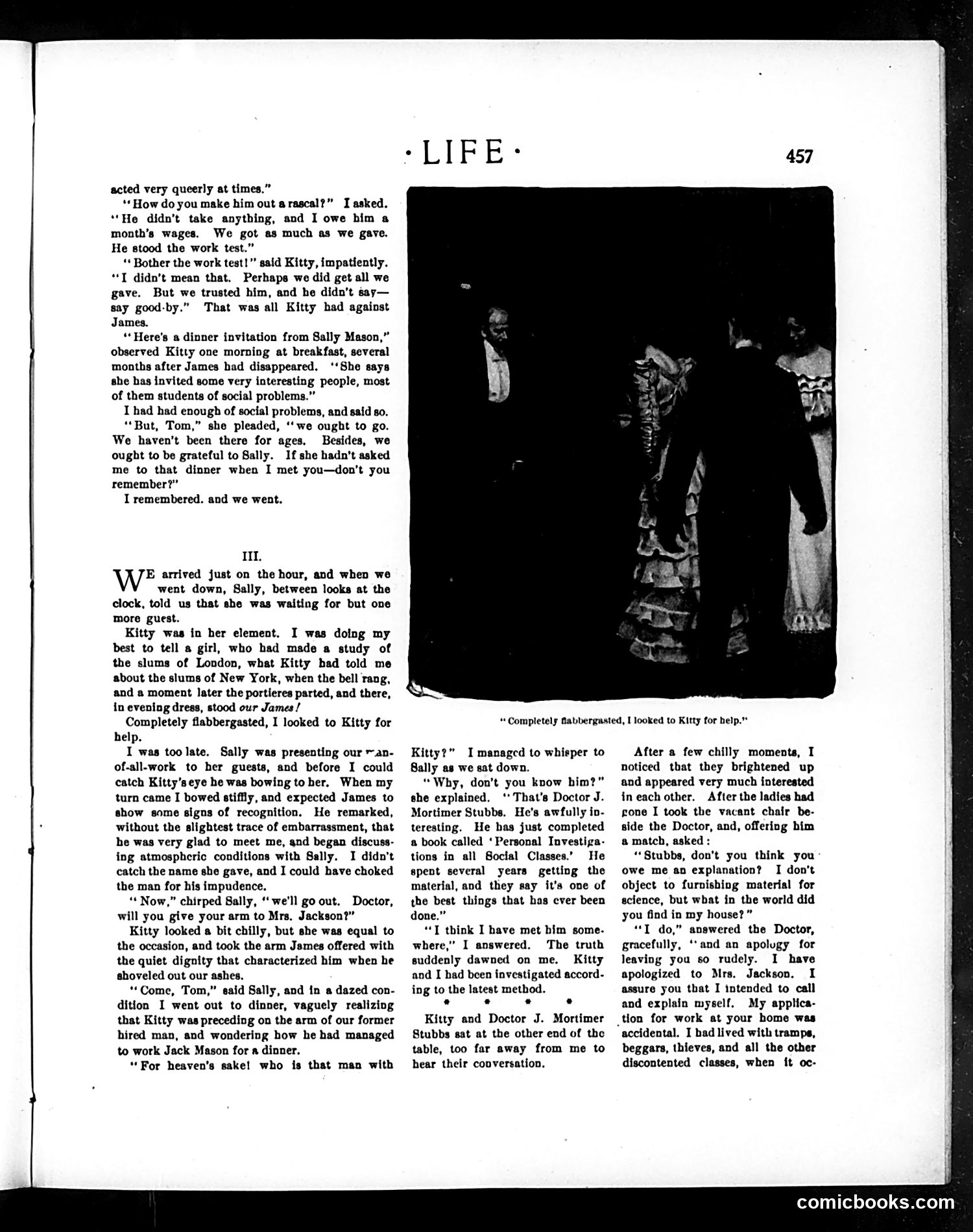
This page presents a satirical short story about class mobility and social pretense in early 20th-century America. The narrative reveals that "James," the narrator's former working-class servant, has reinvented himself as "Doctor J. Mortimer Stubbs," a supposedly distinguished social scientist who studied "Personal Investigations in all Social Classes." The joke targets several things: the fluidity of American class identity, the fashionability of pseudo-intellectual "social problem" studies, and the hypocrisy of wealthy hosts who unknowingly entertain their former employees in disguise. The photograph shows formally dressed dinner guests, reinforcing the contrast between James's earlier station and his current presentation. The satire suggests that social status depends more on presentation and credentials than actual worth—and that servants understand their employers' pretensions well enough to exploit them. The "work test" mentioned earlier becomes ironic: James passed it honestly, but society only recognizes him once he adopts intellectual credentials and formal dress.
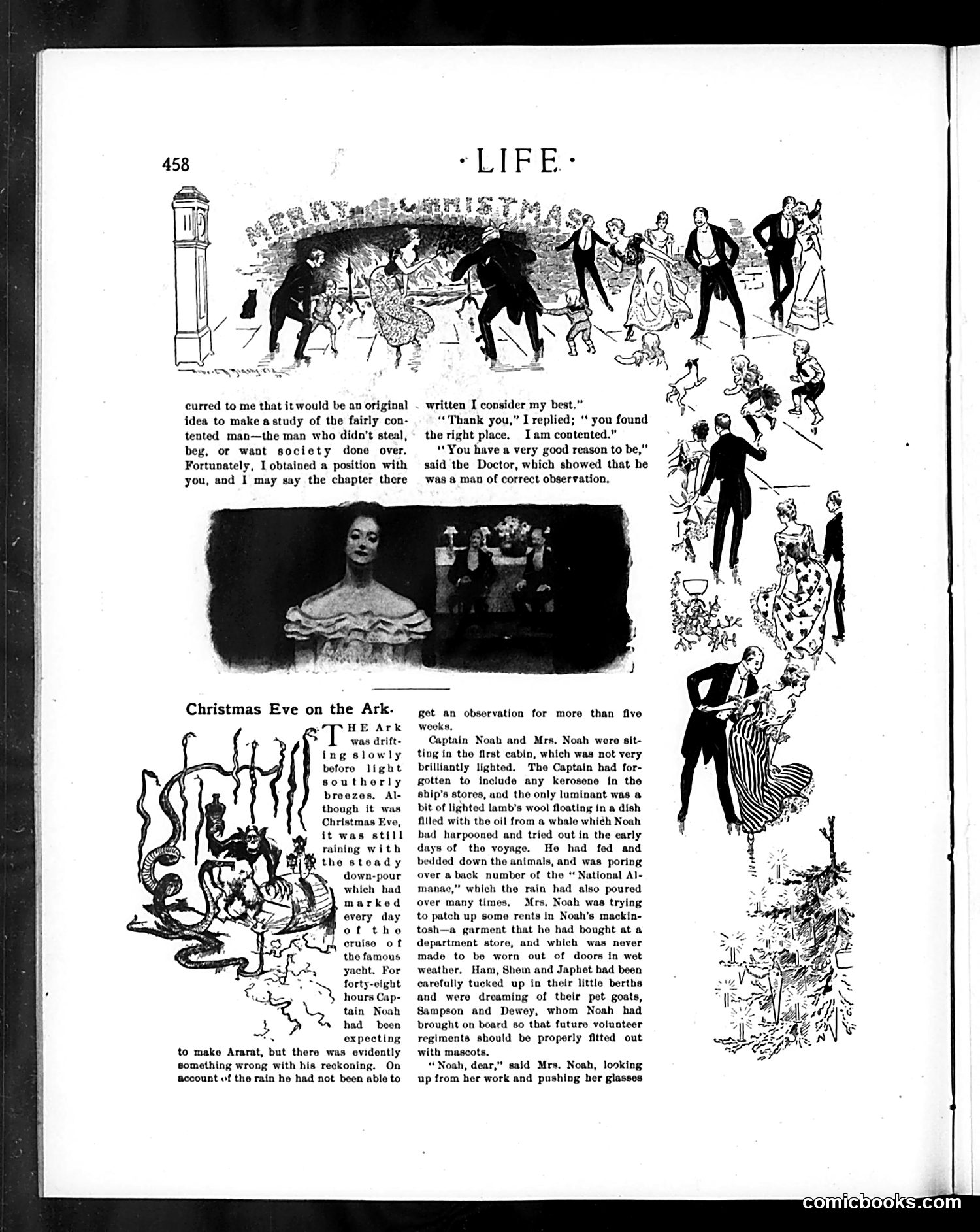
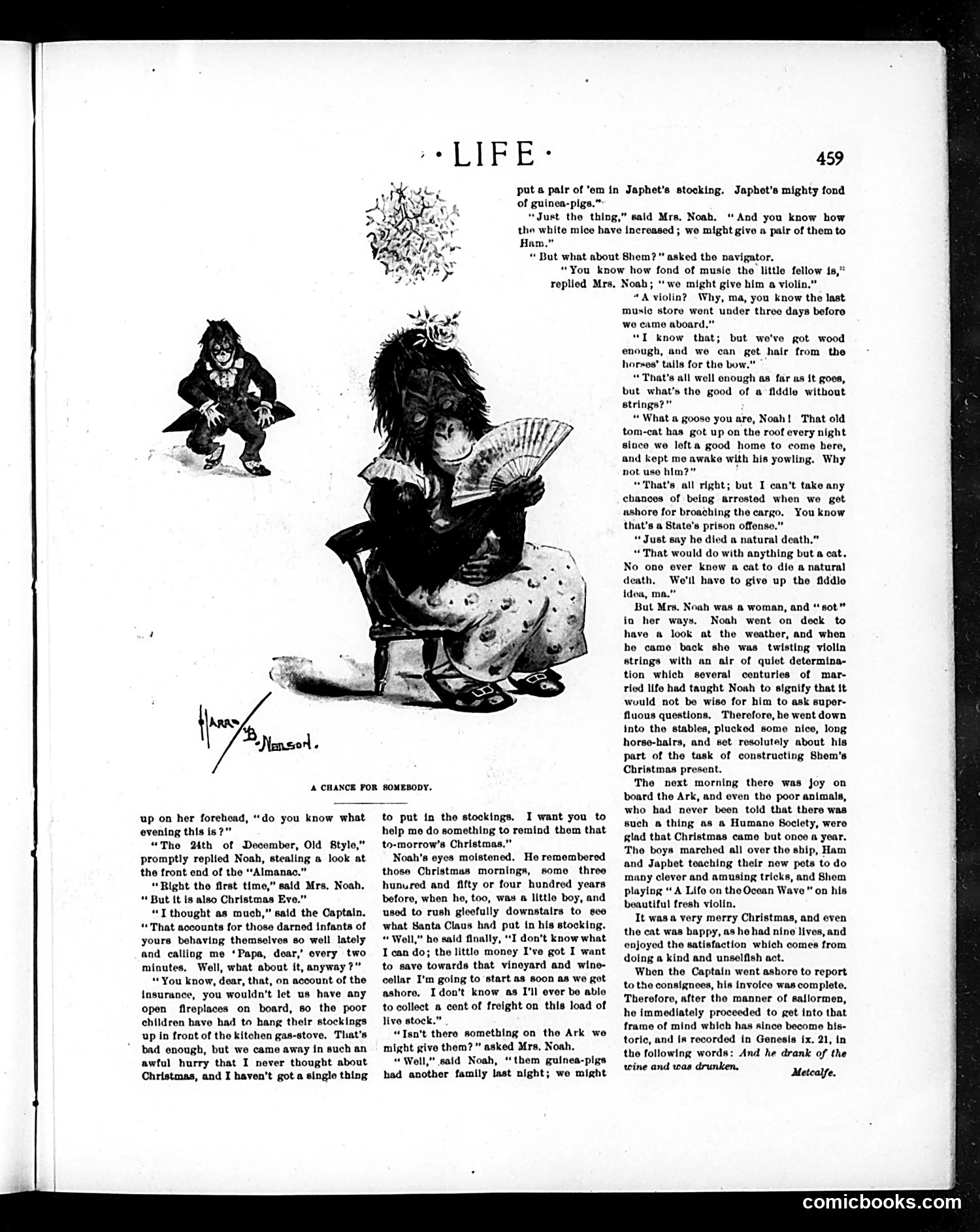
This page presents "Christmas Eve on the Ark," a humorous fictional story using Noah's Ark as a satirical setting. The narrative depicts Captain Noah and Mrs. Noah aboard a ship during Christmas, stuck in rainy weather unable to reach Mount Ararat. The satire appears to mock: 1. **Victorian domestic tedium**: Mrs. Noah mending her husband's worn mackintosh (raincoat) bought from a department store that wasn't designed for actual outdoor use—suggesting complaints about consumer goods 2. **Nautical incompetence**: Captain Noah lost at sea for weeks, unable to take celestial observations due to rain; his poor planning (forgetting kerosene, using whale oil in a dish as lighting) 3. **Period humor about pets**: References to pet goats named "Sampson and Dewey" (likely political figures of the era) being brought aboard to outfit "future volunteer regiments" The story uses the biblical Ark framework as an absurdist setting to gently satirize ordinary middle-class life, practical problems, and contemporary concerns—a typical Life magazine approach to humor and social commentary.
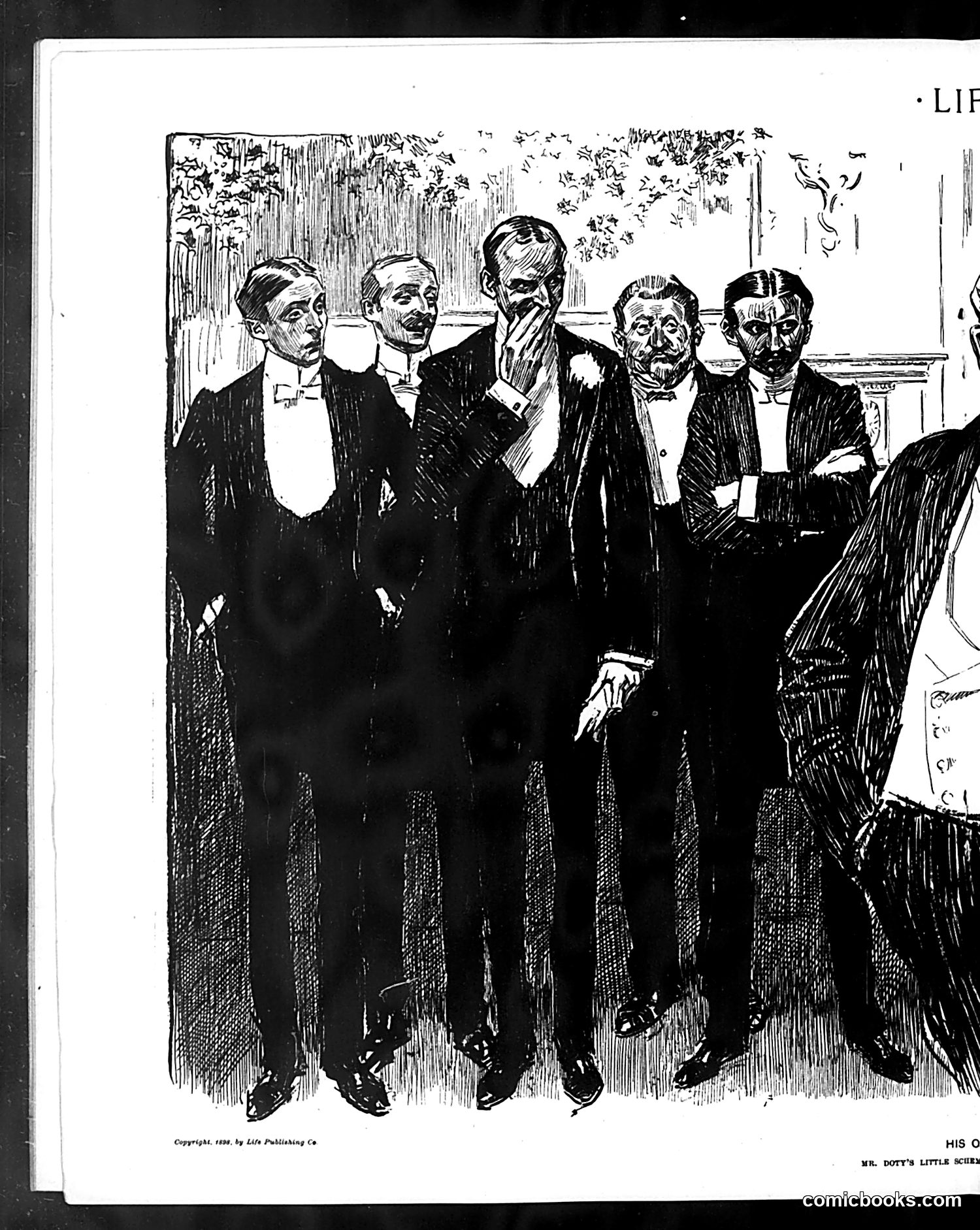
This 1898 Life Magazine illustration depicts five men in formal evening wear (tuxedos) standing together indoors. The caption references "Mr. Doty's Little Schr[eam]" (text appears cut off). Without additional context visible on this page, I cannot definitively identify the specific figures or the particular political/social event being satirized. The formal attire and group composition suggest this comments on a society gathering or political meeting from the 1890s, but the incomplete caption and lack of visible identifying labels or context prevent certain identification of the subjects or the specific satire's point. To accurately explain this cartoon's meaning, I would need either: the complete caption, additional page text, or knowledge of prominent 1898 events involving someone named Doty.
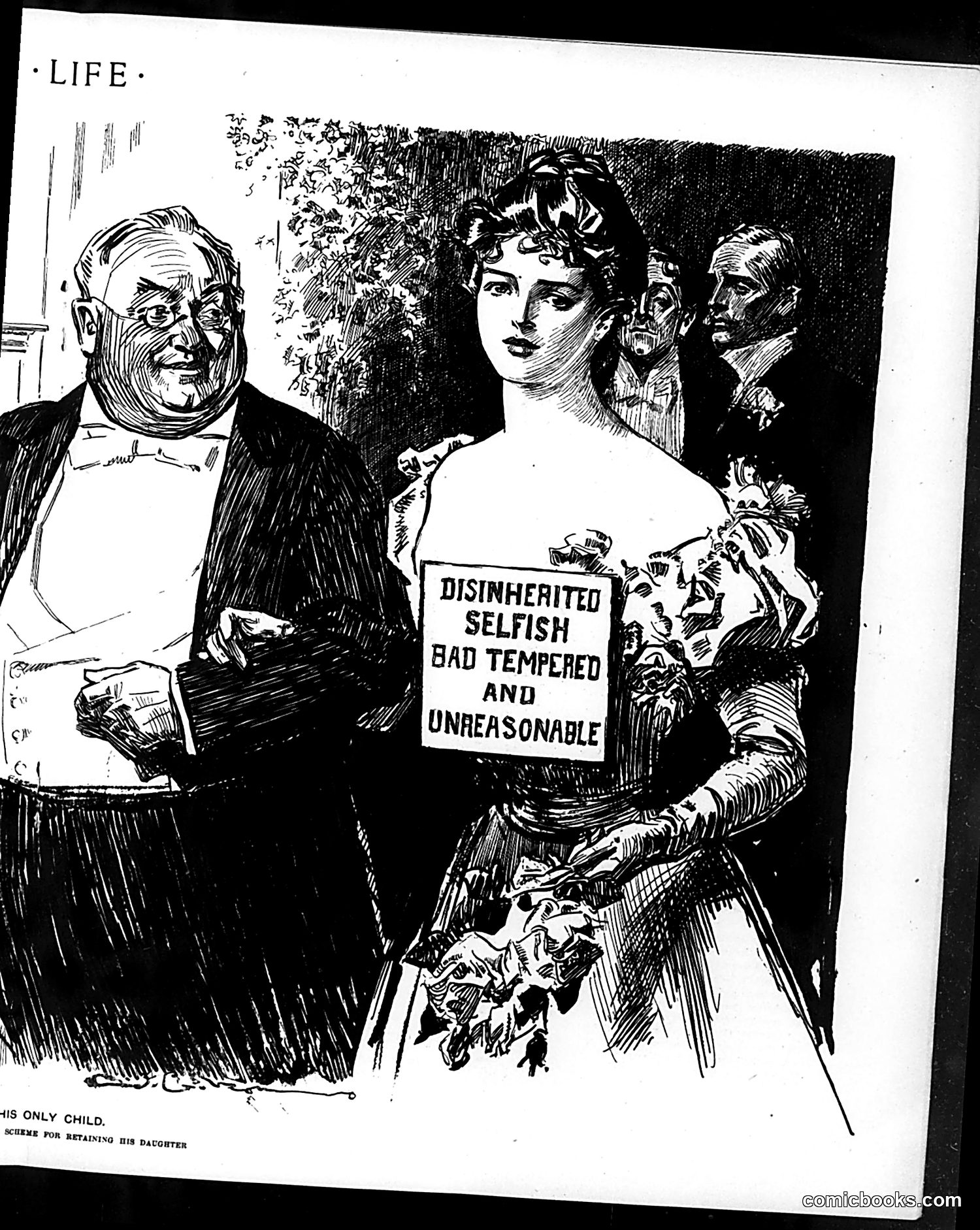
This satirical cartoon critiques a wealthy father's scheme to control his adult daughter through financial manipulation. The label on the woman reads "DISINHERITED / SELFISH / BAD TEMPERED / UNREASONABLE"—character flaws the father has apparently assigned to justify withholding her inheritance. The cartoon mocks the patriarchal practice of using inheritance as leverage to enforce obedience. The woman's "flaws" appear to be her independence and refusal to submit to her father's will. The well-dressed men in formal attire represent the wealthy class protecting their property and family control. The satire targets the hypocrisy of labeling independent women as defective while using financial coercion to maintain paternal dominance over adult children, particularly daughters.
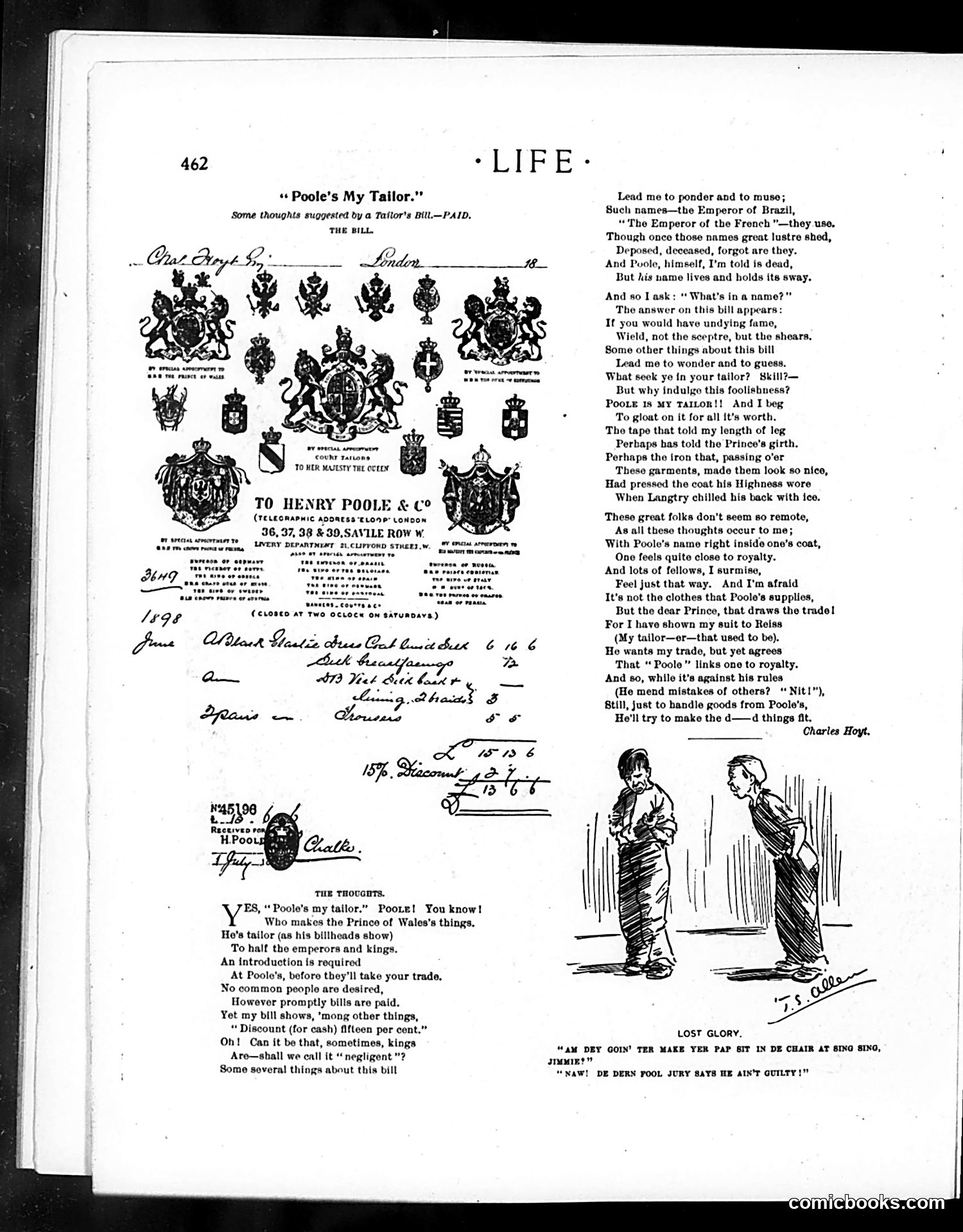
This is social satire by Charles Hoyt about the power of prestigious brand names over actual quality. Henry Poole & Co. was a real, famous Savile Row tailor who dressed royalty and emperors (including the Prince of Wales). The joke: A man receives a tailor's bill from Poole and obsesses over it, not because the clothes are superior, but because owning something with "Poole" in it signals royal connection and status. The bill lists defunct emperors (Brazil, France) as clients—names that "great lustre shed" but whose patronage no longer matters. The satire's point: The tailor's *reputation* (not his skill) sells clothes. Even Poole's competitor tailor Reiss will struggle to fix the garments just to handle Poole's work, hoping the association rubs off. The cartoon illustrates this vanity: a man proudly displays his suit to others. The broader critique targets how people value mere association with the wealthy and powerful over substance.
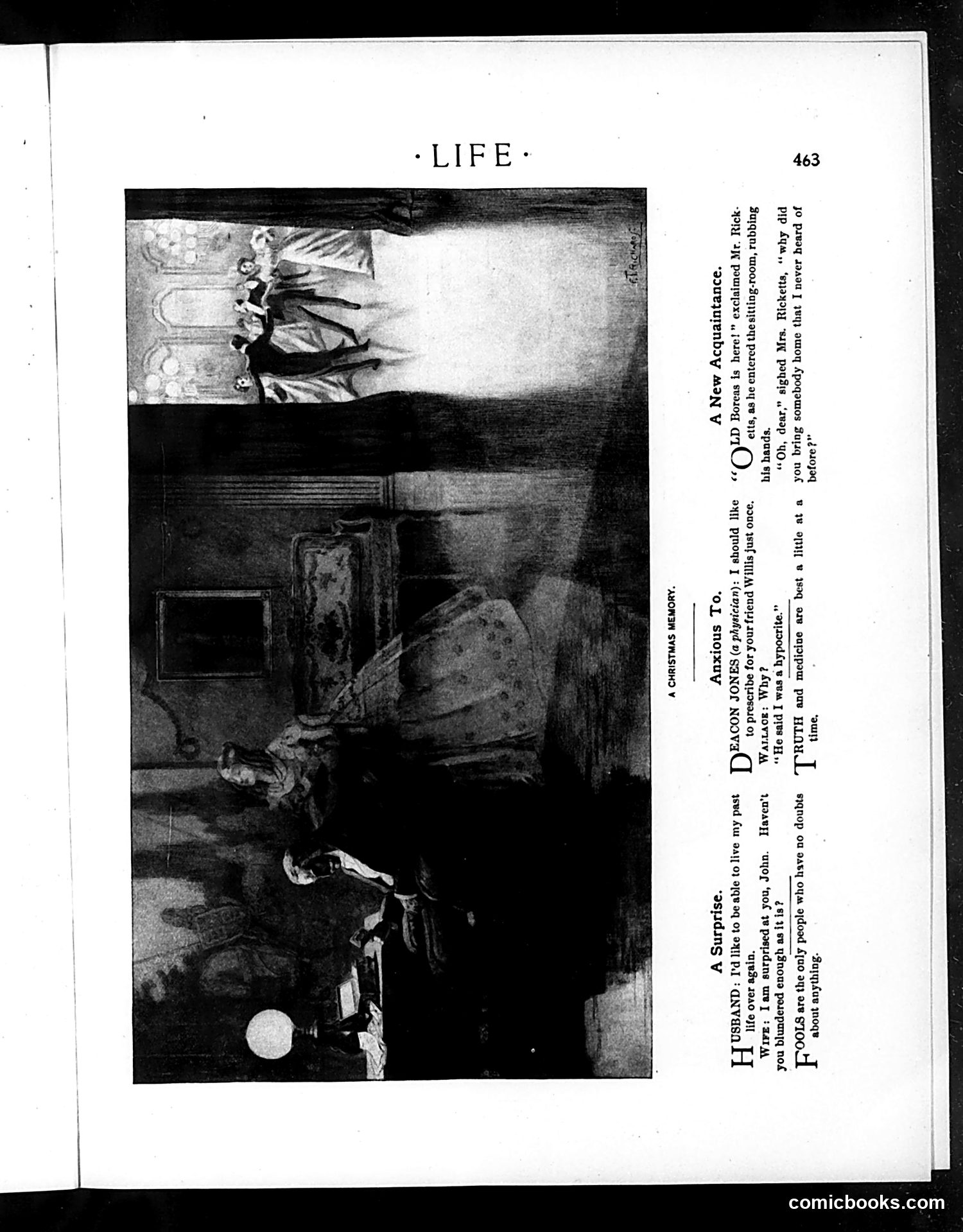
This page from *Life* magazine presents a satirical scene titled "A New Acquaintance." The OCR text is heavily corrupted, making precise dialogue difficult to confirm, but the image shows what appears to be a domestic interior with figures interacting. Based on the visible caption fragments and the cartoon's composition, this appears to be satirizing social awkwardness or an uncomfortable meeting—likely commenting on class differences, social pretension, or an unwelcome introduction between characters. The indoor setting and the figures' body language suggest a comedic social situation meant to ridicule human behavior or social conventions. Without legible OCR text, the specific target of satire remains unclear—it could reference contemporary social figures, types, or situations recognizable to 1920s-era *Life* readers. The humor appears to rely on situational comedy rather than political commentary.
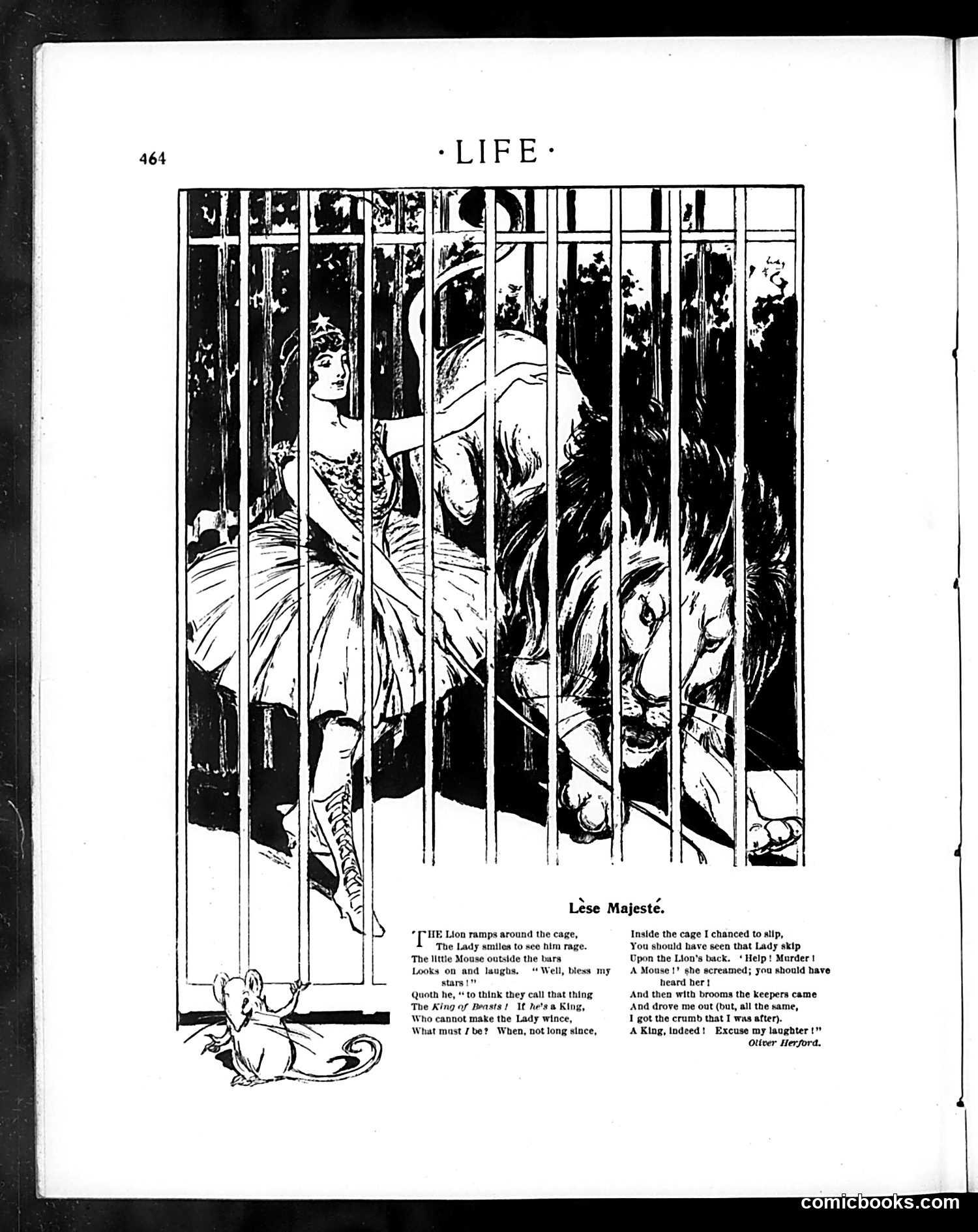
This illustrated poem by Oliver Herford satirizes social hierarchy and pretension through animal characters. A lion (representing authority and nobility—the "King of Beasts") rages impotently in a cage while a lady observes. A mouse outside mocks the scene, noting that if the mighty lion cannot intimidate the lady, what does that make the mouse? The joke inverts expected power: the "king" is caged and powerless; a mere mouse proves braver and more effective (escaping with food). The poem's French title, "Lèse Majeste" (an offense against royal dignity), underscores the irony—the lion's majesty is thoroughly diminished. This reflects early 20th-century humor mocking social pretense: those claiming authority or status are often revealed as ineffectual, while humble underlings succeed through wit and persistence.
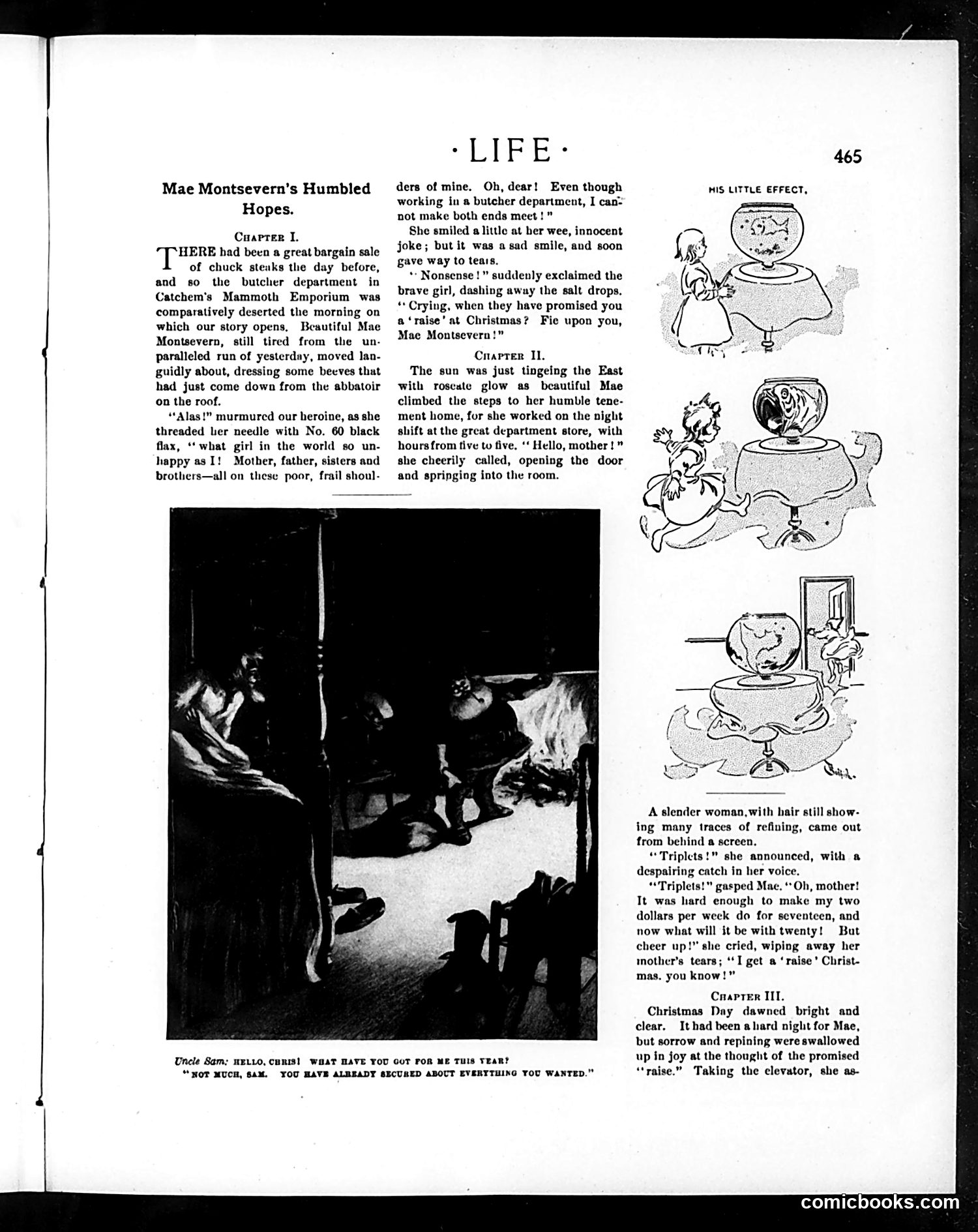
This is a serialized satirical story mocking working-class struggles and empty corporate promises. Mae Montsevern, a butcher-department employee at a large department store, supports a massive impoverished family on meager wages while dreaming of a promised Christmas "raise." The humor lies in the absurdity of her situation: she works the night shift (five to five—likely a joke about long hours), earns only two dollars weekly to support seventeen people, and now expects triplets. The accompanying cartoon shows Uncle Sam telling Christmas he has "already secured about everything you wanted," suggesting the wealthy have monopolized prosperity while workers like Mae receive only hollow promises. The satire critiques early 20th-century labor conditions, corporate exploitation, and the false hope companies dangled before desperate workers during the holiday season.
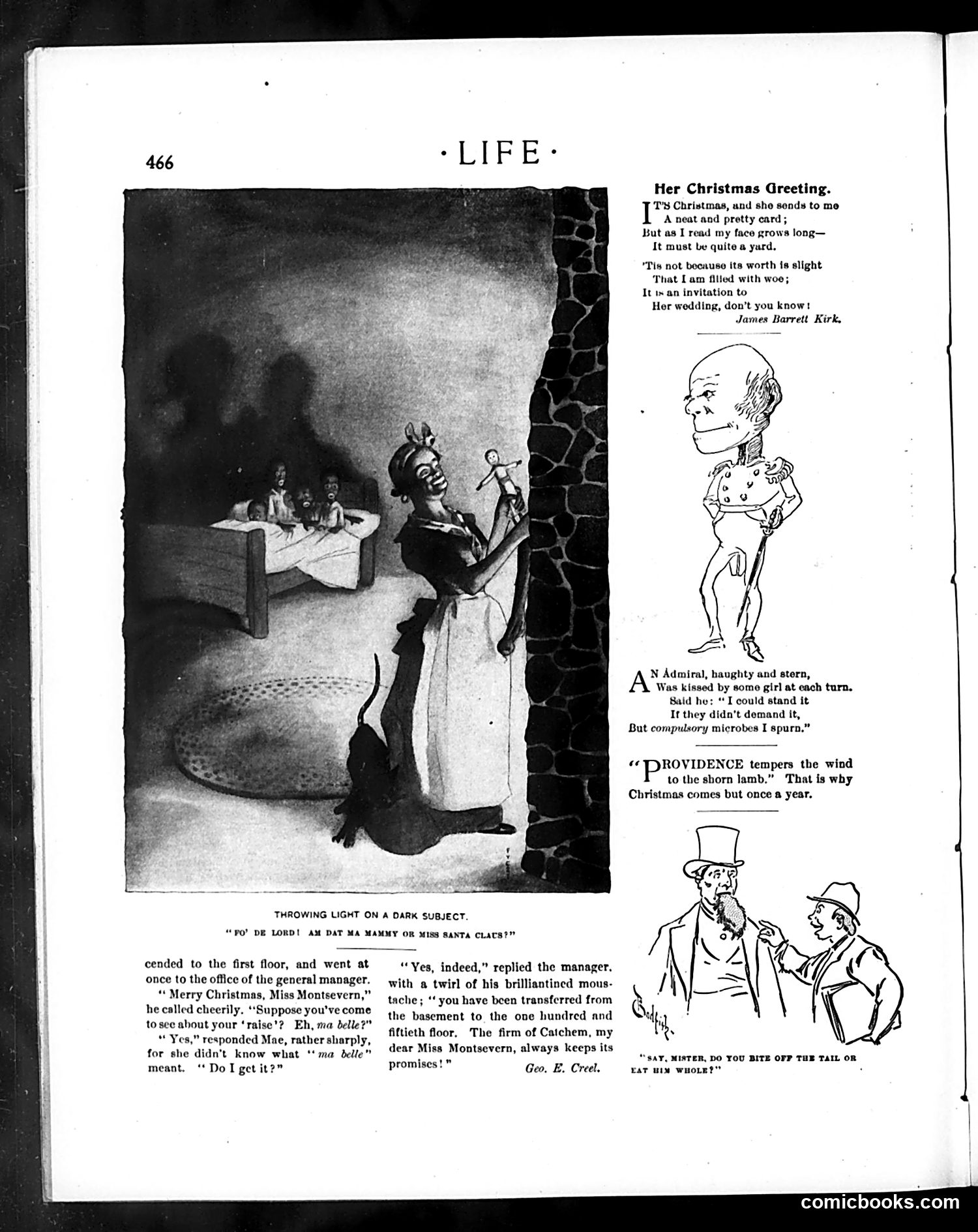
This page contains three satirical pieces from early 20th-century Life magazine: **"Throwing Light on a Dark Subject"** (main illustration): Shows a Black servant recoiling in fear from what appears to be a white figure in white clothing (likely meant to suggest a KKK member), with the caption using heavy dialect stereotyping. The satire appears to mock racist violence and fear, though the execution relies on crude racial caricature typical of the era. **"Her Christmas Greeting"** (verse by James Barrett Kirk): A humorous complaint about receiving an unwanted wedding invitation—the "raise" of expectations is actually a transfer to higher floors (literal rather than financial). **Remaining cartoons**: Include a limerick about an admiral avoiding "compulsory microbes" (possibly venereal disease humor); a quip about Providence and Christmas's rarity; and a joke about eating food (likely ethnic humor based on the illustration style). The page reflects Life's approach: biting social commentary mixed with ethnic stereotyping and crude humor that would be considered offensive today.
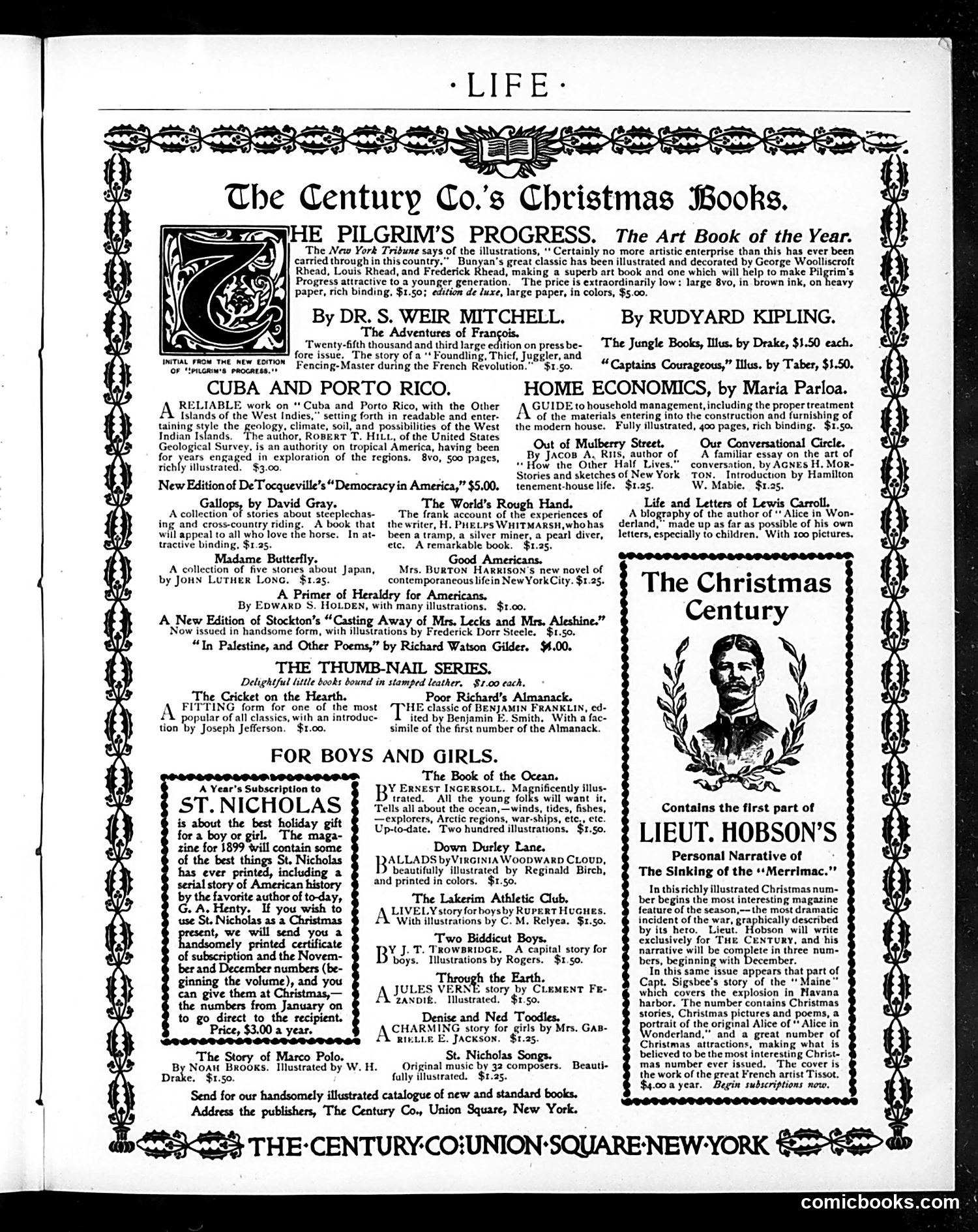
This is primarily a **book advertisement page** from The Century Company publisher, not a political cartoon or satirical content page. The layout announces holiday gift books for 1899. Notable advertised titles include works by **Rudyard Kipling** (*The Jungle Books*, *Captains Courageous*), a new illustrated edition of **Bunyan's *Pilgrim's Progress*** by the Rhead brothers, and **Stockton's *Casting Away of Mrs. Lecks and Mrs. Aleshine***. The right side features "The Christmas Century," prominently displaying **Lieut. Hobson's Personal Narrative of the Sinking of the 'Merrimac'"**—a reference to the Spanish-American War (1898), when Richmond Hobson became famous for attempting to sink a ship to block Santiago harbor. The page targets middle-class gift-givers seeking "extraordinarily low" priced books for children and adults. The St. Nicholas subscription offer ($3.00) emphasizes family reading. No satire is apparent—this is straightforward holiday commerce.
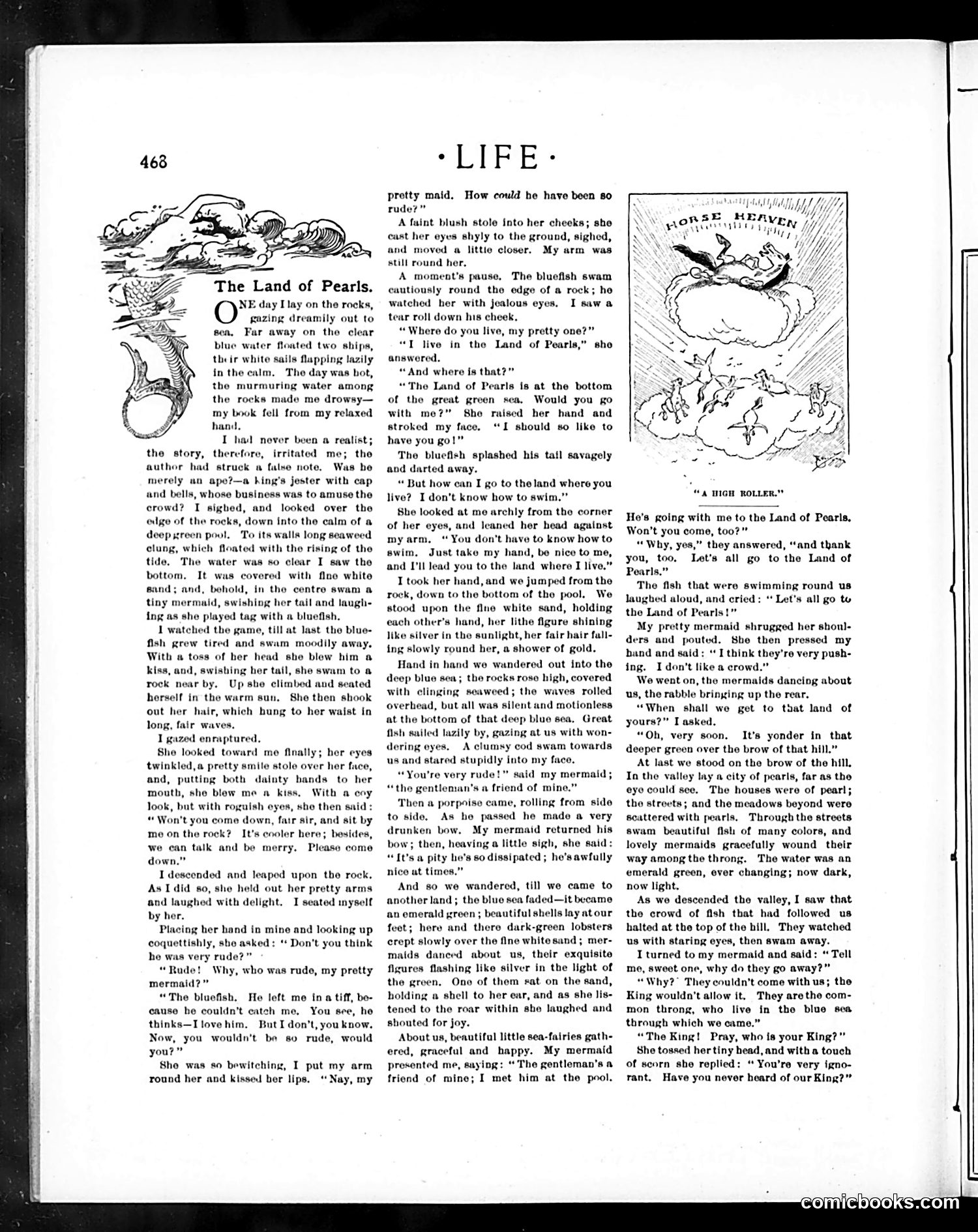
This page presents a romantic fantasy story illustrated with two drawings. The main narrative describes a man who encounters a mermaid while daydreaming by the sea. She invites him to join her in the "Land of Pearls" at the ocean's bottom, and he accepts, jumping into the water with her. The two illustrations support this fantastical tale: the left shows a mermaid in classical style, while the right (labeled "A HIGH ROLLER") depicts a figure ascending toward heaven on clouds—likely representing the narrator's dream-state or imaginative escape. This appears to be escapist fiction typical of *Life* magazine's lighter content—a whimsical, romantic adventure with no apparent political or social satire. The story exemplifies the Victorian/Edwardian taste for mermaid folklore and dreamlike narratives. It serves as entertainment rather than commentary.
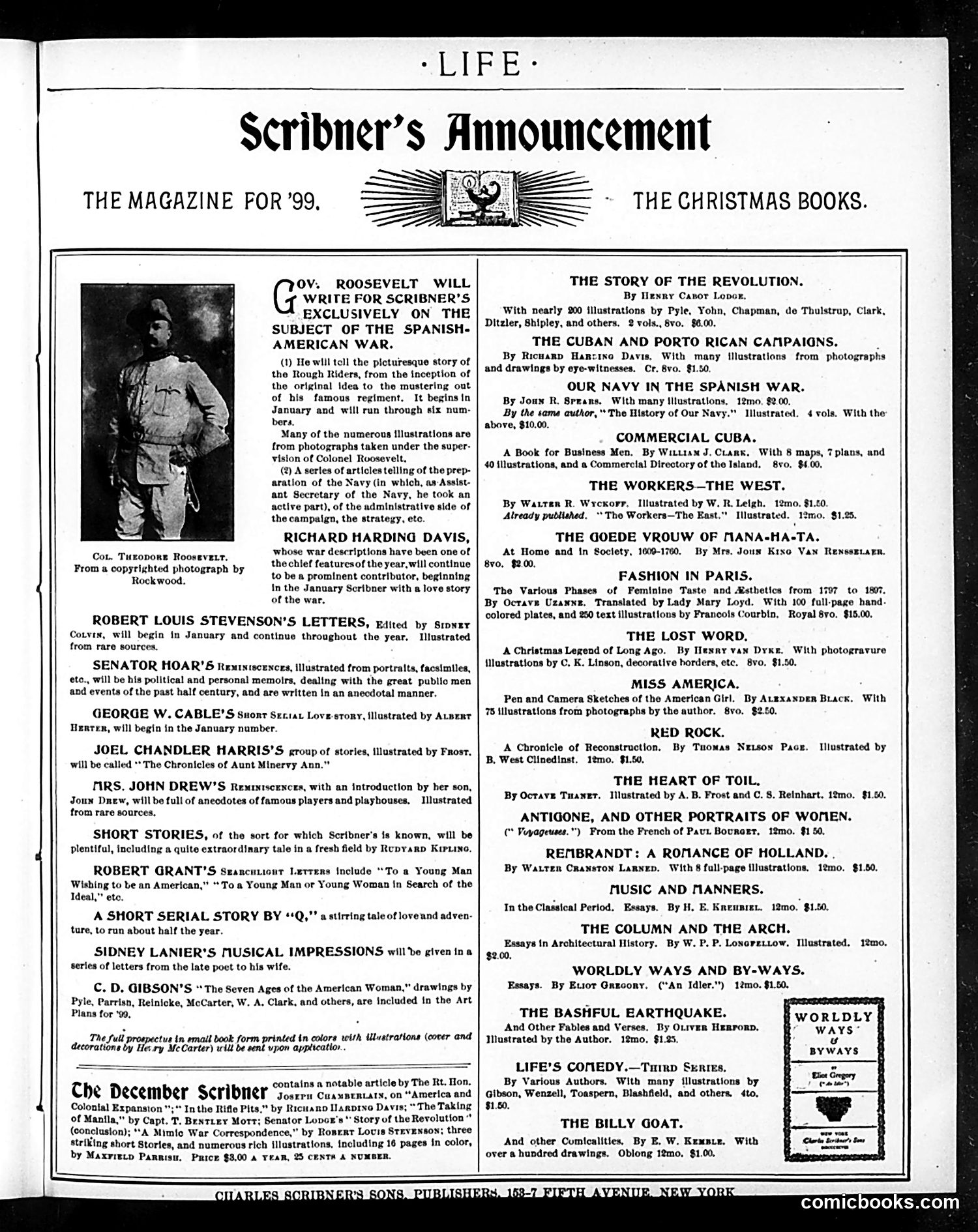
This is primarily a **book advertisement and magazine announcement** rather than a political cartoon. The page announces Scribner's Magazine for 1899 and Christmas book offerings. The notable political content centers on **Theodore Roosevelt**, whose photograph appears prominently. The announcement states Roosevelt will write exclusively for Scribner's about the Spanish-American War (1898)—specifically about the Rough Riders regiment he led and the Navy's role, leveraging his recent fame as a war hero and Assistant Secretary of the Navy. The page emphasizes war-related content generally: war correspondent Richard Harding Davis, Senator Hoar's memoirs, and multiple books about the recent Spanish-American War and its Cuban/Puerto Rican campaigns. **Context for modern readers**: This captures post-1898 America's enthusiasm for Roosevelt and the war, using his celebrity status to promote a magazine. Roosevelt would become President in 1901.
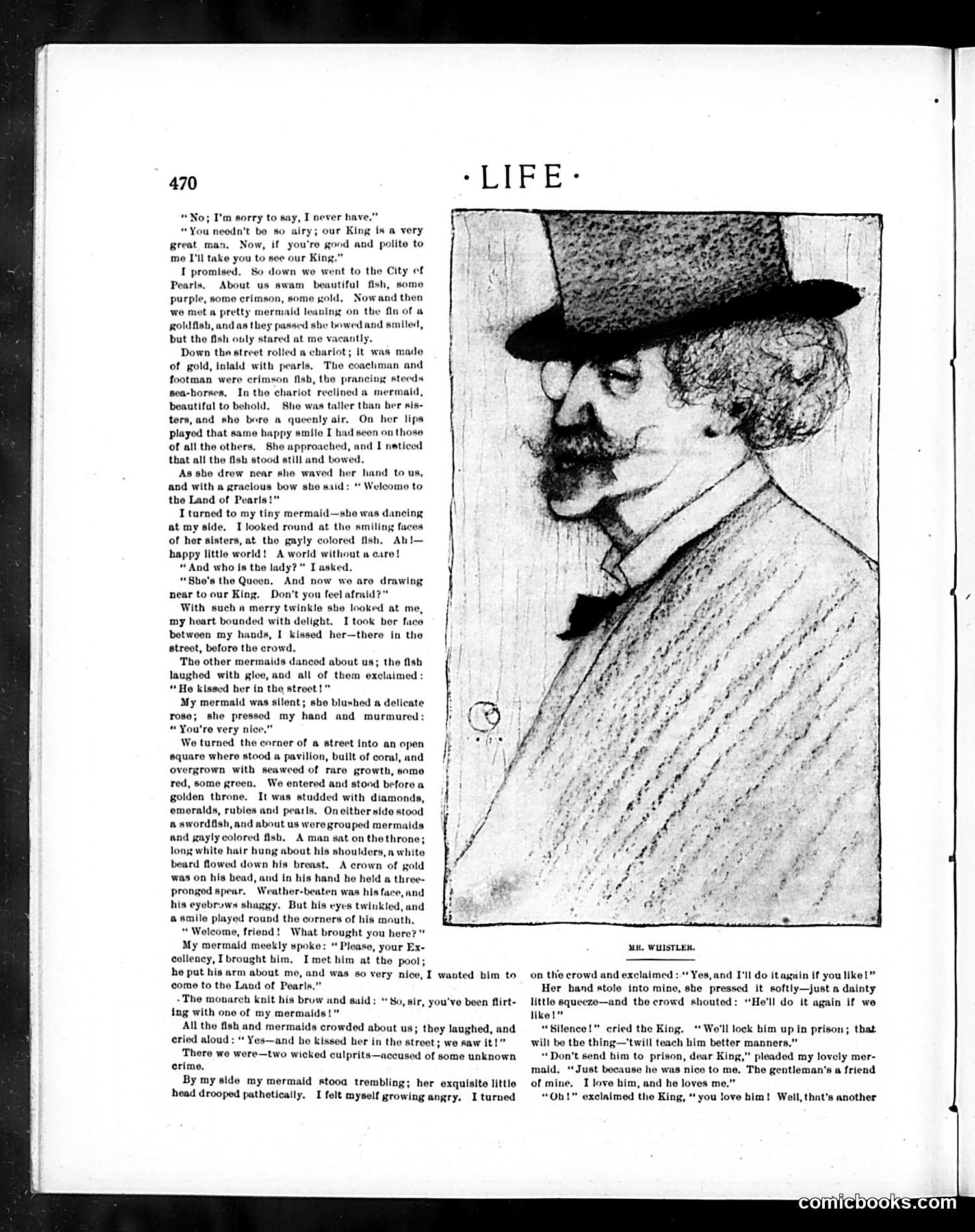
This page depicts a whimsical underwater fantasy narrative illustrated by a caricature labeled "MR. WHISTLER." The image shows an elderly man with flowing white hair and beard, wearing a crown and holding a trident—clearly representing Neptune or an undersea king. The story satirizes romantic transgression and courtly authority. The narrator, visiting an underwater kingdom, falls for a young mermaid and kisses her publicly. This sparks outrage among fish and mermaids who report the scandal to the King. When threatened with imprisonment, the mermaid defends the narrator as a gentleman and declares her love for him. The satire likely targets James McNeill Whistler (1834-1903), the famous American artist known for his eccentric personality and various scandals. The "Mr. Whistler" caption suggests Life magazine is using this fantastical scenario to mock Whistler's reputation and romantic controversies, presenting him as a charming troublemaker who wins sympathy through charisma despite social impropriety—a commentary on his actual public persona and legal disputes.
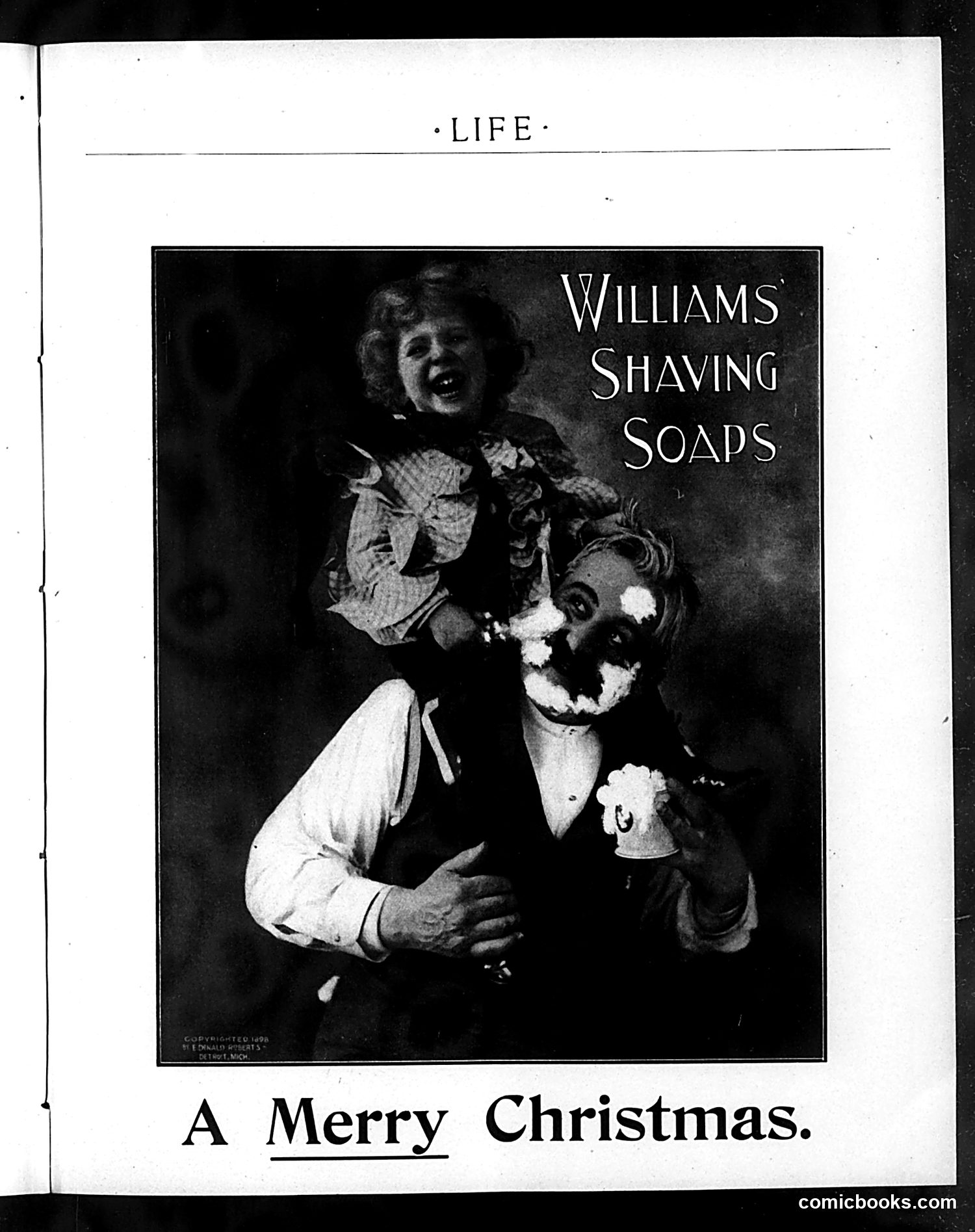
This is a **Christmas advertisement** for Williams Shaving Soaps, not political satire or editorial cartoon. The page features a festive scene showing a woman applying shaving soap to a man's face (creating the white lather visible on his face and hands), while a child watches. The "A Merry Christmas" caption frames this domestic shaving scene as holiday cheer. The advertisement's humor relies on presenting shaving as a wholesome family activity suitable for Christmas celebration. Williams Shaving Soaps uses the holiday season to associate their product with domestic happiness and togetherness. This reflects early 20th-century advertising strategies that linked consumer goods to idealized family moments.
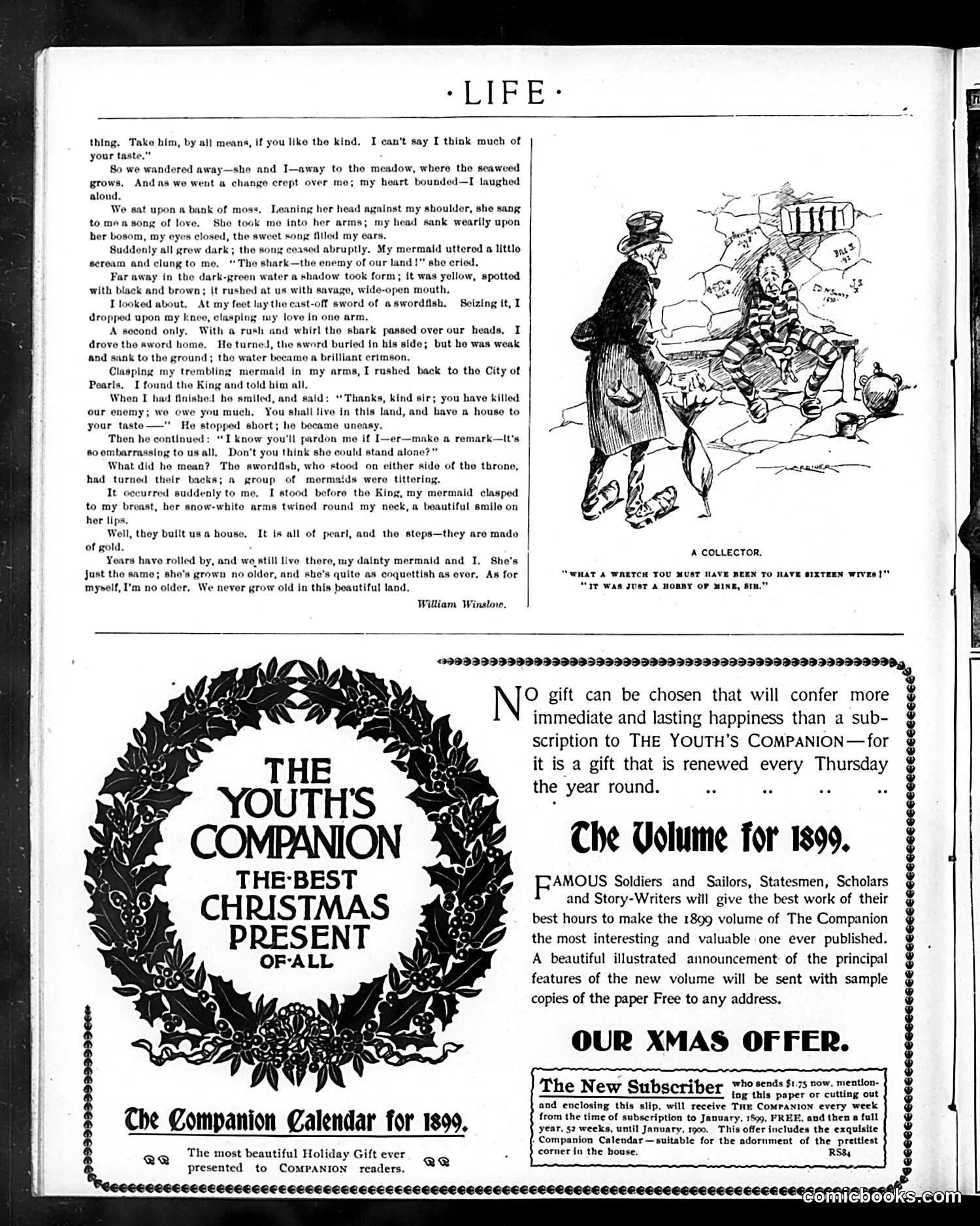
This page contains a romantic fantasy story by William Winslow about a man who falls in love with a mermaid, rescues her from a shark, and marries her—only to face an awkward moment when the King pointedly asks if the mermaid "could stand alone," implying she's dependent and perhaps not a suitable match. The small cartoon titled "A Collector" shows a man claiming his hobby of having "sixteen wives" was "just a hobby"—satire on polygamy or serial marriage, likely mocking wealthy men who collected wives as possessions. The page is primarily **advertising**: the lower half promotes *The Youth's Companion* magazine and subscription offers for 1899, positioning it as an ideal Christmas gift. There is no overt political satire here—this appears to be a leisure/literary page mixed with holiday promotional content typical of late-19th-century magazines.
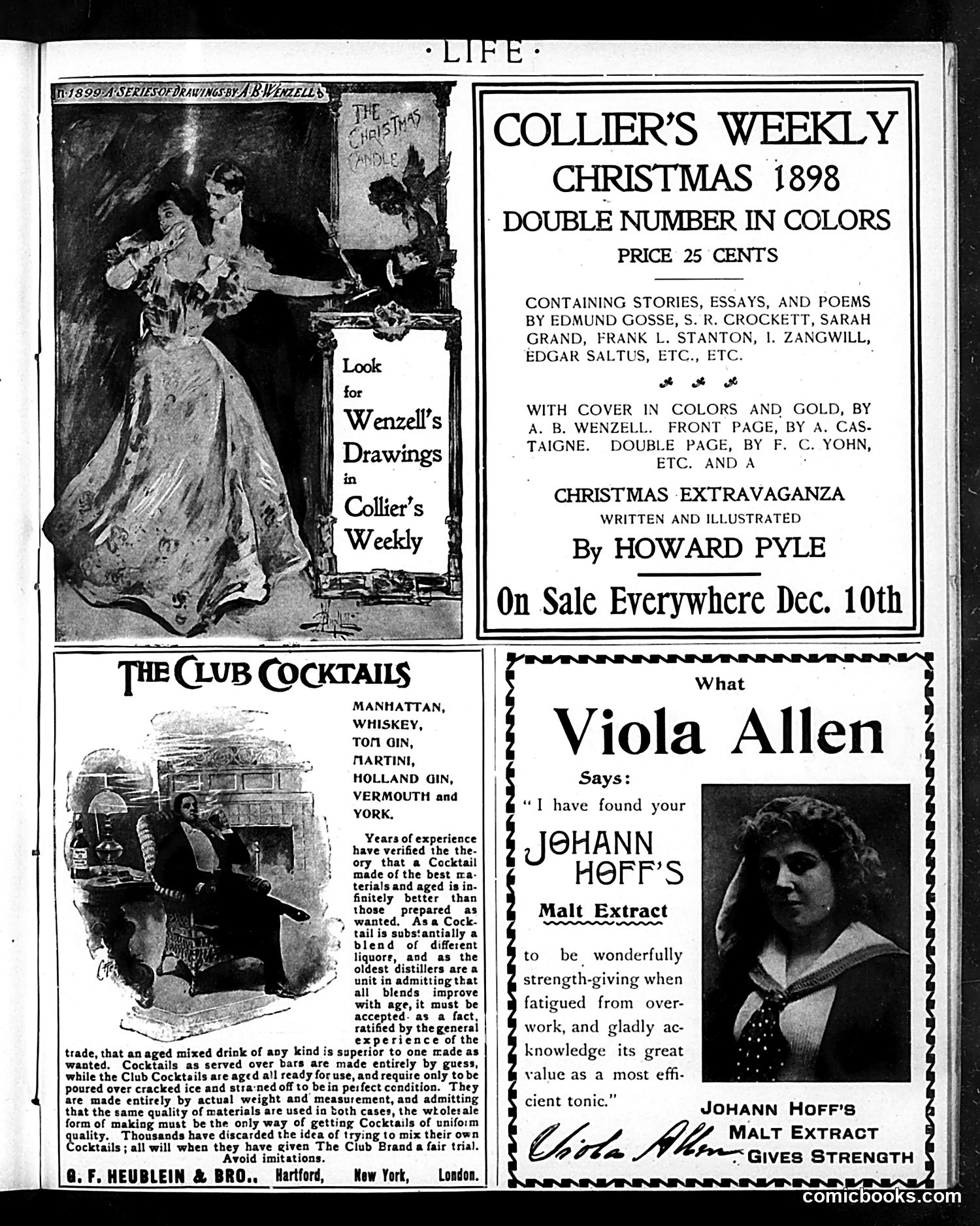
This is primarily a **title/advertisement page** for *Collier's Weekly*'s Christmas 1898 double issue (25 cents), featuring a festive illustration of a woman in an elegant gown by A. B. Wenzell, with a promotional notice for Wenzell's drawings. The page contains **two product advertisements** typical of the era: 1. **Club Cocktails** by G. F. Heublein & Bro.—a lengthy pitch claiming pre-aged cocktails are superior to freshly mixed ones, made with "actual weight and measurement" for consistency. 2. **Johann Hoff's Malt Extract**—endorsed by actress **Viola Allen**, marketed as a strength-giving tonic for fatigue and overwork. Both ads reflect late-Victorian attitudes: cocktails as refined luxury items, and malt extract as a legitimate medicinal/nutritional product (common before modern food regulation). The Viola Allen testimonial leverages celebrity endorsement, a growing advertising strategy. There is **no political satire** on this page—it's commercial promotion.
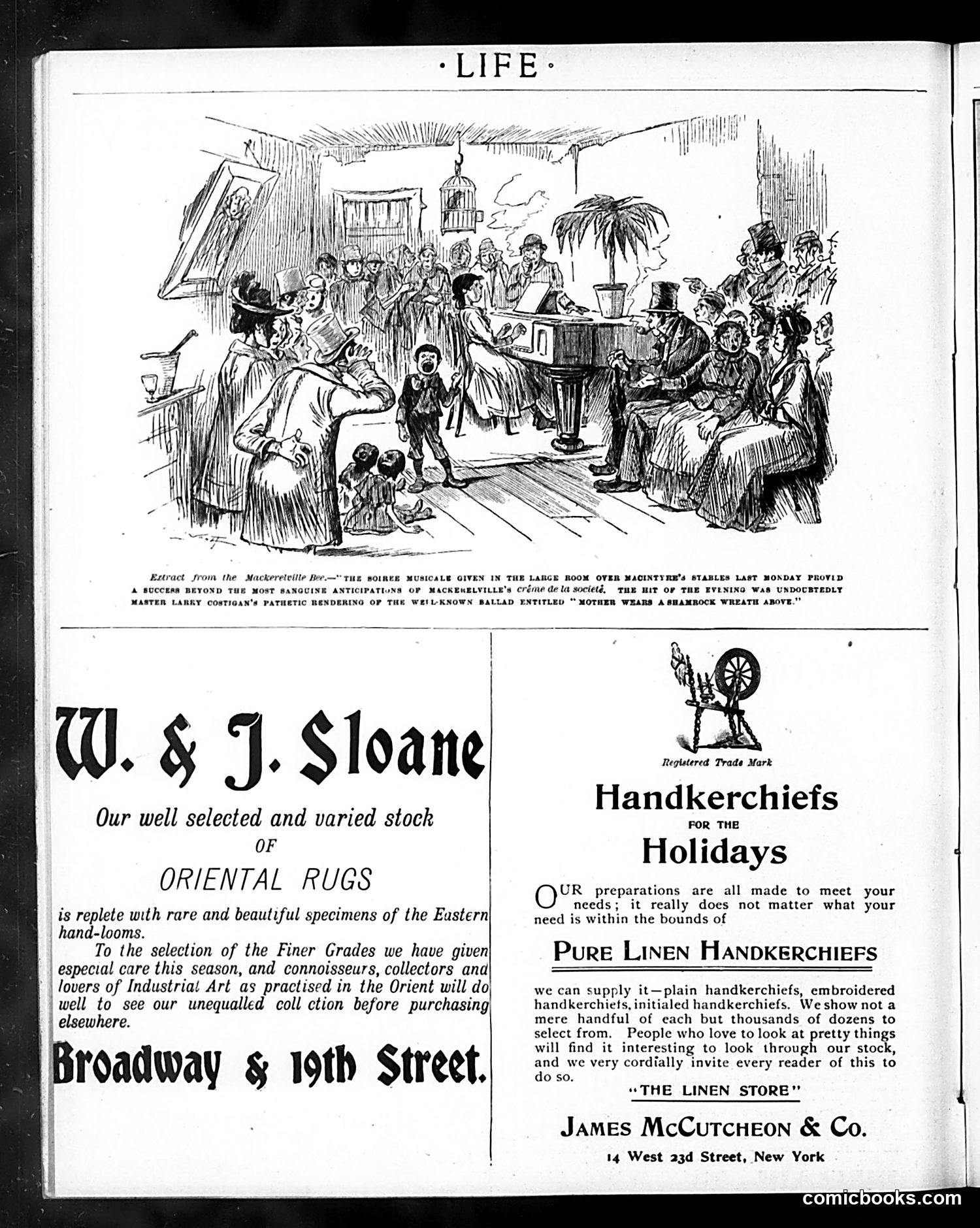
This page combines a satirical sketch with period advertisements. The cartoon depicts "The Soirée Musicale Given in the Large Room Over MacIntyre's Stables," mocking small-town pretension. The scene shows amateur musicians performing for local "society" in what is clearly a humble, makeshift venue—not an elegant concert hall. The satire targets "Mackerelville's *Créme de la société*" (a French phrase humorously applied to this provincial town) and highlights the gap between aspiration and reality. "Master Larry Costigan's" emotional rendition of a sentimental Irish ballad ("Mother Wears a Shamrock Wreath Above") represents the overwrought, melodramatic entertainment typical of such amateur affairs. The accompanying advertisements for Oriental rugs and fine linens contrast sharply with the cartoon's humble setting, emphasizing the irony of provincial social climbing.
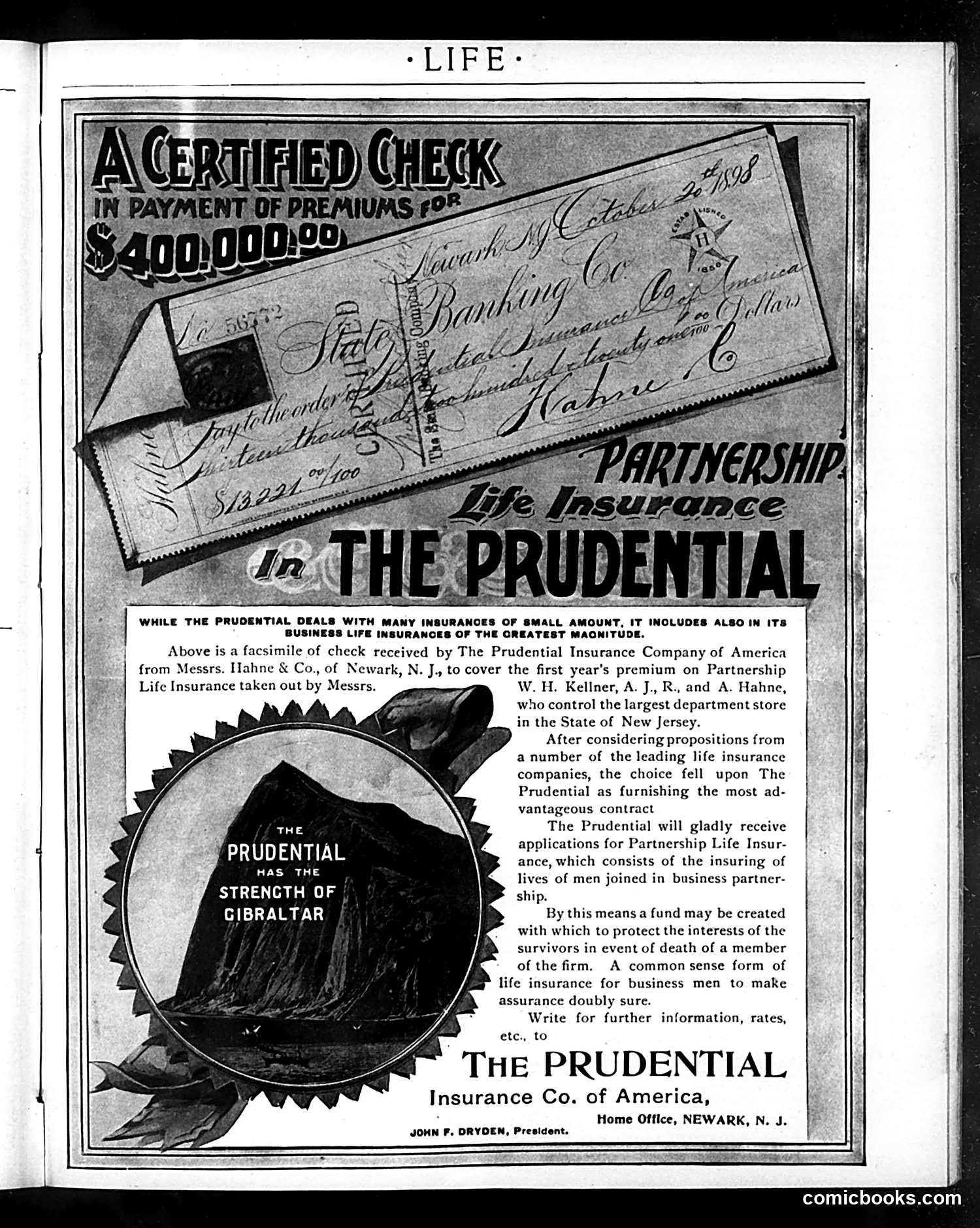
This is **not a cartoon or satire**—it's a straightforward insurance advertisement disguised as editorial content. The Prudential Insurance Company of America is promoting "Partnership Life Insurance" to business owners. The ad uses a facsimile of an actual $400,000 check from Hahne & Co. (a major Newark department store) as proof of the product's legitimacy and appeal. The circular emblem featuring Gibraltar—a symbol of strength and stability—reinforces the company's reliability message. The text explains the practical purpose: business partners can insure each other's lives to create a fund protecting survivors if a partner dies, preventing financial collapse of the firm. This was marketed as "common sense" financial planning for entrepreneurs. The page conflates advertising with journalism—typical of early 20th-century publications where paid ads often appeared editorially formatted to gain credibility.
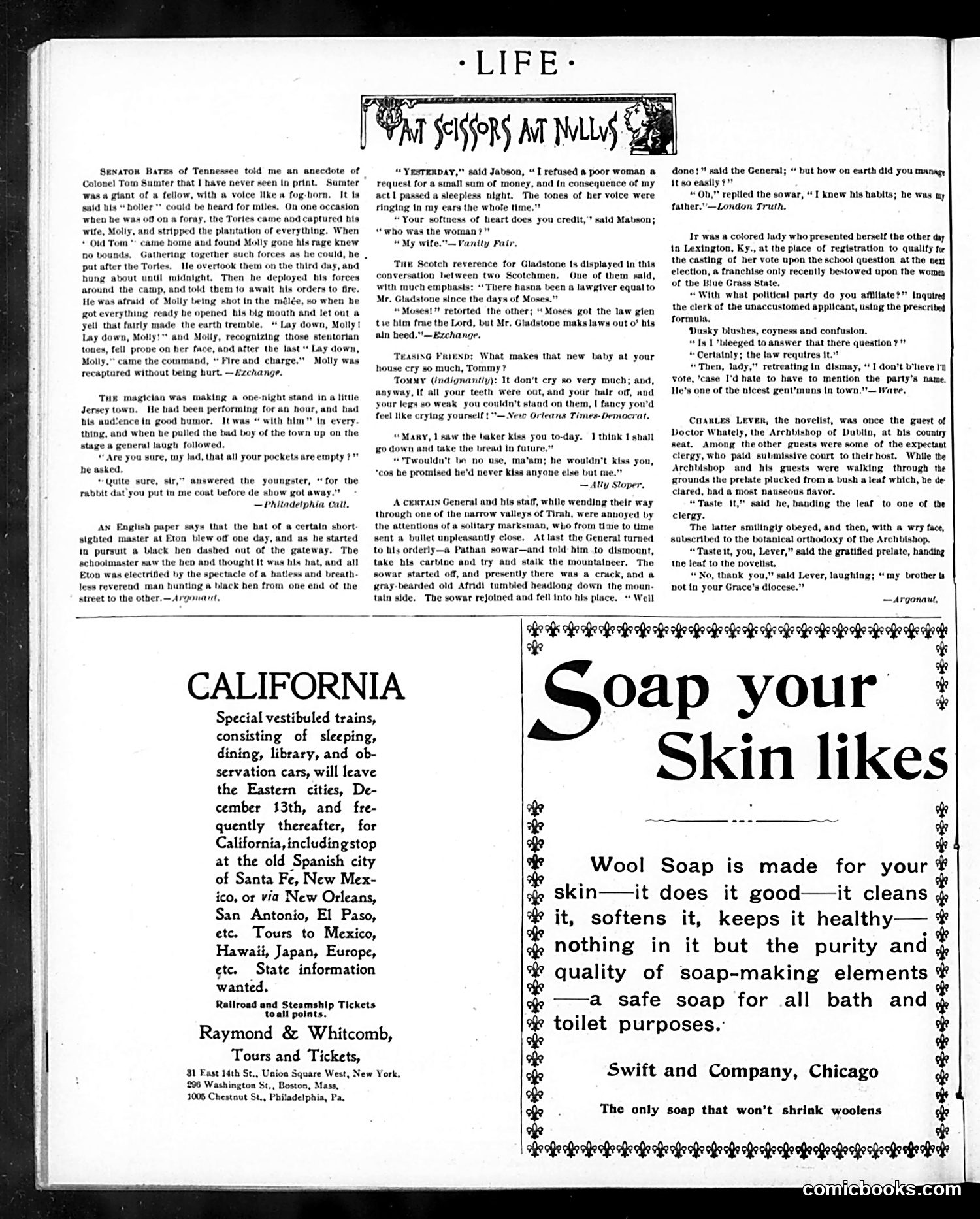
This page from Life magazine (a satirical publication) contains **several brief humorous anecdotes** rather than political cartoons. The humor derives from wordplay, misunderstandings, and character observations typical of early 20th-century American comedy: **Key anecdotes include:** - A Revolutionary War story about Colonel Sumter's loud "holler" rescuing his wife from the British - A magician's trick where a boy claims a rabbit escaped from his pocket before the show - A British schoolmaster chasing a hen, mistaking it for his lost hat - Various domestic and marital humor pieces - A Scottish comparison of Gladstone to Moses (Scottish reverence for the Liberal statesman) The page also features a **Wool Soap advertisement** by Swift and Company, marketing soap as safe for woolens—a significant selling point when wool garments were common and easily damaged. The content reflects period concerns: domestic authority, colonial military pride, and practical household product benefits rather than contemporary social/political critique.
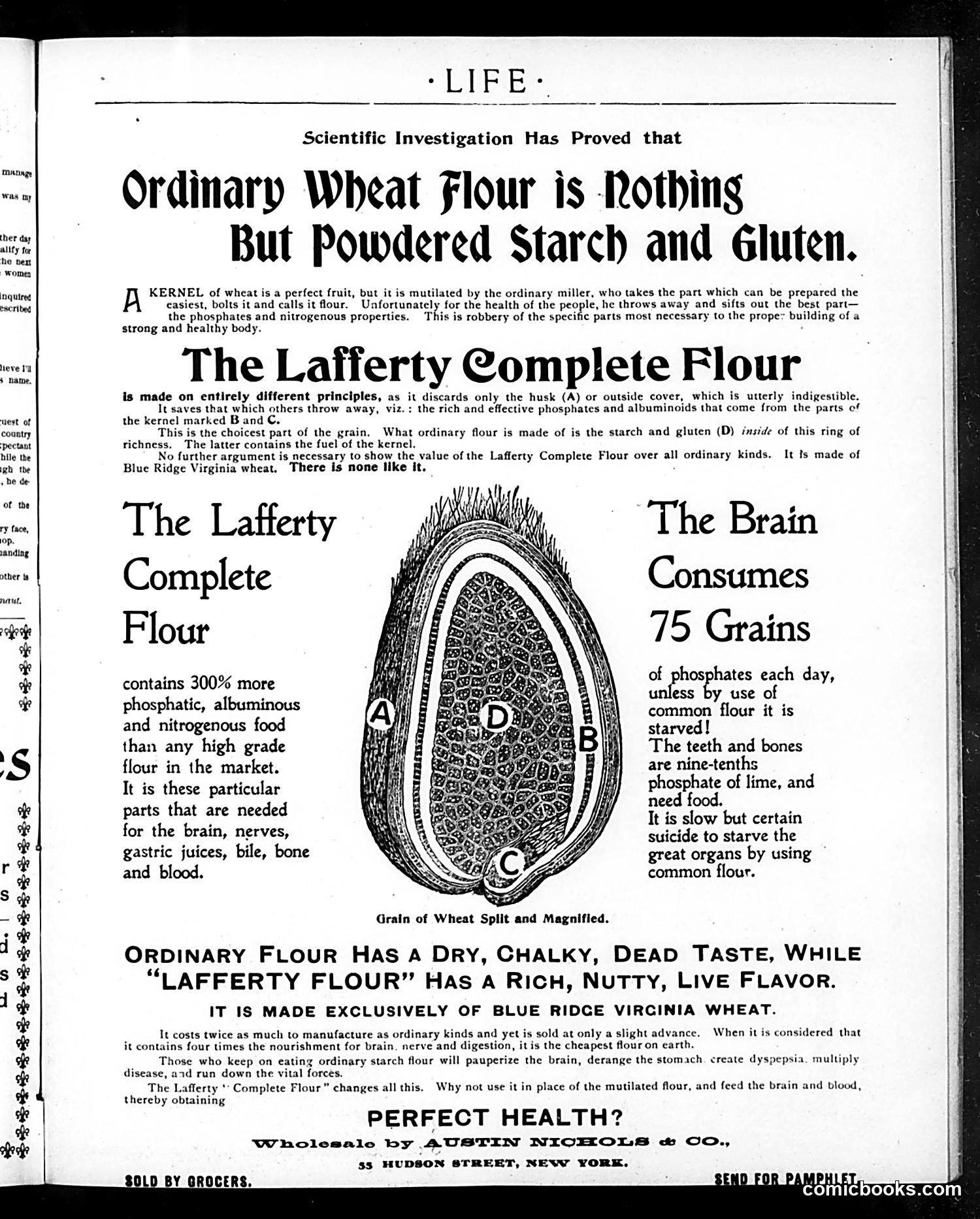
This is **not a cartoon or satire**—it's a **genuine health advertisement** from early-20th-century Life magazine promoting Lafferty Complete Flour. The page reflects real pseudoscientific health claims common in that era. It argues that ordinary wheat flour is nutritionally deficient because mills remove the bran and germ (labeled A, B, C) containing phosphates needed for brain and bone development, leaving only "dead" starch and gluten (D). The diagram of a magnified wheat kernel uses scientific-looking illustrations to legitimize claims that Lafferty's product contains "300% more phosphatic, albuminous and nitrogenous food" and prevents "dyspepsia" and malnutrition. While modern readers recognize this as oversimplified (the removed bran is actually beneficial), the ad reflects genuine early nutritional science debates. Enriched flour became standard only after 1941. The advertisement's breathless tone and health promises typify marketing from an era before FDA regulation of such claims.
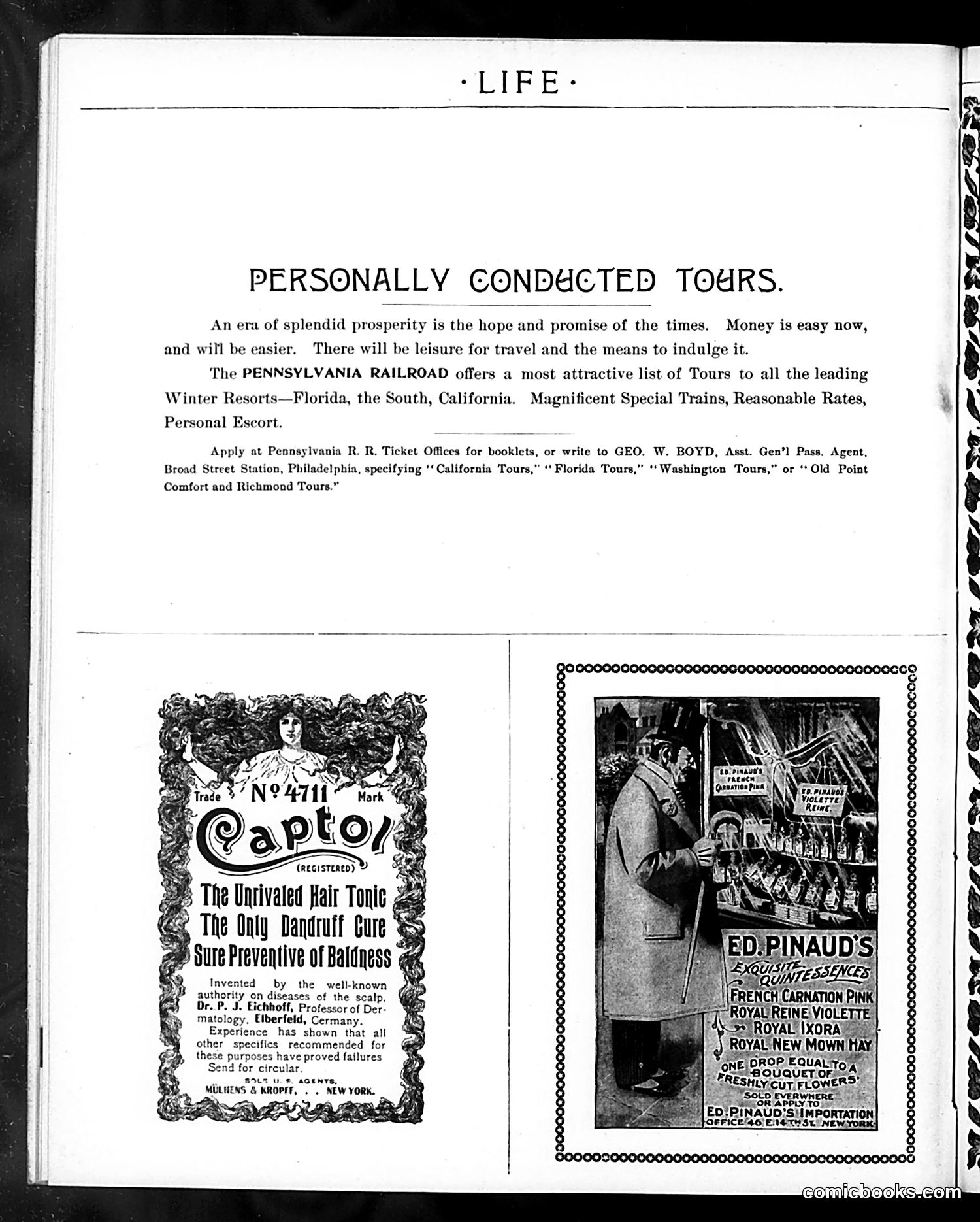
This page primarily consists of **advertisements**, not editorial cartoons or satire. The top section promotes Pennsylvania Railroad "personally conducted tours" to winter destinations (Florida, California, Washington). The text reflects optimistic early-20th-century economic sentiment—"Money is easy now, and will be easier"—targeting affluent travelers with leisure time and disposable income. Below are two product ads: 1. **Captor** hair tonic—claiming to cure dandruff and prevent baldness, invented by a German dermatology professor 2. **Ed. Pinaud's** French beauty products (perfumes, face powders, hair treatments), marketed as luxury imports "sold everywhere" These ads reflect the era's focus on personal grooming and appearance standards, particularly hair care anxieties. The Captor ad's emphasis on a scientific/medical authority reflects period marketing tactics using pseudo-scientific legitimacy. There is **no political satire or cartoon content** on this page.
This is a straightforward **advertisement**, not satire or political content. The American Waltham Watch Company promotes their product in *Life* magazine, likely from the early 1900s. The ad targets consumers directly, instructing them to **demand Waltham watches from jewelers** despite potential sales pressure for competitors. It emphasizes Waltham's market dominance: "the first American company" organized nearly fifty years prior, and currently leading in "quality and volume." The specific pitch highlights the "Riverside" movement as offering **"high quality and medium price"**—a middle-market positioning. The decorative ivy border and formal typography reflect the era's advertising aesthetic. There is **no cartoon or satire** here—simply commercial persuasion typical of early 20th-century magazine advertising, encouraging brand loyalty and direct consumer advocacy.
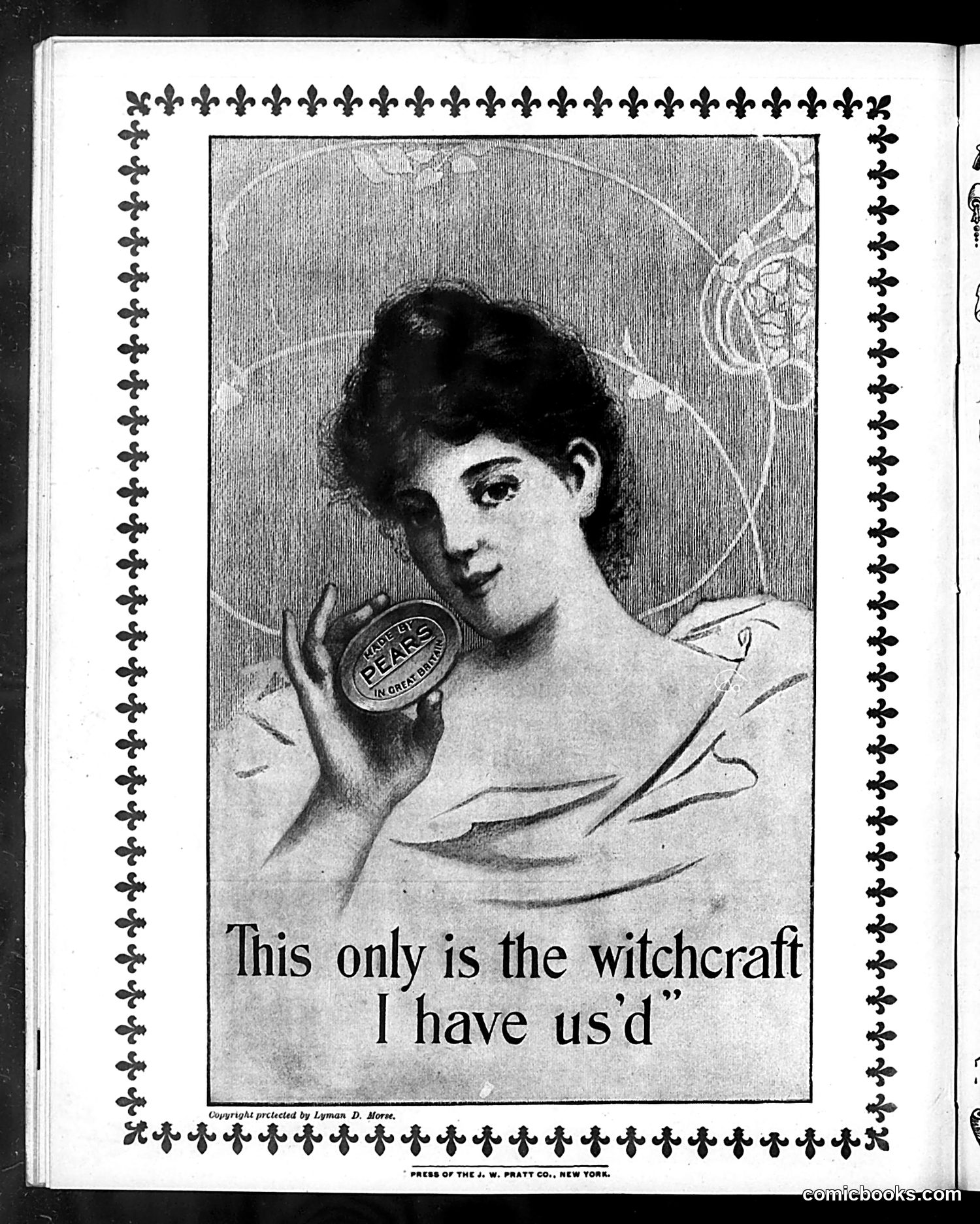
This appears to be an early 20th-century advertisement for a cosmetic or beauty product, likely cold cream or face powder. The image shows a woman holding a jar labeled "SEARS" (partially visible), with the caption "This only is the witchcraft I have us'd." The satire plays on contemporary anxieties about women's cosmetics: the term "witchcraft" humorously references the idea that makeup works like magic to transform appearance. The quote suggests that beauty products—not actual sorcery—are the "secret" to a woman's attractiveness. This reflects the era's tension between traditional views of "natural" beauty and growing acceptance of cosmetics as respectable beauty aids, transforming what was once considered deceptive into normalized self-improvement. The decorative fleur-de-lis border suggests the product's aspirational, elegant positioning.