
Life, 1898-12-03 · page 8 of 40
Life — December 3, 1898 — page 8: what you’re looking at
What you’re looking at
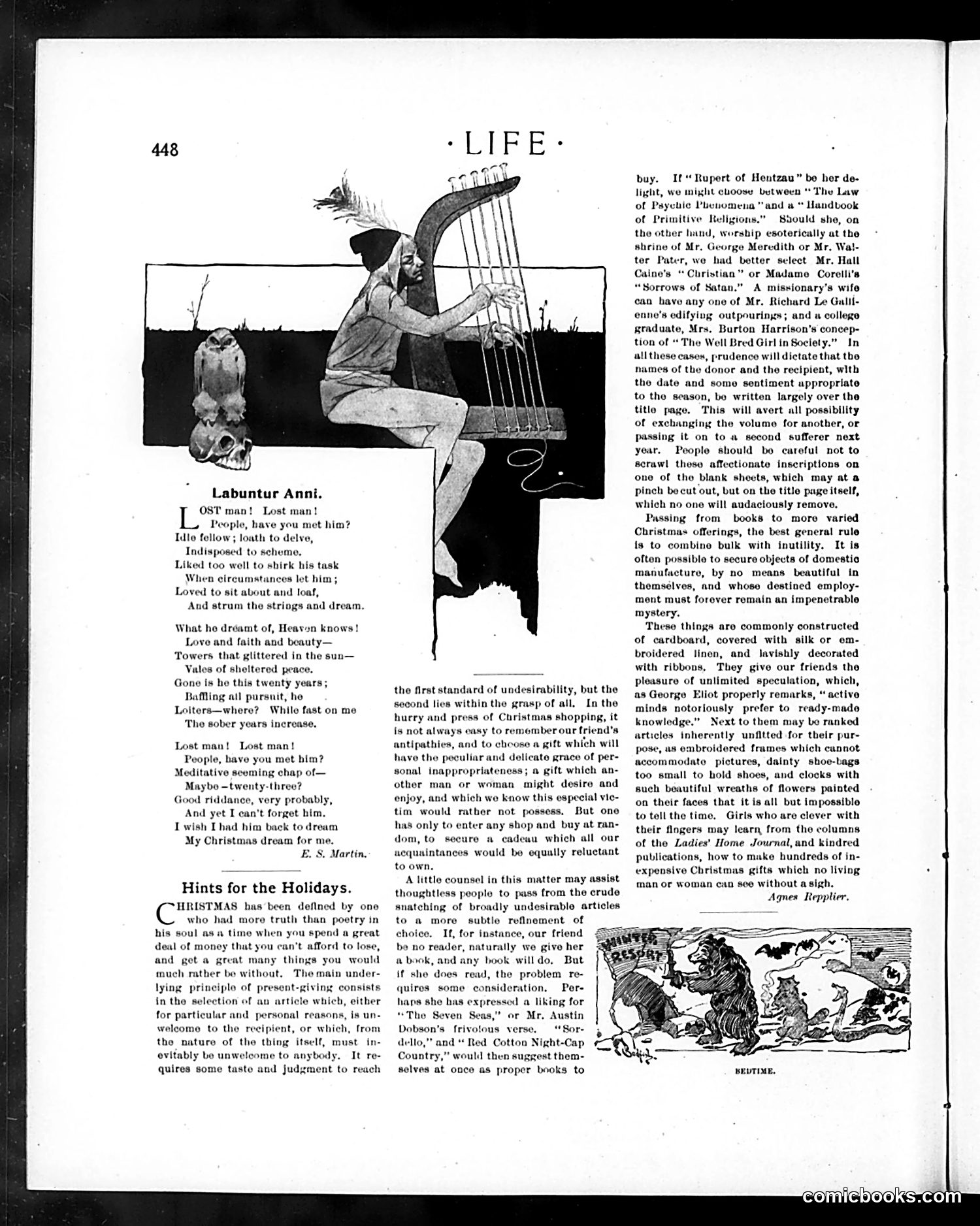
The main illustration shows a melancholic figure seated with a harp, titled "Laburnum Anni" (Latin: "Year of the Laburnum," a flowering shrub). The accompanying poem by F.S. Martin is a sentimental meditation on loss and regret, expressing nostalgia for a lost love or companion. The figure appears to represent a contemplative person reflecting on their 23-year absence from someone. The adjoining "Hints for the Holidays" article addresses Christmas gift-giving etiquette, cautioning readers against giving inappropriate or poorly-chosen presents. It advocates for thoughtful selection—either personal gifts reflecting the recipient's actual interests or practical objects like books. Together, these elements—the melancholic artwork, sentimental verse, and practical holiday advice—represent typical turn-of-the-century *Life* magazine content: blending sentiment, gentle satire, and bourgeois social guidance.
📄 Transcribed text from this page (OCR, searchable)
Machine-transcribed from the original scan — historical spelling and the odd misread are preserved.
Labuntur Anni. OST man! Lost man! People, bave you met him? ule fellow ; loath to delve, Indisposed to scheme. Liked too well to shirk his task When circum: nees let him; Loved to sit about and loaf, And strum the strings and dream. What ho dreamt of, Heaven knows! Love and faith and beauty— Towers that glittered in the sun— Vales of sheltered peace. Gono is he this twenty years; BaMing all pursuit, ho Loiters—where? While fast on mo ‘Tho sober years increase. Lost man! Lost man! People, bave you met bim? Meditative seeming chap of— Maybo —twenty-three? Good riddance, very probably, And yet I can’t forget him. I wish Thad him back to dream My Christmas dream for me. E, 8. Martin, Hints for the Holidays. HRISTMAS has been deflned by one who had more truth than poetry in his soul a8 a time when you spend a great deal of money that you can’t afford to lose, and get a great many things you would much rather be without. ‘The main under- lying principle of present-giving consists in tho selection of an article which, either for particular and personal reasons, is un- welcome to the recipient, or which, from tho nature of the thing itself, must in- ovitably bo unwelcome to anybody, It re- quires some taste and judgment to reach the first standard of undesirability, but the second lies within the grasp of all, In the hurry and press of Christmas shopping, it is not always easy to remember our friend's antipathies, and to choose a gift which will ave the peculiar and delicate grace of per- sonal inappropriatencss; a gift which an- other man or woman might desire and enjoy, and which we know this especial vic- tim would rather not possess, But one only to enter any shop and buy at ran- dom, to secure a cadeau which all our acquaintances would be equally reluctant to own, A little counsel in this matter may assist thoughtless people to pass from the crude snatching of broadly undesirable articles to a more subtle reflnement of choice. If, for instance, our friend be no reader, naturally we give her a book, and any book willdo, But if she does read, the problem re- quires some consideration, Per= hans she bas expressed a liking for “The Seven Seas,” or Mr. Austin Dobson’s frivolous verse. “Sor- dello,” and “ Red Cotton Night-Cap Country,” would then suggest them- selves at once as proper books to buy. If“ Rupert of Hentzau” bo her de- light, we mixht choose between * The Law of Psychic Pucnomena "and a “ Handbook of Primitive Religions.” SBao0uld she, on the other hand, worship esoterically at the shrine of Mr. George Meredith or Mr. Wal- ter Pater, we had better select Mr. Hall Caine’s “Christian” or Madame Corelli's orrows of Satan.” A missionary’s wife can bave any one of Mr. Richard Le Galll- enne’s edifying outpourings; and a college graduate, Mrs, Burton Harrison's concep- tion of “ The Well Bred Girl in Society.” In. all these cases, prudence will dictate that the names of the donor and the recipient, with tho date and some sentiment appropriate to the season, be written largely over the title page. This will avert all possibility of exchanging the volumo for another, or passing it on to a second sufferer next year. People should bo careful not to scrawl these affectionate inscriptions on one of the blank sheets, which may at a pinch becut out, but on the title page itself, which no one will audaciously remove, Passing from books to moro varied Christmas offerings, the best general rule is to combine bulk with inutility, It is often possible to secure objects of domestic manufacture, by no means beautiful in themselves, and whose destined employ- ment must forever remain an impenetrable mystery. ‘These things are commonly constructed of cardboard, covered with silk or em- broidered linen, and lavishly decorated with ribbons, They give our friends the pleasure of unlimited speculation, which, as George Eliot properly remarks, “ active minds notoriously prefer to ready-mado knowledge.” Next to them may be ranked articles inherently unfitted for their pur- pose, as embroidered frames which cannot accommodate pictures, dainty shoe-bags too small to hold shoes, and clocks with such beautiful wreaths of flowers painted on their faces that it is all but impossible to tell the time, Girls who are clever with their flagers may learn from the columns of the Ladies’ Home Journal, and kindred publications, how to make hundreds of in- expensive Christmas gifts which no living man or woman can see without a sigh, Agnes Repplier. BEUTIME.