
Life, 1898-12-03 · page 13 of 40
Life — December 3, 1898 — page 13: what you’re looking at
What you’re looking at
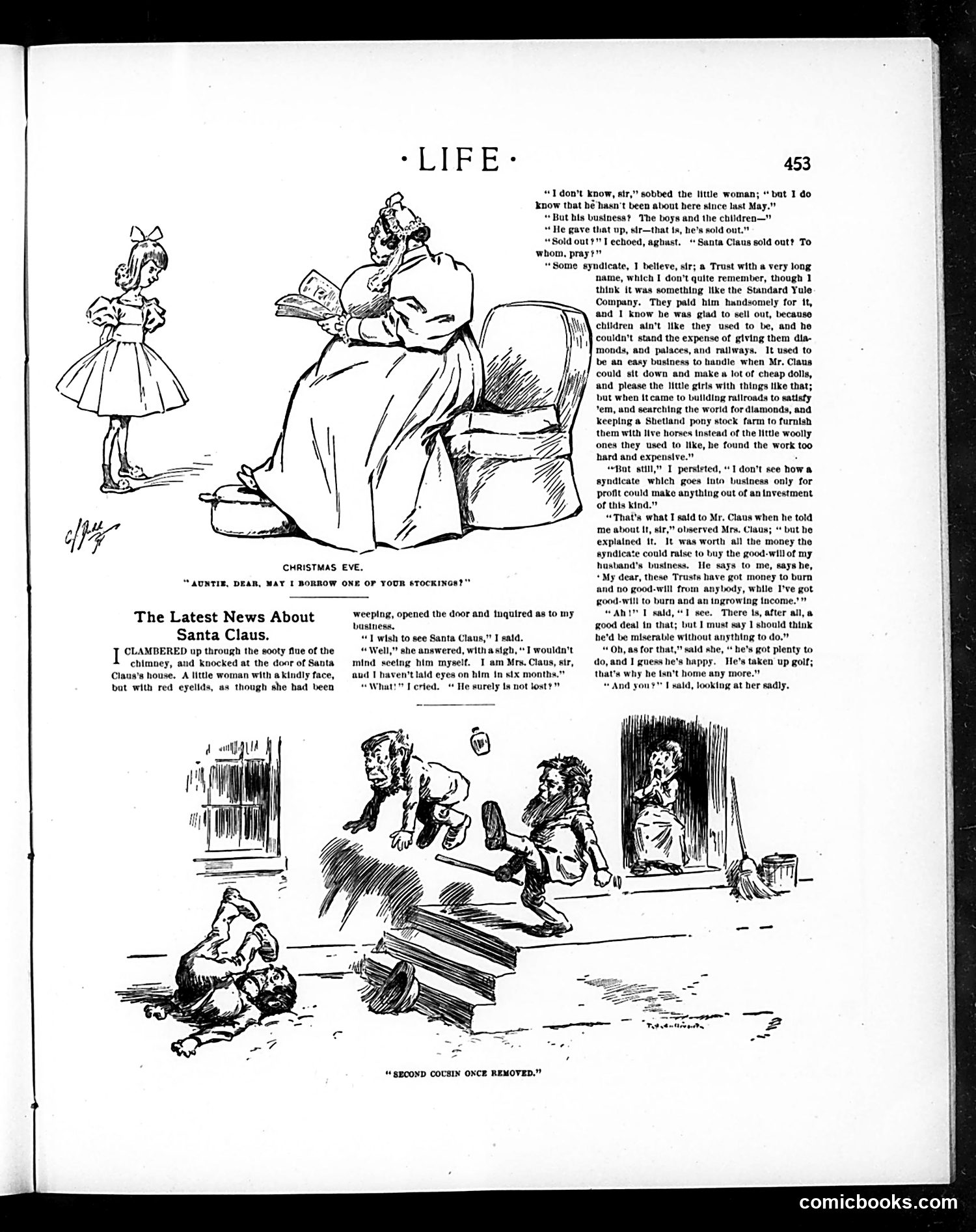
This is a satirical story attacking the rise of corporate trusts and syndicates in the Gilded Age. Santa Claus represents traditional American values and small business; the "Trust" represents the new monopolistic corporations consolidating commerce. The joke: Santa has sold his business to a profit-driven syndicate because modern children's expectations have become impossibly expensive (railroads, diamonds, live ponies instead of cheap toys). The syndicate bought his "good-will"—his reputation and customer loyalty—to exploit it for profit, while Santa himself is now idle, playing golf. The satire critiques both corporate greed and the commercialization of Christmas, lamenting lost simplicity and tradition. Mrs. Claus's sadness suggests the human cost of industrialization and consolidation. The lower cartoons appear to show domestic chaos (possibly depicting the disruption modern life causes to families).
📄 Transcribed text from this page (OCR, searchable)
Machine-transcribed from the original scan — historical spelling and the odd misread are preserved.
453 “1 don’t know, sir,” sobbed the little woman; “ bat I do know that bé hasn't been about here since last May.” “ But his business? The boys and the children—" He gave that up, sir—that 1s, he’s sold out.” “Sold out?" T echoed, aghust. “+ Santa Claus sold out? To whom, pray?" “Some syndicate, 1 belleve, sir; a Trust with a very long CHRISTMAS EVE, “ AUNTIE, DEAR, MAY I BORROW ONE OF YOUR STOCKINGS?” The Latest News About Santa Claus. ] CUAMBERED up through the sooty fue of the chimney, and knocked at the door of Santa Claus’s house, A little woman with a kindly face, bat with red eyelids, as though she had been weeping, opened the door and inquired as to my business. +1 wish to see Santa Claus,” I sald. “Well,” she answered, with asigh, "I wouldn't mind seeing him myself. I am Mrs. Claus, sir, aud I haven't laid eyes on him tn six months.” “What!” Leried. He surely 1s not lost? e “SECOND COUSIN ONCE REMOVED.” name, which I don’t quite remember, though 1 think it was something like the Standard Yule Company. They patd him handsomely for tt, and I know be was glad to sell out, because children ain't lke they used to be, and he couldn't stand the expense of giving them dia- monds, and palaces, and railways, It used to be an easy business to handle when Mr, Claus could sit down and make a lot of cheap dolls, and please the little girls with things like that; but when it came to bullding railroads to satisfy ‘em, and searching the world for diamonds, and Keeping a Shetland pony stock farm to furnish them with live horses instead of the tte woolly ones they used to Itke, he found the work too hard and expensive.” 5 “Tot still,” I persteted, “I don't see how a syndicate which goes Inte business only for profit could make anything out of an investment of this kind.” “That's what I sald to Mr. Claus when he told me about It, sir,” observed Mrs. Claus; “ but he explained it. It was worth all the money the ayndicate could raise to buy the good-will of my husband's business, He says to me, says he, +My dear, these Trusts have got money to burn and no good-will from anybody, while I've got good-will to burn and an ingrowing tncome.’” “AnI” 1 sald, “I see. There ts, after all, good deal in that; but I must say 1 shonld think he'd be miserable without anything to do.” “Oh, as for that,” sald xhe, * he's got plenty to do, and I guess he's happy. He's taken up golf; that's why he isn’t home any more.” * And you?" I sald, looking at her sadly, comicbooks.com