
A complete issue · 20 pages · 1898
Life — September 8, 1898
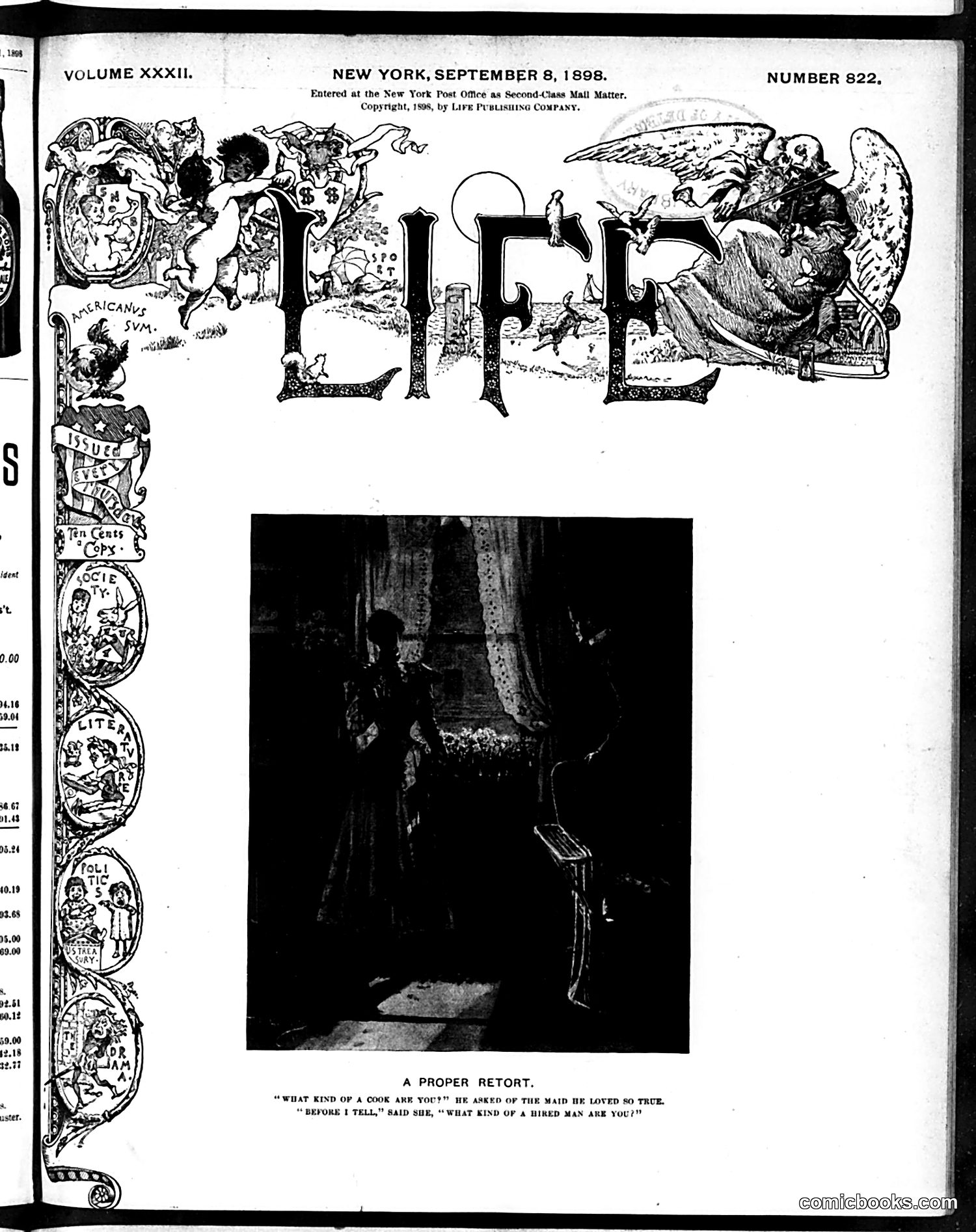
This page features "A Proper Retort," a photographic illustration with satirical caption. The image shows two figures in what appears to be a domestic interior scene. The caption reads: "What kind of a cook are you?" he asked of the maid he loved so true. "Before I tell," said she, "What kind of a hired man are you?" This is a romantic/comedic exchange playing on class dynamics and gender roles of the 1890s. The "retort" humor relies on the maid turning the employer's critical question back on the hired man—a working-class romantic scenario where the maid witty deflects criticism by questioning his own competence. The joke reflects period anxieties about servant relationships and domestic hierarchies, presented as lighthearted banter between working-class characters.
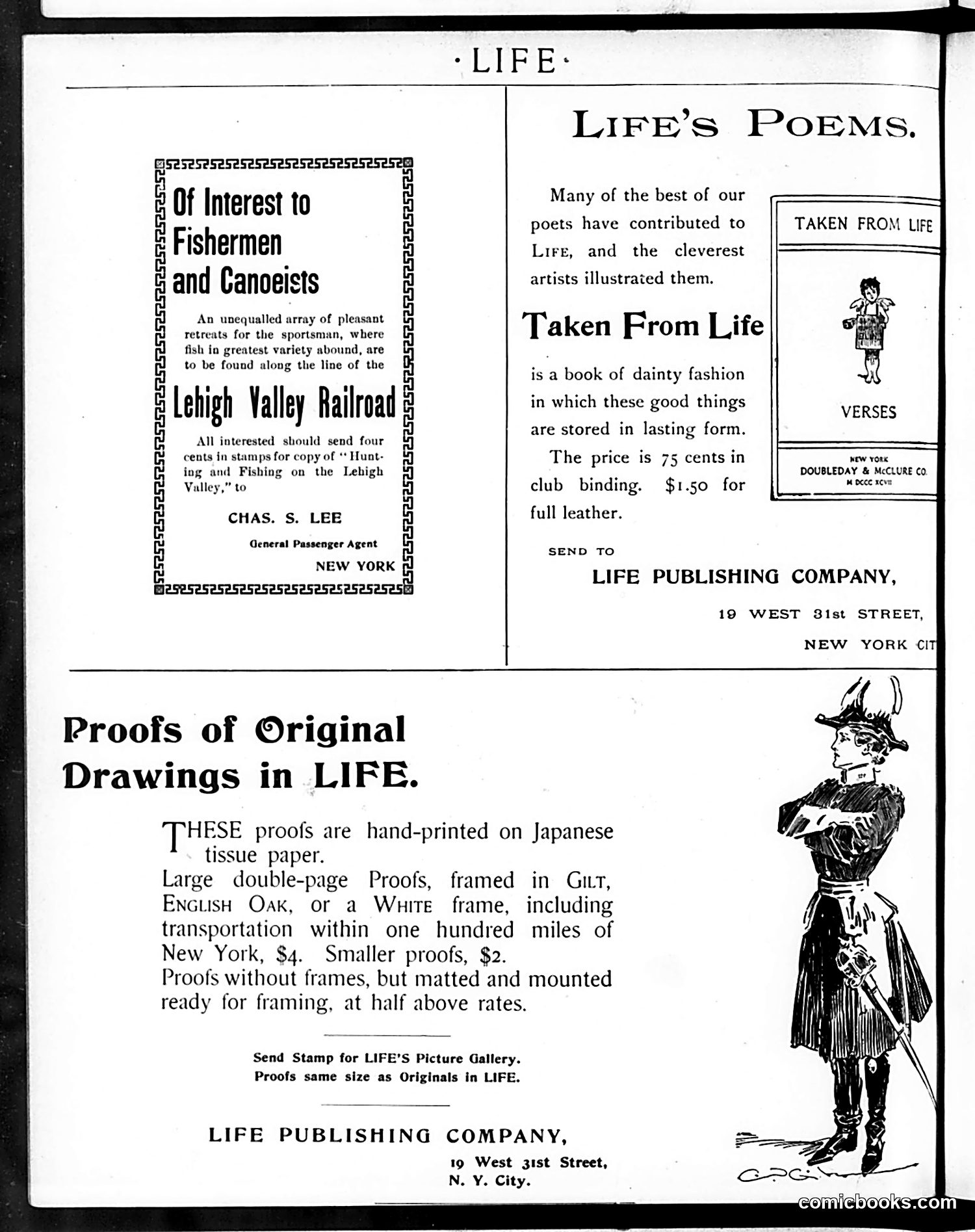
This page is primarily **advertising**, not satirical content. It contains three distinct ads: 1. **Lehigh Valley Railroad** ad (top left) promotes fishing and canoeing retreats along the railroad line, targeting sportsmen. 2. **"Taken From Life" poetry book** (top right) advertises a verse collection illustrated by Life magazine artists, published by Doubleday & McClure Co. at 75 cents or $1.50 depending on binding. 3. **"Proofs of Original Drawings in LIFE"** (bottom) offers high-quality prints of artwork from Life magazine—hand-printed on Japanese tissue paper, framed in various styles, priced from $2-$4 depending on size and framing. The illustrated figure on the right appears to be a fashionable woman in early 1900s attire, likely decorating the poetry book advertisement. No political satire or social commentary is evident on this page.
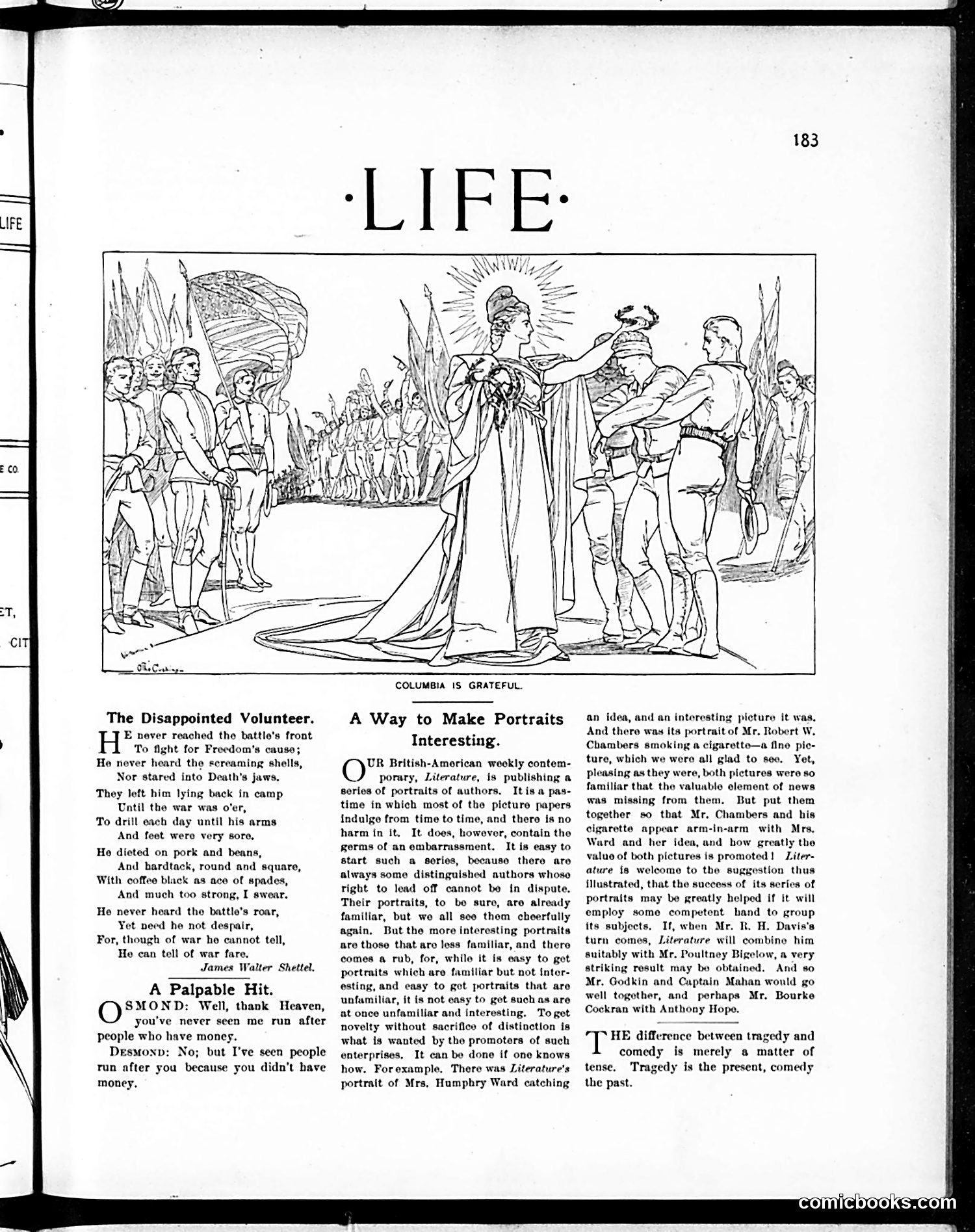
The main illustration, titled "Columbia Is Grateful," depicts a classical female figure (Columbia, personifying America) in flowing robes, surrounded by soldiers. She appears to be bestowing recognition or rewards upon military figures. The accompanying text discusses three separate pieces: 1. **"The Disappointed Volunteer"** - A poem about a soldier who expected combat but instead experienced mundane camp life and poor conditions. 2. **"A Palpable Hit"** - A brief dialogue where a character notes seeing wealthy people who lack money, suggesting irony about financial circumstances. 3. **"A Way to Make Portraits Interesting"** - An editorial discussing *Literature* magazine's author portrait series, debating whether unfamiliar subjects or distinguished authors make more compelling illustrations. The page blends military commentary with literary criticism, typical of *Life's* satirical approach.
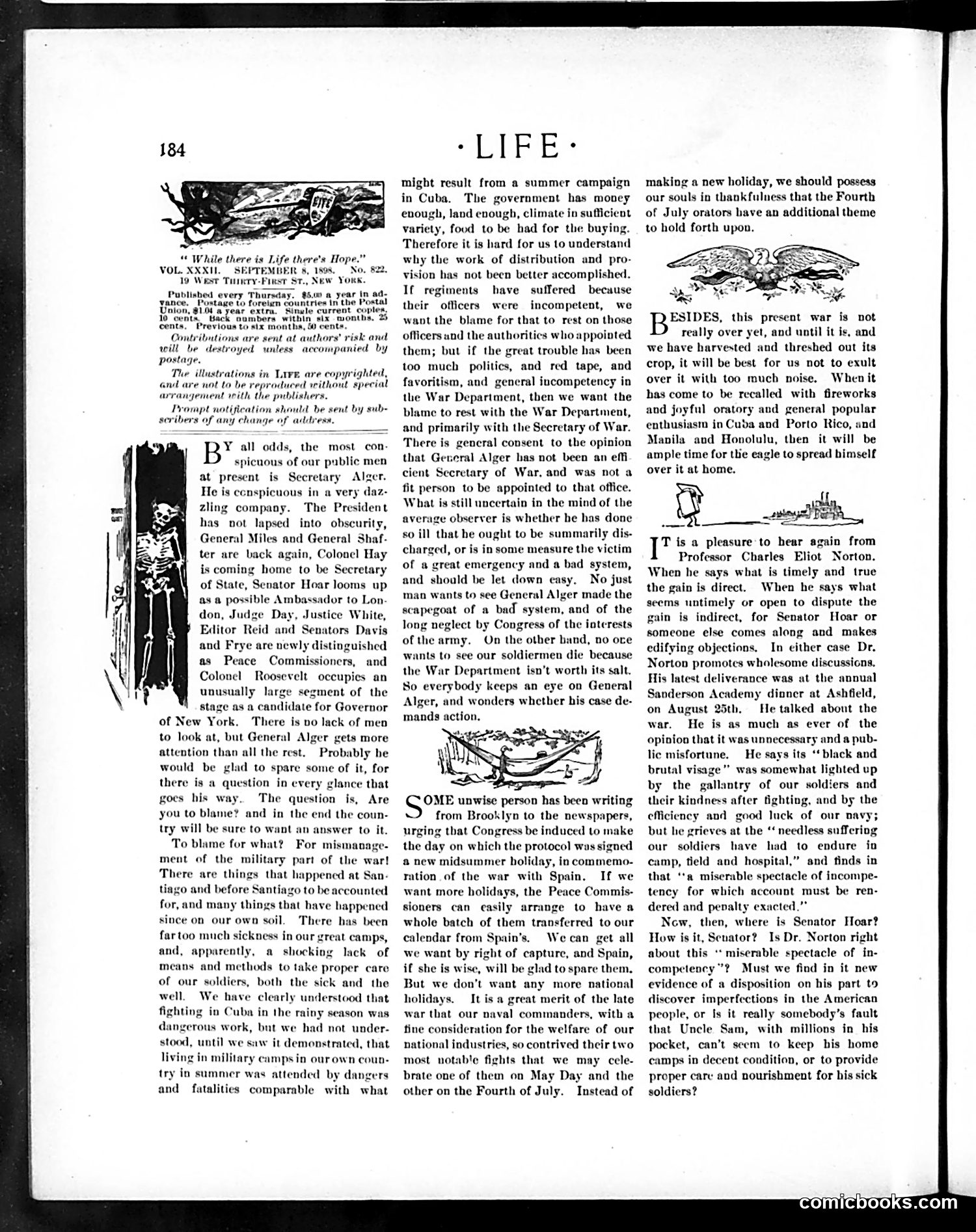
This page critiques Secretary of War Alger, a prominent government figure during the Spanish-American War era. The text argues that military incompetence and poor leadership—not individual soldiers—caused problems in the Cuba campaign. The satire targets those blaming Alger while defending him from removal, suggesting Congress bears responsibility for neglecting the War Department. The piece sarcastically notes that while General Alger receives scrutiny, no one wants soldiers to suffer due to departmental failures. The cartoon appears to depict figures in formal dress, likely representing government officials or military leaders being scrutinized for wartime mismanagement. The overall message: systemic governmental failure, not individual incompetence, caused soldiers' hardships during the Cuban campaign.
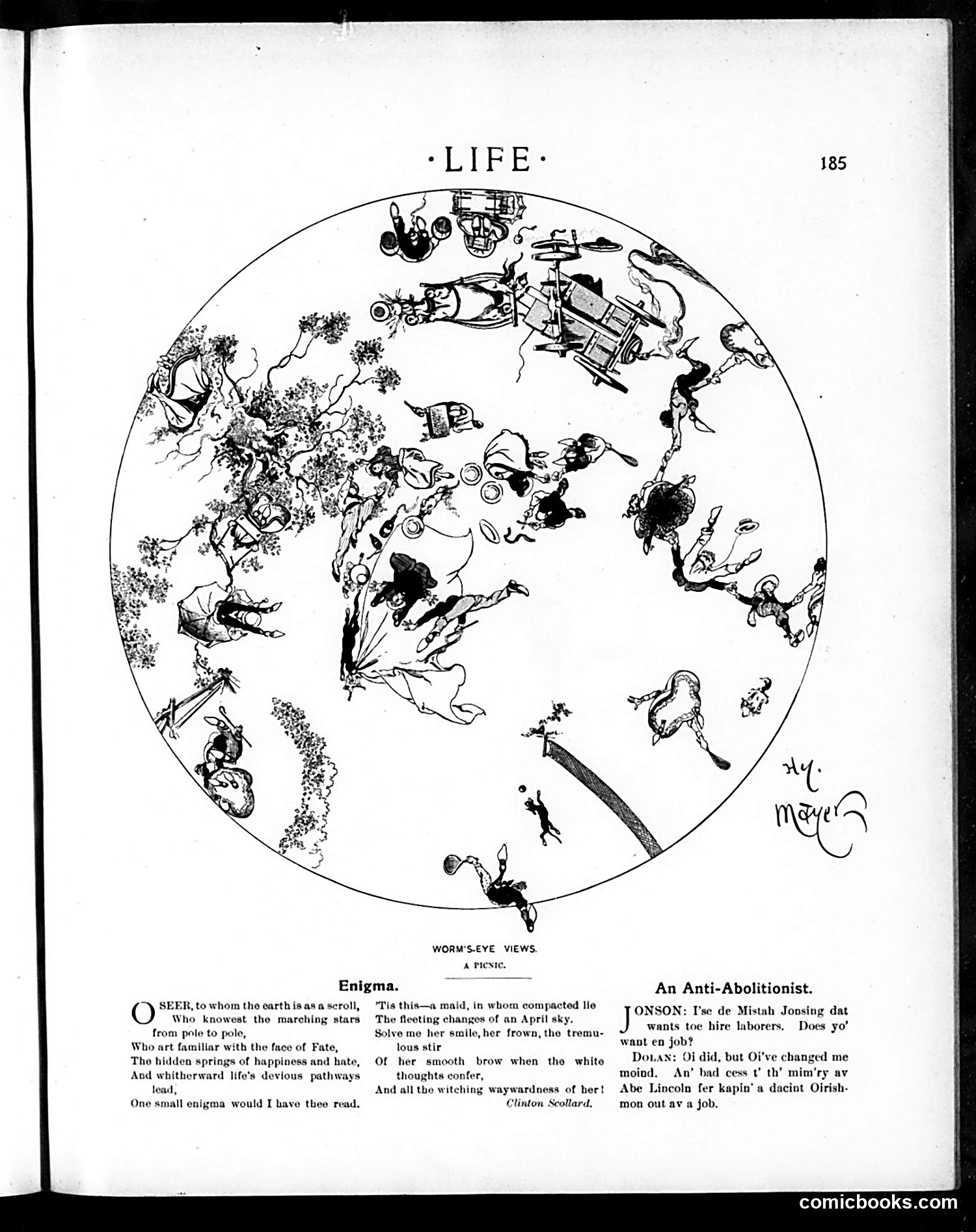
This page features a satirical bird's-eye view titled "Worm's-Eye Views: A Picnic," depicting various social types and activities scattered across a circular composition. The artist is signed "A. Mayer." Below are two separate satirical pieces: "Enigma" (a poem about life's mysteries) and "An Anti-Abolitionist" (a dialogue between characters Jonson and Dolan about employment and labor). The main cartoon appears to mock Victorian picnic culture and social pretensions through exaggerated, chaotic vignettes of people engaged in typical leisure activities—lounging, eating, courting, and socializing. The "worm's-eye view" perspective suggests satirizing how these supposedly genteel pastimes appear undignified when viewed from below, critiquing 19th-century bourgeois social conventions and leisurely excess.
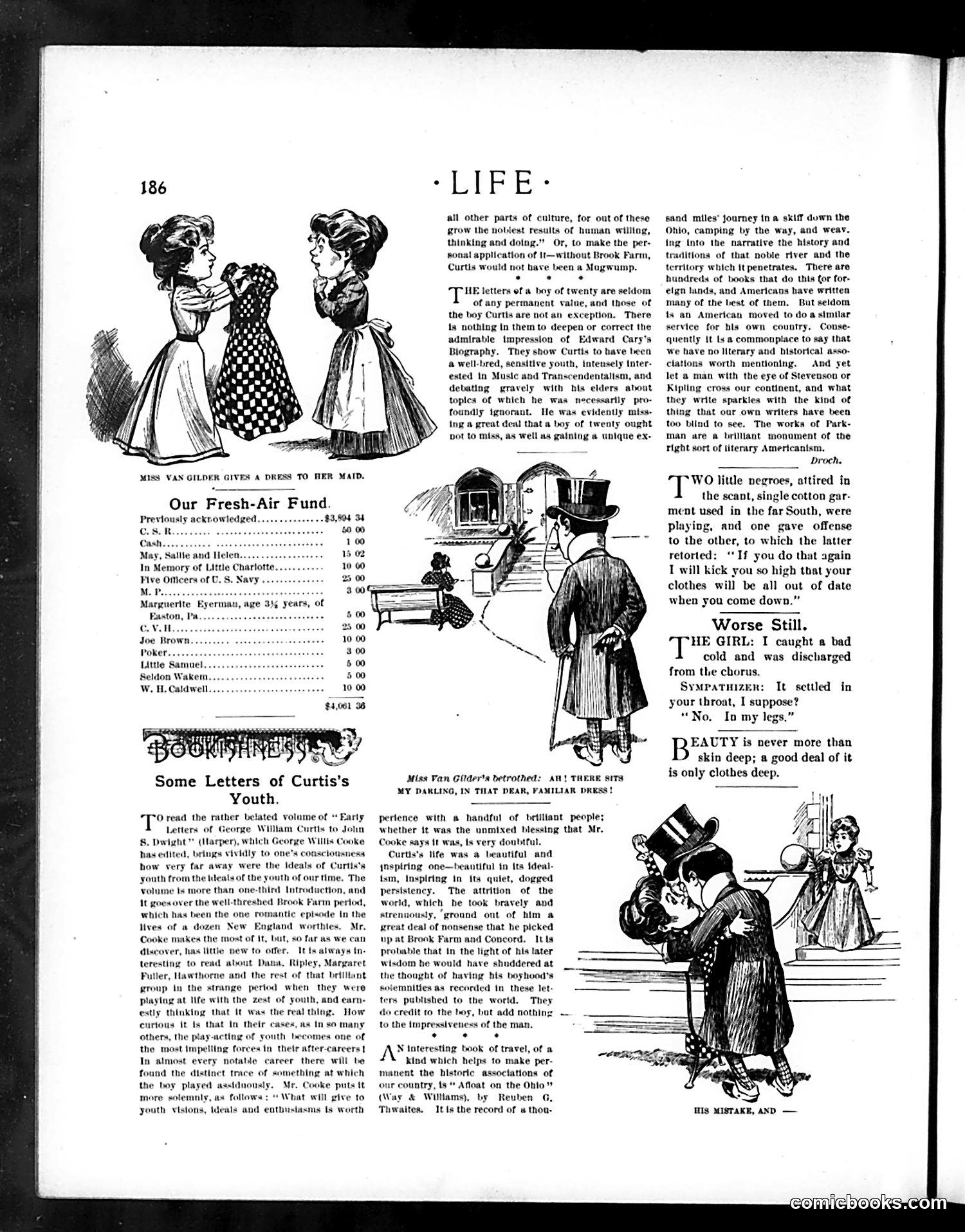
This page contains literary criticism and social humor rather than political cartoons. The main content discusses George William Curtis's published letters from his youth, praising their documentation of 19th-century American ideals and transcendentalism. The illustrations show period domestic scenes: two young women exchanging clothing (titled "Miss Van Gilder Gives a Dress to Her Maid"), and a scene of working-class figures near a carriage. These appear to satirize class distinctions and social pretension of the era. The jokes scattered throughout (titled "Worse Still," "Beauty," and "His Mistake") target contemporary social conventions—illness, appearance, and miscommunication between sexes—offering light domestic humor typical of Life magazine's satirical commentary on everyday American life and manners.
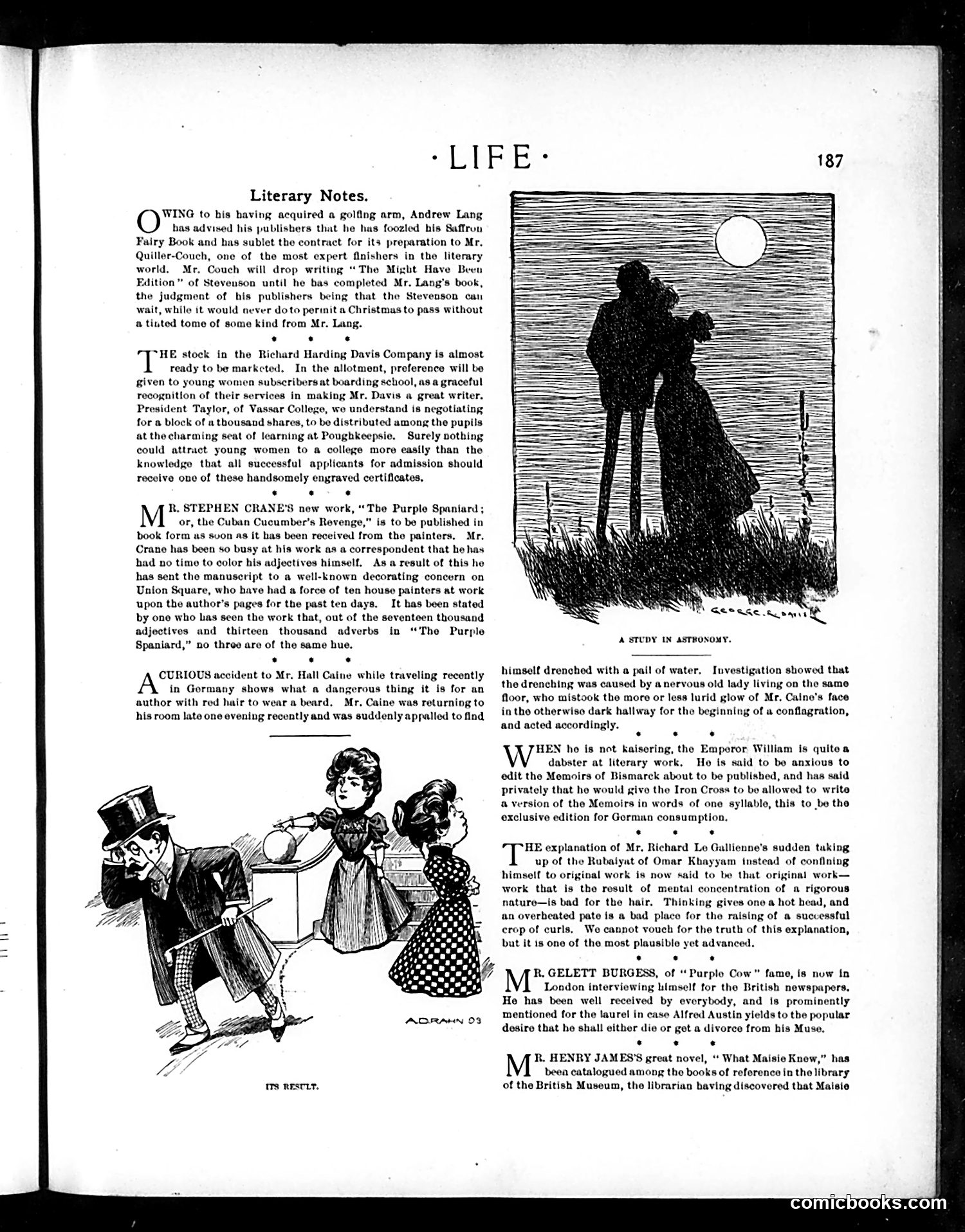
The cartoon labeled "ITS REPLY" depicts a domestic scene with satirical intent. A well-dressed man appears startled or dismayed while a woman and child present him with what seems to be a bill or invoice. The woman's posture and the child's gesture suggest she is demanding payment or retaliation for something—likely a husband's transgression or household expense. The satire plays on Victorian gender dynamics: the "reply" is the woman's economic or domestic retaliation against the man's behavior or irresponsibility. The cartoon suggests wives wielding financial or domestic power as leverage against husbands, a commentary on marital power struggles and women's limited but creative means of asserting authority within marriage during this era.
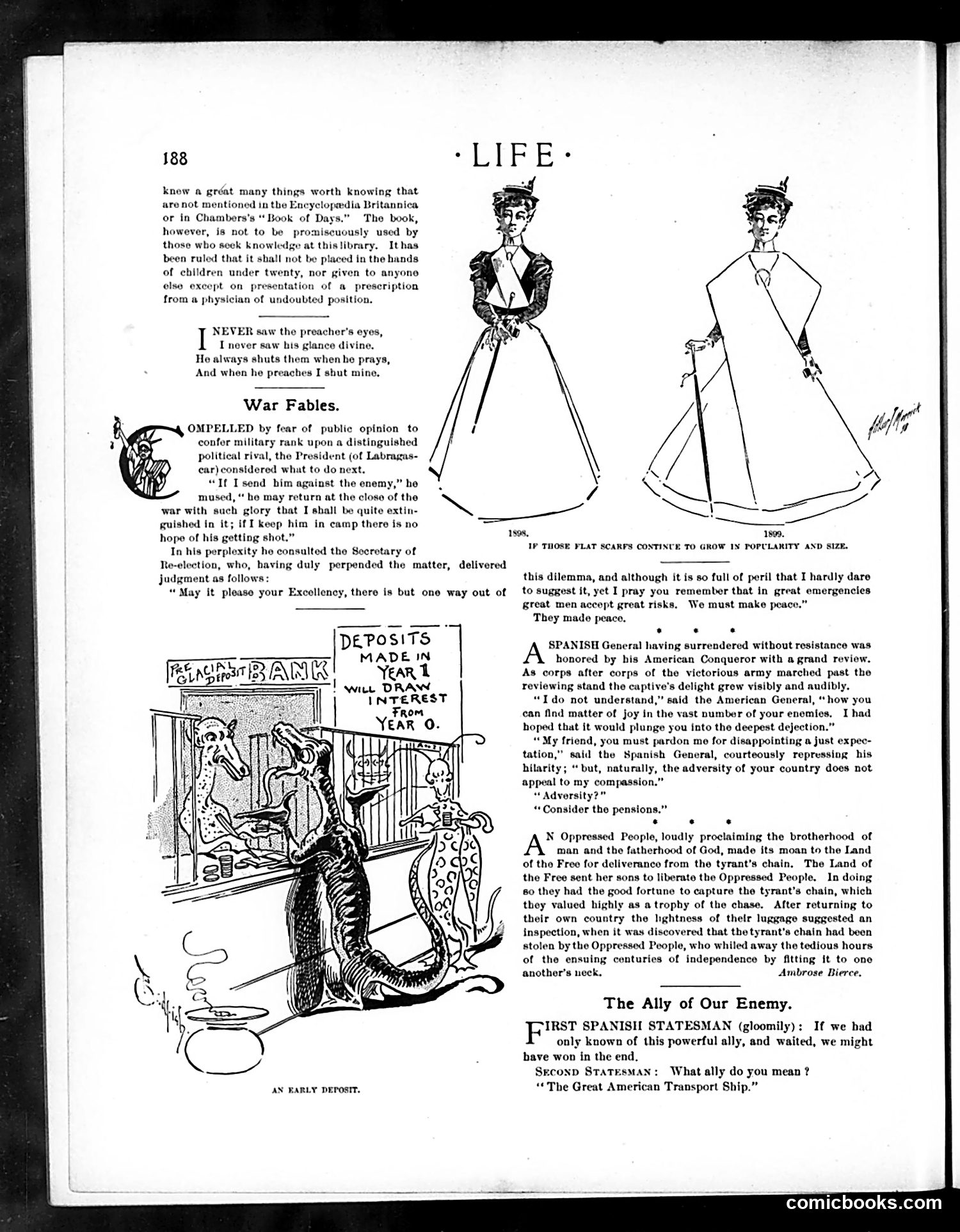
**"War Fables"** presents two satirical pieces mocking military and political leaders during what appears to be a colonial/imperial conflict (likely the Spanish-American War era, given references to "Spanish General"). **Top cartoon**: A dialogue between a political leader and military official discussing sending a rival general into dangerous combat, hoping he won't survive—dark satire on using war to eliminate political enemies. **Bottom cartoon ("An Early Deposit")**: Shows a banker displaying interest-bearing war bonds/deposits, satirizing how financial institutions profited from military conflicts while soldiers fought. **"The Ally of Our Enemy"** section mocks a Spanish general's surrender, with American generals debating whether the enemy's powerful "ally" (likely referencing the U.S. Navy/transportation capabilities) was their actual advantage. The page satirizes war profiteering and cynical political manipulation of military conflict.
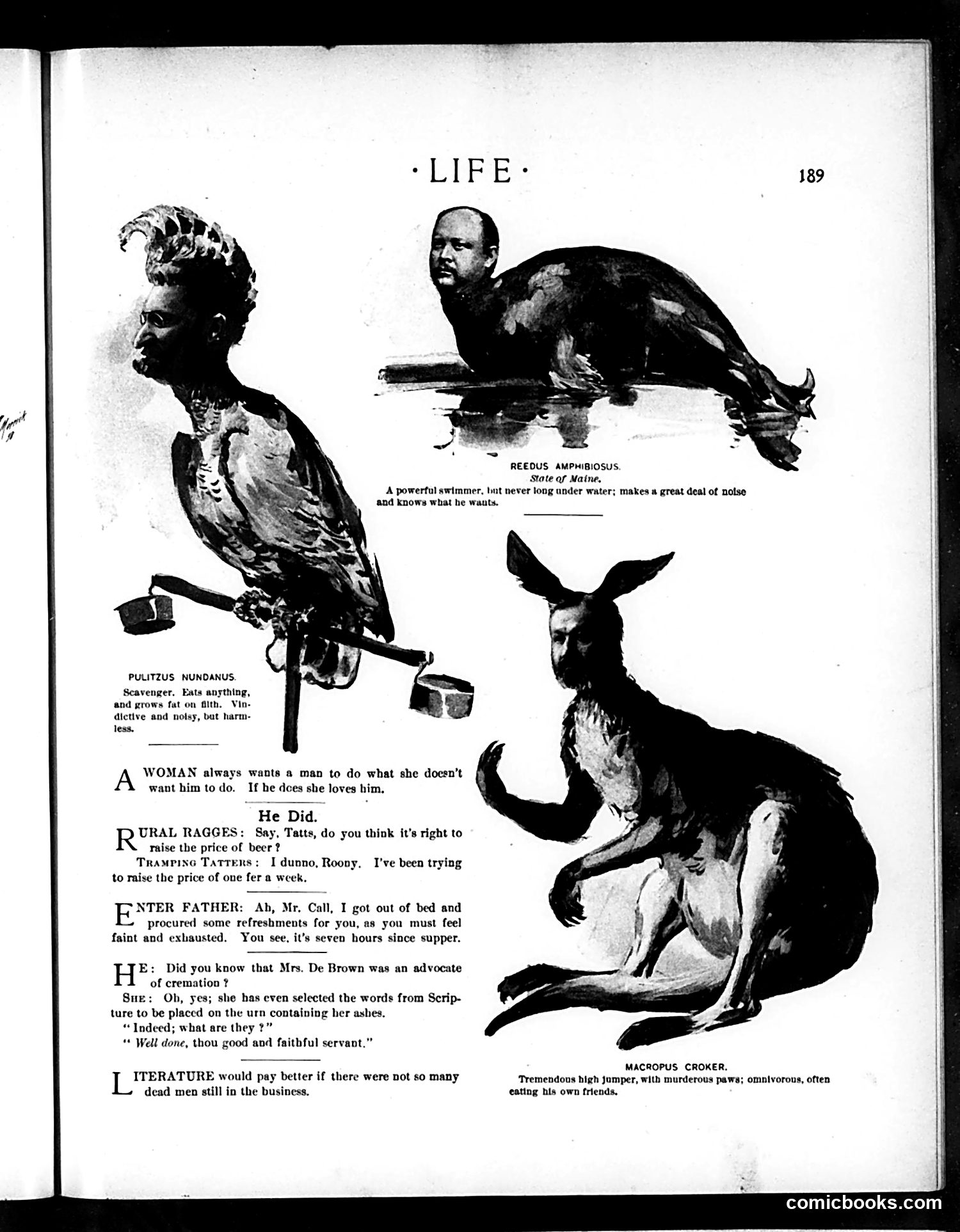
This page combines animal illustrations with short satirical dialogues. The three creatures shown are labeled with Latin names and humorous descriptions: **Pulitzus Mundanus** (a parrot): described as a scavenger that eats anything and grows fat, "vindictive noisy, but harmless" — likely mocking Joseph Pulitzer or sensationalist newspaper publishers. **Reedus Amphibiosus** (appears to be a beaver or similar creature): a powerful swimmer that makes noise and "knows what he wants." **Macropus Croaker** (a kangaroo): described as a "tremendous high jumper with murderous paws; omnivorous, often eating his own friends." The brief dialogues below mock contemporary social issues: women's agency, beef prices, cremation practices, and literary criticism. The satirical tone suggests critique of current events and personalities from the period.
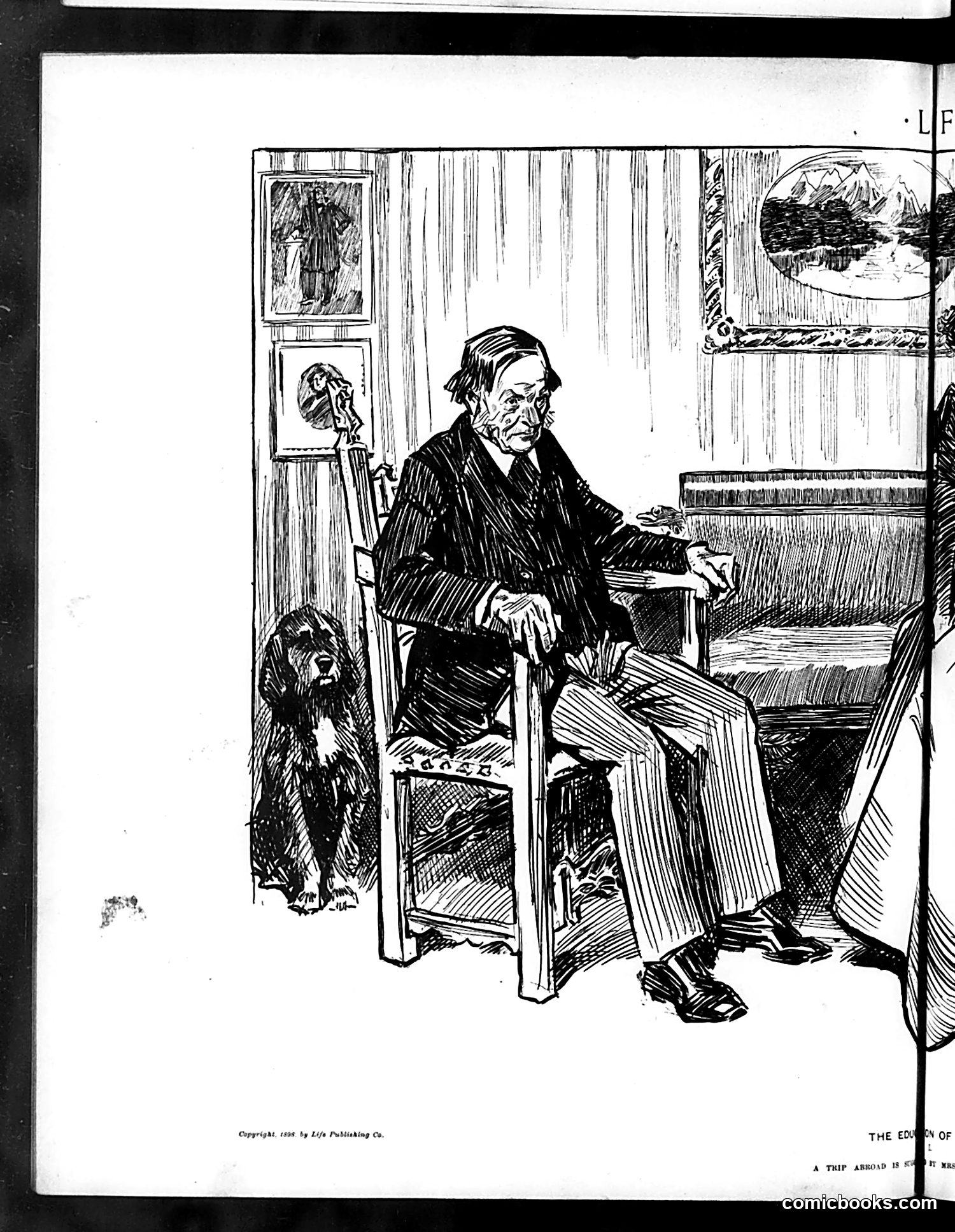
This is a black and white illustration from Life magazine (copyright 1898 by Life Publishing Co.) showing a man seated indoors with a small dog nearby. The man appears gaunt and serious, dressed in dark formal clothing, sitting in a contemplative pose. Behind him are framed pictures on the wall and a window showing a mountainous landscape. The OCR text is fragmentary ("THE ED[ITOR] OF / A TRIP ABROAD H E[...]"), making the specific satirical target unclear. Without complete caption or context, I cannot definitively identify the figure or explain the cartoon's point. The illustration style and setting suggest social or political commentary typical of Life magazine's satirical content from the 1890s, but determining the exact subject and meaning requires additional textual information not fully legible here.
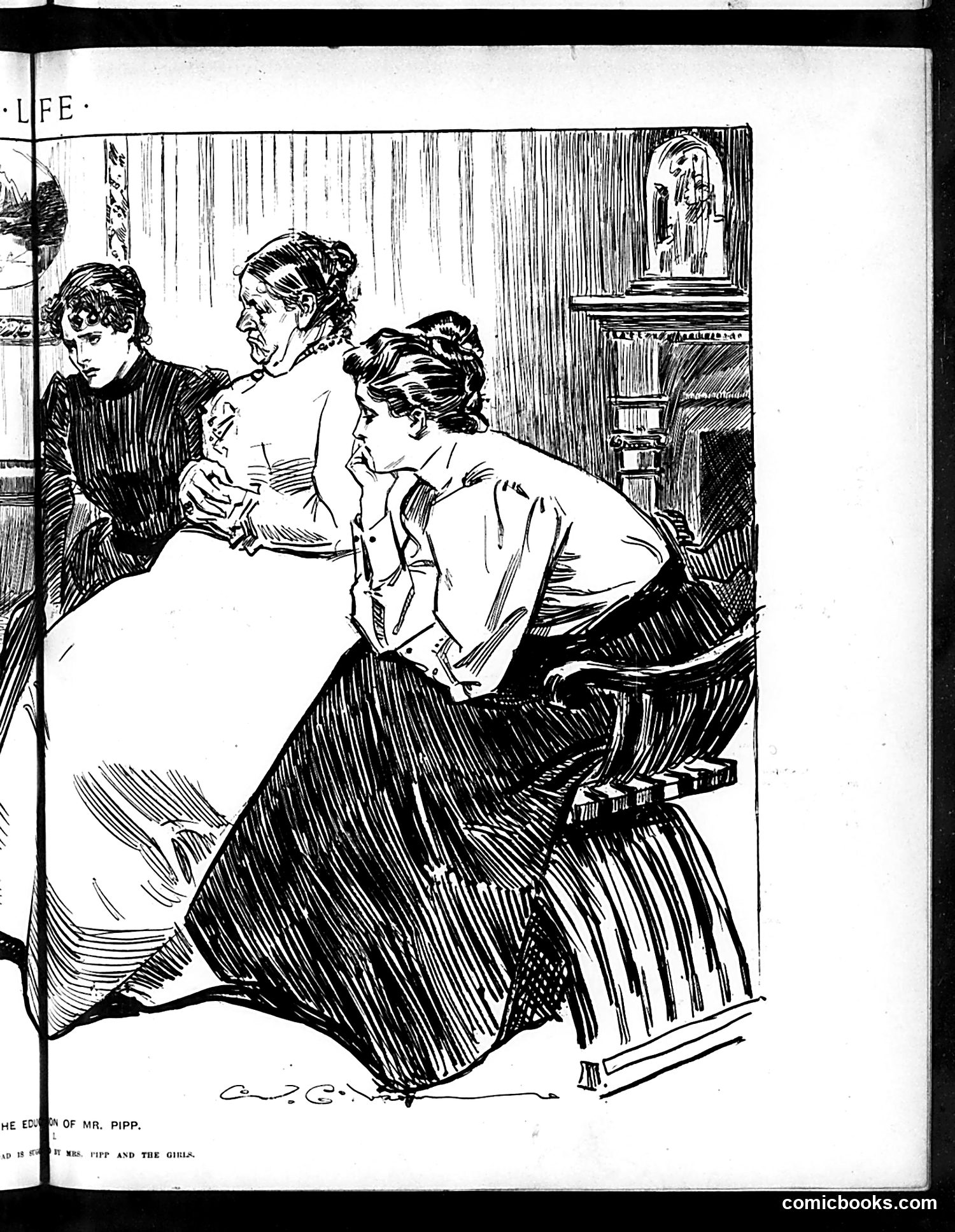
This appears to be an illustration from *Life* magazine showing a domestic interior scene. The caption references "Mr. Pipp" and mentions "Mrs. Pipp and the Girls," suggesting this depicts a family situation. The image shows three women in what appears to be an interior setting with period furnishings and a framed picture on the wall. Based on the styling and the caption mentioning "Mr. Pipp," this likely illustrates a narrative or comedic situation involving a family named Pipp. However, without additional context about who Mr. Pipp was or what specific story this referenced, I cannot definitively explain the satirical or social commentary intent. The illustration style and composition suggest domestic humor typical of early 20th-century *Life* magazine content, but the specific joke or reference remains unclear from the visible text and image alone.
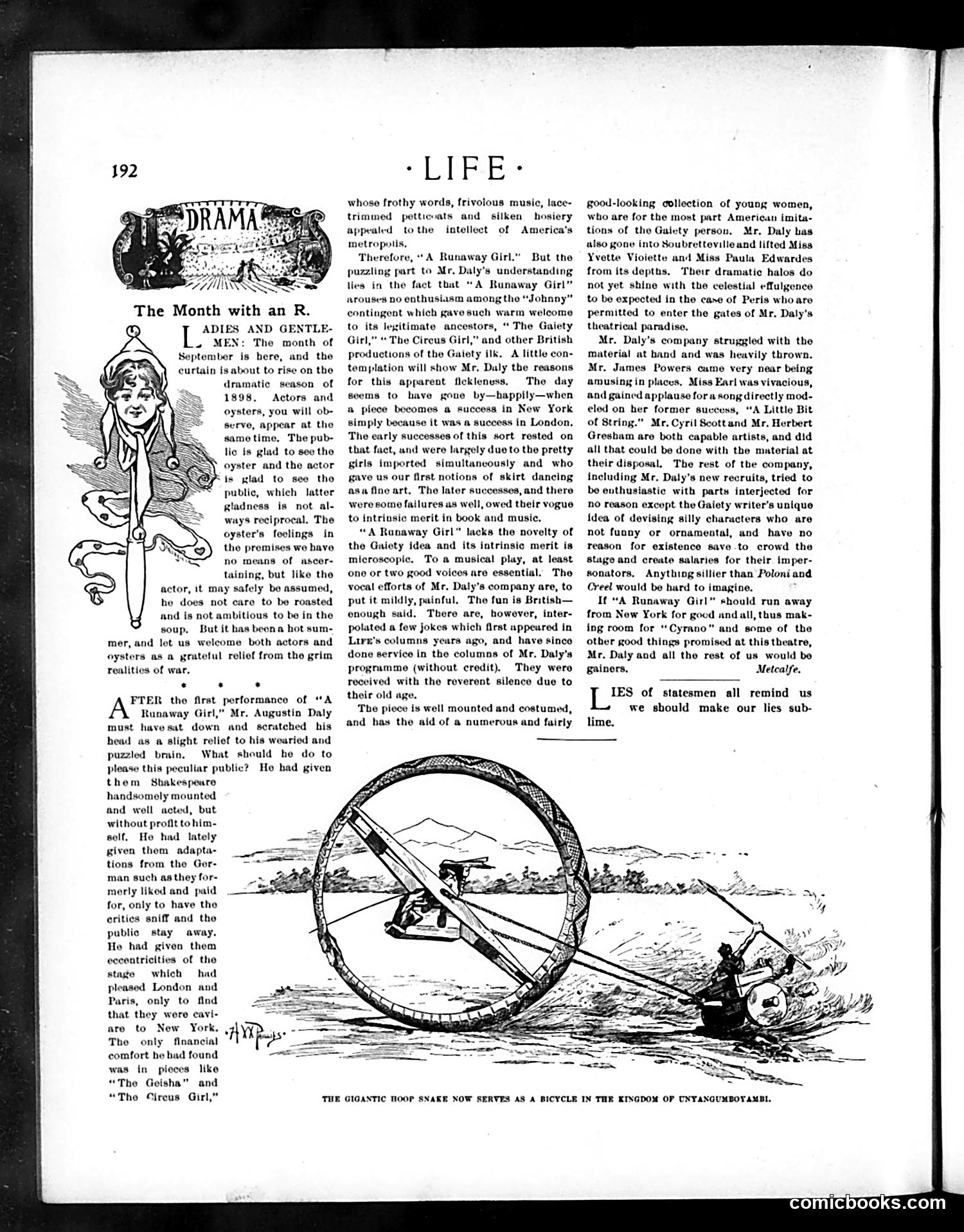
This page reviews theatrical productions for September 1898. The main illustration depicts a grotesque face with exaggerated features, labeled a review of "A Runaway Girl," a musical comedy playing in New York. The accompanying text criticizes the play's lack of novelty, noting it relies on shallow appeal rather than genuine theatrical merit. The reviewer acknowledges the show's commercial success in London but questions whether American audiences should accept such lightweight entertainment. The bottom illustration shows a large hoop snake being repurposed as a bicycle—a whimsical visual joke likely referencing the "Kingdom of Untanguboyanzi," suggesting absurdist humor about exotic or fantastical inventions. Overall, the page blends theatrical criticism with satirical drawings typical of Life's entertainment coverage.
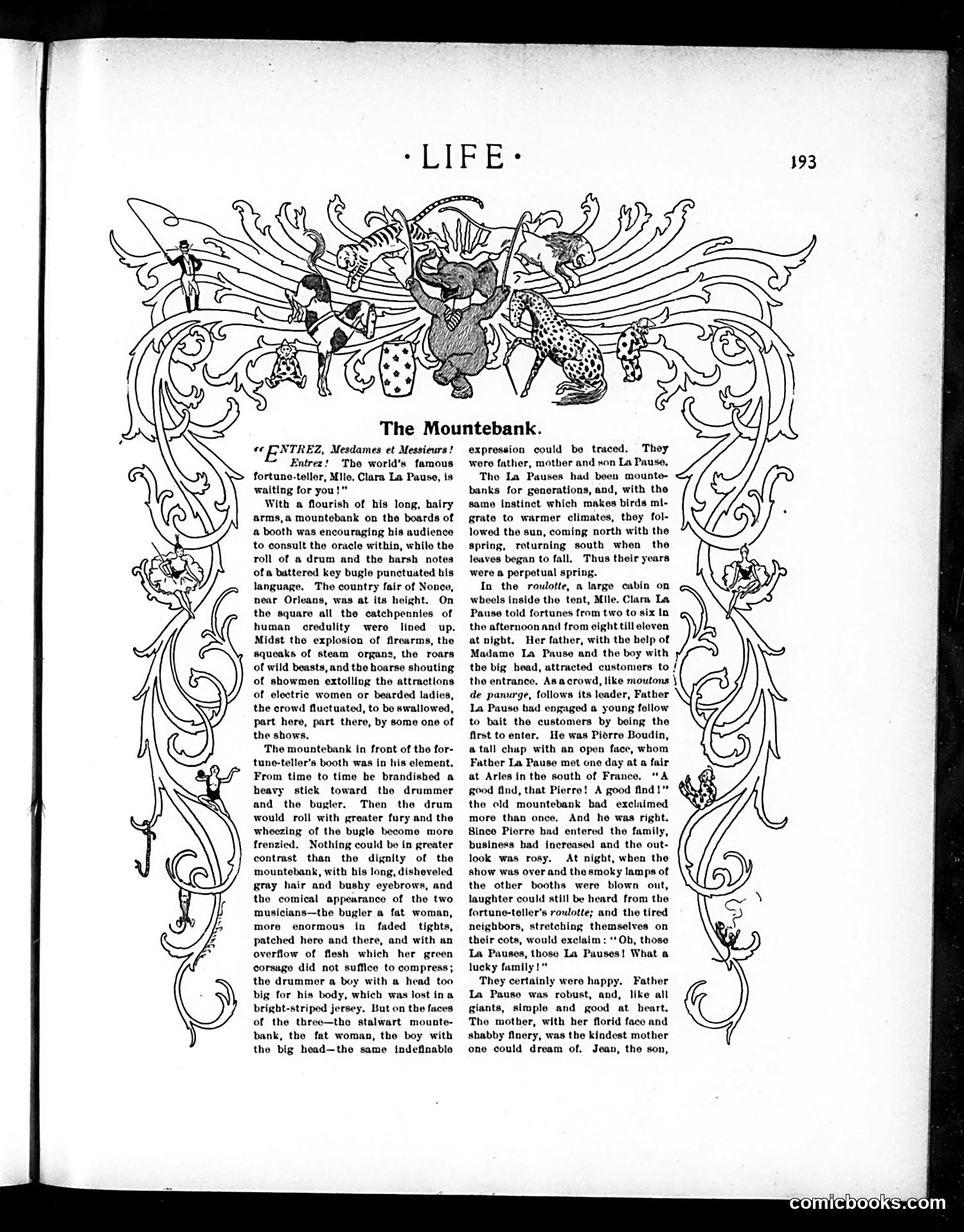
This is a short story illustration, not political satire. It depicts a French fairground scene at Nonce near Orleans, centering on the La Pause family—itinerant fortune-tellers and carnival performers. The mountebank (circus barker) uses theatrical flourishes to lure crowds to consult "Mademoiselle Clara La Pause," the fortune-teller. The family consists of the dignified father, his large wife playing bugle, and their son on drums—all maintaining an "indefinable expression" suggesting their shared profession despite their comical appearances. The story introduces Pierre Boudin, a handsome young man hired to be the first customer, drawing crowds by example. The narrative presents this wandering family sympathetically: hardworking, happy, and prosperous, following seasonal migration patterns like migrating birds. This appears to be light, humanizing fiction about working-class carnival life rather than satirical commentary.
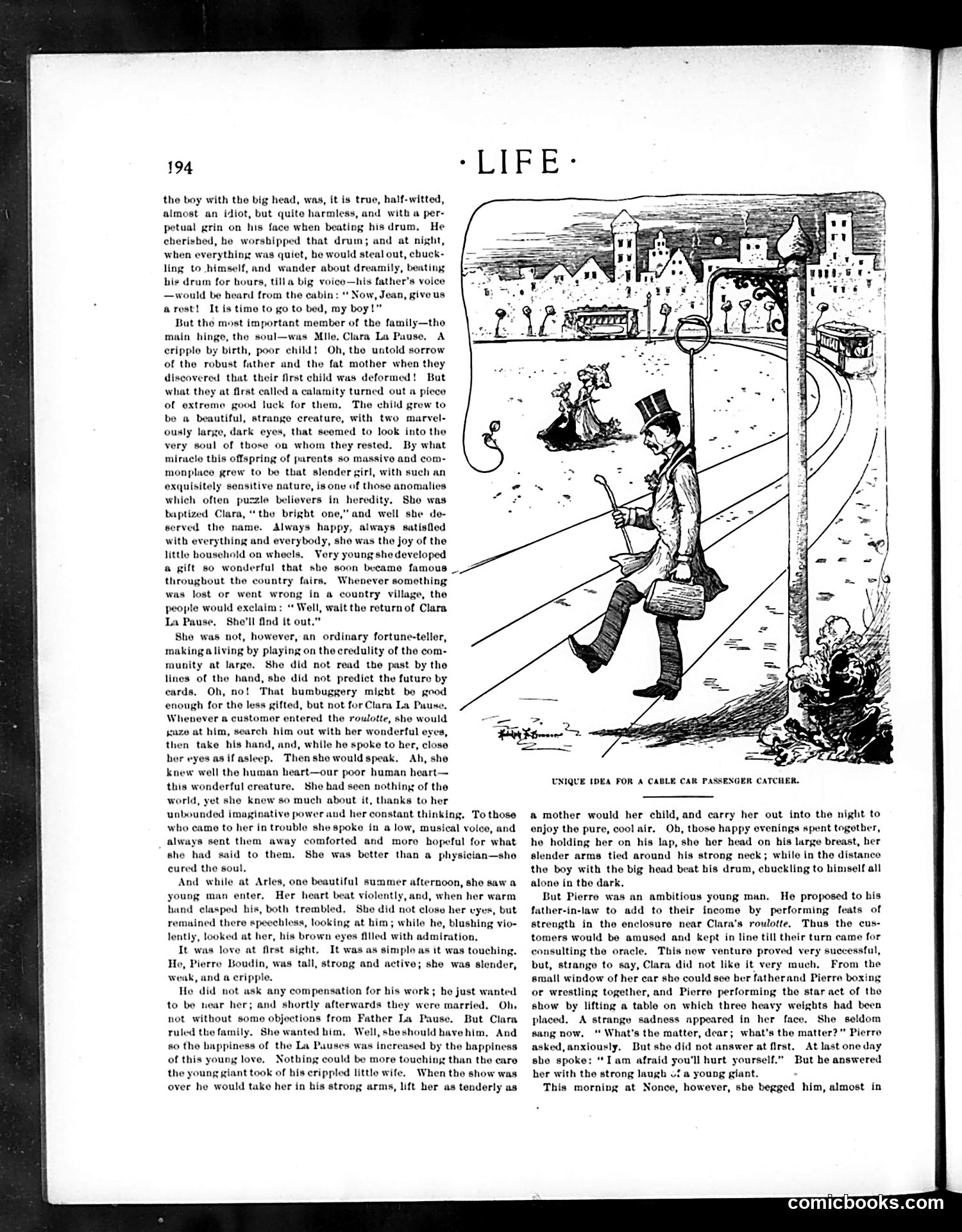
This page presents a serialized story about Clara La Pause, a crippled girl from a traveling circus family who becomes famous as a folk healer/fortune-teller at country fairs. The accompanying illustration shows a street scene with a man in a top hat appearing to catch a woman falling or jumping from above—captioned "UNIQUE IDEA FOR A CABLE CAR PASSENGER CATCHER." The narrative emphasizes Clara's exceptional sensitivity and intuitive understanding of human nature despite her physical disability and lack of worldly experience. She diagnoses emotional troubles through intuition rather than charlatanism (unlike typical fortune-tellers). The story celebrates her as morally superior and spiritually gifted. The illustration's caption suggests contemporary San Francisco cable car humor—depicting an absurd safety device. This page likely dates to the early 1900s and reflects period sentimentality about disabled individuals possessing compensatory spiritual or intuitive gifts, combined with light urban satire about modern transportation.
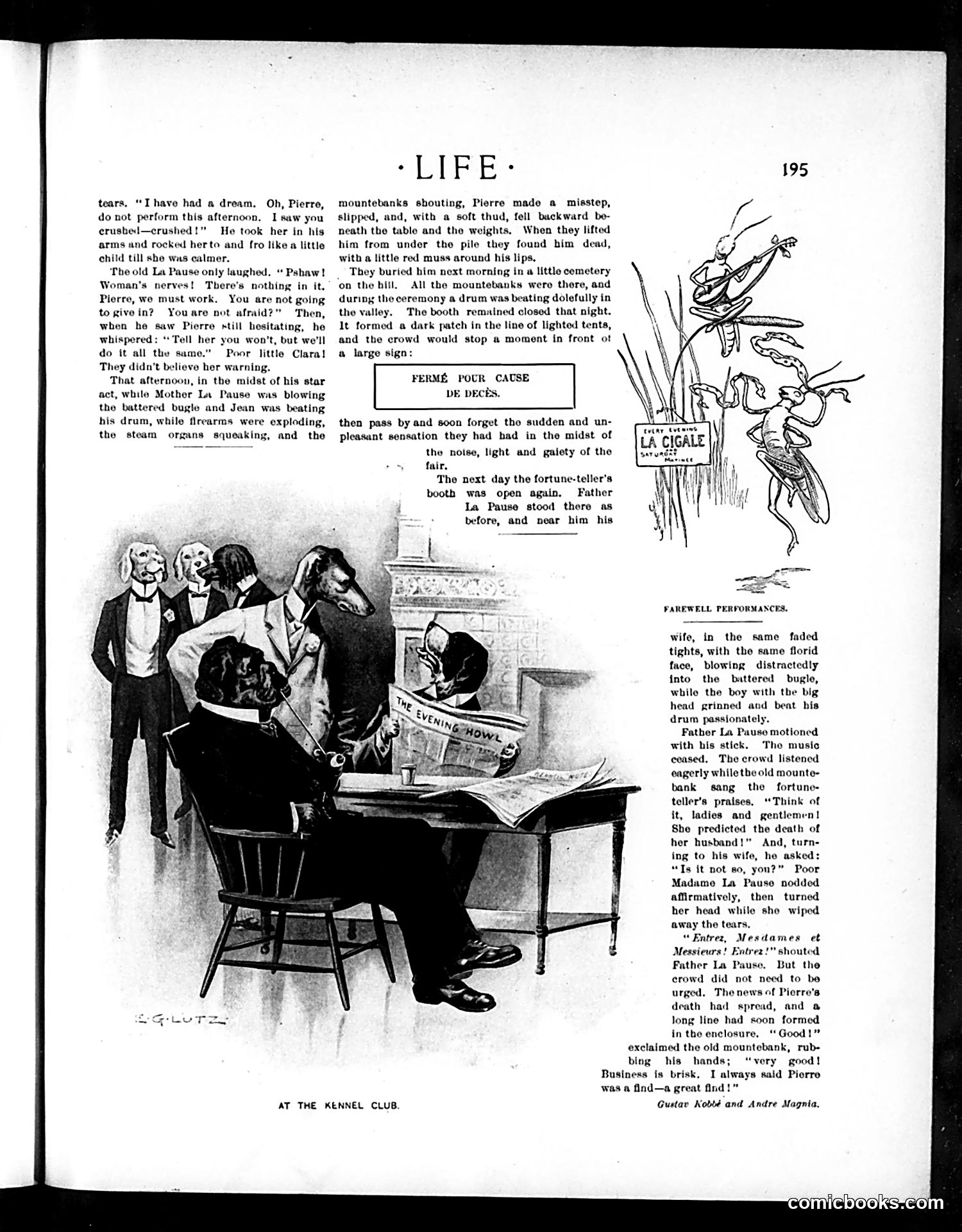
The page presents a cynical narrative about carnival performers, likely from the early 1900s. The main text (attributed to Gustav Kohte and Andre Magnia) describes the death of Pierre, a circus acrobat in a traveling fair, who falls during his act despite his wife's premonition warning him not to perform. The satire centers on the **moral bankruptcy of carnival culture**: Pierre's father-in-law (Father La Pause) dismisses the wife's warning, encourages Pierre to perform anyway for profit, and—most damningly—**exploits Pierre's death as a marketing tool** once it occurs. The crowd now lines up specifically because someone died, and the father cynically remarks that Pierre was "a great find," valuing him only for his commercial utility in death as in life. The illustration "At the Kennel Club" (lower left) shows well-dressed gentlemen at what appears to be a social venue—likely a satirical juxtaposition suggesting that exploitation and callousness exist in respectable society too, not just carnivals. The overall message: **greed and spectacle corrupt human decency**.
This page contains primarily **humorous anecdotes and satirical commentary** rather than political cartoons. The main content is a long poker story illustrating a popular 19th-century joke format: a clever Southerner (Judge from Mississippi) outwits a sharp New York businessman through psychological observation rather than cards. The New Yorker's inability to laugh at a story reveals his anxiety about his hand—allowing the Judge to win with an inferior hand ("two jacks"). The satire plays on **regional stereotypes**: the cunning Southern lawyer versus the rigid, humorless Northern businessman. Additional brief satirical items mock: - **A gossip** who claims a woman "walks in her sleep" (implying loose morality) - **A doctor** whose treatment is so ineffective the patient begs for death - **Bachelors** making cynical remarks about women - **Golf** as an absurd waste of time The page's satire targets **social pretension, masculine competition, regional differences, and modern affectations**—typical Life magazine fare of the era.
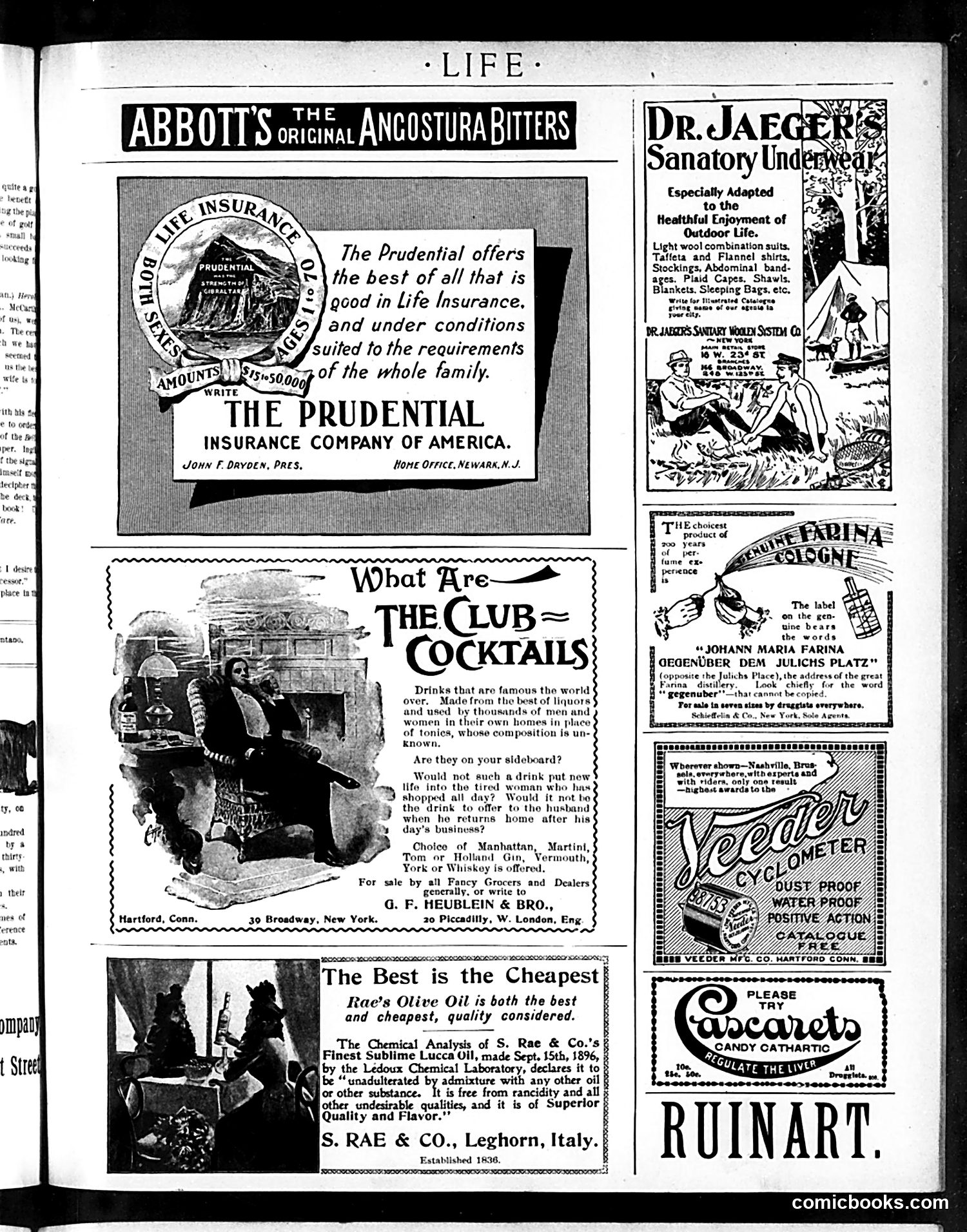
This page is primarily **advertising**, not satirical content. It contains product advertisements from early Life magazine, reflecting turn-of-the-century consumer culture. Key ads include: - **Prudential Insurance**: Promotes life insurance as essential family protection, using a pastoral mountain image to suggest security and stability. - **Club Cocktails**: Markets pre-mixed drinks to middle-class households, suggesting they replace tonics of unknown composition and would energize tired shoppers and working husbands—reflecting both gender roles and the novelty of packaged alcohol products. - **S. Rae & Co. Olive Oil**: Claims chemical purity and superiority, addressing consumer concerns about adulterated foods (a genuine problem in this era before FDA regulations). - **Other products**: Dr. Jaeger's outdoor wear, Veeder cyclometers, Sweets candy. The ads reflect anxieties about quality, health, and family welfare in an era of growing industrial production and consumer skepticism about product authenticity.
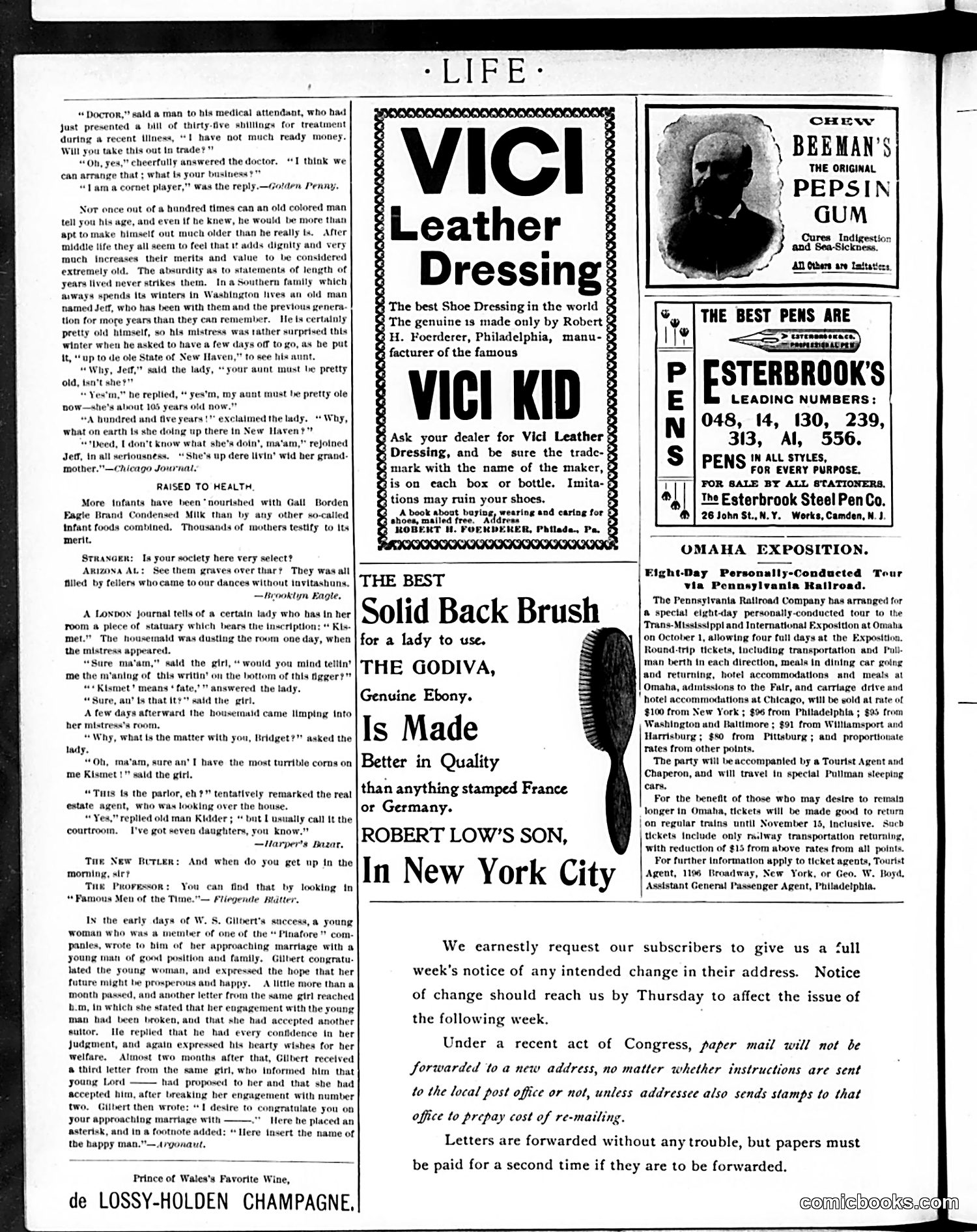
This page is primarily **advertisements and humor columns**, not a political cartoon. The main content consists of short humorous anecdotes typical of early 20th-century Life magazine: 1. **Doctor/Cornet Player joke**: A patient offers to pay medical bills by playing music—a pun on "trade." 2. **Jeff's elderly aunt**: A racist humor piece portraying an enslaved or formerly enslaved man with exaggerated dialect, claiming his 105-year-old aunt lives with her grandmother—the "joke" being the absurd age claim. 3. **Other brief jokes**: Including Arizona frontier humor about selective society enforced by violence, a housemaid's malapropism about "Kismet" (fate/corns), and references to W.S. Gilbert. **Advertisements** dominate the page: Vici Leather Dressing, Beeman's Pepsin Gum, Esterbrook Pens, and a train tour to the Omaha Exposition. The racist content reflects the magazine's historical context but would be considered offensive today.
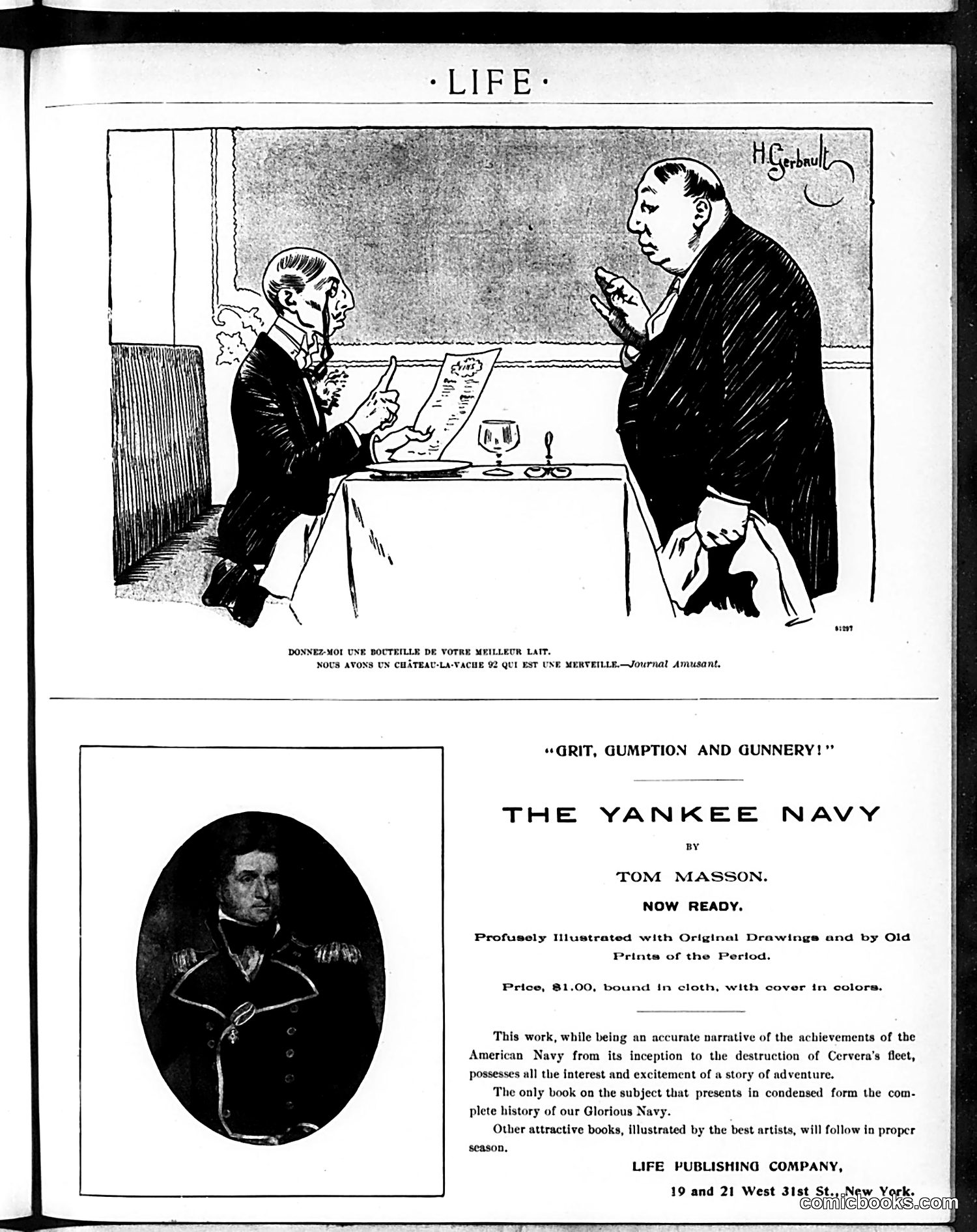
The top cartoon is a French satire (from *Journal Amusant*) mocking pretentious wine culture. Two men dine together; one requests "a bottle of your best milk," then adds that they have a "Château-la-Vache 92" (Castle-the-Cow 92)—a deliberately absurd fake wine name playing on French château naming conventions. The joke ridicules both wine snobbery and the French obsession with elaborate wine classifications. The lower half advertises Tom Masson's book *The Yankee Navy*, celebrating American naval achievements through the Spanish-American War (the "destruction of Cervera's fleet" references the 1898 naval victory). The portrait shows a military officer in period dress. This section represents *Life* magazine's patriotic, triumphalist approach to American naval power during the imperialist era.
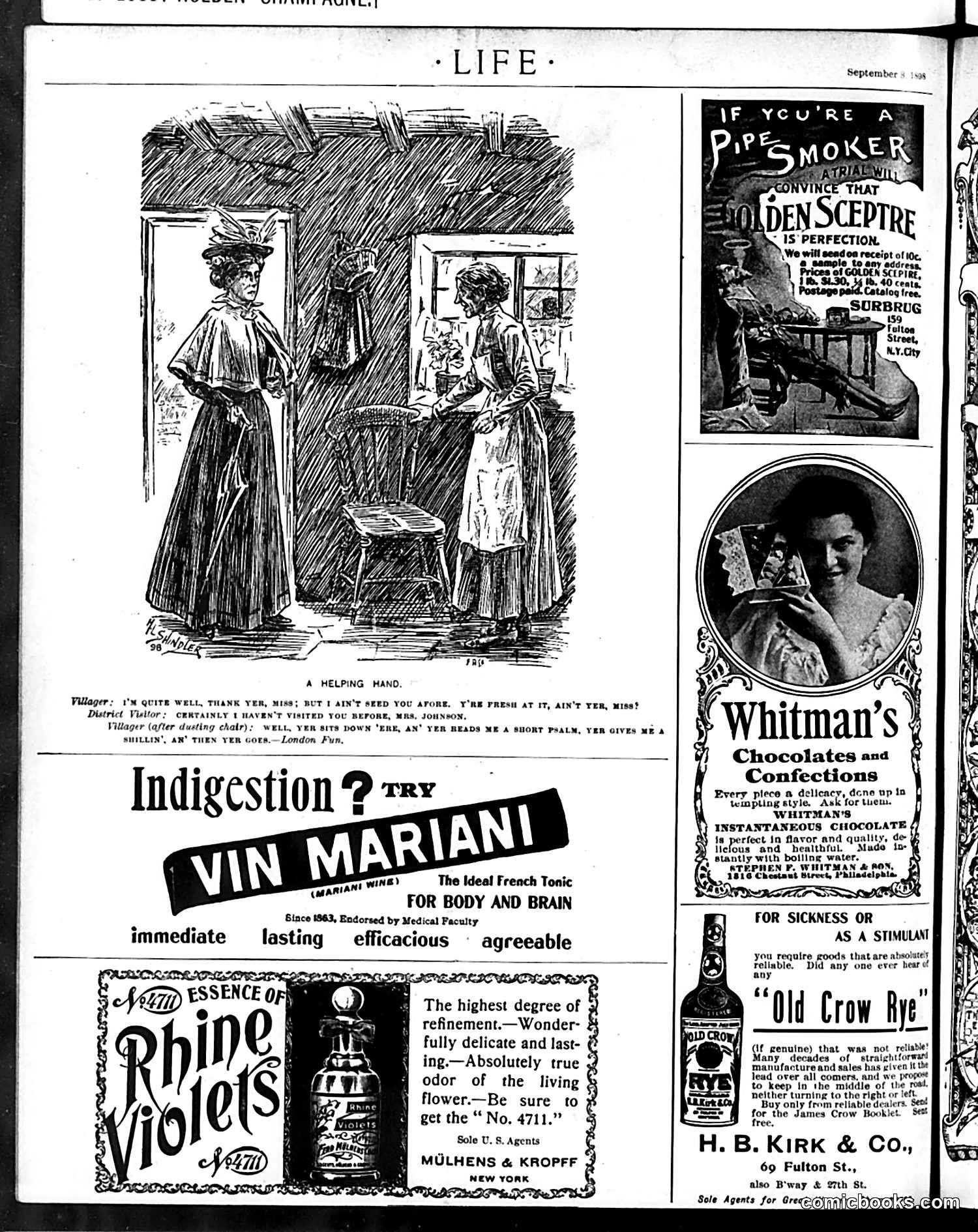
The cartoon depicts a social class interaction typical of Victorian England. A "District Visitor" (a charitable middle-class woman who visited poor families) sits with a working-class "Villager" (Mrs. Jonson). The satire mocks the condescension of charitable visits. The villager's dialect ("I AIN'T SEED YOU AFORE," "Y'RE FRESH") emphasizes class difference. She asks if the visitor is new, then describes the expected ritual: the visitor sits, reads a psalm, gives money ("a shillin'"), and leaves—a mechanical, impersonal "helping hand" that requires nothing of genuine relationship or understanding. The humor lies in the villager's cynical reduction of charity to formula: the visitor performs her duty without authentic connection. The caption, credited to *London Fun*, suggests this satirizes the self-satisfied nature of Victorian charitable work—morally performative rather than truly helpful. The page is otherwise filled with period advertisements (wine tonics, chocolates, perfume).