
Life, 1898-09-08 · page 6 of 20
Life — September 8, 1898 — page 6: what you’re looking at
What you’re looking at
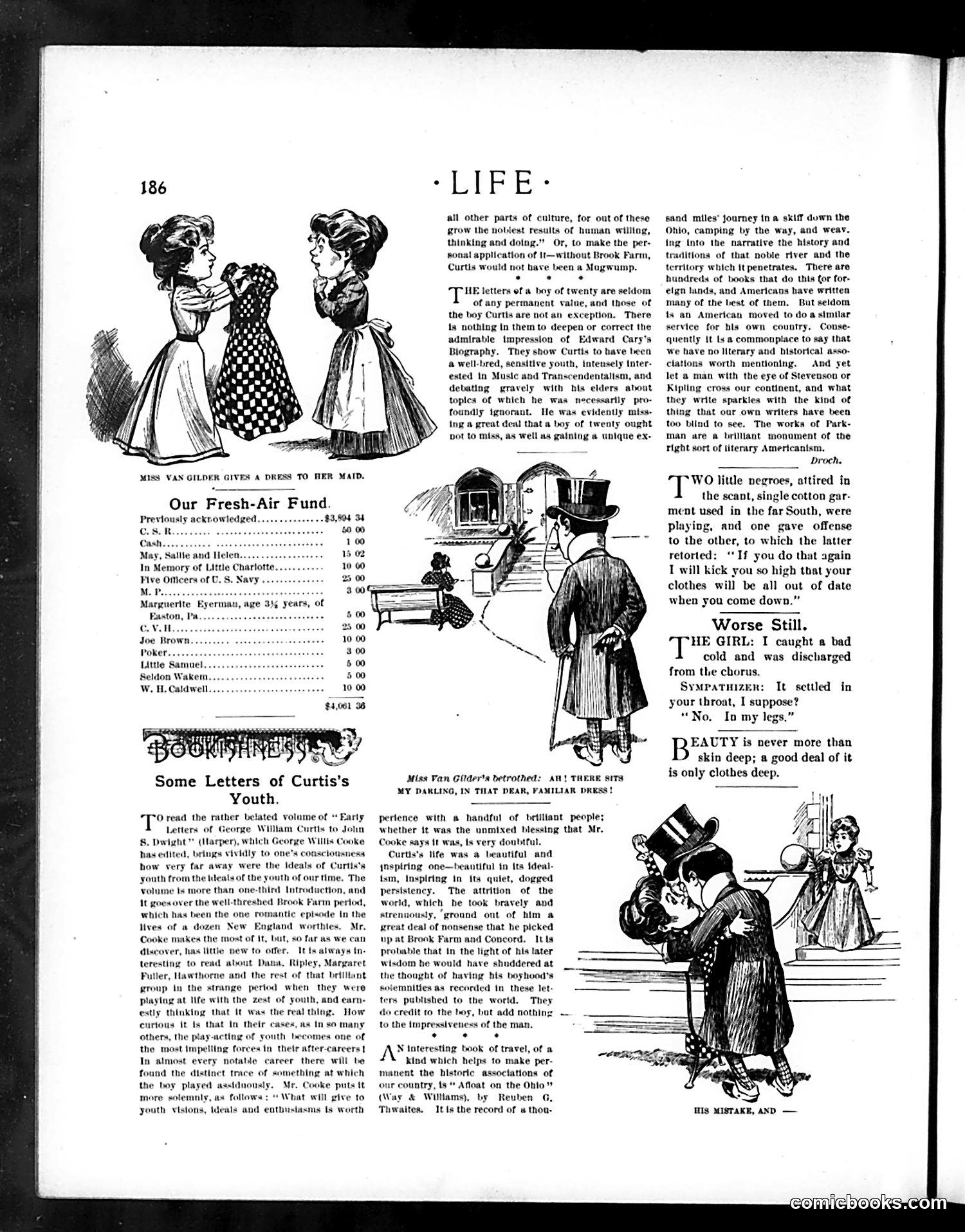
This page contains literary criticism and social humor rather than political cartoons. The main content discusses George William Curtis's published letters from his youth, praising their documentation of 19th-century American ideals and transcendentalism. The illustrations show period domestic scenes: two young women exchanging clothing (titled "Miss Van Gilder Gives a Dress to Her Maid"), and a scene of working-class figures near a carriage. These appear to satirize class distinctions and social pretension of the era. The jokes scattered throughout (titled "Worse Still," "Beauty," and "His Mistake") target contemporary social conventions—illness, appearance, and miscommunication between sexes—offering light domestic humor typical of Life magazine's satirical commentary on everyday American life and manners.
📄 Transcribed text from this page (OCR, searchable)
Machine-transcribed from the original scan — historical spelling and the odd misread are preserved.
MISS VAN GILDER GIVES A DRESS TO HER MAID. Our Fresh-Air Fund. Previously acknowledges $3,504 34 CS. R.. rary . 00 Cash. Pare . 100 May, Sallle and Heleo. In Memory of Little Charlotte. Five Officers of U. S. Navy M. P. Marguerite Easton, Pa.. CV... Joe Brown Poker Little Samuel Seldon Waker. W. H. Caldwell rman, age 3% years, of Some Letters of Curtis’s Youth. ‘O read the rather belated volume of “ Farty Letters of George Willtam Curtis to Joun 8. Dwight (Harper), which George Willis Cooke has edited, brings vividly to one’s consctousness how very far away were the Ideals of Curtis's youth from the ideals of the youth of our time, The ore than one-third Introduction, and It goes over the well-threshed Brook Farm period, which has been the one romantic episode tn the lives of a dozen New England worthtes, Mr. Cooke makes the most of It, but, so far as we can Alxcover, has ttle new to offer, It ts always tn- teresting to read about Dana, Ripley, Margaret Fuller, Hawthorne and the rest of that betiilant group in the strange perlod when they were playing at life with the zest of youth, and earn- estiy thinking that It was the real thing. How curious it Is that In thelr cases, as tn so many others, the play-acting of youth becomes one of the most impelling forces in thetr after-careers | In almost every notable career there will be found the distinct trace of something at which boy played aside Mr. Cooke puts tt more solemnly, as follows: “What will give to youth visions, deals and enthusiasms ts worth -LIFE- all other parts of culture, for ont of these grow the noblest results of human willing, Uinking and doing.” Or, to make the per- sonal application of It—without Brook Farm, Curtis would not have teen a Mogwump. HE letters of a boy of twenty are seldom of any permanent value, and those of the boy Curtis are not an exception, There ts nothing in them to deepen or correct the admirable impression of Edward Cary’s Biography. They show Curtts to have been & well-bred, sensitive youth, intensely tnter- ested In Muste and Transcendentalism, and debating gravely with bis elders about topics of which he was necessarily pro- foundly ignorwut. He was evidently miss- ing a great deal that a boy of twenty ought pot to miss, as well as guining a unique ex- Miss Van Gilder'a betrothed: AW! THERE SITs MY DARLING, IN THAT DEAR, FAMILIAR DRESS! pertence with a handful of brtillant people; whether it was the unmixed blessing that Mr. Cooke says It was, Is very doubtful. Curtis's Ife was a beautiful and inspiring one—beautiful tn tts tdeal- tam, Inspiring tn its quiet, dogged persistency, The attrition of the world, which he took bravely and strenuously, ‘ground ont of him a great deal of nonsense that he picked up at Brook Farm and Concord. It ts probable that in the light of his later wisdom he would have shuddered at the thonght of having hts boyhood's solemnities as re ded In these let- ters published to the world. They do credit to the hos, but add nothing to the Impressiveuess of the man. . * 6 N Interesting book of travel, of a kind which helps to make per- manent the bistoric associations of ut country, {8 * Afloat on the Ohio” (Way & Willams), by Reuben G, Thwaites. It is the record of w thou- sand miles’ Journey in a skiff down the Ohio, camping by the way, and weav. ing into the narrative the history and traditions of that noble river and the territory which tt penetrates. There are hundreds of books that do this for for- elgn lands, and Americans have written many of the best of them. But seldom ts an American moved to do a stinilar service for bls own country. Conse- quently It ts a commonplace to say that We have no literary and bistortcal asso- clations worth mentioning. And yet let a man with the eye of Stevenson or Kipling cross our continent, and what they write sparkles with the kind of thing that our own writers have been too blind to see. The works of Park- man are a brilliant monument of the right sort of literary Americanism, Droch. WO little negroes, attired in the scant, single cotton gar- ment used in the far South, were playing, and one gave offense to the other, to which the latter retorted: ‘If you do that again I will kick you so high that your clothes will be all out of date when you come down.” Worse Still. HE GIRL: I caught a bad cold and was discharged from the chorus. Sympatiizer: It settled in your throat, I suppose? o. In my legs.” EAUTY is never more than skin deep; a good deal of it is only clothes deep. WIS MISTAKE, AND: —