
Life, 1898-09-08 · page 4 of 20
Life — September 8, 1898 — page 4: what you’re looking at
What you’re looking at
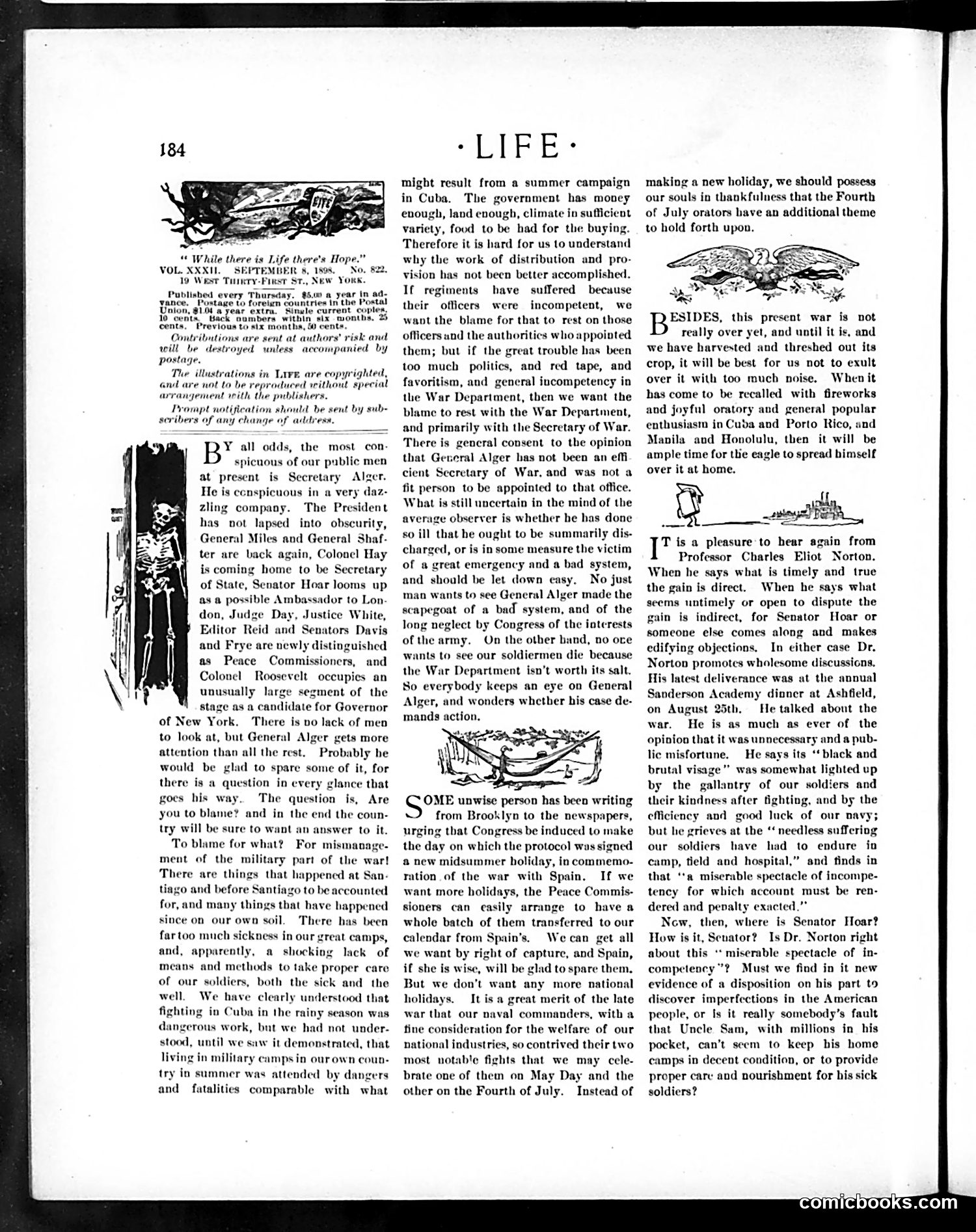
This page critiques Secretary of War Alger, a prominent government figure during the Spanish-American War era. The text argues that military incompetence and poor leadership—not individual soldiers—caused problems in the Cuba campaign. The satire targets those blaming Alger while defending him from removal, suggesting Congress bears responsibility for neglecting the War Department. The piece sarcastically notes that while General Alger receives scrutiny, no one wants soldiers to suffer due to departmental failures. The cartoon appears to depict figures in formal dress, likely representing government officials or military leaders being scrutinized for wartime mismanagement. The overall message: systemic governmental failure, not individual incompetence, caused soldiers' hardships during the Cuban campaign.
📄 Transcribed text from this page (OCR, searchable)
Machine-transcribed from the original scan — historical spelling and the odd misread are preserved.
* While there is Life there's Hope.” VOL. XXXI._ SEPTEMBER 8, 1898. 19 West Tune arsday. $50 a year lun countries in the Postal ‘Sinule current coptes. ambers within six months. 2) Cents. Previous to six months, @ cents, Contributions ars nt at authors’ risk and will be destroyed unless accompanied by postage. The illustrations in Lre are copyrighted, Gnd are not to be reproduced without special arrangement with the publishers. Prompt notification should be sent by sub- seribers of any change of address, Y all odds, the most con- spicuous of our public men at present is Secretary Alger. He is conspicuous in a very daz- zling company. The President has not lapsed into obscurity, General Miles and General Shaf- ter are back again, Colonel Hay is coming home to be Secretary of State, Senator Hoar looms up as a possible Ambassador to Lon- don, Judge Day, Justice White, Editor Reid and Senators Davis and Frye are newly distinguished as Peace Commissioners, and Colonel Roosevelt occupies an unusually large segment of the stage as a candidate for Governor of New York. There is vo lack of men to look at, but General Alger gets more attention than all the rest. Probably he would be glad to spare some of it, for there is a question in every glance that gocs his way. The question is, Are you to blame? and in the end the coun- try will be sure to want an answer to it. To blame for what? For mismanage- ment of the military part of the wart There are things that happened at San- tiago and before Santiago to be accounted for, and many things that have happened since on our own soil. There has been fartoo much sickness in our great camps, and, apparently, a shocking lack of means and methods to take proper care of our soldiers, both the sick and the well. We have clearly understood that fighting in Cuba in the rainy season was dangerous work, but we had not under- stood, until we saw it demonstrated, that living in military campsin our own coun- try in summer was attended by dangers and fatalities comparable with what LIFE might result from a summer campaign in Cuba. The government has money enough, land enough, climate in sufficient variety, food to be had for the buying. Therefore it is hard for us to understand why the work of distribution and pro- vision has not been better accomplished. If regiments have suffered because their officers were incompetent, we want the blame for that to rest on those officers and the authoritics who appointed them; but if the great trouble has been too much politics, and red tape, and favoritism, and gencral incompetency in the War Department, then we want the blame to rest with the War Department, and primarily with the Secretary of War. There is gencral consent to the opinion that General Alger has not been an effi cient Secretary of War, and was not a fit person to be appointed to that office. What is still uncertain in the mind of the average observer is whether he has done so ill that he ought to be summarily dis- charged, or is in some measure the victim of a great emergency and a bad system, and should be let down easy, No just man wants to see General Alger made the scapegoat of a bad system, and of the long neglect by Congress of the ioterests ofthe army. On the other band, no ore wants to see our soldiermen die because the War Department isn’t worth its salt, So everybody keeps an eye on General Alger, and wonders whether his case de- mands action, OME unwise person has been writing \ from Brooklyn to the newspapers, urging that Congress be induced to make the day on which the protocol was signed a new midsummer holiday, in commemo- ration of the war with Spain, If we want more holidays, the Peace Commis- sioners can easily arrange to have a whole batch of them transferred to our calendar from Spain's, We can get all we want by right of capture, and Spain, if she is wise, will be glad to spare them, But we don't want any more national holidays. It is a great merit of the late war that our naval commanders, with a tine consideration for the welfare of our national industries, so contrived their two most notable fights that we may cele- brate one of them on May Day and the other on the Fourth of July. Instead of making a new holiday, we should possess our souls in thankfulness that the Fourth of July orators bave an additional theme to hold forth upon. Besipes this present war is not really over yet, and until it is, and we have harvested and threshed out its crop, it will be best for us not to exult over it with too much noise, When it has come to be recalled with fireworks and joyful oratory and general popular enthusiasm in Cuba and Porto Rico, and Manila and Honolulu, then it will be ample time for the eagle to spread himself. over it at home. oil assy I* is a pleasure to hear again from Professor Charles Eliot Norton. When he says what is timely and true the gain is direct. When he says what seems untimely or open to dispute the gain is indirect, for Senator Hoar or someone else comes along and makes edifying objections, In either case Dr. Norton promotes wholesome discussions, His latest deliverance was at the annual Sanderson Academy dinner at Ashfield, on August 25th, He talked about the war. He is as much as ever of the opinion that it was unnecessary and a pub- lic misfortune. He says its ‘ black and brutal visage” was somewhat lighted up by the gallantry of our soldiers and their kindness after fighting, and by the efficiency and good luck of our navy; but he grieves at the ‘ needless suffering our soldiers have had to endure in camp, tield and hospital,” and finds in that ‘‘a miserable spectacle of incompe- tency for which account must be ren- dered and penalty exacted.” Now, then, where is Senator Hoar? How is it, Senator? Is Dr. Norton right about this * miserable spectacle of in- competency’? Must we find in it new evidence of a disposition on his part to discover imperfections in the American people, or fs it really somebody’s fault that Uncle Sam, with millions in his pocket, can’t seem to keep his home camps in decent condition, or to provide proper care and nourishment for his sick soldiers?