
Life, 1898-09-08 · page 3 of 20
Life — September 8, 1898 — page 3: what you’re looking at
What you’re looking at
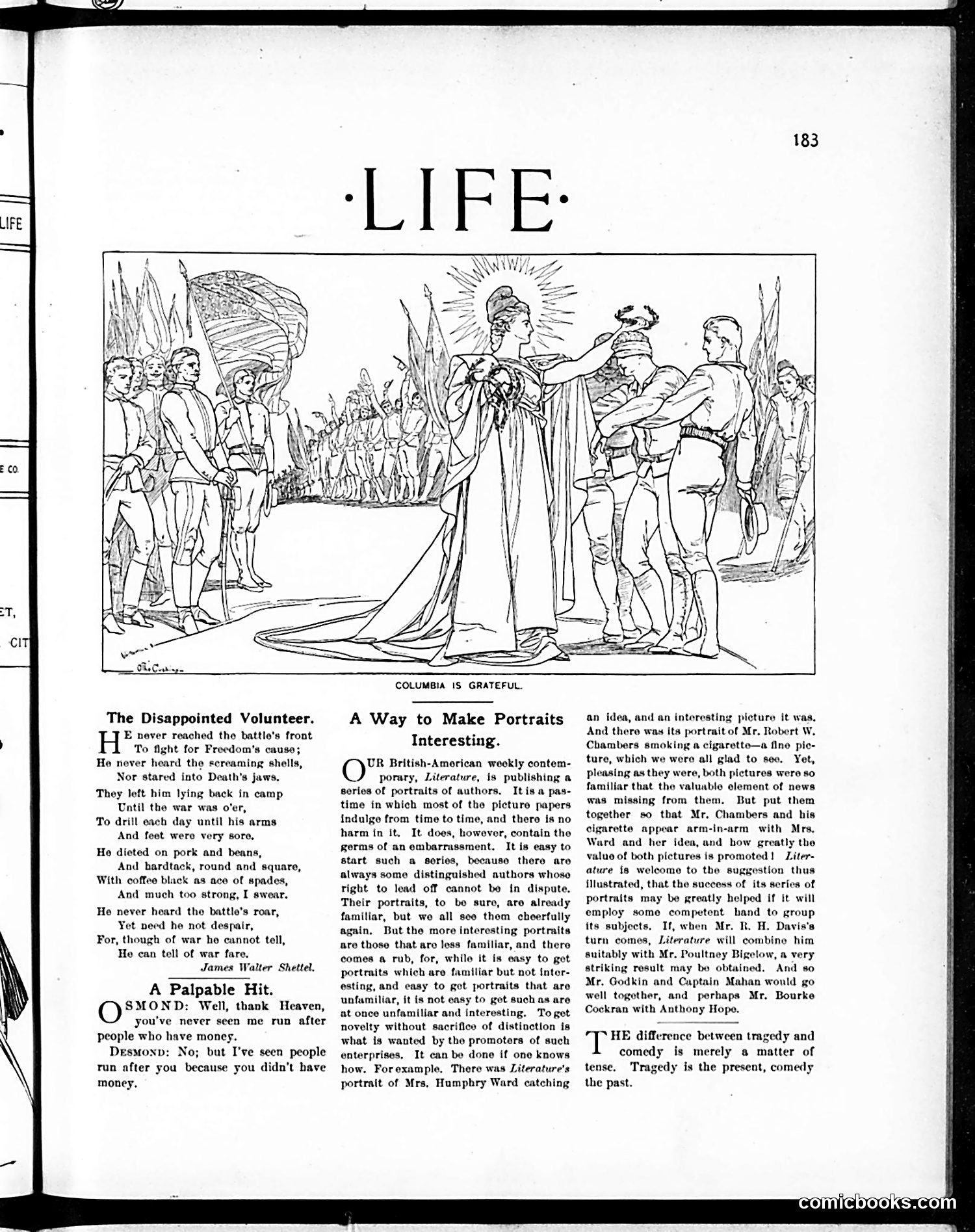
The main illustration, titled "Columbia Is Grateful," depicts a classical female figure (Columbia, personifying America) in flowing robes, surrounded by soldiers. She appears to be bestowing recognition or rewards upon military figures. The accompanying text discusses three separate pieces: 1. **"The Disappointed Volunteer"** - A poem about a soldier who expected combat but instead experienced mundane camp life and poor conditions. 2. **"A Palpable Hit"** - A brief dialogue where a character notes seeing wealthy people who lack money, suggesting irony about financial circumstances. 3. **"A Way to Make Portraits Interesting"** - An editorial discussing *Literature* magazine's author portrait series, debating whether unfamiliar subjects or distinguished authors make more compelling illustrations. The page blends military commentary with literary criticism, typical of *Life's* satirical approach.
📄 Transcribed text from this page (OCR, searchable)
Machine-transcribed from the original scan — historical spelling and the odd misread are preserved.
The Disappointed Volunteer. E never reached tho battle's front To fight for Freedom's causo; Ho never heard the screaming shells, Nor stared into Death's jaws, They left him lying back in camp Until the war was o'er, To drill each day until his arms And feet wero very sore, Ho dicted on pork and beans, And bardtack, round and square, With coffee black as ace of spades, And much too strong, I swear, Ho never heard the battle’s roar, Yet need he not despair, For, though of war ho cannot tell, He can tell of war fare, James Walter Shettel. A Palpable Hit. SMOND: Well, thank Heaven, you've never seen me run after people who have money. Desmonp: ; but I’ve seen people Tun after you because you didn’t have money. COLUMBIA IS GRATEFUL. A Way to Make Portraits Interesting. UR British-Amorican wookly contem- porary, Literature, is publishing a series of portraits of authors. Itis a pas- time in which most of the picture papers Indulge from time to time, and thero is no harm in it. It does, howover, contain tho germs of an embarrassment. It is easy to start such a sories, because there aro always some distinguished authors whoso right to lead off cannot be in dispute. Their portraits, to bo suro, aro already familiar, but wo all sco them cheerfully again, But the more interesting portraits are those that are less familiar, and thero comes a rub, for, while it is easy to got portraits which aro familiar but not inter- esting, and easy to got portraits that aro unfamiliar, it is not easy to get such as are at once unfamiliar and interesting. To get novelty without sacrifice of distinction fs what is wanted by the promoters of such enterprises, It can be done if one knows how. Forexample, There was Literature’s portrait of Mrs, Humphry Ward catching an idea, and an interesting picture it was, And there was its portrait of Mr. Robert W. Chambers smoking a cigaretto—a flno pic- ture, which we wero all glad to see, Yet, pleasing as they were, both pictures wero so familiar that tho valuable olement of news was missing from them. But put them together so that Mr, Chambers and his cigarette appear arm-in-arm with Mra, Ward and her idea, and how greatly tho valuo of both pictures is promoted! Liter- ature is welcome to the suggestion thus ilustrated, that the success of its series of portraits may be greatly helped if it will employ some competent band to group its subjects, If, when Mr. R. H. Davis's turn comes, Literature will combine him suitably with Mr, Poultney Bigelow, a very striking result may be obtained. And so Mr. Godkin and Captain Mahan would go well together, and perhaps Mr. Bourke Cockran with Anthony Hope. HE difference between tragedy and comedy is merely a matter of tense. Tragedy is the present, comedy the past.