
A complete issue · 20 pages · 1898
Life — August 25, 1898
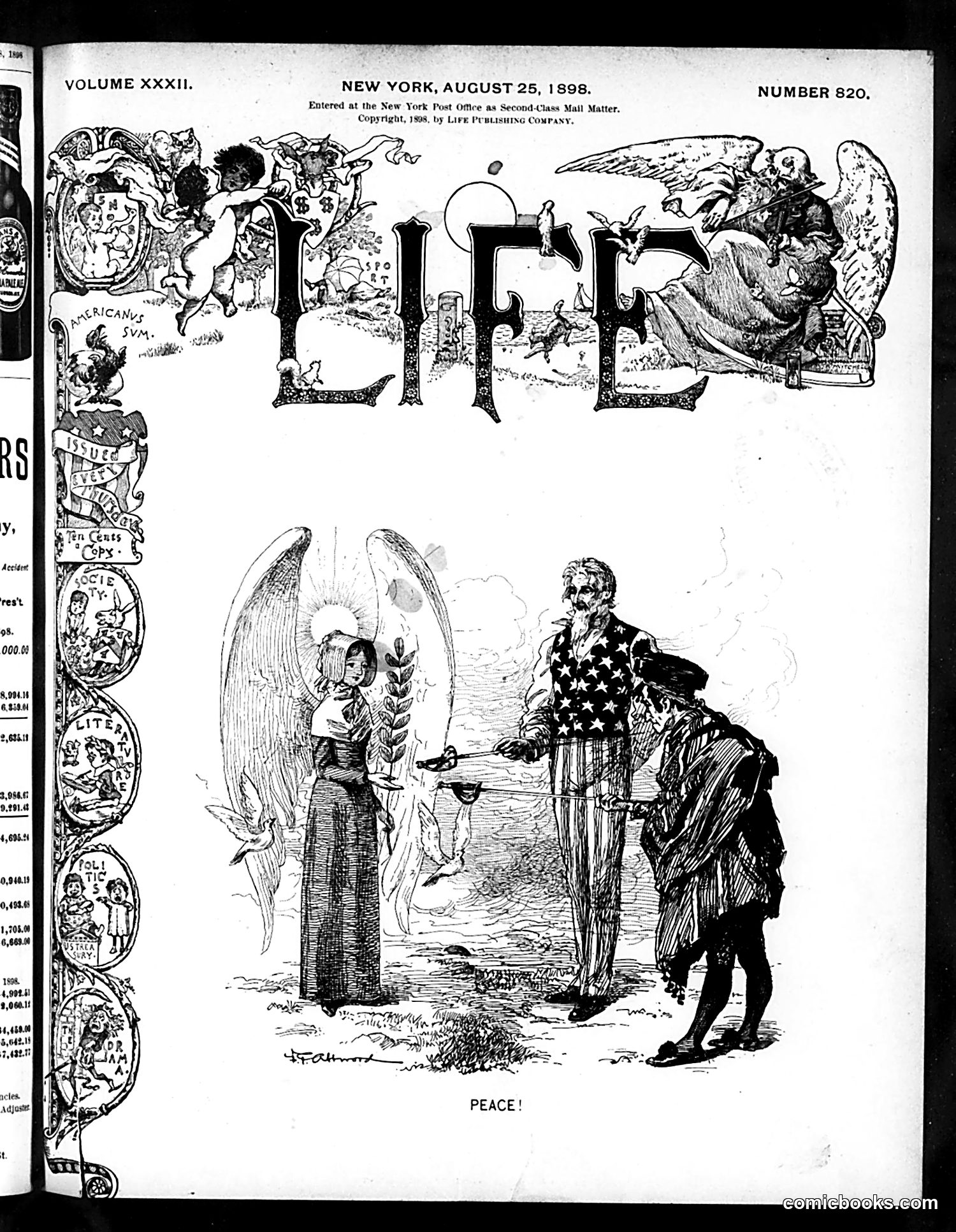
This satirical illustration depicts an angel (representing Peace) meeting with what appears to be Uncle Sam (identifiable by the stars-and-stripes vest). The caption reads "PEACE!" The cartoon likely comments on U.S. military involvement around 1898—potentially the Spanish-American War, which ended that August. The angel's gesture toward the figure suggests an ironic commentary: Peace is being offered to or negotiated with America, possibly criticizing American imperial expansion despite the conflict's conclusion. The winged female figure personifies Peace as a classical allegorical device common in 19th-century political cartoons. The juxtaposition suggests tension between ideals of peace and American military/political ambitions during this period of American imperialism.
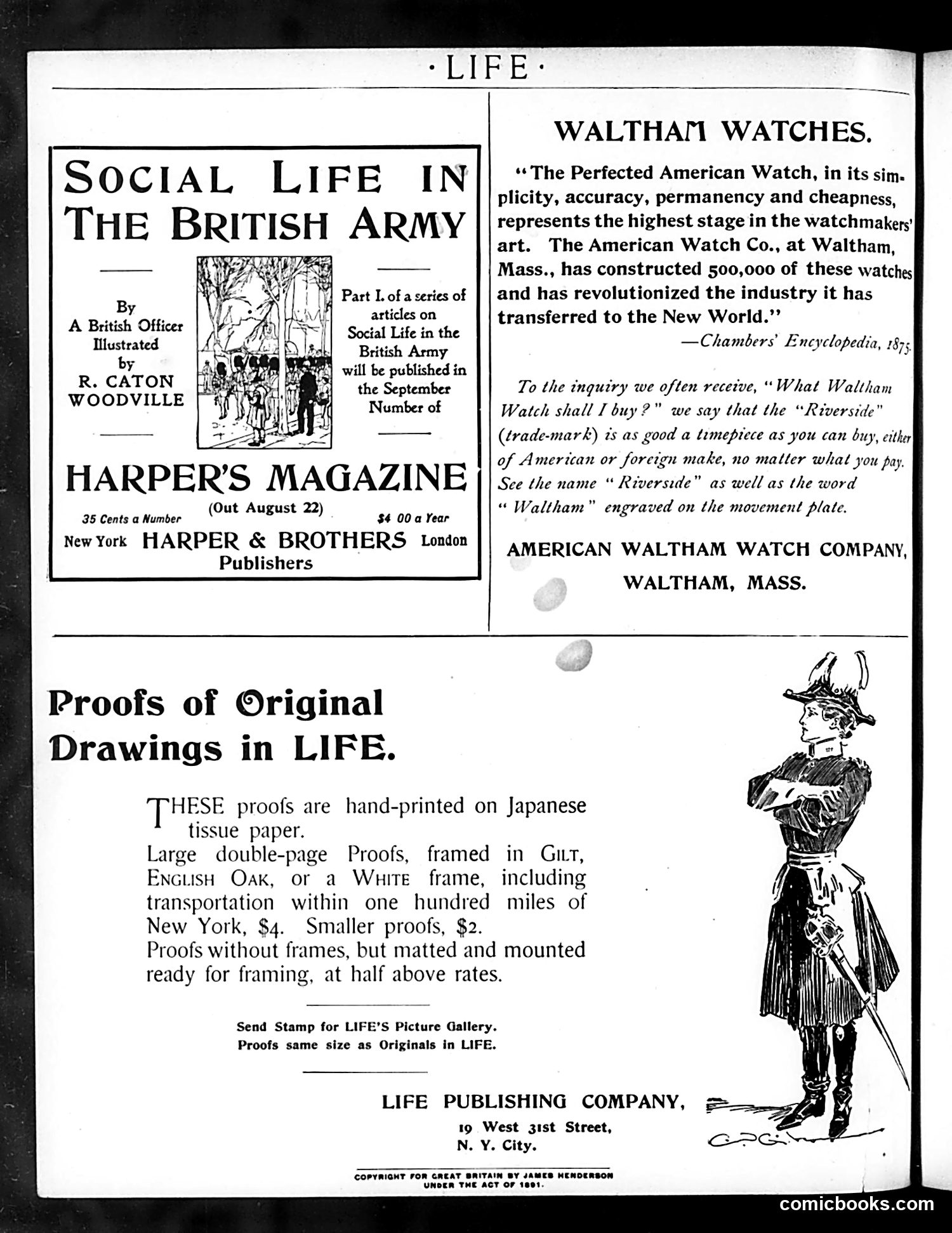
This page is primarily **advertising and promotional content**, not political satire. It contains: 1. **Harper's Magazine advertisement** (left): Announces an upcoming article series on "Social Life in the British Army" by a British officer, illustrated by R. Caton Woodville. 2. **Waltham Watches advertisement** (top right): Promotes American-made timepieces, claiming superiority in "simplicity, accuracy, permanency and cheapness" over foreign watches. References the company's 500,000 units produced. 3. **Life Publishing Company promotion** (bottom): Offers framed proofs of original drawings from Life magazine, printed on Japanese tissue paper with various frame options. 4. **Fashion illustration** (right): A woman in Edwardian-era dress with a large feathered hat and sword—likely decorative rather than satirical commentary. The page reflects early-20th-century consumer culture and magazine advertising practices.
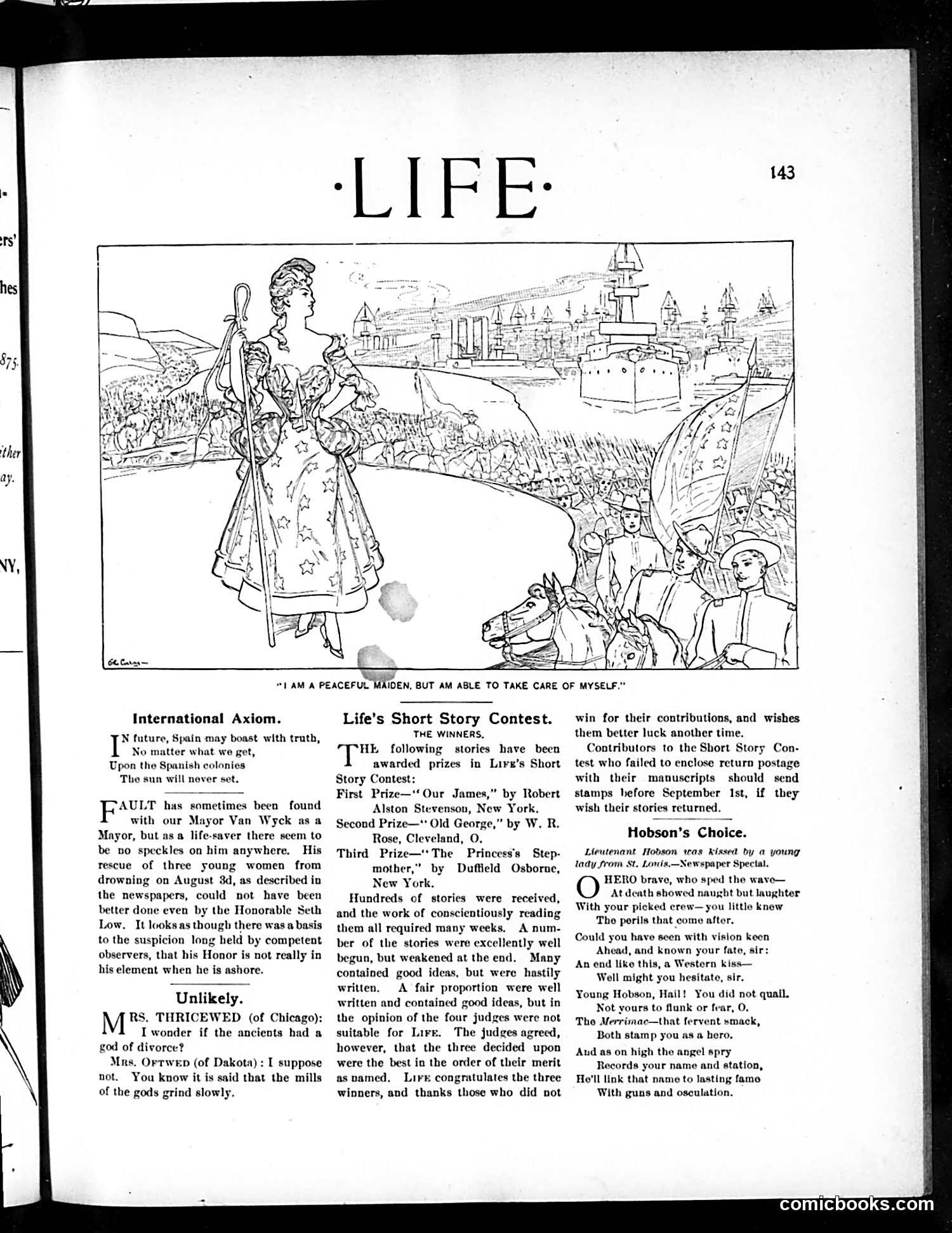
The main illustration depicts a woman in medieval or Renaissance costume standing prominently before a fortified city and assembled crowds. The caption reads: "I AM A PEACEFUL MAIDEN, BUT AN ABLE TO TAKE CARE OF MYSELF." This appears to be satirical commentary on female independence and self-sufficiency, likely from the early 20th century when women's rights were debated. The woman's confident pose—holding a staff, dressed ornately—contrasts with traditional notions of passive femininity. The historical costume suggests ironic comparison to historical female figures. The accompanying text announces Life's Short Story Contest winners. Below are humorous exchanges mocking ancient philosophy and religion, and a poem titled "Hobson's Choice" about military heroism. The overall page combines satirical commentary on gender roles with literary content typical of Life magazine's satirical format.
This page contains political commentary rather than cartoons. The text discusses U.S. policy toward Cuba following what appears to be the Spanish-American War era. Key points satirized: **The Cuba question**: The author critiques American justifications for involvement in Cuba, arguing the U.S. should either fully commit to Cuban independence or acknowledge self-interest rather than moral posturing. **Secretary of State salary debate**: The piece mocks discussion of whether Secretary Day deserves higher pay, suggesting the position shouldn't require private wealth to sustain it—a critique of expecting government officials to subsidize their own roles. **Political appointments**: References to Colonel Astor and Colonel Roosevelt as potential Congressional candidates suggest satire of wealthy figures entering politics, questioning their actual military credentials versus their public image. The satire targets American imperial ambitions and political hypocrisy regarding Cuba while questioning whether wealthy dilettantes should hold office.
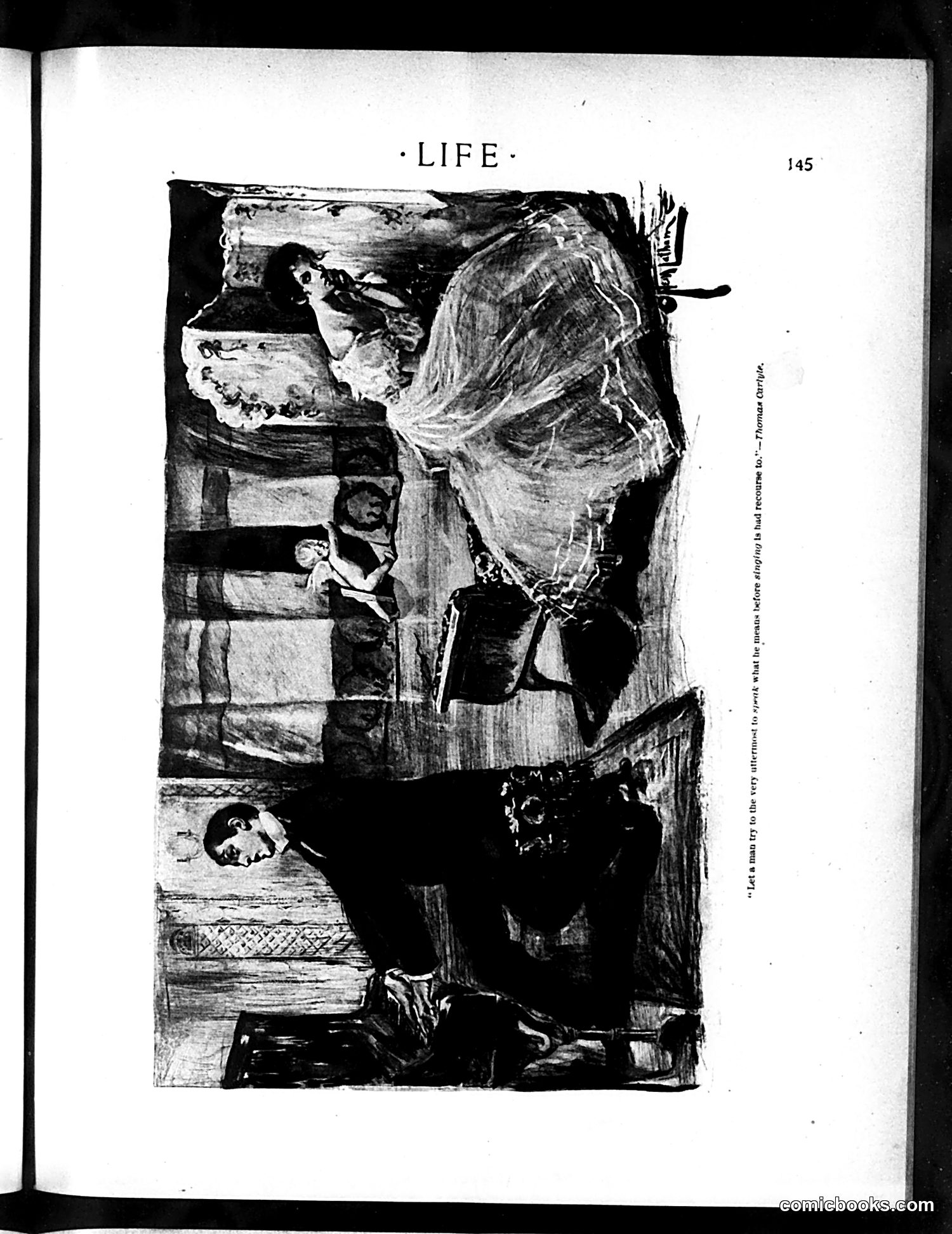
I can see this is a page from *Life* magazine (page 145) with a black and white illustration, but the image quality and orientation make it difficult to read the OCR text clearly or identify specific figures with certainty. The illustration appears to show an interior domestic scene with multiple figures, rendered in a sketchy artistic style typical of early-to-mid 20th century satirical art. There seem to be several people in what looks like a home setting, possibly depicting some kind of social interaction or commentary. Without clearer text or caption visibility, I cannot reliably identify the specific political or social references, the named figures being caricatured, or the satirical point being made. To provide accurate historical context as requested, I would need either a clearer image or visible captions explaining the cartoon's subject matter.
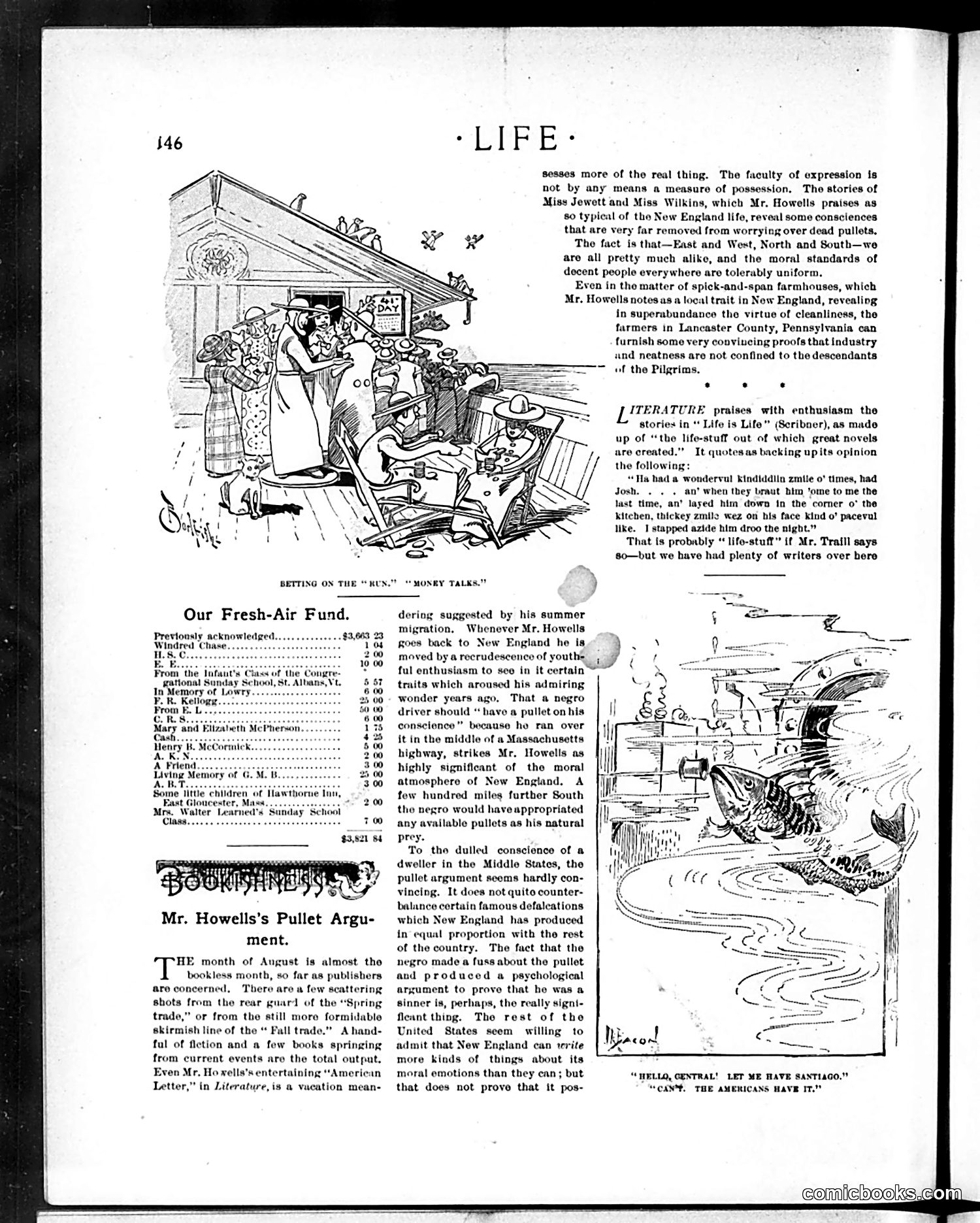
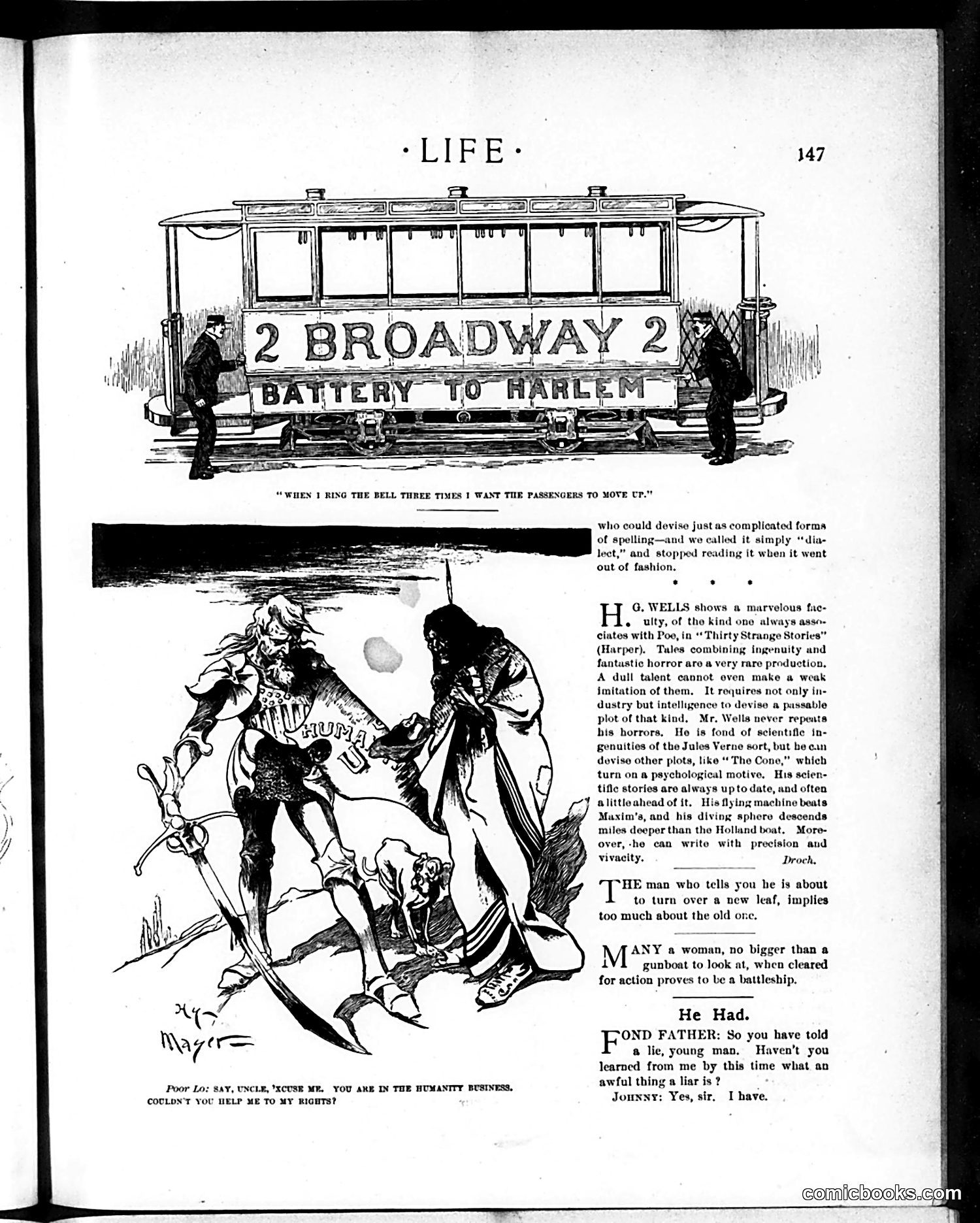
**The Top Image:** A streetcar labeled "2 BROADWAY 2 / BATTERY TO HARLEM" depicts a conductor's management challenge. The caption quotes him saying "When I ring the bell three times I want the passengers to move up"—satirizing the difficulty of coordinating crowded public transportation. **The Bottom Cartoon:** Titled "He Had," this depicts a moral lesson between a "Fond Father" and "Johnny." The father questions whether Johnny has learned what a liar is, and Johnny confirms he has. The accompanying illustration shows fantastical figures (possibly representing lies or deception) in an exaggerated style. This is straightforward Victorian-era moral satire about teaching children honesty, a common Life magazine theme.
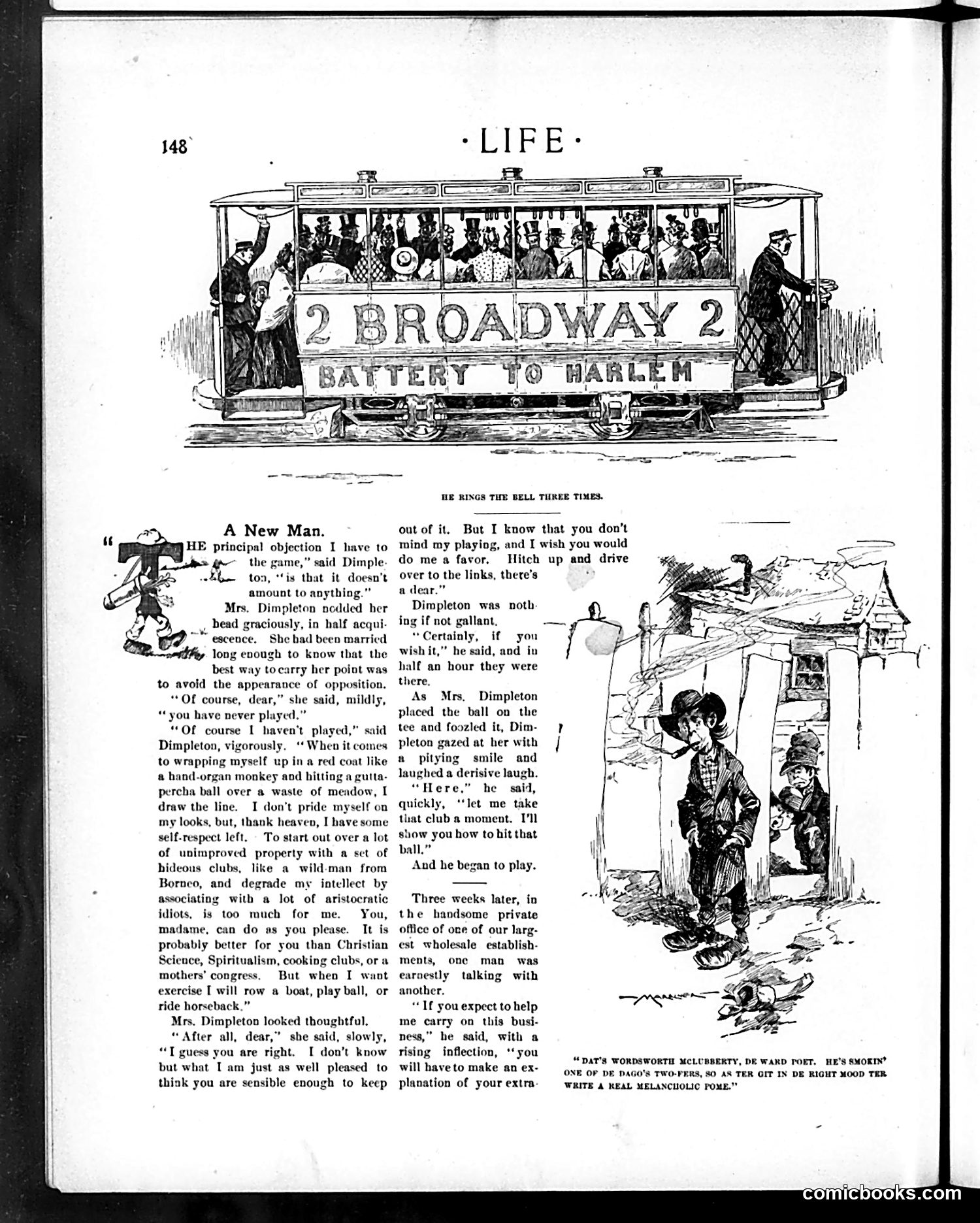
This page features a story about a man named Dimpleton who is socially awkward and wants to learn golf to improve his standing among the aristocratic set. His wife encourages him to take up the sport, believing it will help him fit in with upper-class society. The satirical point targets the Gilded Age obsession with golf as a status symbol. The story mocks both Dimpleton's social climbing and his clumsiness—he's so incompetent that even with instruction, he's unlikely to succeed. The humor lies in the contrast between aspiration and ability: golf was marketed as a gentleman's game, yet Dimpleton's working-class origins and lack of grace make him perpetually unsuitable, regardless of effort. The satire critiques both social pretension and the exclusionary nature of elite leisure activities.
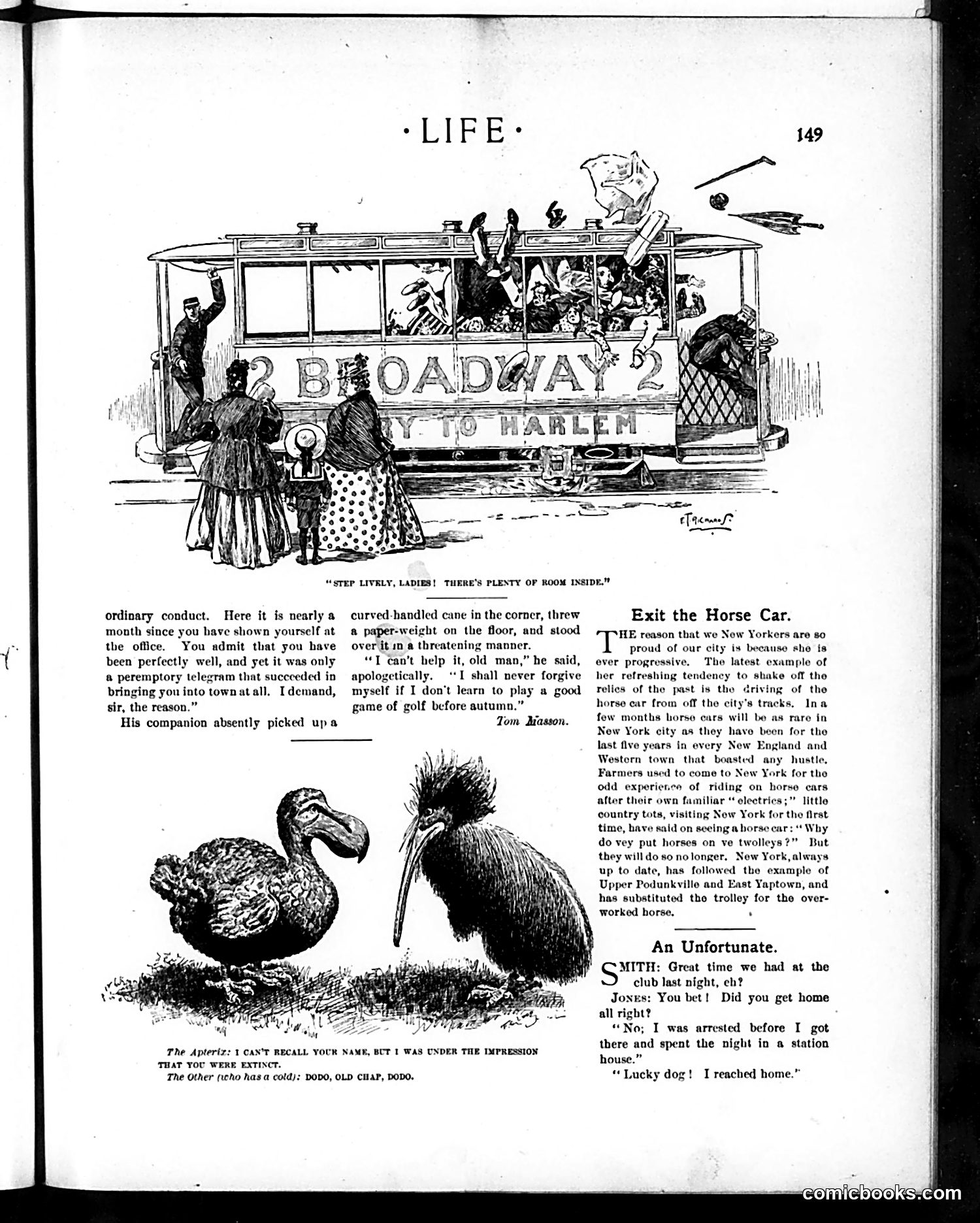
This page contains two distinct pieces: **Top Illustration:** A satirical drawing of a crowded streetcar labeled "Broadway" heading to Harlem. The caption reads "Step lively, ladies! There's plenty of room inside," mocking the contrast between the vehicle's obviously packed interior and the conductor's false claim. This references the popularity of Broadway entertainment and Harlem's emergence as a nightlife destination in what appears to be the Jazz Age era. **Bottom Section:** Two separate humorous dialogues: - A conversation about golf, where one man apologizes for poor play - "An Unfortunate" sketch where Jones asks Smith about a night out, and Smith reveals he was arrested and spent the night in a police station house—a joke about misadventure The illustrations use period caricature style typical of early 20th-century American satire.
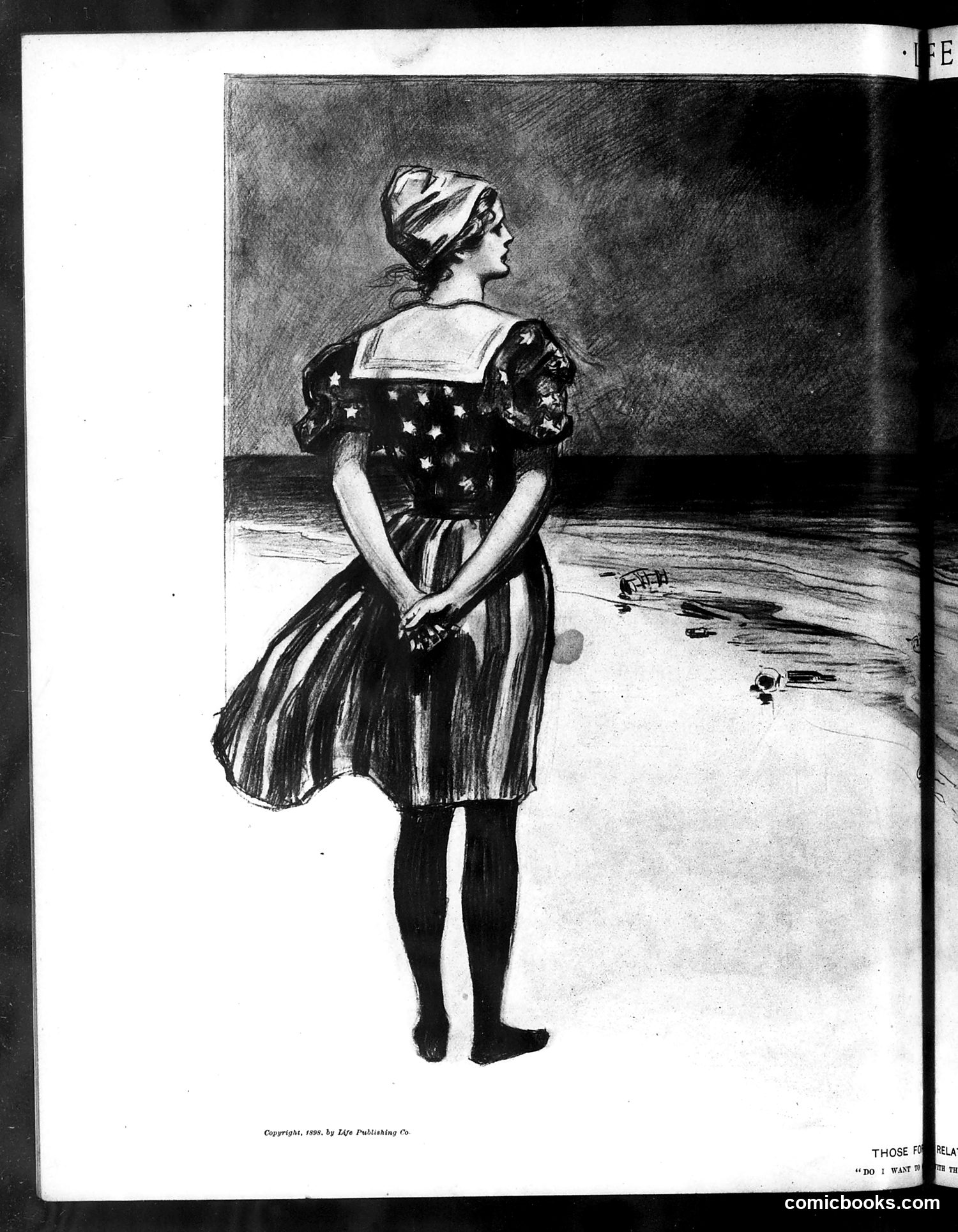
This 1902 Life magazine illustration shows a young woman in an elegant dress with a starred pattern, viewed from behind. She wears a decorative headwrap and stands in a contemplative pose with hands clasped. The copyright credit reads "Copyright, 1902, by Life Publishing Co." Partial text visible on the right edge reads "THOSE P[...]ELA" and "DO I WANT[...] TE TH[...]" Without the complete caption or surrounding text, the specific satirical point is unclear. However, the formal dress, headwrap styling, and the woman's posed stance suggest this may be commentary on fashion, gender roles, or social expectations of the Edwardian era. The incomplete visible text prevents definitive identification of the cartoon's intended message or any referenced public figures or events.
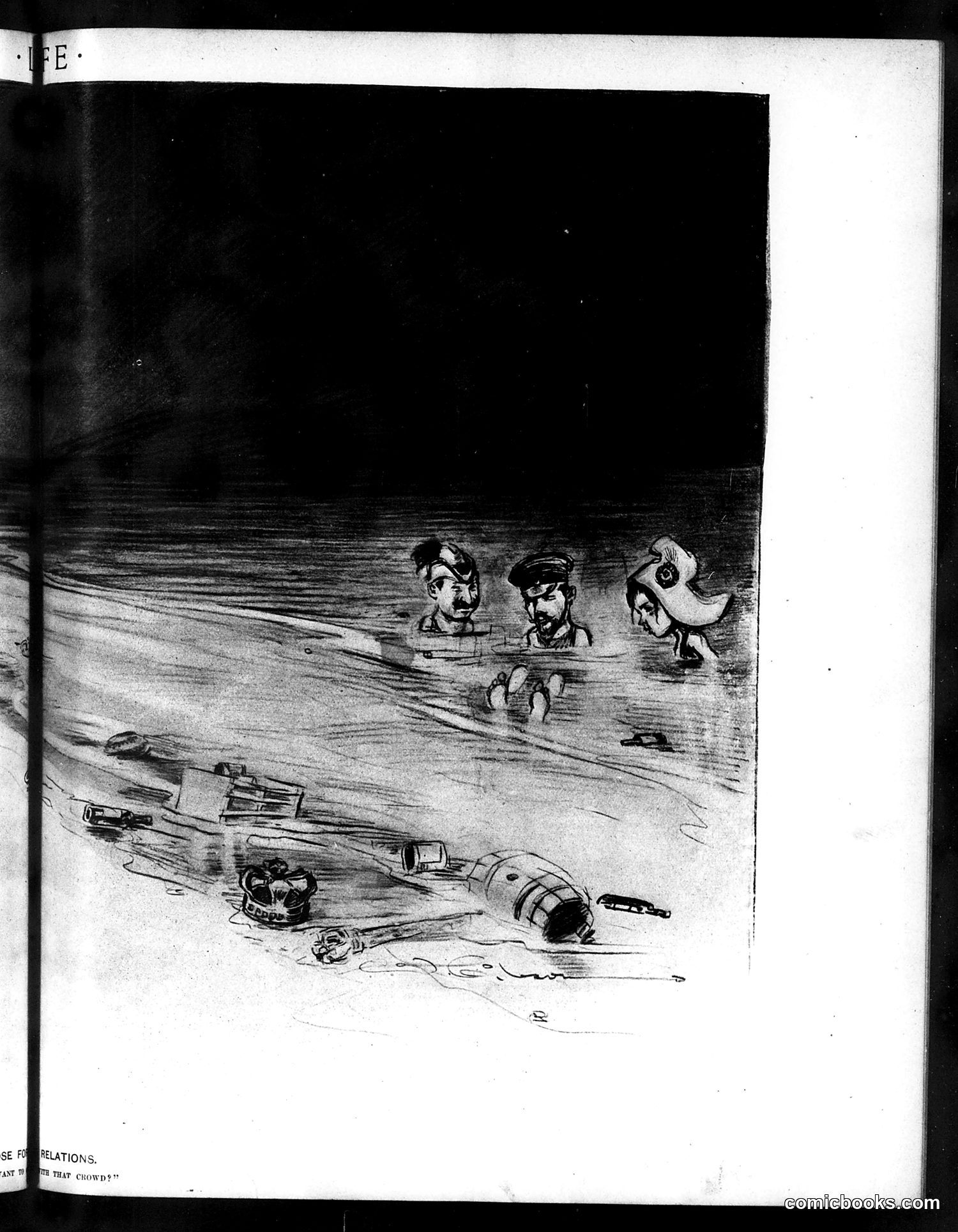
This appears to be a satirical cartoon from Life magazine depicting three figures in water surrounded by various mechanical devices and tools scattered on the ground. The figures are drawn in caricature style with exaggerated facial features typical of early 20th-century political cartoons. The visible text fragment mentions "RELATIONS" and what appears to be "THAT CROWD," though the full context is unclear from this partial page view. The mechanical debris—including what look like industrial tools, possibly bombs or explosives—suggests commentary on industrial conflict, labor relations, or international tensions involving technology or warfare. Without clearer text or identifying labels visible in the image, I cannot definitively identify the specific figures or the precise political event being satirized. The cartoon likely critiques some contemporary scandal or conflict, but specific details remain uncertain from this damaged reproduction.
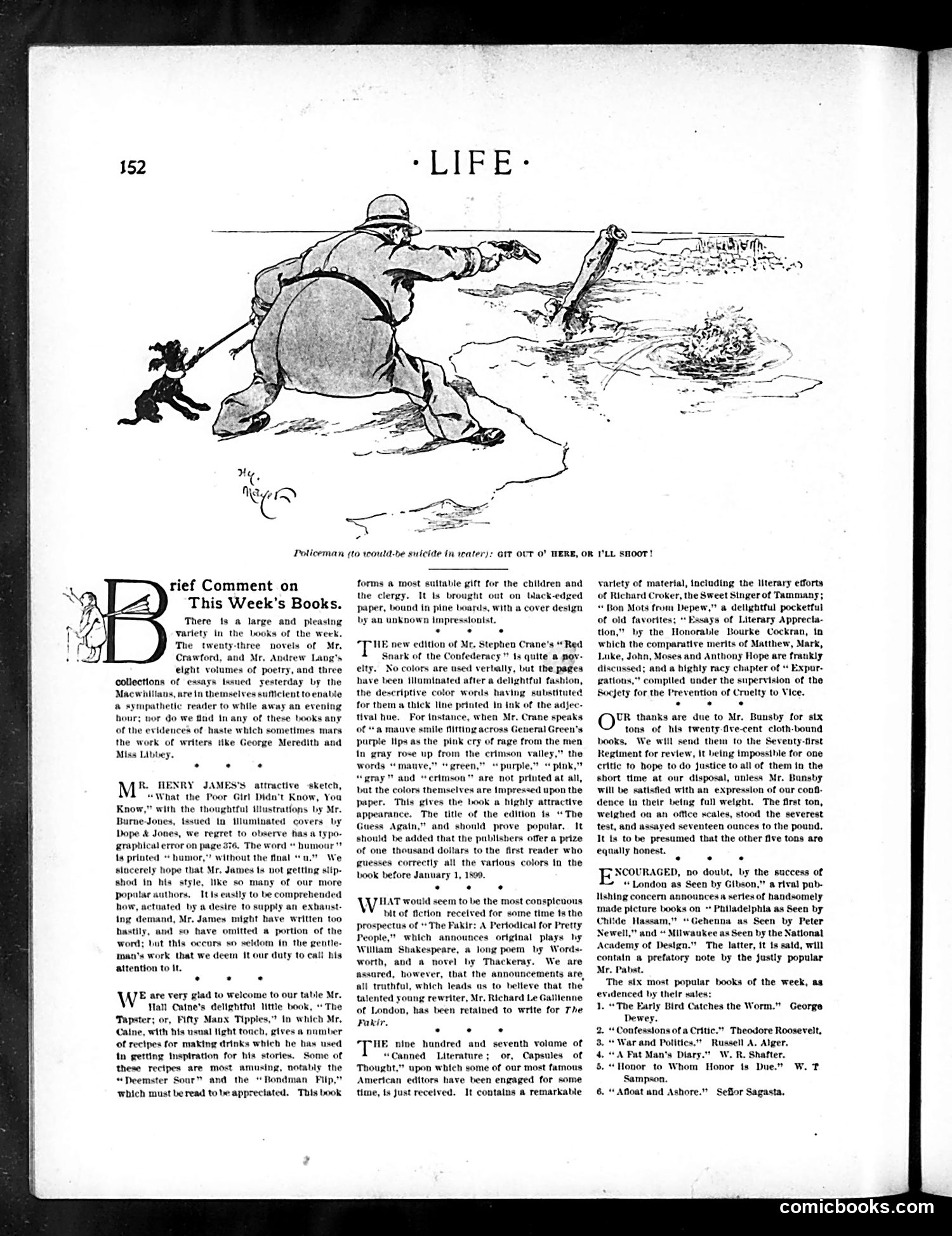
This page contains book reviews rather than political cartoons. The main illustration shows a rotund policeman pointing a gun at a thin man near water, with caption: "Policeman (to would-be suicide in waters): GET OUT O' HERE, OR I'LL SHOOT!" The cartoon satirizes police incompetence or callousness—the officer threatens to shoot someone attempting suicide, an absurd "solution" that defeats the purpose of rescue. It's dark humor mocking both police brutality and the era's casual attitude toward mental health crises. The surrounding text reviews various books from the week, including works by Mr. Crawford and Mr. James Payn, discussing literary merit and publishing trends. No specific political figures or events are referenced in the visible content.
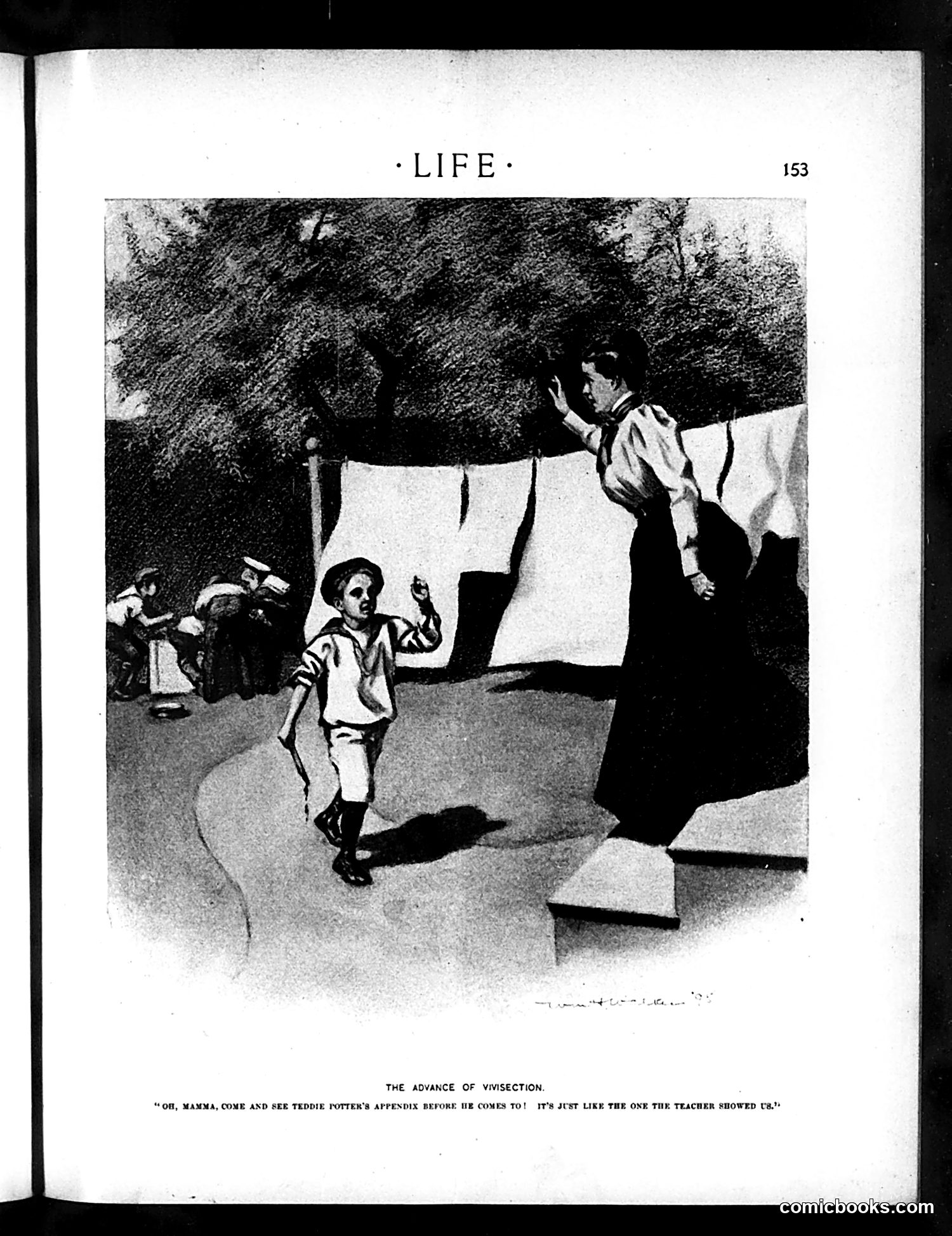
This is a satirical cartoon criticizing the teaching of human anatomy, likely in schools. The caption shows a child excitedly calling his mother to view another child's appendix "before he comes to" (before anesthesia takes effect), comparing it to a classroom anatomy lesson. The satire targets the "advance of vivisection"—the practice of operating on living subjects for scientific education. The cartoon mocks what it portrays as an excessive or inappropriate extension of medical education into casual domestic life, treating a child's surgery as entertainment comparable to a school demonstration. The humor derives from the grotesque juxtaposition: surgery presented as casual spectacle rather than serious medicine, and children treating a peer's surgical procedure as educational fun. This reflects period anxieties about modernization, medical practice boundaries, and appropriate exposure for children.
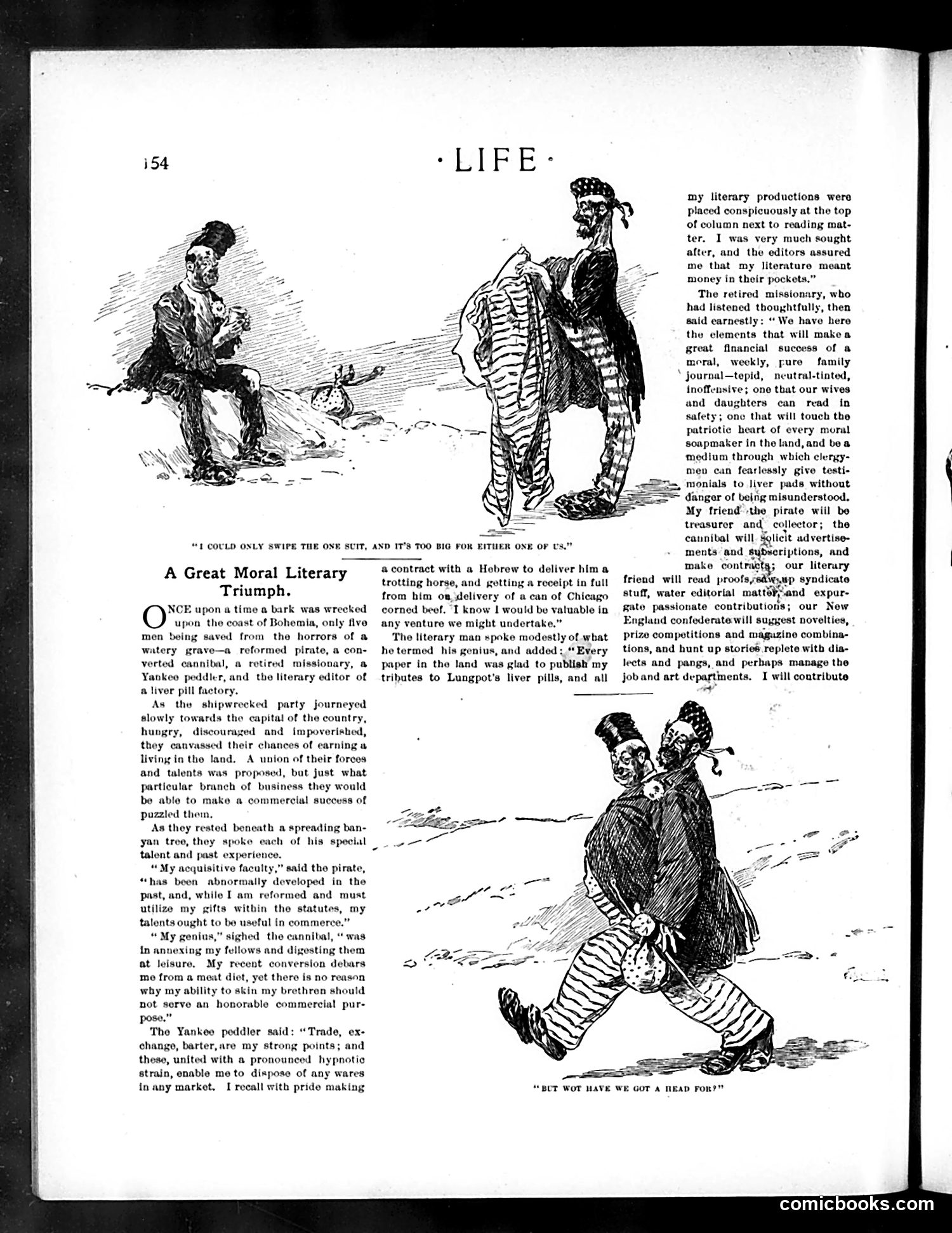
This satire mocks the commercialization of American journalism and the compromised ethics of editors willing to publish anything for profit. Five shipwrecked men—a reformed pirate, converted cannibal, retired missionary, Yankee peddler, and liver-pill factory literary editor—scheme to launch a "moral family journal." The joke: each man's criminal or dubious past becomes an asset. The pirate handles finances (theft repackaged as collection), the cannibal solicits ads (exploitation as persuasion), the peddler hawks content (fraud as salesmanship), and the literary editor "waters" contributions and censors anything controversial—all while a missionary validates the enterprise as wholesome. The cartoon ridicules how American newspapers of this era (likely 1870s-80s) sacrificed editorial integrity for advertiser money, particularly from patent medicines like "Lungpot's liver pills." The satire suggests respectable journalism was merely reformed criminality dressed in moral language.
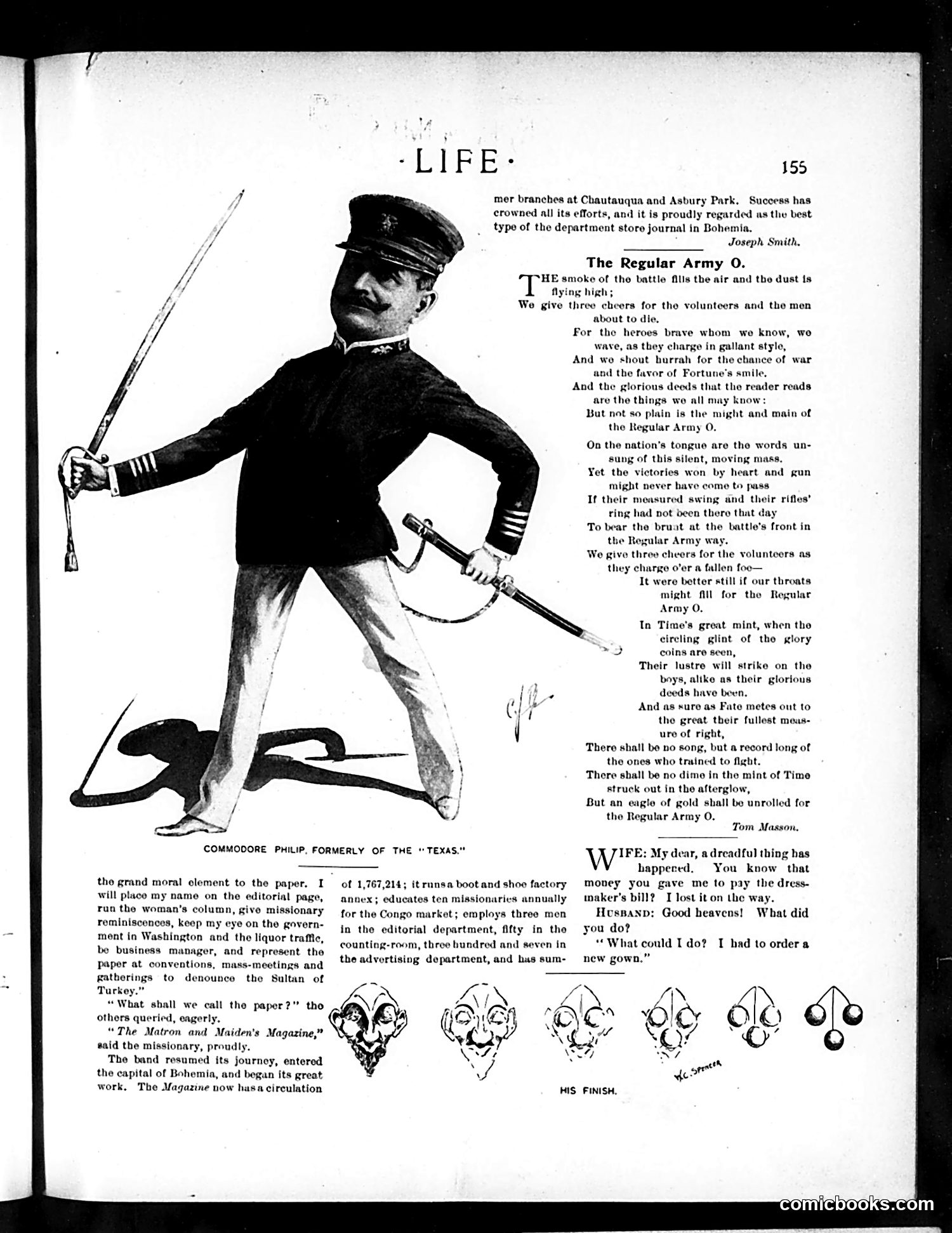
This page contains two distinct pieces: **"The Regular Army O"** (poem by Tom Masson): A patriotic poem celebrating the U.S. Regular Army's unsung contributions to military victories, contrasted with the celebrated volunteers. The piece argues that while volunteers receive public cheers and recognition, the disciplined regular soldiers—the trained, professional force—deserve equal or greater credit for battlefield success. This reflects early 20th-century debates about military organization and the tension between volunteer forces and standing armies. **The illustration** (captioned "Commodore Philip, Formerly of the 'Texas'") depicts a military officer in uniform wielding a sword. This appears to reference the Spanish-American War era, likely Commander Philip of the USS Texas, though context for the specific satirical point is unclear from this page alone. **The wife/husband dialogue** is a brief domestic humor sketch about a wife losing dress-maker money and ordering a new gown instead—typical period satire about women's spending habits.
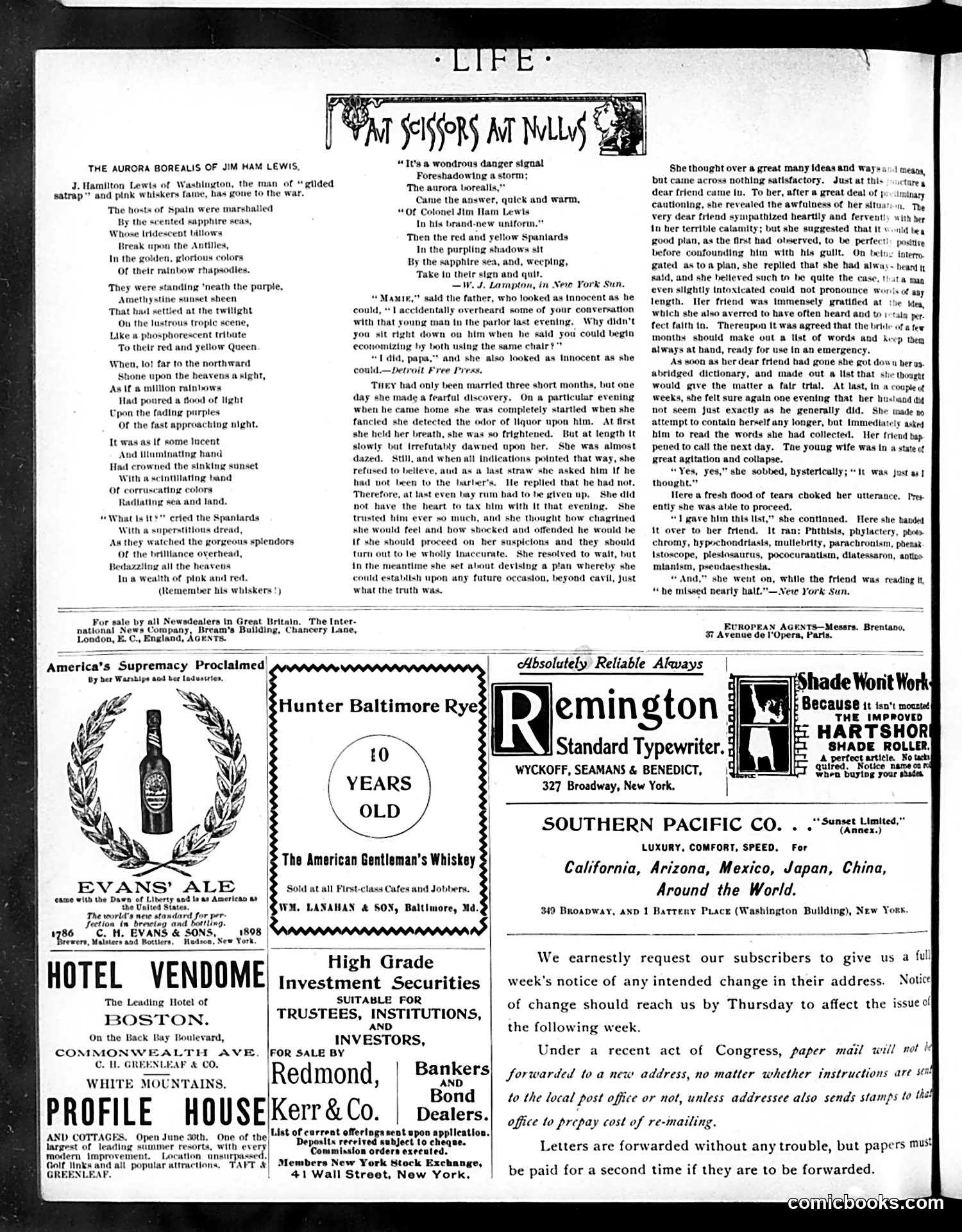
This page from *Life* magazine contains satirical poetry and humorous anecdotes typical of the publication's content. The main cartoon/poem, "The Aurora Borealis of Jim Ham Lewis," mocks Representative James Hamilton Lewis of Washington, known for his distinctive pink whiskers and flamboyant speech. The satire imagines Spanish forces during the Spanish-American War fleeing in terror when they mistake Lewis's red-and-pink uniformed presence for an aurora borealis—implying his notorious appearance is so striking it could frighten enemies. The joke ridicules Lewis's vanity and eccentric public persona. Below are two separate humorous domestic anecdotes: one about a couple economizing by sharing a chair, another about a newlywed wife suspicious her husband has been drinking, planning to test whether intoxication prevents pronouncing long words. The page is primarily filled with period advertisements (whiskey, typewriters, hotels, investment services), which was standard for *Life* magazine.
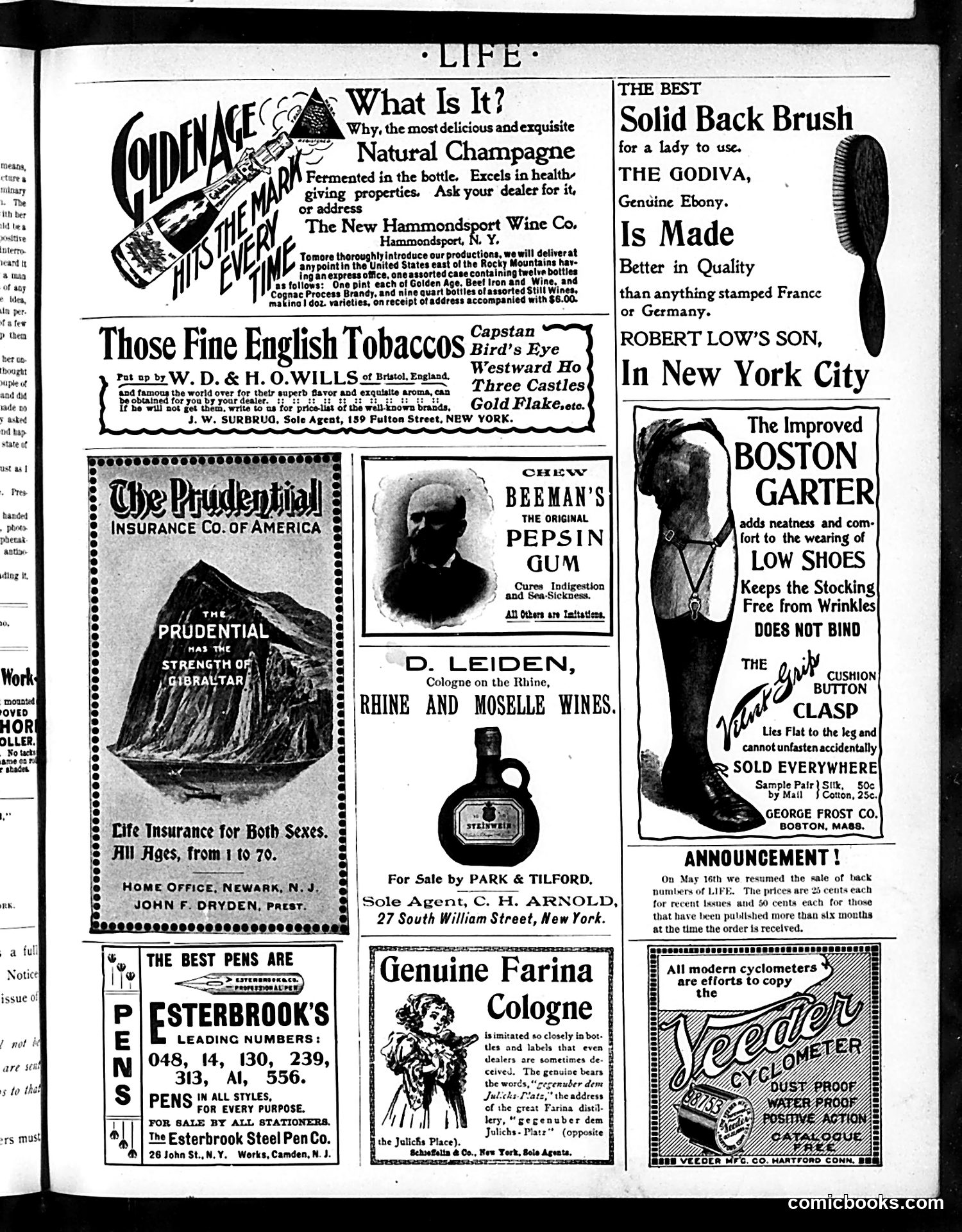
This page is primarily **advertising**, not political satire or editorial cartooning. It contains commercial advertisements typical of early 20th-century *Life* magazine, including: - Champagne and wine promotions - English tobacco brands (Capstan, Gold Flake) - Patent medicines (Beeman's Pepsin Gum for indigestion) - Life insurance (Prudential) - Consumer goods (pens, brushes, garters, shoes) - Cologne and hygiene products The only quasi-editorial content is **The Prudential Insurance advertisement** featuring Gibraltar's Rock, using nationalist imagery ("strength of Gibraltar") to market life insurance across ages 1-70. There is **no political cartoon or satirical commentary** visible on this page. It represents typical commercial space-selling from a magazine that balanced advertising revenue with editorial content. The "Life" brand name suggests satirical intent elsewhere in the magazine, but this particular page is straightforward product promotion.
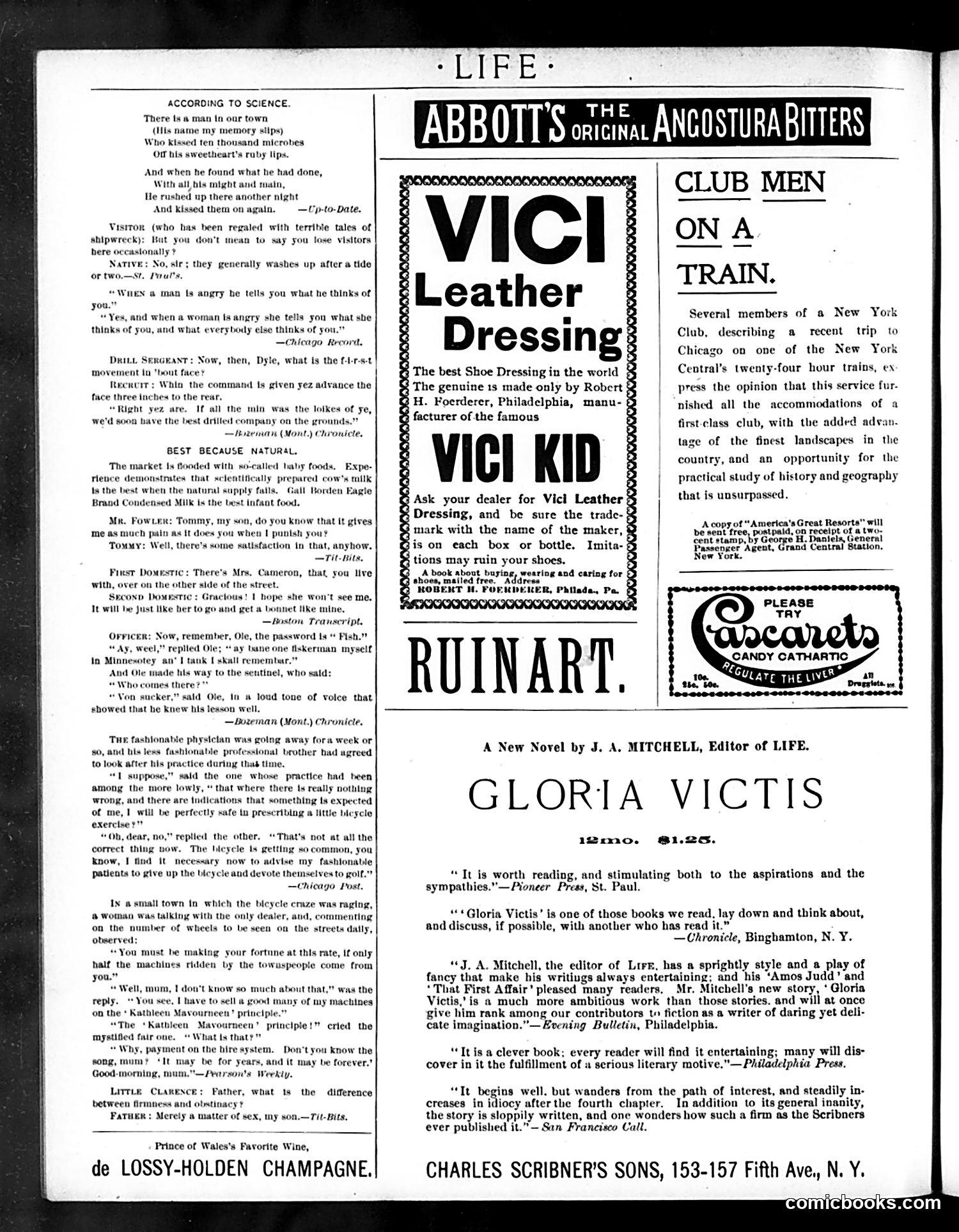
This page is primarily **advertisements and humorous anecdotes** rather than political cartoons. The content reflects early 1900s American humor and social commentary: **Main Jokes:** - A series of brief comedic vignettes about courtship, military training, bicycles, and social behavior - References to the bicycle craze (then fashionable among wealthy urbanites) - Gender stereotypes (women's anger, women's fashion competitiveness) - Class humor (bicycle shop owner using hire-purchase system; physicians abandoning bicycles for golf as fashionable exercise) **Advertisements:** - Vici Kid leather shoe dressing - Abbott's Angostura Bitters - Cocomel candy - De Lossy-Holden Champagne - A novel, *Gloria Victis*, by J.A. Mitchell (Life's editor) **No political satire is evident.** The humor is domestic and social—typical of Life's satirical approach to everyday middle-class American life of the period. The "drill sergeant" anecdote gently mocks military training; the bicycle content reflects contemporary consumer culture fascination.
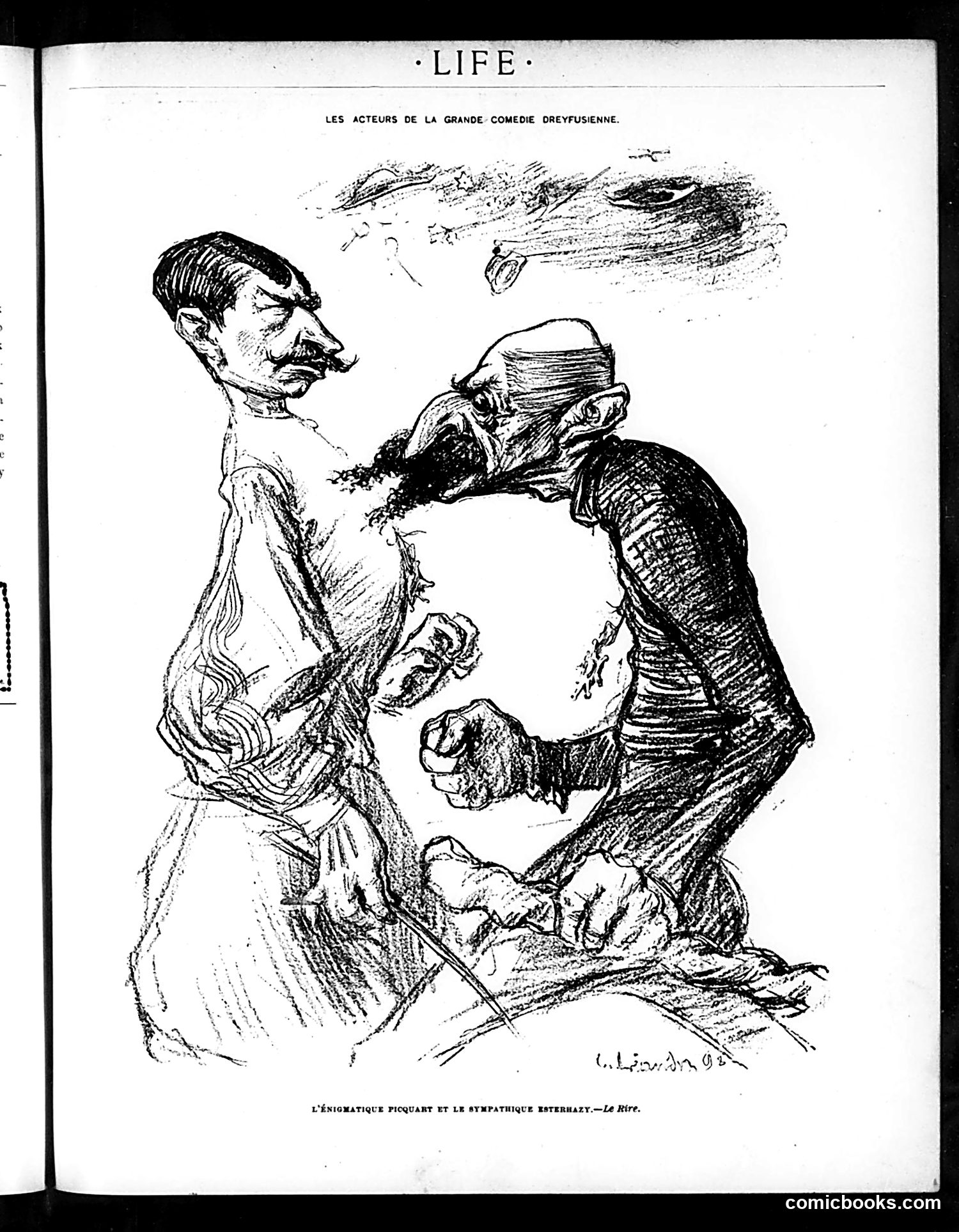
This French satirical cartoon from *Life* magazine depicts two figures in an ambiguous physical confrontation. Based on the caption naming "Picquart" and "Esterhazy," this likely references the Dreyfus Affair, the major French political scandal of the 1890s. Colonel Picquart was a military officer who exposed evidence of Alfred Dreyfus's innocence, while Major Esterhazy was the actual traitor. The caption's ironic descriptions—calling Picquart "enigmatic" and Esterhazy "sympathetic"—mock French society's response to the scandal. The cartoon appears to satirize the physical and political struggle between these figures, with the ambiguity about who is attacking whom reflecting the confusion and reversals of the actual historical controversy, where the guilty man initially seemed innocent and the truth-teller faced persecution.
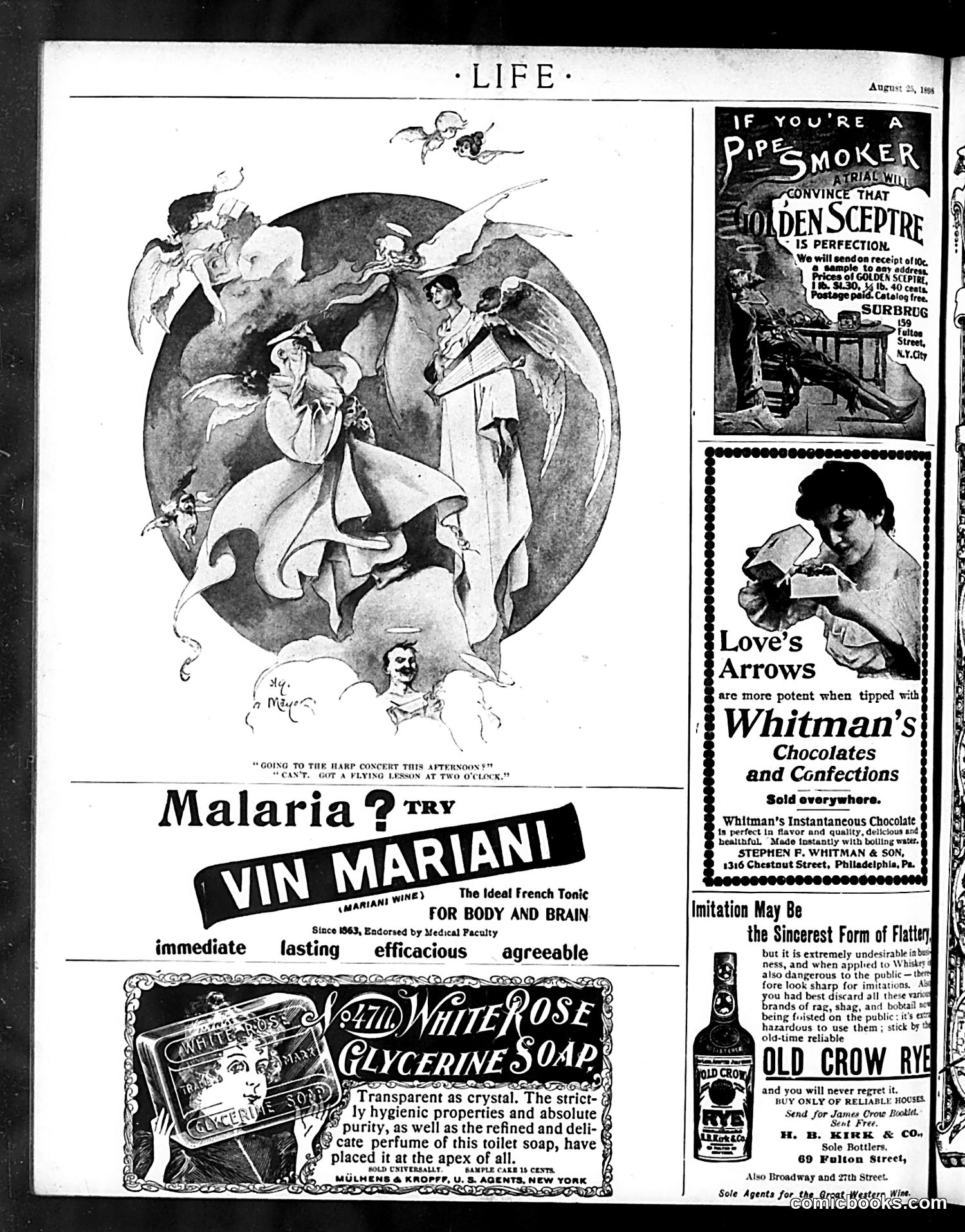
The main cartoon depicts figures engaged in aerial activities—likely referencing the early aviation craze of 1908. The dialogue joke contrasts a mundane social obligation (harp concert) with the novelty thrill of flying lessons, suggesting that aviation was becoming fashionable enough among the wealthy to compete with traditional cultural events. The page is primarily **advertising**, featuring patent medicines and luxury goods typical of the era: Vin Mariani (a cocaine-containing wine marketed as medicinal), White Rose Glycerine Soap, Whitman's Chocolates, and Old Crow Rye whiskey. These ads reflect early-1900s consumer culture where unregulated substances were openly promoted for health benefits. The cartoon itself appears to satirize the faddish enthusiasm for new technologies and leisure activities among the upper classes, rather than making a specific political statement.