
Life, 1898-08-25 · page 8 of 20
Life — August 25, 1898 — page 8: what you’re looking at
What you’re looking at
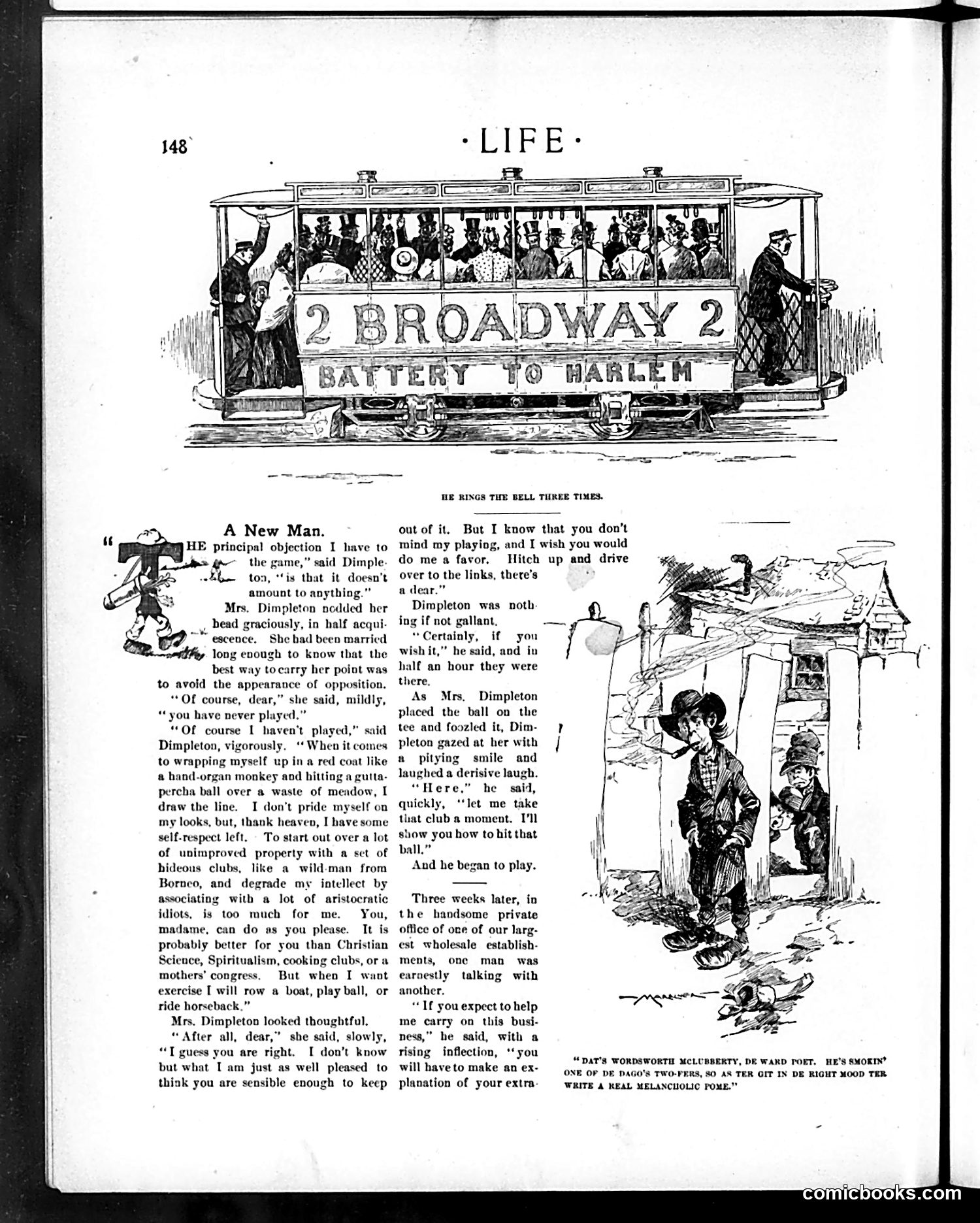
This page features a story about a man named Dimpleton who is socially awkward and wants to learn golf to improve his standing among the aristocratic set. His wife encourages him to take up the sport, believing it will help him fit in with upper-class society. The satirical point targets the Gilded Age obsession with golf as a status symbol. The story mocks both Dimpleton's social climbing and his clumsiness—he's so incompetent that even with instruction, he's unlikely to succeed. The humor lies in the contrast between aspiration and ability: golf was marketed as a gentleman's game, yet Dimpleton's working-class origins and lack of grace make him perpetually unsuitable, regardless of effort. The satire critiques both social pretension and the exclusionary nature of elite leisure activities.
📄 Transcribed text from this page (OCR, searchable)
Machine-transcribed from the original scan — historical spelling and the odd misread are preserved.
A New Man. HE principal objection I have to the game,” said Dimple: is that it doesn’t amount to anything.” Mrs. Dimpleton nodded her , bead graciously, in half acqui- ~"escence. She bad been married long enough to know that the best way tocarry her point was to avoid the appearance of opposition. “Of course, dear,” she said, mildly, “you have never played. “Of course I haven't played,” said Dimpleton, vigorously. ‘ When it comes to wrapping myself up ina red coat like a band-organ monkey and hitting a gutta- percha ball over a waste of meadow, I draw the line. I don’t pride myself on my looks, but, thank heaven, I have some self-respect left. To start out over a lot of unimproved property with a sct of hideous clubs, like a wild-man from Borneo, and degrade my intellect by associating with a lot of aristocratic idiots, is too much for me. You, madame, can do as you please. It is probably better for you than Christian Science, Spiritualism, cooking clubs, or a mothers’ congress. But when I want exercise [ will row a boat, play ball, or ride horseback.” Mrs. Dimpleton looked thoughtful. “After all, dear,” she said, slowly, “T guess you are right. I don’t know but what I am just as well pleased to think you are sensible enough to keep WE RINGS THE BELL TUREE TIMES. out of it, But I know that you don’t mind my playing, and I wish you would do me a favor. Hitch up and drive over to the links, there’s % a dear.” Dimpleton was noth ing if not gallant. iJ ainly, if you wish it,” he said, and in half an hour they were there, As Mrs, Dimpleton placed the ball on the tee and foozled it, Dim- pleton gazed at her with a pitying smile and laughed a derisive laugh. “Here,” he said, quickly, ‘let me take that club a moment. I'll show you how to hit that ball.” And he began to play. Three weeks later, in the handsome private office of one of our larg- est wholesale establish- ments, one man was earnestly talking with another. “If you expect to help me carry on this busi- ness," he said, with a rising inflection, ** you will have to make an ex- planation of your extra “ DAT'S WORDSWORTH MCL ONE OF DE DAGO'S TWO-PERS, SO AR TER GIT IN DE RIGHT MOOD TER WRITE A KEAL MELANCUOLIC POME.” ERTY, DE WARD POET, HE'S SMOKIN?