
Life, 1898-08-25 · page 6 of 20
Life — August 25, 1898 — page 6: what you’re looking at
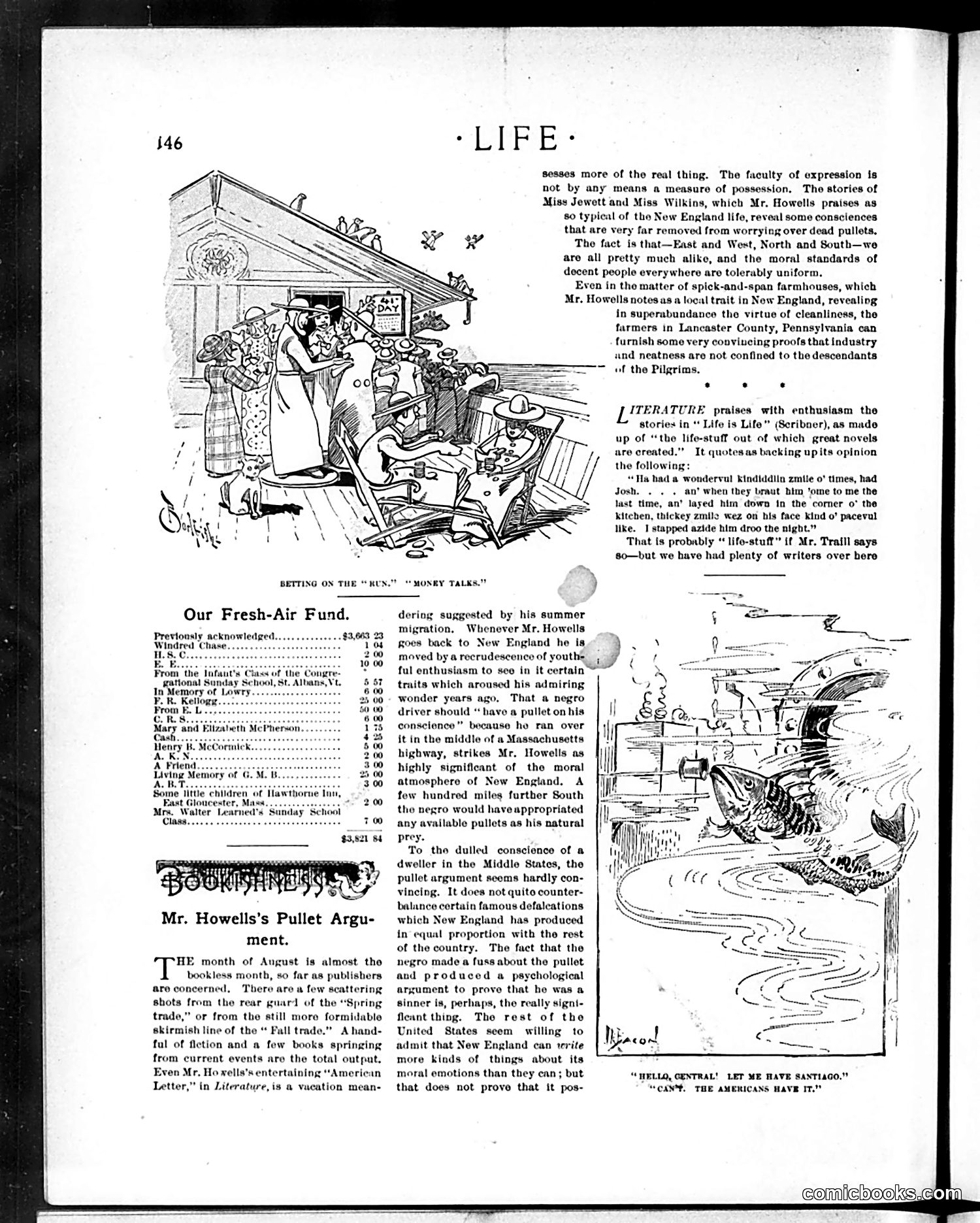
A restored page from Life, 1898-08-25. Page through the whole issue in the reader above.
📄 Transcribed text from this page (OCR, searchable)
Machine-transcribed from the original scan — historical spelling and the odd misread are preserved.
BETTING ON THE “ KU Our Fresh-Air Fund. Previonsly ack! Windred Chas HLS. C. Living Memory of ( BT. ‘ children of Hawthorne int, i Mr. Howells’s Pullet Argu- ment. HE month of Angust is almost tho bookless month, so far as publishers aro concerned, ‘There aro a few scattering shots from the rear guard of the “Spring trade,” or from the still moro formidable skirmish line of the “ Fall trade.” A hand- ful of fiction and a few books springing from current events are the total outpat, Even Mr, Ho xells’s entertaining “American Letter,” in Literature, is a vacation mean- “NEE sesses more of tho real thing. The faculty of expression is not by any means a measure of possession, Tho stories of Miss Jewett and Miss Wilkins, which Mr. Howells praises as 80 typical of tho New England life, reveal some consciences that are very far removed from worrying over dead pullets, The fact is that—East and West, North and South—wo are all pretty much alike, and the moral standards of decent people everywhere are tolerably uniform. Even in tho matter of spick-and-span farmhouses, which Mr. Howolls notes.as a local trait in Now England, revealing “MONRY TALKS.” dering suggested by his summer migration, Whenever Mr. Howells goes back to New England he is moved by a recrudescence of youths ful enthusiasm to see in it certain traits which aroused his admiring wonder years ago, That a negro driver should “ have a pullet on his conscience” because he ran over it in the middle of a Massachusetts highway, strikes Mr. Howells as highly significant of the moral atmosphere of New England. A few hundred miles further South tho negro would have appropriated any available pullets as his natural prey. To tho dulled conscience of a dweller in the Middlo States, the pullet argument seoms hardly con- vincing. It does not quite counter- balance certain famous defalcations which New England has produced in equal proportion with tho rest of the country. The fact that the negro made a fuss about the pullet and produced a psychological argument to prove that he was a sinner is, perhaps, tho really signt- ficant thing. Tho rest of the United States seem willing to admit that New England can trite more kinds of things about its moral emotions than they can; but that does not prove that it pos- wl in superabundanco tho virtue of cleanliness, the farmers in Lancaster County, Pennsylvania can furnish some very convincing proofs that Industry and neatness aro not confined to the descendants of the Pilgrims, * ITERATURE praises with enthusiasm the stories in * Life is Life” (Scribner), as mado up of “the life-stuff out of which great novels are created.” It quotesas backing upits opinion the following: “Ha had a wondervul Kindiddiin zmite o' times, had Josh. + an’ when they braut him ‘ome to me the last time, an’ layed him down in the corner o* the kitchen, thickey zmilo wez on bis face kind o pacevul luke. I stapped azide him droo the night.” That is probably “life-stuff” if Mr. Traill says 60—but we have had plenty of writers over bere “HELLO, CENTRAL! LET ME HAVE SANTIAGO." “CAN. THE AMERICANS HAVE IT." comichooks,