
Life, 1898-08-25 · page 12 of 20
Life — August 25, 1898 — page 12: what you’re looking at
What you’re looking at
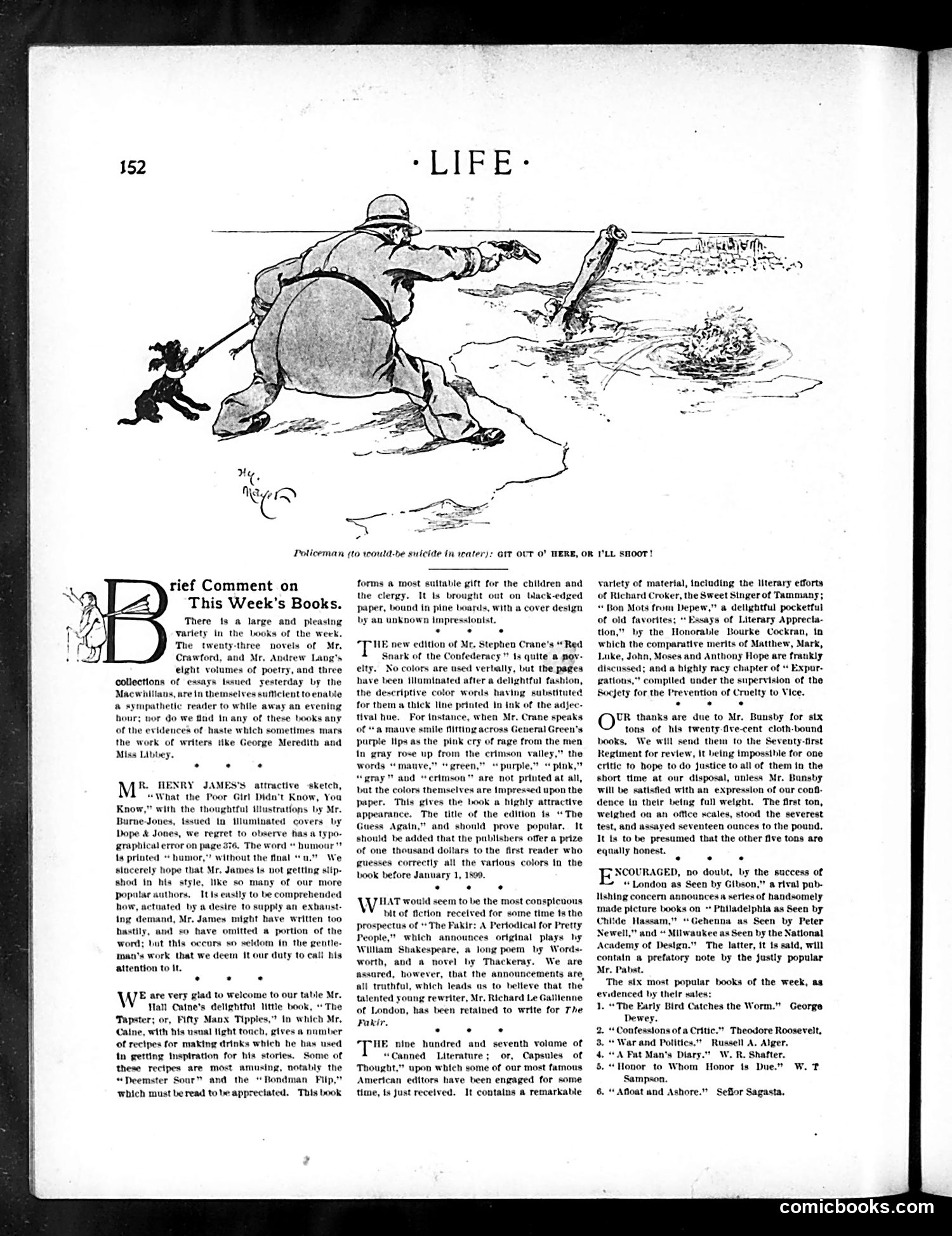
This page contains book reviews rather than political cartoons. The main illustration shows a rotund policeman pointing a gun at a thin man near water, with caption: "Policeman (to would-be suicide in waters): GET OUT O' HERE, OR I'LL SHOOT!" The cartoon satirizes police incompetence or callousness—the officer threatens to shoot someone attempting suicide, an absurd "solution" that defeats the purpose of rescue. It's dark humor mocking both police brutality and the era's casual attitude toward mental health crises. The surrounding text reviews various books from the week, including works by Mr. Crawford and Mr. James Payn, discussing literary merit and publishing trends. No specific political figures or events are referenced in the visible content.
📄 Transcribed text from this page (OCR, searchable)
Machine-transcribed from the original scan — historical spelling and the odd misread are preserved.
Policeman (to would-be suicide tn rater): GIT OCT O° TERE, OR rief Comment on This Week's Books. There ts a large and pleasing variety In the Looks of the week. The twenty-three novels of Mr. Crawford, and Mr, Andrew Lang's eight volumes of poetry, and three collections of essays issued sesterday by the Macwhillans, are in themselves suMictent to enable A sympathetic reader to while away an evening hour; ver do we fad in any of these books any of the evidences of haste which sometimes mars the work of writers like George Meredith and Miss Libbe! . . . R. HENRY JAMES'S attractive sketch, “What the Poor Girl Didn't Know, You Know,” with the thoughtful ttlustratfons by Mr. Burne-Jones, tssued in illuminated covers by Dope & Jones, we regret to observe has a typo- graphical error on page 376. The word * humour"? 1s printed * humor,” without the ual “a2” We sincerely hope that Mr, James ts not getting stip- shod in his style, like so many of our more Popatar authors. Itts eastly to be comprehended how, actuated by a desire to supply an exhaust. ing demand, Mr. James might have written too . and so have omitted @ portion of the Hut this occnrs so seldom in the gentle: man’s work that we deem it our duty to catt his attention to It. . * WE are vers iad to welcome to our table Mr. Mall Catne's delightful ttle book, «The Tapster; or, Fifty Manx Tipples,” In which Mr. Caine, with his usual light tonch, gives a number of recipes for making drinks which he has used in getting Inspiration for his storiex. Some of these recipes are most amusing, notably the “Deemster Sour” and the “Hondman Fitp,” which must be read to be appreciated. This book forms a most suttable gift for the children and the clergy. It Is brought out on black-edged paper, bound in pine boards, with a cover design by an unknown Impresstontst, TE new edition of Mr. Stephen Crane's “Red Snark of the Confederacy” ts quite a pov- elty, No colors are used verbally, but the pages have been Illuminated after a delightful fashion, the descriptive color words having substituted for themn a thick Ine printed tn ink of the adj tival hue. For tnstance, when Mr. Crane speaks of “a mauve smile fitting across Genenu Green's purple lps as the pink cry of rage from the men in gray rose up from the crimson valley,” the words “mauve,” “green,” “purple,” “ pink,’ “gray and “ertmson” are not printed at all, bat the colors themselves are Impressed upon the paper. This gives the book a highly attractive appearance. The ttle of the edition ts “The Guess Again,” and shonid prove popular, It should be added that the pablishers offer a prize of one thousand dollars to the first reader who guesses correctly all the various colors in the book before January 1, 1 o 8 VV HAT would seem to be the most conspicuous bit of fiction recetved for some time ts tho prospectus of “The Fakir: A Pertodical for Pretty People,” which announces original plays hy William Shakespeare, a long poem by Wor worth, and a novel by Thackeray. We are assured, however, that the announcements are, all truthful, which leads us to belleve that the talented young rewriter, Mr, Richard Le Galitenne of London, has been retained to write for The Fakir. THE nine hundred aud seventh volame of “Canned Literatre ; of, Capsules of Thought,” upon which some of our most farnous American editors have been engaged for some time, fs Just recetved. It contains a remarkable LL snoor vartety of material, Including the Iterary efforts of Richard Croker, the Sweet Singer of Tammany; “Bon Mots from Depew,” @ delightful pocketful of old favorites; “Essays of Literary Apprecta- tion,” hy the Honorable Bourke Cockran, tn which the comparative merits of Matthew, Mark, Luke, John, Moses and Anthony Hope are frankly discussed; and a highly racy chapter of « Expur- gations,” complied under the supervision of the Socjety for the Prevention of Cruelty to Vice. 8 UR thanks are due to Mr. Bunsby for six tons of his twenty-flve-cent cloth-bound books, We will send them to the Seventy-first Regiment for review, It being impossible for one critic to hope to do Justice to all of them tn the short time at our disposal, unless Mr. Bunsby will be satisfled with an expression of our conf dence tn ther being full welgbt. The frst ton, welghed ou an oftce scales, stood the severest test, and assayed seventeen ounces to the pound, It ts to be presumed that the other five tons aro equally honest. NCOURAGED, no doubt, by the success of “London as Seen by Gibson,” a rival pab- lshing concern announces a sertes of handsomely made picture books on ~ Philadelphia as Seen by Childe Hassam,” “Gehenna as Seen by Peter Newell,” and “ Milwaukee as Seen by the National Academy of Design." The latter, it 1s satd, will contain a prefatory note by the justly popular Mr. Pabst. The six most popular books of the week, as evidenced by their sales: 1. “The Early Bird Catches the Worm.” George Dewey. “Confessions of a Critic.” Theodore Roosevelt, War and Politics.” Russell A. Alger. “A Fat Man's Diary." W. R. Shafter. “Honor to Whom Honor ts Due.” Sampson. “Afloat und Ashore.” Seffor Sagasta, w.t comicbooks.com