
Life, 1898-08-25 · page 4 of 20
Life — August 25, 1898 — page 4: what you’re looking at
What you’re looking at
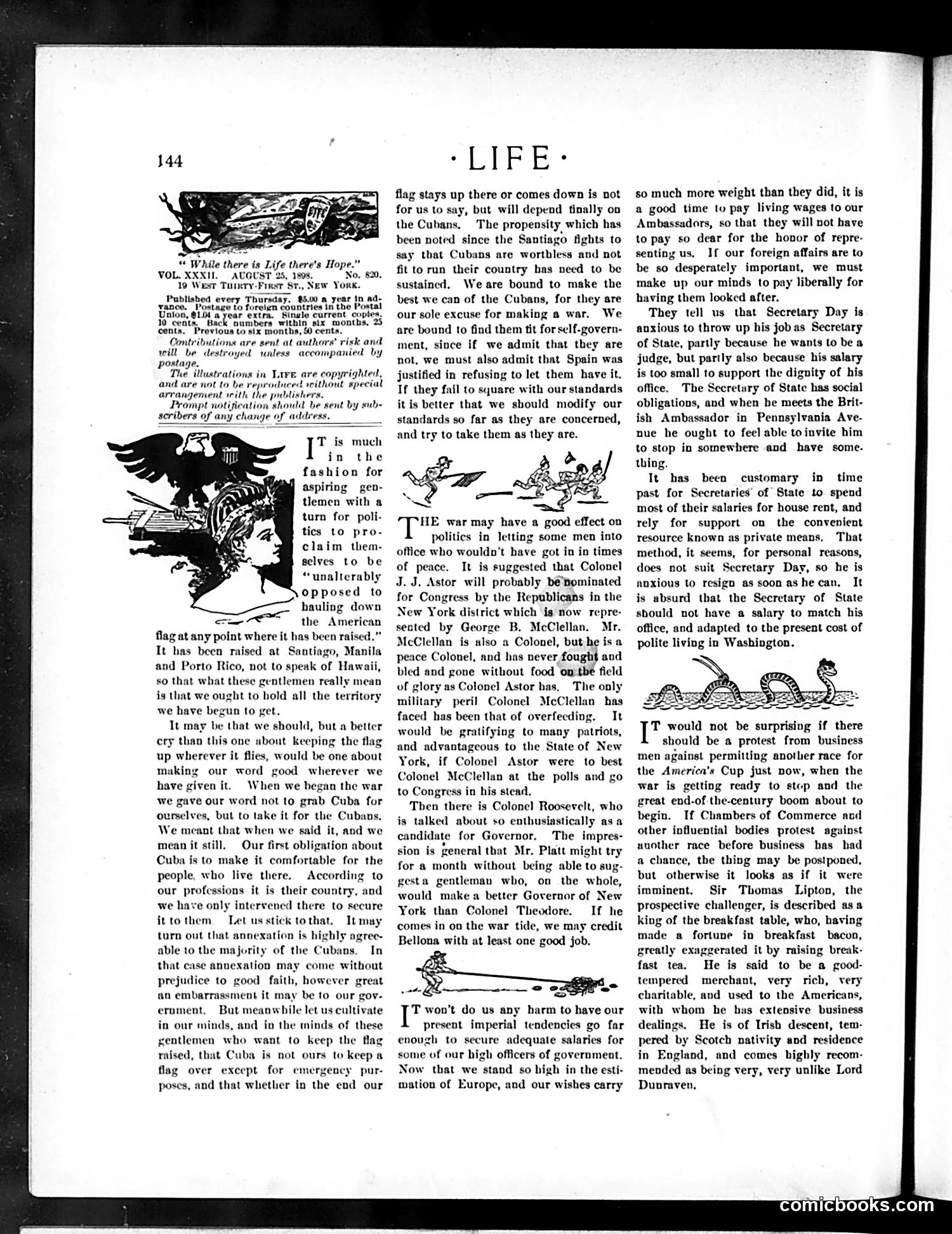
This page contains political commentary rather than cartoons. The text discusses U.S. policy toward Cuba following what appears to be the Spanish-American War era. Key points satirized: **The Cuba question**: The author critiques American justifications for involvement in Cuba, arguing the U.S. should either fully commit to Cuban independence or acknowledge self-interest rather than moral posturing. **Secretary of State salary debate**: The piece mocks discussion of whether Secretary Day deserves higher pay, suggesting the position shouldn't require private wealth to sustain it—a critique of expecting government officials to subsidize their own roles. **Political appointments**: References to Colonel Astor and Colonel Roosevelt as potential Congressional candidates suggest satire of wealthy figures entering politics, questioning their actual military credentials versus their public image. The satire targets American imperial ambitions and political hypocrisy regarding Cuba while questioning whether wealthy dilettantes should hold office.
📄 Transcribed text from this page (OCR, searchable)
Machine-transcribed from the original scan — historical spelling and the odd misread are preserved.
© While there is Life there's Hope.” VOL. XH. AUG! » 1898. a 19 West Tuirry. Published ev: in ad. putllned, ere, Faure usec ine Postal Union, go a@year extra. Single current copies. 10 cents. Back oumbers within six months, 25 . Previous to six months, # ce Contributions are sent at author will be destroyed unless accompanied by postage, The illustrations in Lire are copyrighted, and are not to be reproduced without special arrangement with the publish Prompt notisication should be sent by sub- seribers of any change of adidress. T is much in the fashion for aspiring gen- tlemen with a turn for poli- tics to pro- claim them- selves to be “unalterably opposed to hauling down the American flag at any point where it has been raised.” It has been raised at Santiago, Manila and Porto Rico, not to speak of Hawaii, so that what these gentlemen really mean is that we ought to hold all the territory we have begun to get. It may be that we should, but a better cry than this one about keeping the flag up wherever it flies, would be one about making our word good wherever we have given it. When we began the war ‘we gave our word not to grab Cuba for ourselves, but to take it for the Cubans, We meant that when we said it, and we mean it still. Our first obligation about Cuba is to make it comfortable for the people, who live there. According to our professions it is their country, and we have only intervened there to secure ittothem Let usstick tothat, Itmay turn out that annexation is highly agree- able to the majority of the Cubans. In that case annexation may come without prejudice to good faith, however great an embarrassment it may be to our gov- erument, But meanwhile let us cultivate in our minds, and in the minds of these gentlemen who want to keep the flag raised, that Cuba is not ours to keep a flag over except for emergency pur- poses, and that whether in the end our 2F iE flag stays up there or comes down is not for us to say, but will depend finally on the Cubans. The propensity which has been noted since the Santiago fights to say that Cubans are wortbless and not fit to run their country bas need to be sustained. Weare bound to make the best we can of the Cubans, for they are our sole excuse for making a war. We are bound to find them tit for self-govern- ment, since if we admit that they are not, we must also admit that Spain was justified in refusing to let them have it. If they fail to square with our standards it is better that we should modify our standards so far as they are concerned, and try to take them as they are. o Ni -_ ~ HE war may have a good effect on politics in letting some men into office who wouldn't have got in in times of peace. It is suggested that Colonel J.J. Astor will probably benominated for Congress by the Republicans in the New York district which is now repre- sented by George B. McClellan. Mr. McClellan is also a Colonel, but he is a peace Colonel, and has never fought and bled and gone without food on the field of glory as Colonel Astor has, The only military peril Colonel McClellan has faced has been that of overfecding. It would be gratifying to many patriots, and advantageous to the State of New York, if Colonel Astor were to best Colonel McClellan at the polls and go to Congress in his stead. Then there is Colonel Roosevelt, who is talked about so enthusiastically asa candidate for Governor, The impres- sion is feneral that Mr. Platt might try for a month without being able to sug- gesta gentleman who, on the whole, would make a better Governor of New York than Colonel Theodore. If he comes in on the war tide, we may credit Bellona with at least one good job. T won't do us any harm to have our present imperial tendencies go far enough to secure adequate salaries for some of our high officers of government. Now that we stand so high in the esti- mation of Europe, and our wishes carry so much more weight than they did, it is a good time tv pay living wages to our Ambassadors, so that they will not have to pay so dear for the hovor of repre- senting us. If our foreign affairs are to be so desperately important, we must make up our minds to pay liberally for having them looked after. They tell us that Secretary Day is anxious to throw up his job as Secretary of State, partly because he wants to be a judge, but partly also because his salary is too small to support the dignity of his office. The Secretary of State has social obligations, and when he meets the Brit- ish Ambassador in Pennsylvania Ave- nue he ought to feel able to invite him to stop in somewhere and have some- thing. It has been customary in time past for Secretaries’ of State to spend most of their salaries for house rent, and rely for support on the convenient resource known as private means, That method, it seems, for personal reasons, does not suit Secretary Day, so he is anxious to resign as soon ashe can. It is absurd that the Secretary of State sbould not have a salary to match his office, and adapted to the present cost of polite living in Washington. T would not be surprising if there should be a protest from business men against permitting anotber race for the America's Cup just now, when the war is getting ready to stop and the great end-of.the-century boom about to begin. If Chambers of Commerce and other influential bodies protest against another race before business bas had a chance, the thing may be postponed, but otherwise it looks as if it were imminent. Sir Thomas Lipton, the prospective challenger, is described asa king of the breakfast table, who, having made a fortune in breakfast bacon, greatly exaggerated it by raising break- fast tea. He is said to be a good- tempered merchant, very rich, very charitable, and used to the Americans, with whom he bas extensive business dealings. He is of Irish descent, tem- pered by Scotch nativity and residence in England, and comes bighly recom- mended as being very, very unlike Lord Dunraven, comicbooks.com