
A complete issue · 20 pages · 1898
Life — May 12, 1898
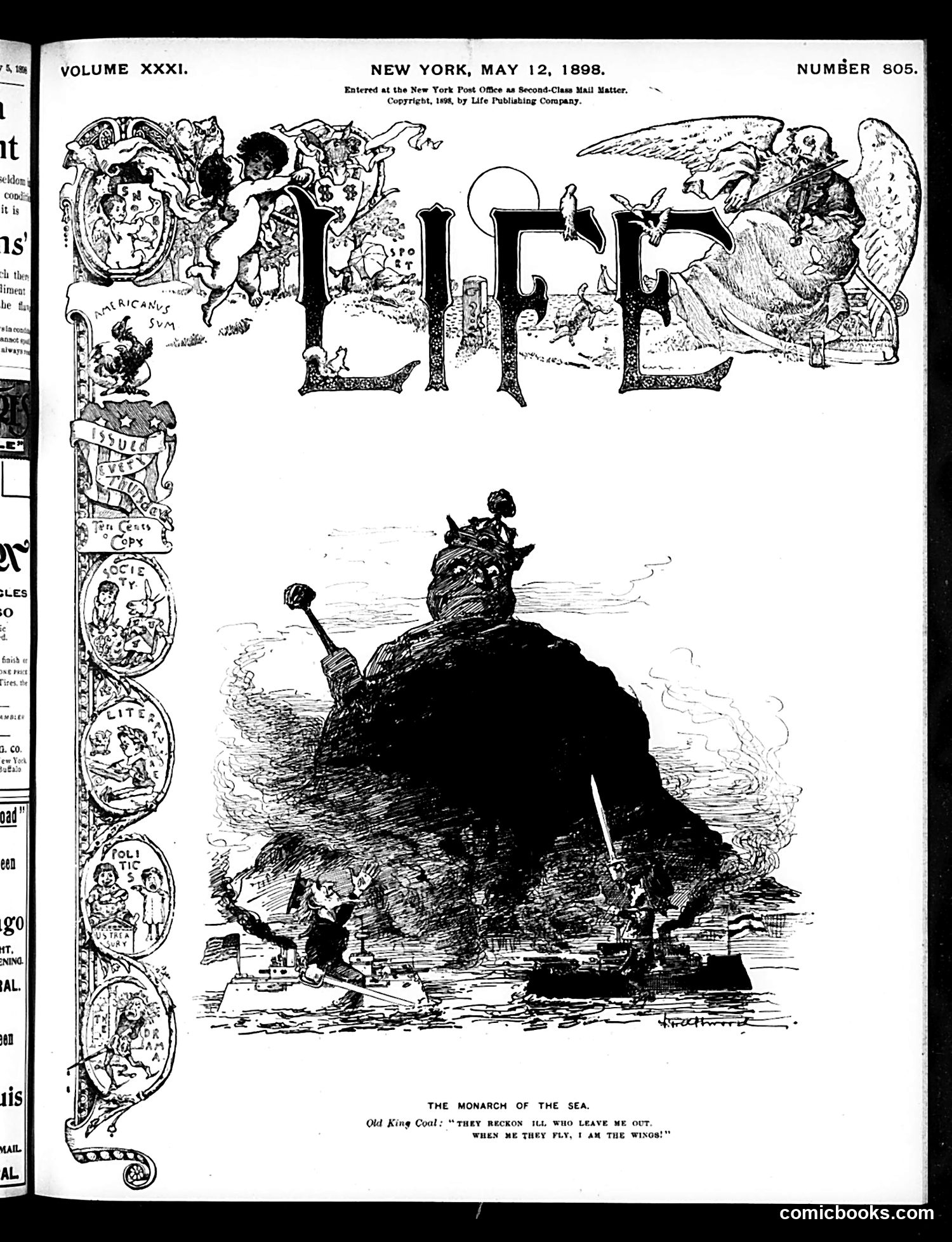
This political cartoon depicts an enormous figure towering over tiny naval vessels and sailors, labeled "The Monarch of the Sea." The caption quotes "Old King Coal": "They reckon ill who leave me out. When me they fly, I am the wind!" The satire addresses American naval power in 1898, likely referencing the Spanish-American War occurring that spring. The giant represents coal's critical importance to naval superiority—steam-powered warships required massive coal supplies for operation. The cartoon suggests that while nations might boast of naval dominance, coal (fuel supply) was the true master controlling maritime power and military capability. It's commentary on the material/industrial foundations of imperial military strength.
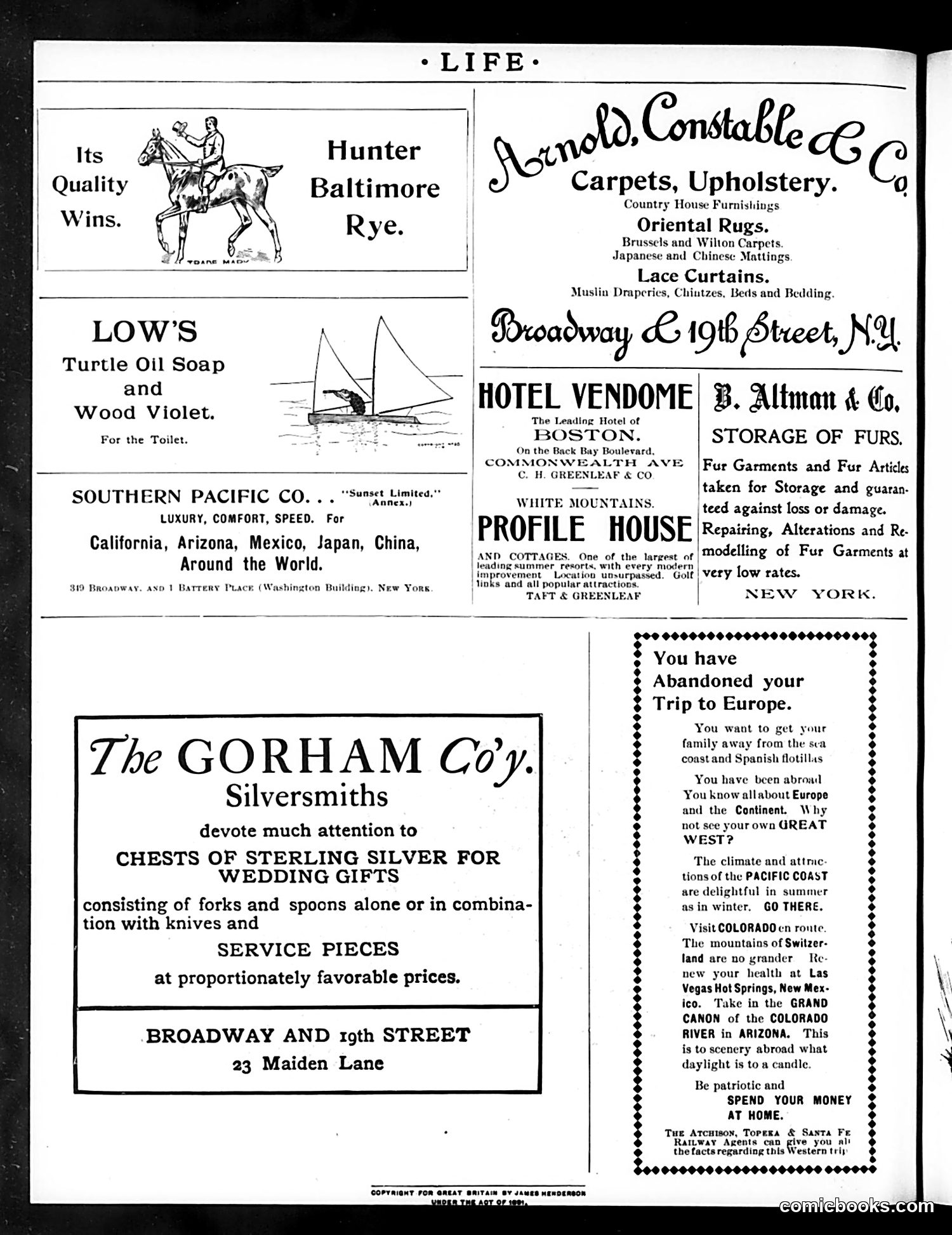
This page is predominantly **advertisements** rather than editorial content or cartoons. The ads showcase various luxury goods and services typical of early 20th-century American commerce: liquor (Hunter Baltimore Rye), toiletries (Low's Turtle Oil Soap), travel services (Southern Pacific Co.), home furnishings (Arnold, Constable & Co.), hotel accommodations (Hotel Vendome in Boston), fur storage services (B. Altman & Co.), and silverware (The Gorham Co.). The one notable editorial element is a boxed piece titled "You have Abandoned your Trip to Europe," which sarcastically encourages Americans to visit the American West instead—Colorado, Arizona, and the Grand Canyon—rather than Europe. This appears to be patriotic messaging encouraging domestic tourism and spending "your money at home."
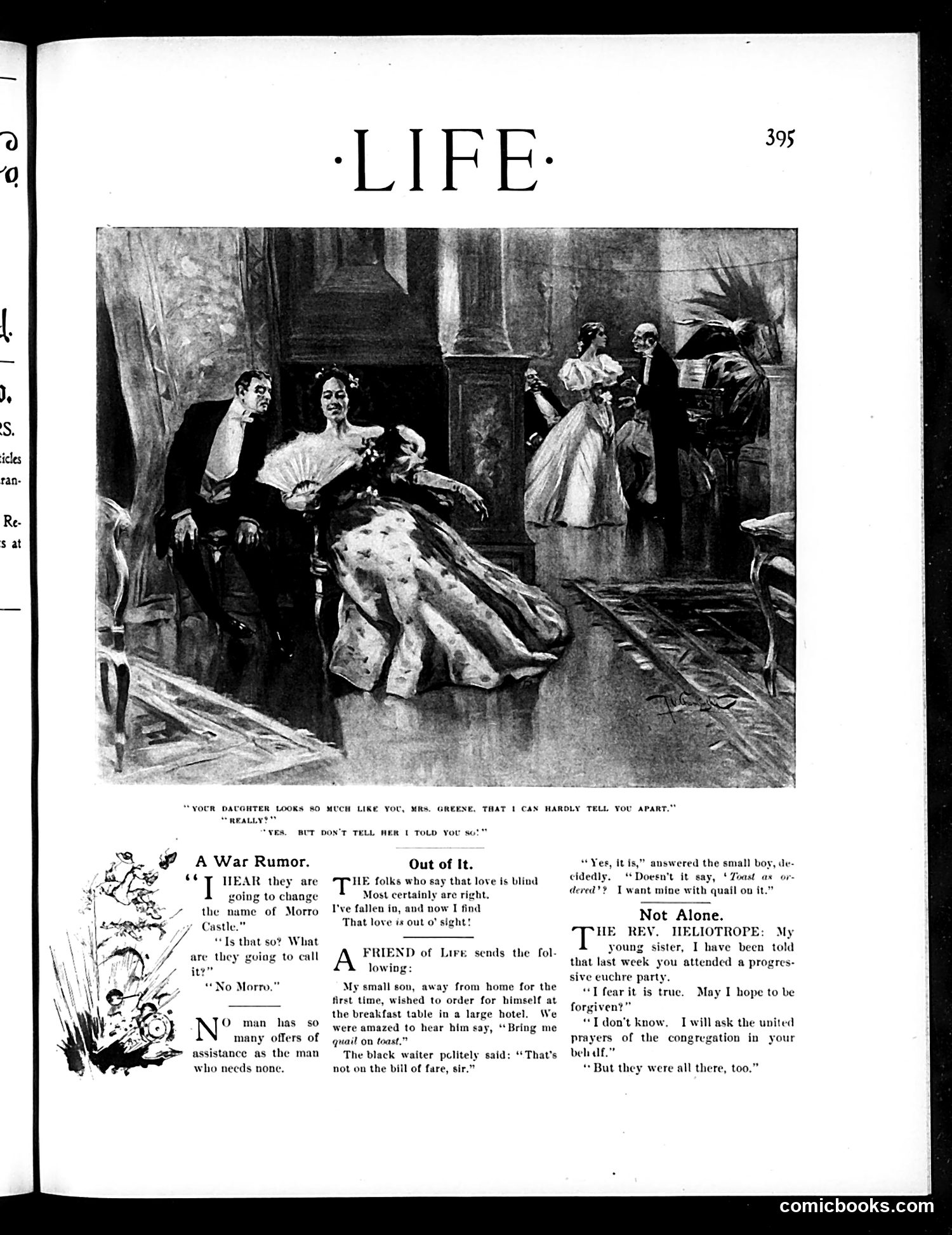
**Main Illustration**: A domestic scene showing a woman in an elaborate gown reclining while men converse. The caption suggests a conversation about resemblance between a daughter and "Mrs. Greene," with someone cautioning against revealing paternity. **"A War Rumor"**: A brief satirical piece mocking military gossip about changing the name of "Morro Castle" (likely referencing the Spanish fortress in Cuba, site of historical conflict). The joke hinges on absurd rumor-spreading. **"Out of It"** and **"Not Alone"**: Two brief humorous anecdotes—one about a boy's innocent misunderstanding of romantic terminology, another about a reverend's embarrassment at missing a church social event his sister attended. The page contains light domestic and social humor typical of early 20th-century American satire, without obvious political commentary.
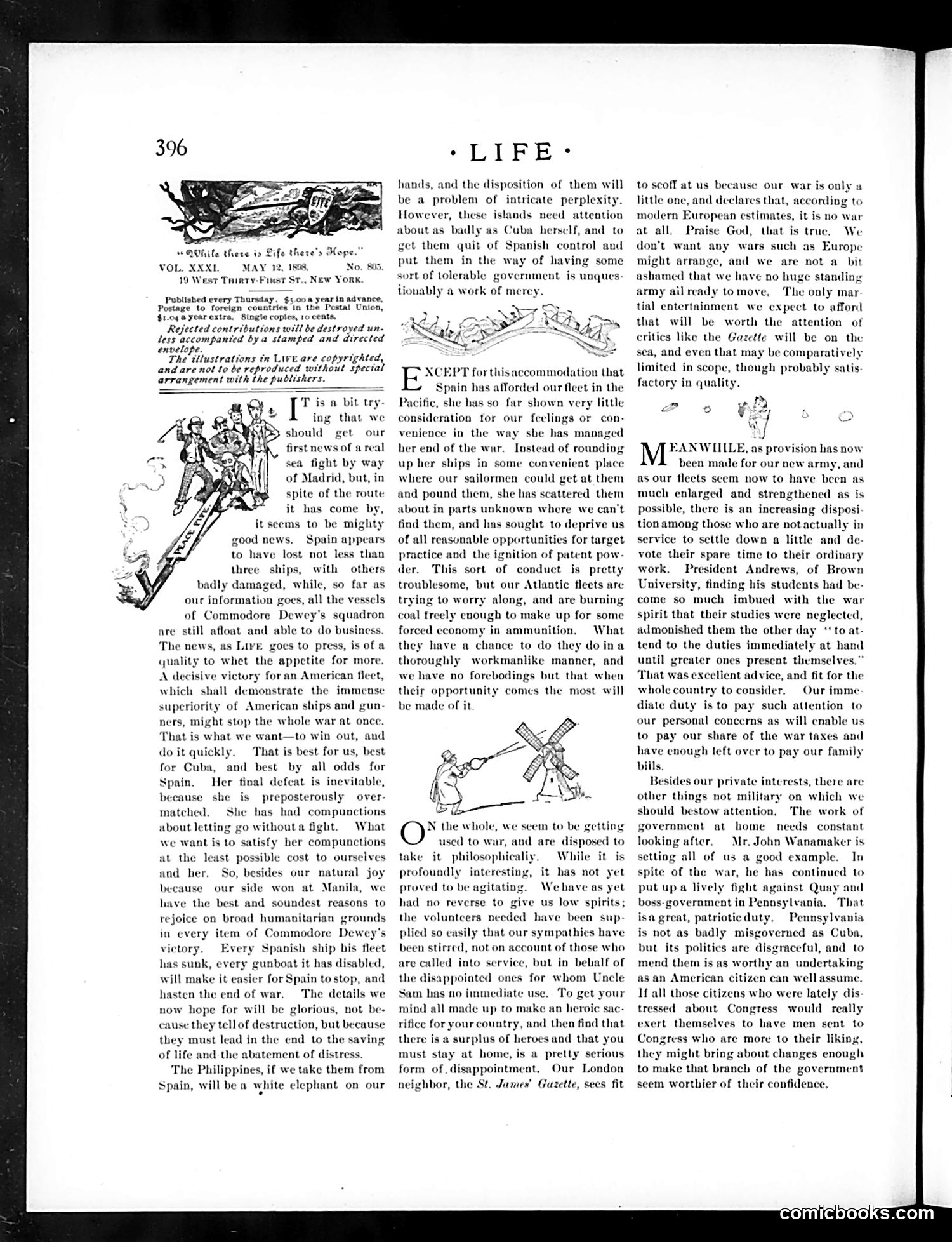
This page contains two editorial cartoons addressing the Spanish-American War era (circa 1898, based on references to Cuba and Spain). The first cartoon depicts a sailor climbing a mast or rigging, illustrating the text's point about Spain's naval weakness compared to American forces, particularly Commodore Dewey's squadron. The second cartoon shows two figures (appearing to be soldiers or workers) at a windmill, likely referencing Cervantes' *Don Quixote*—a symbolic jab at Spain as outdated and foolish, fighting a futile war against superior American power. The editorial text argues that American naval superiority makes Spanish defeat inevitable, while defending American war aims in Cuba as justified. The cartoons reinforce this message through visual mockery of Spanish military capacity.
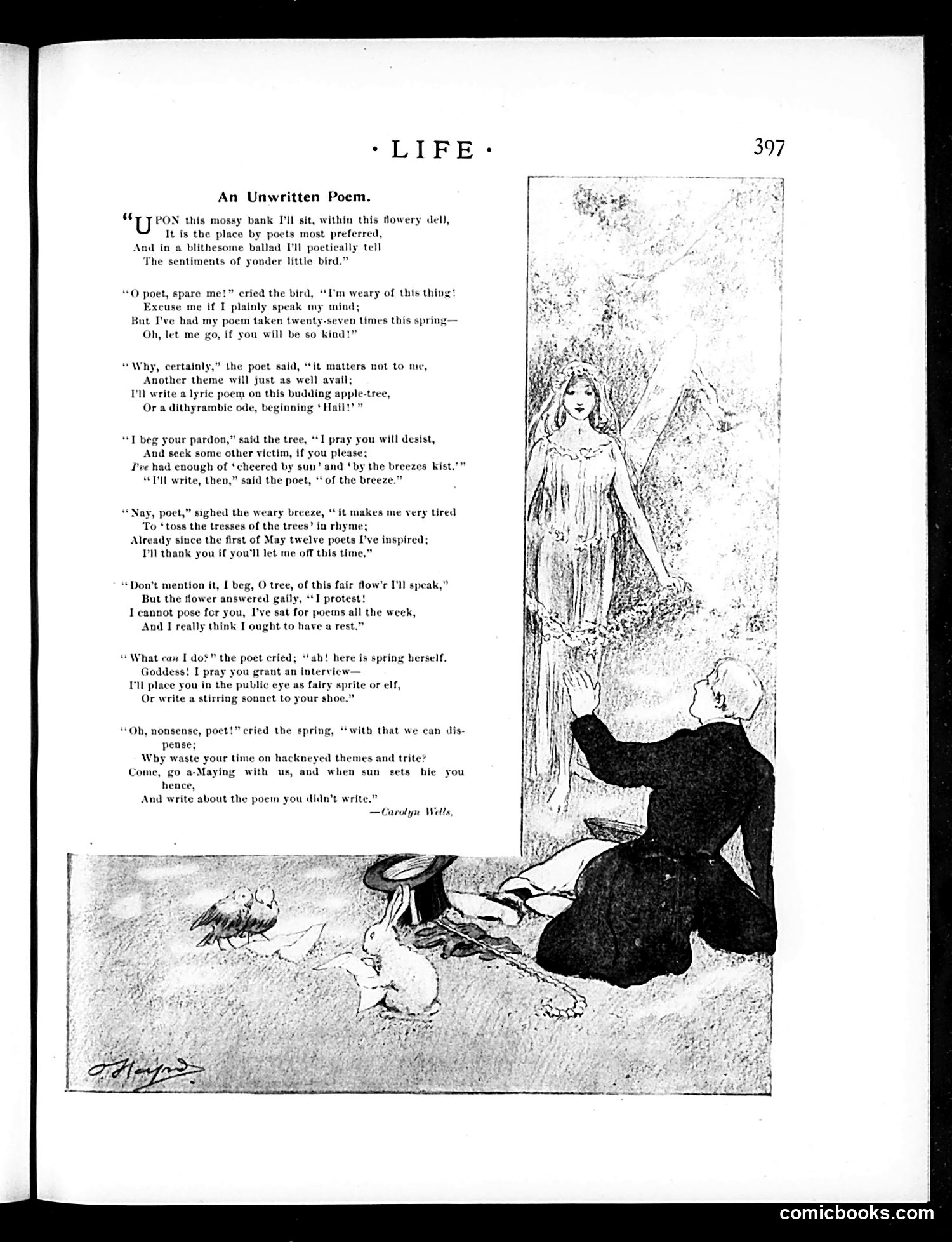
This page contains a humorous poem by Carolyn Wells about a poet being pestered by various elements of nature to write verses about them instead of composing original work. A bird, a breeze, a spring, and flowers all interrupt the poet's attempt at creative writing, each demanding to be the subject of his next poem. The satire targets lazy or derivative poetry—the complaint that poets recycle hackneyed springtime and nature themes rather than developing fresh ideas. The illustrations show a frustrated poet being accosted by anthropomorphized natural elements, literalizing the poem's central joke about artistic interference and creative exhaustion. This reflects early 20th-century literary criticism dismissing sentimental nature poetry as clichéd and uninspired.
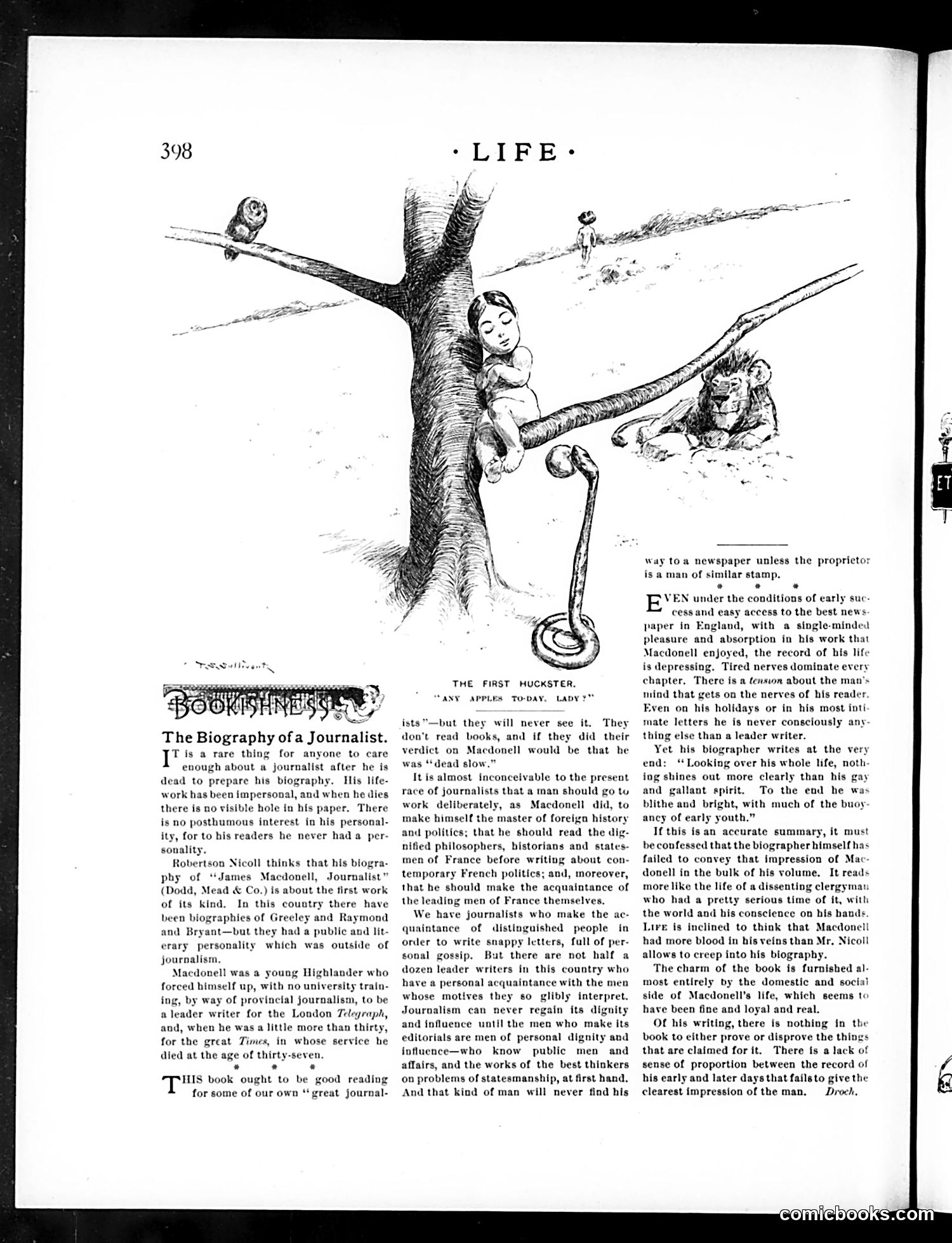
This page reviews a biography of journalist James Macdonell. The accompanying cartoon titled "The First Huckster" satirizes journalism's commercialization by depicting a figure (representing an early or archetypal journalist) as literally a tree growing money-making devices—a child climbing its trunk, animals around it, and what appears to be a snake or contract coiled below. The satire suggests journalism has become primarily about profit extraction rather than public service. The review text itself criticizes journalists who pursue "personal gossip" and lack "dignity and influence," contrasting them with serious political writers. The cartoon's anthropomorphic tree metaphor visually reinforces the text's argument that journalism has become rooted in mercenary rather than noble purposes.
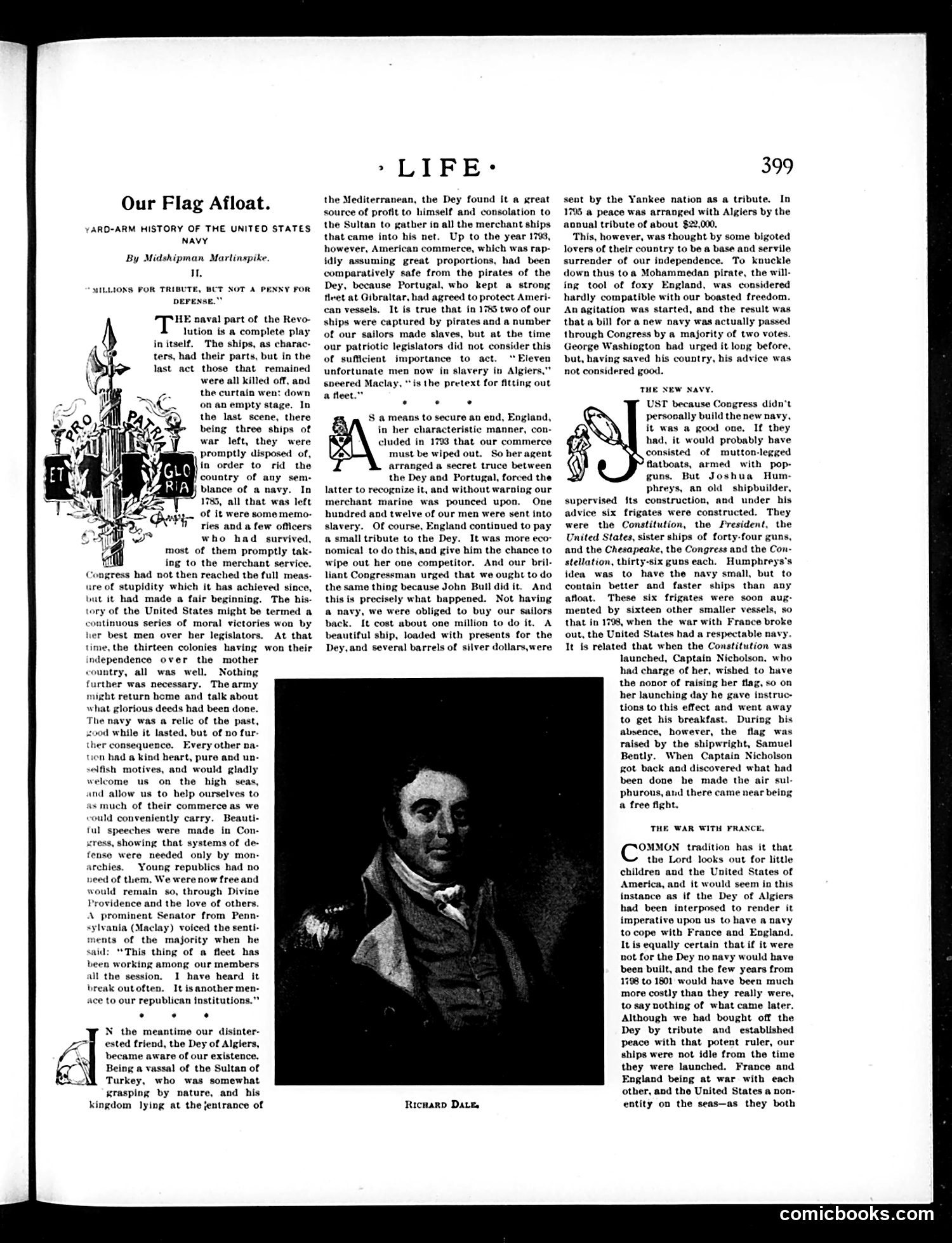
This page contains a historical article titled "Our Flag Afloat: A Yard-Arm History of the United States Navy" by Midshipman Marionspike. The text discusses early American naval history, focusing on tribute payments to the Dey of Algiers and privateering issues. The portrait shown appears to be **Richard Dale**, labeled at the bottom. Based on the naval context, Dale (1756-1826) was a notable early American naval officer. The article's satire criticizes Congress for not properly supporting the Navy—asserting that building the USS Constitution was worthwhile despite cost concerns. The broader point satirizes American reluctance to invest in naval defense while paying tribute to Barbary States, suggesting this was politically and economically foolish compared to building a proper fleet. The decorative naval emblem in the margin reinforces the martial theme.
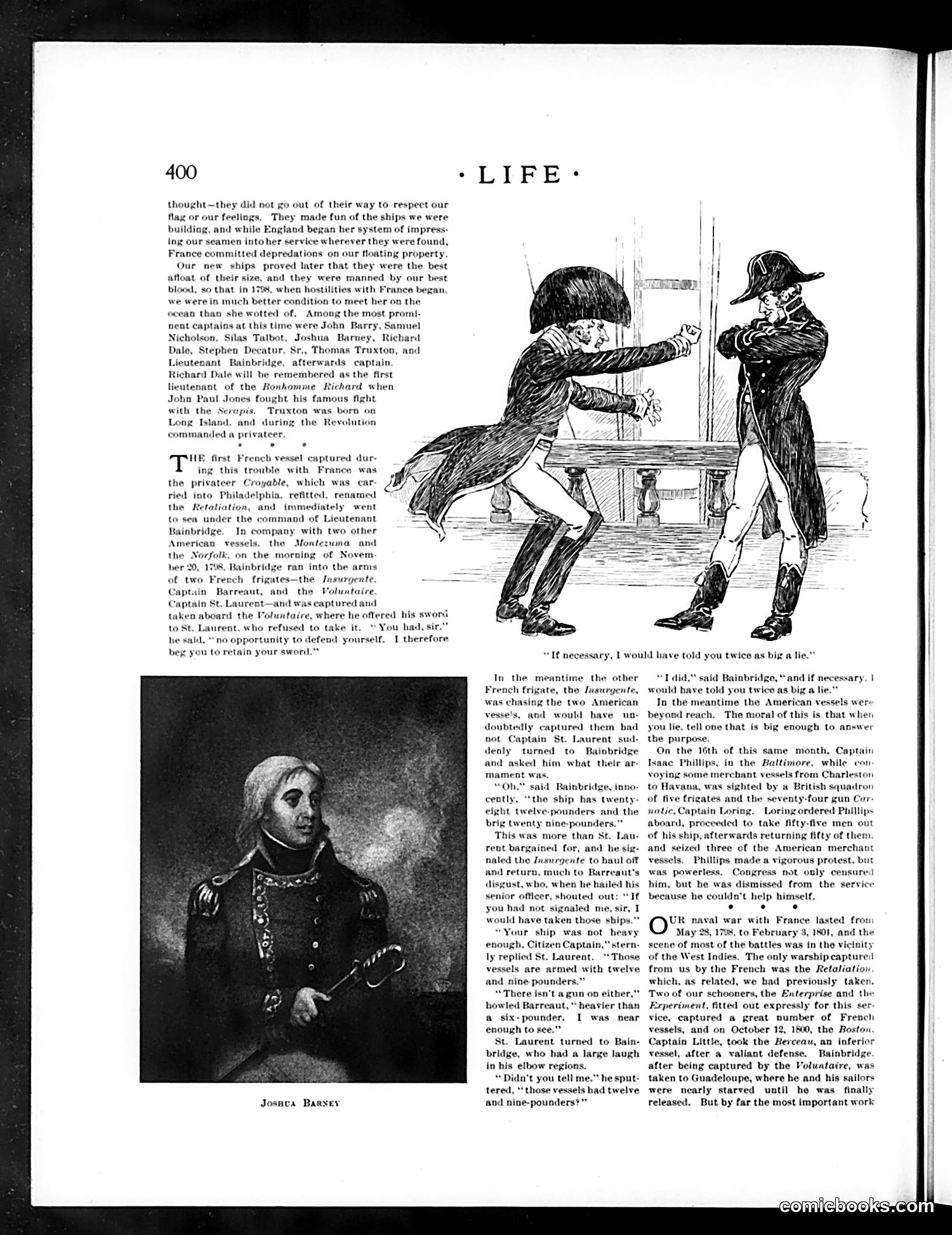
This page from *Life* magazine discusses American naval encounters during the Quasi-War with France (1798-1801). The text celebrates American sea captains and their victories against French vessels. The main illustration depicts a confrontation between two naval officers—likely representing an American captain (left) and a French captain (right)—engaged in a dramatic physical altercation or tense standoff aboard ship. The exaggerated poses and theatrical staging suggest satire of maritime honor codes and the bravado of naval warfare. The portrait below identifies **Joshua Barney**, a prominent American naval commander of the period. The satire appears to mock the grandiose language and theatrical posturing of wartime naval encounters while celebrating American naval prowess. The caption's quote about "telling lies" hints at the page's humorous take on embellished accounts of naval combat.
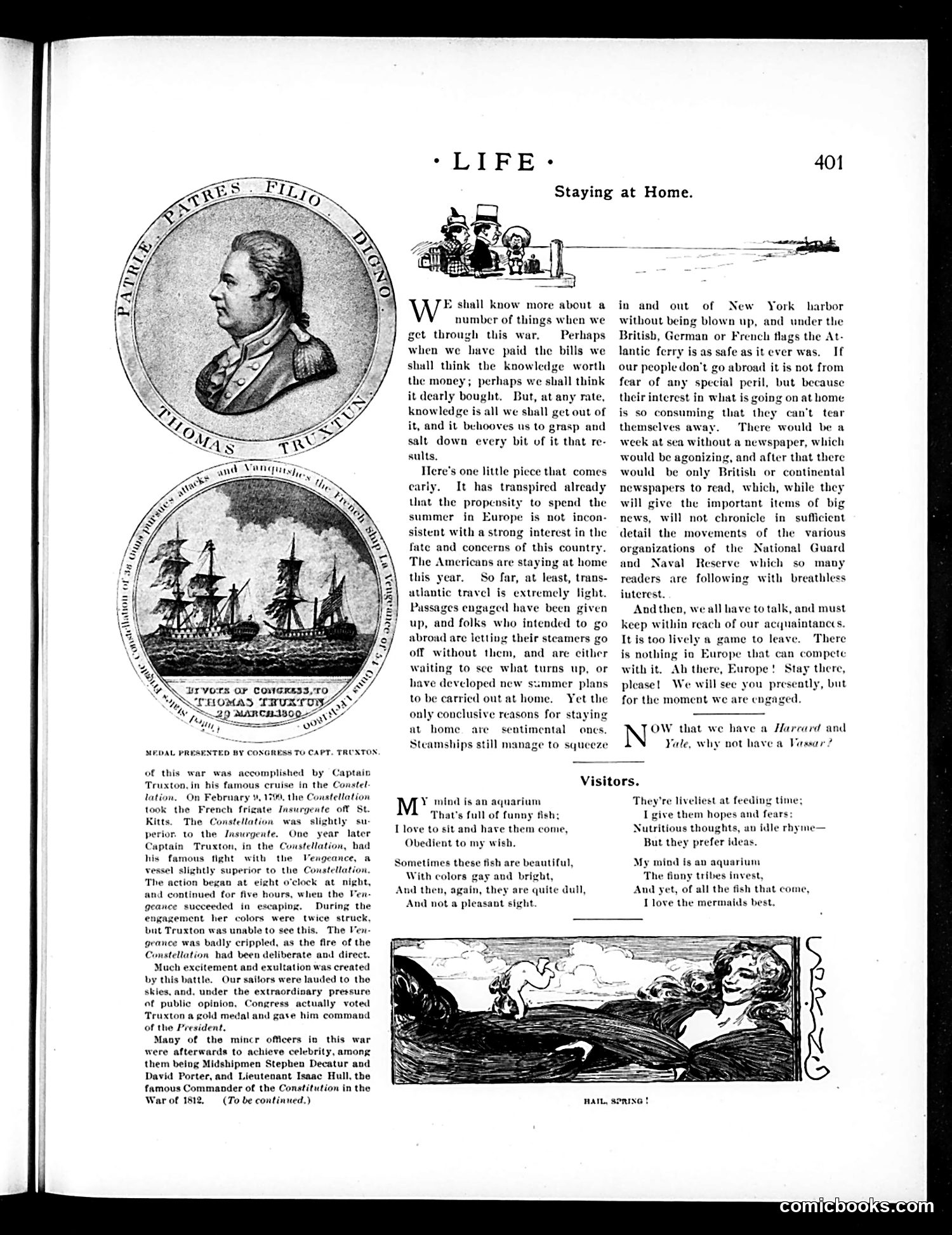
This page discusses "Staying at Home" during wartime (likely WWI based on context). The two medallion portraits at left appear to be historical naval figures—one labeled with references to Thomas Truxton and naval engagements. The main text argues Americans should remain in the U.S. rather than travel abroad, as transatlantic travel is now dangerous and limited. It notes that steamships previously used for European tourism are being repurposed for war efforts. The brief poem "Visitors" uses aquarium fish as a humorous metaphor for unwanted guests—they're pretty to look at but visitors similarly prefer to admire from a distance rather than be kept contained. The small illustration at bottom depicts a cherub or cupid figure, captioned "HAIL, SPRING!"—a seasonal artwork unrelated to the main content.
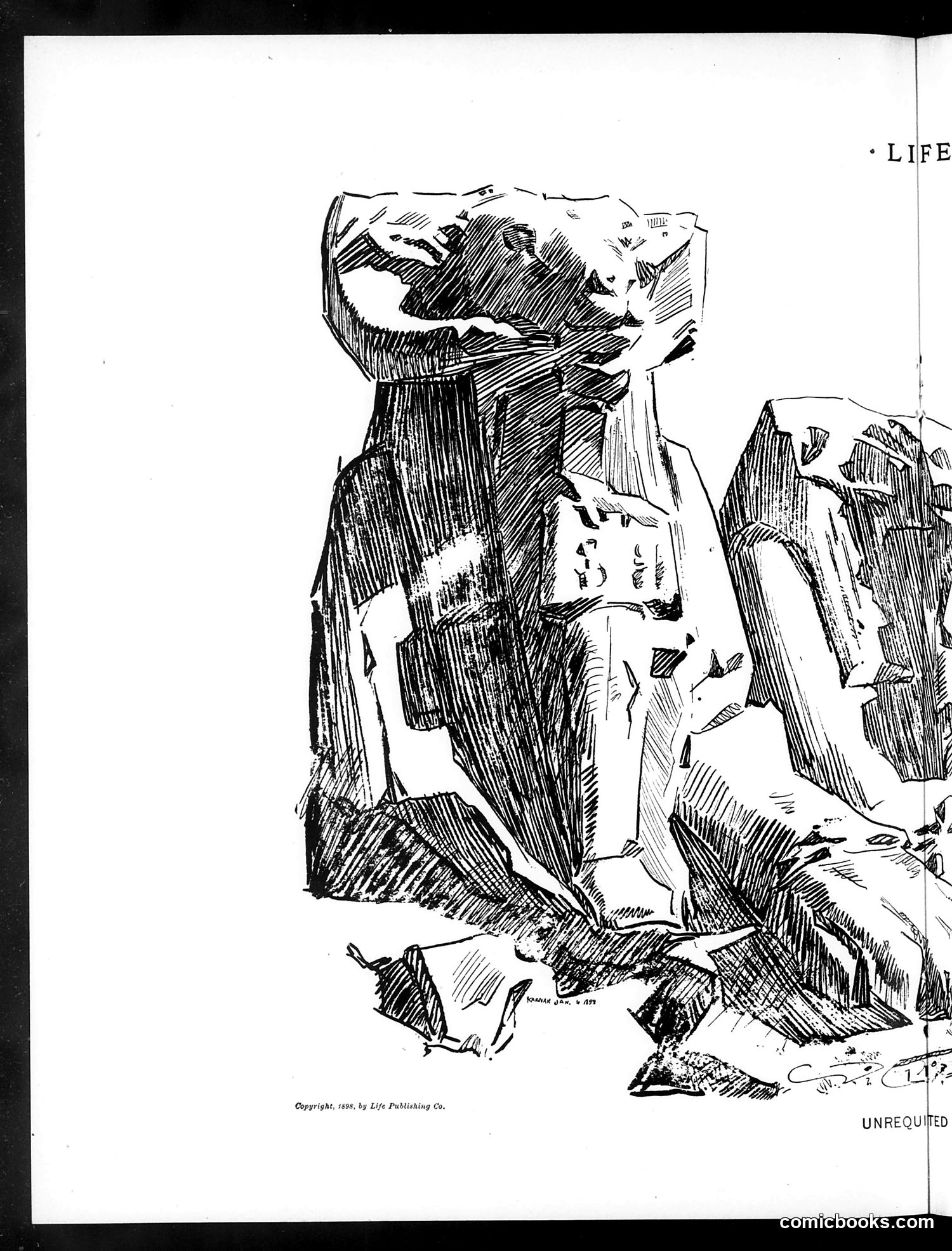
This page contains a single ink sketch from *Life* magazine (copyright 1898). The drawing depicts a figure in classical or allegorical style—appears to be a robed, muscular male form seated or reclining amid scattered debris or broken objects at the base. Without visible caption, title, or accompanying text on this page, the specific political or social reference is unclear. The classical style suggests it may represent an abstract concept (Liberty, America, Labor, etc.) in distress or decline, with the scattered objects possibly symbolizing destruction or collapse. The "UNREQUITED" stamp at bottom-right suggests editorial notation rather than part of the original cartoon. More context—such as the issue date, surrounding articles, or visible captions—would be needed to identify the precise satirical target or contemporary reference intended.
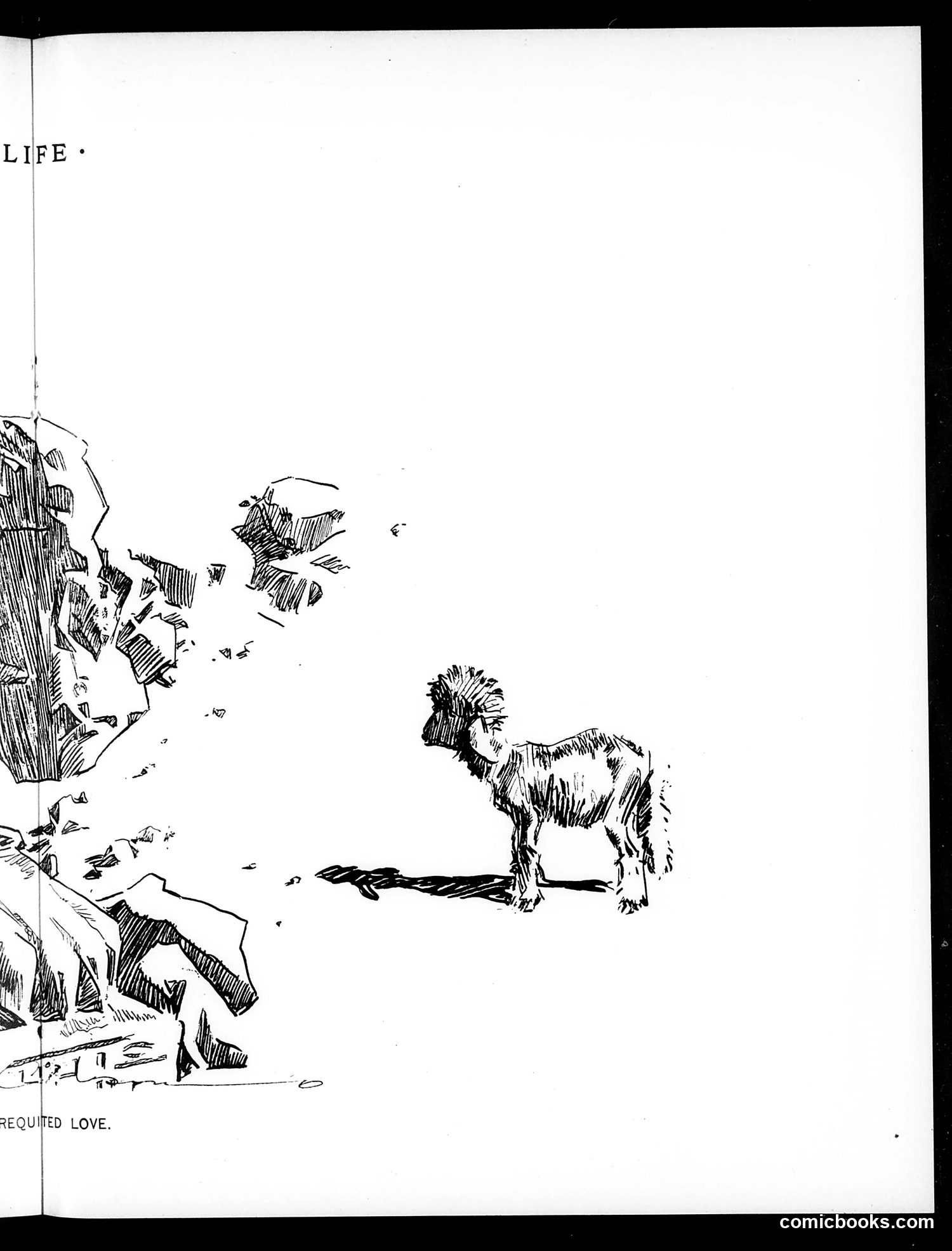
This page from *Life* magazine shows a single cartoon titled "Life—Required Love." The image depicts a small, shaggy dog standing alone in a barren landscape, casting a long shadow. On the left side, rocky terrain or ruins are sketched. The cartoon appears to be a commentary on unconditional companionship or loyalty. The dog—often a symbol of faithful devotion—stands isolated in a desolate setting, suggesting a meditation on the relationship between humans and animals. The phrase "Required Love" indicates that the affection offered by a pet is obligatory or demanded, possibly satirizing how people depend on animals for emotional support, or critiquing the expectation that dogs must provide love regardless of circumstance. The sparse, sketch-like art style emphasizes the melancholy mood.
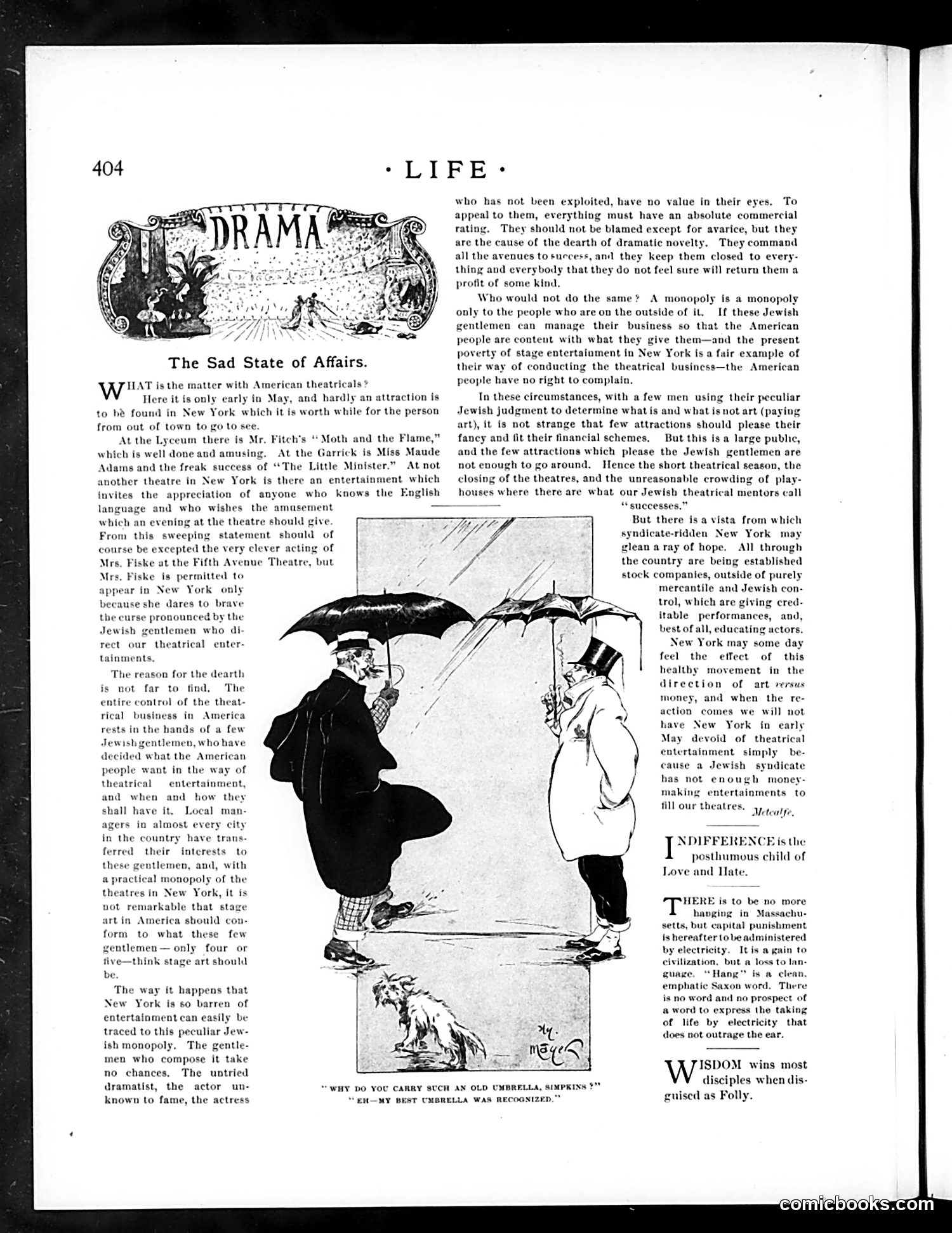
This page critiques the decline of New York theater in May, attributing the problem to Jewish businessmen's monopoly control of theatrical entertainment. The article argues these managers lack appreciation for quality drama, instead preferring commercially profitable but artistically mediocre productions. The cartoon shows two figures with an umbrella in rain, with the caption "Why do you carry such an old umbrella, Simpkins?" / "Eh—my best umbrella was recognized." The humor appears to reference Jewish stereotypes about controlling theaters, though the umbrella joke's specific meaning is unclear without additional context. The text advocates for alternative stock companies and better theatrical management to revitalize American drama, reflecting early 20th-century anti-Semitic attitudes about Jewish involvement in entertainment industries.
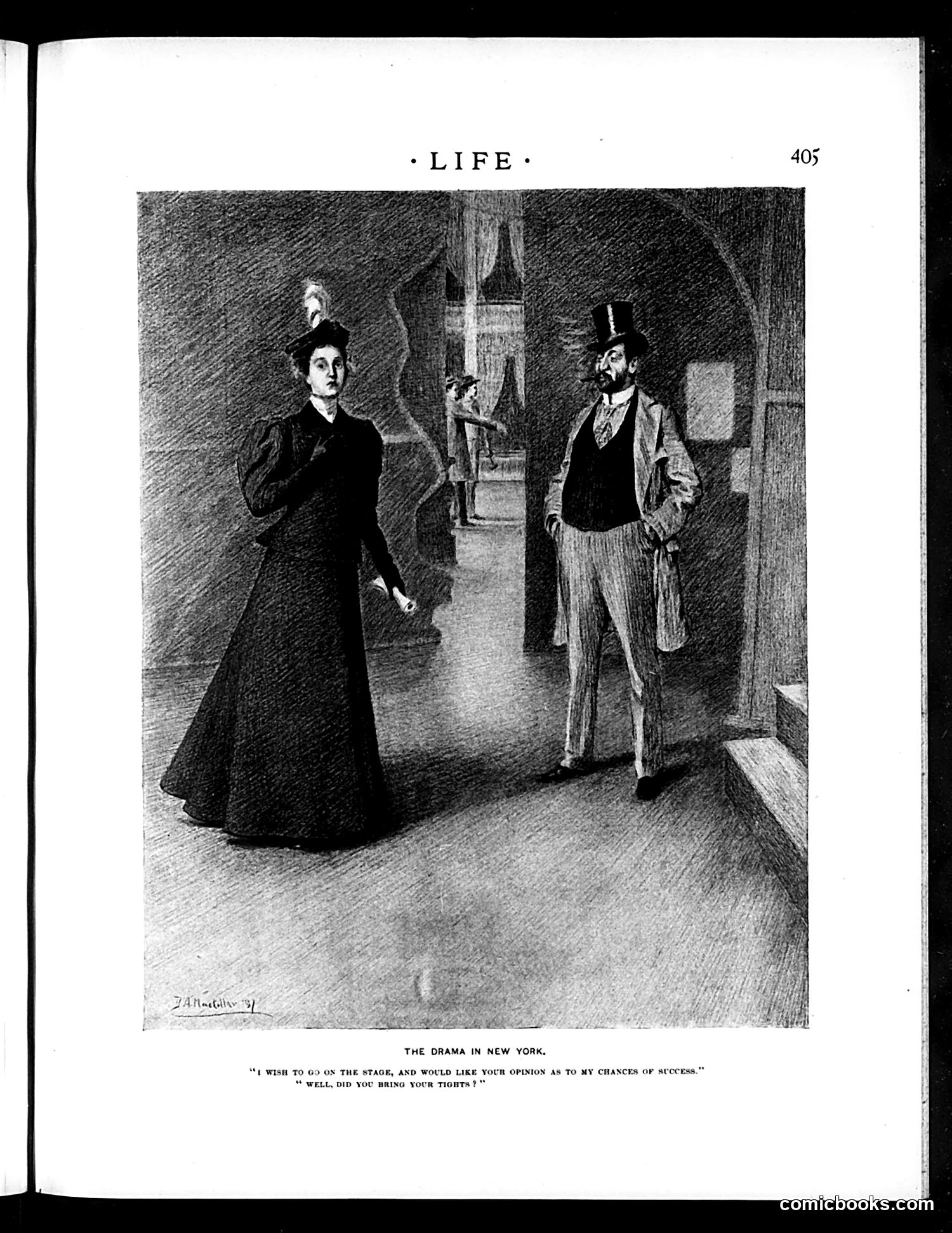
This satirical cartoon mocks aspiring theatrical performers in New York. A well-dressed woman in formal attire approaches a man in a top hat, seeking his opinion on her chances for stage success. His response—asking whether she brought her "tights"—is a crude, dismissive joke suggesting that theatrical success for women depends on physical attractiveness and costume rather than talent or ability. The satire critiques both the shallow standards of theater producers and the naïveté of ambitious performers. The woman's formal dress contrasts with the implication that stage work requires revealing costumes, highlighting the gap between respectable society's expectations and theatrical realities. This reflects period attitudes about actresses and the entertainment industry.
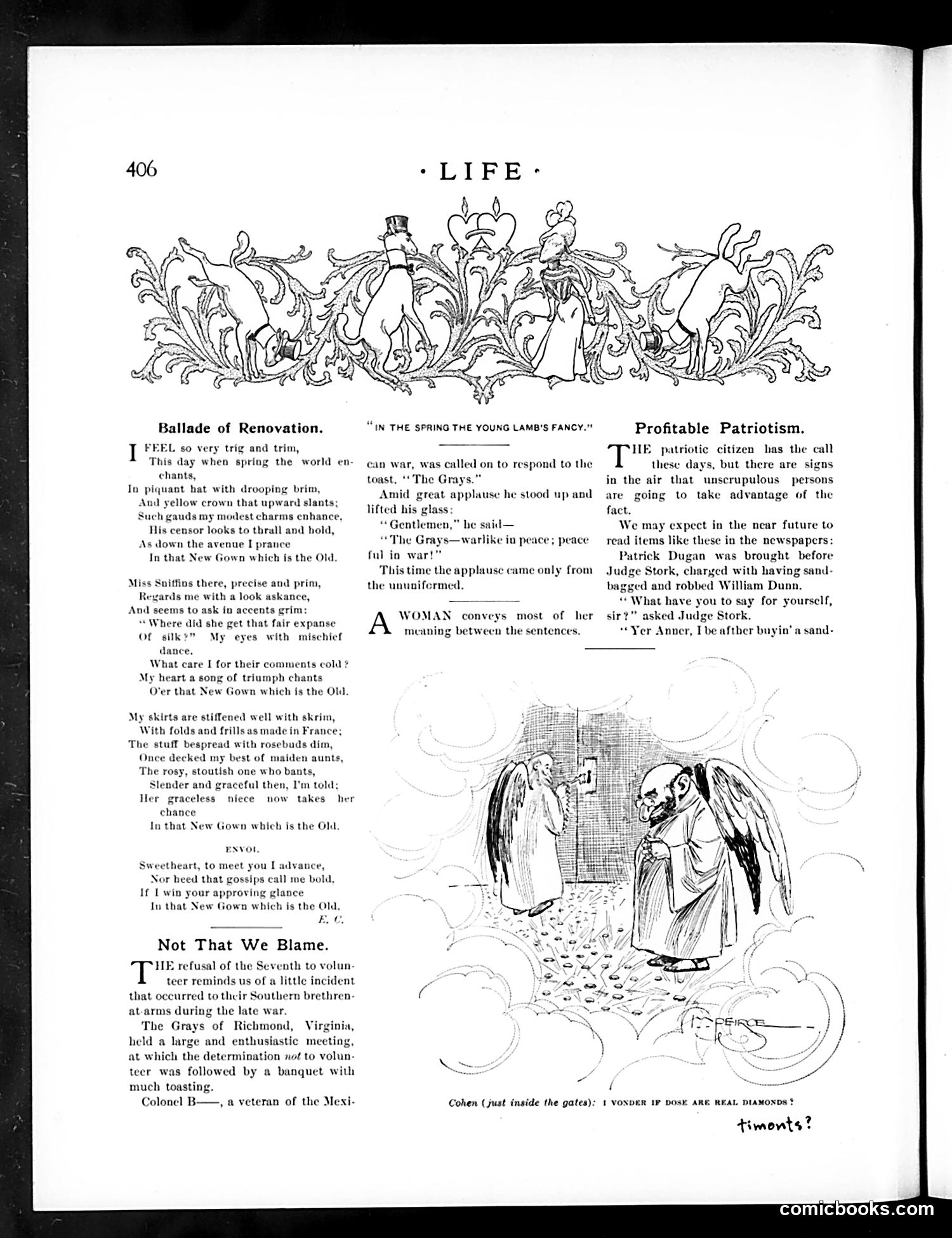
This page contains three satirical pieces reflecting early 20th-century concerns: **"Ballade of Renovation"** satirizes women's fashion and recycling. A woman proudly wears a dress made from her aunt's old fabric, passing it off as new. The satire targets both female vanity (pretending old clothes are fashionable) and social climbing—trying to impress others while hiding the garment's true origins. **"Not That We Blame"** references the Civil War era. Southern volunteers ("The Grays") held a patriotic meeting, but when a Mexican War veteran toasted them as "warlike in peace; peaceful in war," only civilians applauded—the uniformed soldiers remained silent. The joke: his backhanded compliment exposed their lack of actual martial spirit. **"Profitable Patriotism"** warns of war profiteering. An Irishman (Patrick Dugan, suggested by dialect) claims he robbed someone to fund patriotic war bonds. The cartoon satirizes how national crises create opportunities for criminals to hide behind patriotic justification. **The illustration** appears to show an angel at heaven's gates questioning whether diamonds are real—likely commenting on false appearances or fraud.
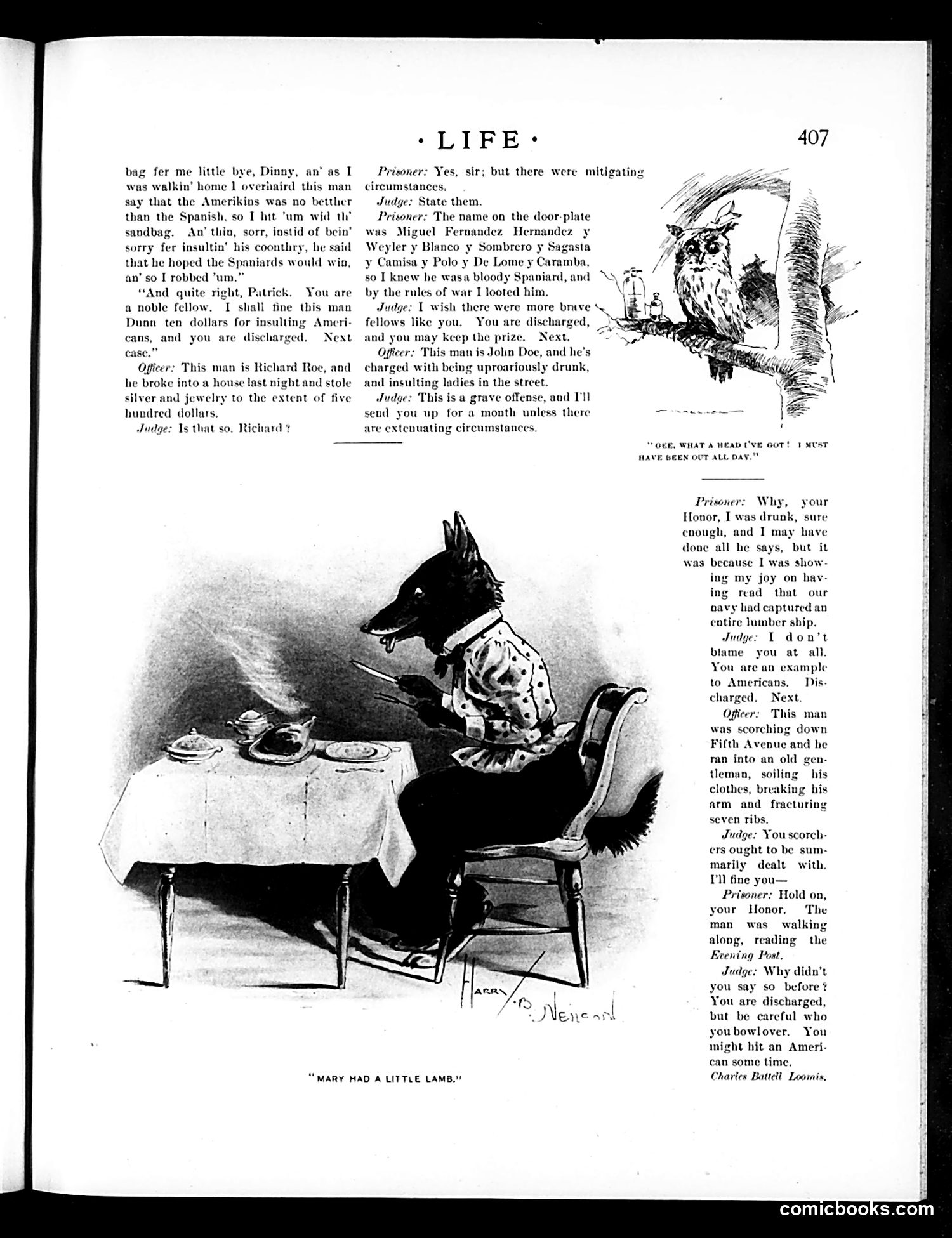
This 1898-era satirical piece (by Charles Battell Loomis) mocks American judicial bias during the Spanish-American War period. The cartoon shows a judge with wildly inconsistent rulings based on anti-Spanish sentiment. **The satire:** A man who assaults someone for pro-Spanish remarks gets discharged and praised. A burglar who robs a Spanish-named person (identified by the absurdly long Hispanic surname listing) is freed because he "looted" an enemy during wartime. A drunk man disrupting the street is excused because he celebrated naval victory. Yet a cyclist who injures a man reading the *Evening Post* is nearly punished—only discharged when the victim wasn't reading pro-war content. **The point:** Life ridicules how American courts and public opinion have become so inflamed by Spanish-American War fervor that judges abandon justice, rewarding violence against Spaniards and Spanish-sympathizers while becoming harsh only toward crimes harming patriotic Americans. It's sharp commentary on wartime hysteria corrupting the legal system.
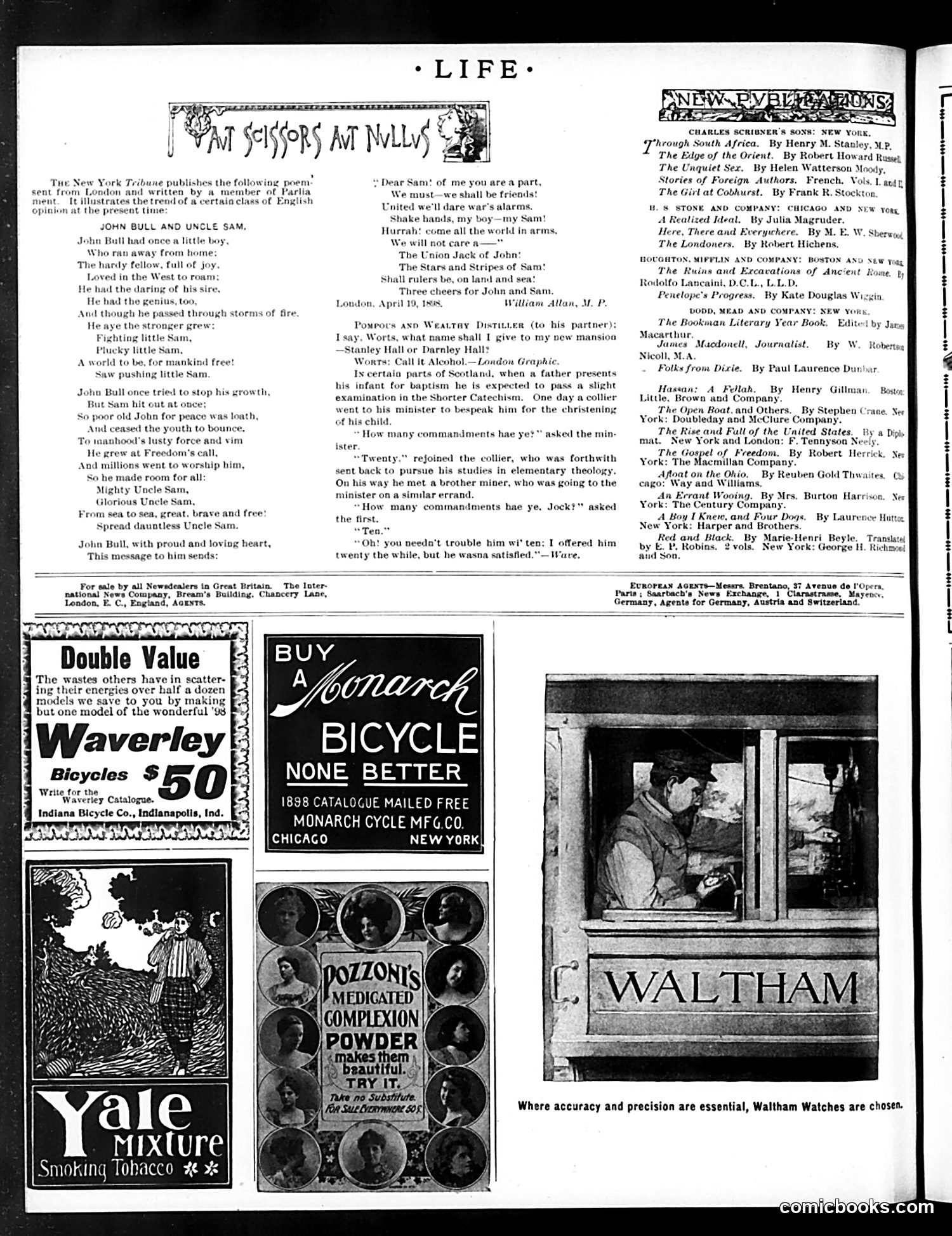
This page combines poetry, humor, and advertisements typical of Life magazine's satirical format. ## Main Content: "John Bull and Uncle Sam" The poem celebrates Anglo-American alliance, personifying Britain ("John Bull") and America ("Uncle Sam") as familial friends united against common enemies. Written by William Allan, M.P., it reflects the 1898 context—likely the Spanish-American War period when Britain and America coordinated foreign policy. The poem's tone is warmly patriotic, with both nations agreeing to cooperate ("Shake hands, my boy—my Sam!"). ## Humor Section Two brief jokes appear: one mocking wealthy industrialists naming mansions after alcohol, and another about Scottish miners misunderstanding the Ten Commandments during baptism examinations—satirizing working-class education gaps. ## Advertisements The page features period product ads (Waverley and Monarch bicycles, Yale tobacco, Mozzoni's complexion powder) and a large Waltham Watches advertisement, typical of Life's commercial revenue model. The page reflects pre-WWI Anglo-American solidarity and Victorian-era consumer culture.
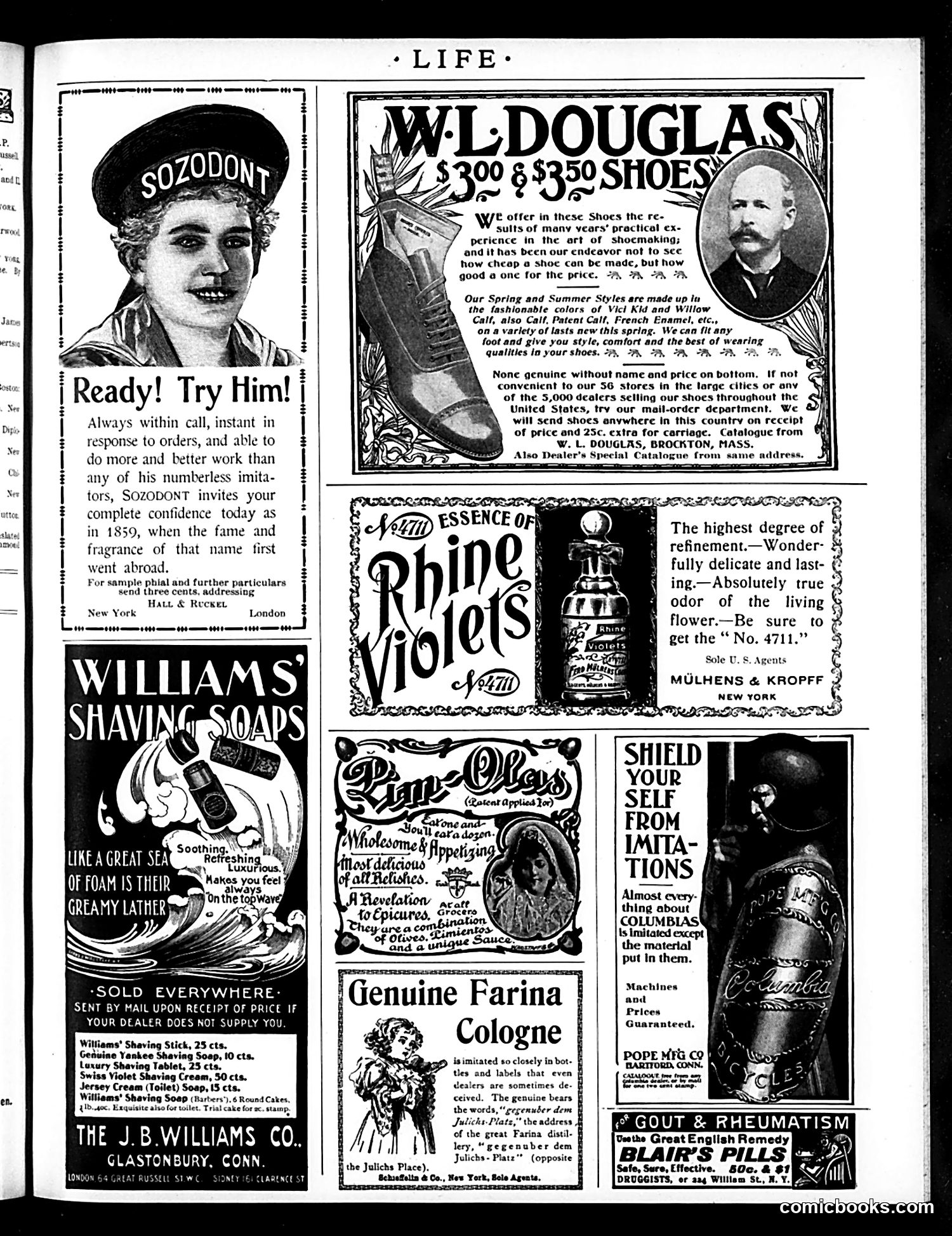
This is primarily an **advertising page** from Life magazine, not a political cartoon. It contains seven distinct product advertisements for personal care and consumer goods, typical of late 19th/early 20th-century magazines. The ads feature: - **Sozodont** toothpaste (claiming 1859 heritage) - **W.L. Douglas shoes** ($2.00-$3.50, mail-order available) - **Williams' Shaving Soaps** (various formulations) - **Rhine Violets** perfume/essence - **Pim Olives** (unclear product, appears food-related) - **Farina Cologne** (genuine vs. imitations warning) - **Pope MFG Co.** product (appears medicinal) - **Blair's Pills** for gout/rheumatism Each ad emphasizes quality, authenticity, and availability through mail-order—reflecting the era's commercial expansion. The caricatured "Sozodont man" (top-left) is a branded mascot, not political satire. This represents mainstream consumer advertising normalized in American magazines of this period.
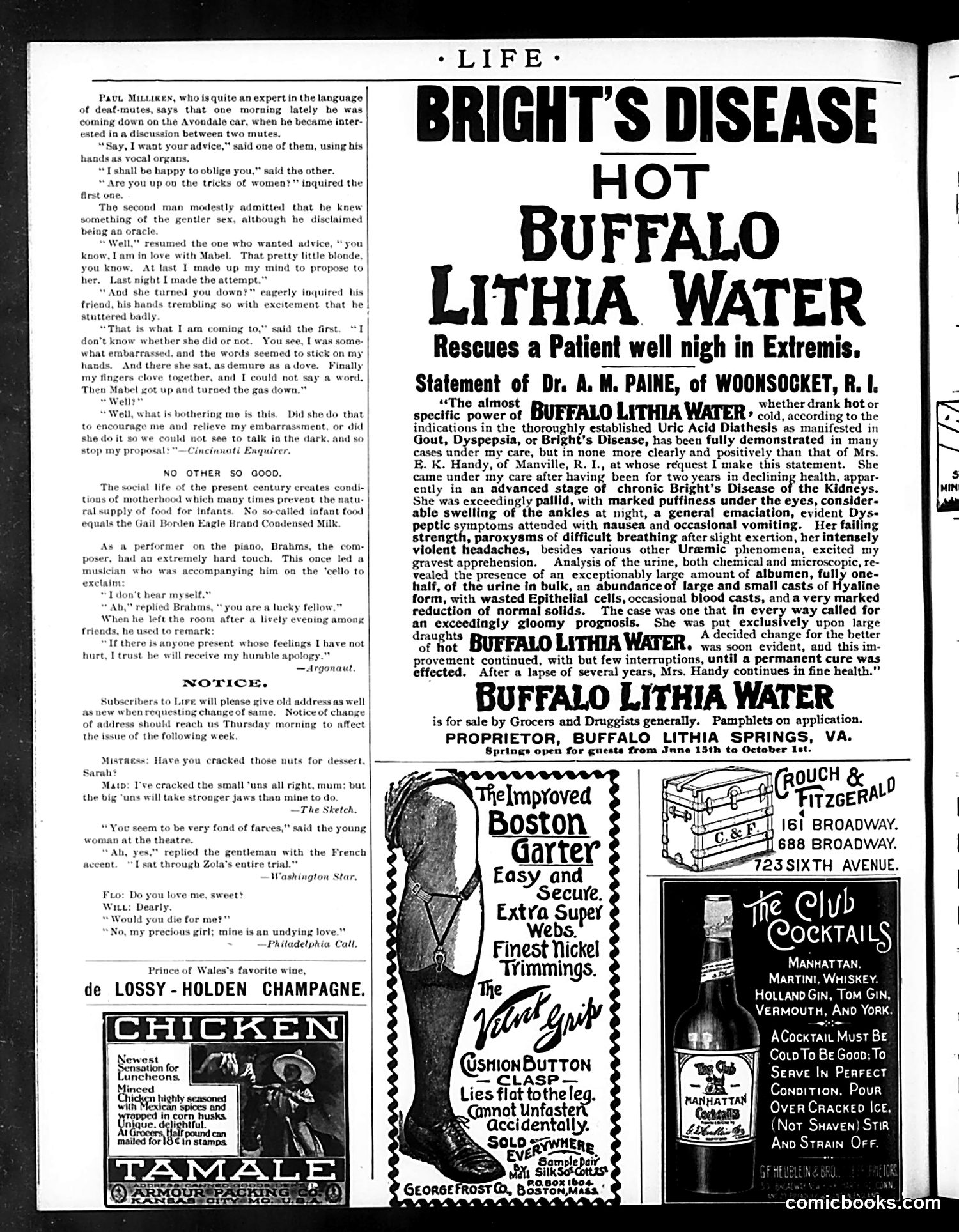
This page is primarily **advertisements and humorous anecdotes**, not political satire. The main content features: **"Bright's Disease Hot Buffalo Lithia Water"** — A patent medicine advertisement claiming to cure Bright's Disease (kidney failure) through mineral water. Dr. A.M. Paine provides a testimonial about treating Mrs. E.K. Handy. This reflects the era's widespread faith in medicinal springs and commercial "cure-alls," often dubious by modern standards. **Humorous stories** include deaf-mute sign language banter about romantic rejection, and quips about composers and romance — typical light fare for Life magazine's satirical humor section. **Other ads** promote Boston garters, champagne, and condensed milk — period commercial goods. The page contains **no political cartoons or identifiable caricatures**. It's standard early-20th-century magazine content mixing advertising with genteel humor, reflecting consumer culture and medical pseudoscience of that era.
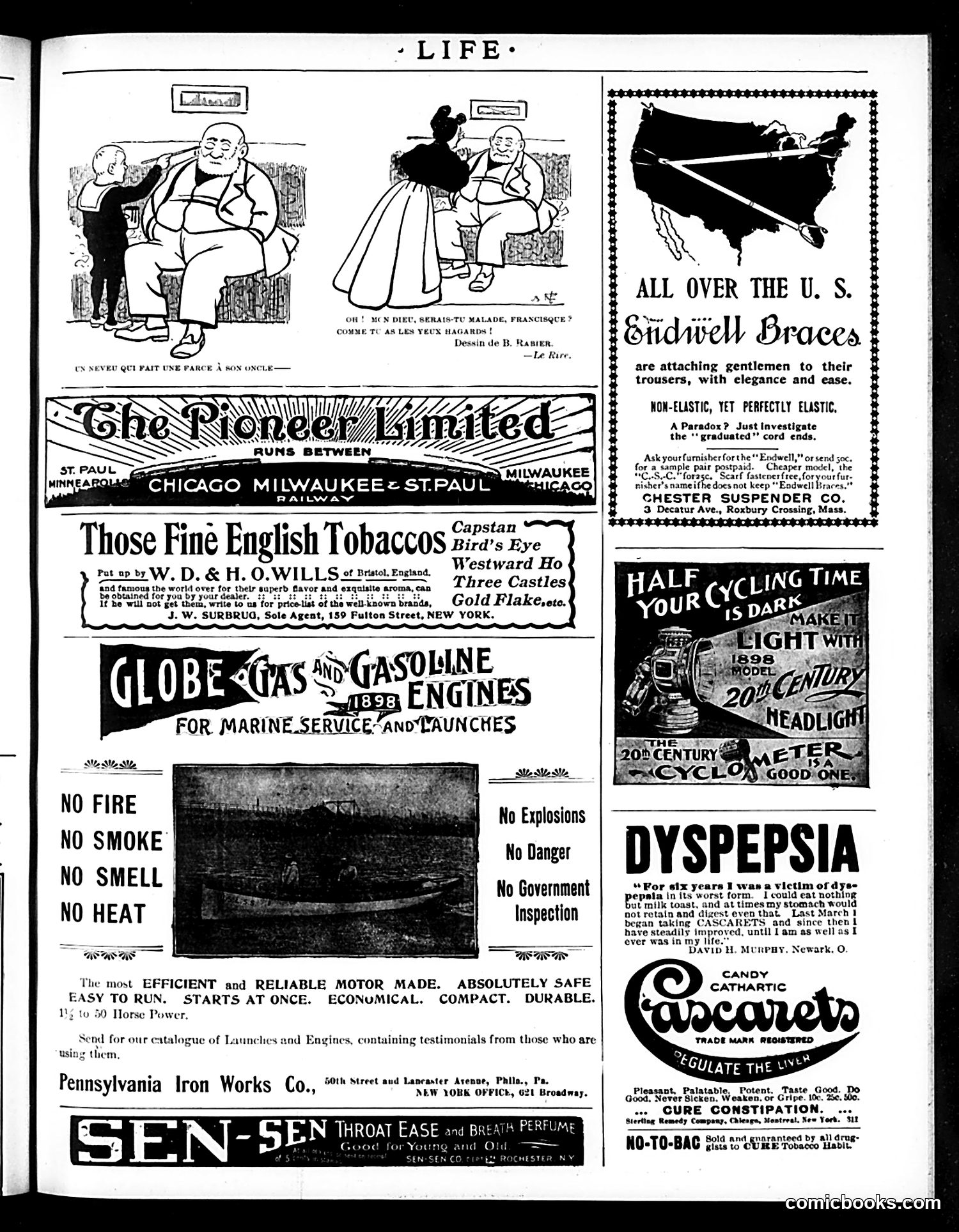
This page is primarily **advertisements** interspersed with two cartoons. The **top cartoons** (credited to B. Raster, from "Le Rire," a French publication) appear to be humorous domestic scenes. The French caption translates roughly to "Oh! My God, are you ill, Francisque? You look haggard!" The joke seems to involve a wife's exasperated reaction to her husband's appearance or behavior—likely satirizing marriage or male vanity, though the specific reference is unclear to modern readers. The page otherwise showcases **turn-of-the-century American advertising**: locomotive services, English tobacco products, industrial engines, suspenders, medicinal products (for dyspepsia/constipation), and cycle headlamps. The ads reflect common health concerns and commercial priorities of the era. One notable advertisement features a **map of the U.S.** promoting Endwell Braces, suggesting widespread national distribution was a selling point. The page represents Life's mixed editorial-advertising format typical of early 20th-century American magazines.
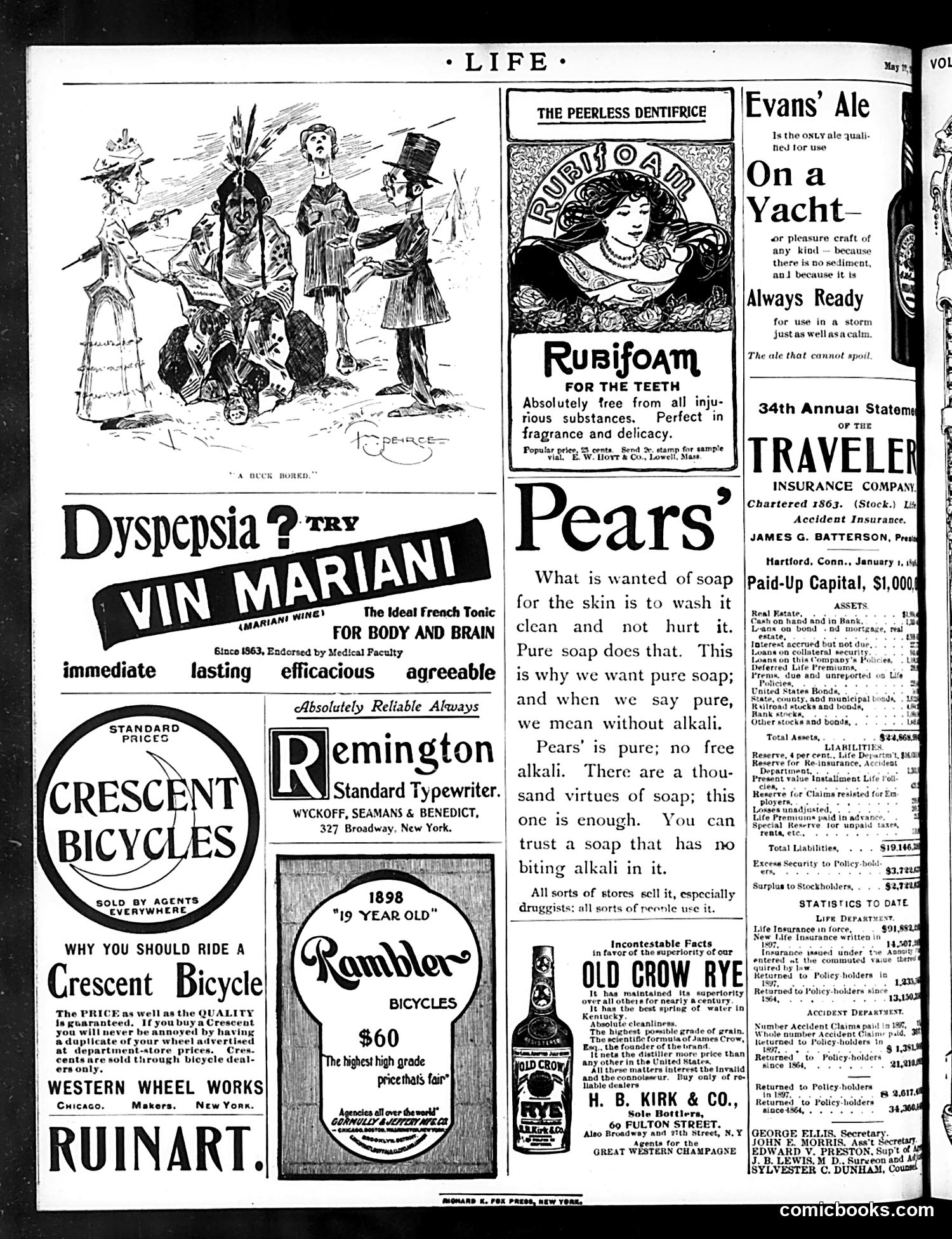
This satirical cartoon depicts three figures in formal attire appearing distressed or exasperated—likely representing political or social figures of the era, though specific identities aren't labeled. The title "A Buck Bored" suggests commentary on wealthy or aristocratic men ("bucks") experiencing ennui or dissatisfaction despite their privileged status. The sketch ridicules the idle boredom of the upper class, a common theme in Life magazine's satirical content. Without clearer labeling or contextual clues, the specific targets remain unclear, but the cartoon likely mocks the complaints or complaints of privileged men, suggesting their problems are trivial compared to ordinary citizens' concerns. The page itself is primarily advertising (Evans' Ale, Pears' Soap, bicycles, typewriters, insurance), with this cartoon serving as the magazine's editorial commentary.