
Life, 1898-05-12 · page 4 of 20
Life — May 12, 1898 — page 4: what you’re looking at
What you’re looking at
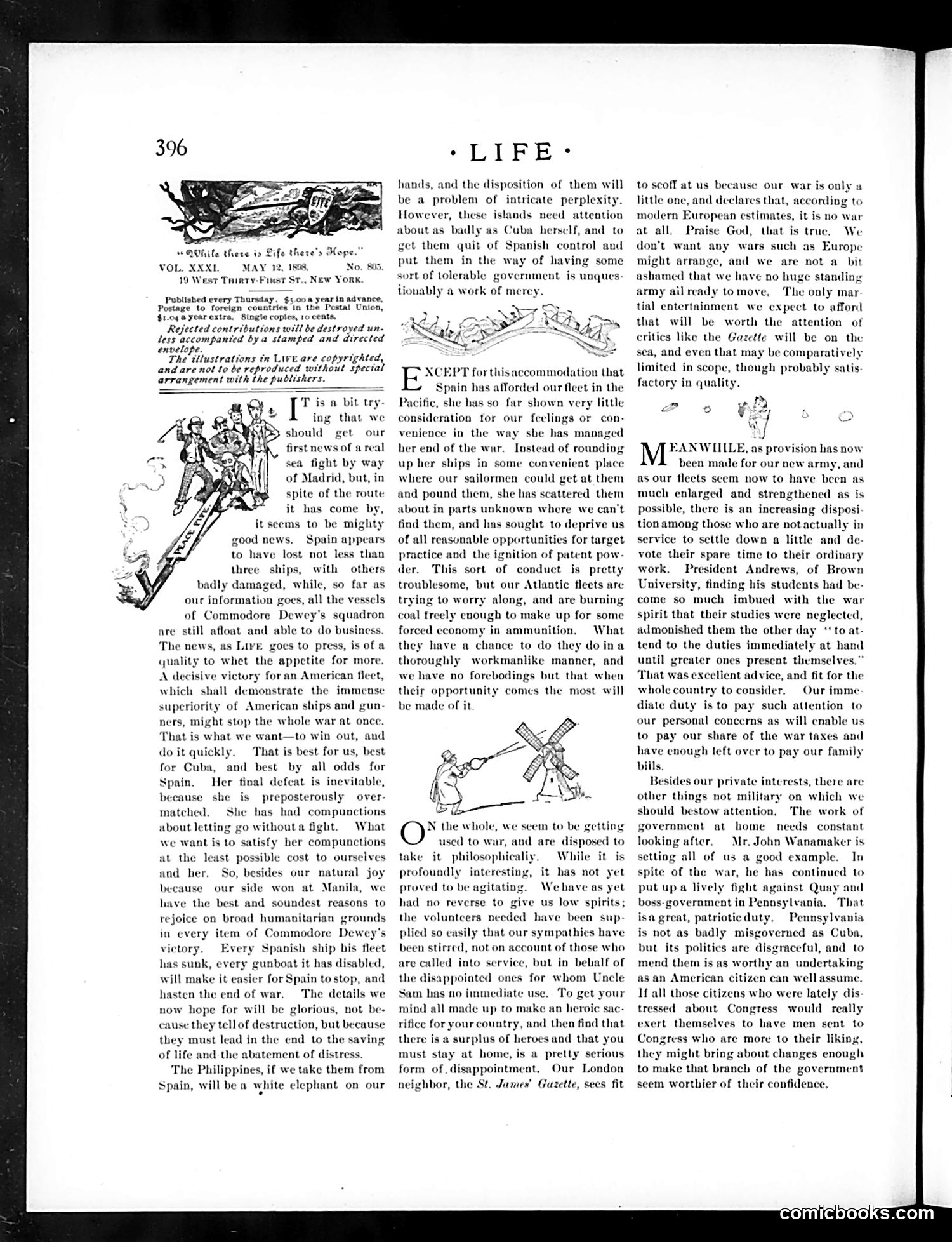
This page contains two editorial cartoons addressing the Spanish-American War era (circa 1898, based on references to Cuba and Spain). The first cartoon depicts a sailor climbing a mast or rigging, illustrating the text's point about Spain's naval weakness compared to American forces, particularly Commodore Dewey's squadron. The second cartoon shows two figures (appearing to be soldiers or workers) at a windmill, likely referencing Cervantes' *Don Quixote*—a symbolic jab at Spain as outdated and foolish, fighting a futile war against superior American power. The editorial text argues that American naval superiority makes Spanish defeat inevitable, while defending American war aims in Cuba as justified. The cartoons reinforce this message through visual mockery of Spanish military capacity.
📄 Transcribed text from this page (OCR, searchable)
Machine-transcribed from the original scan — historical spelling and the odd misread are preserved.
HOWhile there io Life there's Hope.” VOL. XXXL MAY 12, 1898, No, 805, 19 West Thaty-Fiest St., New Yore. Published every Thursday. §5.008 yearin advance, Postage to foreign countries in the Postal Union, $1.04 a year extra. Single copies, 10 cents, Rejected contributions will be destroyed un- tess accompanied bya stamped and directed envelope. . The illustrations in Live are copyrighted, and are not to be reproduced without special arrangement with the publishers. T is a bit tr: ing that we should get our first news of a real sea fight by way of Madrid, but, in spite of the route it has come by, itseems to be mighty good news. Spain appears to have lost not less than three ships, with badly damaged, while, so far as our information goes, all the vessels of Commodore Dewey's squadron are still afloat and able to do business The news, as Lire goes to press, is of a quality to whet the appetite for more. A decisive victory for an American flect, which shall demonstrate the immense superiority of American ships and gun- ners, might stop the whole war at once. ‘That is what we want—to win out, aud do it quickly. That is best for us, best for Cuba, and best by all odds for Spain. Her tinal defeat is inevitable, because preposterously over- matched. She has had compunctions about letting go withouta fight. What we want is to satisfy her compunctions at the least possible cost to ourselves and her. So, besides our natural jo because our side won at Manila, we have the best and soundest reasons to rejoice on broad humanitarian grounds in every item of Commodore Dewey victory. Every Spanish ship his fleet has sunk, every gunboat it has disabled, will make it easicr for Spain to stop, and hasten the end of war. The details we now hope for will be glorious, not be- cause they tell of destruction, but because they must lead in the end to the saving of life and the abatement of distress. The Philippines, if we take them from Spain, will be a white elephant on our others she is *LIFE: hands, and the disposition of them will be a problem of intricate perplexity. Ifowever, these islands need attention about as badly as Cuba herself, and to t them quit of Spanish control and put them in the way of having some sort of tolerable government is unques- iionably a work of mercy. XCEPT forthisaccommodation that Spain has afforded our fleet in the >acific, she has so far shown very litle consideration for our feelings or con- venience in the way she has managed her end of the war. Instead of rounding up her ships in some convenient place where our sailormen could get at them and pound them, she has scattered them about in parts unknown where we can't find them, and has sought to deprive us of all reasonable opportunities for target e and the ignition of patent pow- This sort of conduct is pretty troublesome, but our Atlantic fleets are trying to worry along, and are burning coal freely enough to make up for some forced economy in ammuniti What they have a chance to do they doina thoroughly workmanlike manner, and we have no forebodings but that when their opportunity comes the most will be made of it N the whole, we scem to be getting used to war, and are disposed to take it philosophically. While it i profoundly interesting, it has not yet We have as yet give us low spirits; the volunteers needed have been sup- plied so easily that our sympathies have been stirred, not on account of those who are called into service, but in bebalf of the disappointed ones for whom Uncle Sam has no immediate use. To get your mind all made up to make an heroic sac- rifice for your country, and then find that there is a surplus of heroesand that you must stay at home, is a pretty serious form of. disappointment, Our London neighbor, the St. James’ Gazette, secs fit proved to be agitating. had no reverse to to scoff ut us because our war is only little one, and declares that, according to modern European estimates, it is no war at all, Praise God, that is true. We don’t want apy wars such as Europe might arrang are not a bit ashamed that we have no huge standing army ail ready tomove. The only mar tial entertainment we expect to afford that will be worth the attention of critics like the Gazette will be on the sea, and even that may be comparatively limited in scope, though probably sat factory in quality. and we NWUILE, as provision has now been made for our new army, and as our fleets seem now to have been as much enlarged and strengthened as is possible, there is an increasing disposi tion among those who are not actu service to settle down a little and de vote their spare time to their ordinary work. President Andrews, of Brown University, finding his students had be- come so much imbued with the war spirit that their studies were neglected, admonished them the other day ‘‘to at tend to the duties immediately at hand until greater ones present themselve: That was excellent advice, and fit for the whole country to consider. Our imme diate duty is to pay such attention to our personal concerns as will enable us to pay our share of the war taxes and have cnough left over to pay our family bills. Besides our private interests, there are other things not military on which we should bestow attention, The work of government at needs looking after. Mr. John Wanamaker is setting all of us a good example. In spite of the war, he has continued to put upa lively fight against Quay and boss-government in Pennsylvania, That a great, patrioticduty. Pennsylvania is not as badly misgoverned as Cuba, but its polities are disgraceful, and to mend them is as worthy an undertaking as an American citizen can well assume. If all those citizens who were lately dis. tressed about Congress would really exert themselves to have men sent to Congress who are more to their liking, they might bring about changes enough to make that branch of the government seem worthier of their confidence. home constant