
Life, 1898-05-12 · page 12 of 20
Life — May 12, 1898 — page 12: what you’re looking at
What you’re looking at
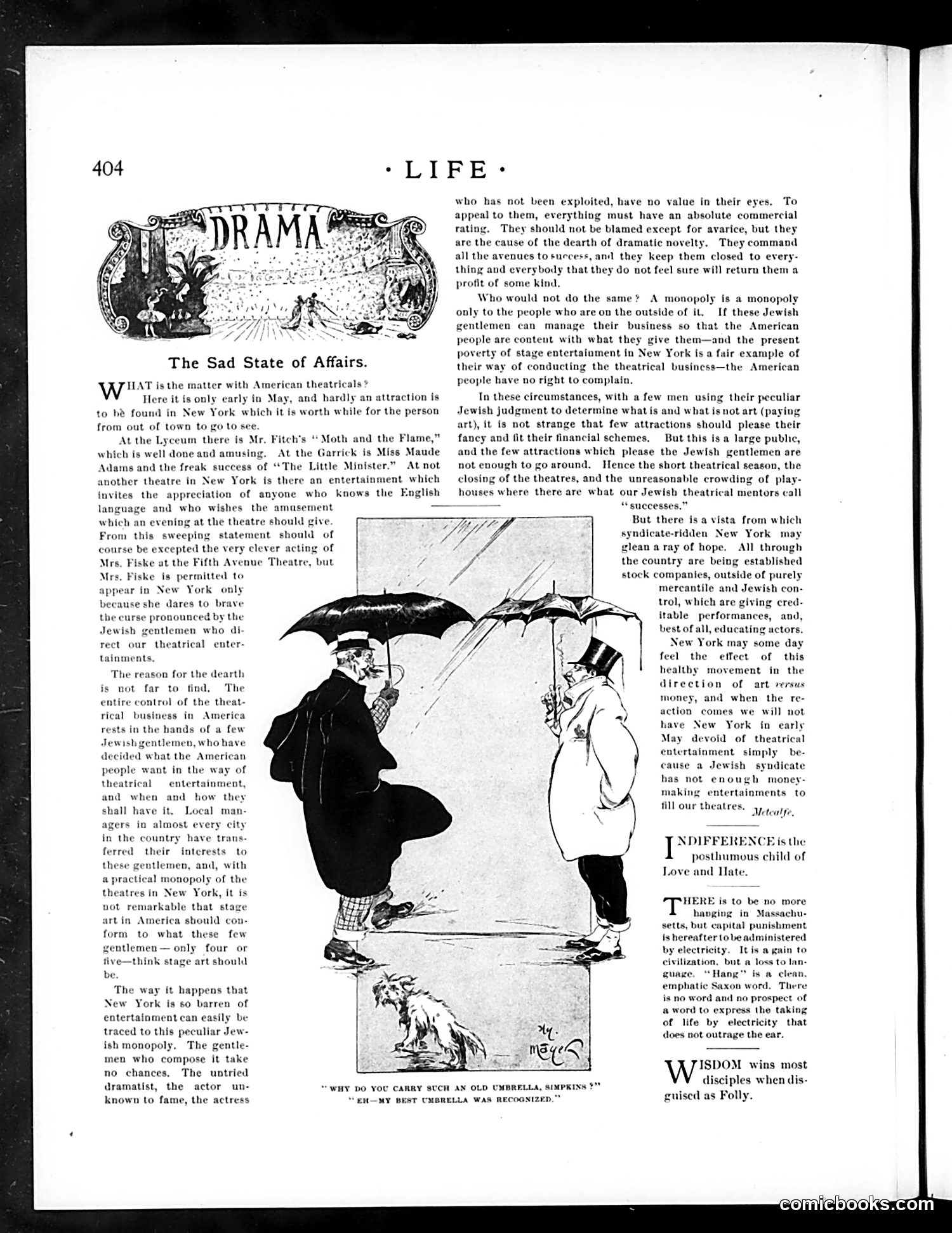
This page critiques the decline of New York theater in May, attributing the problem to Jewish businessmen's monopoly control of theatrical entertainment. The article argues these managers lack appreciation for quality drama, instead preferring commercially profitable but artistically mediocre productions. The cartoon shows two figures with an umbrella in rain, with the caption "Why do you carry such an old umbrella, Simpkins?" / "Eh—my best umbrella was recognized." The humor appears to reference Jewish stereotypes about controlling theaters, though the umbrella joke's specific meaning is unclear without additional context. The text advocates for alternative stock companies and better theatrical management to revitalize American drama, reflecting early 20th-century anti-Semitic attitudes about Jewish involvement in entertainment industries.
📄 Transcribed text from this page (OCR, searchable)
Machine-transcribed from the original scan — historical spelling and the odd misread are preserved.
> LIFE: The Sad State of Affairs. HAT isthe matter with American theatricals ? Here it is only early in May, and hardly an attraction is to b8 found in New York which it is worth while for the person from out of town to go to see. At the Lyceum there is Mr. Fitch's Moth and the Flame,” which is well done and amusing. At the Garrick is Miss Maude Adams and the freak success of ‘The Little Minister.” At not another theatre in New York is there an entertainment which invites the appreciation of anyone who knows the English language and who wishes the amasement who has not been exploited, have no value in their eyes. To appeal to them, everything must have an absolute commercial rating, They should not be blamed except for avarice, but they are the cause of the dearth of dramatic novelty. They command all the avenues to success, and they keep them closed to every- thing and everybody that they do not feel sure will return them a profit of some kind. Who would not do the same? A monopoly is a monopoly only to the people who are on the outside of it, If these Jewish gentlemen can their business so that the American people are content with what they give them—and the present poverty of stage entertainment in New York is a fair example of their way of conducting the theatrical business—the American ople have no right to complain. mana In these circumstances, with afew men using their peculiar Jewish judgment to determine what is and what isnot art (paying art), it is not strange that few attractions should please their fancy and fit their financial schemes. But this is a large public, and the few attractions which please the Jewish gentlemen are not enough to go around. Hence the short theatrical season, the closing of the theatres, and the unreasonable crowding of play- houses where there are what our Jewish theatrical mentors call - “successes.” which an evening at the theatre should give. From this sweeping statement should of course be excepted the very clever acting of Mrs. Fiske at the Fifth Avenue Theatre, but Mrs. Fiske is permitted to appear in New York only because she dares to brave by the Jewish gentlemen who di- rect our theatrical enter- tainments, the curse pronounc ‘The reason for the de: far to find, entire control of the the: rical_ business in America in the hands of a few Jewish gentlemen, who have decided what the American people want in the way of theatric entertainment, and when and they shall have it, Local man- agers in almost every city in the country have ferred their these gentlemen, and, with a practical monopoly of the theatres in New York, it is uot remarkable that sts artin America sbould con- form to what these few gentlemen — only four or five—think stage art should is not how trans: interests to The way it happens that New York is so barren of entertainment can easily be traced to this peculiar Jew- ish monopoly. The gentle- men who compose it take no chances. The untried But there isa vista from which syndicate-ridden New York may glean array of hope. All through the country are being established stock compantes, outside of purely mercantile and Jewish con- trol, which are giving cred- itable performances, and, best of all, educating actors. New York may some day feel the effect of this healthy movement in the direction of art rersus money, and when the re- action comes we will not have New York in early May devoid of theatrical entertainment simply _ be- cause a Jewish syndicate has not enough money- making entert ments to fill our theatres, Metcalfe, NDIFFERE isthe posthumous child of Love and Hate. HERE is to be no more havging in Massachu- setts, but capital punishment is hereafter (o be administered by electric civilization, but a loss to guage. “Hang” is a clean emphatic Saxon word. There is no word and no prospect of a word to express the taking of life by electricity that does not outrage the ear. It is a gain to ISDOM wins most dramatist, the actor un- known to fame, the actress “en “WHY DO YOU CARRY SUCH AN OLD UMBRELLA, SIMPRINS 1" MY BEST UMBRELLA WAS RECOGNIZED.” disciples when dis- gnised as Folly.