
Life, 1898-05-12 · page 8 of 20
Life — May 12, 1898 — page 8: what you’re looking at
What you’re looking at
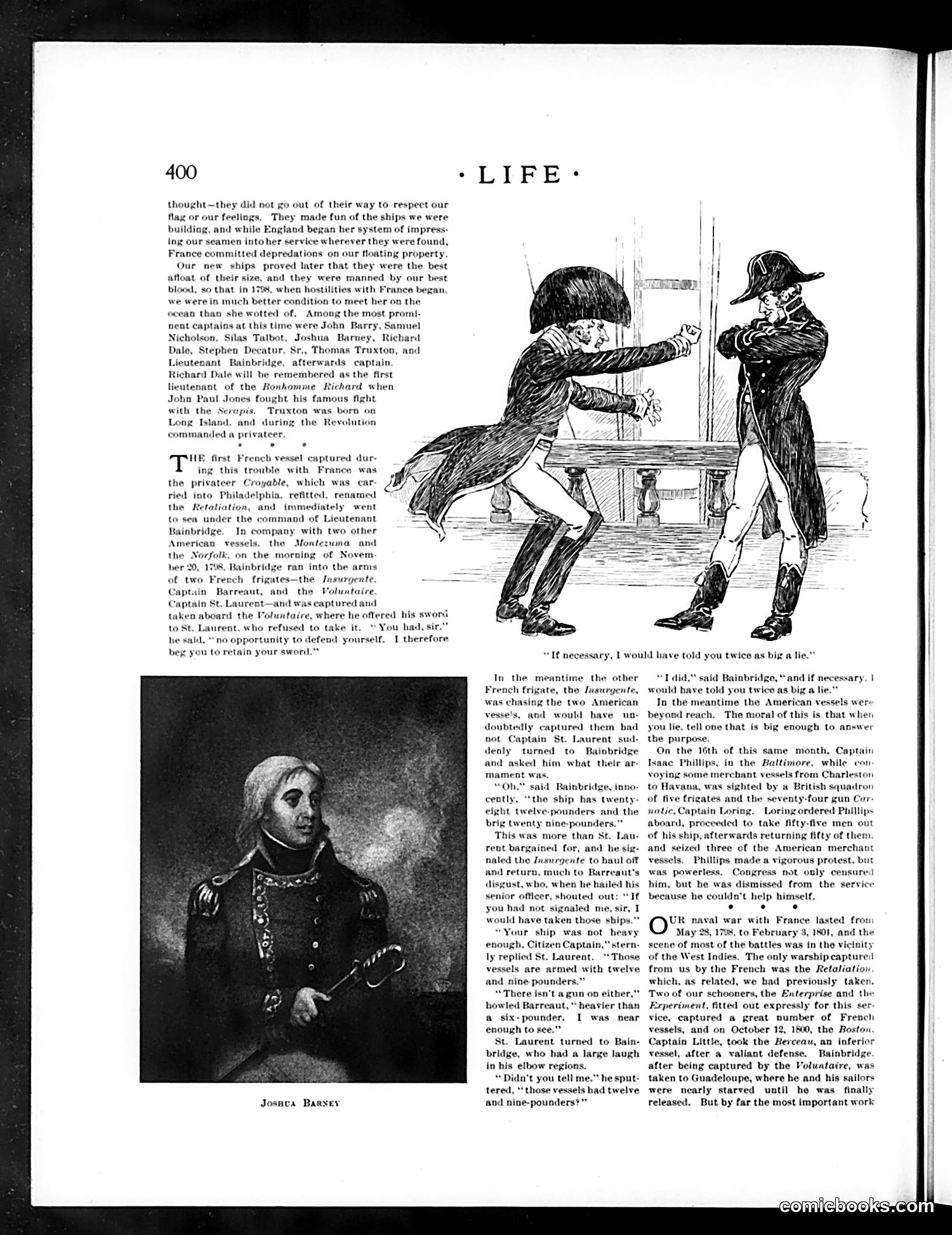
This page from *Life* magazine discusses American naval encounters during the Quasi-War with France (1798-1801). The text celebrates American sea captains and their victories against French vessels. The main illustration depicts a confrontation between two naval officers—likely representing an American captain (left) and a French captain (right)—engaged in a dramatic physical altercation or tense standoff aboard ship. The exaggerated poses and theatrical staging suggest satire of maritime honor codes and the bravado of naval warfare. The portrait below identifies **Joshua Barney**, a prominent American naval commander of the period. The satire appears to mock the grandiose language and theatrical posturing of wartime naval encounters while celebrating American naval prowess. The caption's quote about "telling lies" hints at the page's humorous take on embellished accounts of naval combat.
📄 Transcribed text from this page (OCR, searchable)
Machine-transcribed from the original scan — historical spelling and the odd misread are preserved.
400 thought~they did not go out of their way to respect our flag or our feelings. They made fun of the ships we were building, and while England began her system of impress- ing our seamen into her service wherever they were found, France committed depredations on our floating property. Our new ships proved later that they were the best afloat of their size, and they were manned by our best blood, so that in 179%, when hostilities with France began. we were in much better condition to meet her on the ocean than she wotted of. Among the most promi- nent captains at this time were John Barry, Samuel Nicholson, Silas Talbot, Joshua Barney, Richard Dale, Stephen Decatur, Sr., Thomas Truxton, and Lieutenant Bainbridge, afterwards captain. Richard Dale will be remembered as the first lieutenant of the Bonhomme Richard when John Paul Jones fought his famous fight with the Serapis. Truxton was Long Island. and during the Re commanded a privateer. HE first French vessel captured dur- ing this trouble with France was the privateer Croyable, which was car- ried into Philadelphia, refitted, renamed the Retaliation, and immediately went to sea under the command of Lieutenant Bainbridge. In company with two other ican vessels. the Montezuma and rfolk, on the morning of 18. Bainbrid, of two French frigates—the Insurgente. Captain Barreaut, and the untaire, Captain St. Laurent—and was captured and taken aboard the Voluntaire, where he offered his sword to St. Laurent, who refused to take it. “You had, sir." he said, * no opportunity to defend yourself. I therefore beg you to retain your sword.” Josava Baryey “If necessary, | would bave told you twice as big a lie.” In the meantime the other French frigate, the Insurgente, was chasing the two American vessels, and would have un- doubtedly captured them had not Captain St. Laurent sud: denly turned to Bainbridge and asked him what their ar. mament was, “Oh,” said Bainbridge, inno- cently, “the ship has twenty- eight twelve-pounders and the brig twenty nine-pounders." This was more than St. Lau- rent bargained for, and he sig- naled the Insurgente to haul off and return, much to Barreaut's disgust, who, when he bailed his senior officer, shouted out: “If you had not signaled me, sir, I would have taken those ships." “Your ship was not heavy enough, Citizen Captain,” stern- ly replied St. Laurent. “Those vessels are armed with twelve and nine pounders. “There isn't a gun on either,” howled Barreaut, “ heavier than a six-pounder. I was near enough to see.” St. Laurent turned to Bain- bridge, who had a large laugh in his elbow regions. “Didn't you tell me.” he sput- tered, “those vessels had twelve and nine-pounders?" “Tid,” said Bainbridge, “and if necessary. | would have told you twice as big a lie.” In the meantime the American vessels were beyond reach. The moral of this is that when you lie, tell one that is big enough to answer the purpose. On the 16th of this same month, Captain Isaac Phillips, in the Baltimore, while con ng some merchant vessels from Charlest¢ to Havana, was sighted by # British squadron of five frigates and the seventy-four gun Car- natie, Captain Loring. Loring ordered Phillips aboard, proceeded to take fifty-five men out of his ship, afterwards returning fifty of them. and seized three of the American merchant vessels. Phillips made a vigorous protest, but was powerless, Congress not only censure) him, but he was dismissed from the service because he couldn't help himself. o 8 UR naval war with France lasted fron: May 28, 170%, to February 3, 1801, and the scene of most of the battles was in the vicinity of the West Indies. The only warship captures! from us by the French was the Retaliation which, as related, we bad previously taken. Two of our schooners, the Enterprise and the Experiment, fitted out expressly for this s vice, captured a great number of French vessels, and on October 12, 1800, the Boston Captain Little, took the Berceau, an inferior vessel, after a valiant defense, Bainbridge. after being captured by the Voluntaire, was taken to Guadeloupe, where he and his sailors were nearly starved until he was. finally released, But by far the most important work