
Life, 1898-05-12 · page 7 of 20
Life — May 12, 1898 — page 7: what you’re looking at
What you’re looking at
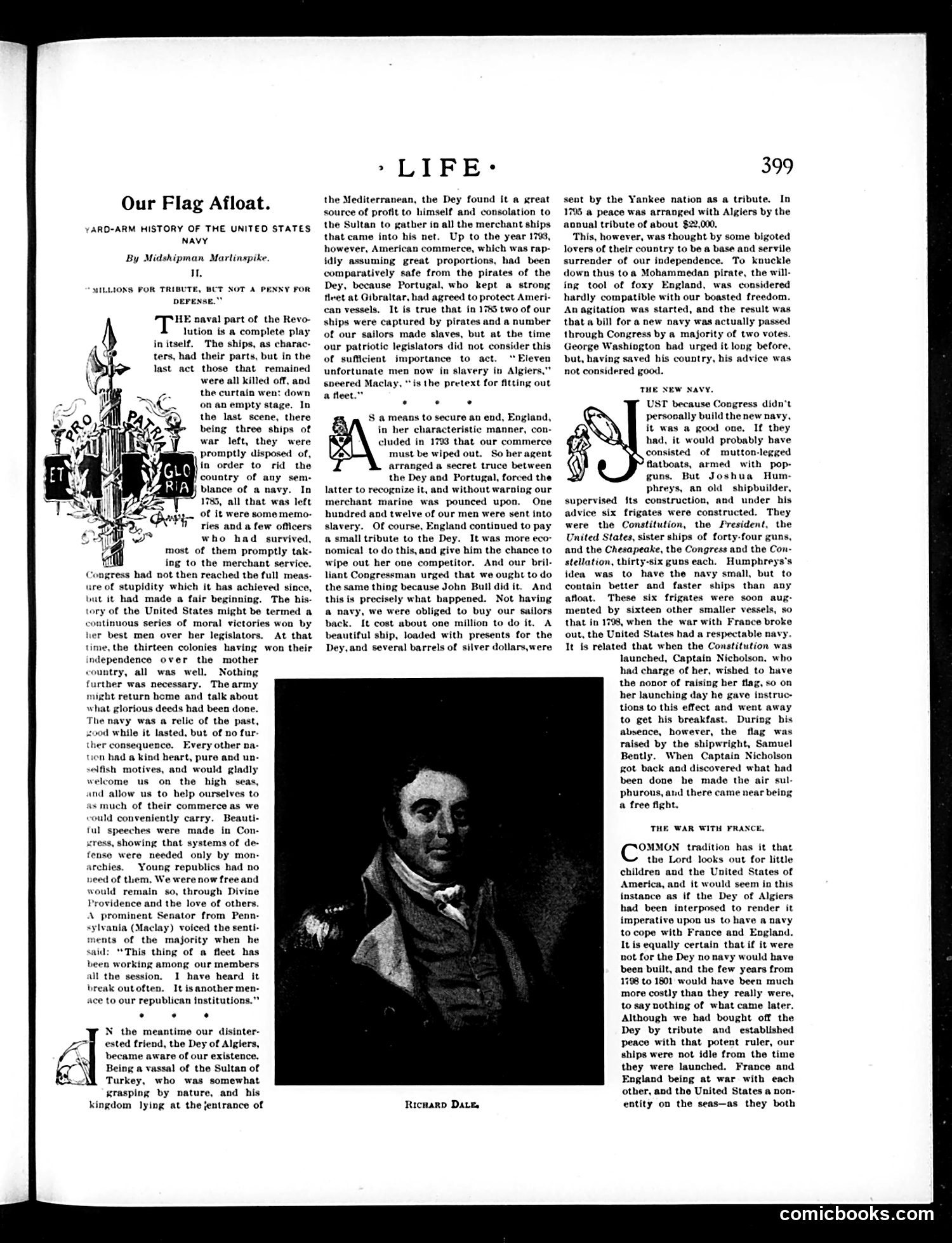
This page contains a historical article titled "Our Flag Afloat: A Yard-Arm History of the United States Navy" by Midshipman Marionspike. The text discusses early American naval history, focusing on tribute payments to the Dey of Algiers and privateering issues. The portrait shown appears to be **Richard Dale**, labeled at the bottom. Based on the naval context, Dale (1756-1826) was a notable early American naval officer. The article's satire criticizes Congress for not properly supporting the Navy—asserting that building the USS Constitution was worthwhile despite cost concerns. The broader point satirizes American reluctance to invest in naval defense while paying tribute to Barbary States, suggesting this was politically and economically foolish compared to building a proper fleet. The decorative naval emblem in the margin reinforces the martial theme.
📄 Transcribed text from this page (OCR, searchable)
Machine-transcribed from the original scan — historical spelling and the odd misread are preserved.
Our Flag Afloat. YARO-ARM HISTORY OF THE UNITED STATES NAVY By Midshipman Marlinspike. I MILLIONS POR TRIBUTE, BUT NOT A PENNY FOR Deresse.” HE naval part of the Revo- lution is a complete play in itself, The ships, as charac- ters, had their parts, but in the last act those that remained were all killed off, and the curtain wen: down on an empty stage. In the last scene, there being three ships of war left, they were promptly disposed of, in order to rid the H country of any sem- blance of a navy. In 1785, all that was left of it were some memo- ries and a few officers who had survived most of them promptly tal ing to the merchant service. Congress had not then reached the full meas- ure of stupidity which it has achieved since, but it had made a fair beginning. The his- tory of the United States might be termed a continuous series of moral victories won by her best men over her legislators. At that time, the thirteen colonies having won their ndependence over the mother country, all was well, Nothing further was necessary, The army might return home and talk about what glorious deeds had been done. The navy was a relic of the past, zood while it lasted, but of no fur- ther consequence. Every other na- tien had a kind heart, pure and un- selfish motives, and would gladly welcome us on the high seas, ind allow us to belp ourselves to as much of their commerce as we vould conveniently carry. Beauti- ful speeches were made in Con- xress, showing that systems of de- fense were needed only by mon- arehies. Young republics had no need of them, We were now free and would remain so, through Divine Providence and the love of others. \ prominent Senator from Penn- sylvania (Maclay) voiced the senti- ts of the majority when he : “This thing of a fleet has been working among our members ail the session, I have heard it break outoften. It isanother men- ace to our republican institutions.” o 8 6 N the meantime our disinter- ested friend, the Dey of Algiers, became aware of our existence. Being a vassal of the Sultan of Turkey, who was somewhat grasping by nature, and his kingdom lying at the jentrance of > LIFE: the Mediterranean, the Dey found it a great source of profit to himself and consolation to the Sultan to gather in all the merchant ships that came into his net. Up to the year 1793, however, American commerce, which was rap- idly assuming great proportions, had been comparatively safe from the pirates of the Dey, because Portugal, who kept a strong fivet at Gibraltar, had agreed to protect Ameri- can vessels. It is true that in 1755 two of our ships were captured by pirates and a number of our sailors made slaves, but at the time our patriotic legislators did not consider this of sufficient importance to act. “Eleven unfortunate men now in slavery iv Algiers,” sneered Maclay, “is the pretext for fitting out a fleet.” ‘ ‘ ‘ $a means to secure an end, England, in her characteristic manner, con- cluded in 1793 that our commerce must be wiped out. So her agent arranged a secret truce between the Dey and Portugal, forced the latter to recognize it, and without warning our merchant marine was pounced upon, One hundred and twelve of our men were sent into slavery. Of course, England continued to pay a small tribute to the Dey. It was more eco- nomical to do this, and give him the chance to wipe out her one competitor. And our bril- lant Congressman urged that we ought to do the same thing because John Bull did it. And this is precisely what happened. Not having @ navy, we were obliged to buy our sailors back. {t cost about one million to do it. A beautiful ship, loaded with presents for the Dey, and several barrels of silver dollars,were Ricmarp Dare, 399 sent by the Yankee nation as a tribute. In 1705 & peace was arranged with Algiers by the annual tribute of about $22,000. This, however, was thought by some bigoted lovers of their country to be a base and servile surrender of our independence. To knuckle down thus toa Mohammedan pirate, the will- ing tool of foxy England, was considered hardly compatible with our boasted freedom. An agitation was started, and the result was that a bill fora new navy was actually passed through Congress by a majority of two votes. George Washington bad urged it long before, but, having saved his country, his advice was not considered good. THE NEW NAVY. UST because Congress didn't personally build the new navy, it was a good one. If they had, it would probably have consisted of mutton-legged flatboats, armed with pop- guns, But Joshua Hum- phreys, an old shipbuilder, supervised {ts construction, and under his advice six frigates were constructed. They were the Constitution, the President, the United States, sister ships of forty-four guns, and the Chesapeake, the Congress and the Con- stellation, thirty-six guns each. Humphreys’s idea was to have the navy small, but to contain better and faster ships than any afloat, These six frigates were soon aug- mented by sixteen other smaller vessels, so that in 1798, when the war with France broke out, the United States had a respectable navy. It fs related that when the Constitution was launched, Captain Nicholson, who had charge of her, wished to have the nonor of raising her flag, so on her launching day he gave instruc tions to this effect and went away to get his breakfast. During bis absence, however, the flag was raised by the shipwright, Samuel Bently. When Captain Nicholson got back and discovered what had been done he made the air sul- phurous, and there came near being a free fight. THE WAR WITH FRAN OMMON tradition has it that the Lord looks out for little children and the United States of America, and it would seem in this instance as if the Dey of Algiers had been interposed to render it imperative upon us to have a navy to cope with France and England. It is equally certain that if it were not for the Dey no navy would have been built, and the few years from 1798 to 1801 would have been much more costly than they really were, to say nothing of what came later. Although we bad bought off the Dey by tribute and established peace with that potent ruler, our ships were not idle from the time they were launched. France and England being at war with each other, and tho United States a non- entity on the seas—as they both comicbooks.com