
Life, 1898-05-12 · page 6 of 20
Life — May 12, 1898 — page 6: what you’re looking at
What you’re looking at
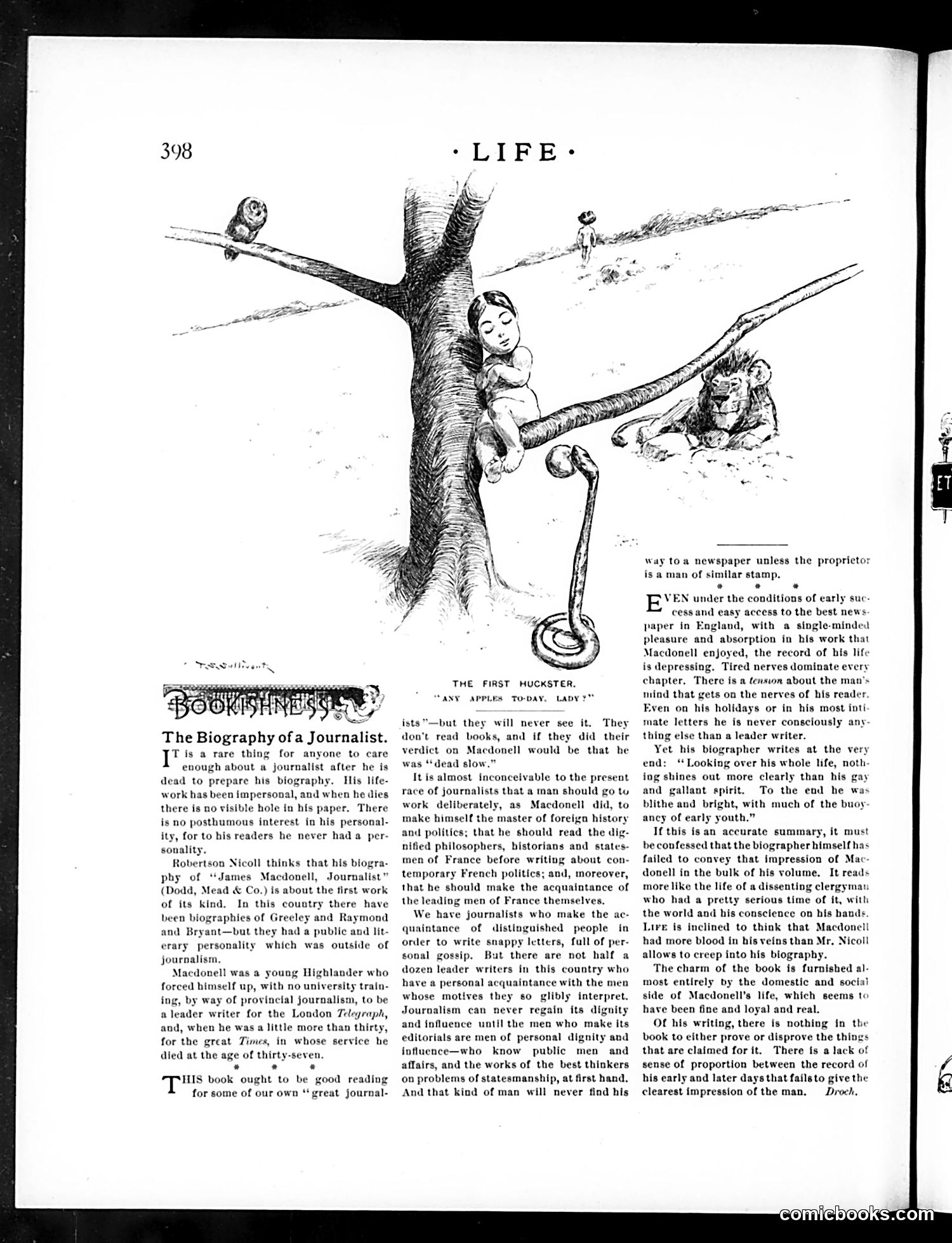
This page reviews a biography of journalist James Macdonell. The accompanying cartoon titled "The First Huckster" satirizes journalism's commercialization by depicting a figure (representing an early or archetypal journalist) as literally a tree growing money-making devices—a child climbing its trunk, animals around it, and what appears to be a snake or contract coiled below. The satire suggests journalism has become primarily about profit extraction rather than public service. The review text itself criticizes journalists who pursue "personal gossip" and lack "dignity and influence," contrasting them with serious political writers. The cartoon's anthropomorphic tree metaphor visually reinforces the text's argument that journalism has become rooted in mercenary rather than noble purposes.
📄 Transcribed text from this page (OCR, searchable)
Machine-transcribed from the original scan — historical spelling and the odd misread are preserved.
The Biography ofa Journalist. T is a rare thing for anyone to care enough about a journalist after he is dead to prepare his biography. His life- work has been impersonal, and when he dies there is no visible hole in his paper. There is no posthumous interest in his personal- ity, for to his readers he never hada per- sonality, Robertson Nicoll thinks that his bi phy of “James Macdonell, Journalist” (Dodd, Mead & Co.) is about the first work of its kind. In this country there have been biographies of Greeley and Raymond and Bryant—but they had a public and lit- erary personality which was outside of era- journalism, Macdonell was a young Highlander who forced himself up, with no university train- ing, by way of provincial journalism, to be aleader writer for the London Telegraph, and, when he was a little more than thirty, for the great Times, in whose service he died at the age of thirty-seven, * * * HIS book ought to be good reading for some of our own “great journal- THE FIRST HUCKSTER. “ANY APPLES To-DaY, Lapy ?™ ists"—but they will never see it. Thi don't read books, and if they did their verdict on Macdonell would be that he was “dead slow, It is almost inconceivable to the present race of journalists that a man should go tu work deliberately, as Macdonell did, to make himself the master of foreign history and politics; that he should read the dig- nified philosophers, bistorians and state men of France before writing about con- temporary French politics; and, moreover, that he should make the acquaintance of the leading men of France themselves, We have journalists who make the ac- quaintance of distinguished people in order to write snappy letters, fall of per- sonal gossip, But there are not half a dozen leader writers in this country who have a personal acquaintance with the men whose motives they so glibly interpret. Journalism can never regain its dignity and influence until the men who make its editorials are men of personal dignity and influence—who know public men and affairs, and the works of the best thinkers on problems of statesmanship, at first hand, And that kind of man will never find his way toa newspaper unless the proprictor is a man of similar stamp. . * « VEN under the conditions of early suc- cess and easy access to the best news paper in England, with a single-minded pleasure and absorption in his work that Macdonell enjoyed, the record of bis life is depressing. Tired nerves dominate every chapter. There is a fension about the man’s mind that gets on the nerves of his reader. Even on his holidays or in his most inti mate letters he is never consciously any- thing else than a leader writer. Yet his biographer writes at the very end: ‘Looking over his whole life, noth- ing shines out more clearly than his gay and gallant spirit, To the end he was blithe and bright, with much of the buoy- ancy of early youth.” If this isan accurate summary, it must be confessed that the biographer himself has failed to convey that impression of Mac- donell in the bulk of his volume. It reads more like the life of a dissenting clergymat who had a pretty serious time of it, with the world and his conscience on his hands. Lire is inclined to think that Macdonell had more blood in his veins than Mr. Nicoll allows to creep into his biography. The charm of the book is furnished al- most entirely by the domestic and social side of Macdonell’s life, which seems to have been fine and loyal and real. Of his writing, there is nothing in the book to either prove or disprove the things that are claimed for it. There is a lack of sense of proportion between the record of his early and later days that failsto give the clearest impression of the man. — Droch.