
A complete issue · 20 pages · 1898
Life — May 5, 1898
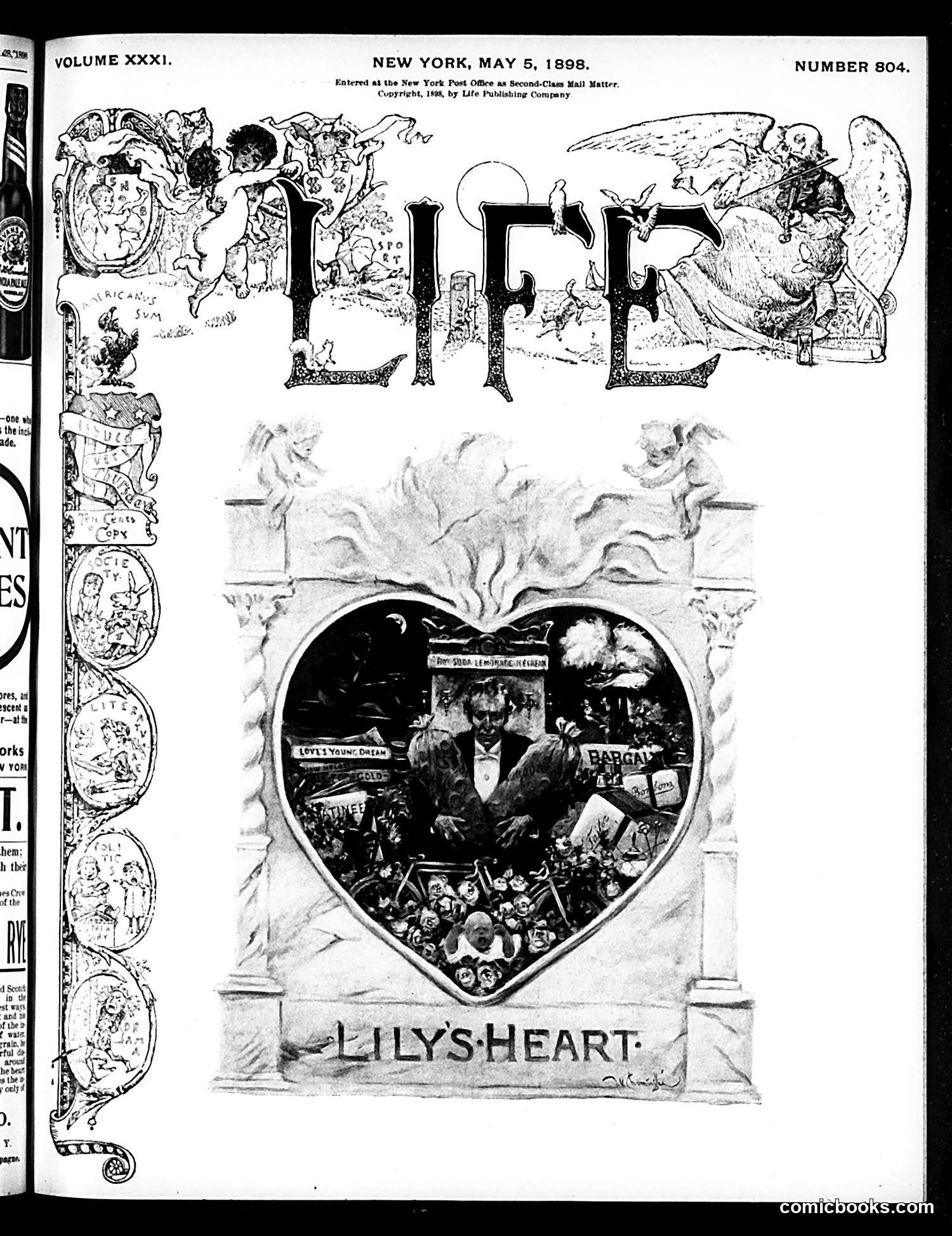
This is a cover design for "Life's Heart" featuring a large heart-shaped frame containing a photograph or illustration of a well-dressed man in formal attire surrounded by various商品 and signage. The satirical point appears to critique commercialism and materialism—the "heart" of American life is depicted not as sentiment or virtue, but as consumption and mercenary interests. The decorative elements framing the heart suggest ornamental beauty masking shallow values. The left border contains classical cherub medallions, creating ironic contrast between refined artistic tradition and the crass commercial content within. The elaborate decorative border itself may be mocking pretentious aesthetics used to dress up materialistic pursuits. Without clearer visibility of specific text on the products or signage in the image, I cannot identify precise commercial targets being satirized, but the overall message critiques what Life's editors viewed as American society's misplaced priorities.
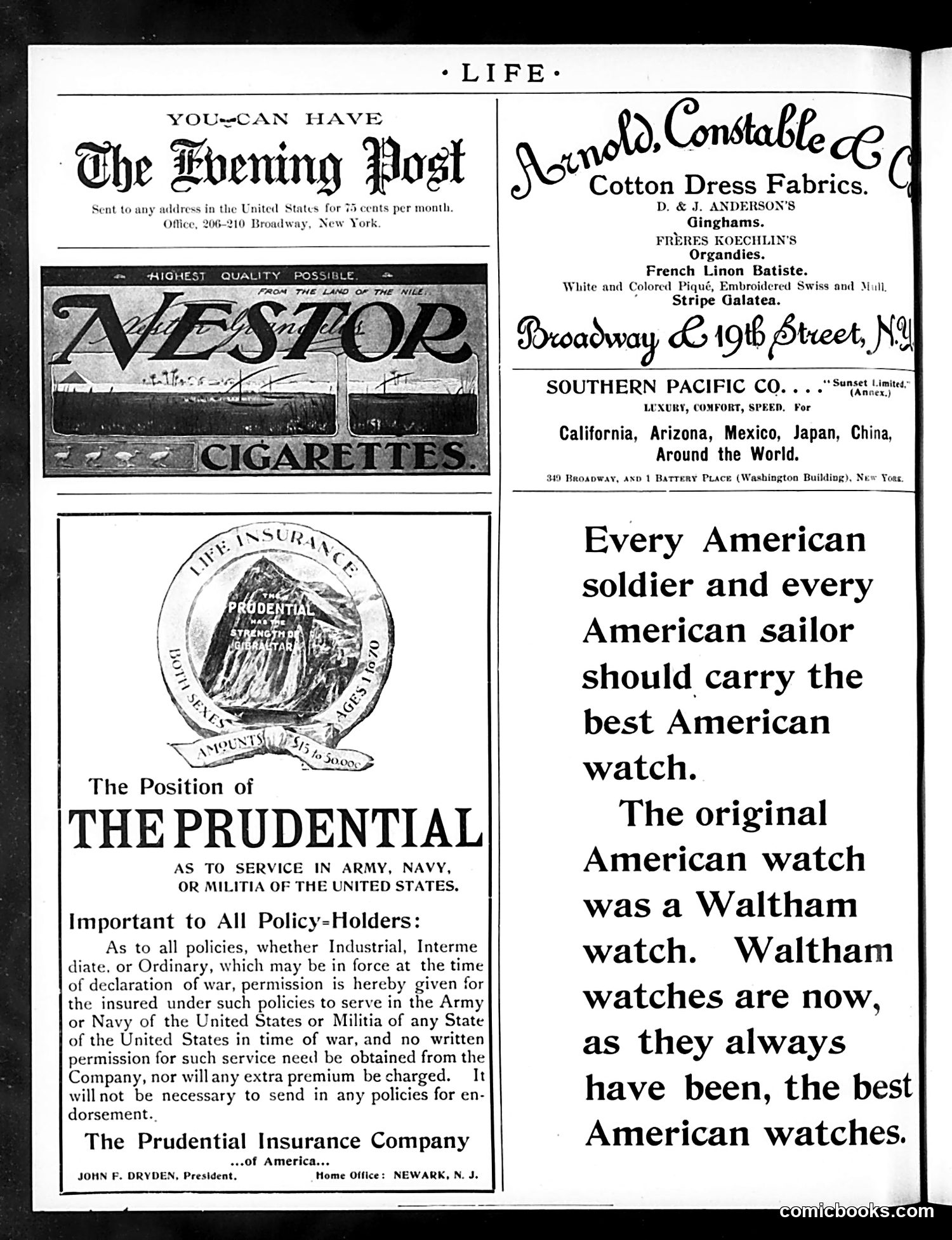
This page is primarily **advertising** rather than satirical content. The left side features ads for The Evening Post newspaper, Nestor Cigarettes, and The Prudential Insurance Company (with a notice about military service during wartime). The right side advertises Arnold Constable cotton fabrics, Southern Pacific railroad travel, and Waltham watches. The only substantive text is a patriotic appeal for American soldiers and sailors to carry Waltham watches, claiming they're "the original American watch" and "the best American watches." This appears to be WWI-era advertising leveraging American nationalism and military service to promote a domestic product. There are no political cartoons or satirical commentary visible on this page.
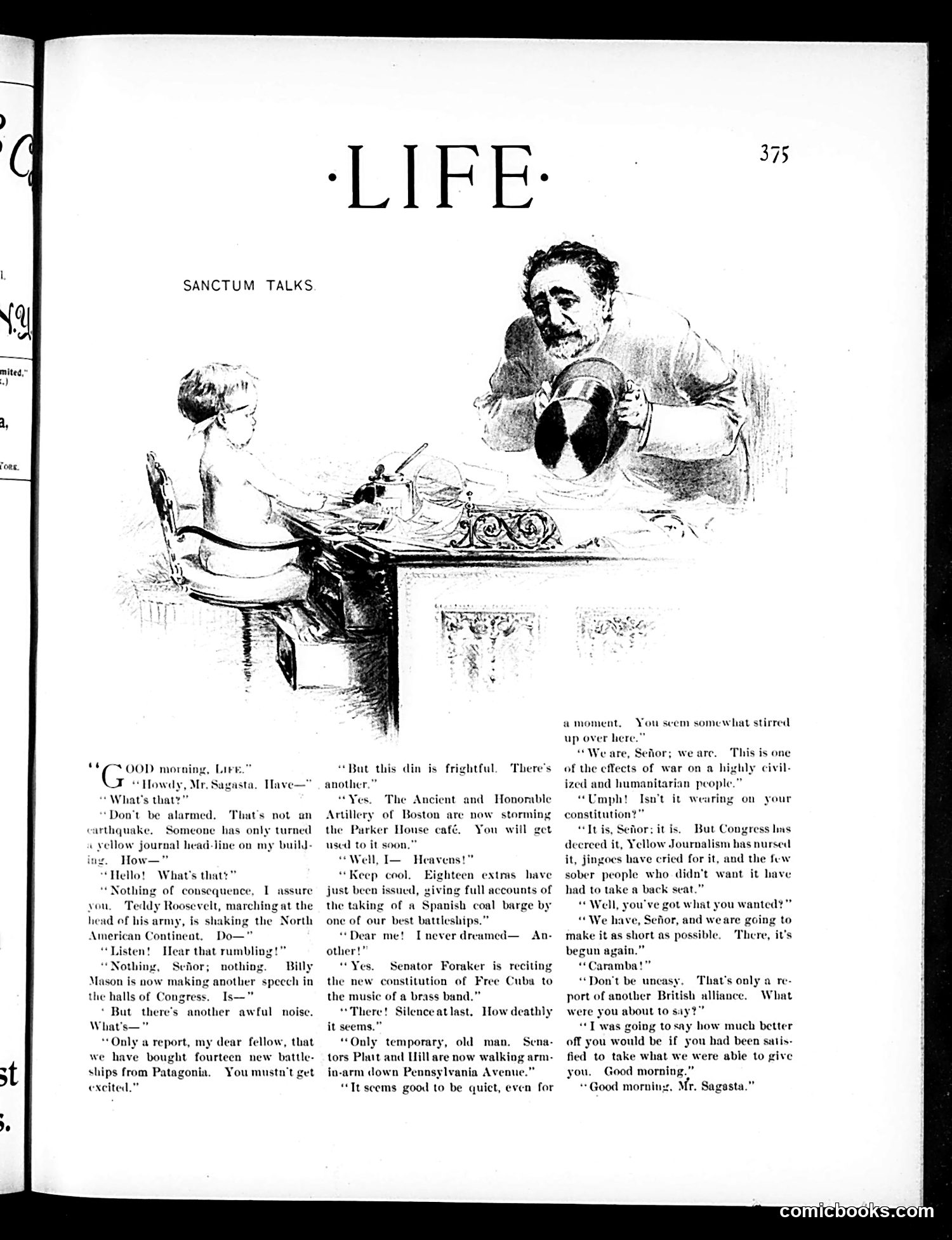
This is a satirical dialogue between "Life" (personified as a woman) and "Mr. Sagasta" (a bearded man), likely a Spanish political figure. The cartoon mocks current events through their conversation. Key references include: - **Spanish colonial conflicts**: Discussion of "Free Cuba" and "Spanish coal" suggests the Cuban independence crisis and Spain's colonial tensions - **American military expansion**: References to "fourteen new battleships from Patagonia" mock U.S. naval buildup - **Yellow journalism**: Criticism of "Yellow Journalism" and newspapers sensationalizing war - **Congressional politics**: Mentions of Senator Foraker and debates over military policy The satire critiques both Spanish imperialism and American jingoism, while lampooning the press for drumming up war fever. The tone suggests skepticism toward military adventurism and warmongering media coverage.
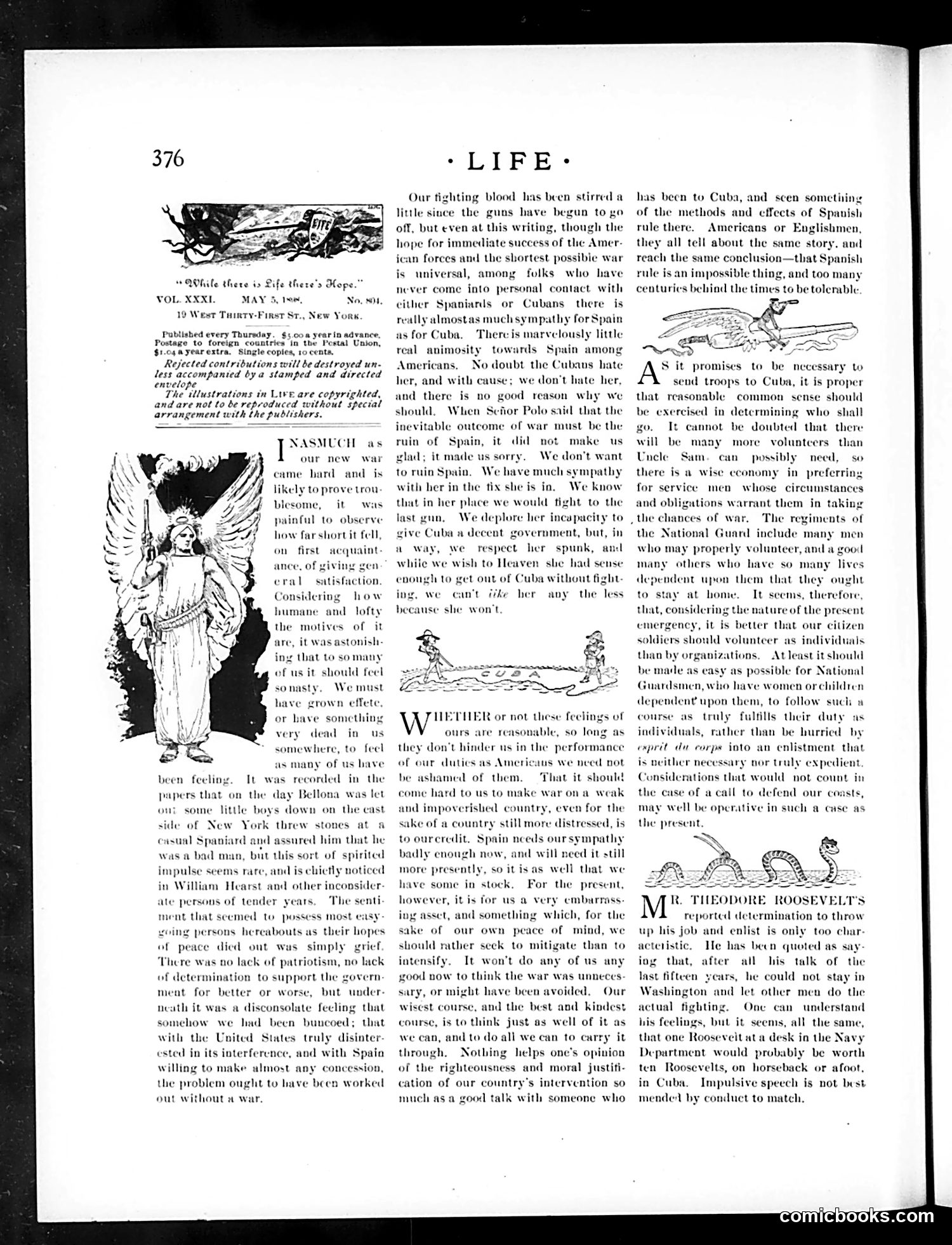
This page discusses American intervention in the Spanish-American War (referenced as recent conflict). The left illustration appears to be an allegorical female figure, likely representing either America or Cuba, rendered in classical style. The main text argues that while Americans sympathize with Cuba's cause against Spain, reasonable judgment should prevail in enlisting National Guard volunteers. The author cautions against hasty military action, noting that emotional patriotism shouldn't override practical considerations. The piece references **Theodore Roosevelt's** reported determination to enlist, suggesting he'd be "worth ten Roosevelts on horseback or afoot in Cuba." The tone is cautiously patriotic but advocates restraint—typical of Life magazine's satirical approach to contemporary political debate during this imperial period.
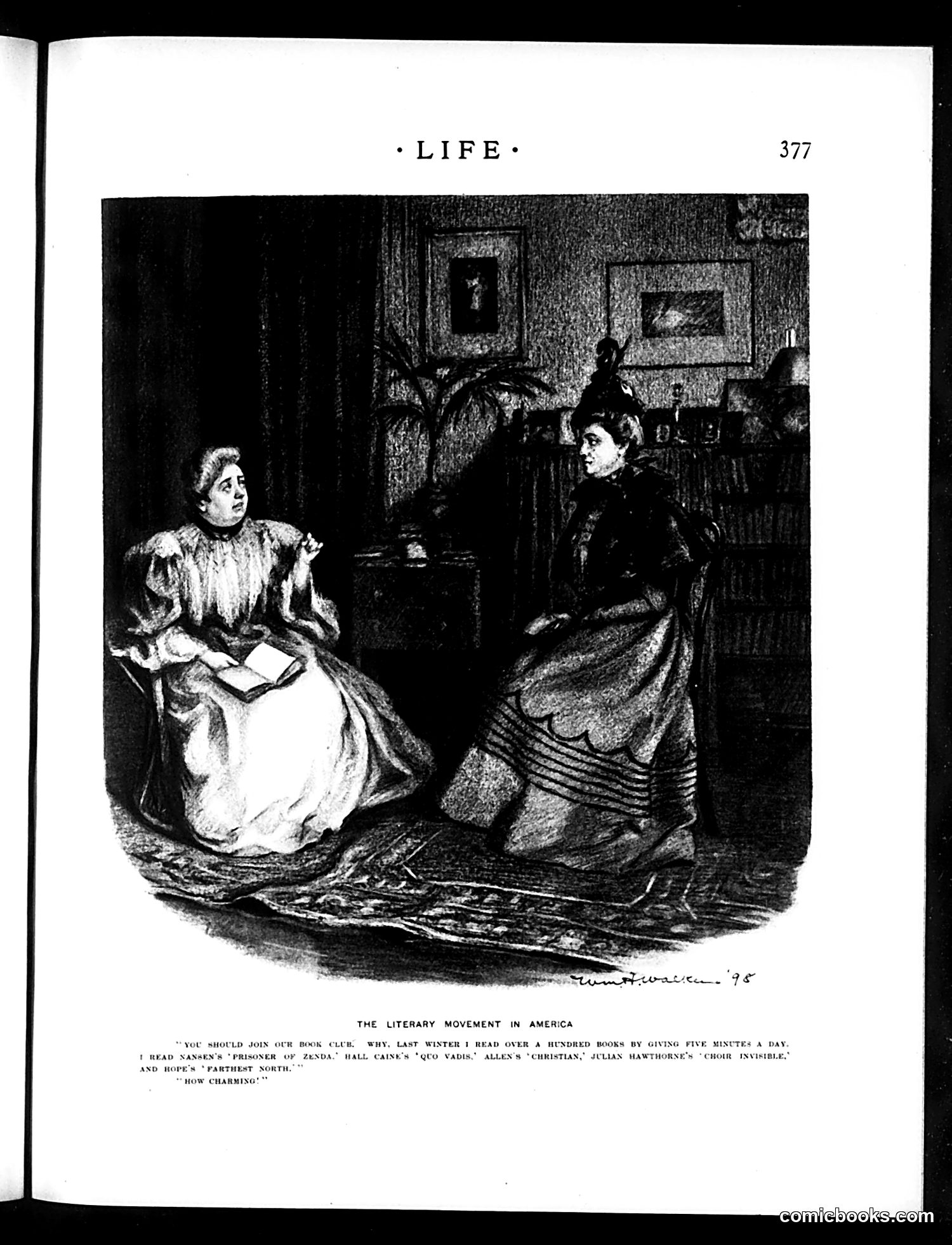
This satirical cartoon depicts two women in an interior setting, with the caption quoting one encouraging the other to join a book club. The speaker boasts of reading over a hundred books annually by devoting just five minutes daily to works by Zane Grey, Hall Caine, Louisa May Alcott, Nathaniel Hawthorne, and others. The satire targets the "literary movement" of early 20th-century America—specifically mocking dilettante book clubs and the claim that rapid, superficial reading constitutes genuine literary engagement. The cartoon suggests that spending mere minutes on disparate classic and popular authors produces no real understanding, satirizing both the pretension of such clubs and the cultural phenomenon of quantity-over-quality reading habits among American women of leisure.
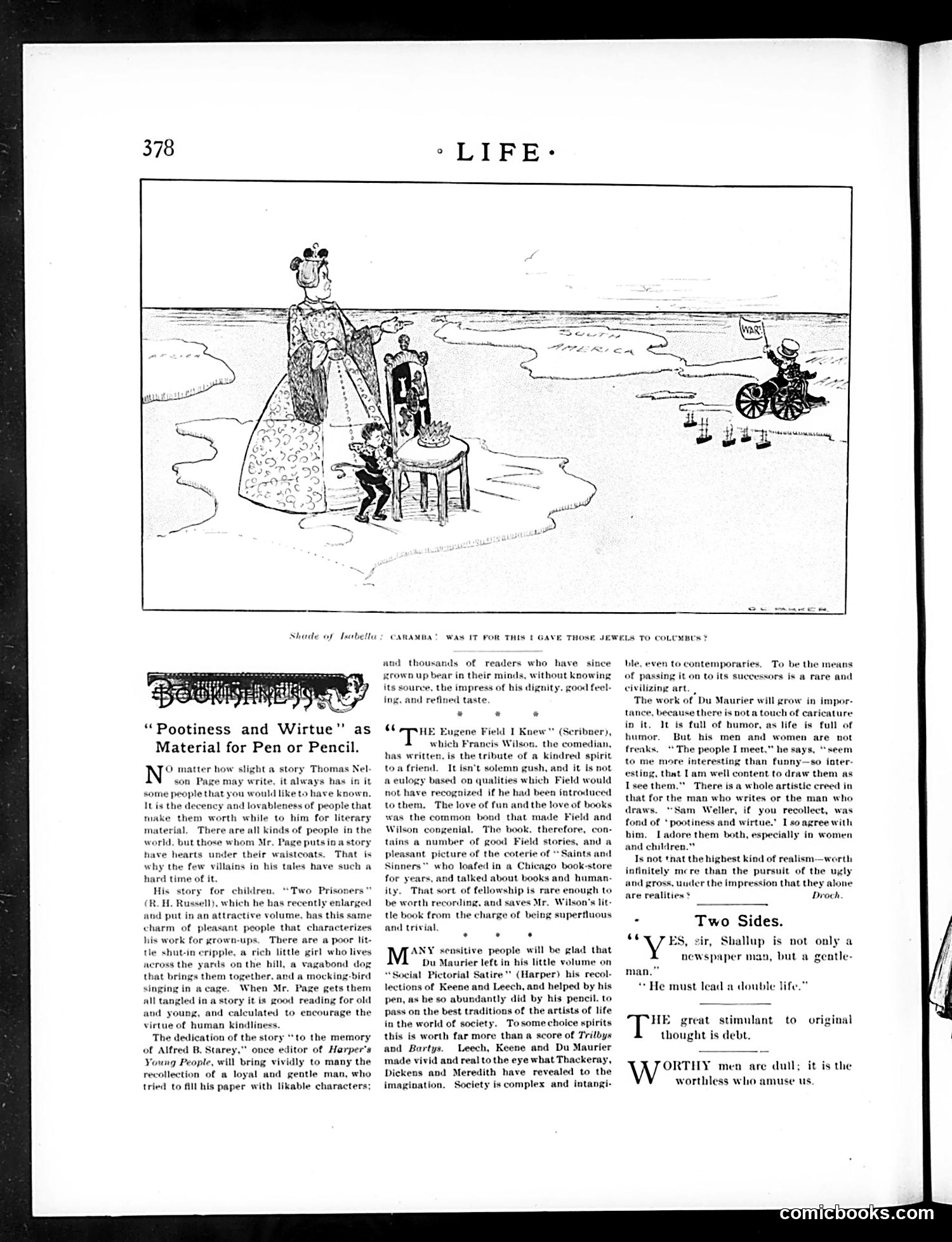
The cartoon depicts a woman in elaborate dress standing in a barren landscape, holding what appears to be a mirror or reflective object. A figure on the right operates some kind of machinery or apparatus. The caption reads: "Shade of Isabella: 'CARAMBA' WAS IT FOR THIS I GAVE THOSE JEWELS TO COLUMBUS?" This references Queen Isabella of Spain, who historically funded Columbus's 1492 voyage by pawning her jewels. The satire suggests that the grand, ornate civilization Isabella envisioned has been reduced to this desolate scene—a commentary on disappointed expectations or the gap between noble intentions and actual outcomes. The barren landscape and mechanical apparatus suggest industrialization or modern development has failed to deliver promised progress, making Isabella's historical sacrifice seem foolish in retrospect.
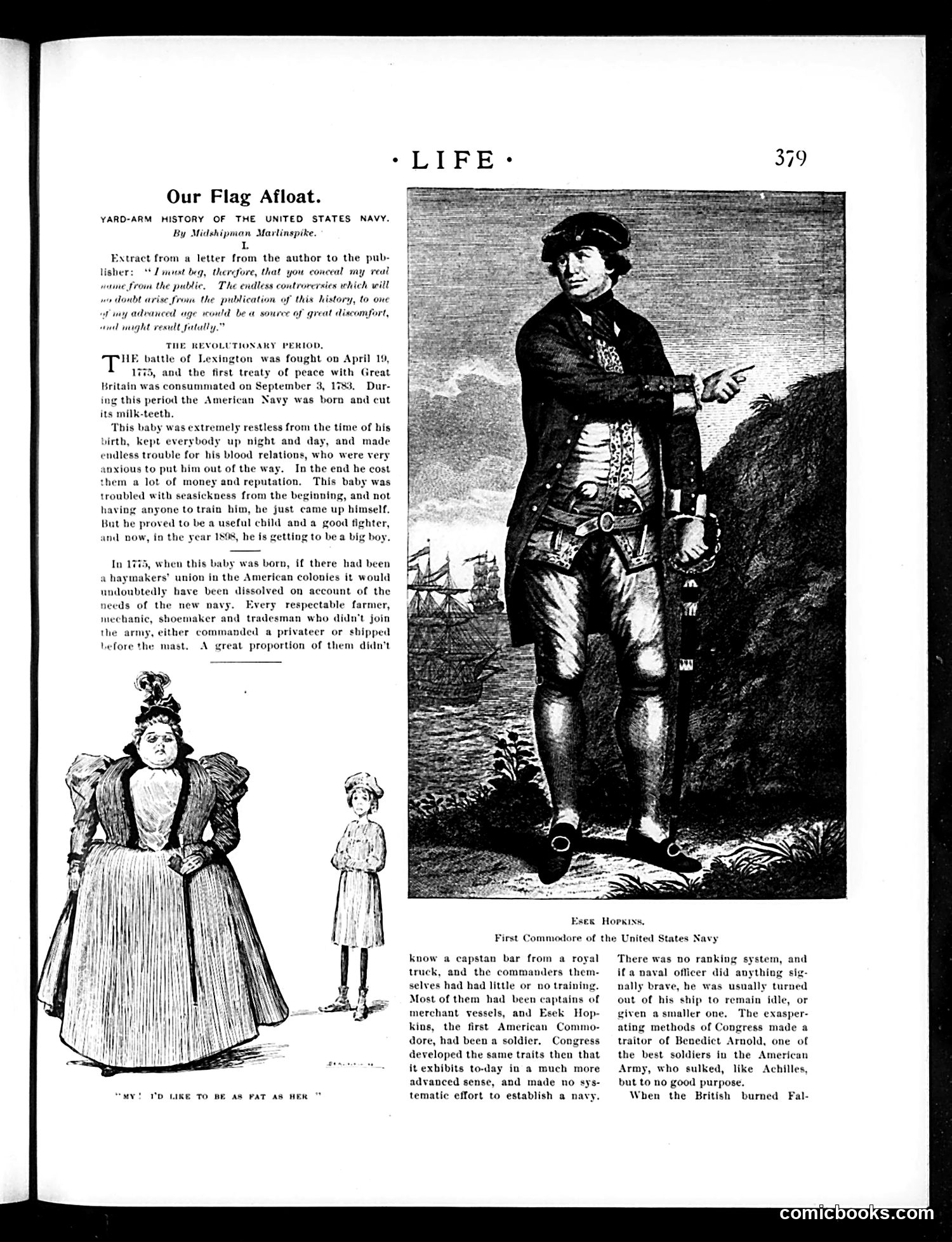
This page presents a historical article about the early American Navy, featuring a portrait of **Ezek Hopkins**, identified as "First Commodore of the United States Navy." The left illustration appears to be a satirical social cartoon (separate from the naval history), showing a woman in 1890s fashion with the caption **"Why I'd like to be as fat as her."** This mocks contemporary beauty standards and weight obsession among women of the era. The main article discusses how during the Revolutionary War (1775-1783), the American Navy was born from necessity and struggled with untrained personnel—mostly merchant sailors and soldiers pressed into service. The text contrasts this chaotic beginning with Congress's later efforts to establish a more systematic, professional naval force, suggesting early American naval development was haphazard compared to later institutional improvements.
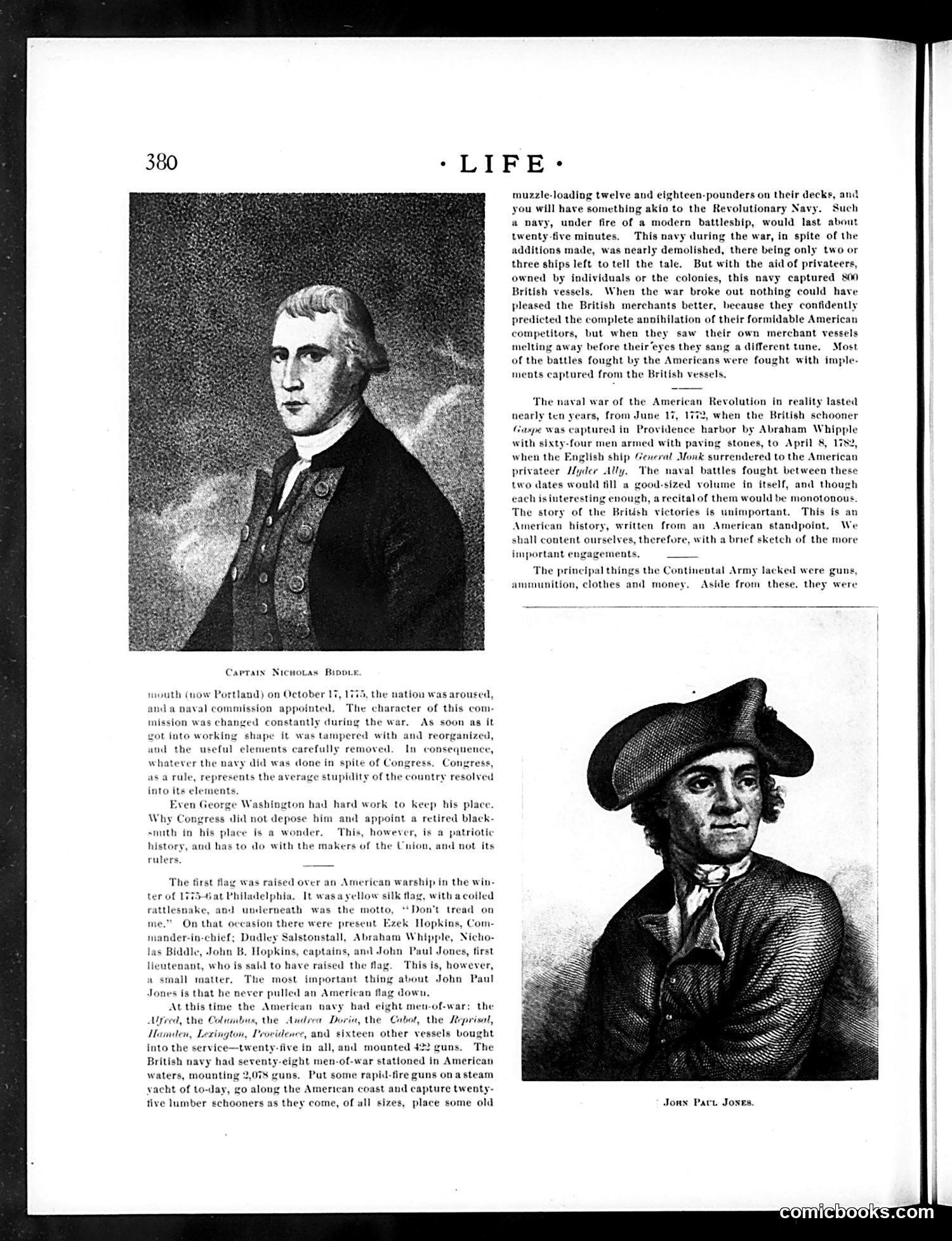
This page from *Life* magazine presents historical rather than satirical content. It features two portraits: **Captain Nicholas Biddle** (top) and **John Paul Jones** (bottom), both Revolutionary War naval figures. The text discusses the Continental Navy's struggles—lacking guns, ammunition, clothes, and money. It describes early American naval engagements from June 1775 to April 1782, noting that despite British naval superiority, Americans captured important vessels and fought notable battles. The page emphasizes this is "an American history, written from an American standpoint," suggesting the author's patriotic perspective on naval warfare. Rather than satire, this appears to be educational content celebrating American naval achievements during the Revolution.
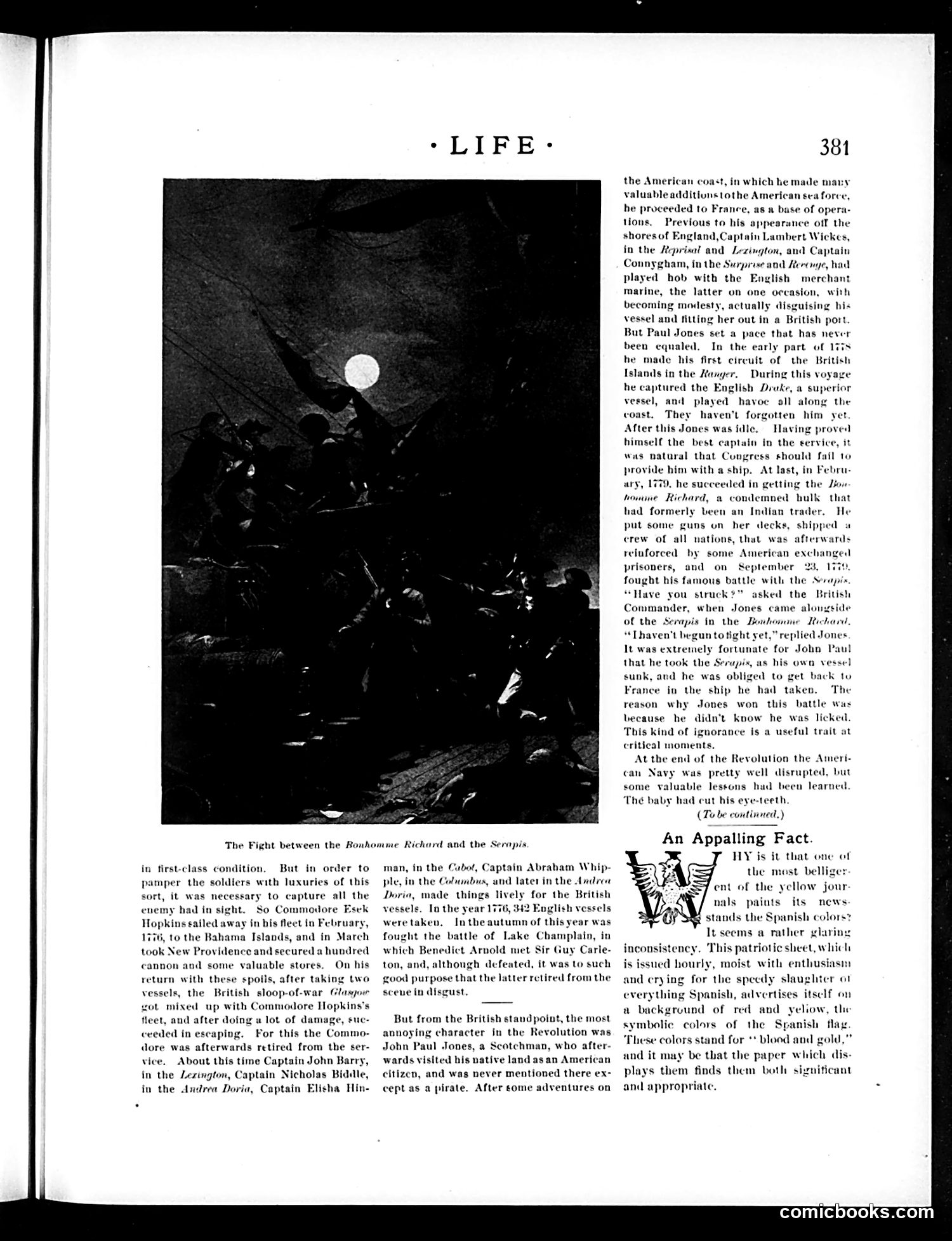
This page from *Life* magazine discusses naval warfare during the American Revolution, specifically the fight between the British ship *Serapis* and John Paul Jones's vessel. The accompanying illustration appears to depict a nighttime naval battle scene with dramatic lighting. The text describes Jones's famous encounter where he refused to surrender despite damage to his ship, declaring "I have not yet begun to fight." The article notes Jones was Scottish-born but became an American naval commander, and that his victory was significant despite his initial disadvantage. A sidebar titled "An Appalling Fact" critiques Spanish flag colors (red and yellow) as symbols of "blood and gold," suggesting Spain's colonial exploitation. This reflects American attitudes toward European imperialism during the Revolutionary era.
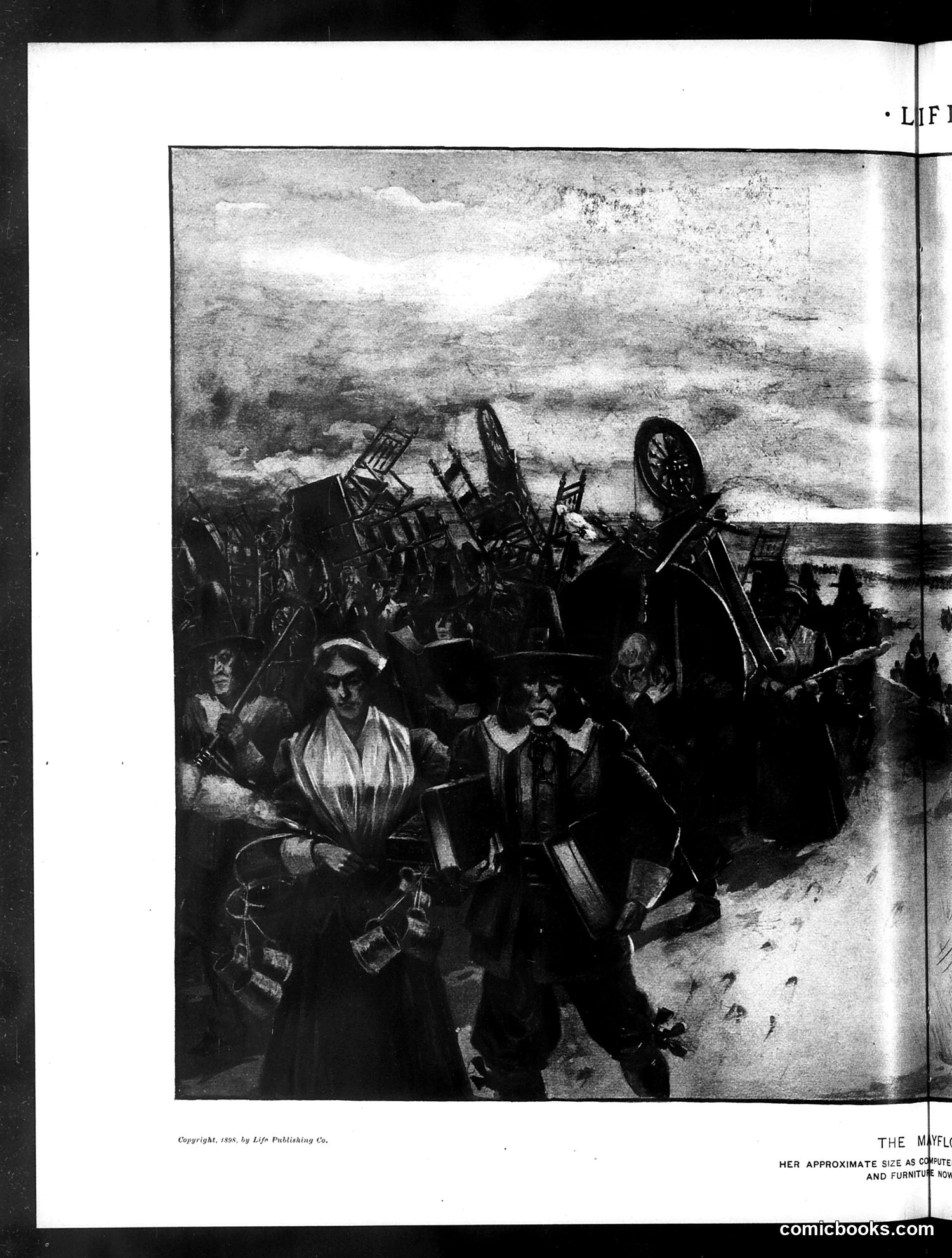
This appears to be a Life Magazine illustration (copyright 1908) depicting "The Mayflower" with a caption referencing "her approximate size as computed" and furnishings. The image shows a crowded scene with multiple figures in period dress gathered around what appear to be large mechanical or industrial objects silhouetted against a sky. The composition suggests a satirical commentary on the Mayflower—the famous ship that transported Pilgrims to America in 1620. The satire likely mocks the Mayflower's actual size relative to the number of passengers or cargo it carried, or possibly critiques contemporary American society by contrasting modern industrial objects with historical colonial references. However, without clearer text or additional context, the specific satirical point remains **unclear**. The heavy use of silhouettes and the crowded composition emphasize scale and quantity, suggesting the humor involves disproportion or overcrowding.
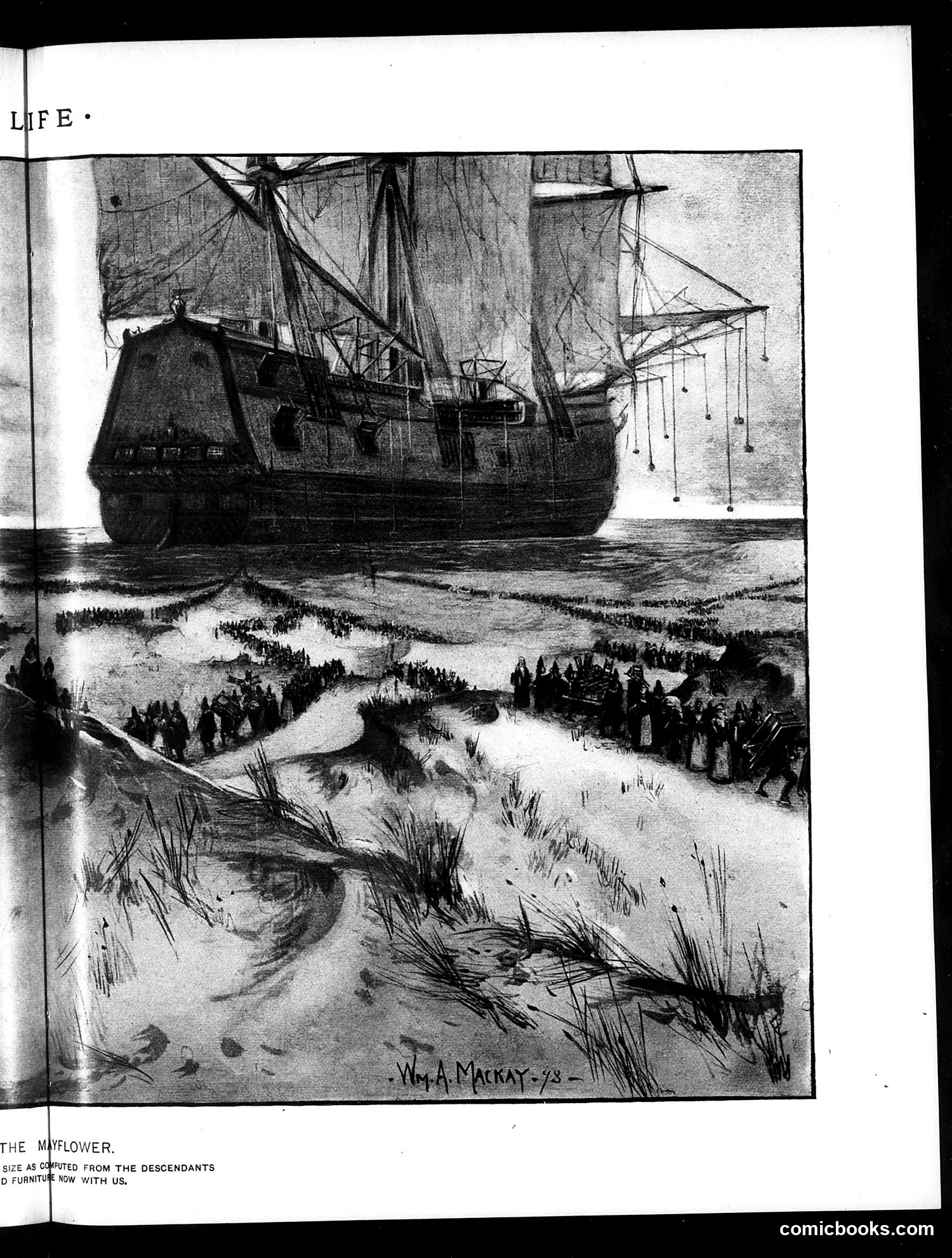
This illustration depicts the Mayflower, the ship that carried Pilgrims to America in 1620. The image shows the historic vessel beached or in shallow water with crowds of people gathered on the shore below. The artist has signed the work "W.A. Mackay '28," indicating this is from 1928. The caption reads: "THE MAYFLOWER. SIZE AS COMPUTED FROM THE DESCENDANTS AND FURNITURE NOW WITH US." The satire appears to mock the exponential growth of Americans claiming Mayflower ancestry by the 1920s. The joke suggests that if all the people who claimed descent from Mayflower passengers were actually on board, the ship would need to be absurdly massive. This critiques Americans' inflated genealogical claims and nostalgia for early colonial heritage.
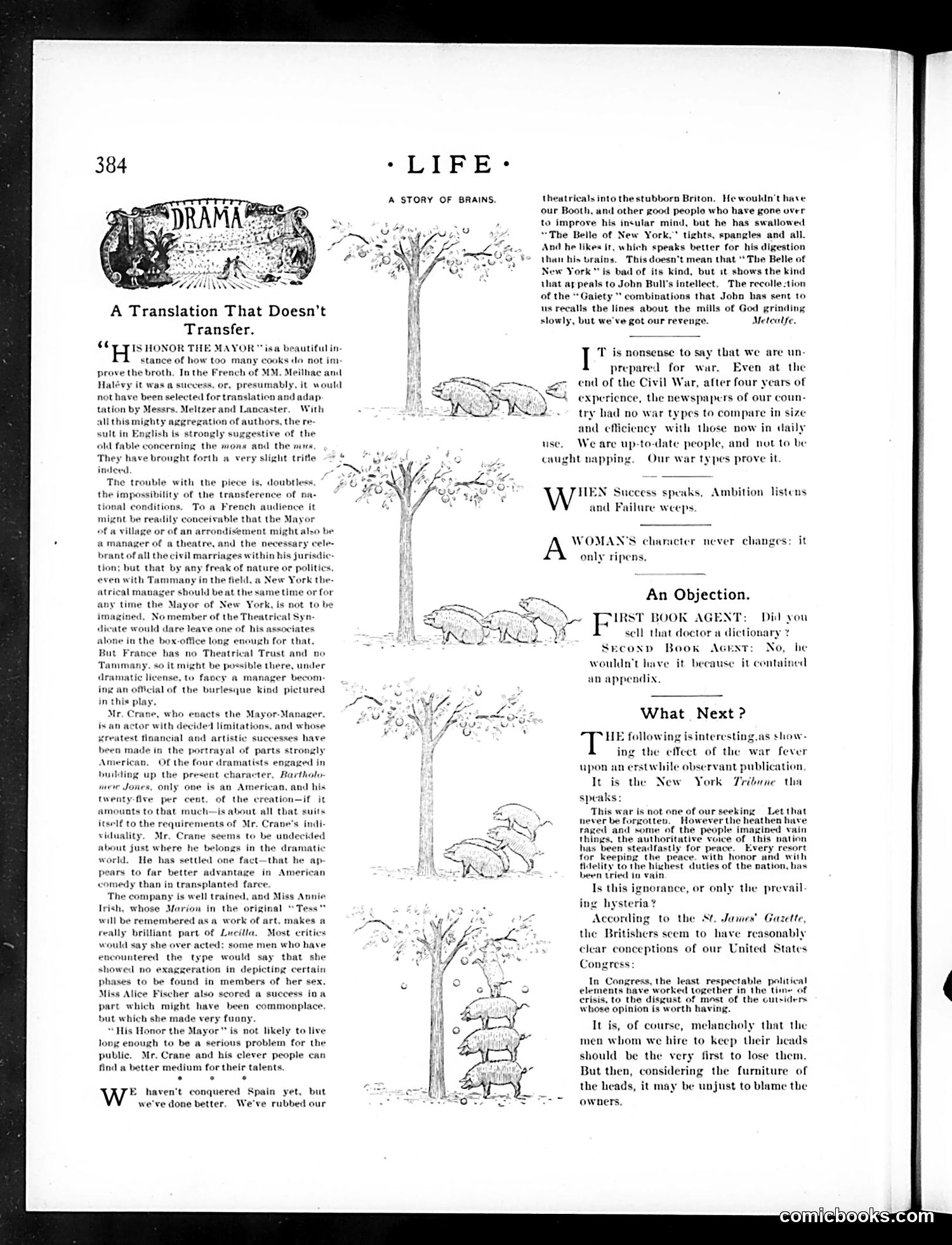
This page contains **literary criticism and short satirical pieces**, not political cartoons. The main article, "A Translation That Doesn't Transfer," critiques a French theatrical production's English adaptation, arguing that translating plays loses essential cultural context—a theatrical work designed for French audiences doesn't transplant smoothly to American stages. The right column contains brief humorous exchanges titled "An Objection" and "What Next?"—short joke pieces typical of Life's satirical format. The **left illustration** shows a bare tree with sheep clustered beneath it, likely accompanying the main article's discussion of theatrical adaptation challenges. The page demonstrates Life's use of **literary and theatrical satire** rather than political cartooning, targeting educated readers familiar with dramatic arts and cultural criticism.
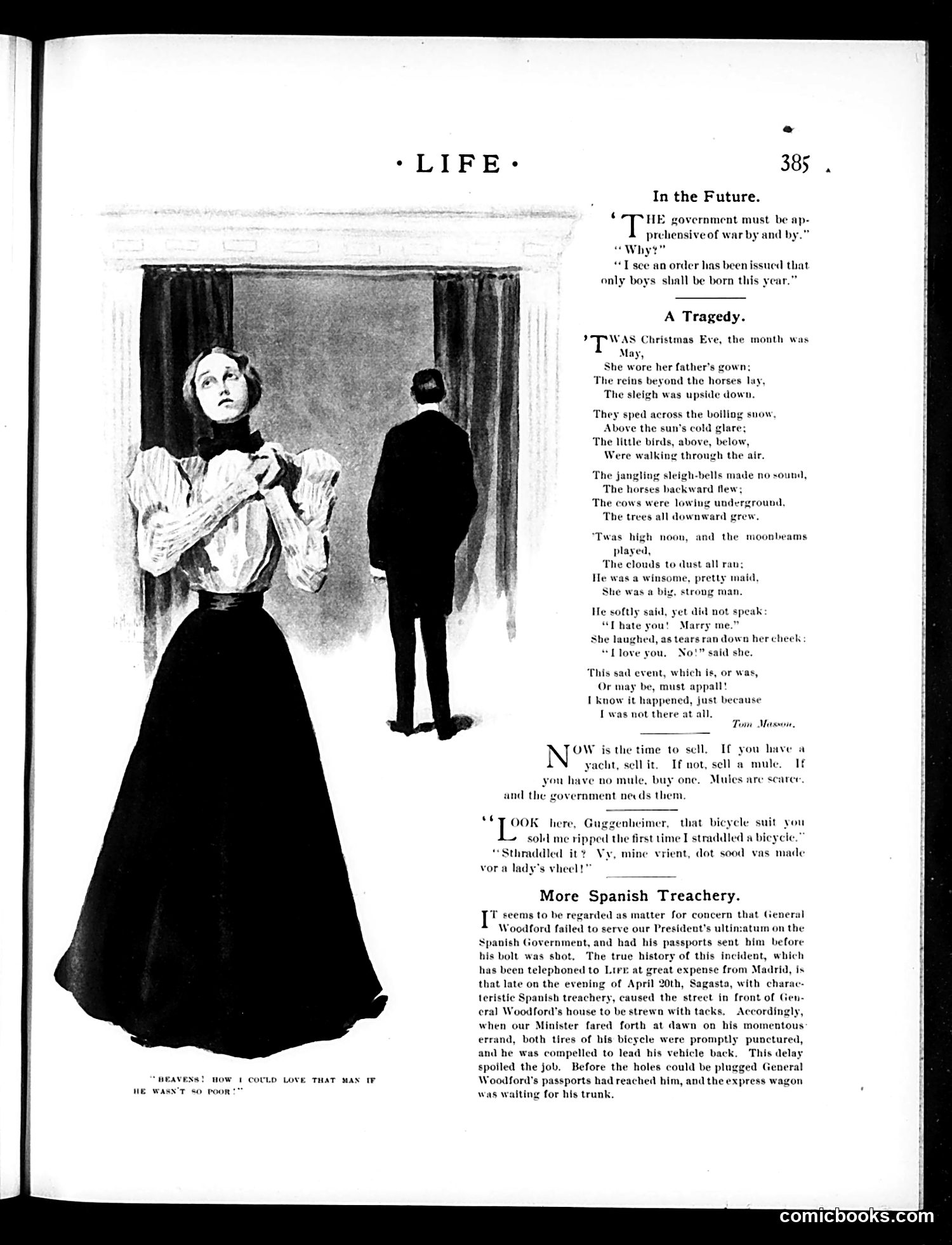
This page contains three distinct satirical pieces: **"In the Future"** mocks government war preparedness through absurdist dialogue about a decree limiting births to boys—suggesting anxious over-planning for future conflicts. **"A Tragedy"** is a nonsensical poem intentionally full of logical contradictions (horses flying backward, trees growing downward, noon with moonbeams) that parodies overly sentimental Victorian poetry. The absurdity is the point—mocking melodramatic literary conventions. **"More Spanish Treachery"** satirizes American-Spanish diplomatic tensions (likely referencing the 1898 Spanish-American War period). It humorously "explains" why U.S. Minister Woodford's diplomatic mission failed: Spanish officials supposedly scattered tacks on the street to puncture his bicycle tires. This mocks both Spanish duplicity and the farcical nature of the diplomatic breakdown, treating a serious geopolitical failure as slapstick comedy. The illustration shows a romantic scene matching "A Tragedy's" sentimental tone, ironically paired with absurdist text.
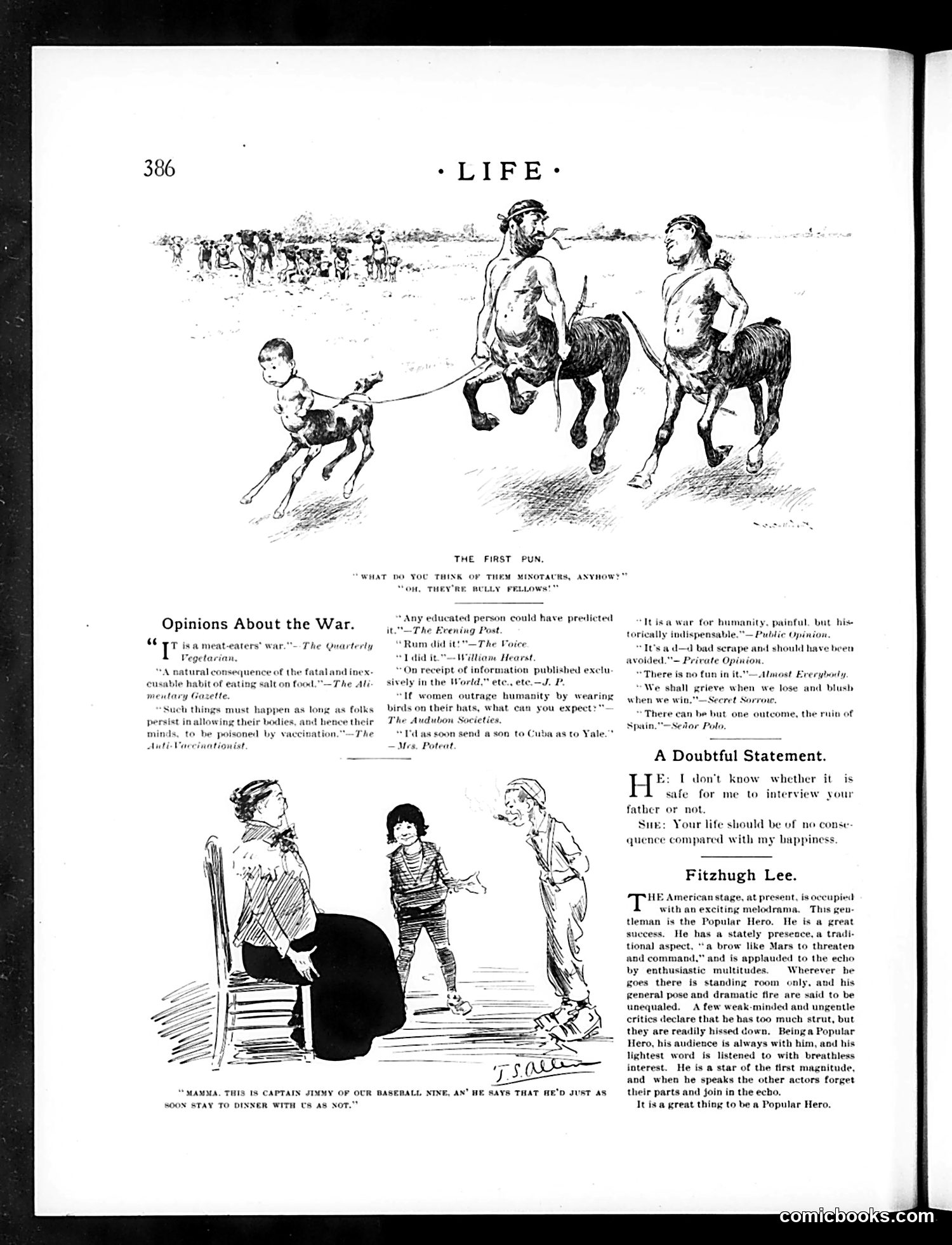
**"The First Pun"** (top): A prehistoric joke—a child leads a man-beast hybrid creature (a "minotaur") while two centaurs converse. One asks what the other thinks of minotaurs; the response is "they're bully fellows"—a pun on "bull" (the creature's animal half). This is labeled humanity's first joke, suggesting absurdist humor about origins. **"Opinions About the War"**: A collection of contradictory quotes about an unnamed war (appears to be the Spanish-American War, given the Cuba reference). The satire mocks how different newspapers, activists, and public figures offered incompatible explanations—vegetarians blamed salt-eating, pacifists called it inevitable, some praised it as humanitarian. It's political satire exposing how everyone interprets the same event through their own ideological lens. **"Fitzhugh Lee"**: Praises an unnamed American stage actor (likely a real Popular Hero of the period) for his commanding presence and audience devotion, while gently mocking how enthusiastically crowds worship such performers. The page satirizes war rhetoric, ideological disagreement, and celebrity worship.
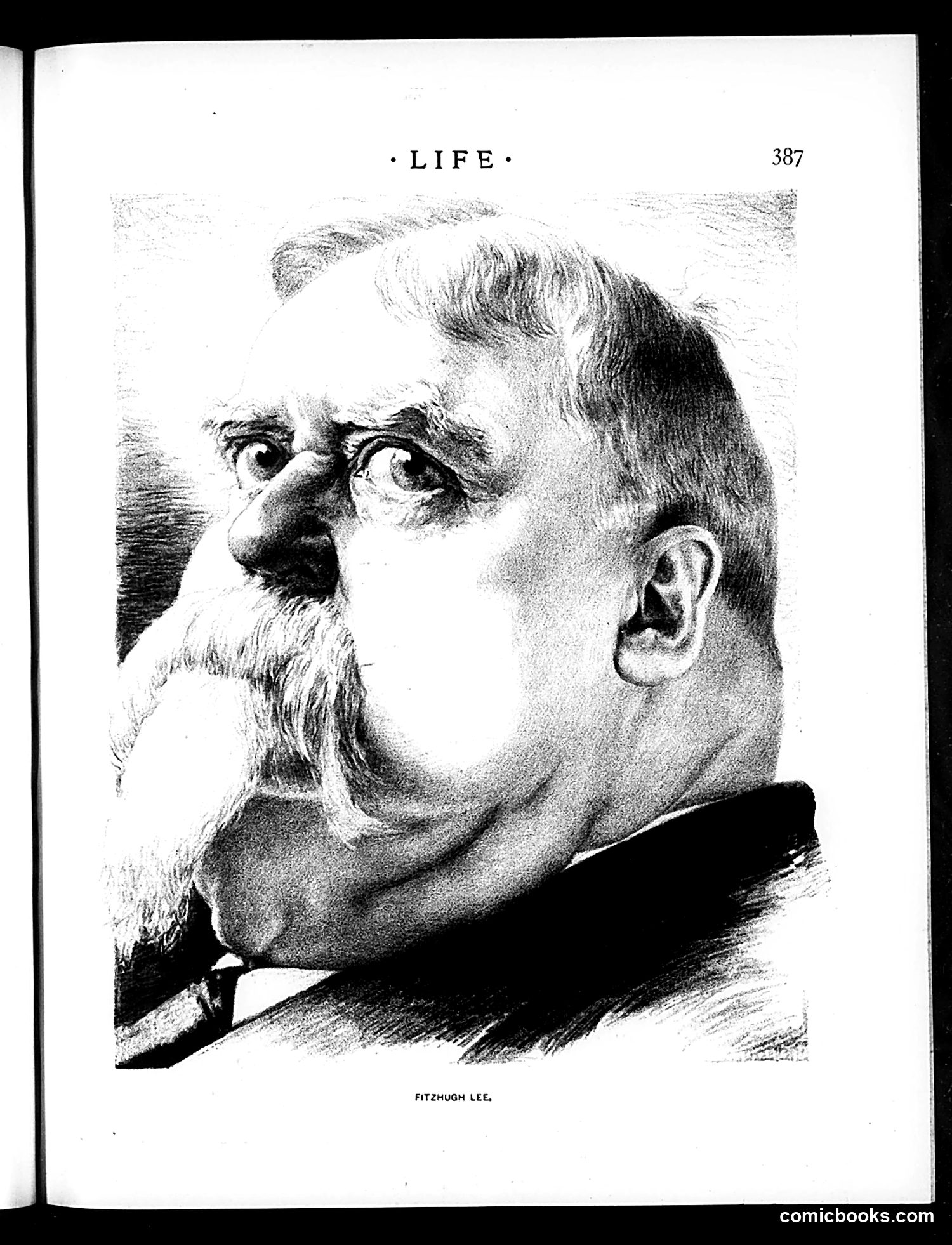
This page from *Life* magazine features a portrait sketch labeled "Fitzhugh Lee." The image shows a distinguished older man with a full beard, wearing glasses and formal attire with a dark coat. Fitzhugh Lee (1835-1905) was a prominent American military and political figure—a Confederate general during the Civil War who later served as Governor of Virginia and U.S. Ambassador to Cuba. As a satirical magazine, *Life* likely included this portrait as part of biographical or commentary coverage of contemporary public figures. Without additional visible text or cartoons on the page, the specific satirical angle remains unclear, though the formal presentation suggests this was part of the magazine's regular coverage of notable Americans of the era.
This page contains a poem mocking "The New Woman"—a late-19th-century social figure representing women seeking education, independence, and rights beyond traditional domesticity. The poem sarcastically traces woman's creation from Adam's rib, then contrasts the docile original with the modern version's assertiveness and "singular rabies" (obsessions with "physies and law"). The accompanying story depicts a stagecoach driver deliberately terrifying a timid male passenger by recklessly driving near cliff edges. The irony: the driver does this to scare the man, expecting entertainment from danger—commentary on reckless masculinity and thrill-seeking. Together, these pieces satirize gender anxieties of the era: the traditional, passive "New Woman" of nostalgia versus the educated, opinionated woman emerging in reality, while also mocking masculine bravado. The page reflects Life magazine's role as social satirist during America's debates over women's roles. The rest of the page contains period advertisements unrelated to the satire.
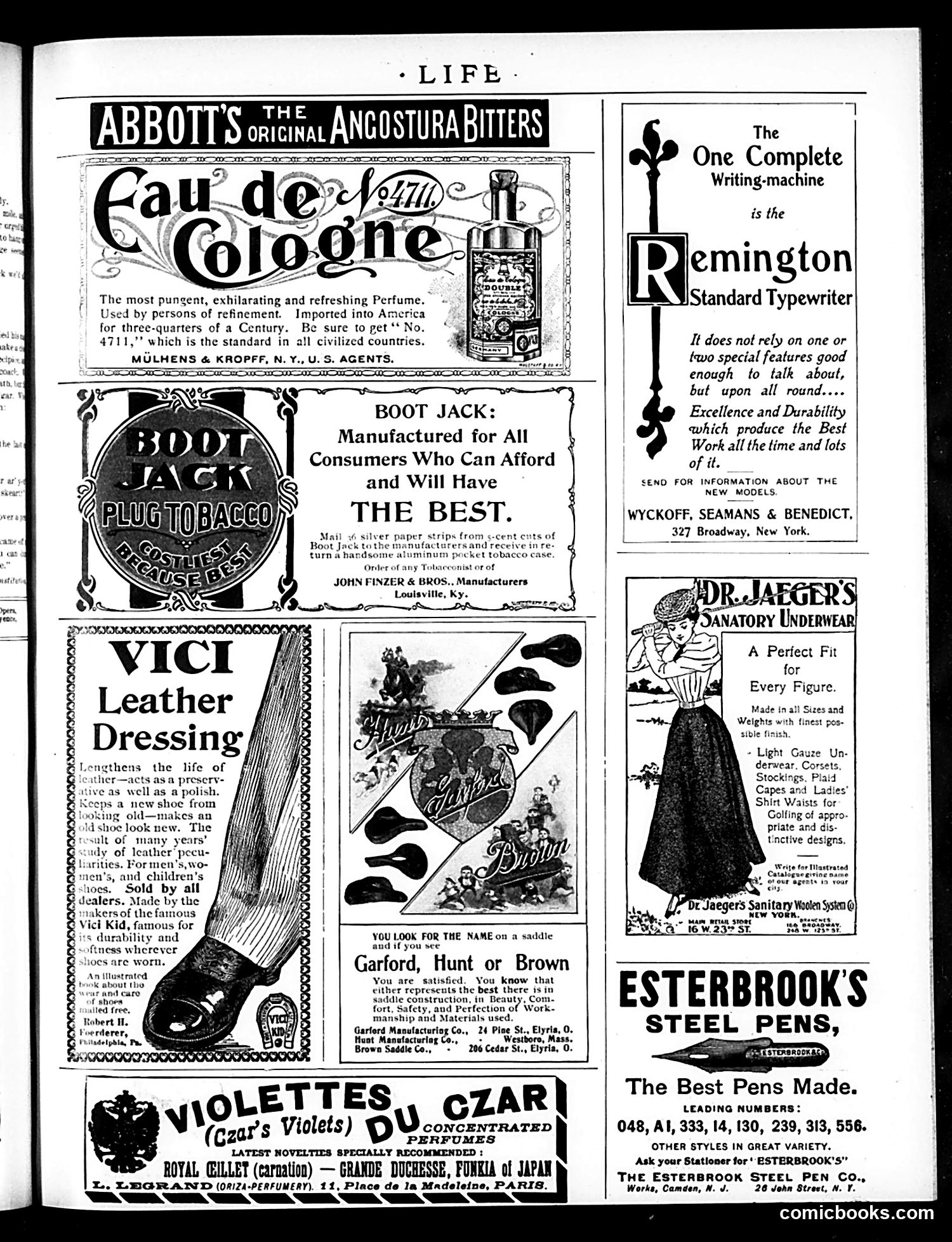
This is **not a political cartoon page**—it's an advertising section from Life magazine's early era. The page contains approximately eight product advertisements aimed at affluent readers, reflecting turn-of-the-century consumer goods and class markers. Notable ads include: - **Eau de Cologne No. 4711**: Imported German perfume marketed as a refinement standard - **Boot Jack tobacco**: Positioned as "the best" for consumers who can afford quality - **Remington Standard Typewriter**: Emphasized durability and all-around excellence - **Dr. Jaeger's Sanitary Underwear**: Women's undergarments in various styles - **Saddles** (Garford, Hunt, Brown brands): Luxury equestrian equipment - **Esterbrook Steel Pens**: Writing instruments - **Vici Leather Dressing**: Shoe care products The advertising reflects Life's audience: educated, wealthy individuals concerned with status symbols, imported luxuries, and refined taste. These ads reveal early 20th-century consumer culture and the class aspirations marketing targeted.
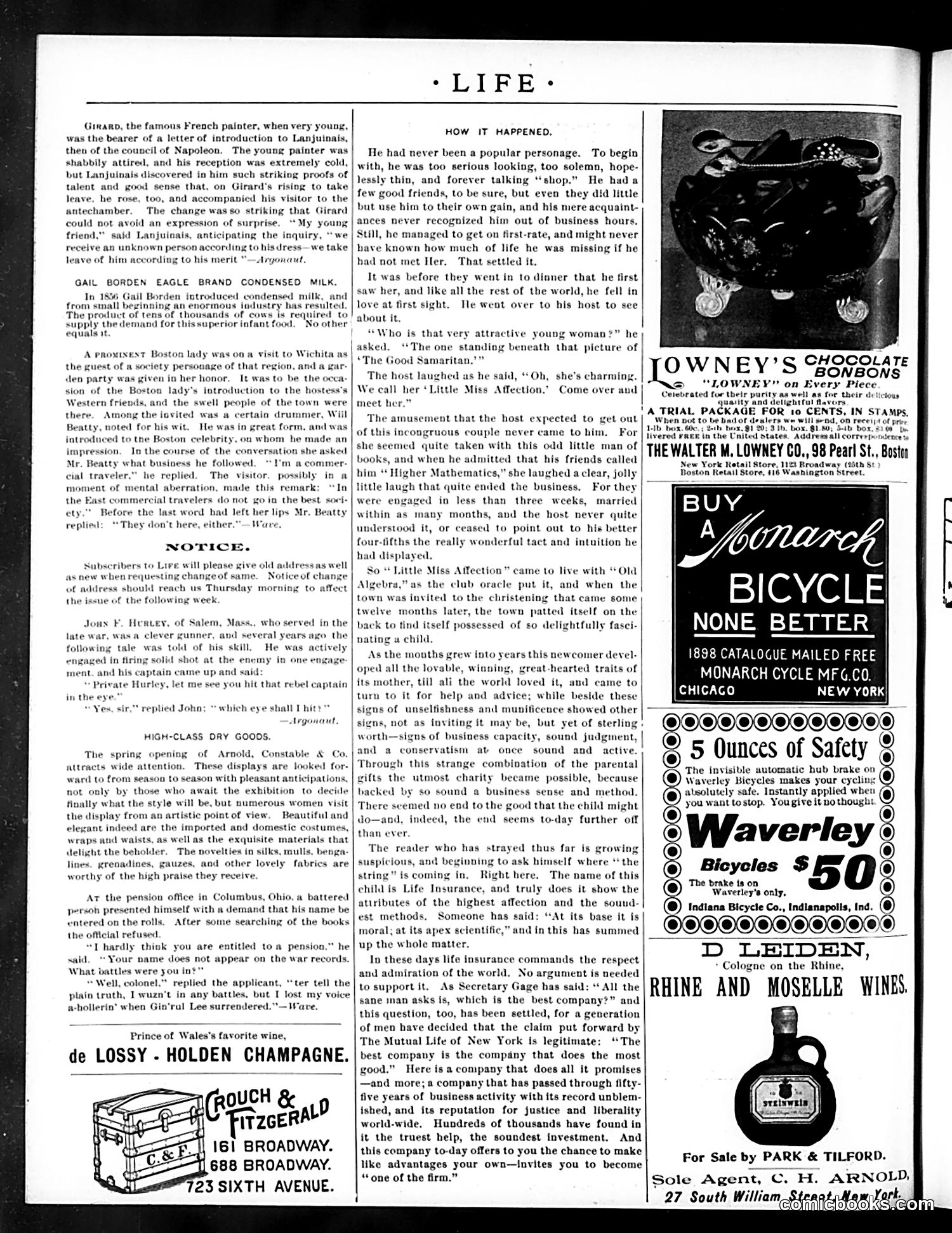
This page is primarily **advertisements and short humorous anecdotes**, not political cartoons. The content includes: **Main narrative ("How It Happened")**: A romantic story about an unpopular, serious man who falls in love at first sight with a woman. The text suggests he's unremarkable until this encounter changes his life trajectory. **Anecdotes**: - A story about French painter Girard receiving better treatment once his talent is recognized (about judging people by merit, not appearance) - A Boston society lady's condescending encounter with a traveling salesman/drummer, who quips back that commercial travelers "don't" belong in good society there either—implying Boston's social pretension **Advertisements**: The page features ads for bicycles (Monarch, Waverley), champagne, chocolate bonbons, and other consumer goods typical of early 1900s Life magazine. The humor is gentle social observation—poking fun at class consciousness, romantic earnestness, and regional pride rather than sharp political satire.
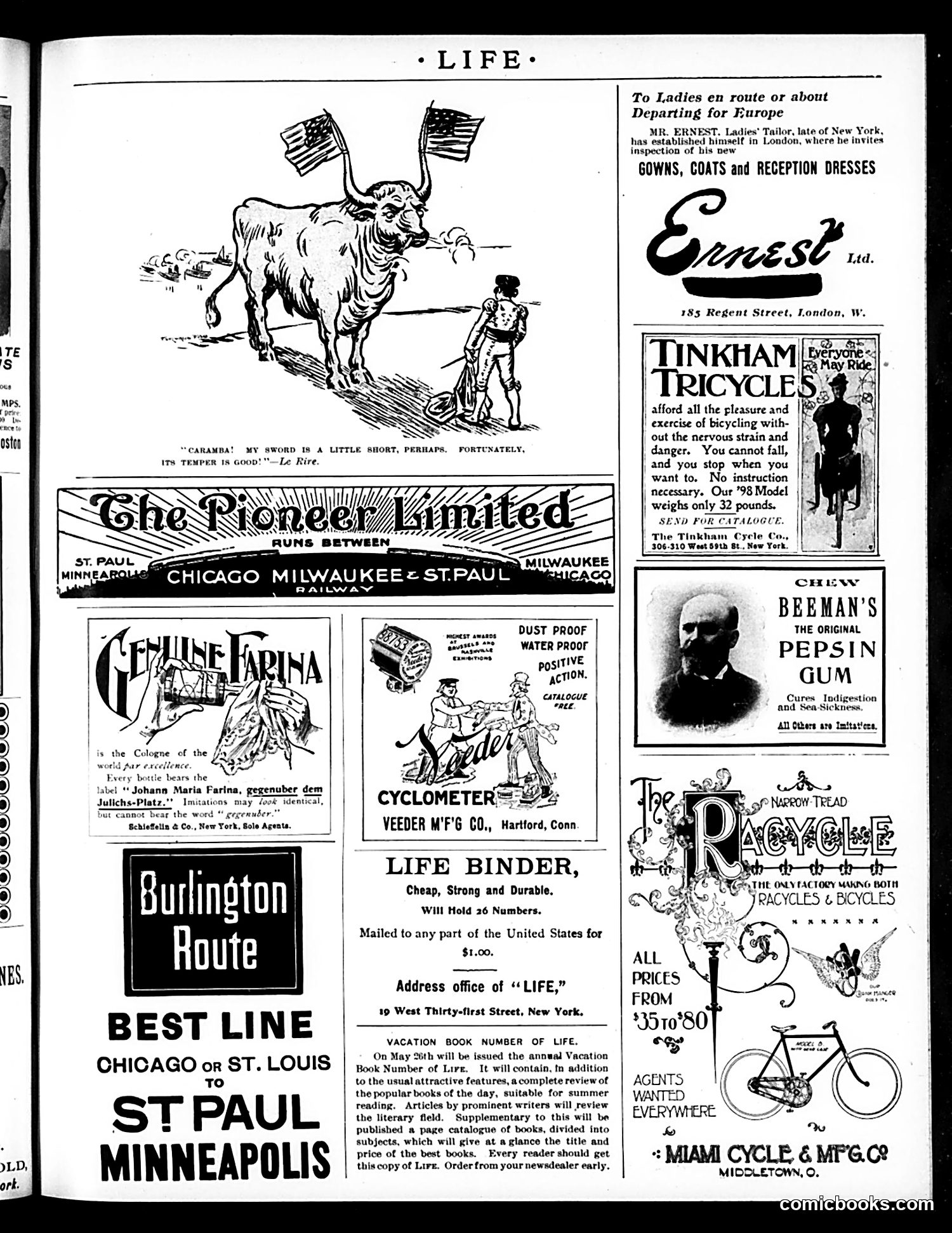
The main cartoon depicts a Spanish or Latin American military figure (indicated by "Caramba" and the reference to "Le Rire," a French publication) brandishing a sword, saying his weapon is "a little short, perhaps. Fortunately, its temper is good." This appears to be Cold War-era satire about **American military or diplomatic confidence despite perceived weakness**. The joke suggests that while the speaker's actual power ("sword") may be limited, their resolve and determination ("temper") compensate. The cartoon likely comments on U.S. posturing in Latin America or Spain during a period of regional tension—asserting strength through willpower rather than true capability. The rest of the page is primarily **period advertisements** for bicycles, gum, tailoring services, and railroad routes—typical early 20th-century Life magazine content. No additional political satire is evident on this page beyond the single cartoon.
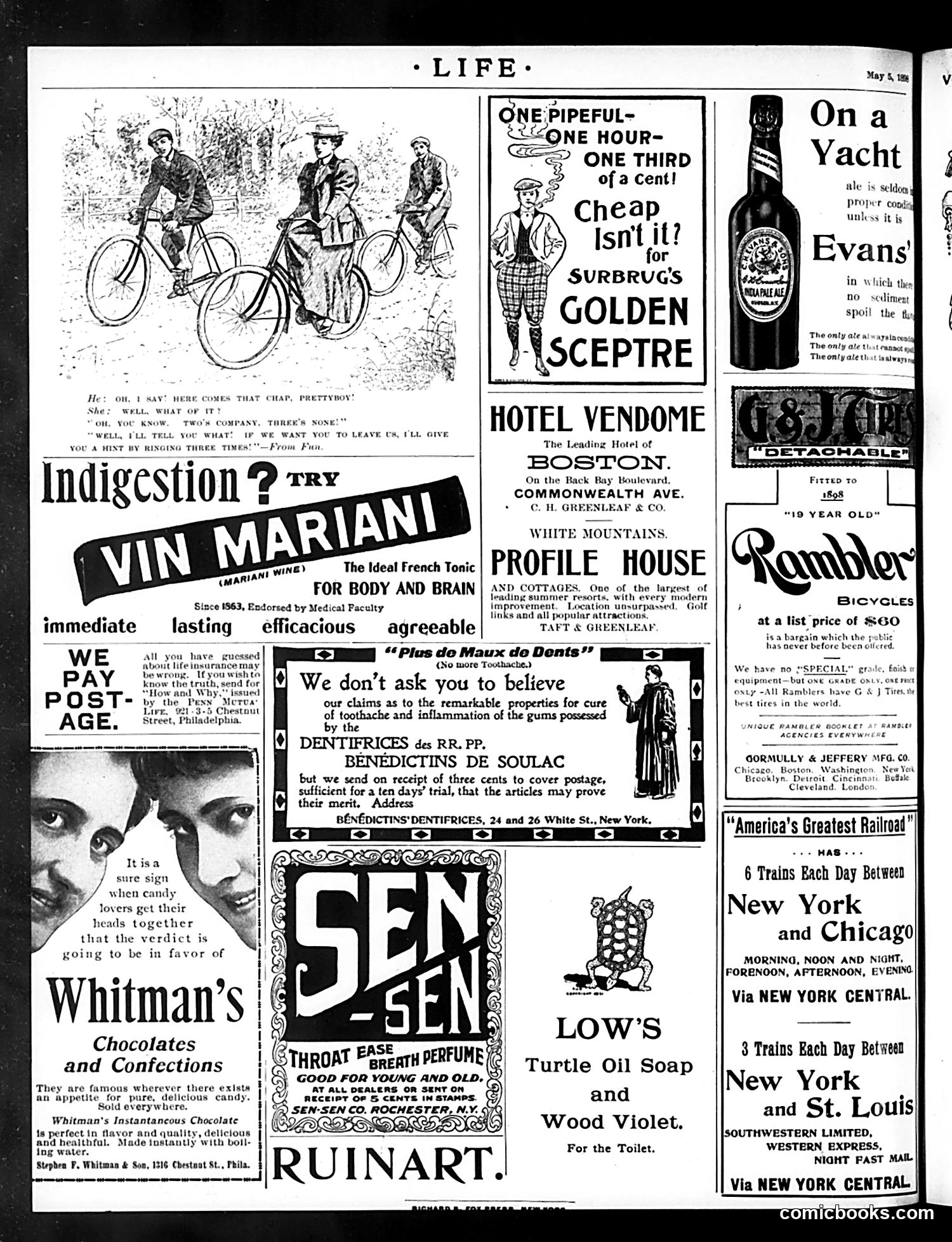
The main cartoon depicts a romantic scenario: a man and woman are interrupted by a third male cyclist arriving ("that chap, prettyboy"). The woman jokes that if the unwanted visitor keeps coming around, she'll ring a bell three times as a signal for him to leave—a humorous reference to the social awkwardness of unwanted romantic rivals in Victorian courtship. The page is predominantly **advertising**, featuring typical 1890s products: Vin Mariani (a French wine tonic), Whitman's chocolates, Sen-Sen breath lozenges, and railroad services. One notable ad for Benedictins' toothache remedy explicitly uses the phrase "No more Toothache" in French, reflecting the era's association of French products with sophistication. The humor is genteel and domestic—poking fun at courtship etiquette and the awkwardness of romantic triangles among the leisured classes. No specific political figures or current events are referenced; this is social satire aimed at middle-to-upper-class readers.