
Life, 1898-05-05 · page 6 of 20
Life — May 5, 1898 — page 6: what you’re looking at
What you’re looking at
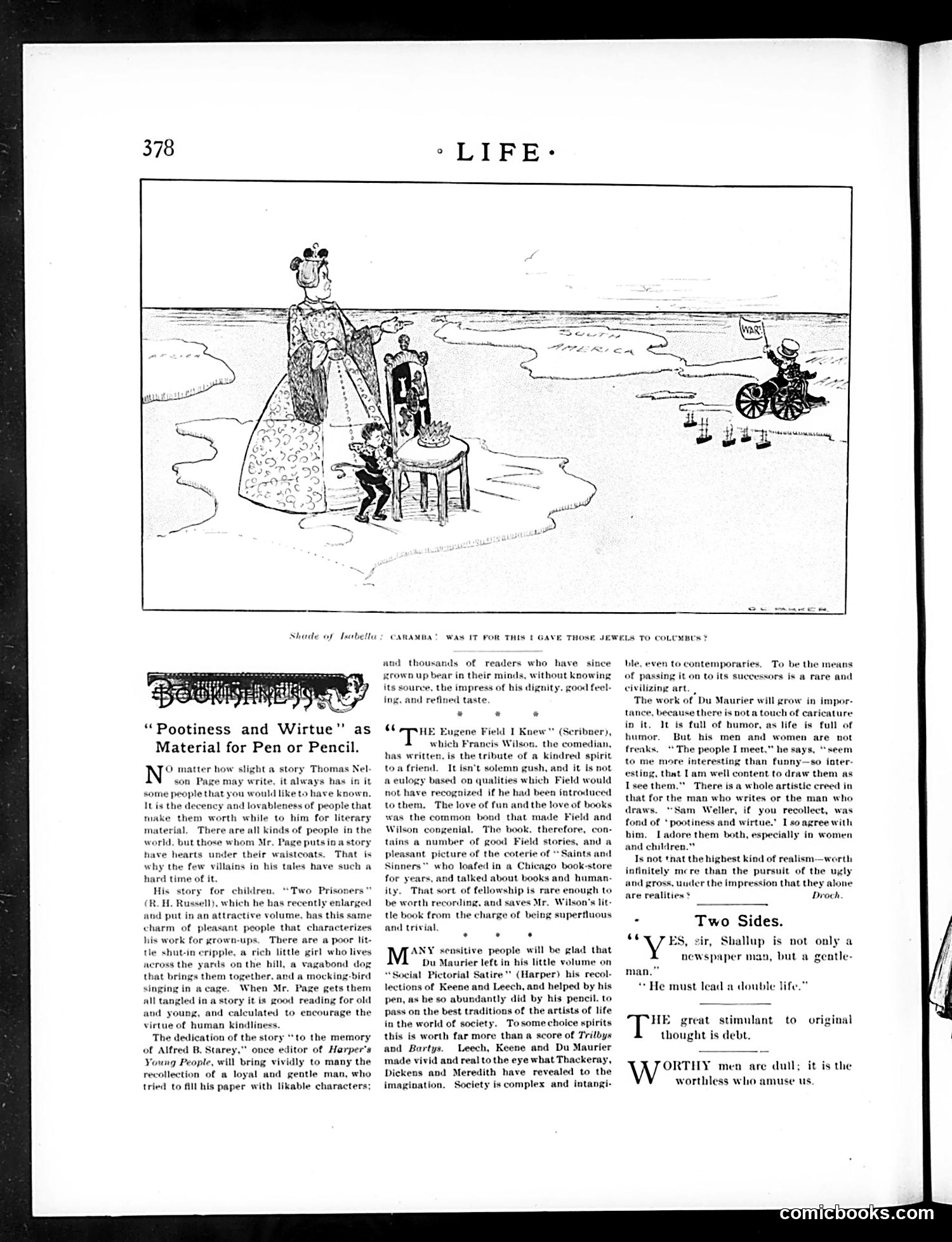
The cartoon depicts a woman in elaborate dress standing in a barren landscape, holding what appears to be a mirror or reflective object. A figure on the right operates some kind of machinery or apparatus. The caption reads: "Shade of Isabella: 'CARAMBA' WAS IT FOR THIS I GAVE THOSE JEWELS TO COLUMBUS?" This references Queen Isabella of Spain, who historically funded Columbus's 1492 voyage by pawning her jewels. The satire suggests that the grand, ornate civilization Isabella envisioned has been reduced to this desolate scene—a commentary on disappointed expectations or the gap between noble intentions and actual outcomes. The barren landscape and mechanical apparatus suggest industrialization or modern development has failed to deliver promised progress, making Isabella's historical sacrifice seem foolish in retrospect.
📄 Transcribed text from this page (OCR, searchable)
Machine-transcribed from the original scan — historical spelling and the odd misread are preserved.
Shade of abettu “Pootiness and Wirtue” as Material for Pen or Pencil. N° matter how slight « story Thoma son Page may write, it always has i some people that you would like to have known, It is the decency and lovableness of people that make them worth while to him for liter material, There are all kinds of people in the world, but those whom Mr. Page puts in a story have hearts under their waistcoats. That is why the few villains in his tales have such a hard time of it. His story for children, “Two Prisoners (R.H, Russell), which he has recently enlarged and put in an attractive volume, has this same charm of pleasant people that characterizes his work for grown-ups. There are a poor lit- tle shut-in eripple, a rich little girl who lives across the yards on the bill, a vagabond dog that brings them together, and a mocking-bird singing in acage. When Mr. Page gets them all tangled in a story it is good reading for old and young, and calculated to encourage the virtue of human kindliness. The dedication of the story “to the memory of Alfred B. Starey,” once editor of Harper's Young People, will bring vividly to many the recollection of a loyal and gentle man, who tried to fill his paper with likable characters; CARAMDA! WAS IT FOR THIS [GAVE THOSE and thousands of readers who have since grown up bear in their minds, without knowing its source, the impress of his dignity. good feel- ing. and refined taste * * * SC -AHE Eugene Field I Knew” (Scribner), which Francis Wilson. the comedian, has written, is the tribute of a kindred spirit toafriend. It isn't solemn gush, and it is not a eulogy based on qualities which Field would not have recognized if he had been introduced tothem. The love of fun and the love of books was the common bond that made Field and Wilson congenial, The book, therefore, con- tains a number of good Field stories, and a pleasant picture of the coterie of * Saints and Sinners who loafed in a Chicago book-store for years, and talked about books and human- ily. That sort of fellowship is rare enough to be worth recording. and saves Mr, Wilson's lit tle book from the charge of being superfluous ani trivial . . 6 NY sensitive people will be glad that Du Maurier left in his little volume on “Social Pictorial Satire" (Harper) his recol- lections of Keene and Leech, and helped by his pen, as be so abundantly did by his pencil. to pass on the best traditions of the artists of life in the world of society. Tosome choice spirits this is worth far more than a score of Trilbys and Bartys. Leech, Keene and Du Maurier made vivid and real to the eye what Thackeray, Dickens and Meredith have revealed to the imagination. Society is complex and intangi- ELS TO COLESBUS ble, even to contemporaries, To be the means of passing it on to its successors is a rare and civilizing art. , The work of Du Maurier will grow in impor- tance, because there is not a touch of caricatu in it. It ts full of humor, as life is full of humor. But his men and women are not freaks. “The people I meet,” he says, “seem to me more interesting than funny—so inter- esting, that Lam well content to draw them as Isee them.” There is a whole artistic creed in that for the man who writes or the man who draws. “Sam Weller, if you recollect, was fond of * pootiness and wirtue.’ Iso agree with him. Ladore them both, especially in women and children.” Is not that the highest kind of realism—worth infinitely mere than the pursuit of the ugly and gross, under the Impression that they alone are realities > Dvroch Two Sides. , cir, Shallup is not only a newspaper man, but a gentle- man. “He must lead a double life.” HE great stimulant to. ori thought is debt. ORTHY men are dull; it is the worthless who amuse us. Comicbooks.com