
Life, 1898-05-05 · page 4 of 20
Life — May 5, 1898 — page 4: what you’re looking at
What you’re looking at
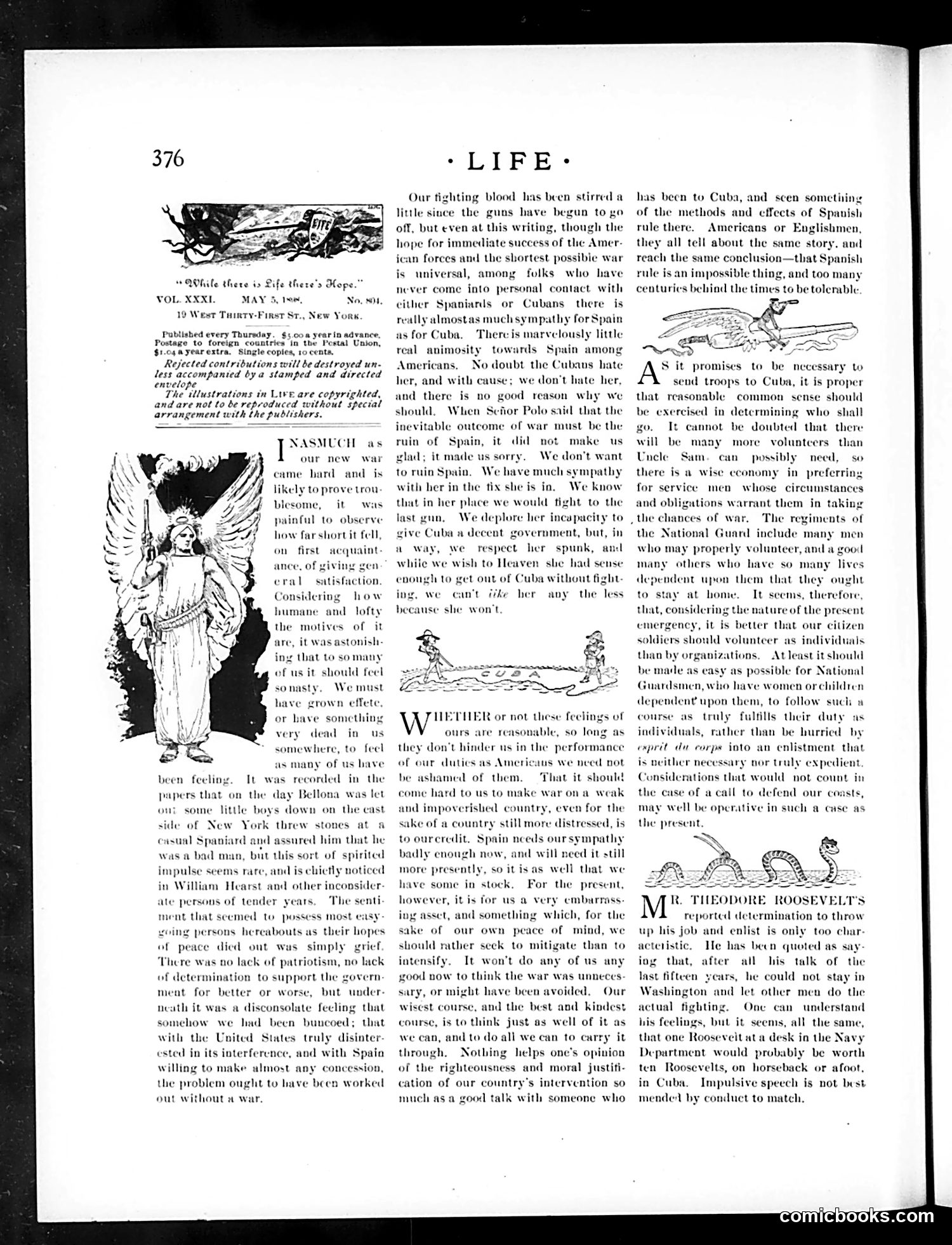
This page discusses American intervention in the Spanish-American War (referenced as recent conflict). The left illustration appears to be an allegorical female figure, likely representing either America or Cuba, rendered in classical style. The main text argues that while Americans sympathize with Cuba's cause against Spain, reasonable judgment should prevail in enlisting National Guard volunteers. The author cautions against hasty military action, noting that emotional patriotism shouldn't override practical considerations. The piece references **Theodore Roosevelt's** reported determination to enlist, suggesting he'd be "worth ten Roosevelts on horseback or afoot in Cuba." The tone is cautiously patriotic but advocates restraint—typical of Life magazine's satirical approach to contemporary political debate during this imperial period.
📄 Transcribed text from this page (OCR, searchable)
Machine-transcribed from the original scan — historical spelling and the odd misread are preserved.
“While there is Life there's Hope. VOL. XXXI. MAY 19 West Tainty-First Sr. ew YORK. Published every Thursday. $3.00. year in advance, Postage to foreign countries in the Postal Union, $1.04 8 year extra. Single copies, 10 cents Rejected contributions will be destroyed un- less accompanied bya stamped and directed envelope The illustrations in Lue are copyrighted, and are not to be reproduced without special arrangement with the publishers. | NASMUCH our new war came bard and is likely to prove trou Dlesome, — it painful to observ how far shortit fell, on first acquaint wis ance, of giving gen eral sati Considering humane and action how lofty the motives of it are, it Was astonish- iny that to somany of us it should feel We must own effete, so nasty have or have somethin very dead in us somewhere, to feel as many of us have been feeling. It was recorded in the papers that on the day Bellona was let some little boys down on the cast side of New York threw casual Spaniard and assured him th was a bad man, bit this sort of spirited impulse seems rare, and is chictly noticed in William Hearst and other inconsider- The senti stones at ate persons of tender years. ment that seemed to possess most ensy going persons hereabouts as their hopes of peace died out was simply grief ‘There was no lack of patriotism, no lack tthe govern but under- neath it was a disconsolute fecling that somehow we had been buncoed; that with the United Stttes truly disinter. ested in its interference, and with Spaia willing to make almost any concession, the problem ought to have been worked of determinat ment on to suppe for better or worse, out without a war. * LIFE: nting blood has been stirred a the guns have begun to go writing, though the little since off, but even at th hope for immediate success of the Amer- ican forces and the shortest possibile war is universal, among folks who have never come into personal contact: with either Spaniarnls or Cubans there is really almostas much sympathy forSpain as for Cuba, Thercis marvelously litle real towards Spain among Americans. No doubt the Cubans hate her, and with cause; we don't hate 1 and there i animosi no good reason why w should. When Scior Polo said that the inevitable outcome of war must be the ruin of Spain, it did not make us glad; it made us sorr We don’t want to ruin Spain, We have much sympathy with her in the tix she is in. We know that in her place we would fight to the last gun, We deplore her incapacity to give Cuba a decent government, but, in respect’ her spunk, and while we wish to Heaven she had sense a way, we enough to get out of Cuba without fight- ing, we can't her any the less because she won't w"t THER or not these feclings of ours are reasonable, so long as they don’t hinder us in the performance of our duties as Americaus we need not be ashamed of them. hat it should rd to us to make war ona weak even for the come | and impoverished country. sake of a country still more distressed, is ympathy badly enough now, and will need it still more presently, so it i well that we have some in stock, For the present, to oureredit. Spain needs our however, itis for us a very emburrass- iny asset, and something which, for the sake of mind, we should rather seck to mitigate than to intensify. It won't do any of us any good now to think the war was unneces- sary, or might have been avoided. Our wisest course, and the best and kindest course, is to think just as well of it as we can, and to do all we can to carry it throw Nothing helps one’s opinion of the righteousness and moral justifi- cation of our country’s intervention so much asa good talk with someone who our own peace of _ the chances of war. has been to Cuba, and scen sometiing of the methods and effects of Spanish rule there. Americans or Englishmen, they all tell about the same story, and reach the same conclusion—that Spanish rule isan impossible thing, and too many centuries behind the times to be tolerable AS it promises to be necessary to send troops to Cuba, it is proper that reasonable common sense should be exercised in determining who shall It cannot be doubted that there will be many volunteers than Uncle Sam possibly need, so there is a wise economy in preferring for service whose circumstances and obligations warrant them in takin The regiments of the National Guard include many men who may properly volunteer, and a goo others who have so many li go. more can men man spendent upon them that th to stay at 1 It seems, therefore that, considering the nature of the present it is better that our citizen soldiers should volunteer as individuals than by organizations, Atleast it should be maile as easy as possible for National emerge! Guardsmen, who have women orchildren dependent upon them, to follow such a as truly fultills their duty as individuals, rather than be hurried by courss exprit du corps into an enlistment that is neither necessary nor truly expedient Considerations that would not count in iL to defend our ec may well be operative in such a case as the case of ac the present, M* THEODORE ROOSEYV reported determination to throw up his job and enlist is only too char- acteristic. He has been quoted as say- iog that, after all his talk of the last fifteen years, he could not stay in Washington and let other men do the actual fighting. One can understand his feelings, but it seems, all the same, that one Rooseveit at a desk in the Navy Department would probably be worth ten Roosevelts, on horseback or afoot, in Cuba, Impulsive speech is not best mended by conduct to match,