
Life, 1898-05-05 · page 8 of 20
Life — May 5, 1898 — page 8: what you’re looking at
What you’re looking at
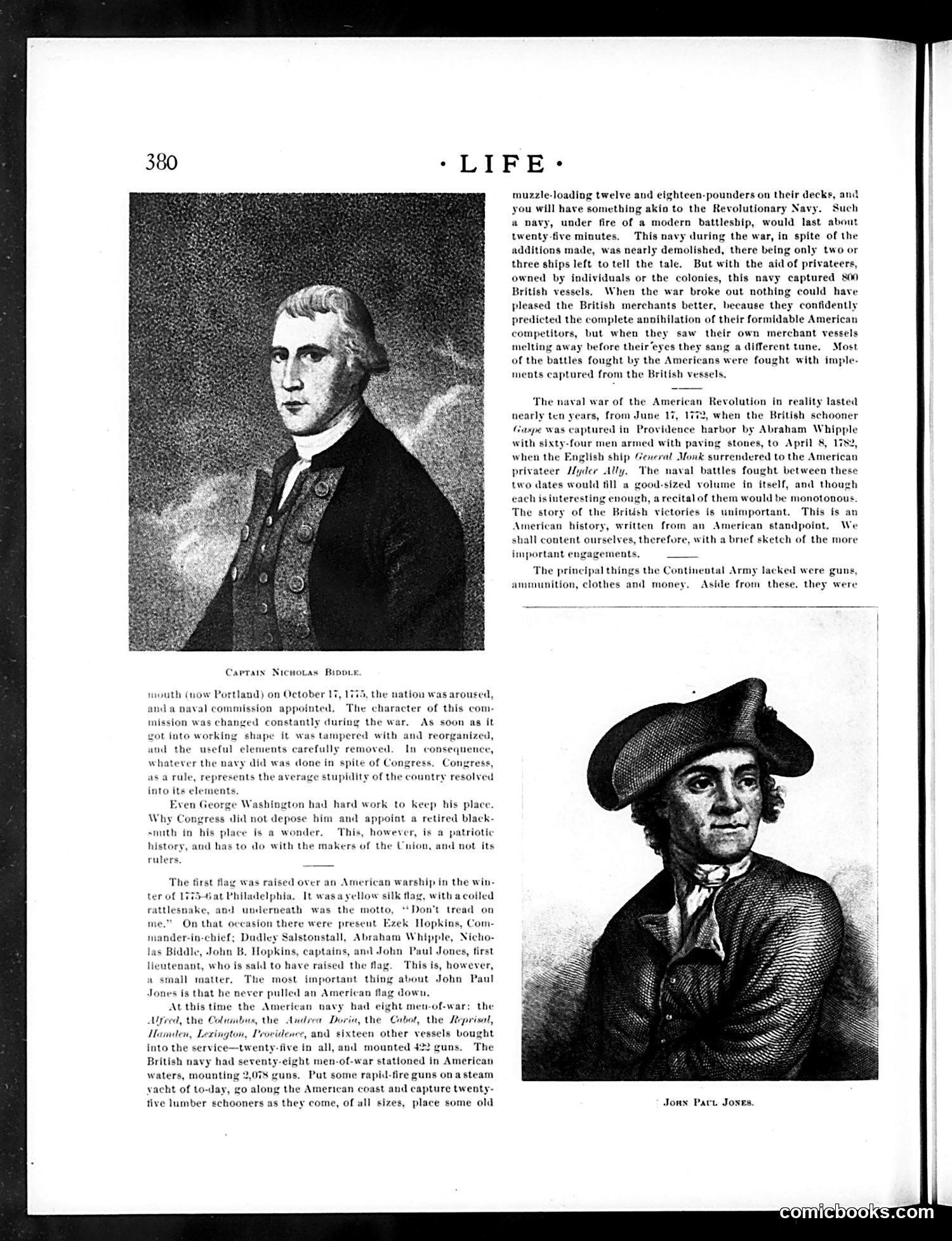
This page from *Life* magazine presents historical rather than satirical content. It features two portraits: **Captain Nicholas Biddle** (top) and **John Paul Jones** (bottom), both Revolutionary War naval figures. The text discusses the Continental Navy's struggles—lacking guns, ammunition, clothes, and money. It describes early American naval engagements from June 1775 to April 1782, noting that despite British naval superiority, Americans captured important vessels and fought notable battles. The page emphasizes this is "an American history, written from an American standpoint," suggesting the author's patriotic perspective on naval warfare. Rather than satire, this appears to be educational content celebrating American naval achievements during the Revolution.
📄 Transcribed text from this page (OCR, searchable)
Machine-transcribed from the original scan — historical spelling and the odd misread are preserved.
* LIFE: Capraty Nicnotas Bippwe iouth (now Portland) on October 17, 1735, the nation was aroused, a paval commission appointed, The character of this com- mission was changed constantly during the war, As soon as it got into working shape it was tampered with and reorganized, id the useful elements carefully removed. In consequence, whatever the navy did was done in spite of Congress. Con; asa rule, represents the average stupidity of the country resolve: into its el Even George Washington had hard work to keep his place. Why Congress did not depose him and appoint a retired black- snuth in his place is a wonder, Thi history, to do with th ments, however, is a patriotic nd ha makers of the Cuion, and not its rulers. The first flag was raised over an American warship in the win- ter of lt Vhiladelphia, It wasayellow silk flag, with acoiled rattlesnake, apd underneath was the motto, ‘Don't tread on m On that occasion there were present Ezek Hopkins, Com- mander-in-chief; Dadley Salstonstall, Abraham Whipple, Nicho- las Biddle, John B, Hopkins, captains, and John Paul Jones, first lieutenant, who is said to have raised the flag. 4 small matter, The most important thing about John Paul Jones is that he never pulled an American flag down, At this time the American navy had eight men-of-war: the Urred, the Colanbus, the Andrea Doria, the Cabot, the Reprisal, Hamden, Lexington, Providence, and sixteen other vessels bought into the service—twenty-five in all, and mounted 422 guns. The British navy had seventy-eight men-of-war stationed in American waters, mounting 2,078 guns. Put some rapid-fire guns on asteam yacht of to-day, go along the American coast aud capture twenty- tive lumber schooners as they come, of all sizes, place some old This is, however, muzzle-loading twelve and eighteen-pounders on their decks, and you will have something akia to the Revolutionary Navy. Such a navy, under fire of a modern battleship, would last about twenty-five minutes. This navy during the war, in spite of the additions made, was nearly demolished, there being only two or three ships left to tell the tale, But with the aid of privateers, owned by individuals or the colonies, this navy captured 80 British vessels, When the war broke out nothing could have pleased the British merchants better, because they confidently predicted the complete annihilation of their formidable American competitors, but when they saw their own merchant vessels melting away before their‘eyes they sang a different tune, Most of the battles fought by the Americans were fought with imple- ments captured from the British vessels. an Revolution in reality lasted years, from June 17, 1772, when the British schooner Gaspe was captured in Providence harbor by Abraham Whipple with sixty-four men armed with paving stones, to April 8, 1782, when the English ship General Monk surrendered to the American privateer Myder Aly, The naval battles fought between these two dates would fill a good-sized volume in itself, and though each isinteresting enough, a recital of them would be monotonous. The story of the British victories is unimportant, This is an American history, written from an American standpoint, We shall content ourselves, therefore, with a brief sketch of the more important engagements, ‘The naval war of the Ameri nearly t The principal things the Continental Army lacked were guns, ammunition, clothes and money, Aside from these, they wi Jonx Pact Jonrs.