
Life, 1898-05-05 · page 9 of 20
Life — May 5, 1898 — page 9: what you’re looking at
What you’re looking at
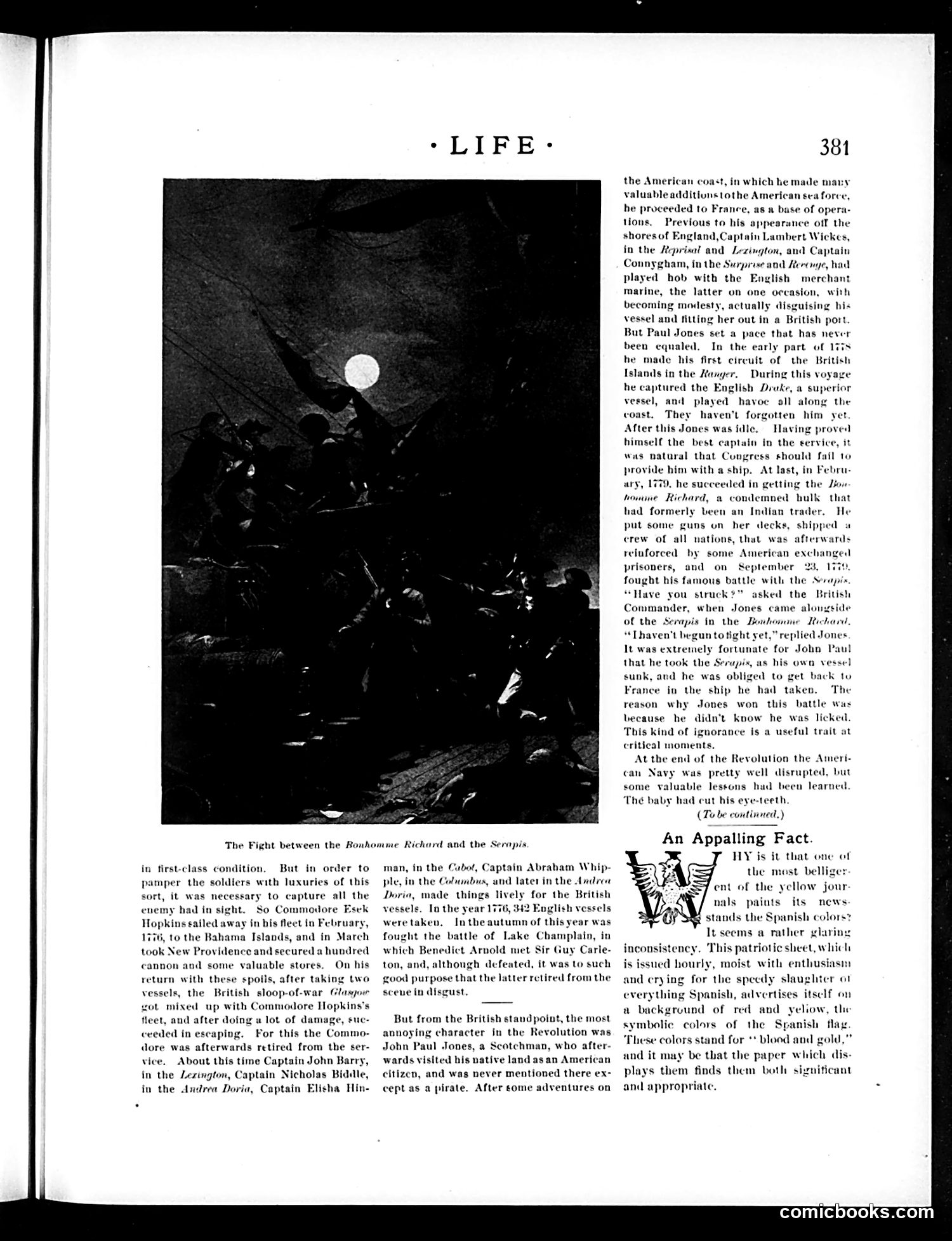
This page from *Life* magazine discusses naval warfare during the American Revolution, specifically the fight between the British ship *Serapis* and John Paul Jones's vessel. The accompanying illustration appears to depict a nighttime naval battle scene with dramatic lighting. The text describes Jones's famous encounter where he refused to surrender despite damage to his ship, declaring "I have not yet begun to fight." The article notes Jones was Scottish-born but became an American naval commander, and that his victory was significant despite his initial disadvantage. A sidebar titled "An Appalling Fact" critiques Spanish flag colors (red and yellow) as symbols of "blood and gold," suggesting Spain's colonial exploitation. This reflects American attitudes toward European imperialism during the Revolutionary era.
📄 Transcribed text from this page (OCR, searchable)
Machine-transcribed from the original scan — historical spelling and the odd misread are preserved.
The Fight between the Bonhomme Richard and the Serapis in first-class condition, But in order to pamper the soldiers with luxuries of this sort, it was ne y to capture all the enemy bad ins So Commodore Esek ins sailed away in bis fleet in February, to the Bahama Islands, and in March ‘ew Providence and secured a hundred cannon and some valuable stores. On his after taking two Is, the British sloop-of-war Glasyor ot mixed up with Commodore Hopkin t, and after doing u lot of damage, #uc- ceeded in escaping. For this the Commo- dore was afterwards retired from the ser- vice. About this time Captain John Barry, in the Lezington, Captain Nicholas Biddle, in the Andrea Doria, Captain Elisha Hin man, in the Cudof, Captain Abraham Whip- ple, in the Cobunbus, und later in the Andree Doi made things lively for the British vessels. In the year 17 Engli els weretaken, Inthe autumn of thisy fought the battle of Lake Champlain, in which Benedict Arnold met Sir Guy Carle- ton, and, although defeated, it was to such good purpose that the latter retired from the sceue in disgust, But from the British standpoint, the most annoying character in the Revolution was John Paul Jones, a Scotchman, who after- wards visited bis native land asan American citizen, and was never mentioned there ex- cept as a pirate. After come adventures on 381 the Ameri t, in which he made many valuable additions tothe American sea force, he proceeded to France, as a base of opera- tions. Previous to his appearance off the shoresof England,Captain Lambert Wickes, in the Reprisal and Lezington, and Captain Connygham, in the Surprise and Rerenye, had played hob with the English marine, the latter on one occasion, with becoming modesty, actually disguising his vessel and fitting her out in a British port. But Paul Jones set a pace that has never been equaled, In the early part of 1778 he made his first circuit of the British Islands in the Hav During this voyage he captured the English Drake, a superior vessel, and played havoc oll along the coast, They haven't forgotten him After this Jones was idle. Having proved himself the best captain in the service, it was natural that Congress should fail to provide him with a ship. At last, in Febru- ary, 1779. he succeeded in getting the How Richard, a condemned bulk that had formerly been an Indian trader. He put some guns on her decks, shipped a crew of all nations, that was afterwards reiuforced by some Americ prisoners, and on Septe fought his famous battle with the Scraps “Have you struck?” asked the British Commander, when Jones came alongside of the Serapis in the Bouhonane Richard, “Thaven’'t begun to tight yet,” replied Jones It was extremely fortunate for John Paul that he took the Serupis, as his own ves sunk, and he was obli, to get back t “rance in the ship he had taken. The reason why Jones won this battle was bec didn't know This kind of ignorance is a useful trait at critical moments. At the end of the Revolution the Ameri- can Navy was pretty well disrupted, but some valuable lessons had been learned. he baby had cut his eye-teeth. (To be continned.) merchant yer hom use he he was licked. An Appalling Fact. HY is it that one of the most belliger ent of the yellow jour nals paints its stands the Spanish colors: It seems a rather glaring inconsistency. This patriotic sheet, which is issued hourly, moist with enthusiasm: news and crying for the speedy slaughter ot Spanish, advertises itself on ‘uund of red and yeliow, th symbolic colors of the Spanish flay hese colors stand for ** blood and gold,”” and it may be that the paper which dis- plays them finds them both siznificant and appropriate, comicbooks.com