
Life, 1898-05-05 · page 7 of 20
Life — May 5, 1898 — page 7: what you’re looking at
What you’re looking at
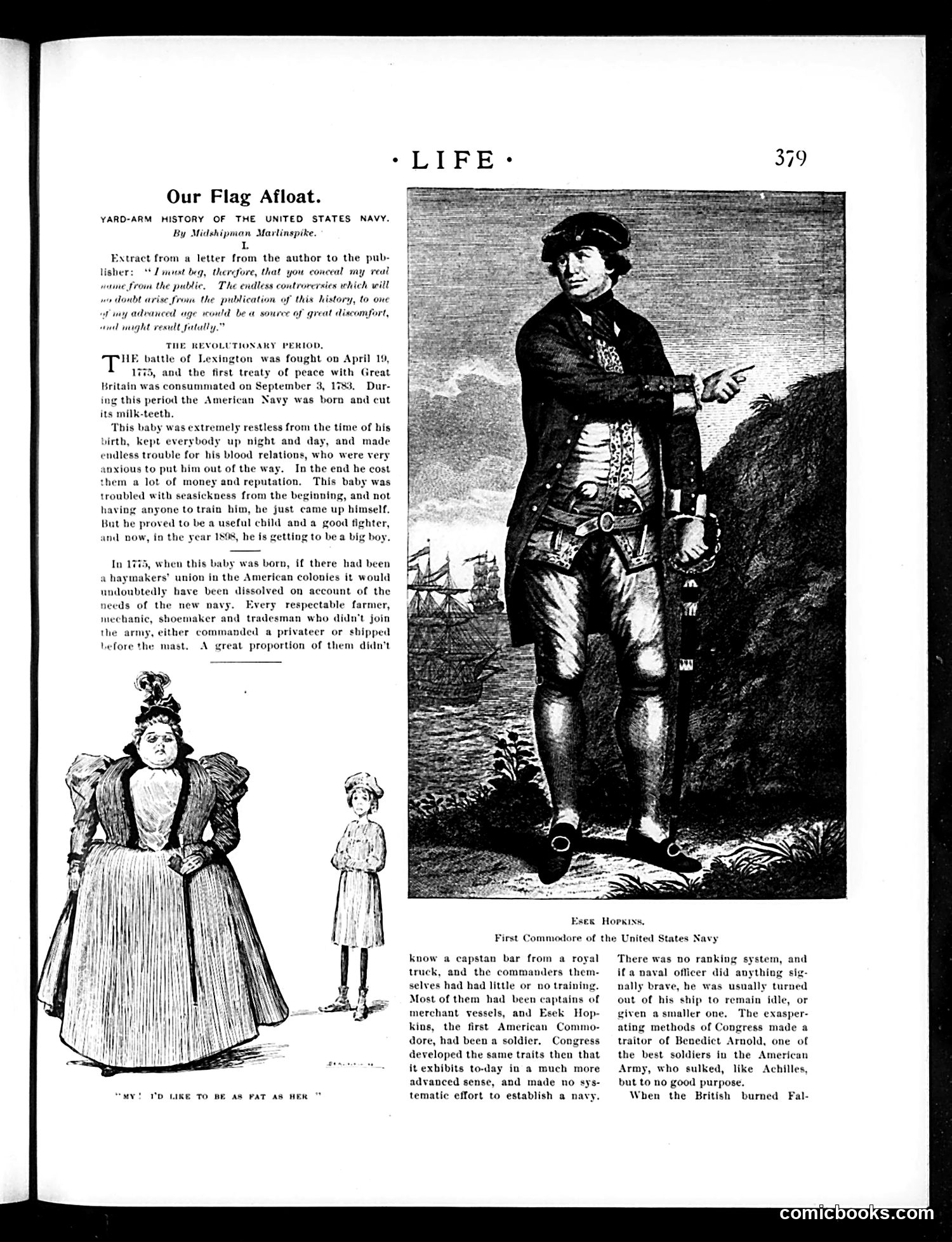
This page presents a historical article about the early American Navy, featuring a portrait of **Ezek Hopkins**, identified as "First Commodore of the United States Navy." The left illustration appears to be a satirical social cartoon (separate from the naval history), showing a woman in 1890s fashion with the caption **"Why I'd like to be as fat as her."** This mocks contemporary beauty standards and weight obsession among women of the era. The main article discusses how during the Revolutionary War (1775-1783), the American Navy was born from necessity and struggled with untrained personnel—mostly merchant sailors and soldiers pressed into service. The text contrasts this chaotic beginning with Congress's later efforts to establish a more systematic, professional naval force, suggesting early American naval development was haphazard compared to later institutional improvements.
📄 Transcribed text from this page (OCR, searchable)
Machine-transcribed from the original scan — historical spelling and the odd misread are preserved.
Our Flag Afloat. YARD-ARM HISTORY OF THE UNITED STATES NAVY. By Midshipman Mavtinspike. L Extract from a letter from the author to the pub- lisher: “J rnust beg, Heerefore, hat you conceal my real name from the public. The endless controversies which will me he this history, to one winy advanced age ould be a source of great discomfort, J maght result fatally.” THe tle of Lexington was fought on April 19, » and the first treaty of peace with Great Kritain was consummated on September 3, 1783. Dur- ing this period the American Navy was born and cut its milk-teeth. This baby was extremely restless from the time of his birth, kept everybody up night and day, and made endless trouble for his blood relations, who were very xious to put him out of the w In the end he cost hem a lot of money and reputation. This baby was troubled with seasickness from the beginning, and not having anyone to train him, be just came up himself. But he proved to be a useful child and a good fighter, ind now, in the year 1898, he is getting to be a big boy. nr dandt avise fr publication THE REVOLUTIONARY PERIOD, In 1775, when this baby was born, if there had been a haymakers’ union in the American colonies it would undoubtedly have been dissolved on account of the needs of the new navy. Every respectable farmer, hoemaker and tradesman who didn’t join the her commanded a privateer or shipped ast. A great proportion of them didn't VD LIKE TO BE AS FAT AS HER Ssem HOPKINS, First Commodo: know a capstan bar from a royal truck, and the commanders them- selves had had little or no training. Most of them had been captains of merchant vessels, and Esek Hop- kins, the first American Commo- dore, had been a soldier, Congress developed the same traits then that it exbibits to-day in a much more advanced sense, and made no tematic effort to establish a navy. of the United States Navy ‘There was no ranking system, and ifa naval officer did anything sig- nally brave, he was usually turned out of his ship to remain idle, or given a smaller one. The exasper- ating methods of Congress made a traitor of Benedict Arnold, one of the best soldiers in the American Army, who sulked, like Achilles, but to no good purpose. When the British burned Fal- comicbooks.com