
A complete issue · 20 pages · 1898
Life — March 3, 1898
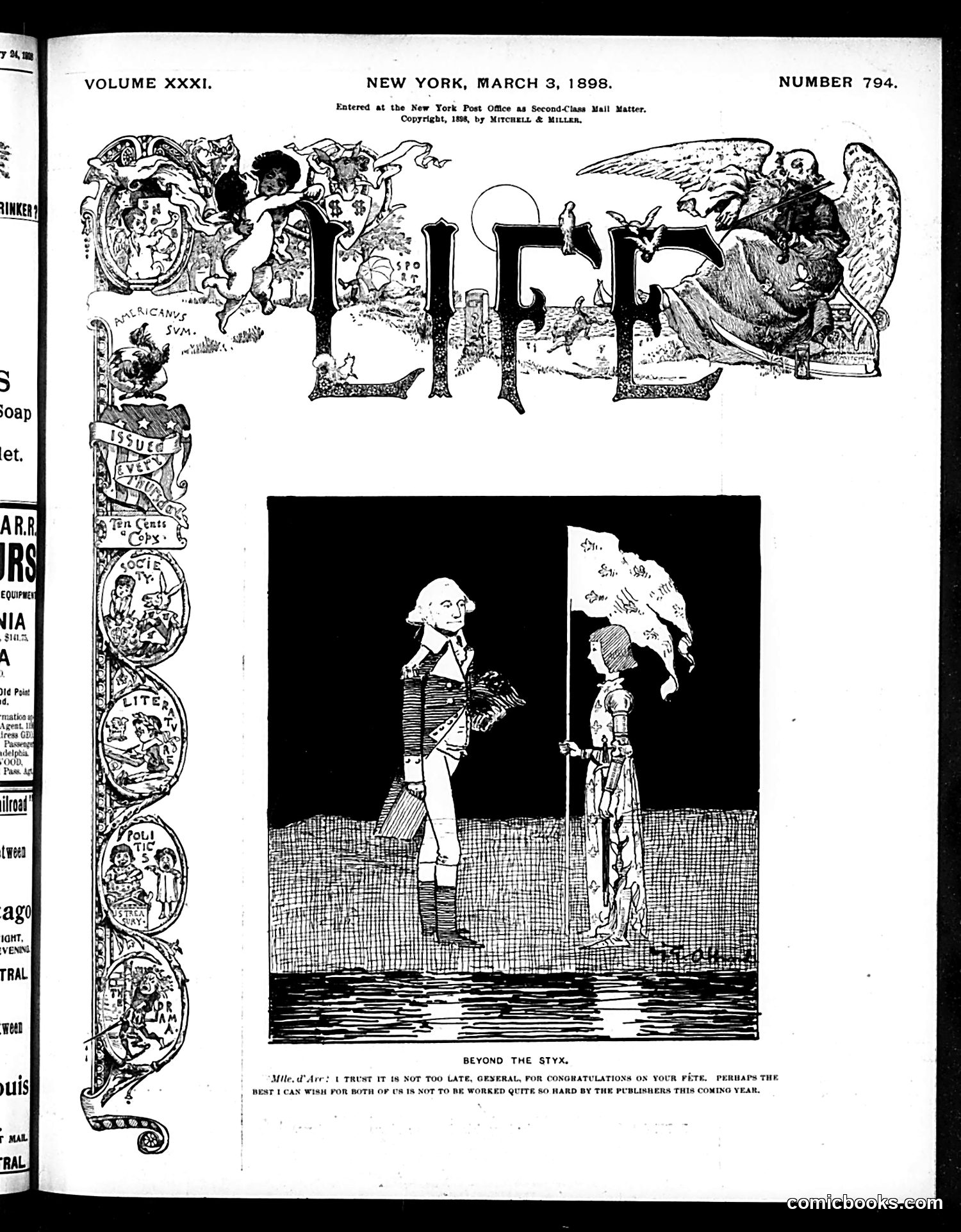
The main cartoon, titled "Beyond the Styx," depicts two figures by a river (the mythological boundary between life and death). The left figure wears 18th-century military dress, appearing to be a historical general. The right figure holds a flag with text. The caption reads: "Mlle d'Arc: 'I TRUST IT IS NOT TOO LATE, GENERAL, FOR CONGRATULATIONS ON YOUR FÊTE. PERHAPS THE BEST I CAN WISH FOR BIRTH OF US IS NOT TO BE WORKED QUITE SO HARD BY THE PUBLISHERS THIS COMING YEAR.'" The reference to "Mlle d'Arc" (Joan of Arc) suggests the left figure represents a historical military leader. This appears to be satirizing heavy commercialization or exploitation of historical figures by publishers, with even famous historical personages complaining about overwork in their modern representations.
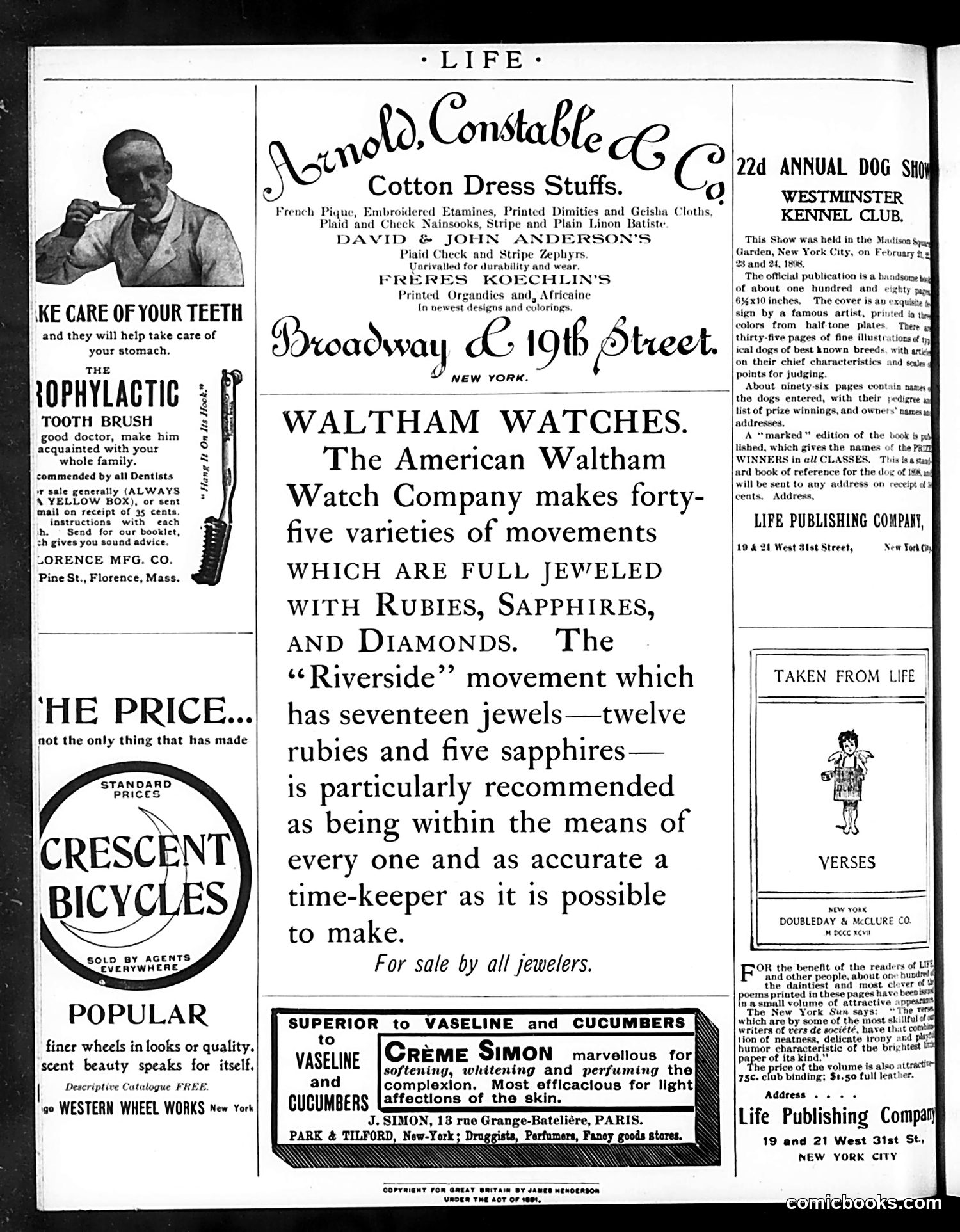
This page is predominantly **advertisements** with minimal editorial content. The visible ads include: - **Biophylactic Tooth Brush** (upper left): Features a man's portrait and pitch emphasizing dentist approval - **Waltham Watches** (center): Highlights luxury jeweled movements - **Crescent Bicycles** (lower left): Emphasizes quality and affordability - **Crème Simon** (bottom): A beauty product for skin care - **Cotton Dress Stuffs** and other textile ads (upper right) The page also advertises a **22nd Annual Dog Show** at Westminster Kennel Club and promotes **Life Publishing Company's** "Taken from Life Verses" poetry collection. There is **no political cartoon or social satire evident** on this page. It functions as a standard magazine advertising section typical of early 20th-century publications, mixing consumer goods with cultural event promotion.
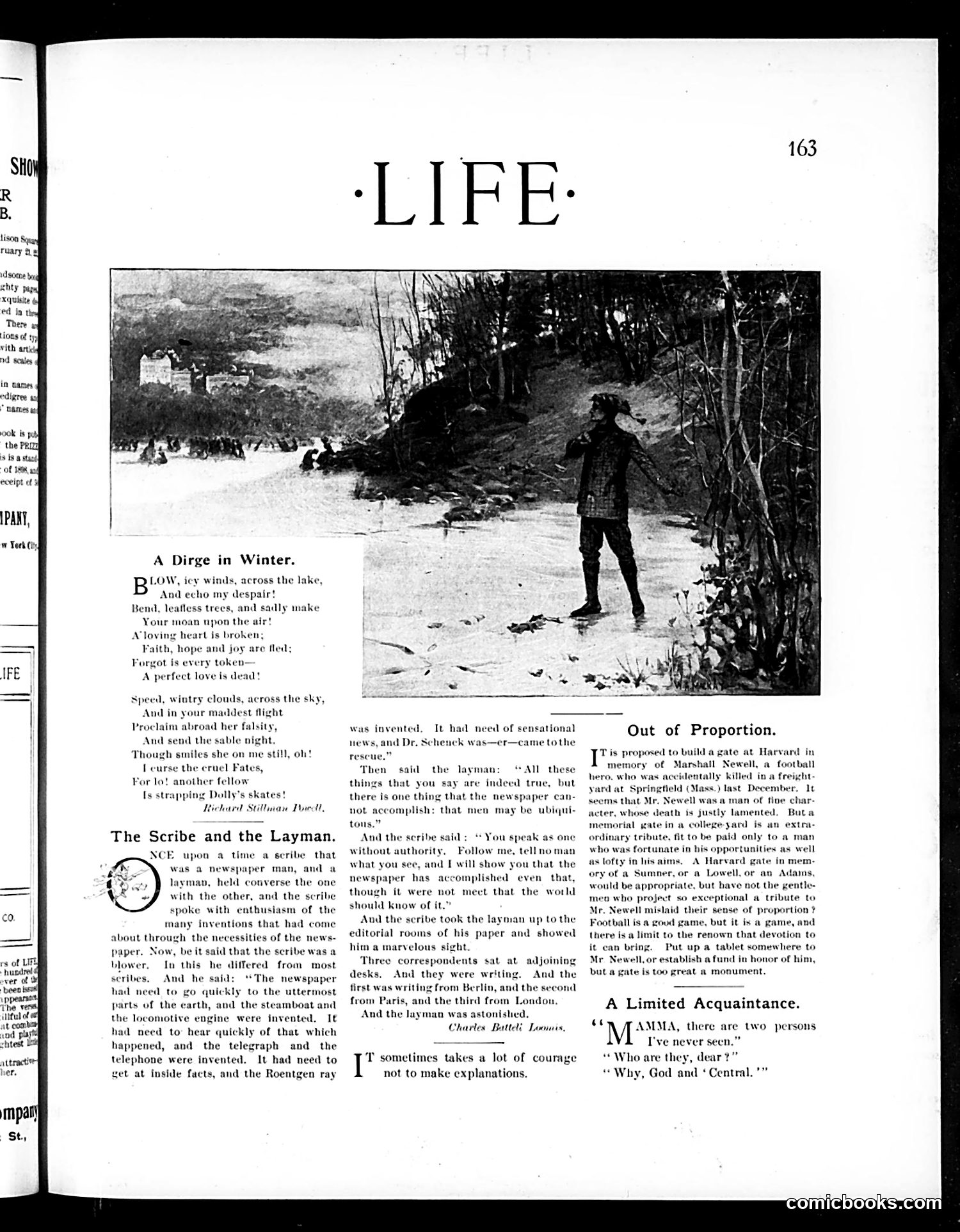
This page contains three distinct literary pieces rather than political cartoons: 1. **"A Dirge in Winter"** — A melancholic poem illustrated with a photograph of a solitary figure by a frozen lake, reflecting on lost love and broken faith. 2. **"The Scribe and the Layman"** — A dialogue piece satirizing the relationship between newspaper men and laypeople. It appears to mock how newspapers claim accomplishments they haven't actually achieved, with the layman challenging the scribe's boasts about newspaper innovations (the locomotive engine, telegraph, telephone, Roentgen ray). 3. **"A Limited Acquaintance"** and **"Out of Proportion"** — Brief anecdotal pieces about social situations. The page is primarily literary/satirical commentary rather than visual political satire, focusing on early 20th-century social observations about media credibility and human relationships.
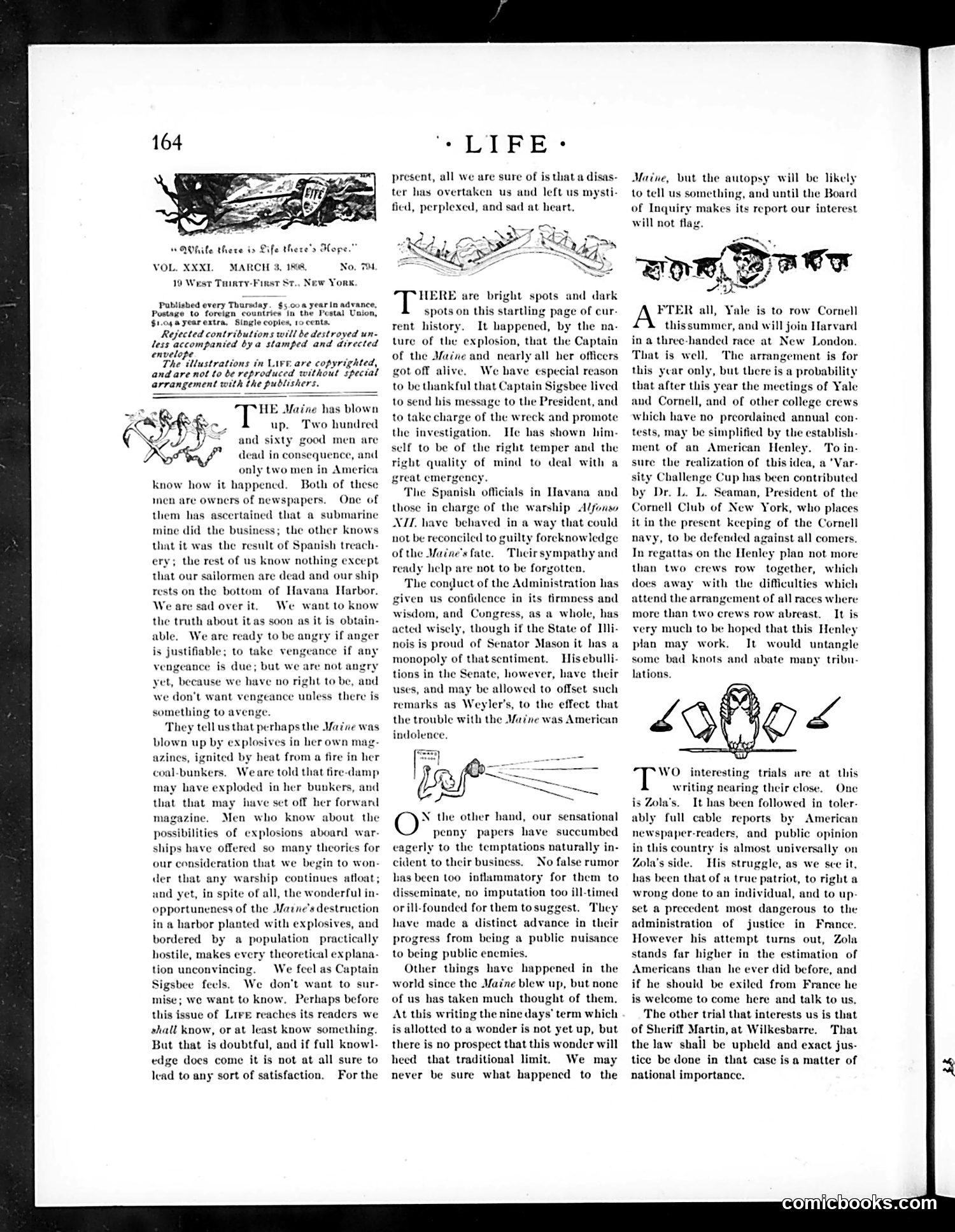
This page discusses the USS *Maine* explosion in Havana Harbor. The text references Captain Sigsbee's survival and the investigation into the disaster. Key points include: **The Main Issue:** Whether the explosion was accidental (caused by the ship's own magazine) or sabotage by Spanish forces. The text notes uncertainty persists about the actual cause. **Political Context:** Spanish officials in Havana and those managing the warship *Alfonso XII* are mentioned sympathetically, while American papers are criticized for sensationalism and inflammatory reporting that advanced from "public nuisance to being public enemies." **The Satire:** The piece mocks American newspapers for eagerly spreading unverified rumors and inflaming tensions rather than waiting for facts from the official investigation. The small cartoons appear decorative rather than directly satirical.
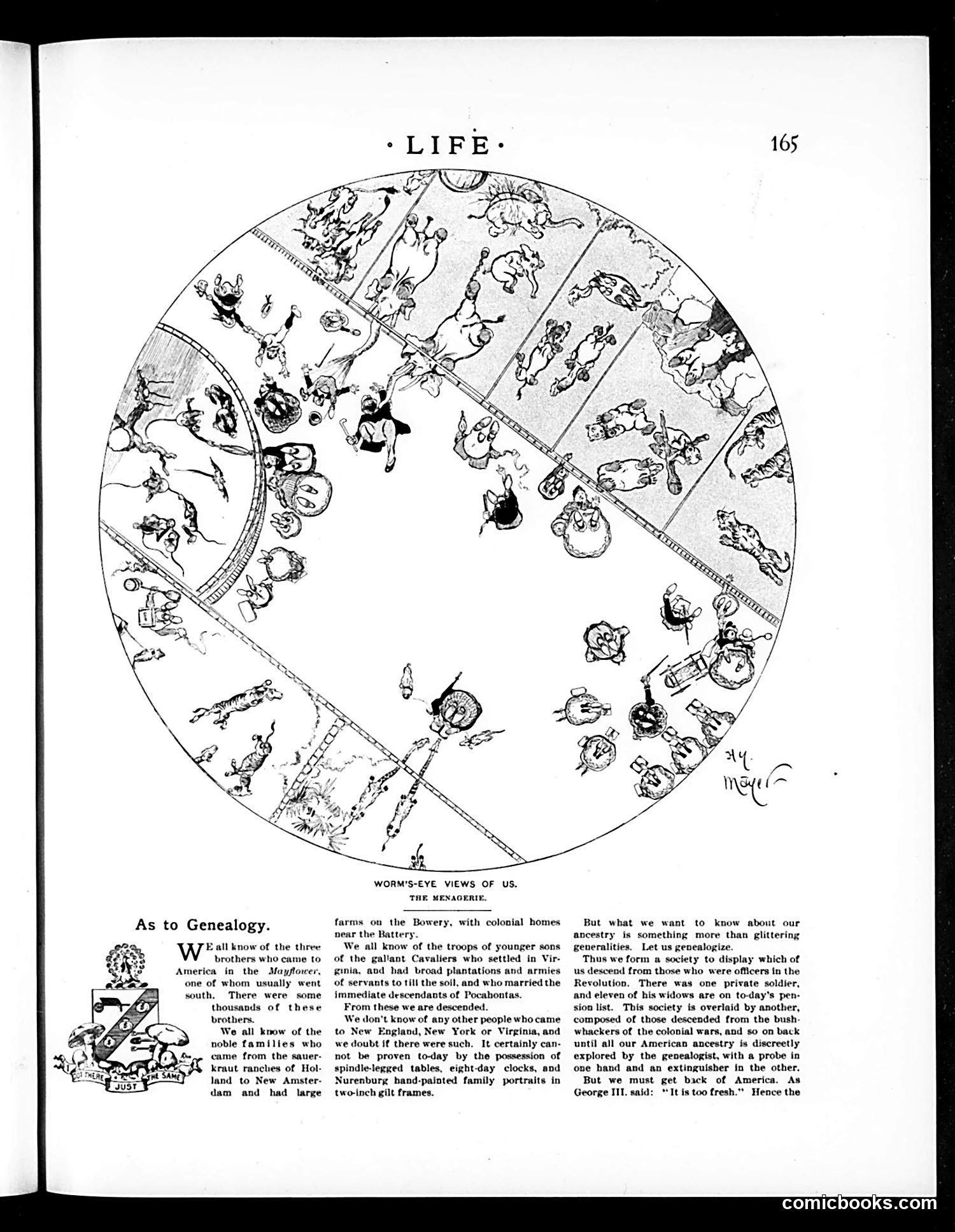
This page presents "Worm's-Eye Views of Us: The Menagerie"—a satirical circular illustration depicting American society as viewed from below, like from a worm's perspective. The image shows various social classes and types arranged around a circle, suggesting a hierarchical or interconnected social structure. The accompanying text "As to Genealogy" traces American ancestry humorously, claiming descent from various colonial settlers and noble families. The satire mocks Americans' obsession with genealogy and inherited status, suggesting that most ancestry derives from ordinary colonists rather than nobility. The reference to "spindle-legged tables" and other possessions pokes fun at how people claim aristocratic lineage through material objects. The overall message critiques American pretension about social hierarchy and bloodline.
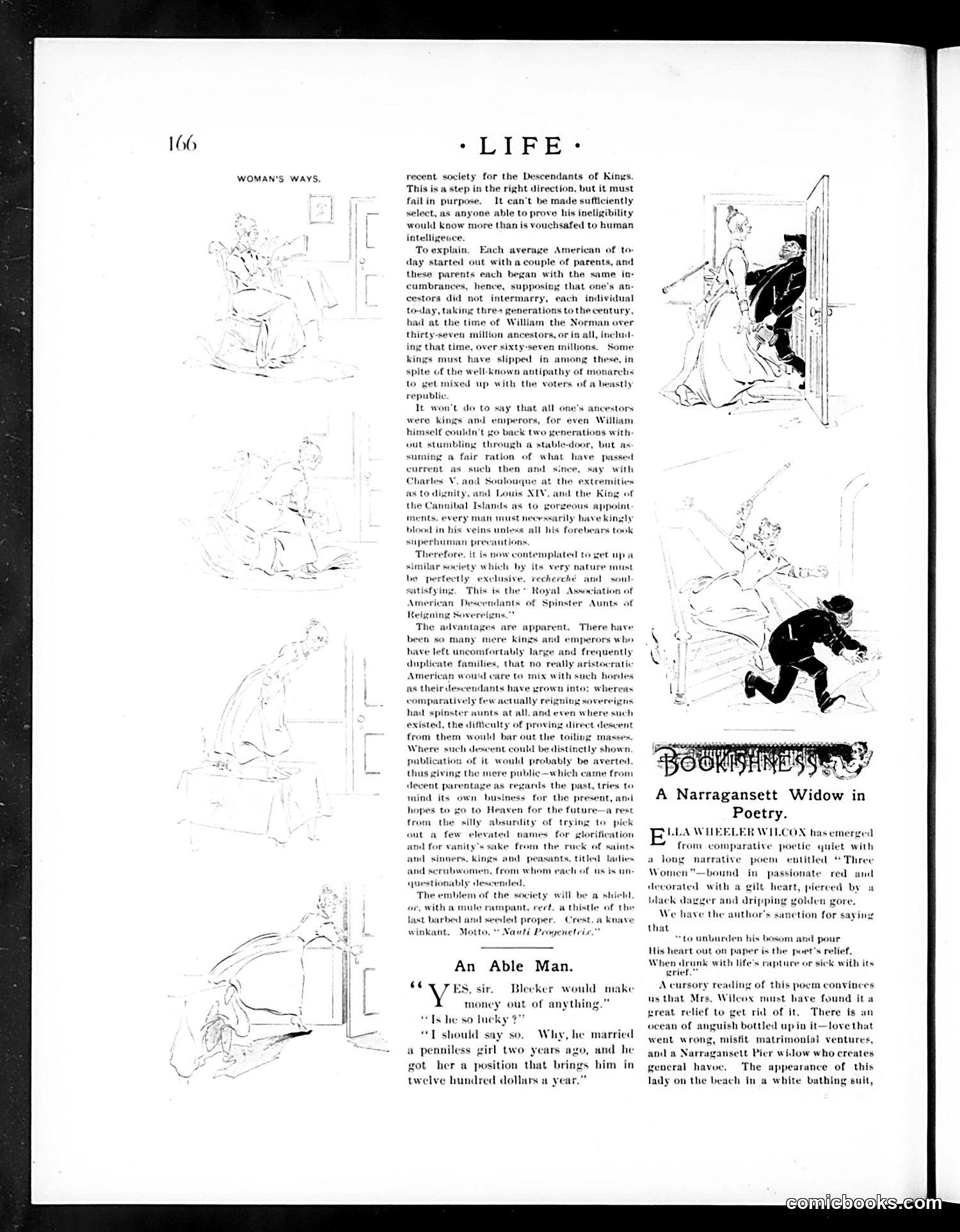
This page contains two distinct pieces: **"An Able Man"** (bottom left): A brief dialogue joke about someone named Blecker who married "a penniless girl two years ago" and now has "a position that brings him in twelve hundred dollars a year." The humor depends on whether readers interpret his good fortune as genuine merit or suspect he married into money/connections—a commentary on class mobility and nepotism in the Gilded Age. **"A Narragansett Widow in Poetry"** (right): An article reviewing Ella Wheeler Wilcox's poem "Three Women." The text critiques the work as melodramatic, describing a Narragansett Pier widow creating "general havoc." This appears to be literary criticism mocking both Wilcox's sentimental style and perhaps the wealthy leisure class she depicts. The left side contains sketch illustrations related to "Woman's Ways," apparently depicting social scenes.
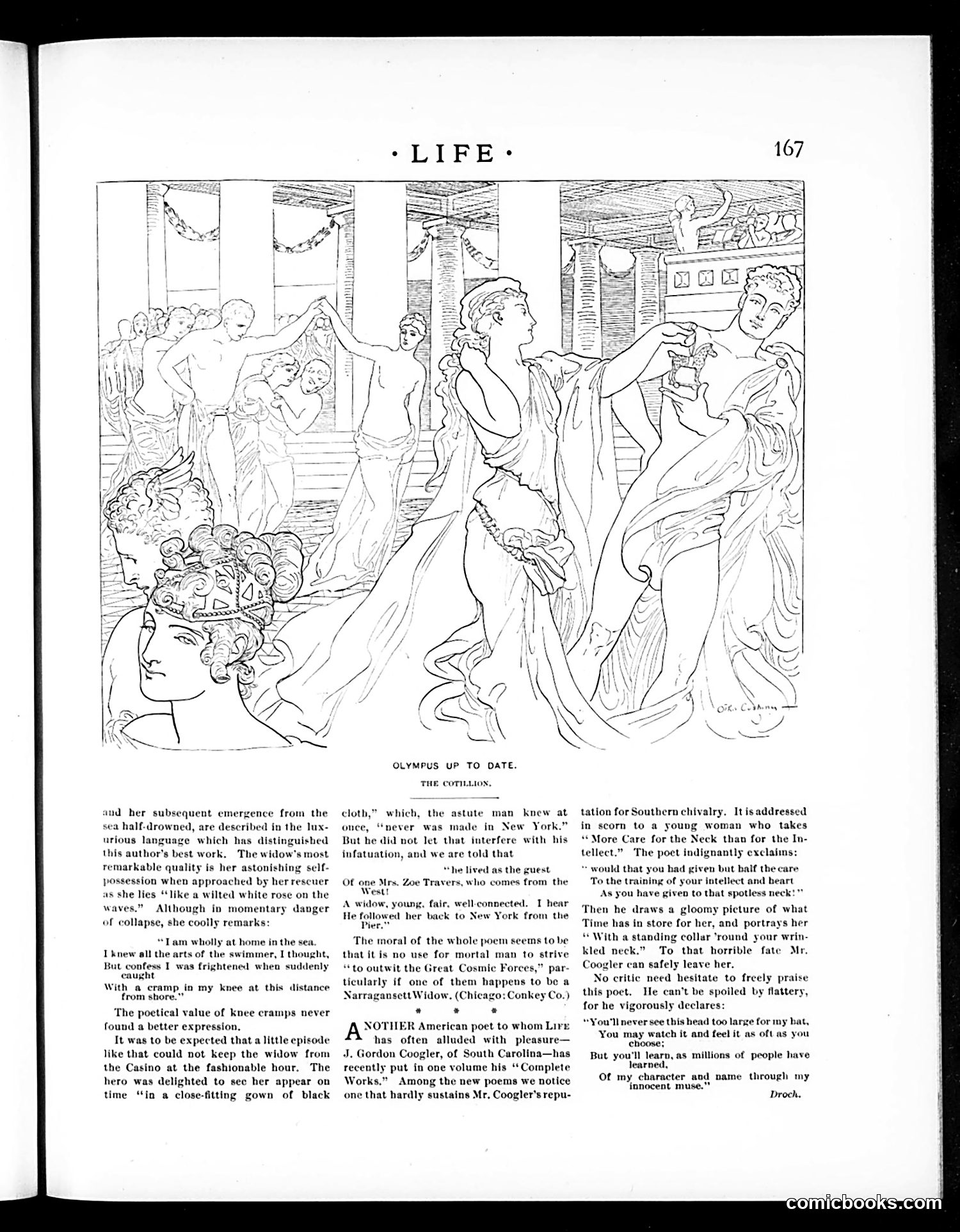
This satirical illustration depicts classical Greek gods and goddesses attending a modern American formal dance (cotillion). The artwork juxtaposes ancient mythology with contemporary Gilded Age high society, suggesting that America's wealthy elite see themselves as divine or superior beings. The image shows elaborately dressed figures in classical drapery mingling at what appears to be a fashionable ballroom, complete with decorative garlands. By placing mythological figures in a modern social setting, the cartoonist mocks the pretensions of aristocratic society—implying that these supposedly refined people are little different from the vain, gossiping gods of antiquity. The satire criticizes upper-class vanity and self-importance through classical allusion.
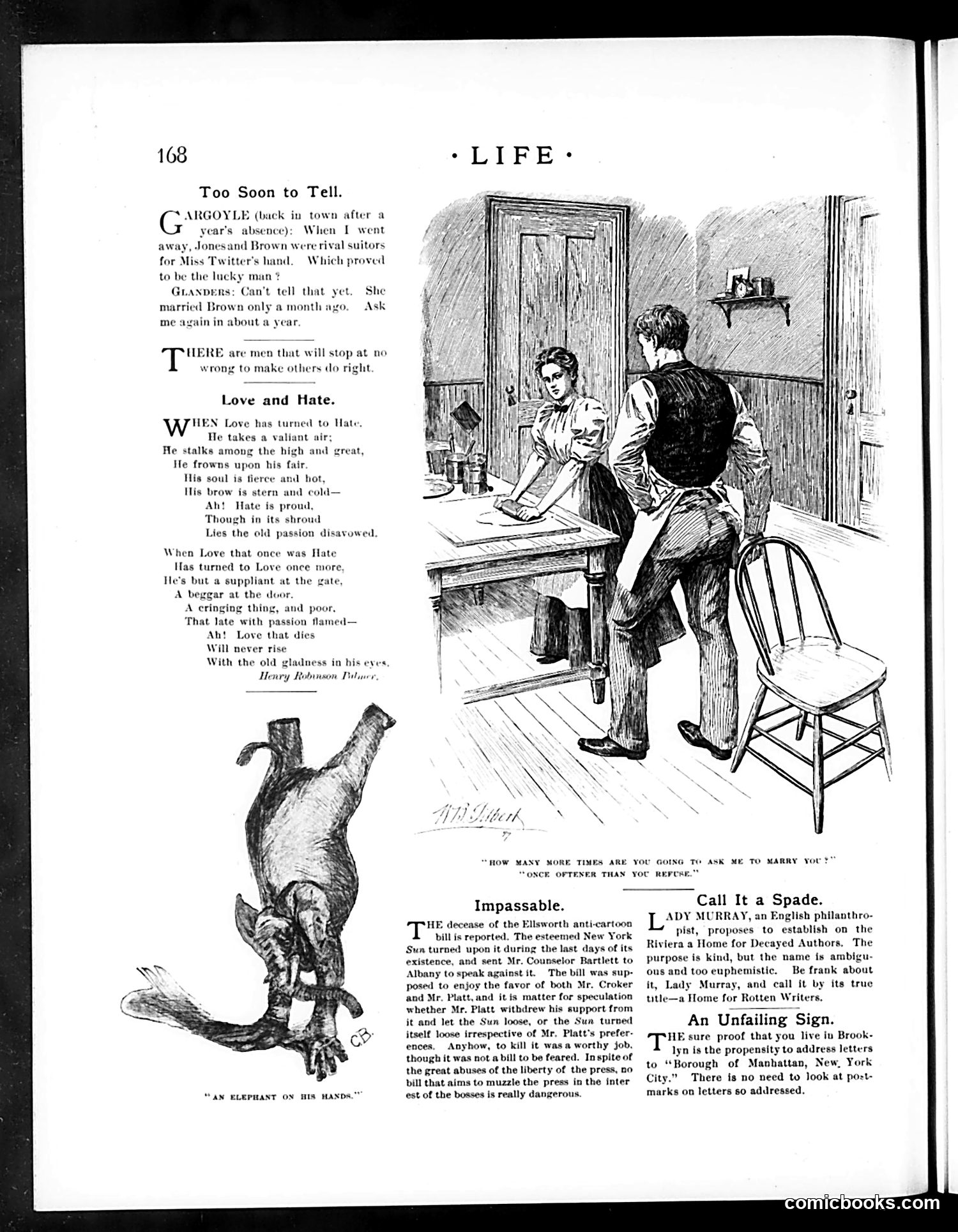
This page contains several satirical pieces unrelated to each other: **"Too Soon to Tell"** - A brief joke about gossip timing regarding Miss Twitter's engagement to Brown. **"Love and Hate"** - A poem by Henry Robinson Palmer contrasting passionate love turned to hate with passionate hate transformed to love, illustrated by a domestic scene of a couple at a table. **"An Elephant on His Hands"** - Political satire about the Elsworth anti-cartoon bill, referencing attempts to muzzle press freedom. The elephant cartoon symbolizes the burden this legislation represents. **"Call It a Spade"** and **"An Unfailing Sign"** - Brief satirical notes about establishing homes for "Decayed Authors" and Brooklyn address conventions. The page represents *Life*'s typical mix of social commentary, domestic humor, and political critique through verse and illustration.
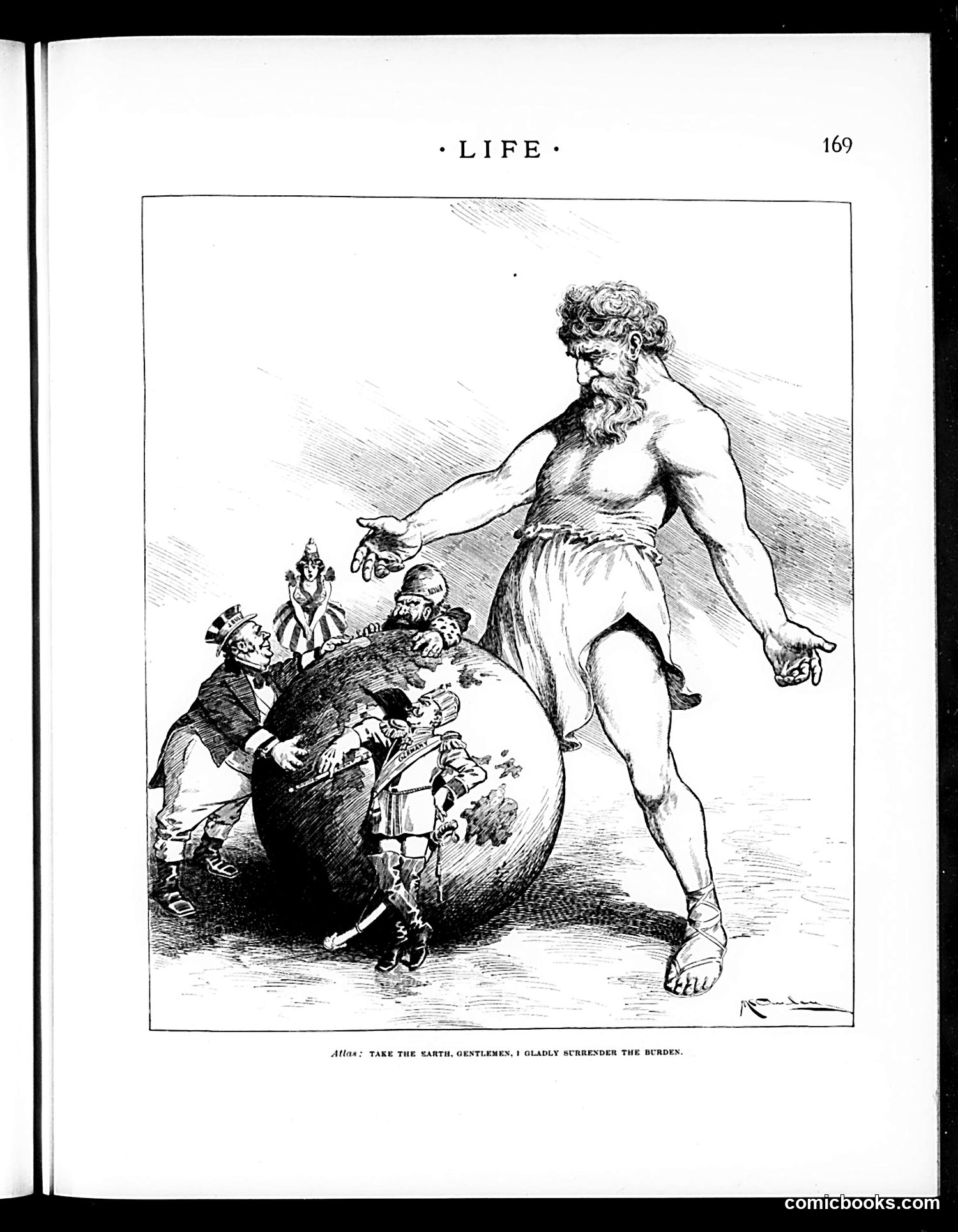
This is a satirical engraving titled "Atlas: Take the Earth, Gentlemen, I Gladly Surrender the Burden." A giant bearded figure (Atlas, the mythological Titan who carries the world) stands holding a massive globe and gestures it toward several smaller figures clustered around it. These figures appear to be political or military leaders wearing various uniforms and formal dress, suggesting they represent government officials or statesmen. The satire suggests that Atlas—representing perhaps the common man or a weary nation—is offering to hand over responsibility for world affairs to the politicians and leaders below. The implication is ironic: these leaders eagerly accept burdens they're unprepared for, or the cartoon critiques political leadership as incompetent to manage global affairs. The specific historical context remains unclear without additional information about Life magazine's publication date.
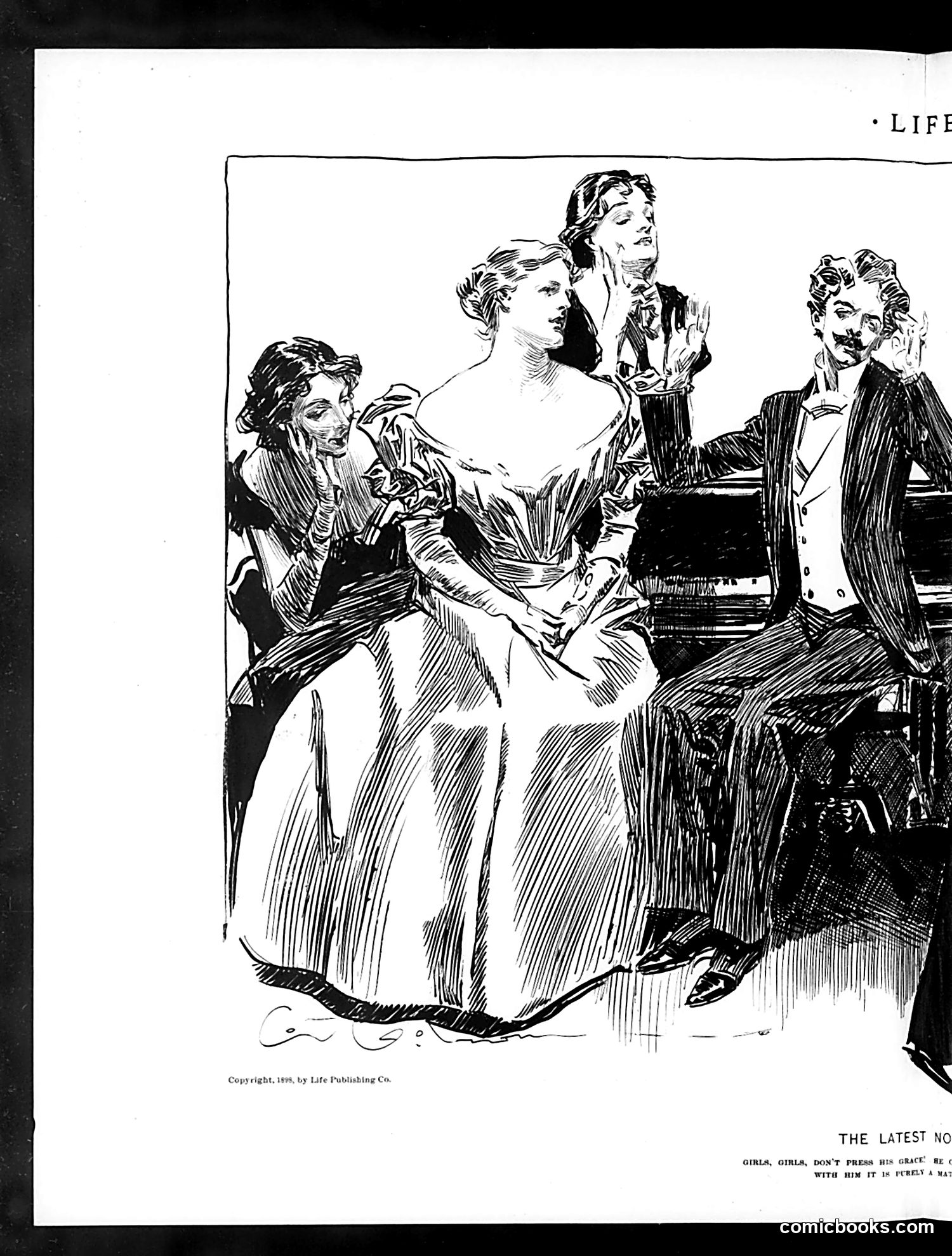
This is a satirical illustration from Life magazine (copyright 1898) depicting a social scene. The image shows a woman in an elegant evening gown seated centrally, surrounded by attentive men in formal dress. The partially visible caption at bottom reads "GIRLS, GIRLS, DON'T PRESS HIS GRACE..." and references him being "PURELY A MAN," suggesting commentary on male behavior or social dynamics. The satire likely critiques either: - The competitive attention men lavish on attractive women in high society - Aristocratic male pretense or vanity (the "Grace" reference suggests nobility) - The performative nature of courtship rituals among the wealthy The woman's composed expression contrasts with the men's obvious interest, possibly mocking either gender's role in these social interactions. Without the complete caption, the specific target of the satire remains partially unclear, though it addresses late-19th-century courtship conventions.
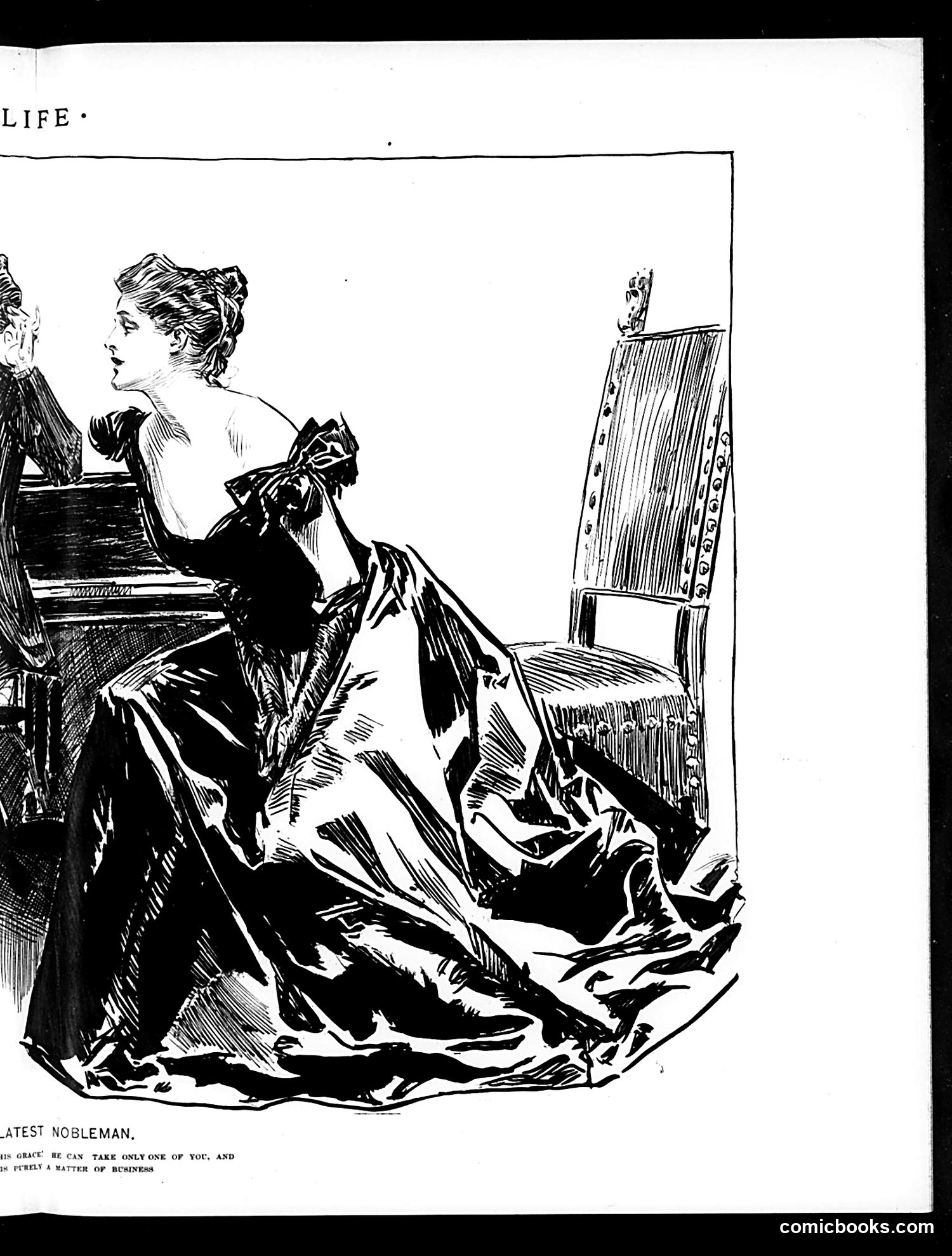
This satirical cartoon depicts a woman in elaborate evening dress with a prominent bow, seated before a mirror. The caption reads: "HIS GRACE BE CAN TAKE ONLY ONE OF YOU, AND IS PURELY A MATTER OF BUSINESS." The joke appears to target wealthy American women's social climbing and marriage aspirations toward European nobility. The "Latest Nobleman" likely refers to a wealthy foreign aristocrat, with the implication that multiple women are competing for his attention—framed cynically as "purely a matter of business" rather than romance. This reflects turn-of-the-century anxieties about American heiresses marrying impoverished European titles for social prestige. The woman's fashionable dress and vanity suggest she's one of many pursuing such a match.
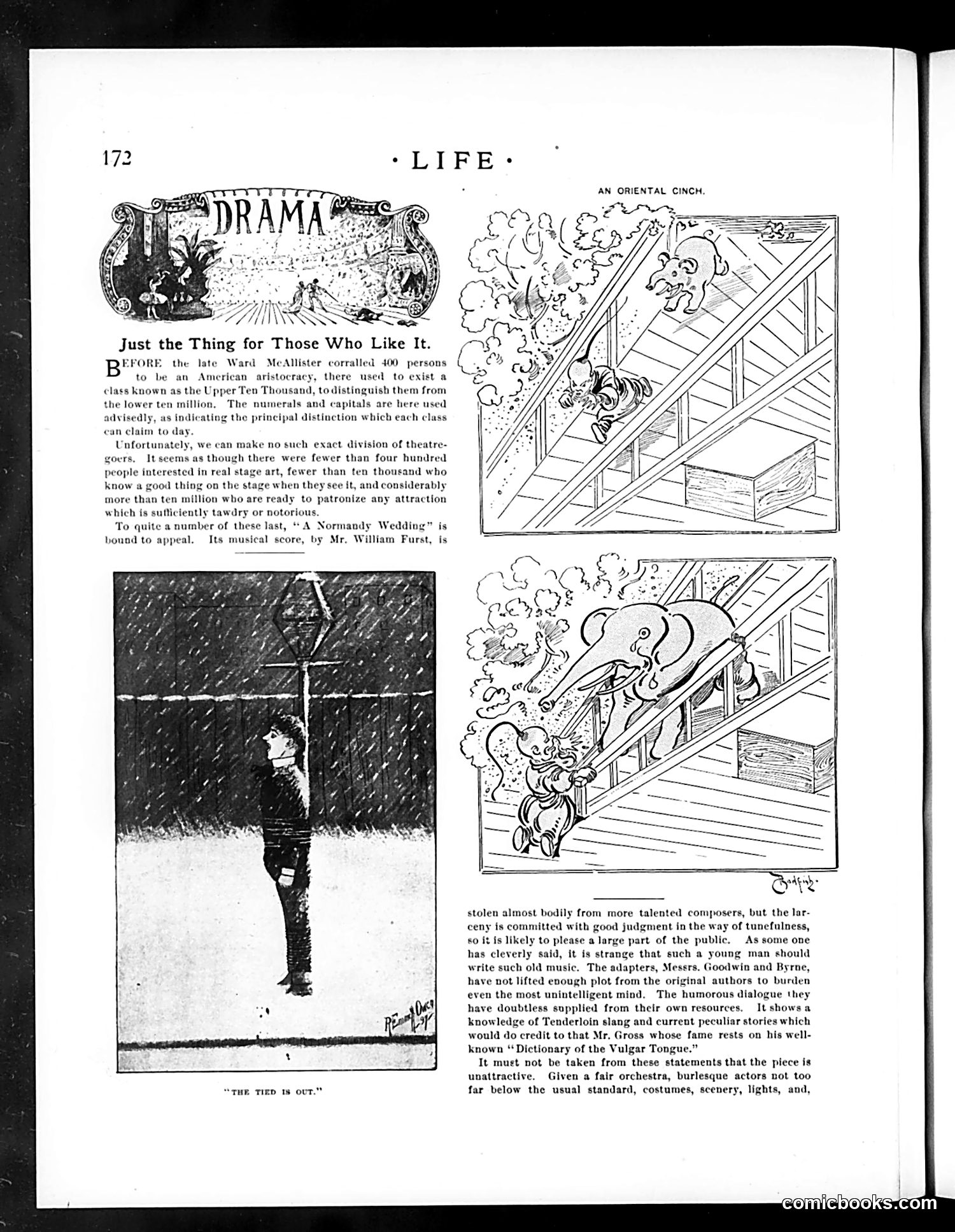
This page discusses theatrical productions, specifically praising "A Normandy Wedding" with music by William Furst. The text critiques theater audiences, noting that fewer than 400 people in America constitute the "Upper Ten Thousand" (wealthy elite) who traditionally patronize theater, yet this small class dominates the arts. The two cartoon panels titled "An Oriental Cinch" (credited to Cesare) depict a comedic scene of someone being pulled up exterior stairs by what appears to be an octopus or sea creature—likely satirizing the plot or absurdist humor of the musical being reviewed. The photograph below labeled "The Tied Is Out" shows a man in winter conditions, possibly illustrating another theatrical scene or dramatic moment referenced in the text.
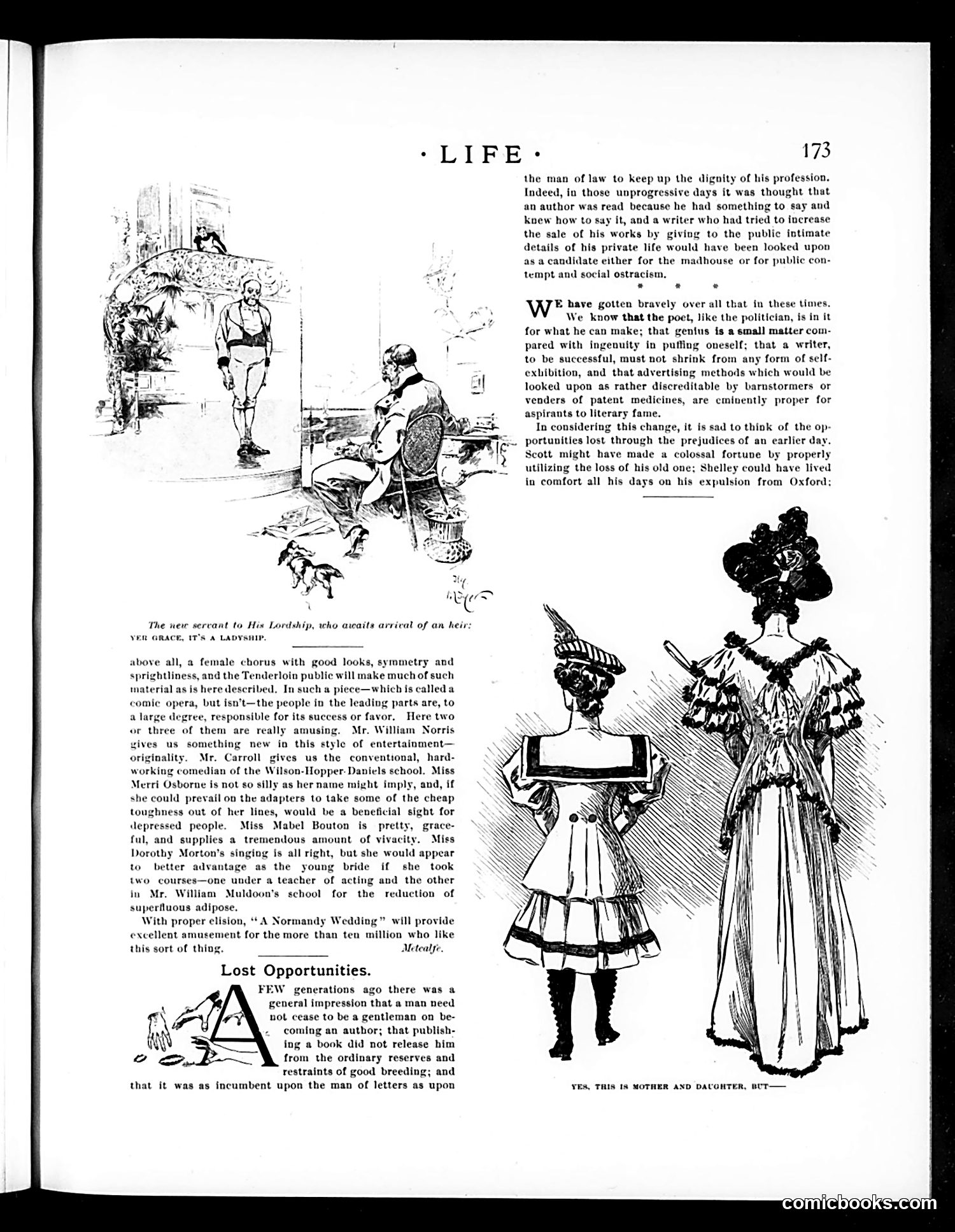
This page contains two satirical pieces about changing social standards in late 19th/early 20th-century America. **Top cartoon**: A servant announces to a nobleman that his wife has produced a "ladyship" (daughter) rather than the desired male heir. The joke mocks aristocratic obsession with male succession and inheritance. **"Lost Opportunities" essay**: This criticizes how 19th-century authors maintained professional dignity by *not* exploiting their private lives for publicity. The author sardonically regrets that earlier literary figures like Sir Walter Scott and Shelley didn't capitalize on their misfortunes through modern marketing tactics. The piece laments that contemporary writers now eagerly pursue self-promotion and sensational personal disclosure—practices once considered undignified. This reflects tension between artistic integrity and commercial ambition during an era of expanding publishing and celebrity culture. The bottom illustration showing fashionable women likely relates to theatrical content reviewed elsewhere on the page.
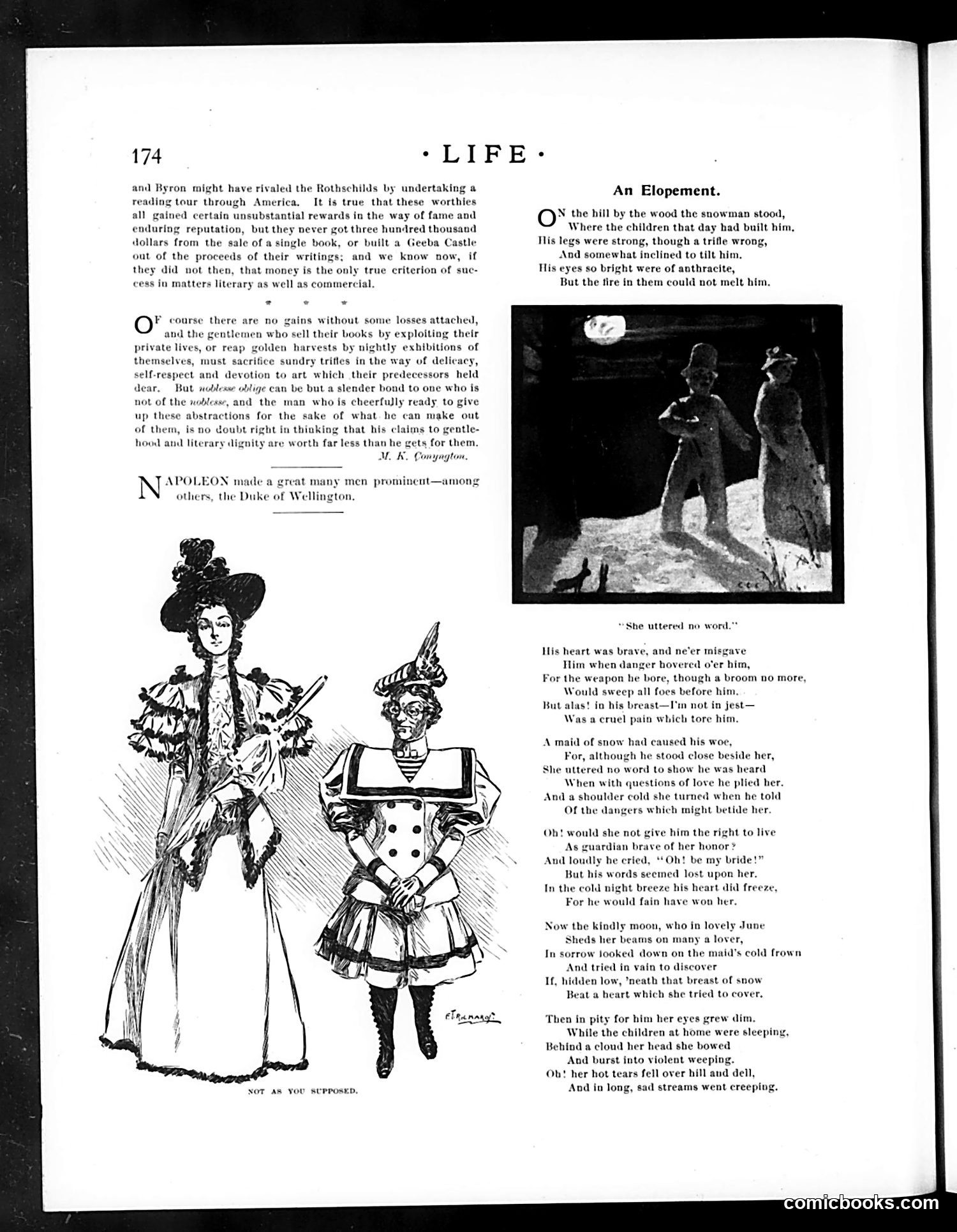
This page contains two distinct pieces. The upper section is prose commentary by M.K. Congapton critiquing modern authors who exploit their private lives for commercial gain—contrasting them unfavorably with historical literary figures like Byron who maintained dignity despite financial struggles. The satire targets 19th-century celebrity culture and the commodification of writers' personas. The lower section, "An Elopement," is a sentimental poem illustrated with a cartoon labeled "NOT AS YOU SUPPOSED." The cartoon depicts a fashionably-dressed woman and a small figure (likely a child or imp), playing on reader expectations. The poem itself is a whimsical tragedy about a snowman who falls unrequited love with a "maid of snow"—a personified snowball or snow figure. The joke appears to be subverting romantic elopement stories through absurdist humor and unexpected pathos about inanimate objects.
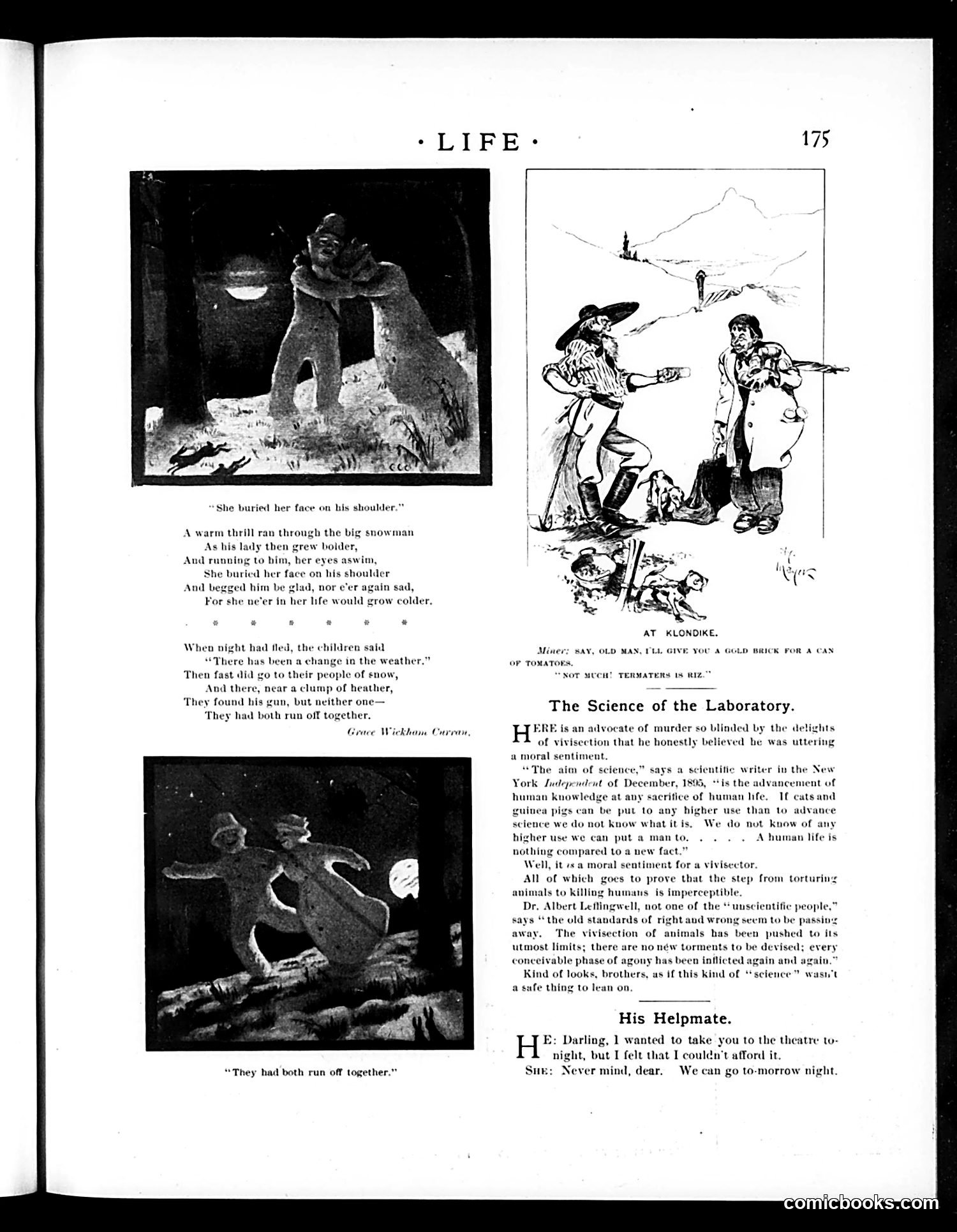
This page contains three distinct pieces of satire: **The Snowman Poem**: A humorous narrative where a snowman and snowwoman "fall in love" and run away together. The joke is the absurdist premise of snow figures developing romance and eloping—gentle, whimsical humor with no political content. **The Klondike Cartoon**: References the Klondike Gold Rush (1890s Alaska). A miner offers a prospector "a gold brick" (slang for a swindle or worthless item) in exchange for canned tomatoes. The satire mocks the desperation and poor judgment of gold-rush miners who overpay for basic provisions, and the con artists who exploit them. **"The Science of the Laboratory"**: A serious critique of vivisection (animal experimentation). Life quotes anti-vivisection advocates arguing that justifying animal torture as scientific progress is a dangerous moral slope toward devaluing human life. This reflects genuine 1890s-era reform debates about laboratory animal ethics. **"His Helpmate"**: A brief domestic joke about a wife accepting postponed theater plans—light, period-appropriate gender satire with no deeper political meaning.
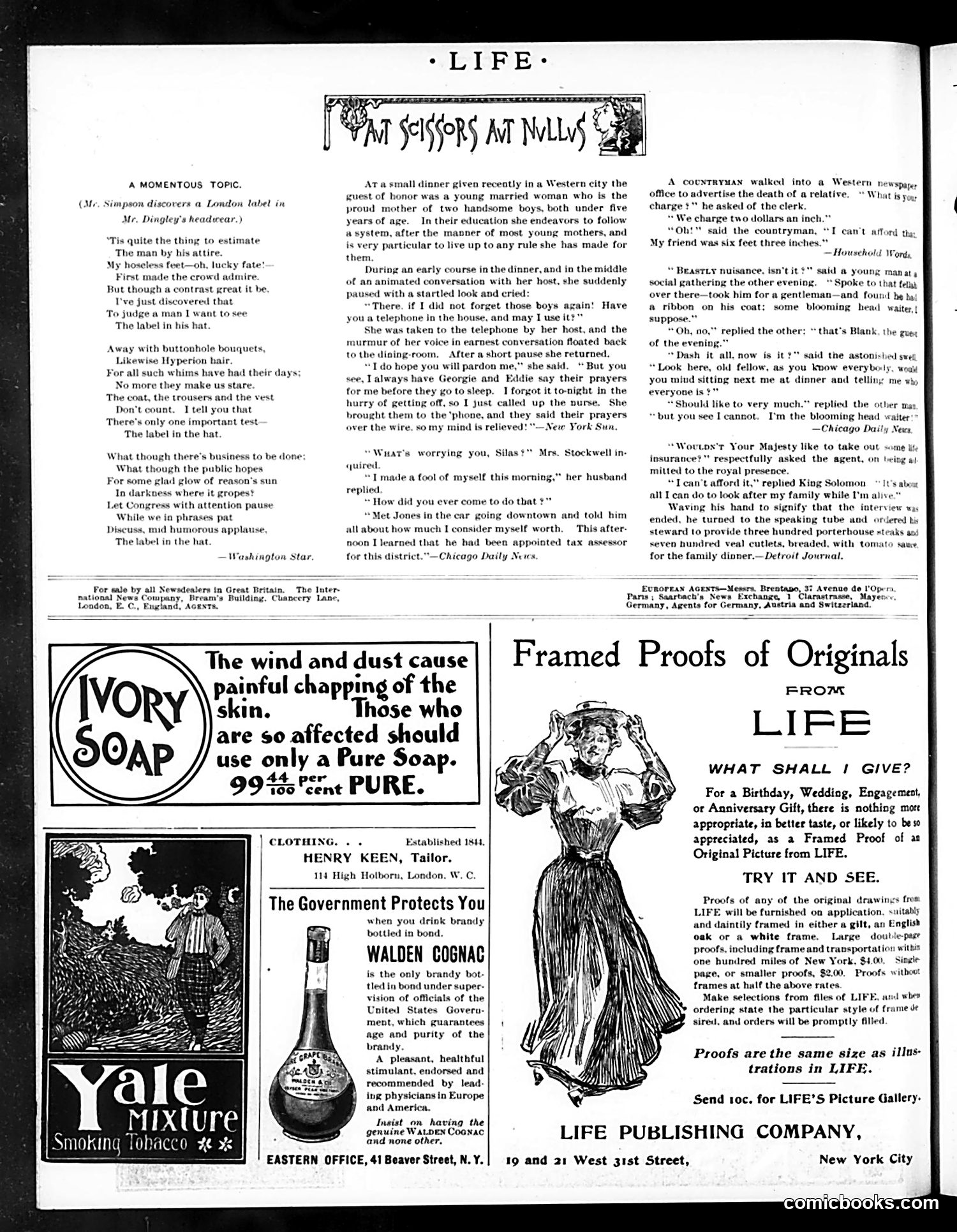
This page combines satirical humor pieces with period advertising. The main cartoons mock contemporary concerns: **"The Label in the Hat"** ridicules the obsession with clothing labels as status markers—suggesting that what matters is the hat's interior label, not the wearer's character or accomplishments. It's social satire on materialism and appearance-consciousness. The anecdotes below satirize modern anxieties: a mother interrupts dinner to telephone her children's prayers to a nurse (mocking excessive parenting rules), and a man embarrasses himself bragging about his wealth to someone who becomes a tax assessor (satirizing social pretension). The page is dominated by period advertisements for Ivory Soap, Henry Keen tailoring, Yale tobacco, and Walden Cognac—typical early 20th-century product placements promising purity, government protection, and respectability to middle-class consumers.
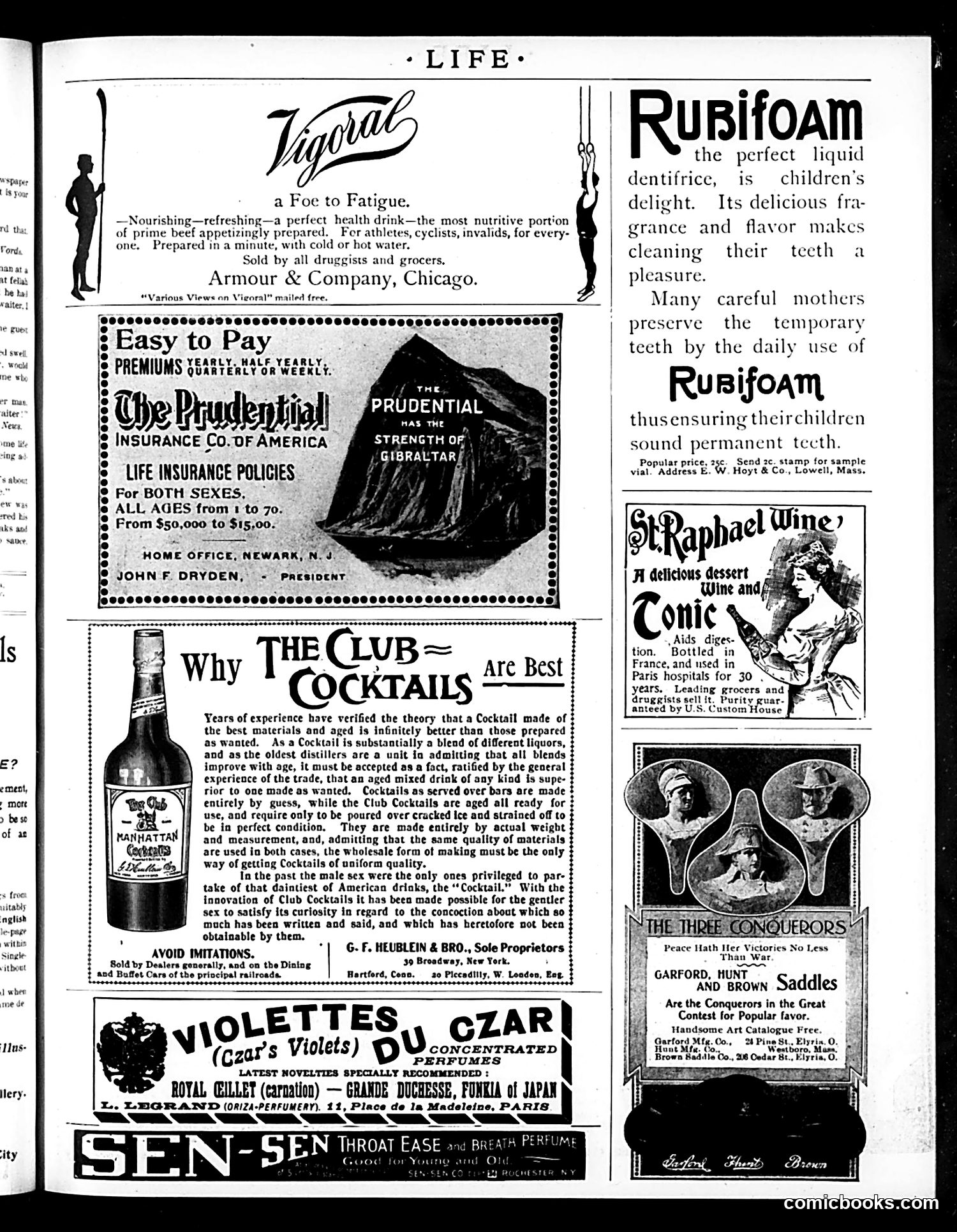
This is primarily a **vintage advertisements page** with no political cartoons or satirical content requiring historical explanation. The page showcases early 1900s consumer products: Vigoral (beef extract tonic), The Prudential Insurance Company, Rubifoam toothpaste, Club Cocktails liquor, St. Raphael Wine, perfumes, and saddles. The only notable social detail is the **Club Cocktails advertisement**, which explicitly notes that cocktails were historically "the only ones privileged" to male consumption, but the "innovation of Club Cocktails" now allows women to access this drink. This reflects genuine early-20th-century gender restrictions on women's public drinking, presented here as progressive marketing. The ads emphasize health claims (Vigoral for "fatigue," Rubifoam for children's teeth) typical of the era, when patent medicines and unregulated products made sweeping medical promises. **No satire or political commentary is present**—this is straightforward period advertising.
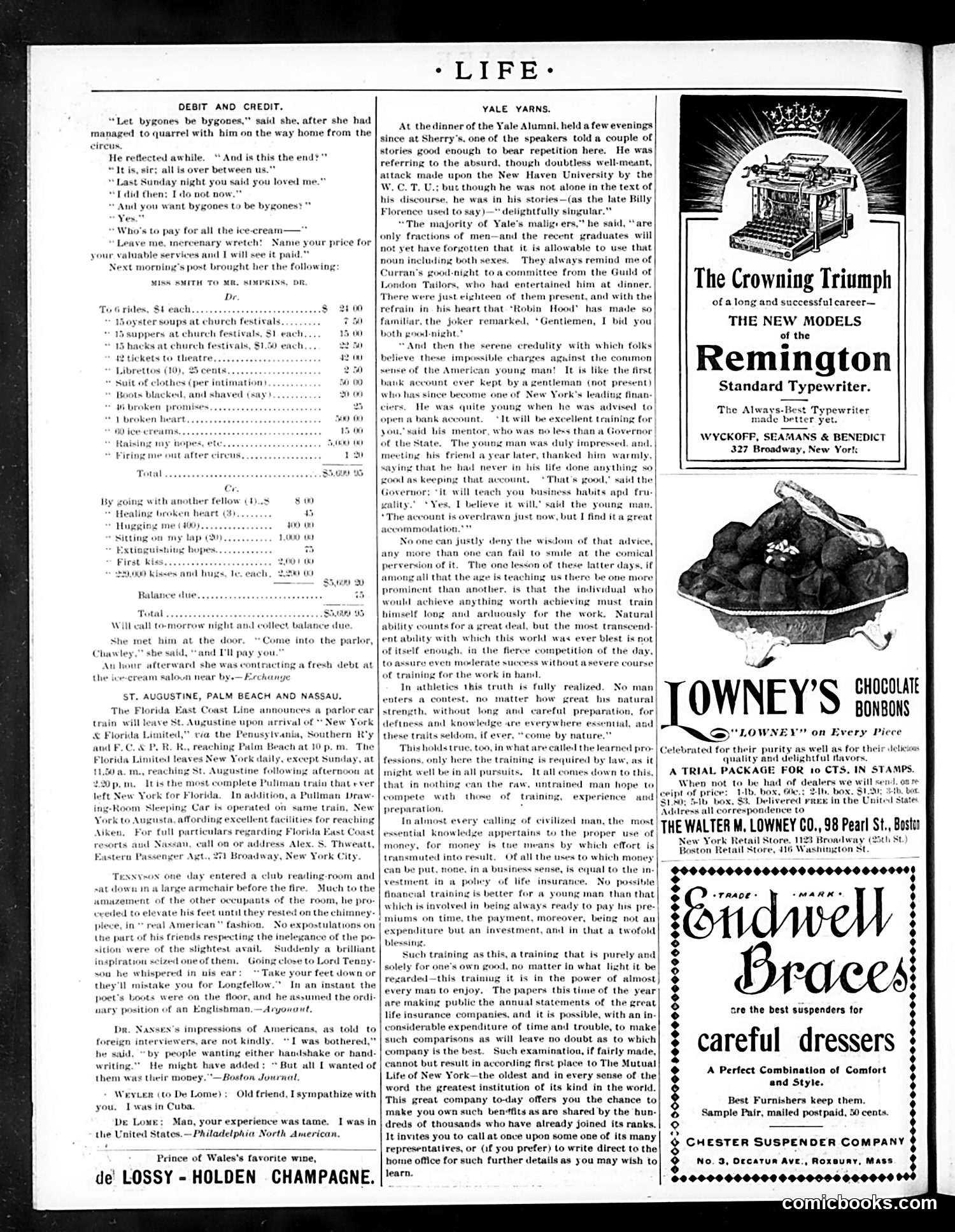
This page is primarily **advertising and humor columns**, not political cartooning. The main content includes: **"Debit and Credit"** — A humorous dialogue about a couple's quarrel where the woman demands payment for "services rendered" (kisses, emotional support, etc.), itemized like a business ledger. The joke is the transactional framing of romance. **"Yale Yarns"** — Anecdotes from a Yale Alumni dinner featuring speeches. One story references the W.C.T.U. (Women's Christian Temperance Union, a real reform organization) and mentions a joke by "Curran" about London tailors. The humor involves satirizing Yale alumni and their pretensions. **Advertisements** dominate the right side: Remington typewriters, Lowney's chocolate, and other products typical of early 1900s publications. The page reflects period attitudes about gender relations (treating romance commercially) and collegiate humor, but contains **no significant political satire** — it's entertainment and advertising rather than social commentary.
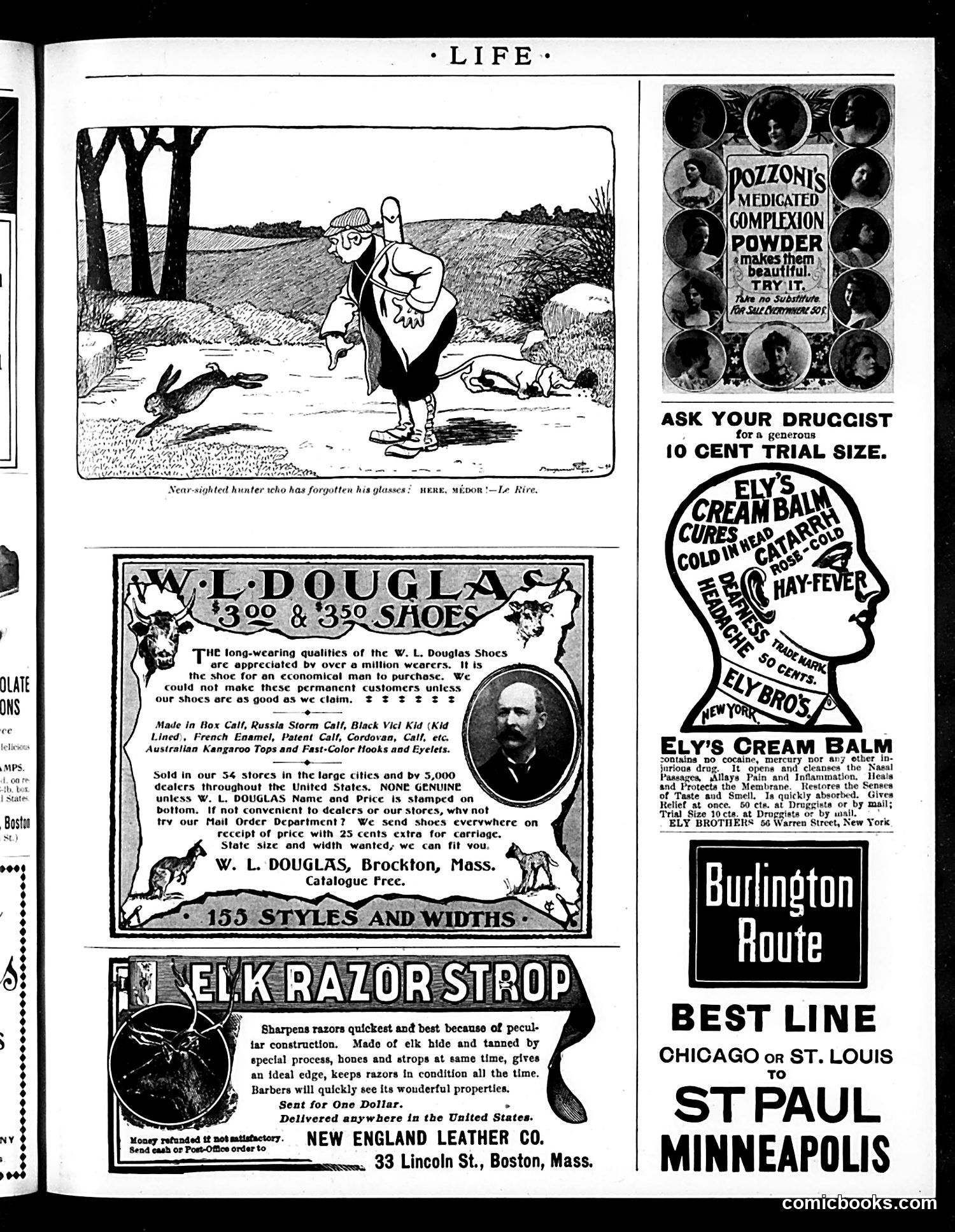
This page is primarily **advertising**, with one small cartoon at the top. The cartoon depicts a "nearsighted hunter who has forgotten his glasses"—a simple visual gag where the hunter appears to have mistaken rabbits (or similar small game) for larger prey, suggesting comical confusion due to poor vision. The humor relies on the absurdity of hunting without proper eyesight. The page otherwise features period advertisements for W.L. Douglas shoes, Elk razor strops, Pozzoni's complexion powder, Ely's cream balm (a nasal remedy), and the Burlington Route railroad. These ads reflect early 20th-century consumer products and services typical of American Life magazine. The cartoon's credit "Le Rire" indicates it was reprinted from a French satirical publication, suggesting Life regularly borrowed international humor for its American audience.
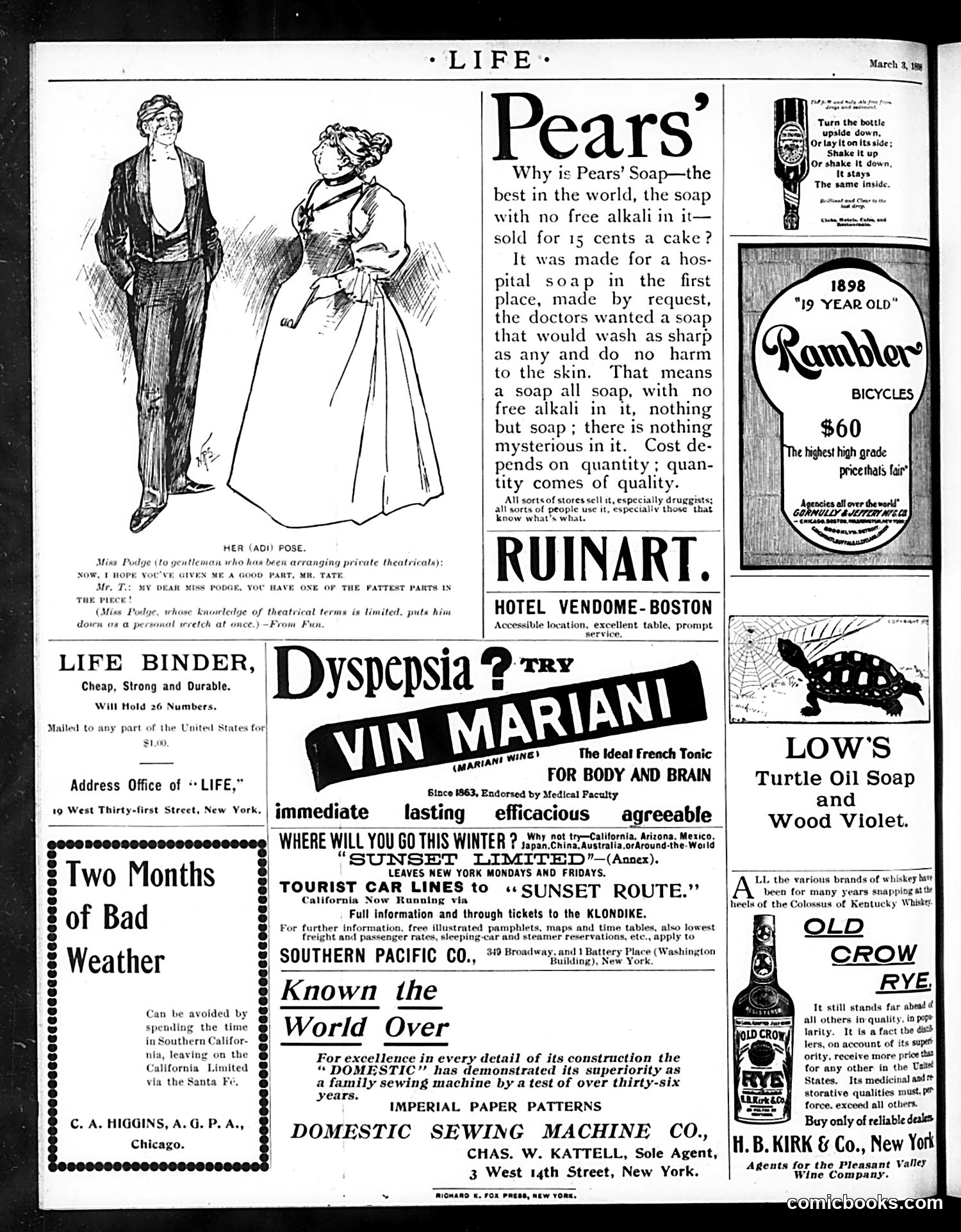
This is primarily a **full-page advertisement compilation**, not a political cartoon. The upper left contains a small sketch labeled "Her (Ad) Pose," showing two figures—likely representing theatrical or social figures—with the caption crediting "Miss Fudge" as someone arranging private theatricals. The accompanying text suggests satire about theatrical pretension or social climbing, though the specific reference is unclear without fuller context. The remainder of the page showcases vintage product advertisements (Pears' Soap, Rambler Bicycles, Vin Mariani wine tonic, sewing machines, whiskey, etc.), typical of Life magazine's advertising structure circa 1908. These ads reflect period attitudes toward medical remedies, luxury goods, and transportation that modern readers would find notably dated and sometimes dubious (the wine's medicinal claims, for example). The page serves mainly as a historical document of early 1900s consumerism rather than satirical commentary.