
Life, 1898-03-03 · page 7 of 20
Life — March 3, 1898 — page 7: what you’re looking at
What you’re looking at
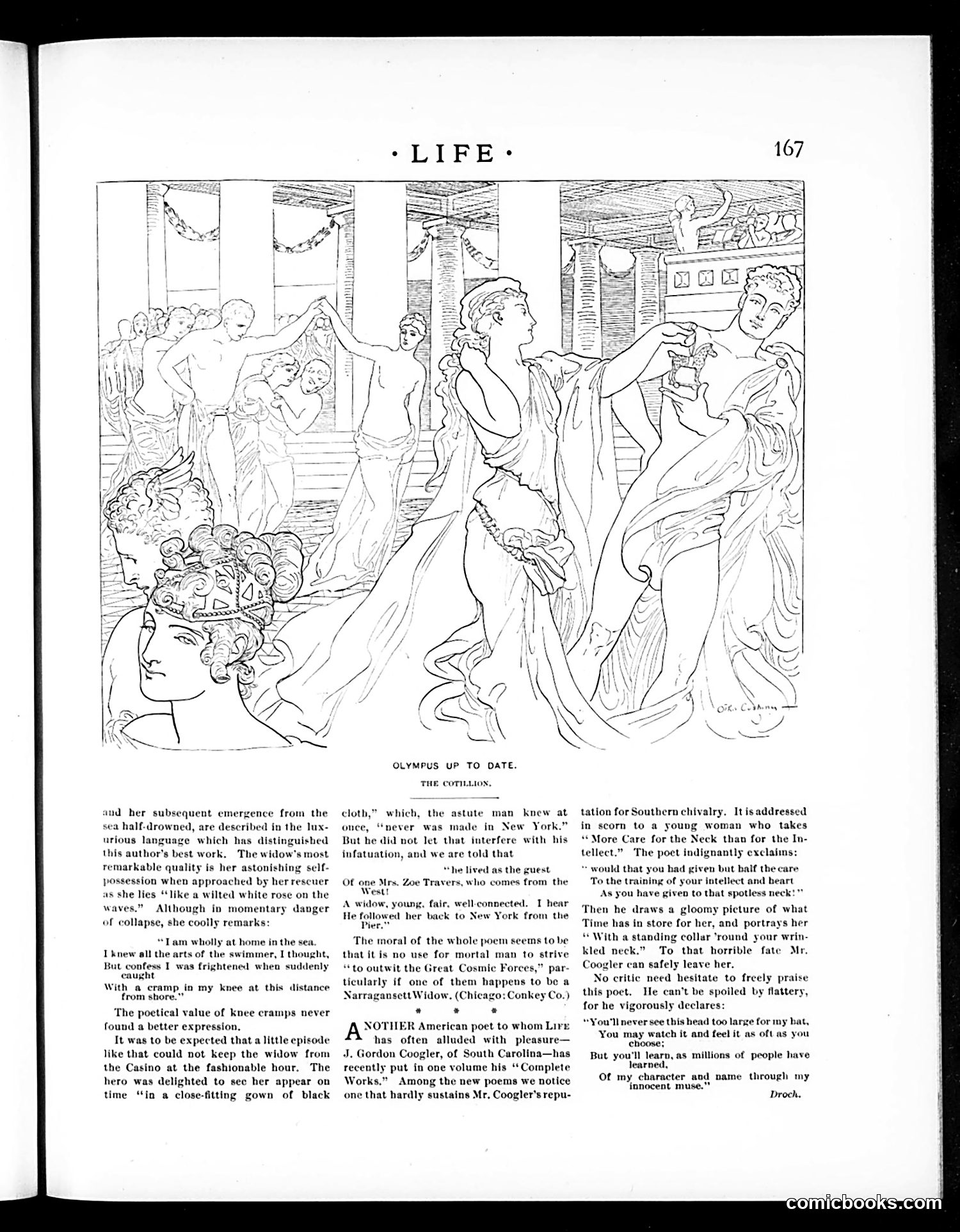
This satirical illustration depicts classical Greek gods and goddesses attending a modern American formal dance (cotillion). The artwork juxtaposes ancient mythology with contemporary Gilded Age high society, suggesting that America's wealthy elite see themselves as divine or superior beings. The image shows elaborately dressed figures in classical drapery mingling at what appears to be a fashionable ballroom, complete with decorative garlands. By placing mythological figures in a modern social setting, the cartoonist mocks the pretensions of aristocratic society—implying that these supposedly refined people are little different from the vain, gossiping gods of antiquity. The satire criticizes upper-class vanity and self-importance through classical allusion.
📄 Transcribed text from this page (OCR, searchable)
Machine-transcribed from the original scan — historical spelling and the odd misread are preserved.
wud her subsequent emergence from the sea half-drowned, are described in the Iux- urious language which has distinguished Uhis author's best work. The widow's most remarkable quality is her astonishing self- possession when approached by her rescuer as she lies “like a wilted white rose on the waves.” Although in momentary danger of collapse, she coolly remarks: “Tam wholly at home in the sea. I knew all the arts of the swimmer, I thought, But confess I was frightened when suddenly caught With a cramp in my knee at this distance from shore."* The poetical value of knee cramps never found a better expression, It was to be expected that a little episode like that could not keep the widow from the Casino at the fashionable hour, The hero was delighted to sec her appear on time “in a close-fitting gown of black OLYMPUS UP TO DATE. TH coTHAt0N. cloth,” once, which, the astute man knew at “never was made in New York.” But he did pot let that interfere with his infatuation, and we are told that “he lived as the guest OF one Mes. Zoe Travers, who comes from the A widow, young, fair, well-connected. I hear A her back to New York from the The moral of the whole poem seems to be that itis no use for mortal man to strive ‘to outwit the Great Cosmic Forces,” par- ticularly if one of them happens to be a Narragansett Widow, (Chicago: Conkey Co.) * * . NOTHER American poet to whom Lire has often alluded with pleasure— J. Gordon Coogler, of South Carolina—has recently put in one volume his ‘Complete Works.” Among the new poems we notice one that hardly sustains Mr. Coogler’s repu- tation for Southern chivalry, It is addressed in scorn to a young woman who takes “More Care for the Neck than for the In- tellect.”. The poet indignantly exclaims: * would that you had given but baif the care To the training of your intellect and heart As you have given to that spotless neck!" Then he draws a gloomy picture of what Time has in store for her, and portrays her “With a standing collar ‘round your wrin- kled neck.” To that horrible fate Mr. Coogler can safely leave her. No critic need hesitate to freely praise this poet. He can't be spoiled by flattery, for he vigorously declares: “You'll never see this head too large for my hat, You may watch it and feel it as oft as you choose; But you'll learn, as millions of people have learned, Of my character and name through my innocent muse." Droch.