
Life, 1898-03-03 · page 3 of 20
Life — March 3, 1898 — page 3: what you’re looking at
What you’re looking at
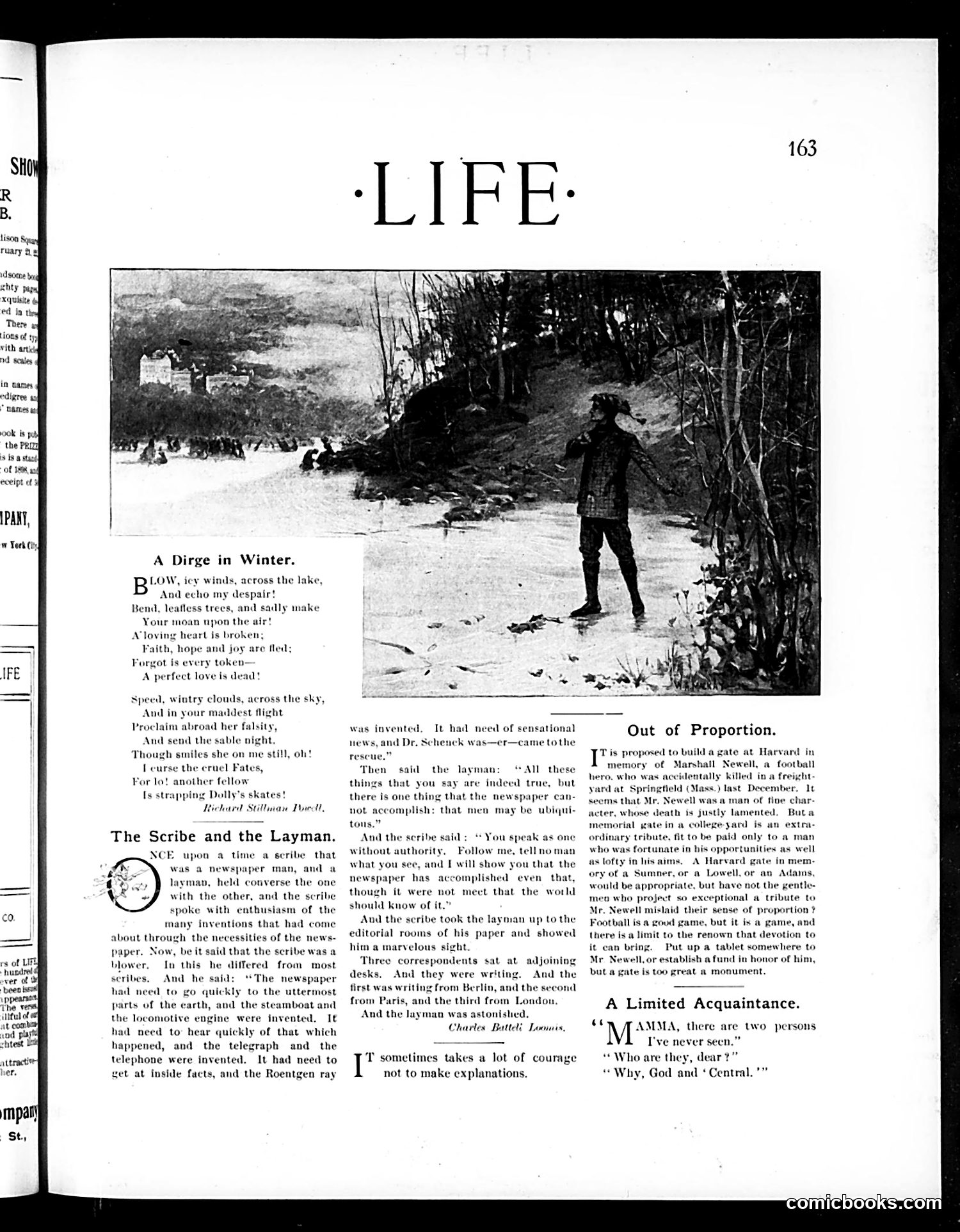
This page contains three distinct literary pieces rather than political cartoons: 1. **"A Dirge in Winter"** — A melancholic poem illustrated with a photograph of a solitary figure by a frozen lake, reflecting on lost love and broken faith. 2. **"The Scribe and the Layman"** — A dialogue piece satirizing the relationship between newspaper men and laypeople. It appears to mock how newspapers claim accomplishments they haven't actually achieved, with the layman challenging the scribe's boasts about newspaper innovations (the locomotive engine, telegraph, telephone, Roentgen ray). 3. **"A Limited Acquaintance"** and **"Out of Proportion"** — Brief anecdotal pieces about social situations. The page is primarily literary/satirical commentary rather than visual political satire, focusing on early 20th-century social observations about media credibility and human relationships.
📄 Transcribed text from this page (OCR, searchable)
Machine-transcribed from the original scan — historical spelling and the odd misread are preserved.
A Dirge in Winter. LOW, iey winds, across the lake, And echo my despair! Bend, leafless trees, and sadly make our moan upon the air! N loving heart is broken Faith, hope and joy a Forgot is every token— A perfect love is dead! e feds Vr broad he And send the sable night, Though smiles she on me still, oh! Teurse the eruel F For lo! another fellow Is strapping Dolly's skates! Richard Stitnan Duet, The Scribe and the Layman. NCE upon a tin seribe that a bewspaper man, and a yman, held converse the one with the other, and the scribe spoke with enthusiasm of the many inventions that had come about through the necessities of the news: paper, Now, be it said that the scribe w lower. In this he differed from seriti And he said: “The newspaper had need to go quickly to the uttermost parts of the earth, and the steamboat and the locomotive engine were invented. It had need to hear quickly of that which happened, and the telegraph and the telephone were invented. It had need to get at inside facts, and the Roentgen ray most It had need of sensatic nd Dr. Schenck was—er—came tothe was invented, news, rescue. en said the layman: things that you say are indeed there is one thing that the news; not accomplish: that men may be ubi tons.” And the seribe said; * You speak as one without authority, what you see, and [ will show you that the news| has pinplished even that, though it were not mect that the world should know of it.” And the scribe took the layman up tothe editorial rooms of his paper and showed him a marvelous sight. Three correspondents sat at adjoining were writing. And the rom Berlin, and the second from Paris, and the third from London, And the layman was astonished, Charles Batteli: Loos, these Follow me, tell no man aper T sometimes takes a lot of courage not to make explanations. Out of Proportion. Tis proposed to build a gate at Harvard in memory of Marshall Newell, a football hero. who was accidentally killed in a freight yard at Springfield (Mass.) last December, It seems that Mr. Newell was a man of tine char- acter, whose ¢ hb is justly lame “1. Buta memorial gate in a collegeyard is an extra- ordinary tribute, fit to be paid only to a man who was fortunate in bis opportunit as lofty in his aims. A Harvard gate in mem- ory of a Sumner, or a Lowell, or an Adai would be appropriate, but have not the genth men who proje xceptional a tribute Mr. id their sense of proportion ? Football is a good game, but it is a game, and there isa limit to the renown that devotion to it bring. Put up a tablet somewhere to Mr Newell, or establish a fund in honor of him, but a gate is too great a monume: < as well A Limited Acquaintance. “pee. there are two persons I've never seen.” “Who are they, dear “Why, God and ‘Central. '”