
Life, 1898-03-03 · page 14 of 20
Life — March 3, 1898 — page 14: what you’re looking at
What you’re looking at
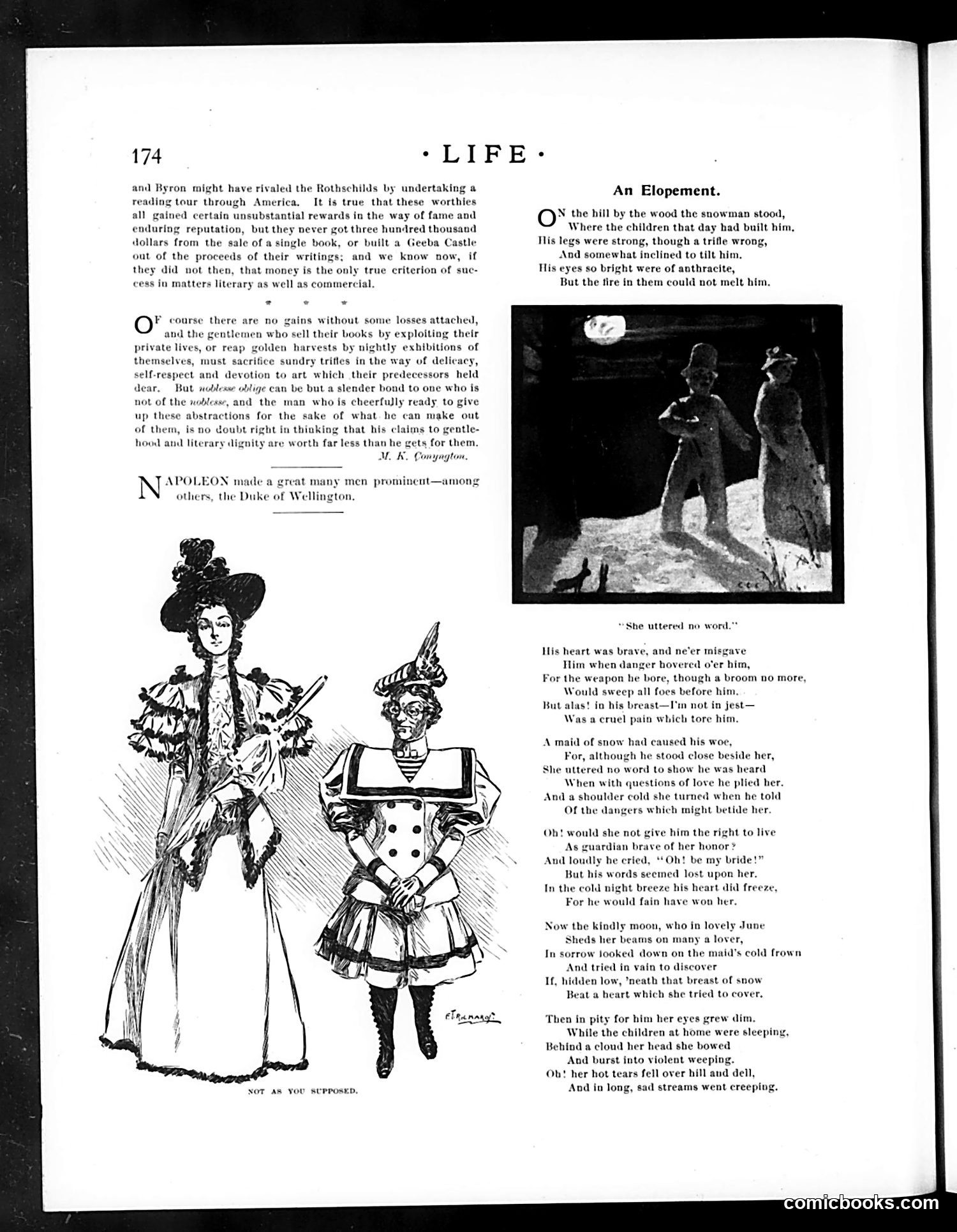
This page contains two distinct pieces. The upper section is prose commentary by M.K. Congapton critiquing modern authors who exploit their private lives for commercial gain—contrasting them unfavorably with historical literary figures like Byron who maintained dignity despite financial struggles. The satire targets 19th-century celebrity culture and the commodification of writers' personas. The lower section, "An Elopement," is a sentimental poem illustrated with a cartoon labeled "NOT AS YOU SUPPOSED." The cartoon depicts a fashionably-dressed woman and a small figure (likely a child or imp), playing on reader expectations. The poem itself is a whimsical tragedy about a snowman who falls unrequited love with a "maid of snow"—a personified snowball or snow figure. The joke appears to be subverting romantic elopement stories through absurdist humor and unexpected pathos about inanimate objects.
📄 Transcribed text from this page (OCR, searchable)
Machine-transcribed from the original scan — historical spelling and the odd misread are preserved.
174 *LIFE- and Byron might have rivaled the Rothschilds by undertaking a reading tour through America, It is true that these worthies all gained certain unsubstantial rewards in the way of fame and enduring reputation, but they never got three hundred thousand dollars from the sale of a single book, or built a Geeba Castle out of the proceeds of their writings; and we know now, if they did not then, that money is the only true criterion of suc- in matters literary as well as commercial. OF course there are no s without some losses attached, and the gentlemen who sell their books by exploiting their private lives, or reap golden harvests by nightly exhibitions of themselves, must sacrifice sundry trifles in the way of delicacy, self-respect and devotion to art which their predecessors held dear, But wubleas oblige can be but a slender bond to one who fs not of the nobles, and the man who is cheerfwly ready to give up these abstractions for the sake of what he can make out of them, is no doubt right in thinking that his claims to gentle- hood and literary dignity are worth far less than he gets for them. MK. Conyagton } many men promincut—among NOT AS YOU SUPPOSED. An Elopement. N the hill by the wood the snowman stood, Where the children that day had built him, His legs were strong, though a trifle wrong, And somewhat inclined to tilt him. Tlis eyes so bright were of anthracite, But the fire in them could not melt him, “She uttered no word.” Ilis heart was brave, and ne’er misgave Tlim when danger hovered o'er him, For the weapon he bore, though a broom no more, Would sweep all foes before him, But alas! in his breast—I'm not in jest— Was a cruel pain which tore him. A maid of snow had caused woe, For, although he stood close beside her, She uttered no word to show he was heard When with questions of love he plied her. And a shoulder cold she turned when he told Of the dangers which might betide her. Ob! would she not give him the right to live As guardian brave of her honor ? And loudly he eried, “Oh! be my bride!” But his words seemed lost upon he In the cold night breeze his heart did freeze, For he would fain have won her. Now the kindly moon, who in lovely June Sheds her beams on many a lover, In sorrow looked down on the maid’s cold frown And tried in vain to discover If, hidden low, *neath that breast of snow Beat a heart which she tried to cover, Then in pity for him her eyes grew dim, While the children at home were sleeping, Behind a cloud her head she bowed And burst into violent weeping. Ob! her hot tears fell over hill aud dell, And in long, sad streams went creeping.