
Life, 1898-03-03 · page 4 of 20
Life — March 3, 1898 — page 4: what you’re looking at
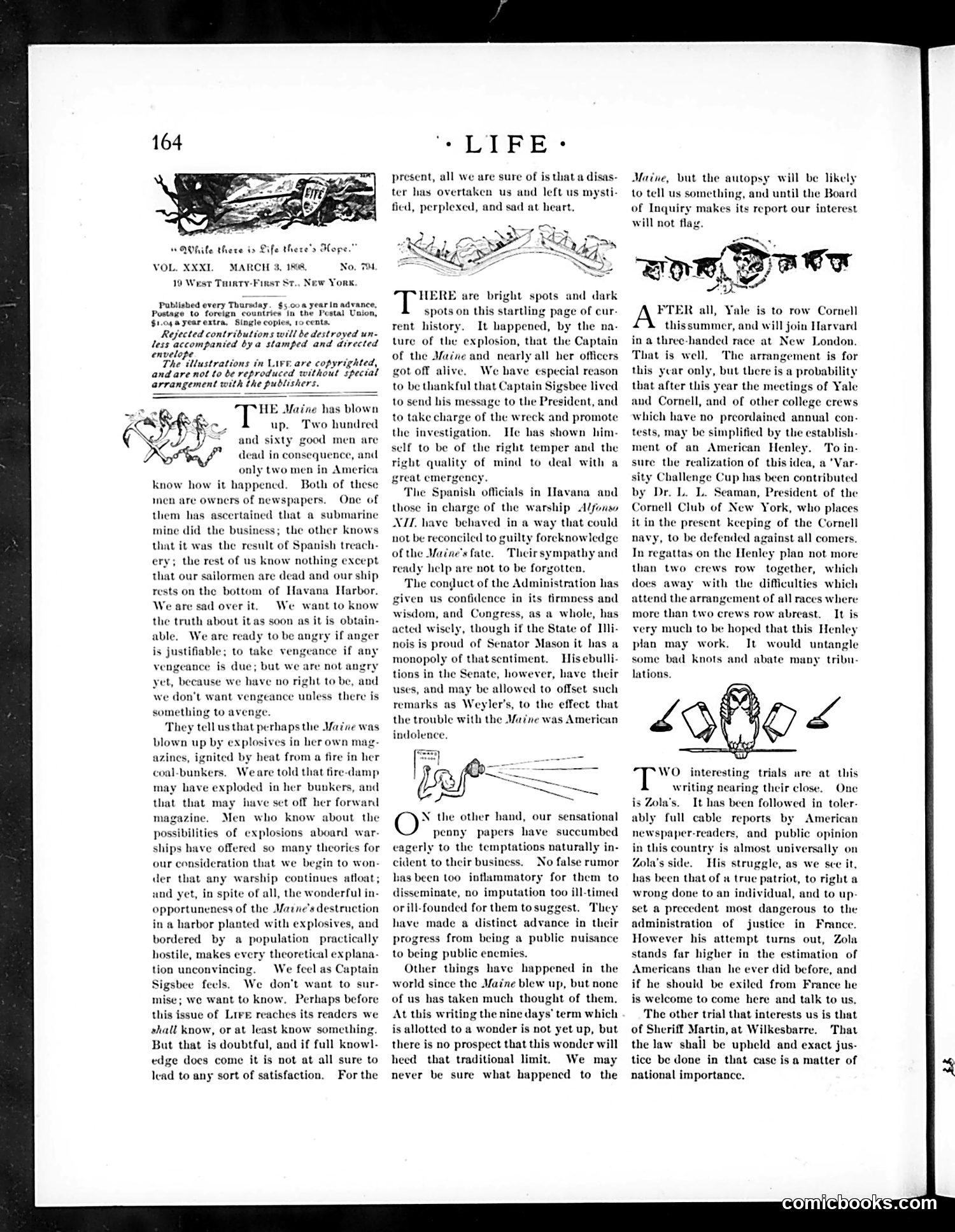
What you’re looking at
This page discusses the USS *Maine* explosion in Havana Harbor. The text references Captain Sigsbee's survival and the investigation into the disaster. Key points include: **The Main Issue:** Whether the explosion was accidental (caused by the ship's own magazine) or sabotage by Spanish forces. The text notes uncertainty persists about the actual cause. **Political Context:** Spanish officials in Havana and those managing the warship *Alfonso XII* are mentioned sympathetically, while American papers are criticized for sensationalism and inflammatory reporting that advanced from "public nuisance to being public enemies." **The Satire:** The piece mocks American newspapers for eagerly spreading unverified rumors and inflaming tensions rather than waiting for facts from the official investigation. The small cartoons appear decorative rather than directly satirical.
📄 Transcribed text from this page (OCR, searchable)
Machine-transcribed from the original scan — historical spelling and the odd misread are preserved.
“OWhile there is XI. MARCHE 19 West Tmnty: Published every Thuraday. $5.00 yearin advance, Postage to foreign countries in the Pestal Union, $1.04 a year extra. Single copies, ro cents. Rejected contributions will be destroyed un- tess accompanied bya stamped and directed envelope The illustrations in LAE are copyrighted, and are not to be reproduced without special arrangement with the publishers. HE Maine has blown up. Two hundred and sixty good men are dead in consequence, and only two men in America know how it happened. Both of these men are owners of newspapers. One of them has ascertained that a submarine mine did the business; the other knows that it was the result of Spanish treach- ery; the rest of us know nothing except that our sailormen are dead and our ship rests on the bottom of Havana Harbor. We are sad over it. We want to know the truth about itas soon as it is obtain- able. We are ready to be angry if anger is justifiable; to take vengeance if any vengeance is due; but we are not angry yet, because we have no it to be, and we don't want vengeance unless there is something to avenge. They tell us that perhaps the Maine was blown up by explosives in her own mag- azines, ignited by heat from a fire in her coal-bunkers. Weare told that fire-damp may have exploded in her bunkers, and that that may have set off her forward magazine. Men who know about the possibilities of explosions aboard war- ships have offered so many theories for our consideration that we begin to won- der that any warship continues atloat; und yet, in spite of all, the wonderful in- opportuneness of the Mazne’s destruction in a harbor planted with explosives, and bordered by a population practically hostile, makes every theoretical explana- tion unconvincing. We feel as Captain Sigsbee fee We don’t want to sur- mise; we want to know. Perhaps before this issue of Lrre reaches its readers we shall know, or at least know something. But that is doubtful, and if full knowl- edge docs come it is not at all sure to lead to any sort of satisfaction. For the ‘'* LIFE: present, all we are sure of is that a disas- ter has overtaken us and left us mysti- fied, perplexed, and sad at heart, HERE are bright spots and dark spots on this startling page of cur- rent history. It happened, by the na- ture of the explosion, that the Captain of the Maine and nearly all her officers got off alive. We have especial reason to be thankful that Captain Sigsbee lived to send his message to the President, and to take charge of the wreck and promote the investigation. He has shown him- self to be of the right temper and the right quality of mind to deal with a great cmergency. The Spanish officials in Havana and those in charge of the warship Alfonso NIL. have behaved in a way that could not be reconciled to guilty foreknowledge of the Maine's fate. Theirsympathy and ready help are not to be forgotten, The conduct of the Administration has given us confidence in its firmness and wisdom, and Congress, as a whole, has acted wisely, though if the State of Ili- nois is proud of Senator Mason it has a monopoly of that sentiment. Hisebulli- tions in the Senate, however, have their u and may be allowed to offset such remarks as Weyler’s, to the effect that the trouble with the Maine was American indolence. ‘ the other hand, our sensational penny papers have succumbed eagerly to the temptations naturally in- cident to their business, No false rumor has been too inflammatory for them to disseminate, no imputation too ill-timed or ill-founded for them to suggest. They have made a distinct advance in their progress from being a public nuisance to being public encmies. Other things have happened in the world since the Maine blew up, but none of us has taken much thought of them, At this writing the nine days’ term which is allotted to a wonder is not yet up, but there is no prospect that this wonder will heed that traditional limit, We may never be sure what happencd to the Maine, vut the autopsy will be likely to tell us something, and until the Board of Inquiry makes its report our interest will not flag. SHRP ROH FTER all, Yale is to row Cornell thissummer, and will join Harvard in a three-handed race at New London. That is well, The arrangement is for this year only, but there is a probability that after this year the meetings of Yale and Cornell, and of other college crews which have no preordained annual con- tests, may be simplified by the establish- ment of an American Henley. To in- sure the realization of this idea, a 'Var- sity Challenge Cup has been contributed by Dr. L. L. Seaman, President of the Cornell Club of New York, who places it in the present keeping of the Cornell navy, to be defended against all comers. In regattas on the Henley plan not more than two crews row together, which does away with the difficulties which attend the arrangement of all races where more than two crews row abreast. It is very much to be hoped that this Henley plan may work. It would untangle some bad knots and abate many tribu- lations. WO interesting trials ure at this writing nearing their close, One is Zola’s. It has been followed in toler- ably full cable reports by American newspaper-readers, and public opinion in this country is almost universally on Zola’s side. His struggle, as we sce it, has been that of a true patriot, to right a wrong done to an individual, and to up set a precedent most dangerous to the administration of justice in France. However his attempt turns out, Zola stands far higher in the estimation of Americans than he ever did before, and if he should be exiled from France he is welcome to come here and talk to us, The other trial that interests us is that of Sheriff Martin, at Wilkesbarre, That the law shall be upheld and exact jus- tice be done in that casc is a matter of national importance.