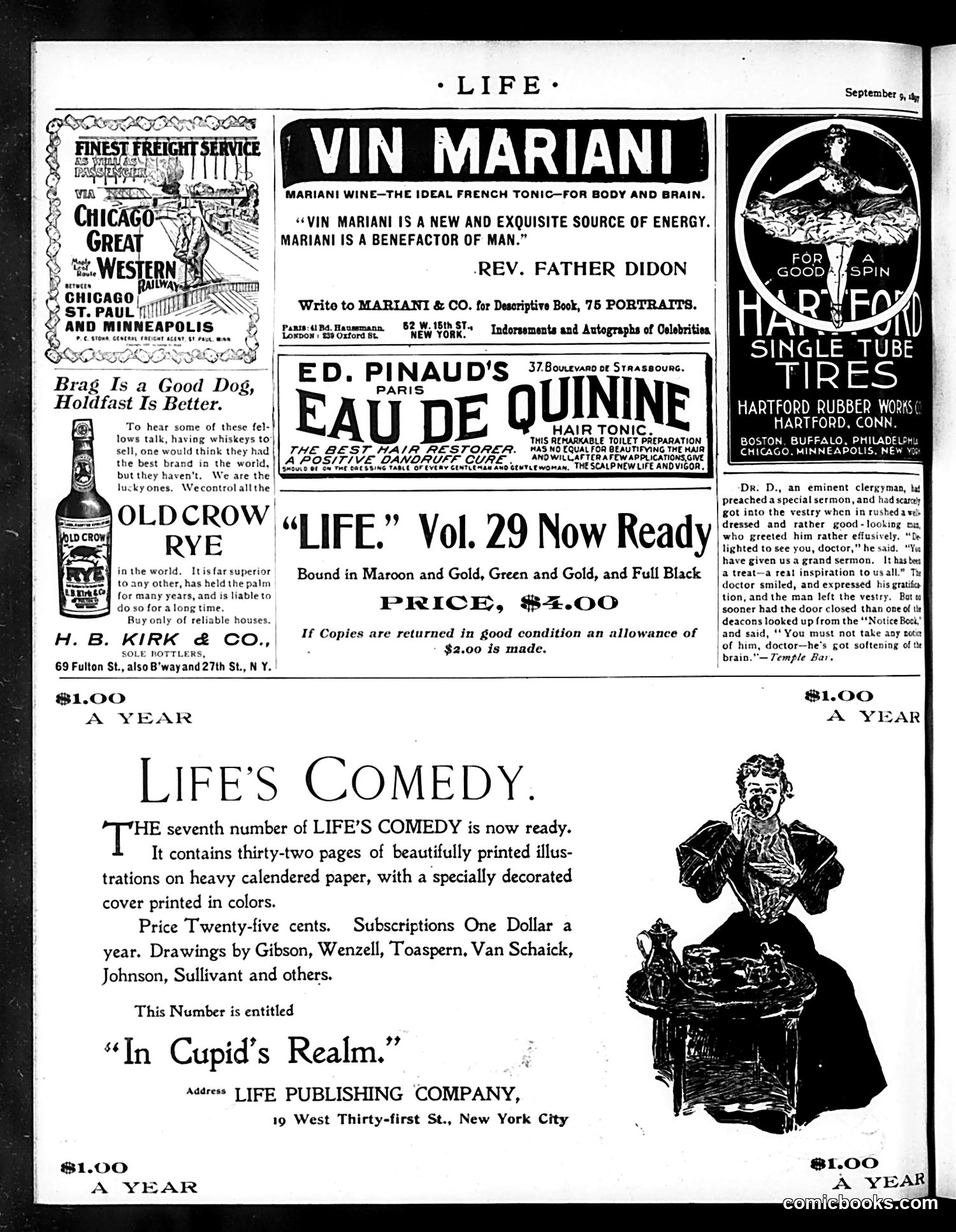
A complete issue · 20 pages · 1897
Life — September 9, 1897
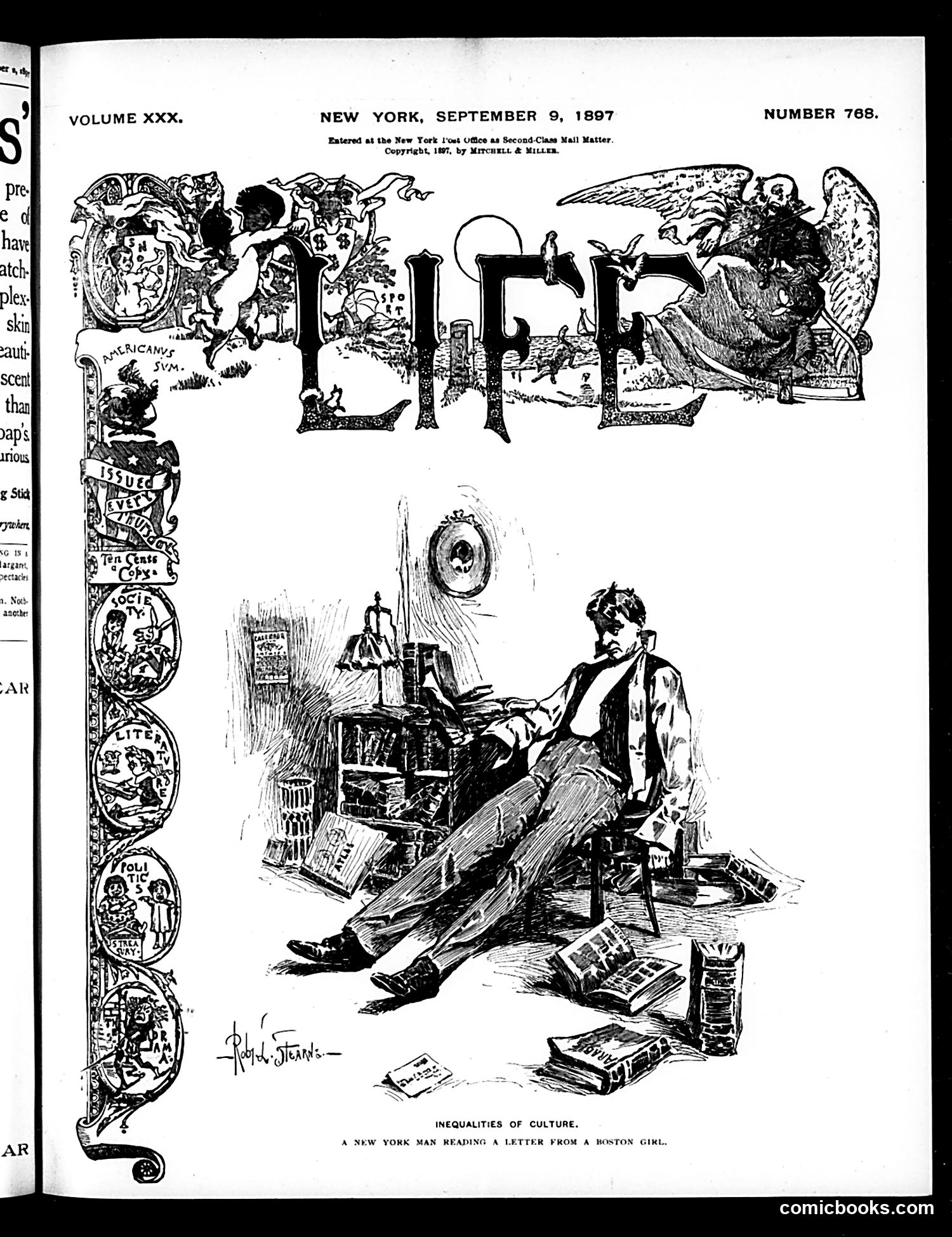
**Title:** "Inequalities of Culture: A New York Man Reading a Letter from a Boston Girl" This satirical cartoon mocks class and regional pretensions. A man lounges casually in his chair, surrounded by scattered books and reading materials, receiving correspondence from a Boston woman. The joke appears to critique the perceived cultural superiority of Boston (historically seen as intellectually elite) versus New York's more commercial, less refined reputation. The ornate decorative border on the left suggests Life's typical satirical flourishes. The man's relaxed posture and casual environment contrast with Boston's reputation for serious intellectual pursuits, suggesting the cartoon is poking fun at New York men's lack of cultural refinement compared to Boston's educated circles.
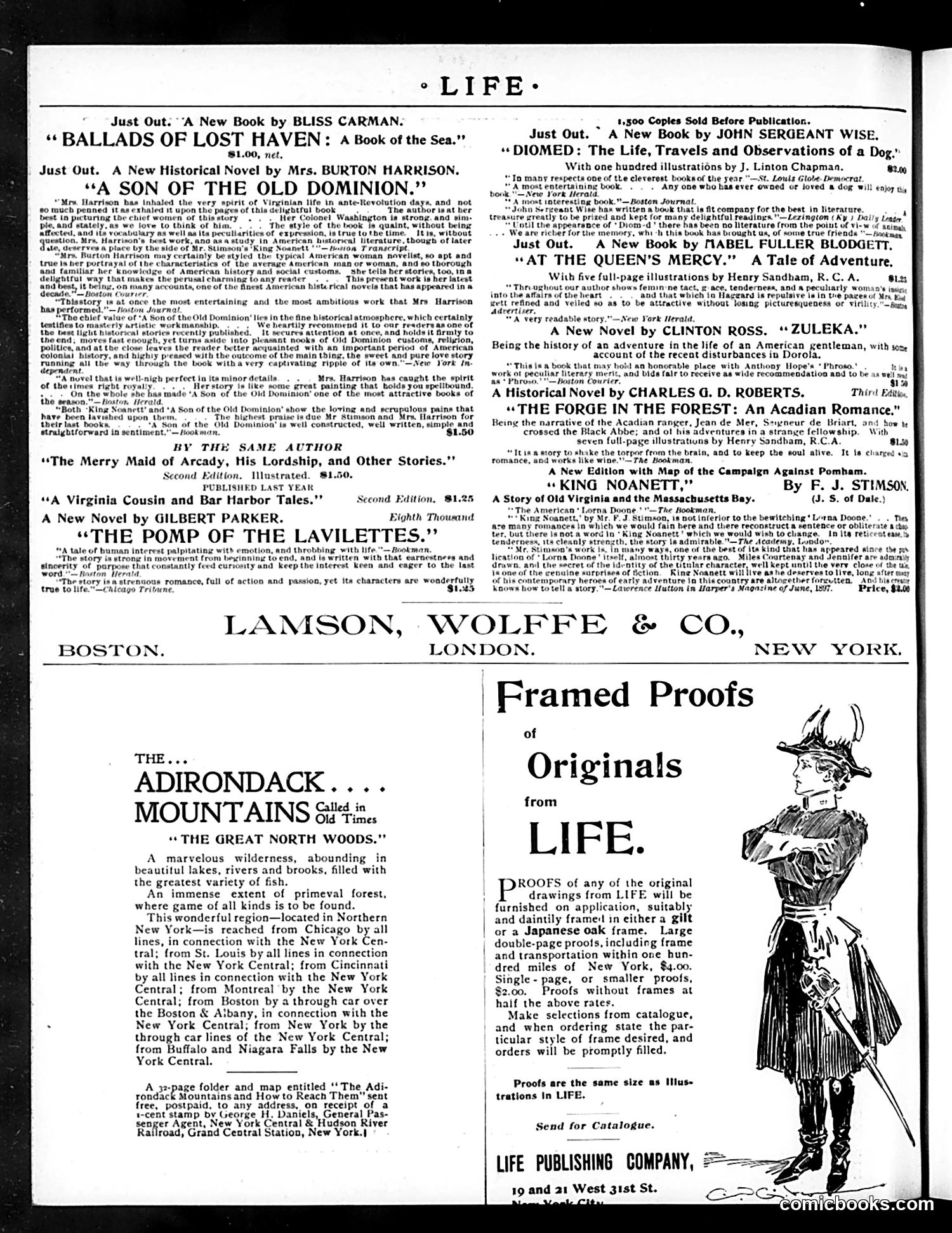
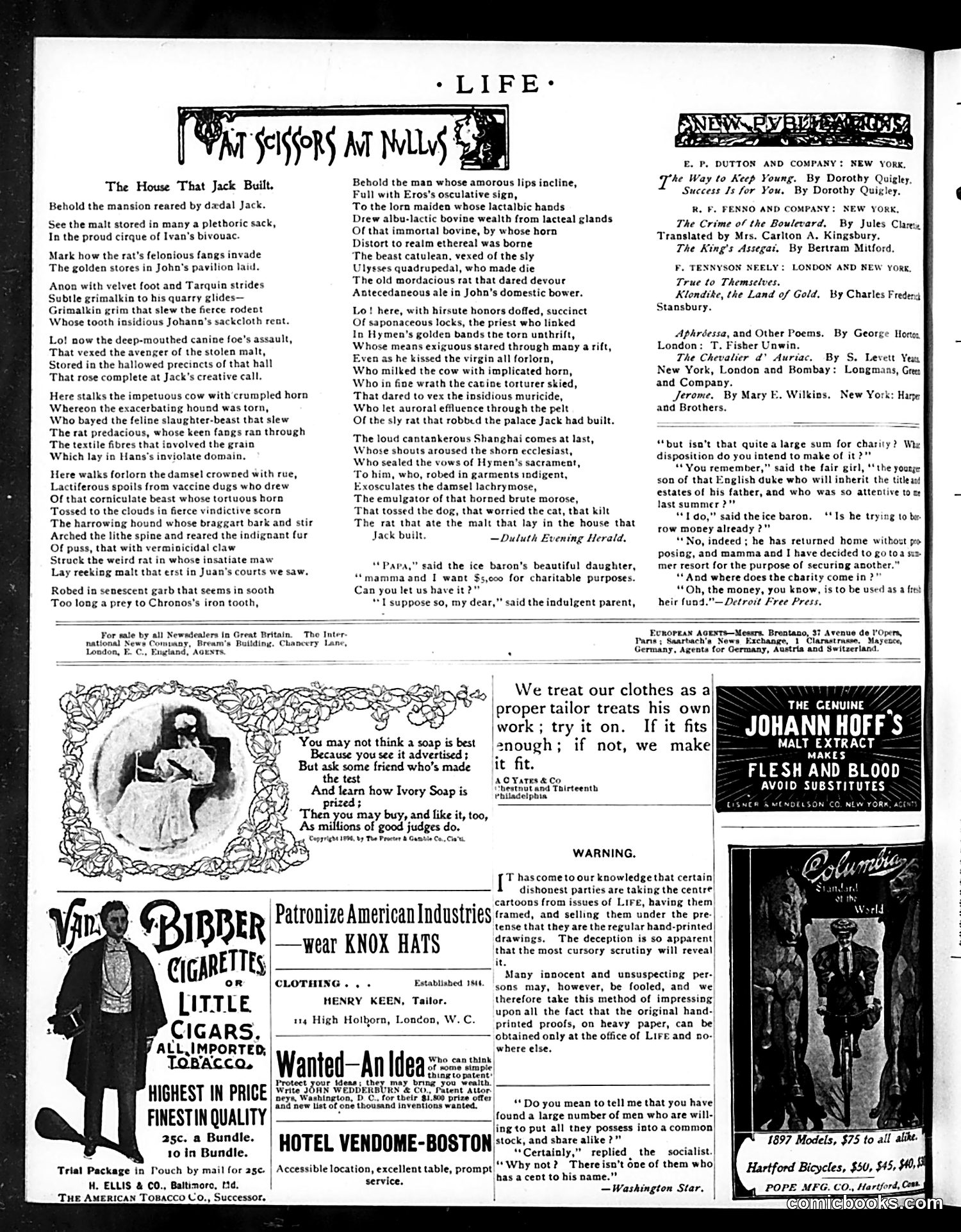
This page is primarily **advertising and book announcements** rather than satirical cartoons. The upper portion features publisher announcements for new books from Lamson, Wolffe & Co., including titles like "Ballads of Lost Haven" by Bliss Carman and "A Son of the Old Dominion" by Mrs. Burton Harrison. The lower half advertises the **Adirondack Mountains** as a travel destination, describing wilderness, lakes, and hunting opportunities in northern New York, accessible via various railroad lines. On the right side, **Life Publishing Company** promotes framed reproductions of original artworks from *Life* magazine, available in gilt or Japanese oak frames. An illustration shows a fashionably-dressed woman holding a large framed proof. There is no political satire or caricature on this particular page—it's a straightforward commercial advertisement section.
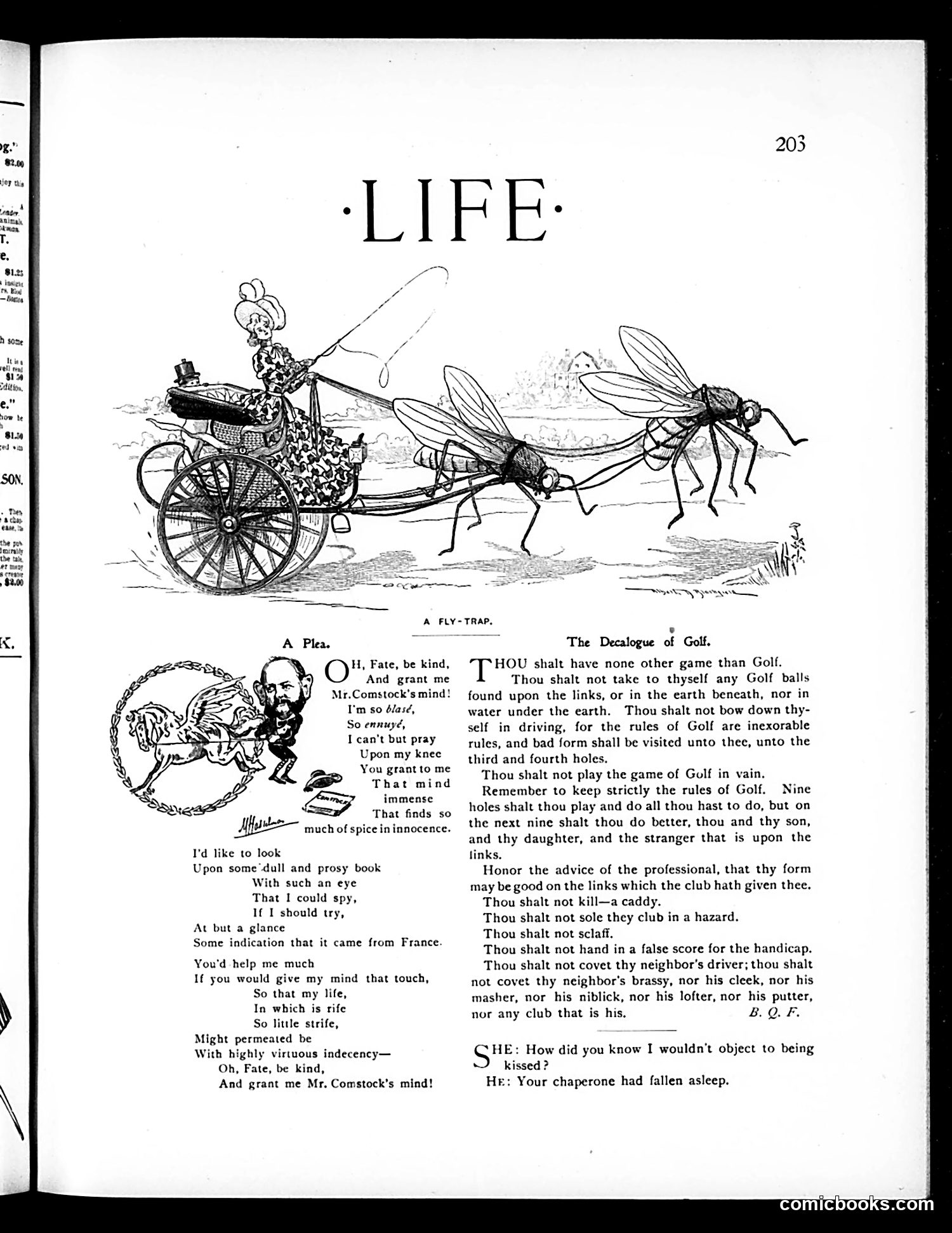
**Top Illustration ("A Fly-Trap"):** A whimsical drawing shows a fashionably dressed woman in an elaborate carriage being pulled by two large flies, satirizing absurd transportation or social pretension. **"A Plea" (Left Column):** The poem humorously addresses "Mr. Comstock's mind," requesting mercy and an end to prudish censorship. The speaker seeks to examine "dull and prosy" books, suggesting this mocks Anthony Comstock, the famous anti-vice crusader who aggressively censored publications he deemed immoral. The satire criticizes his rigid moralism as stifling. **"The Decalogue of Golf" (Right):** A humorous mock-religious text ("thou shalt") listing golf etiquette rules—a parody of the Ten Commandments applied to the sport. **Bottom Exchange:** A flirtatious joke about kissing, likely satirizing Victorian propriety.
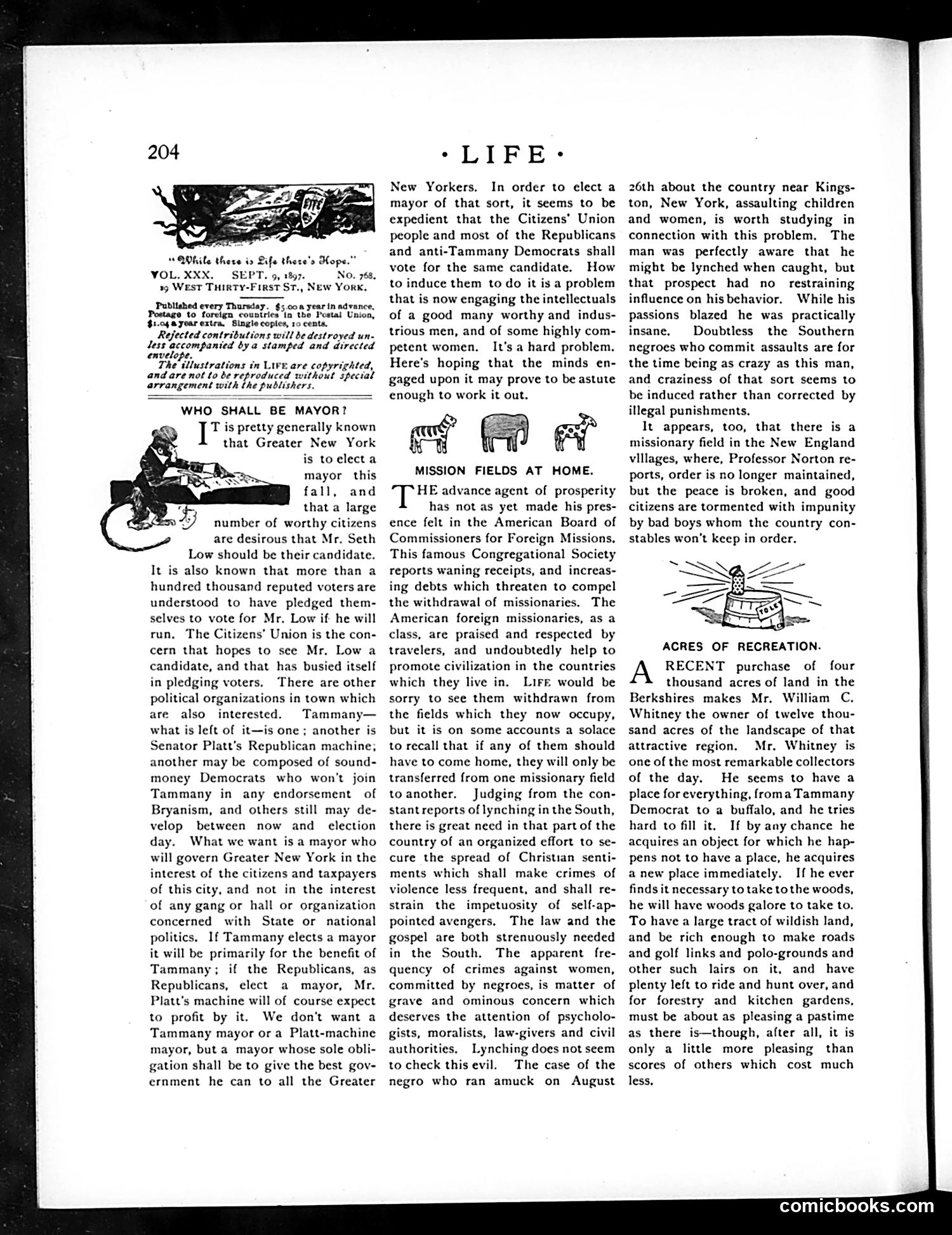
The main cartoon shows a figure at a desk labeled "WHO SHALL BE MAYOR?" The text discusses New York City's mayoral election, arguing against candidates like Seth Low (a reformer and Citizens' Union pick) and Tammany Hall politicians. The illustration appears to satirize the difficulty of finding an acceptable mayoral candidate—someone independent of both corrupt Tammany machine politics and the interests of wealthy Republican elites. The text critiques Tammany Democrats while also dismissing machine Republicans, suggesting the real need is for a mayor genuinely serving "Greater New York" citizens rather than partisan interests. The secondary items address foreign missionaries' funding crises and William C. Whitney's land purchase in the Berkshires—typical satirical commentary on contemporary affairs and wealthy New Yorkers.
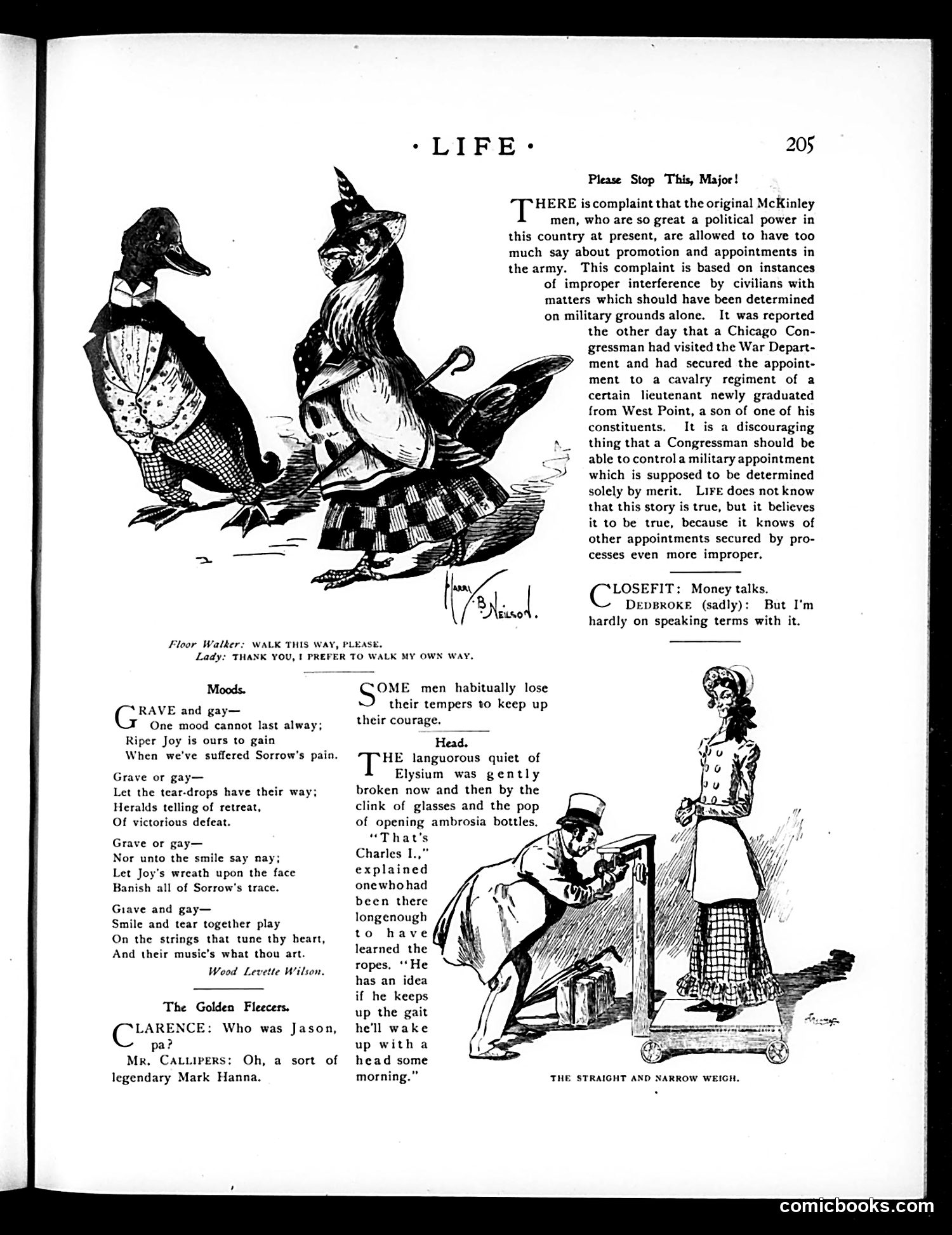
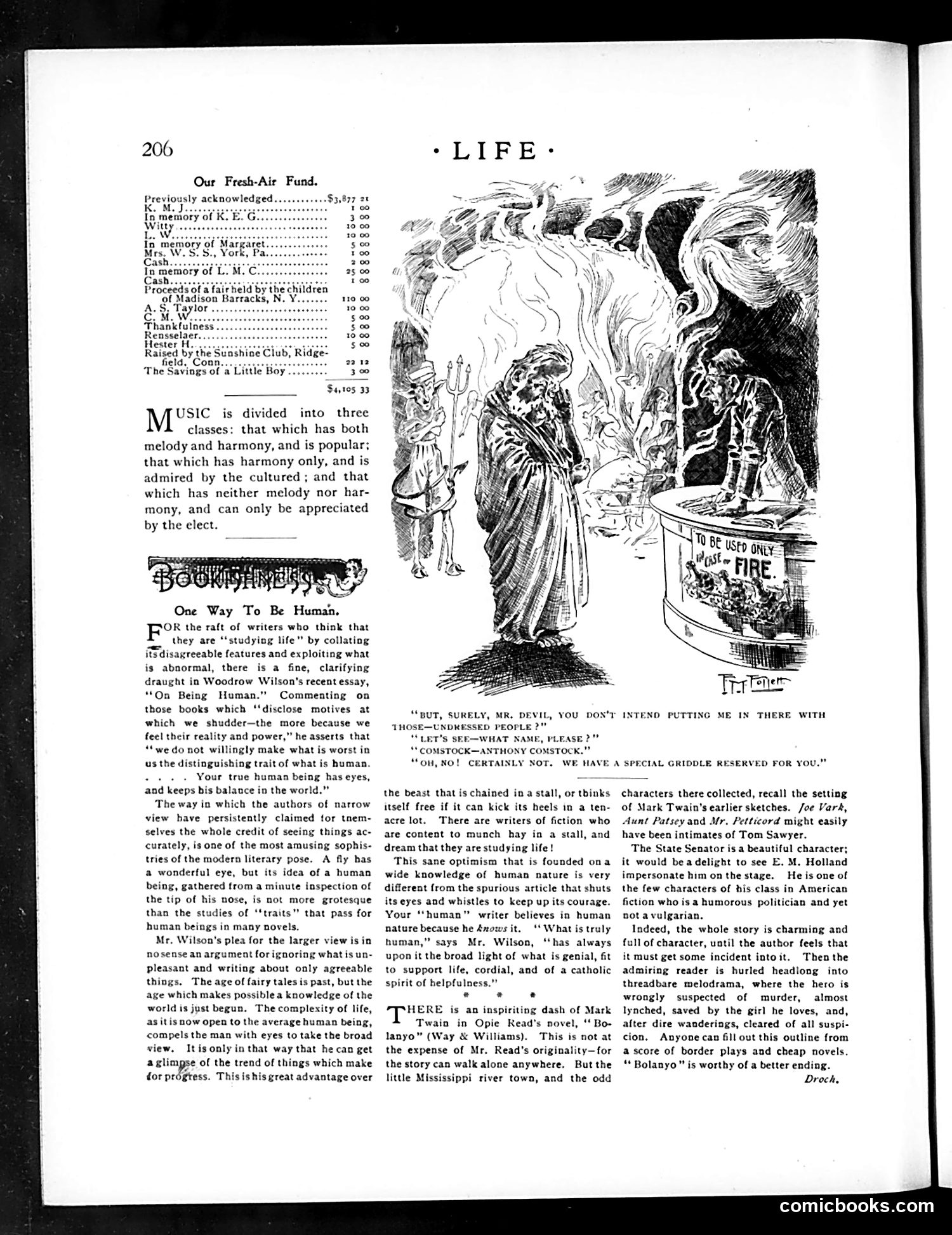
The main illustration depicts a darkly comedic scene: the Devil offers a contract to a woman while angelic figures hover above. The caption reads: "But, surely, Mr. Devil, you don't intend putting me in there with those dreadful creatures?" / "Let's see—what name, please?" / "Comstock—Anthony Comstock." / "Oh, no! Certainly not. We have a special griddle reserved for you." This satirizes **Anthony Comstock**, the real historical figure famous for aggressive censorship of literature and art in America. The joke: even the Devil considers Comstock too extreme and reserves special (hotter) punishment for him. The satire mocks Comstock's zealous moral crusading as hell-worthy—a common critique among artists and writers he targeted. The accompanying text discusses literature and human nature, reflecting contemporary debates about censorship versus artistic freedom.
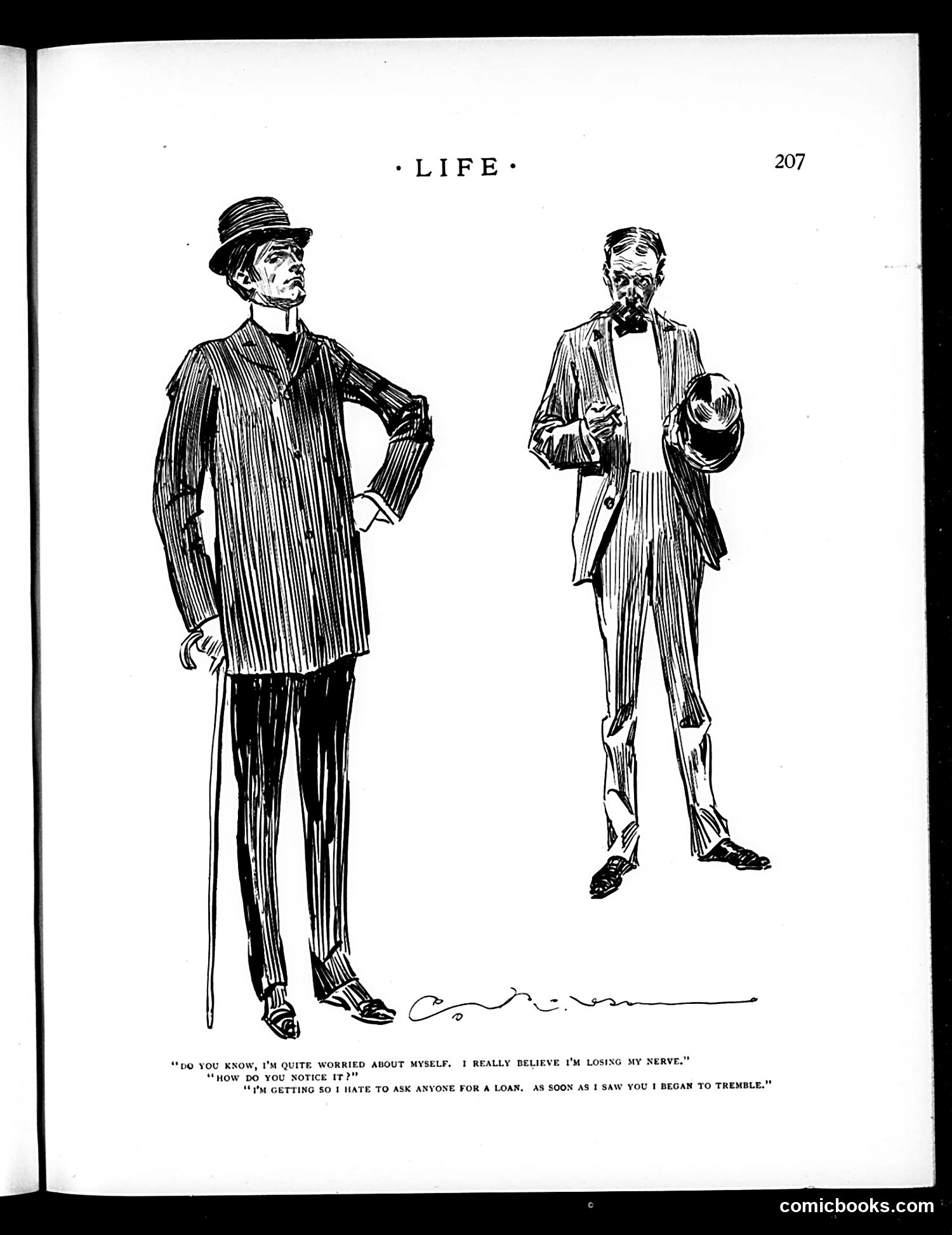
This is a satirical cartoon from Life magazine (page 207) depicting two men in contrasting circumstances, illustrating anxiety about financial instability during what appears to be an economic downturn. The figure on the left—well-dressed in a pinstriped suit and hat, using a cane—represents someone of apparent means worried about losing their social standing. His dialogue reveals his anxiety: "Do you know, I'm quite worried about myself. I really believe I'm losing my nerve" and "How do you notice it?" The figure on the right, formally dressed but noticeably trembling, answers: "I'm getting so I hate to ask anyone for a loan. As soon as I saw you I began to tremble." The satire mocks the desperation of wealthy men reduced to borrowing money—a commentary on economic hardship affecting even the privileged classes, likely referencing financial crisis or recession.
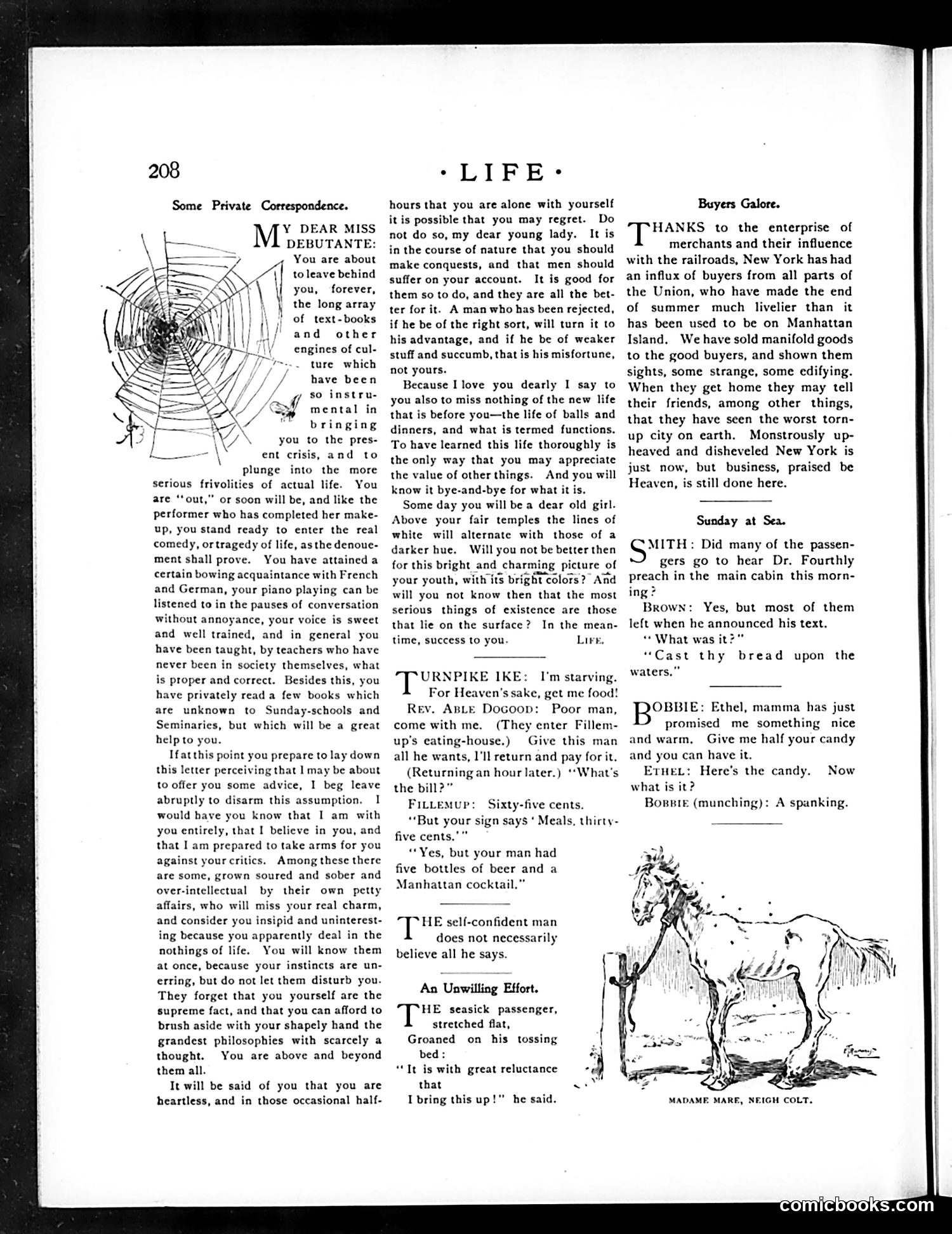
This page contains satirical short prose pieces rather than political cartoons. The main content includes: **"Some Private Correspondence"**: A lengthy letter from "My Dear Miss Unfortunate" advising a young woman leaving behind her life—books, piano, German language skills—to marry. The writer warns her that marriage will diminish her intellectual pursuits and suggests she'll regret losing her independence. **"Buyers Galore"**: A brief piece celebrating New York merchants' success selling goods to summer visitors. **Other humorous vignettes**: Including dialogue about Dr. Fourtily's preaching, candy-sharing between children, and a quip about a self-confident man. A small illustration shows a horse labeled "Madame Mare, Neigh Colt." The satire targets Victorian-era marriage's restrictions on women's intellectual life and contains light domestic humor typical of early 20th-century Life magazine.
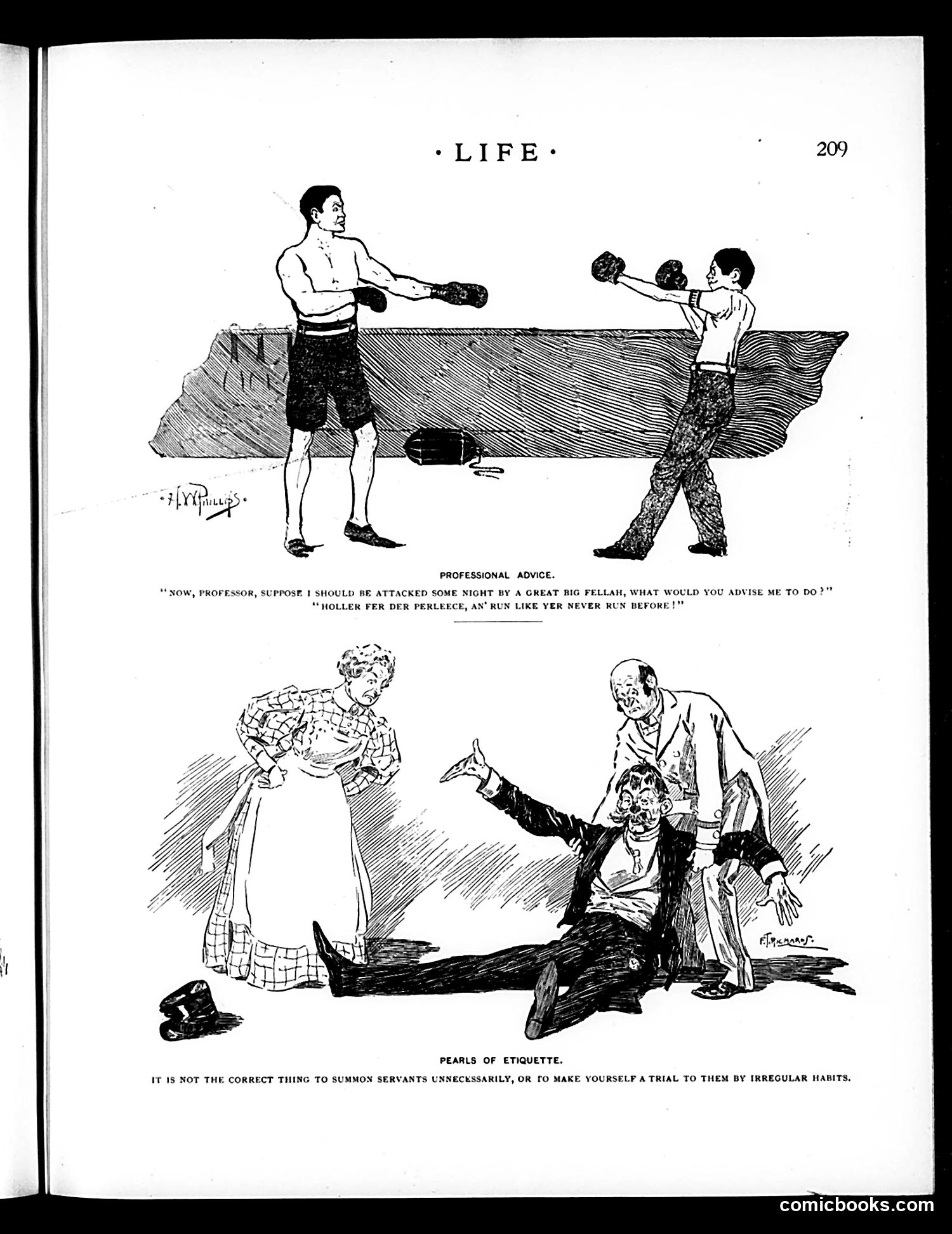
This page contains two satirical cartoon panels from *Life* magazine mocking social conventions and masculinity. **Top cartoon**: A boxing instructor advises a student on self-defense. The humor targets the absurdity of seeking "professional advice" on street fighting—the professor's suggestion to "holler fer der perfleckce, an' run like yer never run before!" mocks both the pretense of boxing expertise and cowardly practicality. **Bottom cartoon**: Titled "Pearls of Etiquette," this depicts a disheveled man being ejected, apparently for improper behavior toward servants. The caption emphasizes that summoning servants unnecessarily or displaying irregular habits violates proper decorum—satirizing class pretension and the rigid social rules governing servant-master interactions in the early 20th century. Both cartoons use working-class or lower-class figures to mock those claiming sophistication.
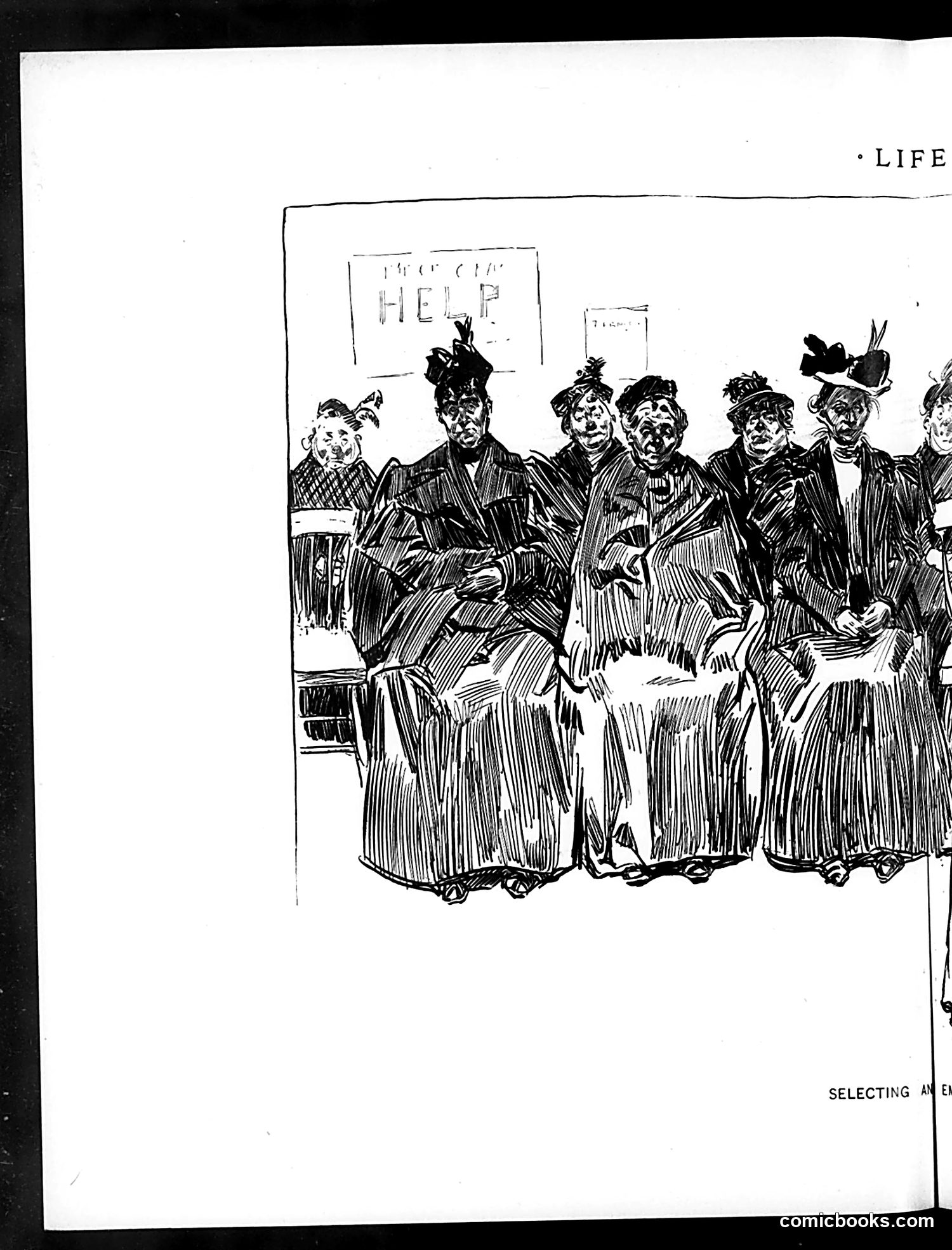
This Life magazine page shows a satirical cartoon depicting a group of women in long dresses and elaborate hats gathered in what appears to be an official or institutional setting (suggested by the "HELP" sign visible on the wall). The women appear to be caricatured with exaggerated facial features typical of early 20th-century political cartoons. The caption at bottom reads "SELECTING AN E[...]" (text cut off), suggesting this depicts women selecting or voting for something—likely a candidate or official position. The cartoon appears to satirize women's political participation or voting behavior, mocking their appearance and choices through exaggerated illustration. Without the complete caption, the specific target of satire remains unclear, though it clearly comments on women's political engagement during the suffrage or early post-suffrage era.
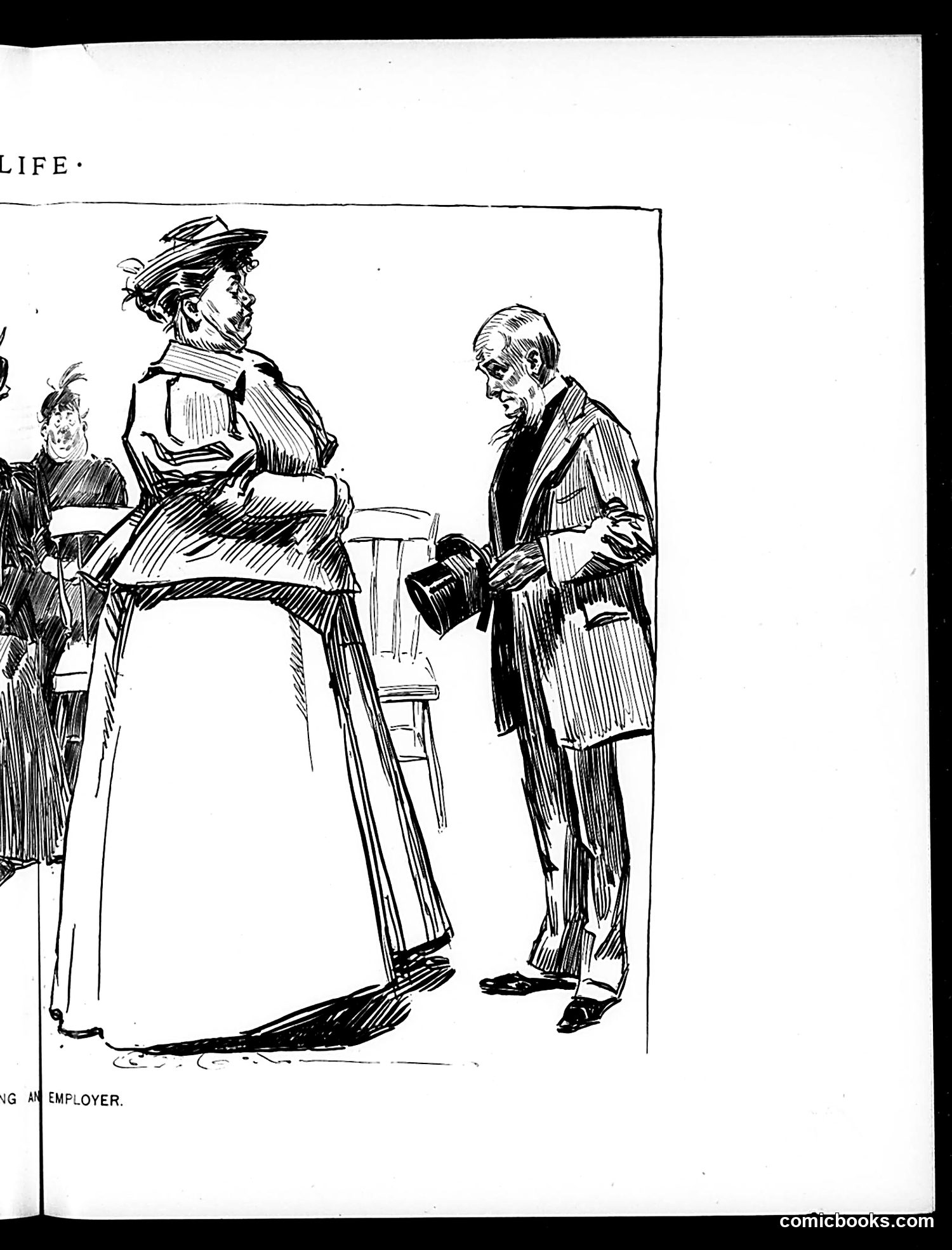
This cartoon depicts a social interaction between two men and appears to illustrate employer-employee dynamics, as indicated by the caption "AN EMPLOYER." The figure on the left wears a hat and formal attire suggesting middle-class or working-class status, while the man on the right—identified as the employer—wears a suit and holds what appears to be a hat or document. A woman in the background observes the interaction. The satire likely comments on the power imbalance between employers and workers during the early 20th century. The specific nature of their conversation remains unclear from the image alone, but the composition suggests commentary on workplace authority, labor relations, or employment conditions—common themes in *Life* magazine's social criticism of this era.
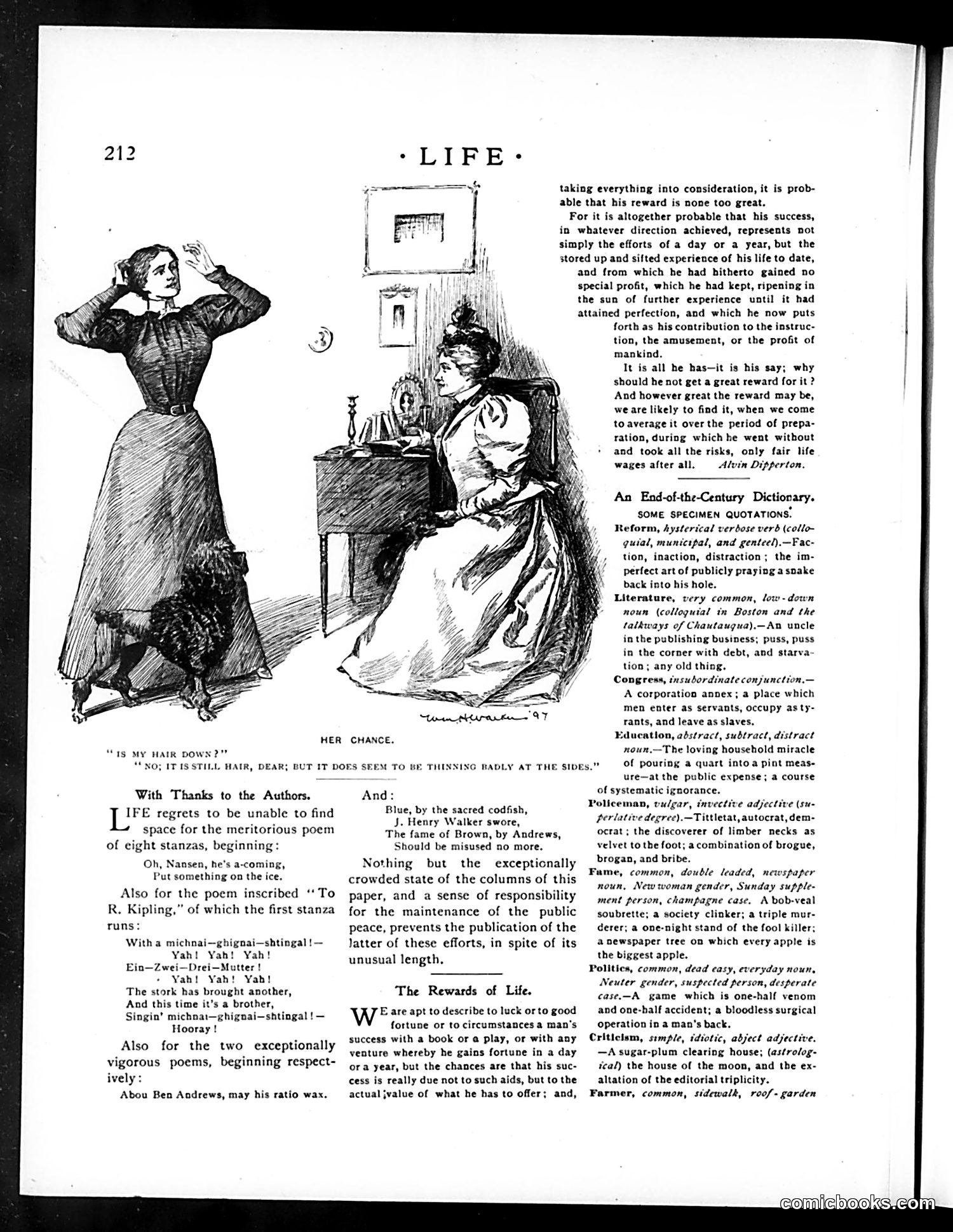
This cartoon depicts a woman standing before a mirror, dramatically clutching her head in apparent distress. The caption reads: "Is my hair down?... No, it is still hair, dear; but it does seem to be thinning badly at the sides." The satire targets Victorian anxieties about women's vanity and aging. The woman's exaggerated distress over hair thinning is played for comic effect—suggesting the absurdity of female concern with appearance. The humor relies on period attitudes treating women's looks as their primary value and source of identity. The surrounding text discusses "The Rewards of Life," examining success and fortune, which contextualizes the cartoon as commentary on women's limited opportunities beyond physical attractiveness in late 19th-century society.
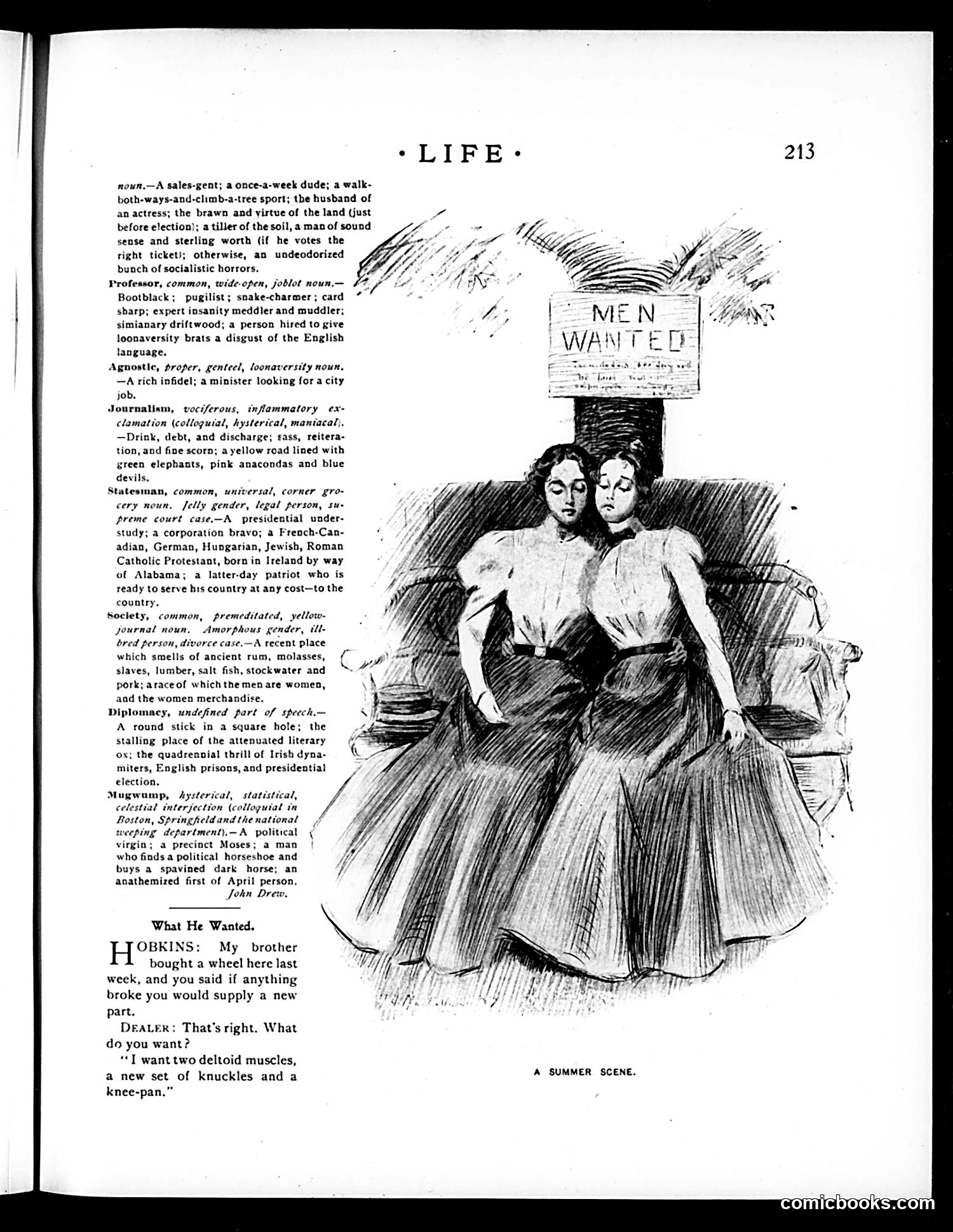
This page from *Life* magazine contains two distinct elements: **Left side:** A satirical dictionary defining American social types with biting political humor. The definitions mock various professions and classes—salesmen, professors, journalists, statesmen, and society figures—using absurdist language to critique their hypocrisy. For example, a "Man" is virtuous "before election" but otherwise "an undeodorized bunch of socialistic horrors." The piece skewers political opportunism, journalistic sensationalism, and upper-class pretension through exaggerated, darkly comedic definitions. **Right side:** A cartoon titled "A Summer Scene" shows two fashionable women beneath a "Men Wanted" sign. Below this is a short comic dialogue about a bicycle repair customer requesting replacement body parts—a joke playing on the mechanical nature of both bicycles and human bodies, likely satirizing consumer culture's disposable attitude toward objects and people. Both elements employ satire typical of *Life*'s early progressive critique of American society.
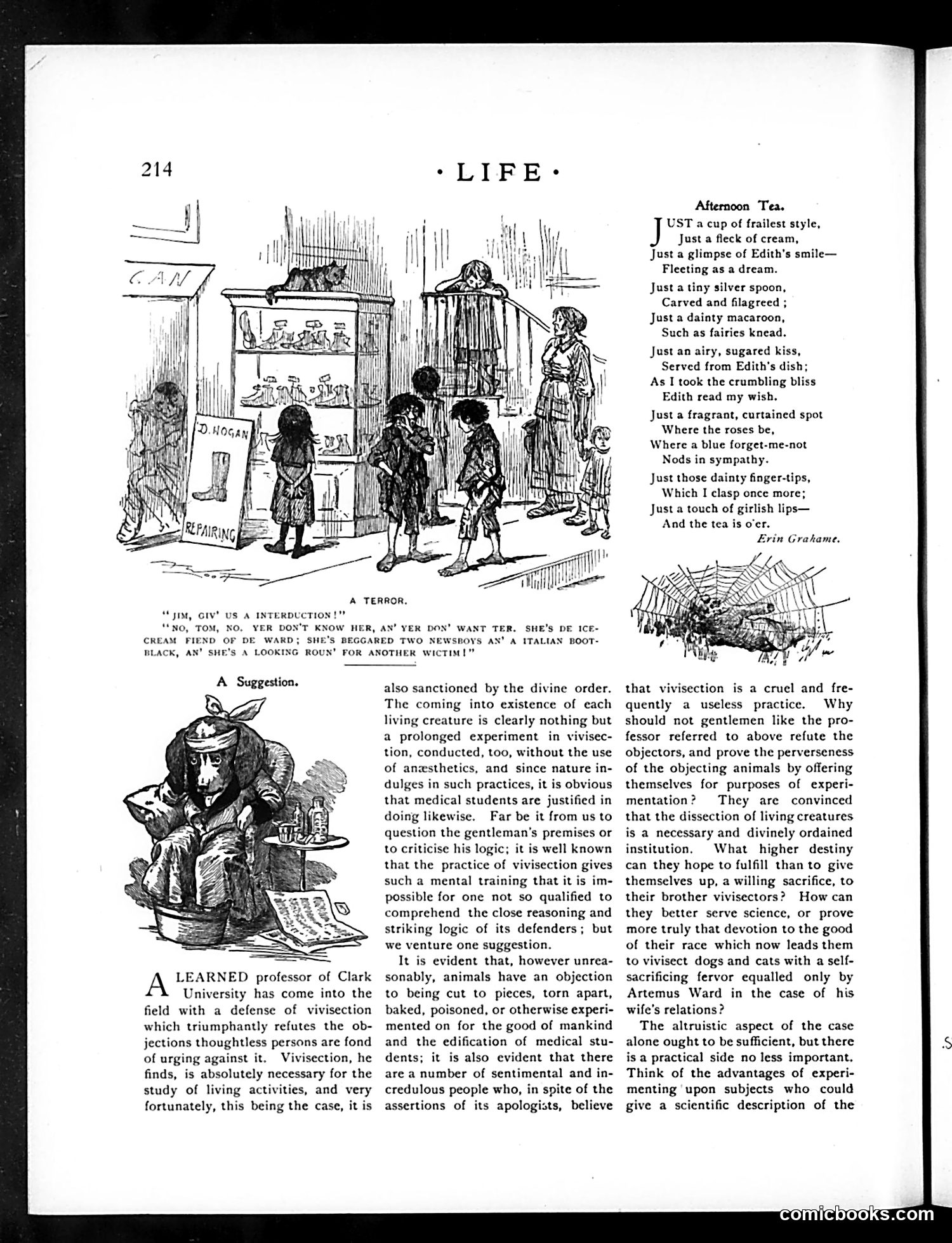
**"A Terror" (top cartoon):** This depicts street children observing a shop window display. The caption's dialect suggests a street urchin warning others away from a girl—calling her "ice-cream fiend" and "looking roun' for another victim," implying she's a danger to other children. This appears to be satirizing Victorian anxieties about urban poverty and street children as either criminals or victims. **"A Suggestion" (main article with illustration):** Life sarcastically attacks a Clark University professor's defense of vivisection (animal experimentation). The author agrees with the professor's logic that if nature conducts "vivisection" during childbirth without anesthetics, then medical students may do likewise. However, Life's satirical "suggestion" is cutting: if vivisection is truly justified and beneficial, why don't the professor and his colleagues volunteer themselves as experimental subjects instead of using animals? It's a biting critique using the professor's own reasoning against him. **"Afternoon Tea" (poem):** A sentimental romantic poem—unrelated to the political content.
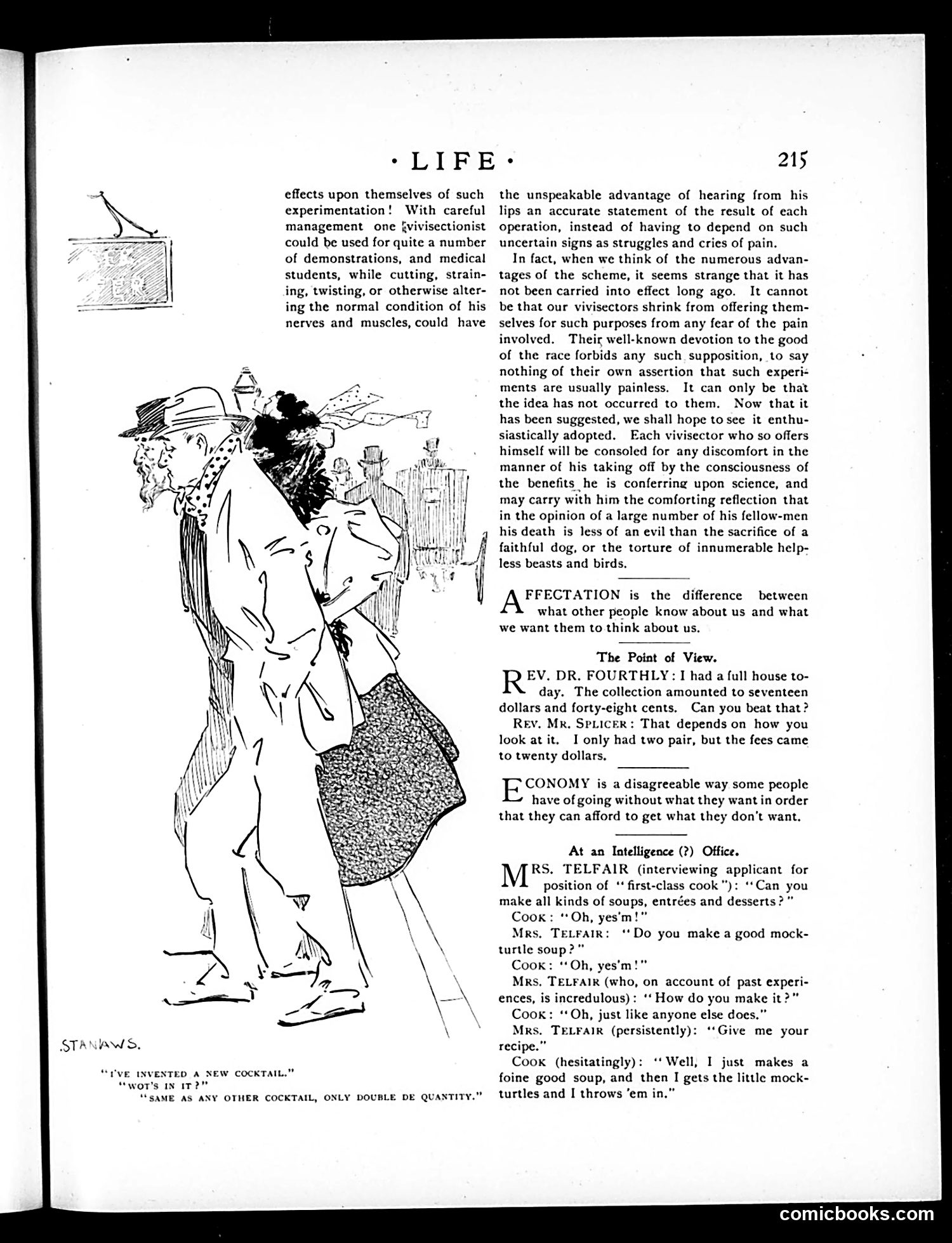
**Main Cartoon (Stanaway):** A caricatured figure with exaggerated features holds a cocktail. The caption jokes that this is "a new cocktail" that works by using "double the quantity" of a standard cocktail—satirizing either the absurdity of marketing gimmicks or Prohibition-era drinking culture. **Vivisection Editorial:** The text sarcastically proposes that animal researchers ("vivisectors") should experiment on themselves rather than animals, exposing the hypocrisy of those who claim experiments are painless yet won't volunteer as subjects. **The Point of View:** Two clergy exchange anecdotes about church collections versus poker winnings, satirizing how ministers measure success and the role of money in religious life. **Intelligence Office Sketch:** A domestic worker hired as a "first-class cook" is exposed as a fraud when pressed for her mock-turtle soup recipe—she admits she simply boils soup then adds actual turtles, mocking incompetent household staff and employment agencies' vetting failures. All pieces target hypocrisy, pretension, and social absurdities through humor.
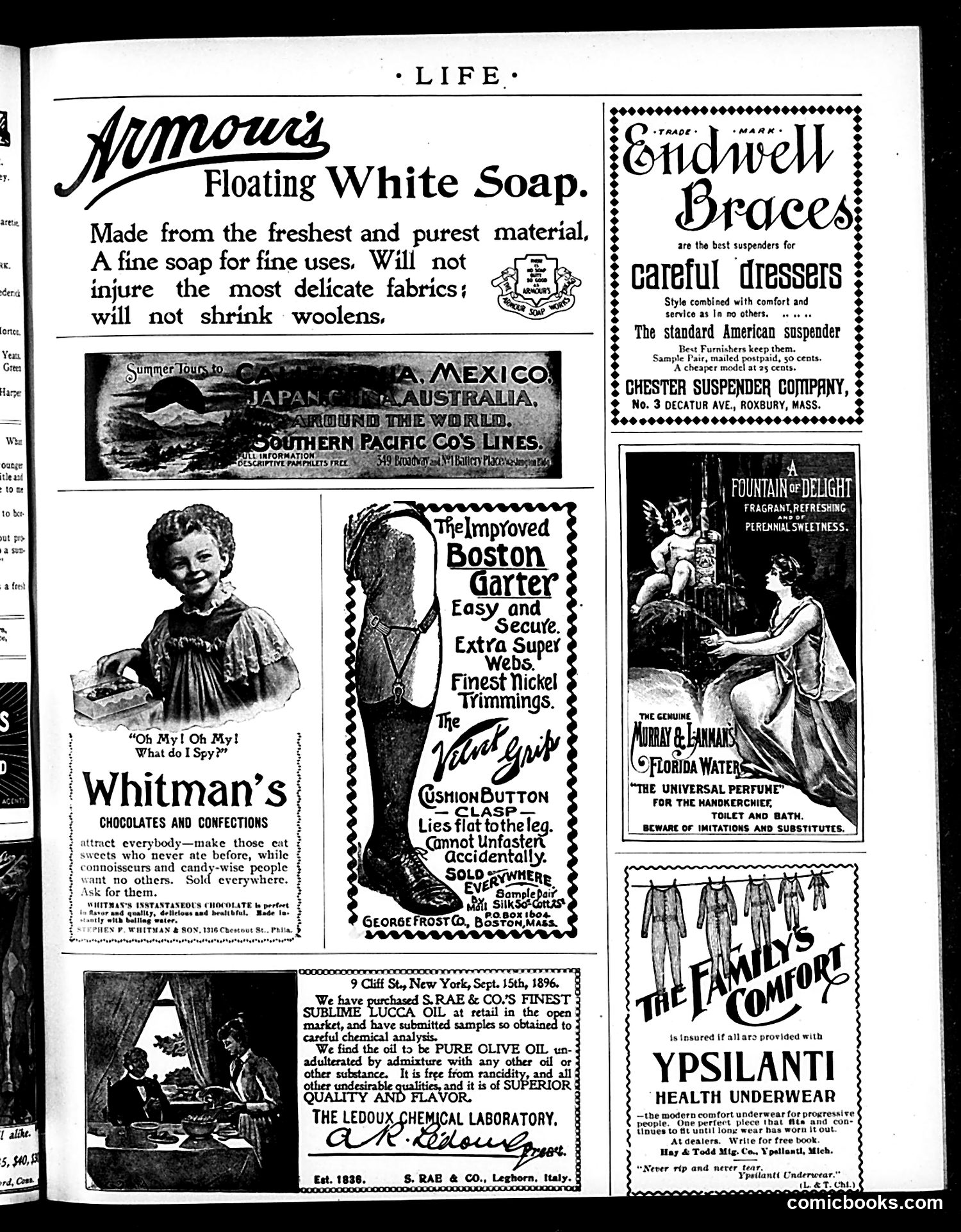
This is primarily a **commercial advertisement page** rather than satirical content. Dated September 15, 1896, it showcases various consumer products typical of the late Victorian era: **Key advertisements include:** - Armour's Floating White Soap (fine fabrics) - Whitman's Chocolates and Confections - The Improved Boston Garter (shoe fastener) - Endwell Braces (suspenders) - Murray & Lanman's Florida Water (perfume) - Ypsilanti Health Underwear - S. Rae & Co.'s Lucca Oil **The imagery** features period-appropriate illustrations: a young girl with a sewing basket, a woman's leg displaying a garter, classical female figures promoting perfume, and formal dress figures modeling underwear. There is **no identifiable political satire** on this page. The "satire" in Life magazine typically appeared elsewhere in the publication. This page represents straightforward product marketing aimed at middle-to-upper-class consumers, emphasizing quality, comfort, and propriety—values central to 1890s American advertising.
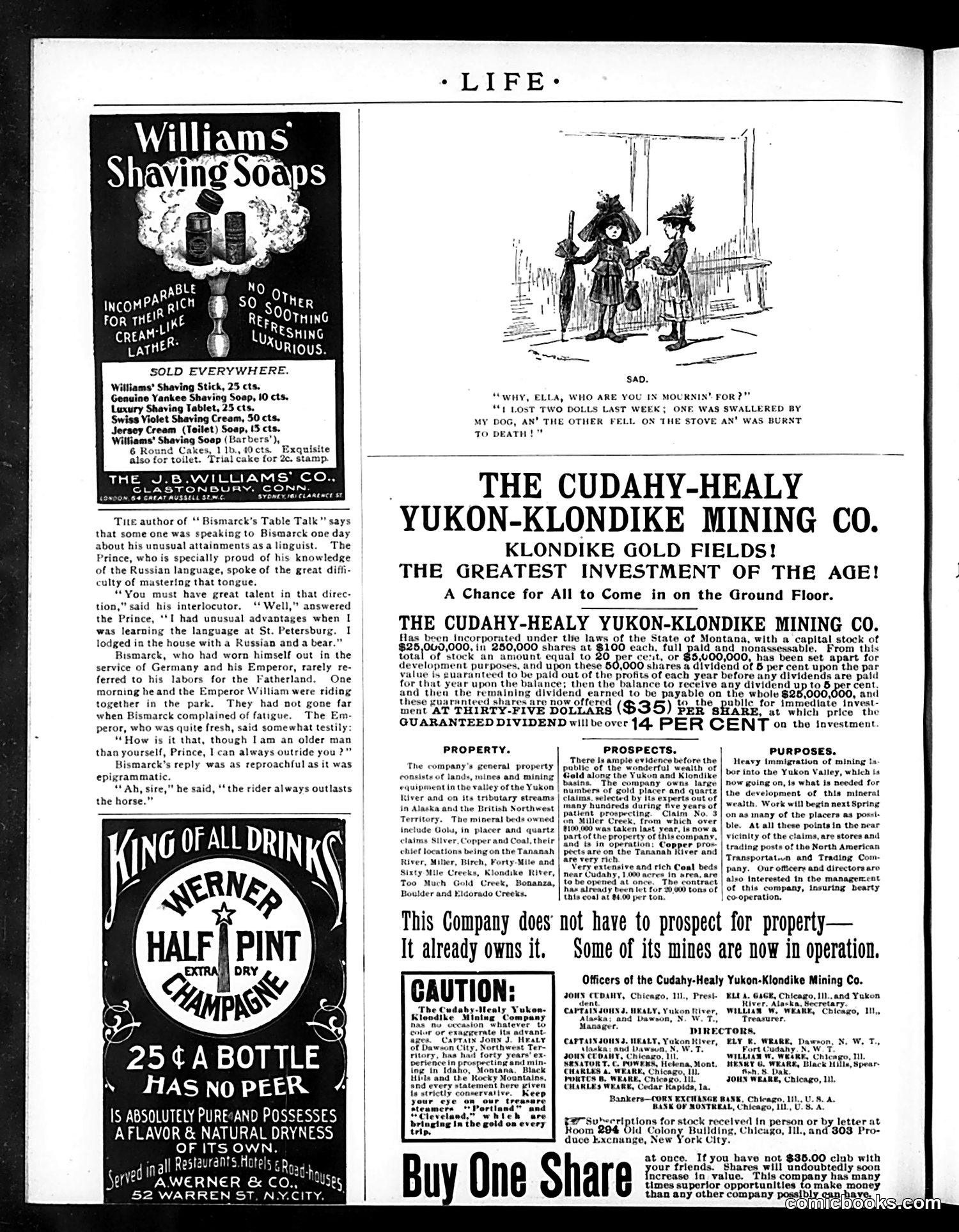
This page is primarily **advertising and promotional content** rather than political satire. The notable elements are: **The cartoon** (top right, labeled "SAD") depicts two children mourning lost dolls—one swallowed by a dog, the other burned on a stove. This appears to be a humorous illustration accompanying an anecdote, unrelated to politics. **The main content** is a speculative investment advertisement for the "Cudahy-Healy Yukon-Klondike Mining Co.," promoting shares in Klondike gold field mining operations. The ad promises guaranteed dividends of 14+ percent—a classic hallmark of **get-rich-quick schemes** common during the Klondike Gold Rush era (1890s). **Supporting advertisements** for Williams' Shaving Soaps and Werner's Champagne fill the remaining space. The page reflects turn-of-the-century American entrepreneurial optimism and aggressive marketing tactics, but contains no political commentary or sophisticated satire—it's straightforward commercial promotion mixed with light humor.
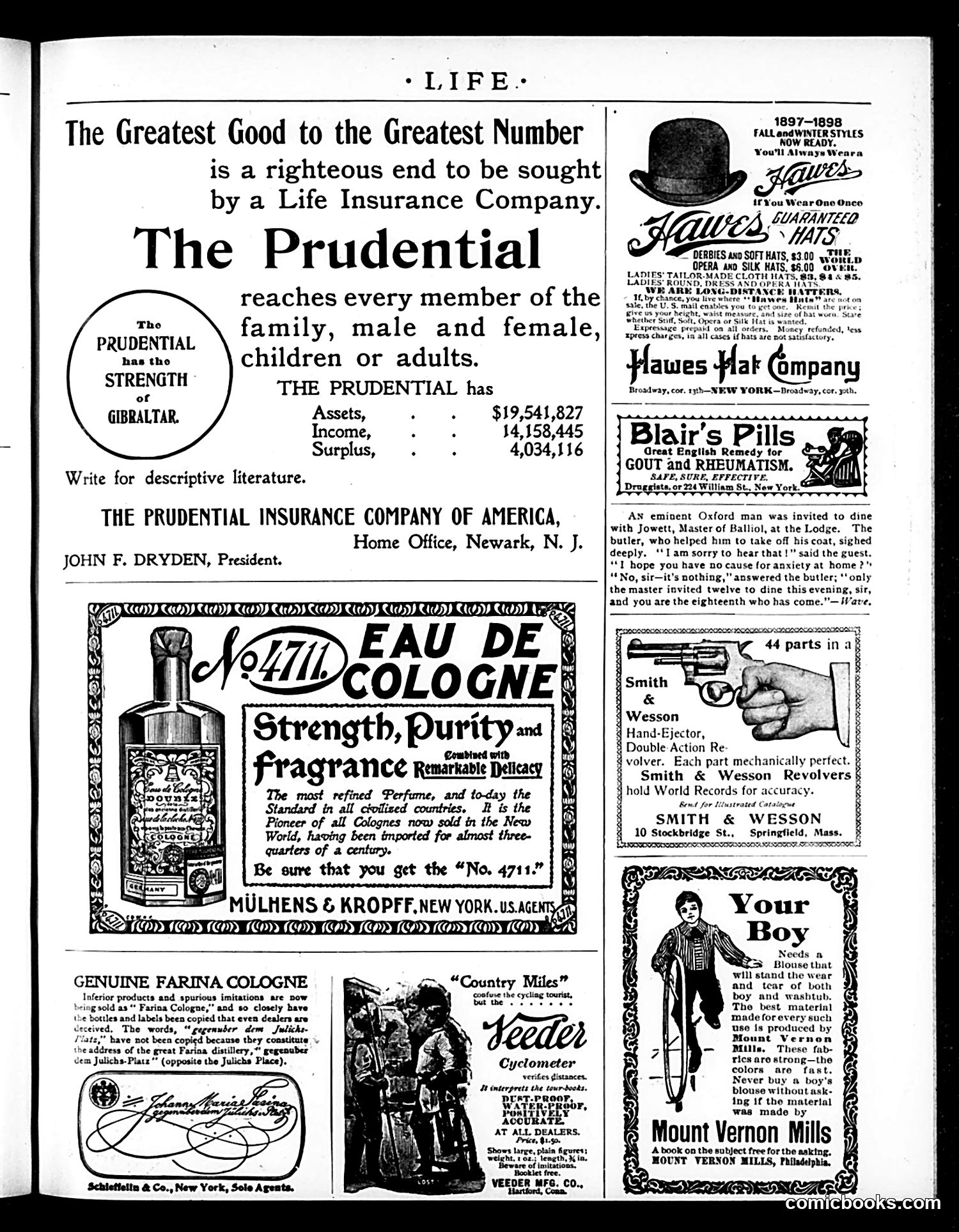
This is primarily a **commercial advertising page** with minimal political content. The layout reflects turn-of-century American consumer culture. **Main Advertisement:** The Prudential Insurance Company occupies the top half, using the utilitarian slogan "The Greatest Good to the Greatest Number" to market life insurance. The "Strength of Gibraltar" metaphor suggests financial stability and security—likely resonating with readers concerned about family welfare during economic uncertainty. **Surrounding Ads** include luxury goods (Eau de Cologne, Hawes hats, Blair's Pills) and practical products (Smith & Wesson revolvers, Mount Vernon Mills fabric). These suggest Life's affluent readership. **Embedded Humor:** A brief anecdote about a dinner party satirizes social pretension—a butler's exhaustion when twelve dinner guests arrive unexpectedly. This light social commentary typifies Life's satirical tradition. **Overall:** Rather than political satire, this page reflects genteel consumer aspirations of the 1890s upper-middle class.