
Life, 1897-09-09 · page 4 of 20
Life — September 9, 1897 — page 4: what you’re looking at
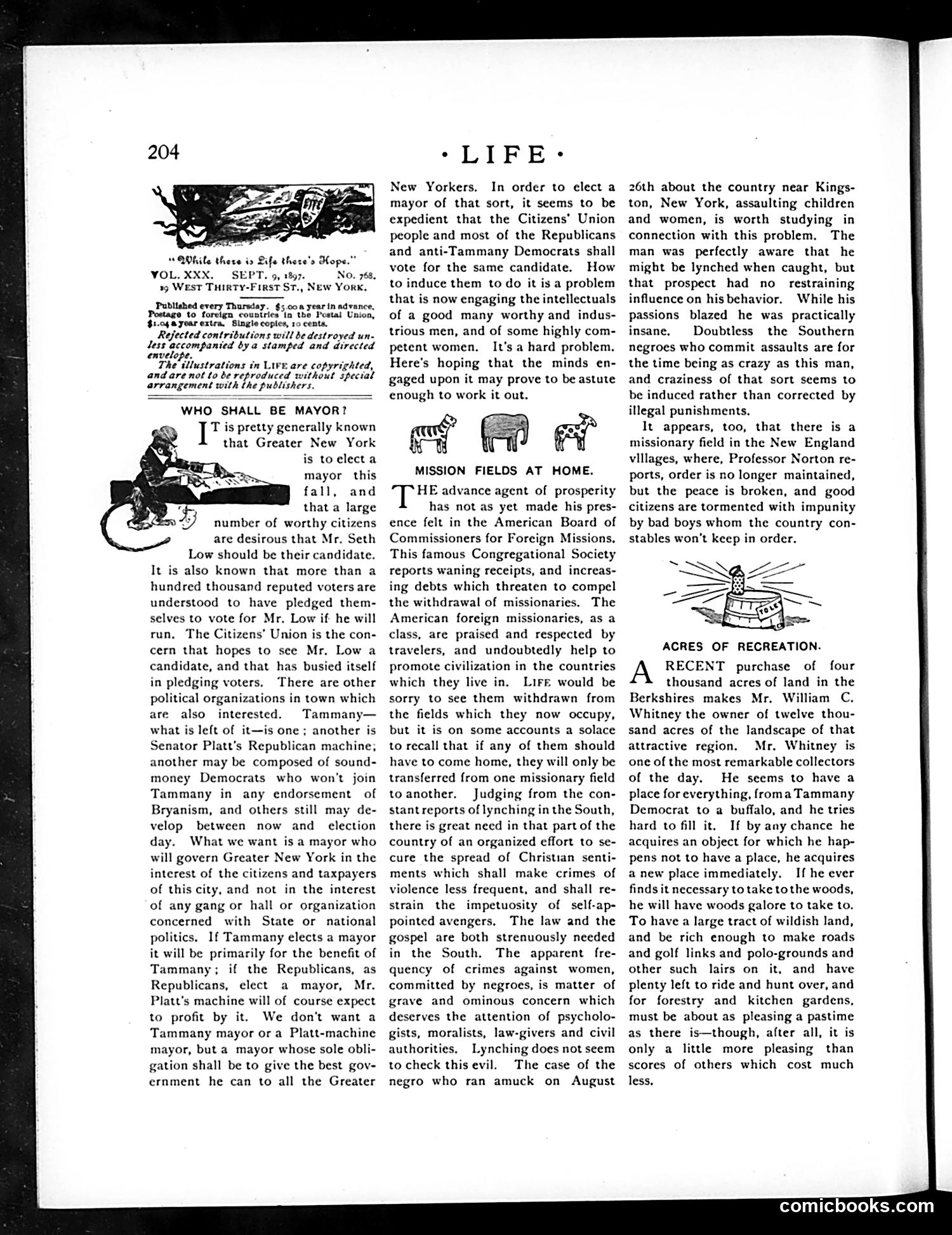
What you’re looking at
The main cartoon shows a figure at a desk labeled "WHO SHALL BE MAYOR?" The text discusses New York City's mayoral election, arguing against candidates like Seth Low (a reformer and Citizens' Union pick) and Tammany Hall politicians. The illustration appears to satirize the difficulty of finding an acceptable mayoral candidate—someone independent of both corrupt Tammany machine politics and the interests of wealthy Republican elites. The text critiques Tammany Democrats while also dismissing machine Republicans, suggesting the real need is for a mayor genuinely serving "Greater New York" citizens rather than partisan interests. The secondary items address foreign missionaries' funding crises and William C. Whitney's land purchase in the Berkshires—typical satirical commentary on contemporary affairs and wealthy New Yorkers.
📄 Transcribed text from this page (OCR, searchable)
Machine-transcribed from the original scan — historical spelling and the odd misread are preserved.
“While there is Life there's Hope.” VOL. XXX. SEPT. 9, 1897. No. ag West THIRTY-FirsT St., NEw York, Published every Thursday. $5.00 year in advance, Postage to foreign couniries in the Postal Union, $1.04 @yoar extra, Single copies, 10 cents, Rejected contributions will be destroyed un- Jess accompanied bya stamped and directed envelope. The illustrations in Live are copyrighted, and are not to be reproduced without special arrangement with the publishers. WHO SHALL BE MAYOR? T is pretty generally known that Greater New York is toclecta mayor this fall, and that a large 4} number of worthy citizens are desirous that Mr. Seth Low should be their candidate. It is also known that more than a hundred thousand reputed voters are understood to have pledged them- selves to vote for Mr. Low if he will run. The Citizens’ Union is the con- cern that hopes to see Mr. Low a candidate, and that has busied itself in pledging voters. There are other political organizations in town which are also interested. Tammany— what is left of it—is one ; another is Senator Platt’s Republican machine, another may be composed of sound- money Democrats who won't join Tammany in any endorsement of Bryanism, and others still may de- velop between now and election day. What we want is a mayor who will govern Greater New York in the interest of the citizens and taxpayers of this city, and not in the interest of any gang or hall or organization concerned with State or national politics, If Tammany elects a mayor it will be primarily for the benefit of Tammany; if the Republicans, as Republicans, elect a mayor, Mr. Platt’s machine will of course expect to profit by it. We don’t want a Tammany mayor or a Platt-machine mayor, but a mayor whose sole obli- gation shall be to give the best gov- ernment he can to all the Greater *LIFE- New Yorkers. In order to elect a mayor of that sort, it seems to be expedient that the Citizens’ Union people and most of the Republicans and anti-Tammany Democrats shall vote for the same candidate. How to induce them to do it is a problem that is now engaging the intellectuals of a good many worthy and indus- trious men, and of some highly com- petent women. It’s a hard problem. Here's hoping that the minds en- gaged upon it may prove to be astute enough to work it out. cy Gl MISSION FIELDS AT HOME. HE advance agent of prosperity has not as yet made his pres- ence felt in the American Board of Commissioners for Foreign Missions. This famous Congregational Society reports waning receipts, and increas- ing debts which threaten to compel the withdrawal of missionaries. The American foreign missionaries, as a class, are praised and respected by travelers, and undoubtedly help to promote civilization in the countries which they live in. Lire would be sorry to see them withdrawn from the fields which they now occupy, but it is on some accounts a solace to recall that if any of them should have to come home, they will only be transferred from one missionary field toanother, Judging from the con- stant reports of lynching in the South, there is great need in that part of the country of an organized effort to se- cure the spread of Christian senti- ments which shall make crimes of violence less frequent, and shall re- strain the impetuosity of self-ap- pointed avengers. The law and the gospel are both strenuously needed in the South, The apparent fre- quency of crimes against women, committed by negroes, is matter of grave and ominous concern which deserves the attention of psycholo- gists, moralists, law-givers and civil authorities. Lynching does not seem to check this evil. The case of the negro who ran amuck on August 26th about the country near Kings- ton, New York, assaulting children and women, is worth studying in connection with this problem. The man was perfectly aware that he might be lynched when caught, but that prospect had no restraining influence on his behavior. While his passions blazed he was practically insane. Doubtless the Southern negroes who commit assaults are for the time being as crazy as this man, and craziness of that sort seems to be induced rather than corrected by illegal punishments. It appears, too, that there is a missionary field in the New England villages, where, Professor Norton re- ports, order is no longer maintained, but the peace is broken, and good citizens are tormented with impunity by bad boys whom the country con- stables won't keep in order. ACRES OF RECREATION. RECENT purchase of four thousand acres of land in the Berkshires makes Mr. William C. Whitney the owner of twelve thou- sand acres of the landscape of that attractive region. Mr. Whitney is one of the most remarkable collectors of the day. He seems to have a place for everything, froma Tammany Democrat to a buffalo, and he tries hard to fill it. If by any chance he acquires an object for which he hap- pens not to have a place, he acquires a new place immediately. If he ever finds it necessary to take tothe woods, he will have woods galore to take to. To have a large tract of wildish land, and be rich enough to make roads and golf links and polo-grounds and other such lairs on it, and have plenty left to ride and hunt over, and for forestry and kitchen gardens, must be about as pleasing a pastime as there is—though, after all, it is only a little more pleasing than scores of others which cost much less, comicbooks.com