
Life, 1897-09-09 · page 6 of 20
Life — September 9, 1897 — page 6: what you’re looking at
What you’re looking at
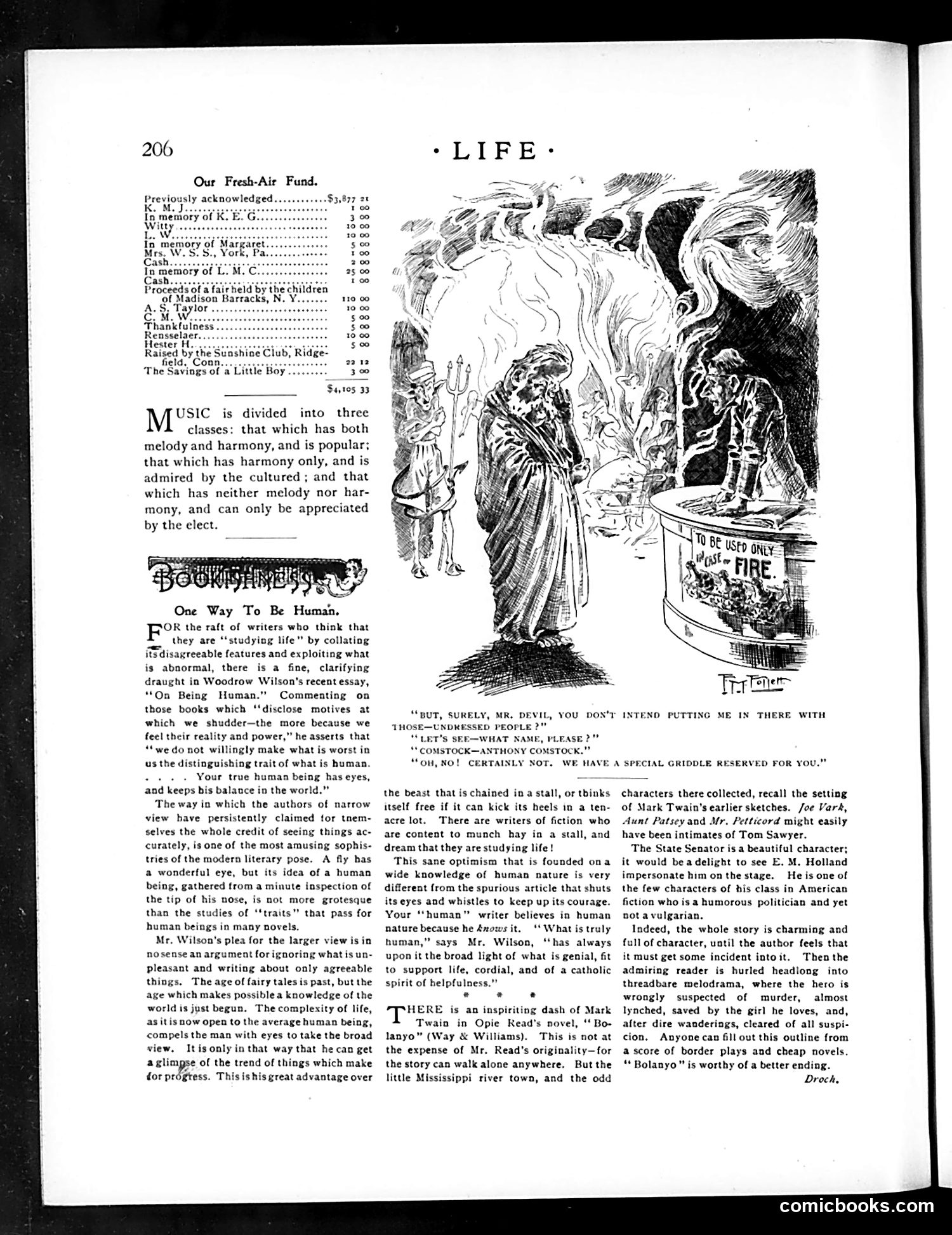
The main illustration depicts a darkly comedic scene: the Devil offers a contract to a woman while angelic figures hover above. The caption reads: "But, surely, Mr. Devil, you don't intend putting me in there with those dreadful creatures?" / "Let's see—what name, please?" / "Comstock—Anthony Comstock." / "Oh, no! Certainly not. We have a special griddle reserved for you." This satirizes **Anthony Comstock**, the real historical figure famous for aggressive censorship of literature and art in America. The joke: even the Devil considers Comstock too extreme and reserves special (hotter) punishment for him. The satire mocks Comstock's zealous moral crusading as hell-worthy—a common critique among artists and writers he targeted. The accompanying text discusses literature and human nature, reflecting contemporary debates about censorship versus artistic freedom.
📄 Transcribed text from this page (OCR, searchable)
Machine-transcribed from the original scan — historical spelling and the odd misread are preserved.
Our Fresh-Air Fund. y acknowledged. In meimery of K.E. winy now nad ound 888888838 Raised pydheS Uashine Club, Ridge: field, Cor . ‘The Savings sor" a Little Boy 2 $4,105 33 USIC is divided into three classes: that which has both melody and harmony, and is popular; that which has harmony only, and is admired by the cultured ; and that which has neither melody nor har- mony, and can only be appreciated by the elect. One Way To Be Human, OR the raft of writers who think that they are ‘studying life" by collating its disagreeable features and exploiting what is abnormal, there is a fine, clarifying draught in Woodrow Wilson's recent essay, “On Being Human.” Commenting on those books which ‘‘disclose motives at which we shudder—the more because we feel their reality and power,” he asserts that **wedo not willingly make what is worst in us the distinguishing trait of what is human. Your true human being has eyes, and keeps his balance in the world.” ‘The way in which the authors of narrow view have persistently claimed for tnem- selves the whole credit of seeing things ac- curately, is one of the most amusing sophis- tries of the modern literary pose. A fly has a wonderful eye, but its idea of a human being, gathered from a minute inspection of the tip of his nose, is not more grotesque than the studies of ‘traits’ that pass for human beings in many novels, Mr. Wilson's plea for the larger view isin no sense an argument for ignoring what is un- pleasant and writing about only agreeable things. The age of fairy tales is past, but the age which makes possible a knowledge of the world is just begun. The complexity of life, as it is now open to the average human being, compels the man with eyes to take the broad view. Itisonly in that way that he can get aglimgse of the trend of things which make for progress. This ishis great advantage over “BUT, SURELY, MR. DEVIL, YOU DON": JE WHAT NAME, PLEASE ?"? * CoMSTOCK—ANTHONY COMSTOCK, “Ou, NOL CERTAINLY NOT. W the beast that is chained ina stall, or tbinks itself free if it can kick its heels in a ten- acre lot. There are writers of fiction who are content to munch hay in a stall, and dream that they are studying life! This sane optimism that is founded ona wide knowledge of human nature is very different {rom the spurious article that shuts its eyes and whistles to keep up its courage. Your human” writer believes in human nature because he Anows it. ‘* What is truly human,” says Mr. Wilson, ‘has always upon it the broad light of what is genial, fit to support life, cordial, and of a catholic spirit of helpfulness.” * * * HERE is an inspiriting dash of Mark Twain in Opie Read's novel, ‘* Bo- lanyo” (Way & Williams). This is not at the expense of Mr. Read's originality—for the story can walk alone anywhere. But the little Mississippi river town, and the odd INTEND PUTTING ME IN THERE WITH HAVE A SPECIAL GRIDDLE RESERVED FOR YOU." characters there collected, recall the setting of Mark Twain's earlier sketches. Joe Vark, Aunt Patseyand Mr. Petticord might easily have been intimates of Tom Sawyer. The State Senator is a beautiful character; it would be adelight to see E. M. Holland impersonate him on the stage. He is one of the few characters of his class in American fiction who is a humorous politician and yet not a vulgarian. Indeed, the whole story is charming and full of character, uotil the author feels that it must get some incident intoit. Then the admiring reader is hurled headlong into threadbare melodrama, where the hero is wrongly suspected of murder, almost lynched, saved by the girl he loves, and, after dire wanderings, cleared of all suspi- cion, Anyone can fill out this outline from a score of border plays and cheap novels Bolanyo” is worthy of a better ending. Droch, comicbooks.com