
Life, 1897-09-09 · page 8 of 20
Life — September 9, 1897 — page 8: what you’re looking at
What you’re looking at
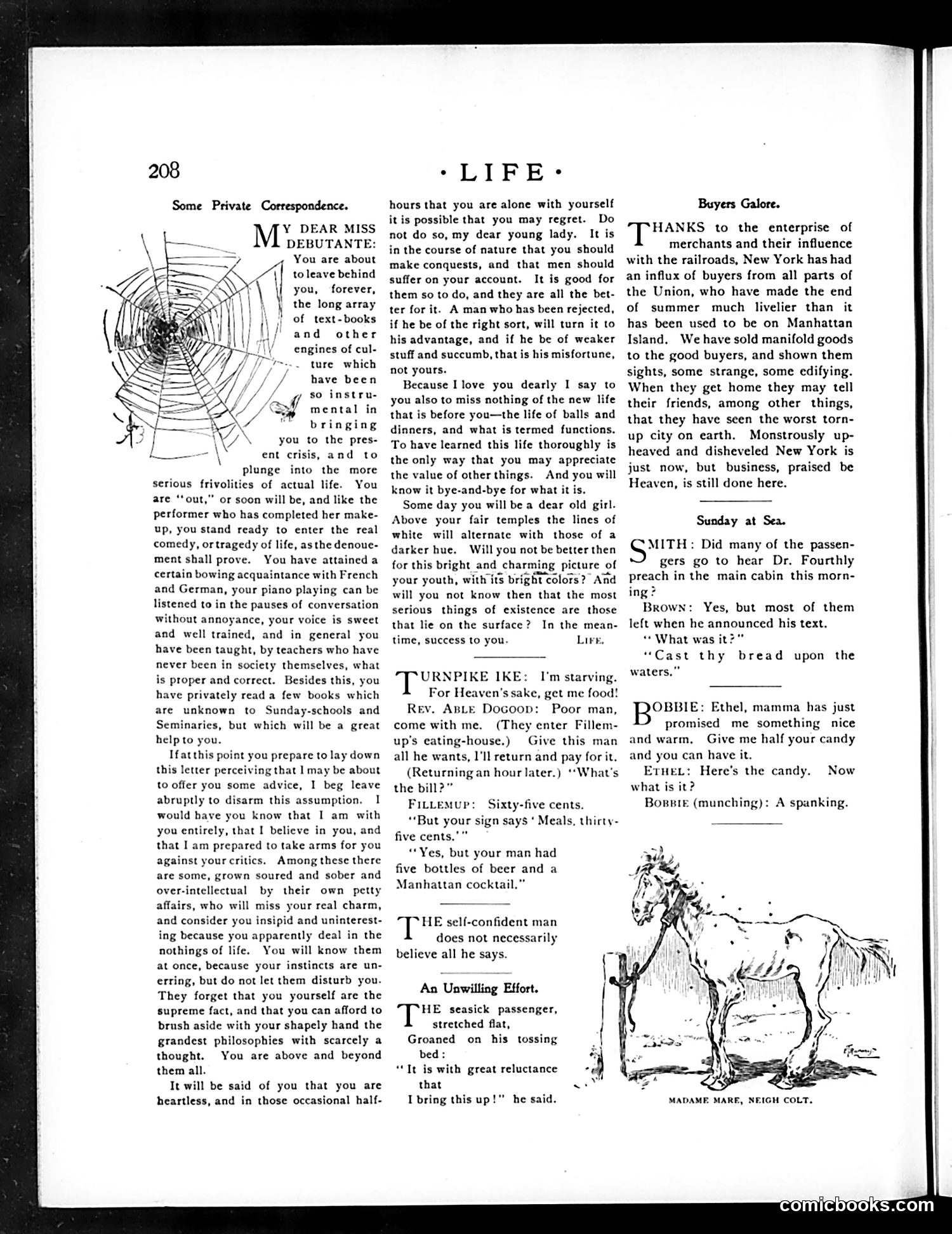
This page contains satirical short prose pieces rather than political cartoons. The main content includes: **"Some Private Correspondence"**: A lengthy letter from "My Dear Miss Unfortunate" advising a young woman leaving behind her life—books, piano, German language skills—to marry. The writer warns her that marriage will diminish her intellectual pursuits and suggests she'll regret losing her independence. **"Buyers Galore"**: A brief piece celebrating New York merchants' success selling goods to summer visitors. **Other humorous vignettes**: Including dialogue about Dr. Fourtily's preaching, candy-sharing between children, and a quip about a self-confident man. A small illustration shows a horse labeled "Madame Mare, Neigh Colt." The satire targets Victorian-era marriage's restrictions on women's intellectual life and contains light domestic humor typical of early 20th-century Life magazine.
📄 Transcribed text from this page (OCR, searchable)
Machine-transcribed from the original scan — historical spelling and the odd misread are preserved.
208 Some Private Correspondence. Y DEAR MISS DEBUTANTE: You are about toleave behind you, forever, the long array of text-books and other engines of cul- ture which have been so instru- mental in bringing you to the pres- ent crisis, and to plunge into the more serious frivolities of actual life. You are ‘‘out,” or soon will be, and like the performer who has completed her make- up, you stand ready to enter the real comedy, or tragedy of life, as the denoue- ment shall prove. You have attained a certain bowing acquaintance with French and German, your piano playing can be listened to in the pauses of conversation without annoyance, your voice is sweet and well trained, and in general you have been taught, by teachers who have never been in society themselves, what is proper and correct. Besides this, you have privately read a few books which are unknown to Sunday-schools and Seminaries, but which will be a great help to you. Ifatthis point you prepare to lay down this letter perceiving that | may be about to offer you some advice, 1 beg leave abruptly to disarm this assumption. 1 would have you know that I am with you entirely, that I believe in you, and that I am prepared to take arms for you against yourcritics. Among these there are some, grown soured and sober and over-intellectual by their own petty affairs, who will miss your real charm, and consider you insipid and uninterest- ing because you apparently deal in the nothings of life. You will know them at once, because your instincts are un- erring, but do not let them disturb you. They forget that you yourself are the supreme fact, and that you can afford to brush aside with your shapely hand the grandest philosophies with scarcely a thought. You are above and beyond them all. It will be said of you that you are heartless, and in those occasional half- * LIFE: hours that you are alone with yourself it is possible that you may regret. Do not do so, my dear young lady. It is in the course of nature that you should make conquests, and that men should suffer on your account. It is good for them so to do, and they are all the bet- ter for it. A man who has been rejected, if he be of the right sort, will turn it to his advantage, and if he be of weaker stuff and succumb, that is his misfortune, not yours. Because I love you dearly I say to you also to miss nothing of the new life that is before you—the life of balls and dinners, and what is termed functions. To have learned this life thoroughly is the only way that you may appreciate the value of otherthings. And you will know it bye-and-bye for what it is, Some day you will be a dear old girl. Above your fair temples the lines of white will alternate with those of a darker hue. Will you not be better then for this bright and charming picture of your youth, with its bright colors? And will you not know then that the most serious things of existence are those that lie on the surface ? time, success to you. In the mean- Lire. URNPIKE IKE: I'm starving. For Heaven's sake, get me food! Rev. ABLE DoGoop: Poor man, come with me. (They enter Fillem- up's eating-house.) Give this man all he wants, I'll return and pay for it. (Returning an hour later.) ‘What's the bill?” FILLemMuP: Sixty-five cents. “But your sign says ‘ Meals, thirty- five cents." “Yes, but your man had five bottles of beer and a Manhattan cocktail.” HE self-confident man does not necessarily believe all he says. An Unwilling Effort. HE seasick passenger, stretched flat, Groaned on his tossing bed: “Tt is with great reluctance that I bring this up!" he said. Buyers Galore. HANKS to the enterprise of merchants and their influence with the railroads, New York has had an influx of buyers from all parts of the Union, who have made the end of summer much livelier than it has been used to be on Manhattan Island. We have sold manifold goods to the good buyers, and shown them sights, some strange, some edifying. When they get home they may tell their friends, among other things, that they have seen the worst torn- up city on earth. Monstrously up- heaved and disheveled New York is just now, but business, praised be Heaven, is still done here. Sunday at Sea. MITH: Did many of the passen- gers go to hear Dr. Fourthly preach in the main cabin this morn- ing? Brown: Yes, but most of them left when he announced his text. ** What was it?" “Cast thy bread upon the waters,” OBBIE: Ethel, mamma has just promised me something nice and warm, Give me half your candy and you can have it. Eru Here's the candy, what is it? Bosste (munching): A spanking. Now MADAME MARE, NEIGH COLT.