
A complete issue · 20 pages · 1897
Life — May 6, 1897
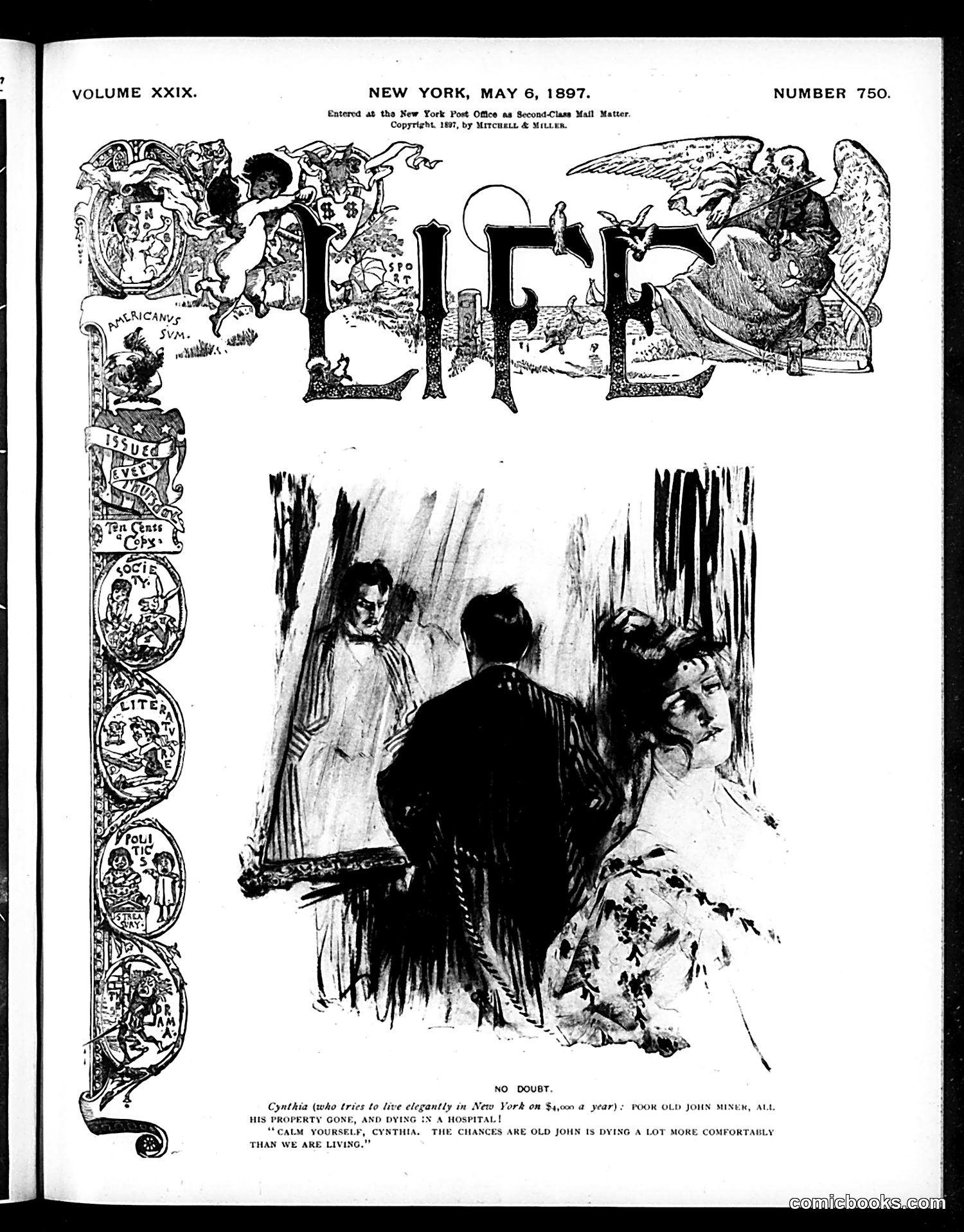
This cartoon satirizes wealth inequality in the Gilded Age. The caption presents a dialogue between Cynthia (a wealthy woman trying to live "elegantly in New York on $4,000 a year") and Poor Old John Miner, who has lost his property and is dying in a hospital. Cynthia's smug comment—that John is "dying a lot more comfortably than we are living"—is the joke's bitter irony. It mocks the pretensions of the upper-middle class, suggesting their desperate struggles to maintain appearances of gentility are actually *worse* than the poverty and death of working people. The satire targets how the wealthy obsess over status symbols while dismissing genuine suffering below them.
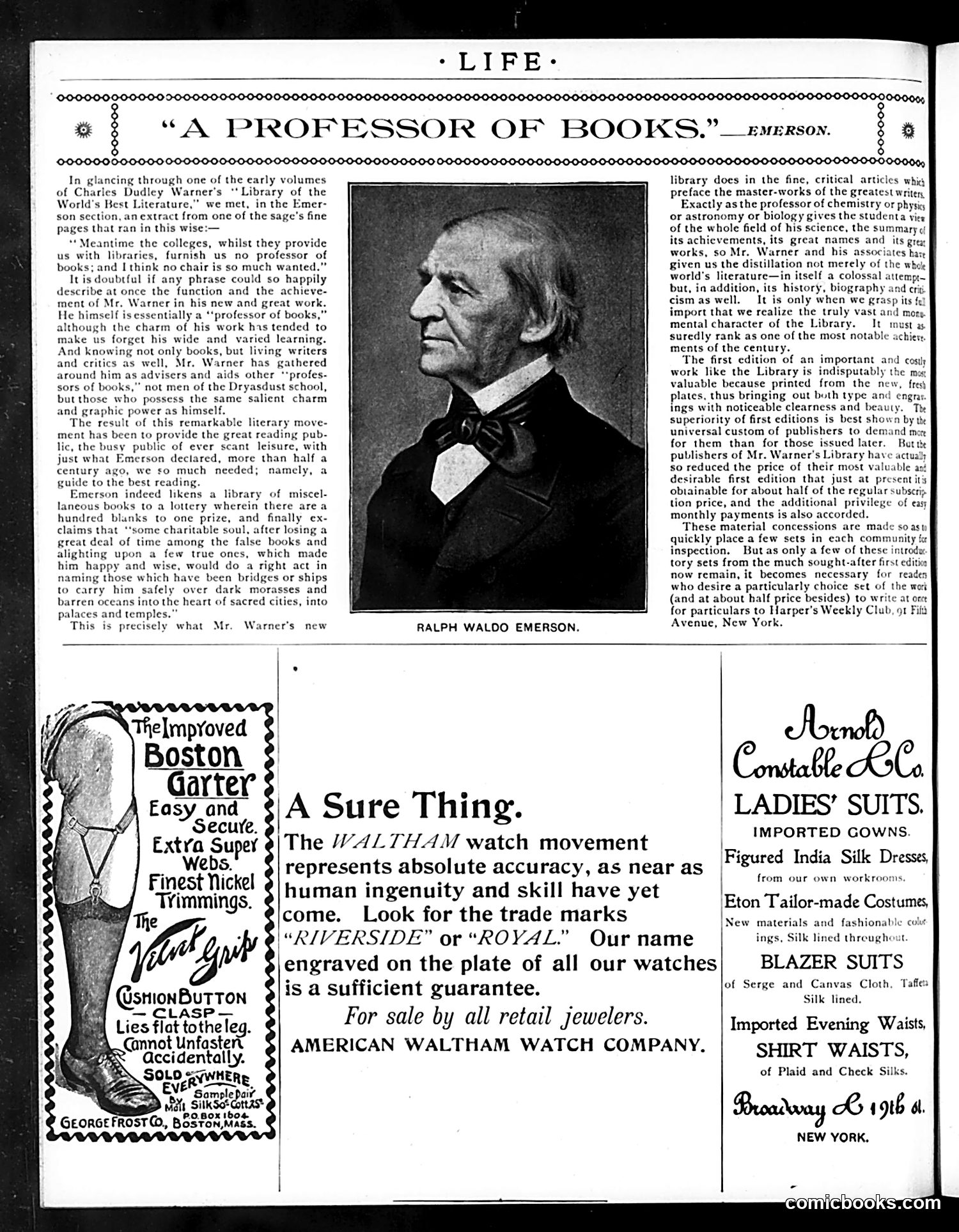
This page is **primarily advertising** with one substantive article. The main content is "A Professor of Books," a tribute to Ralph Waldo Emerson (whose portrait is shown). The article praises Emerson's curation of a library, comparing him to a "professor of books" who guides readers toward quality literature—referencing Emerson's famous declaration that libraries serve this function. The advertisements below are era-typical: a Boston garter, Waltham watches, and ladies' fashion suits. These represent early 1900s consumer culture aimed at middle and upper-class readers. There is **no political cartoon** on this page. The satire is implicit in the article's framing: celebrating Emerson's intellectual authority in an age when consumer goods dominated American magazines.
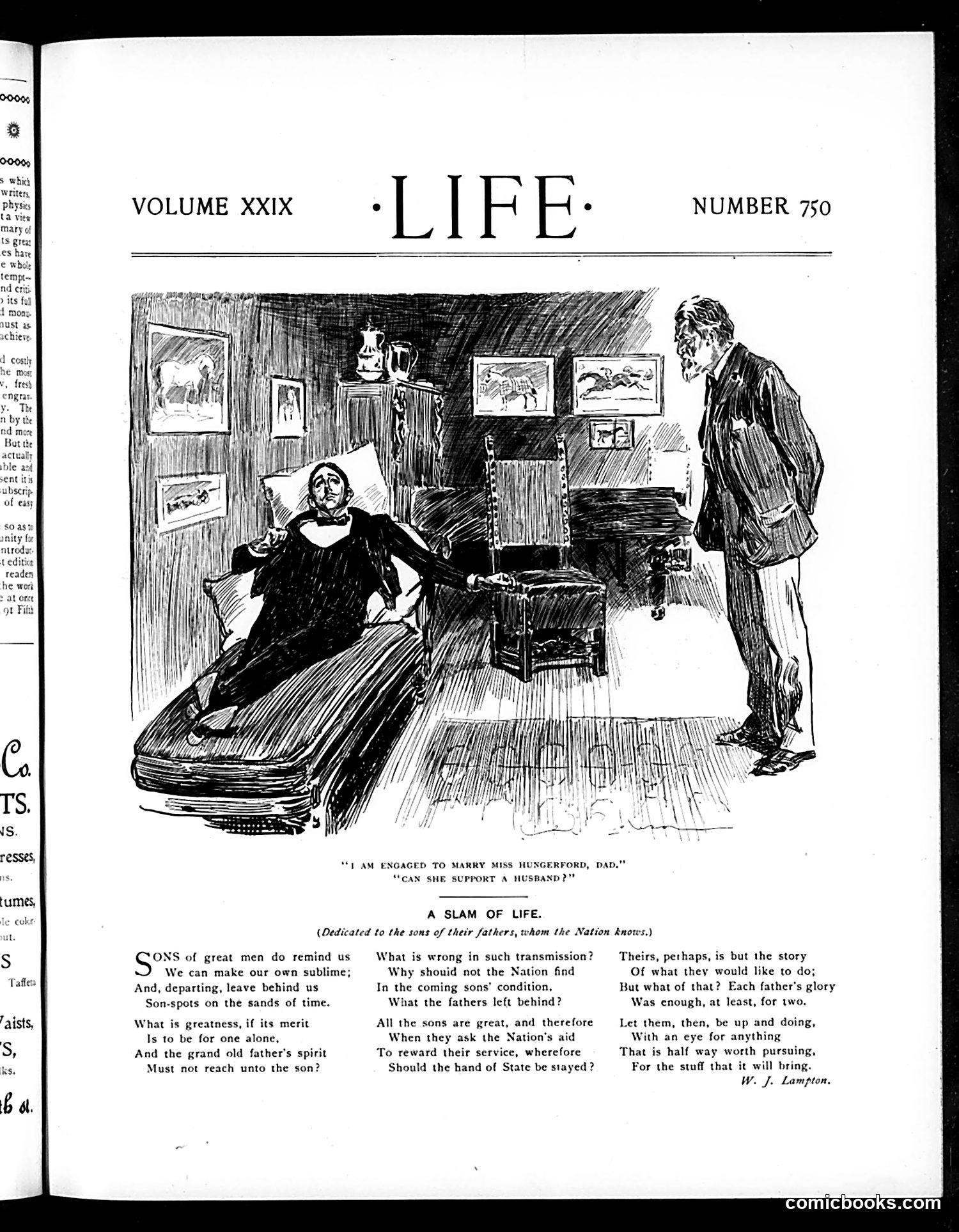
This cartoon satirizes wealthy fathers' concerns about their sons' marriages and financial security. The scene shows a young man reclining casually while his father stands disapprovingly. The dialogue—"I am engaged to marry Miss Hungerford, Dad. Can she support a husband?"—inverts traditional expectations by having the son ask whether his fiancée can financially support *him*, rather than vice versa. The satire critiques both idle sons of wealthy families (who lack ambition or means) and the anxiety about women's economic independence. The poem below reinforces this, questioning why sons of great men fail to achieve their own merit. The piece mocks the social anxiety of the era regarding changing gender roles and economic dependency.
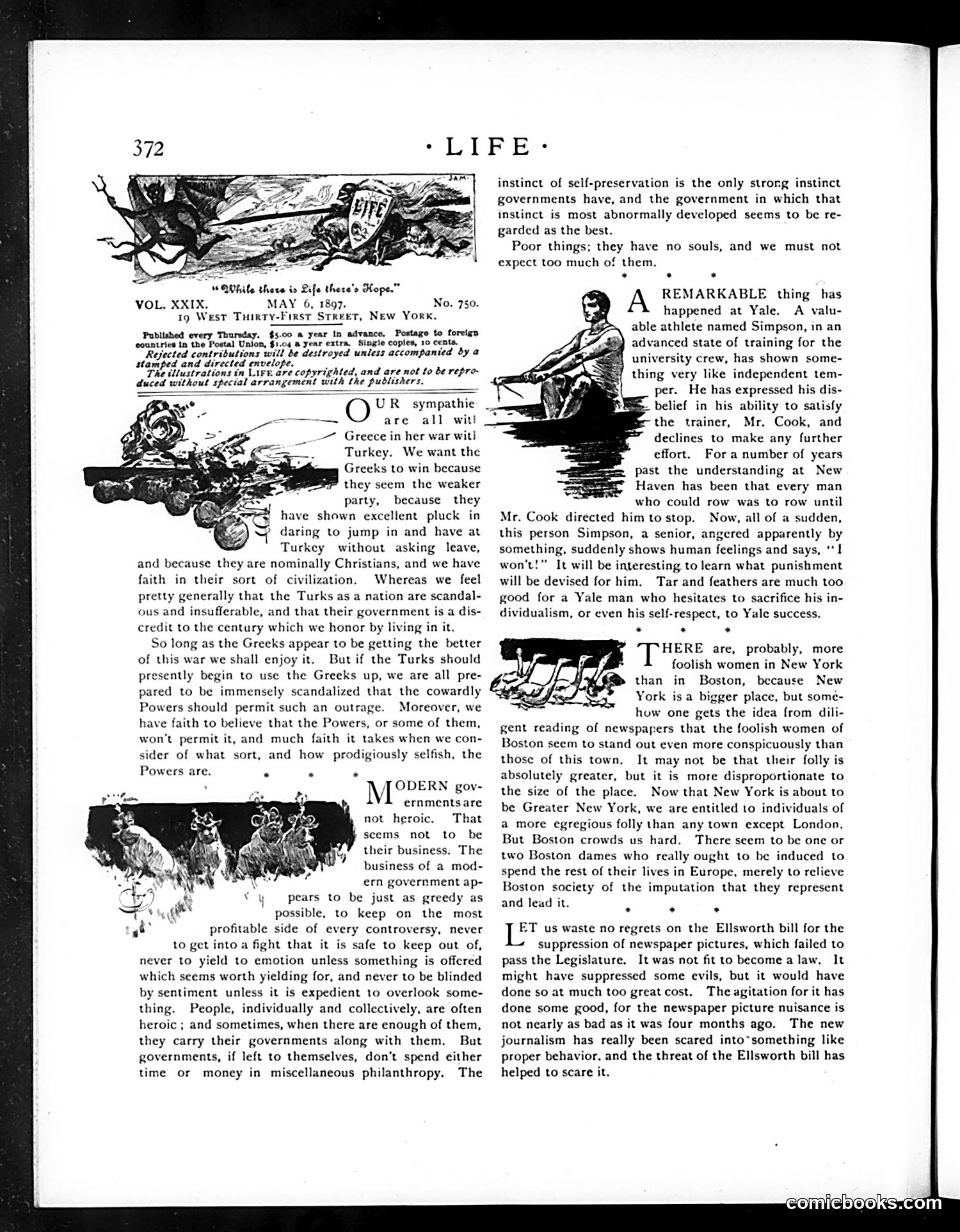
The top cartoon depicts a figure labeled "Life" shielding themselves, commenting on Greek-Turkish conflict. The accompanying article expresses sympathy for Greeks in their war with Turkey, criticizing Turkey's government as scandalous and arguing the Powers should support Greece militarily. The middle illustration shows fashionable women, relating to text mocking "foolish women in New York" for their frivolity compared to Boston women. The satire suggests New York's larger size enables greater foolishness. The bottom section discusses the failed Ellsworth bill—legislation to suppress newspaper picture supplements. The text argues the threat of the bill itself scared journalism into better behavior, making actual passage unnecessary. These pieces collectively target government inefficiency, urban vanity, and press accountability—typical Life magazine concerns of the era.
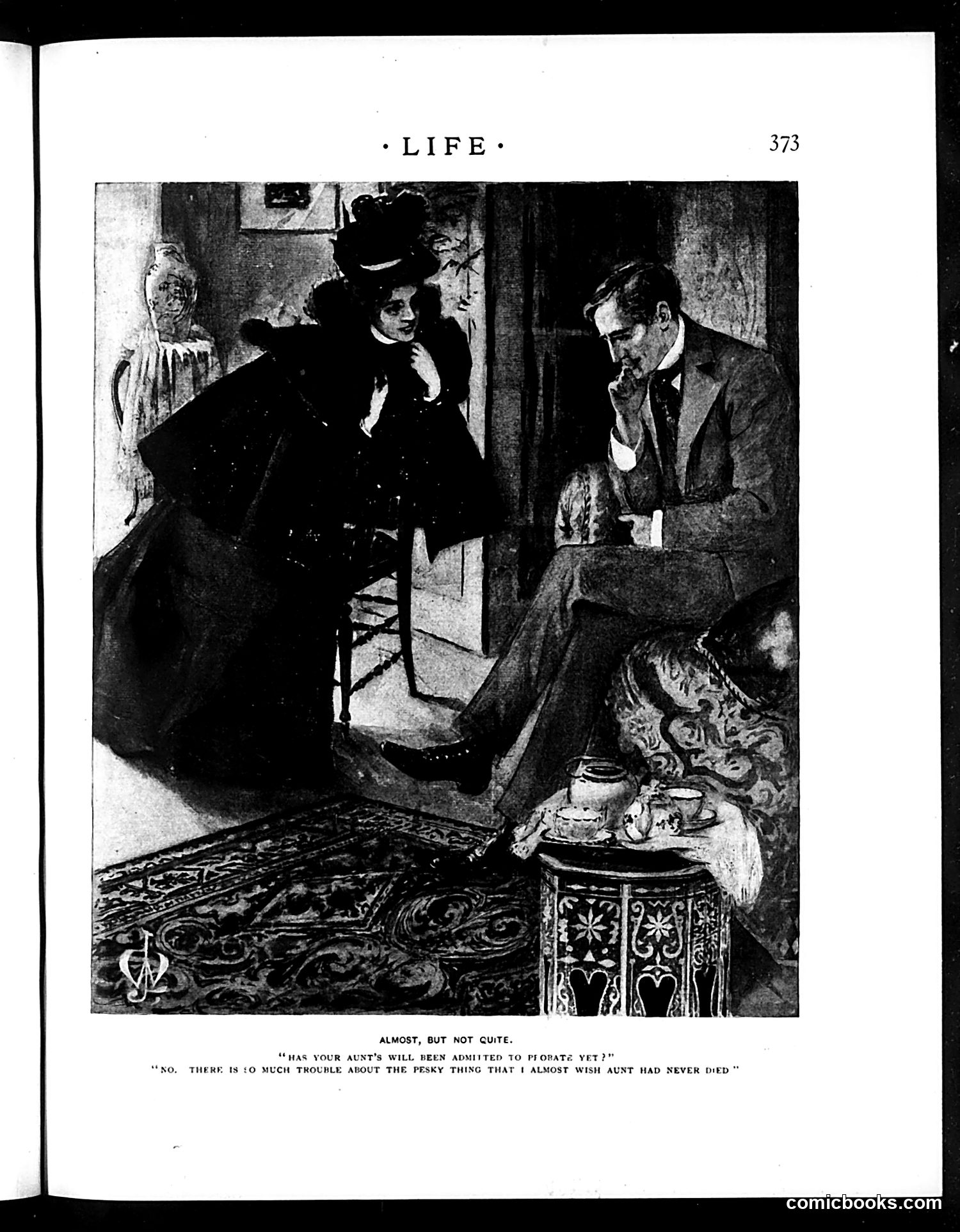
This illustration depicts a domestic scene involving inheritance disputes. The caption indicates a conversation about an aunt's will and probate proceedings. A woman (seated, right) discusses troubling matters with visiting relatives—a well-dressed man and an elegantly clothed woman in a feathered hat. The joke hinges on the speaker's complaint that although the aunt's will admission to probate is nearly settled, there remains "so much trouble about the pesky thing" that the speaker almost wishes the aunt "had never died." The satire targets the tedious legal and financial complications surrounding inheritance, suggesting that even modest estates create disproportionate bureaucratic headaches. The title "Almost, But Not Cute" implies such troubles, while perhaps inevitable, lack the charm or humor one might expect from domestic comedy.
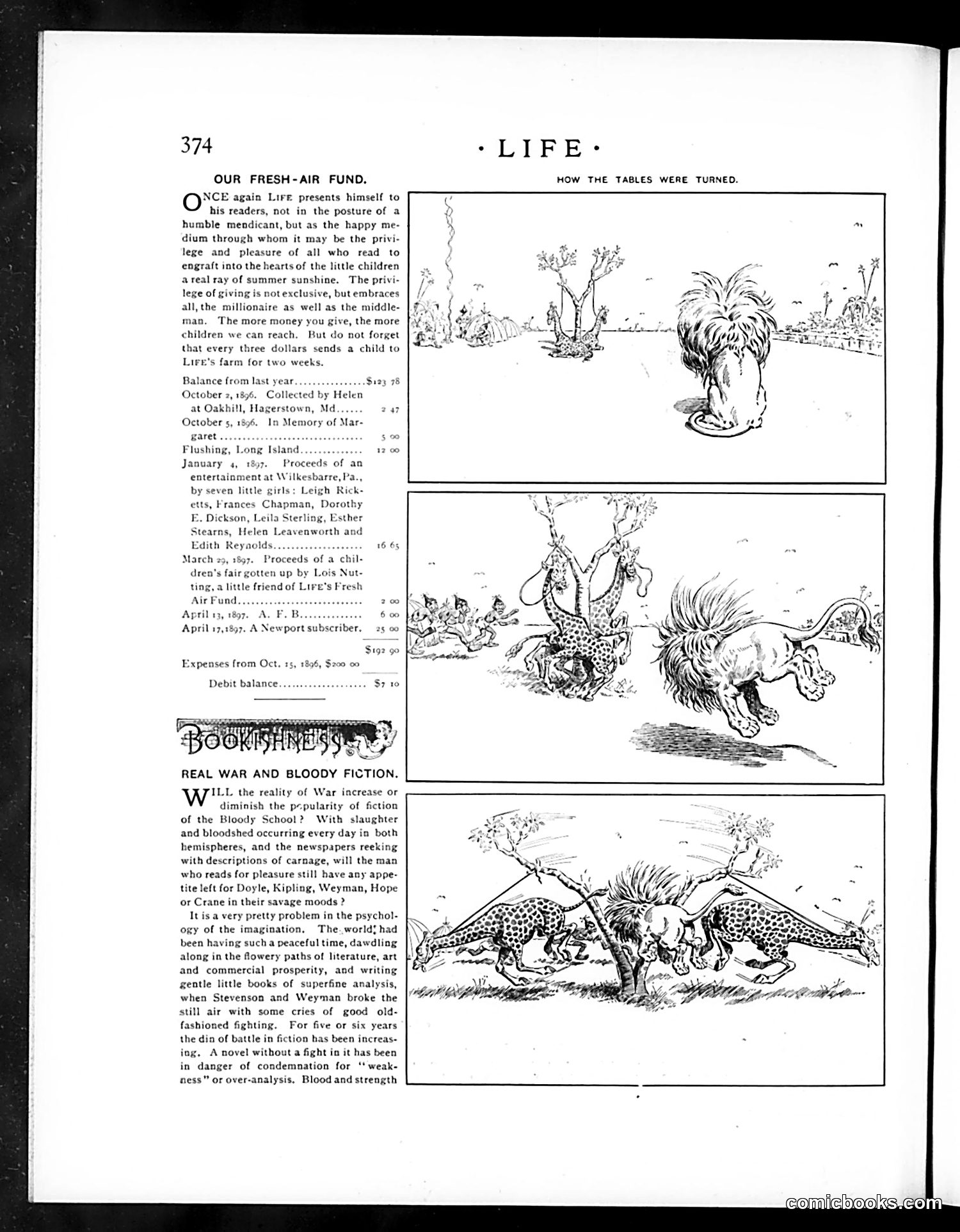
**"Our Fresh-Air Fund"** (top section): This reports on Life magazine's charitable initiative providing summer outings for urban children. The three illustrated panels show children's delight at encountering nature—a pastoral landscape, playing with a dog, and discovering wildlife (appears to be an armadillo). The satire is gentle: it celebrates the magazine's philanthropic work while depicting the children's amazement at simple natural experiences, implying that urban poverty denies even basic encounters with nature. **"Real War and Bloody Fiction"** (bottom section): This critiques the popularity of violent adventure fiction (authors like Doyle, Kipling, Stevenson, and Weyman are mentioned). The article questions whether actual warfare's horrors would diminish readers' appetite for fictional combat narratives. The social commentary suggests tension between literary taste and moral sensibility during a period of contemporary military conflict.
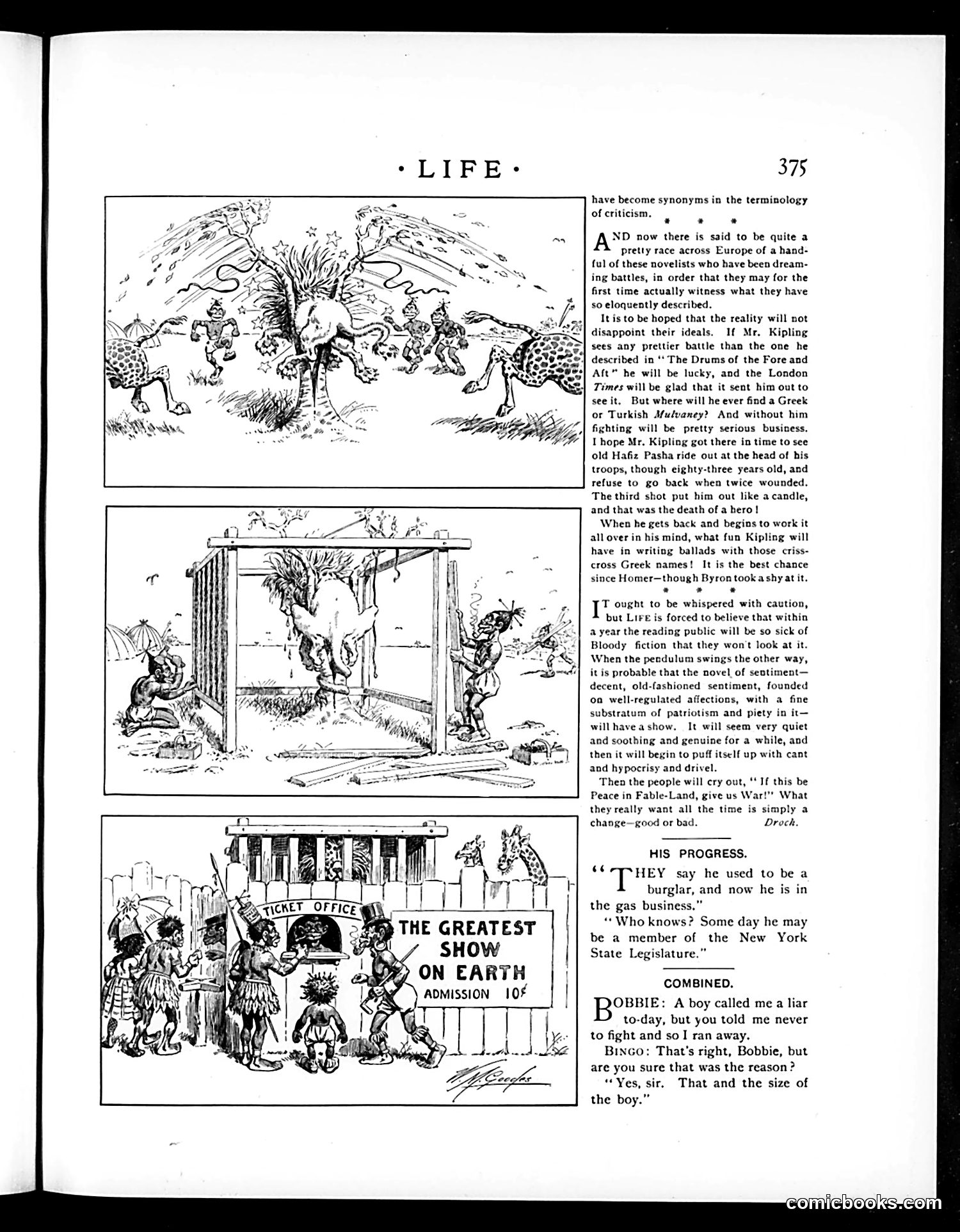
This page contains three satirical cartoon panels and accompanying commentary. The top panel depicts figures around a tree, likely referencing colonial or imperial conflicts. The middle panel shows a gallows structure, suggesting dark political humor about execution or justice. The bottom panel advertises "The Greatest Show on Earth" with a ticket office, parodying P.T. Barnum's famous circus while depicting crowds of caricatured figures—likely satirizing public spectacle and entertainment culture. The text discusses Rudyard Kipling's anticipated writings about military conflicts (possibly referencing Haji Pasha and Turkish forces), suggesting anticipation for sensationalist war narratives. The page's commentary expresses skepticism about forthcoming "bloody fiction" and sentiment-driven literature, indicating Life's satirical critique of both imperial military adventures and their popular literary dramatization.
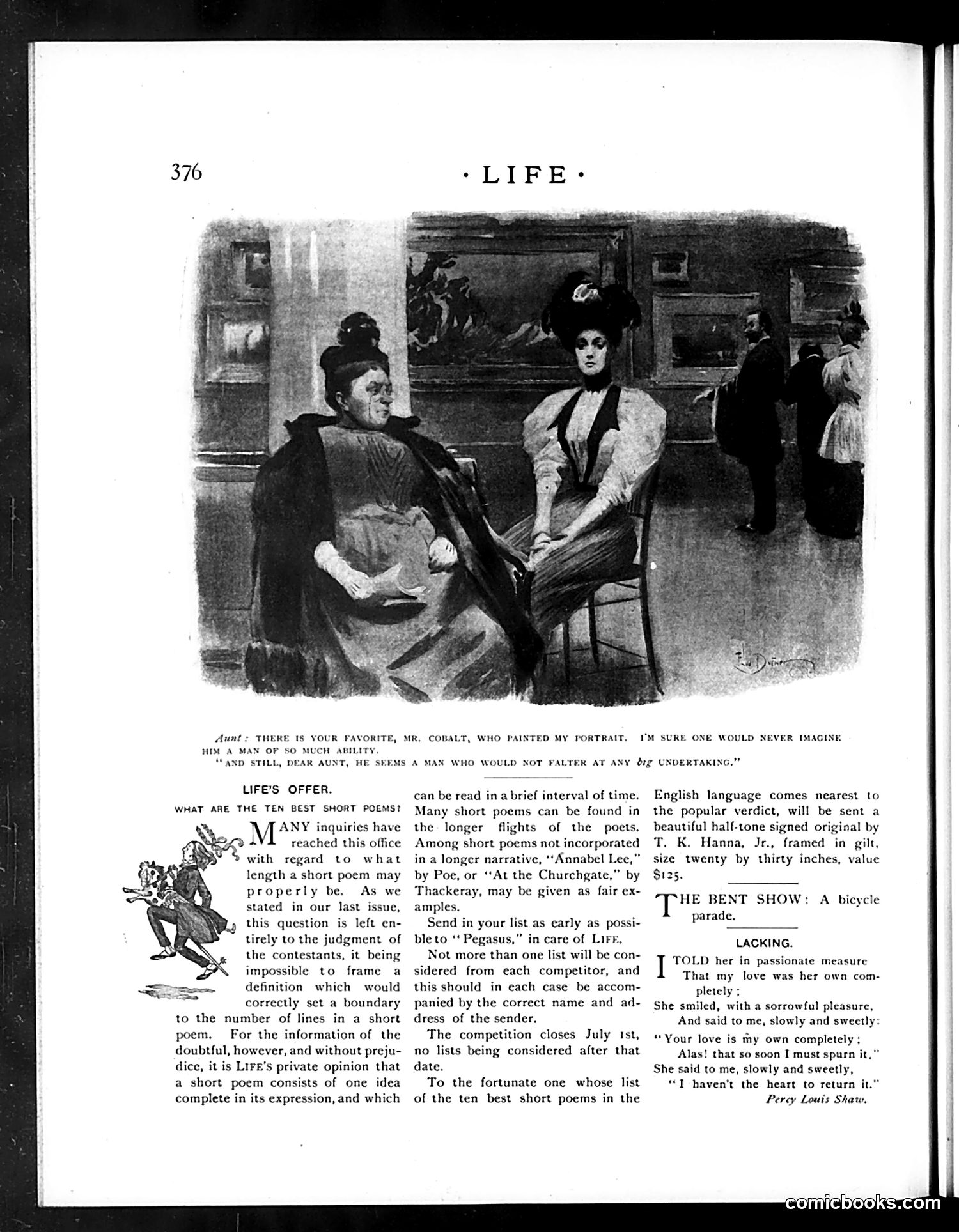
The main illustration depicts two women in an art gallery or museum setting, with the caption quoting an aunt praising a portrait painter named Cobalt for his work. The aunt suggests he's a man of "such solid respectability" that she couldn't imagine him faltering at any undertaking. This appears to be gentle satire about social pretension and artistic reputation. The joke likely hinges on a contrast between the aunt's high opinion of the painter's character and reliability versus some implicit irony about artists or portrait painters that contemporary readers would have recognized. The page also contains "Life's Offer"—a literary competition soliciting short poems, with submission details and rules. This was a common feature of early-20th-century magazines encouraging reader participation.
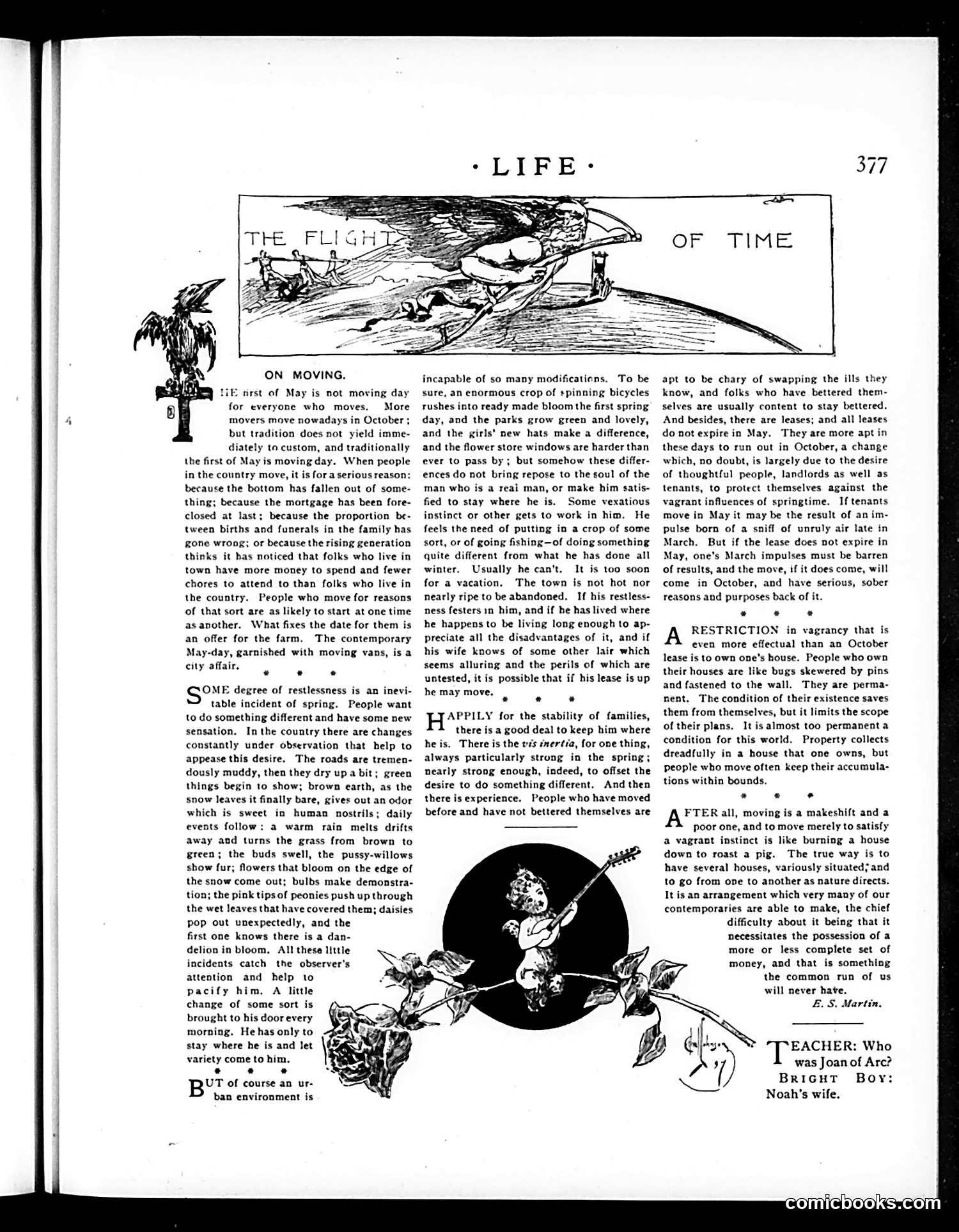
This page contains a humorous essay titled "The Flight of Time" discussing spring moving season in America. The central cartoon depicts Cupid with a violin surrounded by spring flowers and foliage, symbolizing the romantic associations of May and the season's influence on people's decisions to relocate. The text satirizes the American practice of moving house in May, arguing that urban residents flee the city during spring driven by "vagrant instinct" rather than rational planning. The author (E.S. Martin) mocks those who abandon homes yearly, comparing it to "burning a house down to roast a pig." The small footer quiz asks "Who was Joan of Arc?" with the answer "Noah's wife"—a simple joke rather than political commentary.
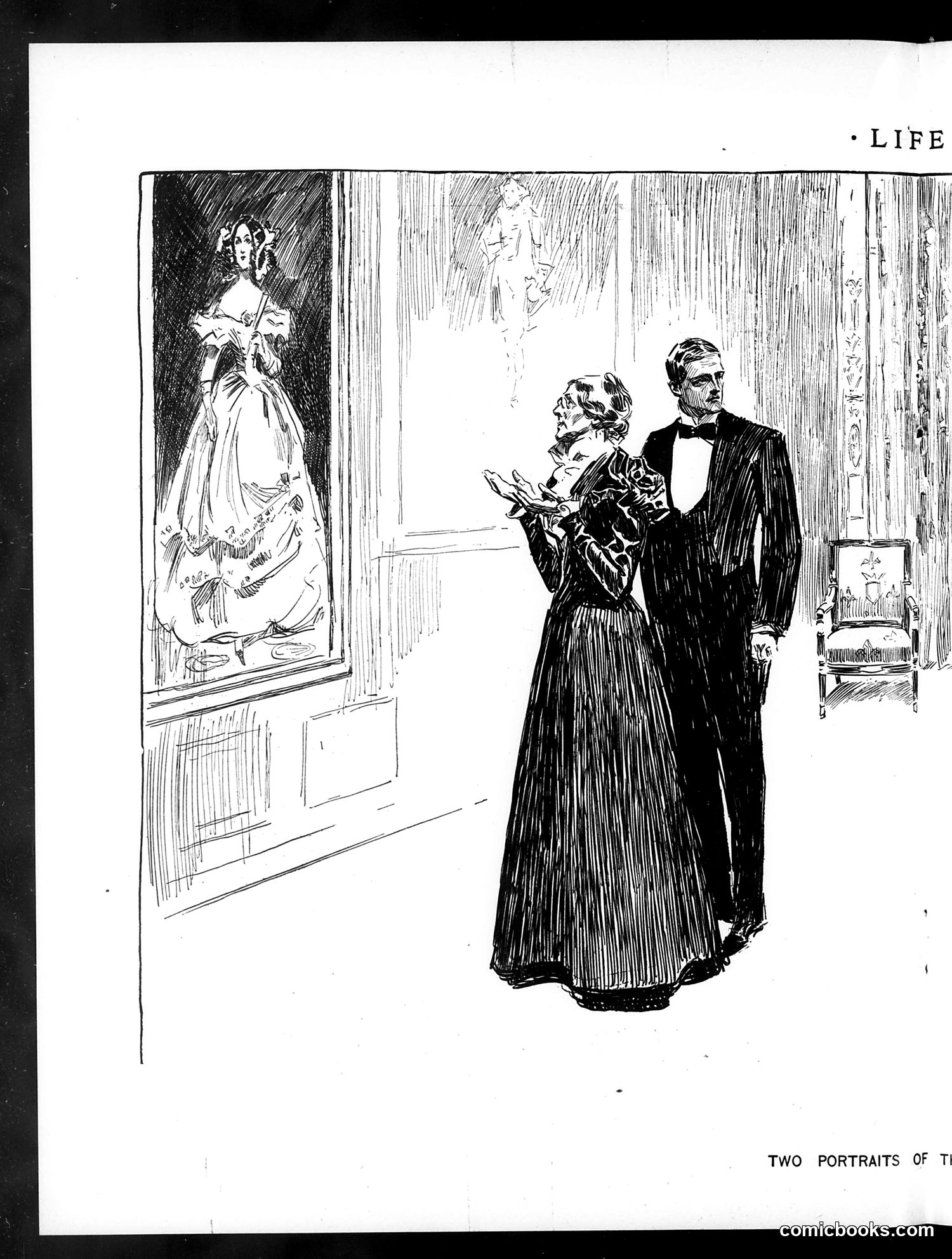
This appears to be a satirical illustration from *Life* magazine showing a couple admiring portraits. The caption reads "TWO PORTRAITS OF..." but is cut off, making the specific subject unclear. The image depicts a well-dressed man in formal evening wear (tuxedo) and a woman in an elegant gown viewing what appears to be a portrait in a frame on the wall. The woman is gesturing toward it while holding what looks like a program or placard. Without the complete caption, the precise satirical target is difficult to determine. The humor likely involves commentary on either the people being portrayed, the portraits themselves, or perhaps society's obsession with status symbols and appearances. The formal setting suggests this may reference high society or cultural institutions, but the exact point of satire cannot be definitively stated from the visible text alone.
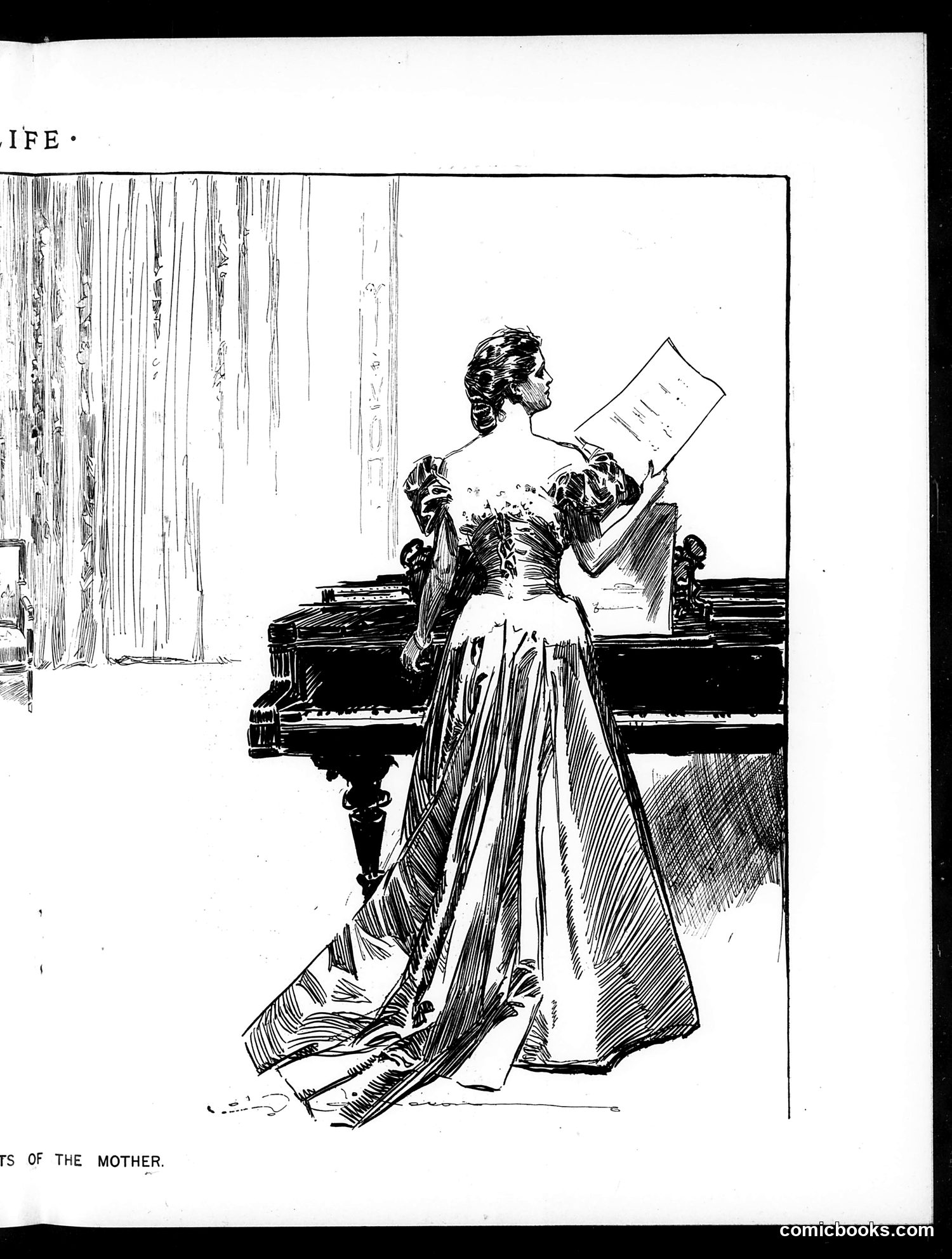
This is a pen-and-ink illustration showing an elegantly dressed woman in an elaborate gown, seated at a piano while reading sheet music. The partial caption reads "TS OF THE MOTHER," suggesting this is part of a larger title. The image appears to be a straightforward domestic scene depicting a refined woman engaged in cultured leisure activity—piano playing being a marker of genteel femininity and education in early 20th-century society. Without additional context or visible satirical elements (caricature, exaggeration, or ironic juxtaposition), this reads as an aspirational illustration rather than political satire. The actual satirical point or social commentary, if present, likely depends on the complete caption and surrounding page content not fully visible here.
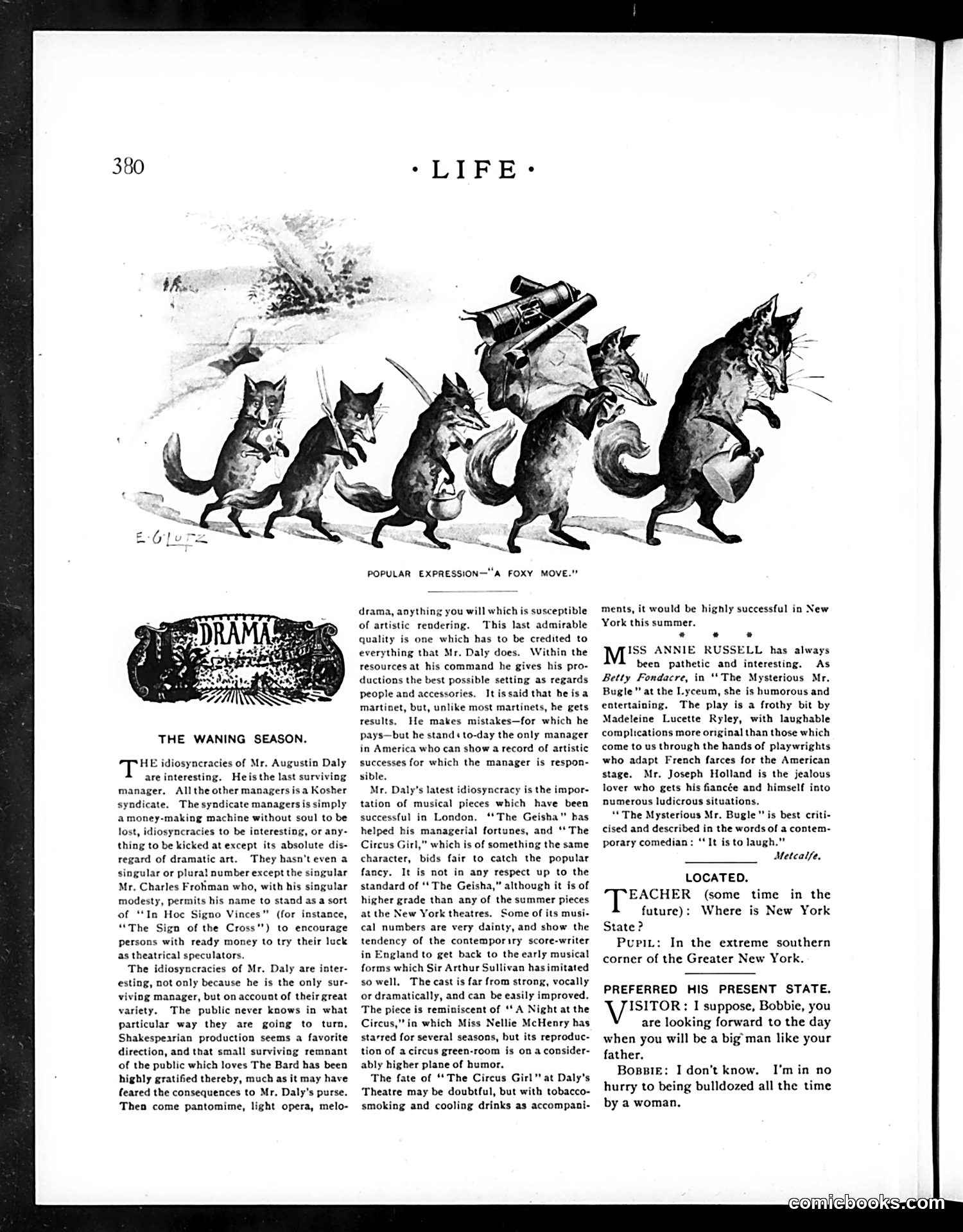
This satirical cartoon depicts five anthropomorphic foxes in a line, with the lead fox carrying what appears to be binoculars or a telescope. The caption "POPULAR EXPRESSION—'A FOXY MOVE'" suggests the image is a visual pun playing on the word "foxy," meaning cunning or clever. The cartoon illustrates the idiomatic expression literally—actual foxes executing what humans would call a "foxy" (shrewd, deceptive) maneuver. The progression of foxes and their coordinated positioning suggest they're engaged in some form of cunning scheme or heist, with the telescope-like object suggesting surveillance or reconnaissance. This is a straightforward visual joke exploiting the double meaning of "foxy" in early 20th-century American slang.
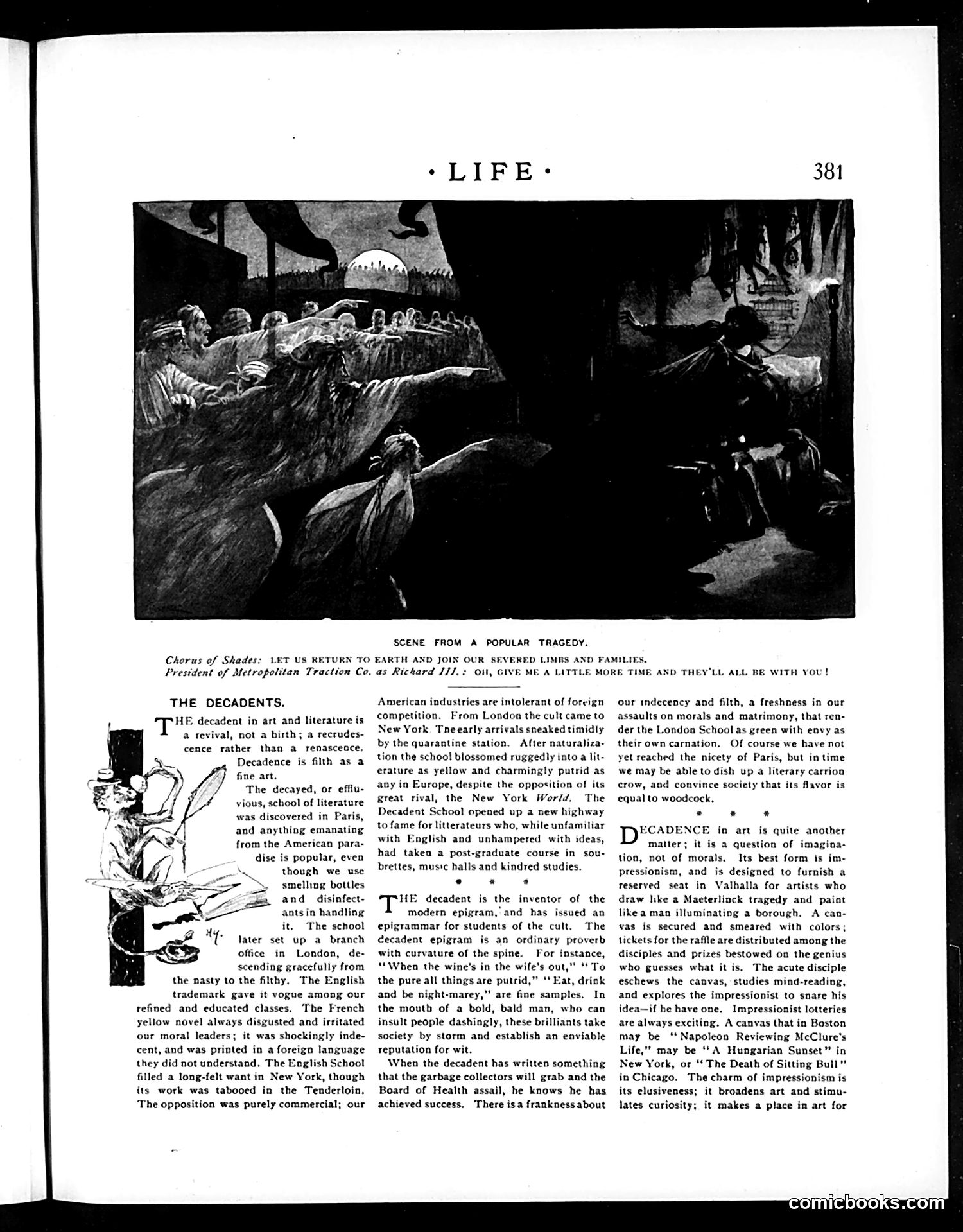
This article satirizes the "Decadent" artistic movement that had migrated from Paris to London and then to New York. The text argues that this school of art and literature deliberately embraces obscenity and moral corruption as aesthetic virtue. The satire targets: 1. **Foreign artistic snobbery**: Americans blindly adopt European (especially French and English) cultural trends without understanding them, including morally questionable work. 2. **Artistic pretension**: Decadents create deliberately obscure, "putrid" work and claim genius status. The epigrams quoted are intentionally absurd ("When the wine's in the wife's out"). 3. **Impressionism's vagueness**: The final section mocks Impressionist painting as so unclear that the same canvas receives different titles in different cities—suggesting the movement relies on viewer projection rather than artistic skill. The accompanying illustration shows a theatrical tragedy scene, possibly Shakespeare, contrasting classical dramatic art with modern decadence. The overall tone is one of moral outrage mixed with ridicule at pretentious avant-garde fashionability.
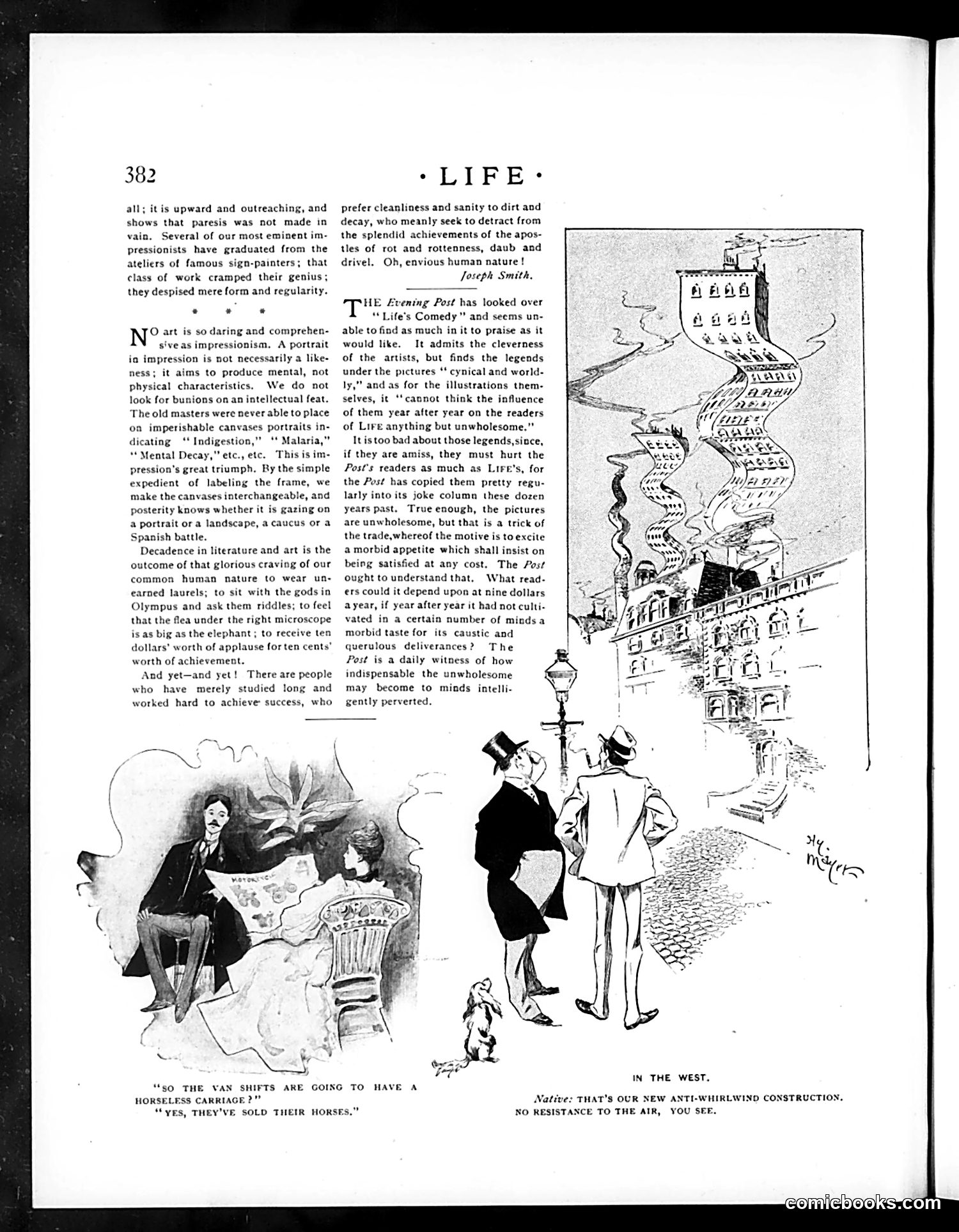
This page satirizes **Impressionism in art** and defends traditional craftsmanship. The text mocks artists who claim "impressionism" excuses poor technical skill—labeling sloppy work as expressing "mental" rather than "physical" qualities. Life argues these artists merely relabel interchangeable canvases to avoid accountability. The **left cartoon** shows a man presenting what appears to be abstract or poorly executed art, captioned about selling horses for a "horseless carriage"—satirizing how artists abandon proven methods for fashionable but inferior new trends. The **right cartoon** depicts two men observing a tall building in the West with an "anti-whirlwind construction" design, likely mocking over-engineered or absurd architectural solutions to practical problems. The page also **attacks the Evening Post** for criticizing Life's humor while simultaneously copying Life's jokes—calling out hypocrisy. Throughout, Life defends merit-based achievement against what it sees as pretentious mediocrity dressed up as modern artistic progress.
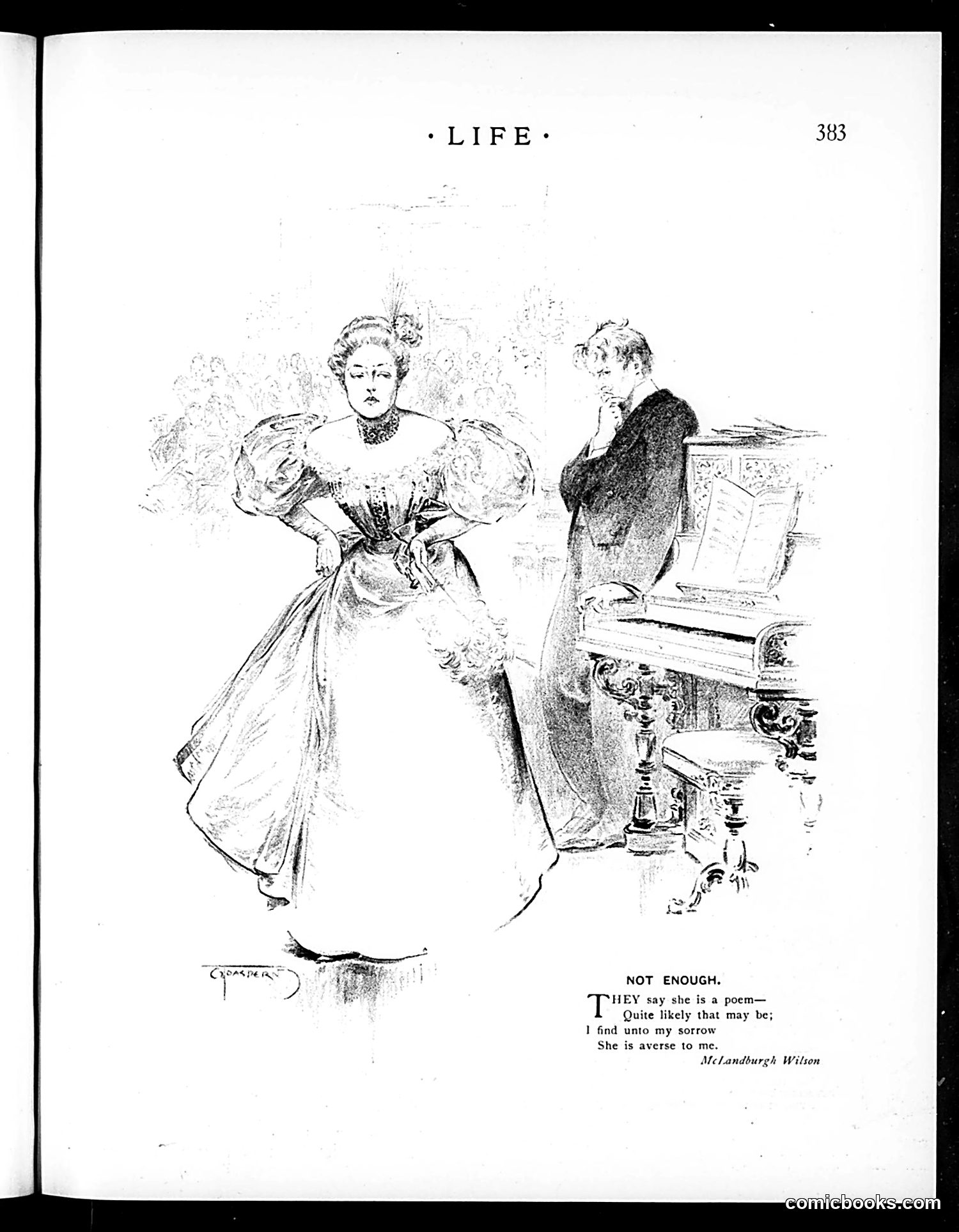
This illustration depicts a romantic rejection scene. A well-dressed man stands anxiously by an ornate desk, while an elegantly dressed woman in fashionable 1890s attire (with characteristic puffy sleeves) turns away from him with an indifferent or dismissive expression. The accompanying verse by Melandburgh Wilson sarcastically comments that though others praise the woman as poetic or admirable ("a poem"), the speaker finds her fundamentally uninterested in him personally—she is "averse" to his romantic advances. The joke is the gap between her supposed qualities and her actual coldness toward this particular suitor. The cartoon satirizes romantic pursuit and the painful reality that admiration alone doesn't create reciprocal affection.
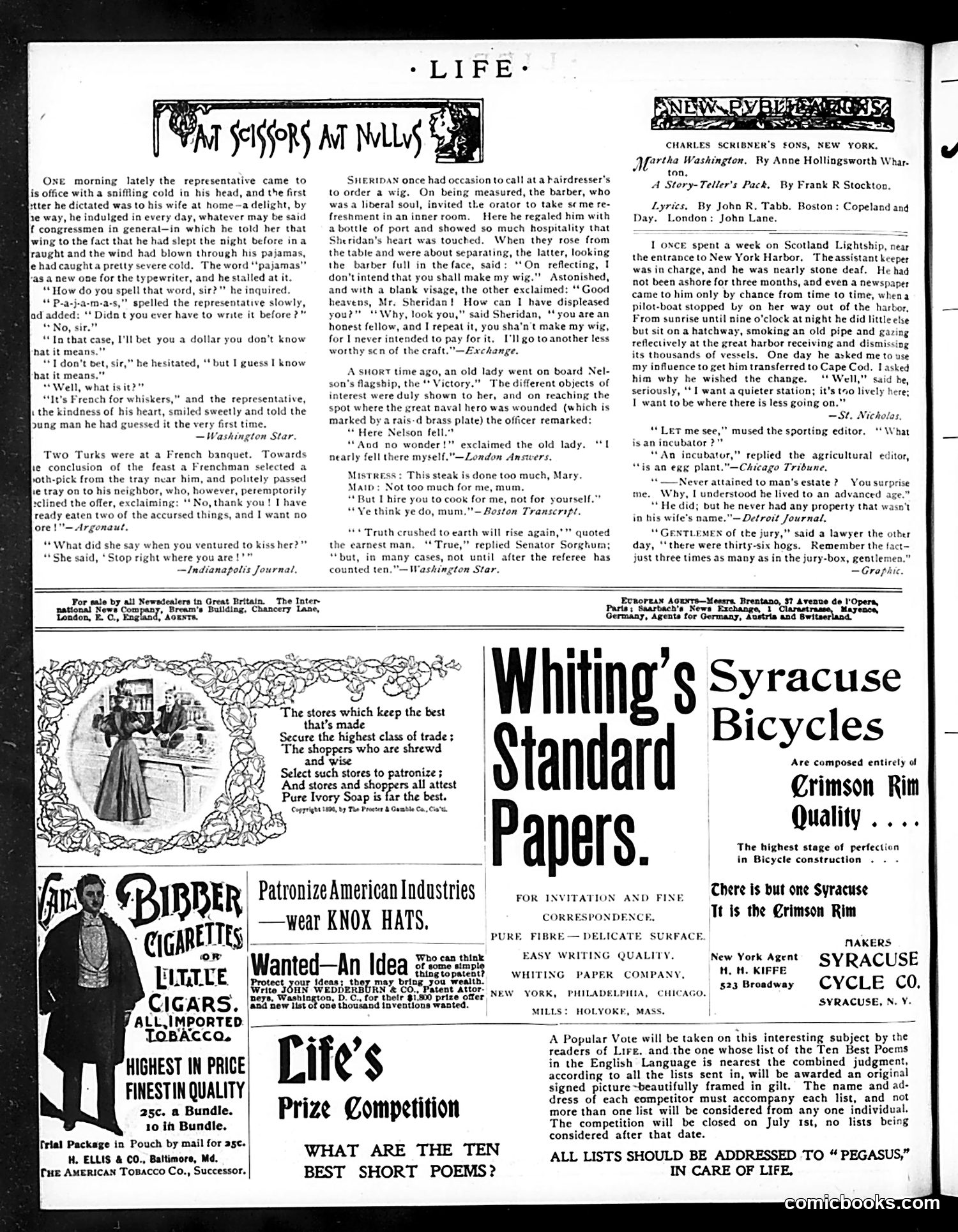
This page consists primarily of **humorous anecdotes** rather than political cartoons. The jokes satirize everyday social situations and linguistic confusion common to early 20th-century American life. The main content includes: 1. **"Pajamas" anecdote**: A congressman's secretary doesn't know the word "pajamas" and hilariously guesses it means "French for whiskers"—mocking clerical incompetence and linguistic ignorance. 2. **Other brief jokes** about social awkwardness: a Turk refusing toothpicks at a French banquet, Sheridan avoiding a barber's wig, a servant mishearing Nelson's death location, and class-conflict humor about cooking. The page is primarily **advertising** for books (Charles Scribner's Sons), bicycles, cigarettes, and paper products—typical for Life magazine's business model. The satire targets pretension, miscommunication, and class differences rather than specific political figures or events. The humor relies on wordplay and social embarrassment rather than contemporary political commentary.
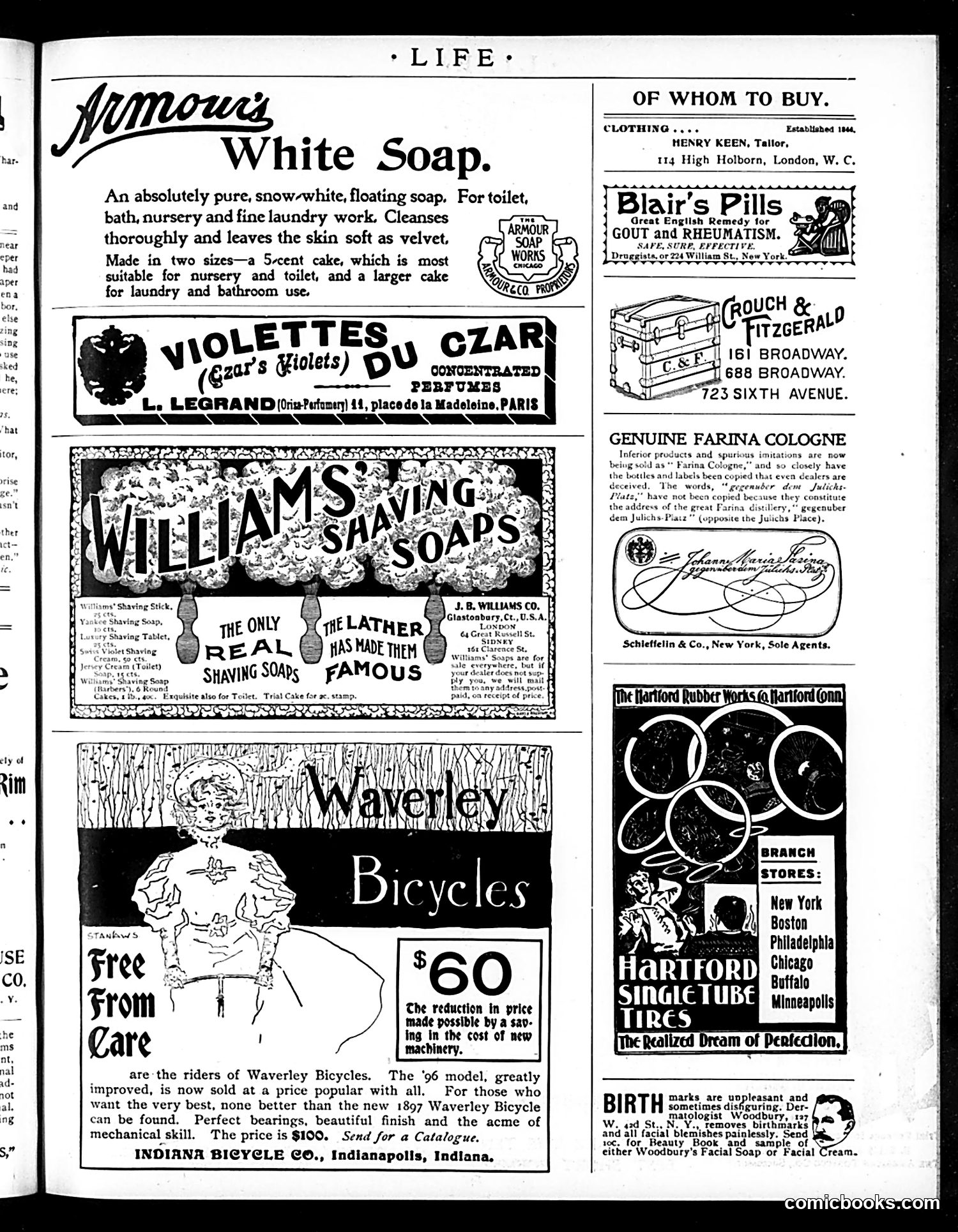
This page is primarily **advertising**, not political satire. It contains product advertisements from the 1890s era, including: - **Armour's White Soap** and **Williams' Shaving Soaps** — hygiene products - **Violettes du Czar perfume** — a French luxury fragrance - **Waverley Bicycles** — priced at $60, marketed as improved 1896-1897 models with "perfect bearings" and "beautiful finish" - **Hartford Single Tube Tires** — bicycle equipment with branch stores listed - Various other products: Blair's Pills (gout/rheumatism remedy), luggage, a tailor, and beauty treatments The bicycle and tire ads reflect the 1890s cycling craze. There is **no visible political cartoon or satire** on this page — it's a straightforward commercial section titled "Of Whom to Buy," typical of *Life* magazine's business directory format during this period.
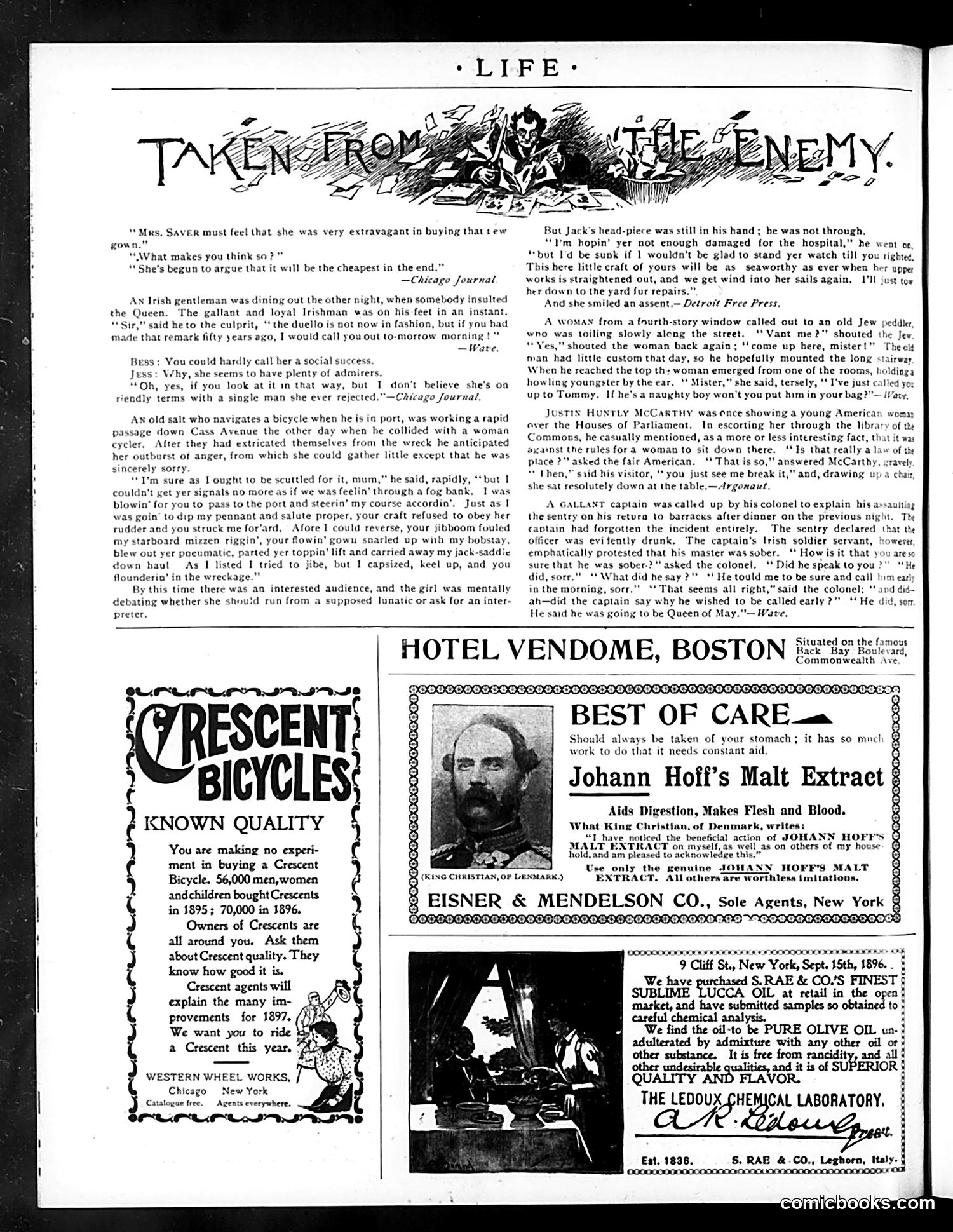
This page contains humorous anecdotes rather than political cartoons. The jokes reflect late-19th century social attitudes: 1. **"Mrs. Saver" joke**: Satirizes wives' frugality—a woman arguing cheap purchases are economical is mocked as foolish. 2. **Irish gentleman anecdote**: Shows Irish loyalty to the British Queen, with the Irishman defending her honor despite the duel being outdated. 3. **Bicycle collision**: A sailor uses nautical jargon to describe a bike accident with a woman, the humor deriving from absurd technical language applied to mundane events. 4. **Jewish peddler**: Reflects period stereotypes; a woman tricks the peddler into babysitting by claiming he'll "bag" her naughty child. 5. **American woman at Parliament**: An American woman defies British rules against women sitting in the Commons library—satirizing American irreverence toward tradition. The page's humor relies on gender stereotypes, ethnic caricatures, and class-based comedy typical of 1890s Life magazine.
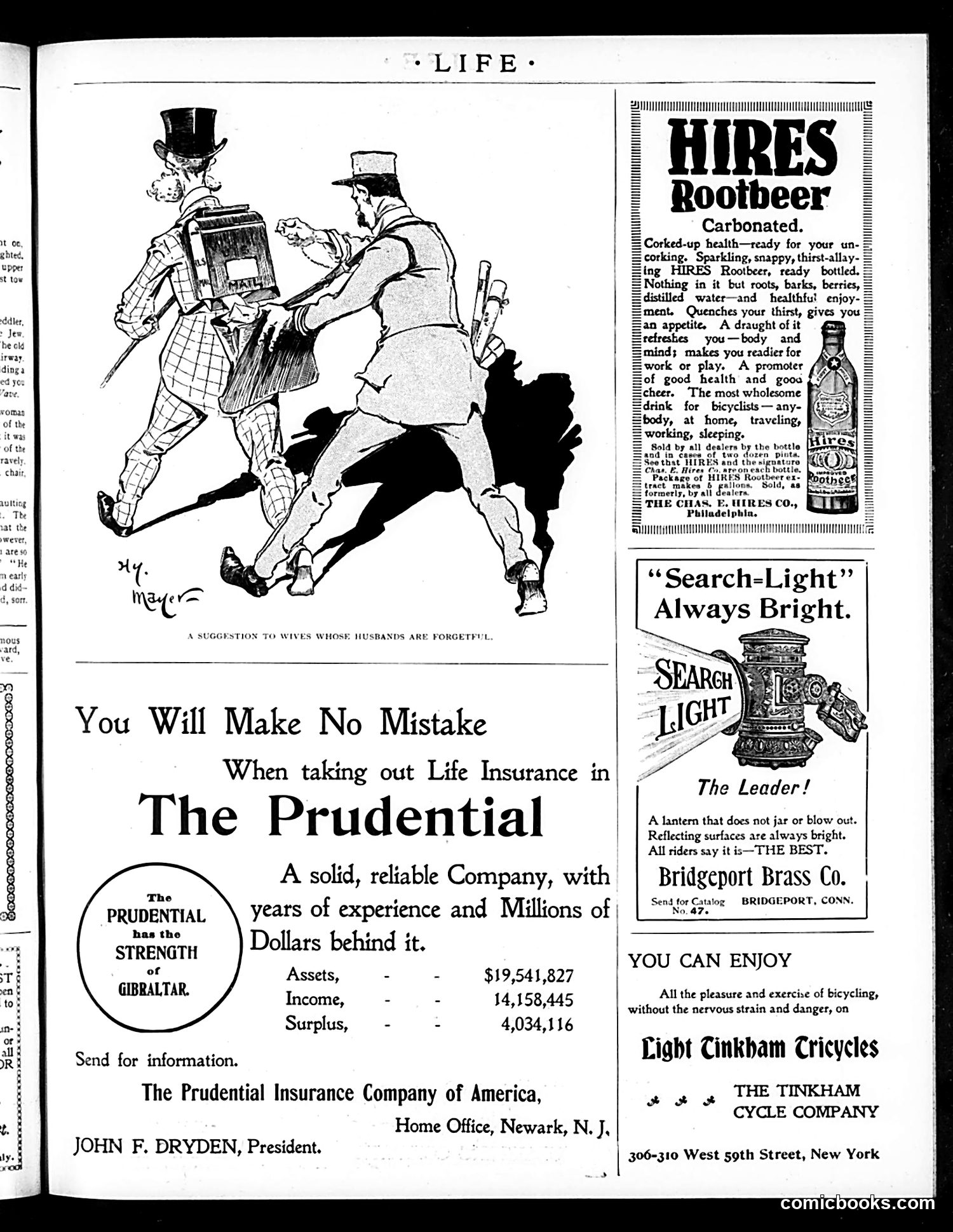
**Main Cartoon:** The illustration depicts a man in formal attire (top hat and suit) being tackled or pushed forcefully by another man, with a mailbox visible. The caption reads "A Suggestion to Wives Whose Husbands Are Forgetful." This is satirical commentary on life insurance: the joke suggests that wives should forcefully ensure their forgetful husbands obtain life insurance—the violent tackle humorously represents the "strong-arm" tactics needed. It's dark humor about marriage dynamics and financial responsibility. **Page Content:** The page is primarily advertisements interspersed with this cartoon. The Prudential Insurance Company's ad emphasizes their financial strength ("strength of Gibraltar"), while other ads promote Hires Rootbeer, Search-Light lanterns, and Tinkham Tricycles—typical early 20th-century consumer products. The satire critiques both careless husbands and the insurance industry's sales tactics.
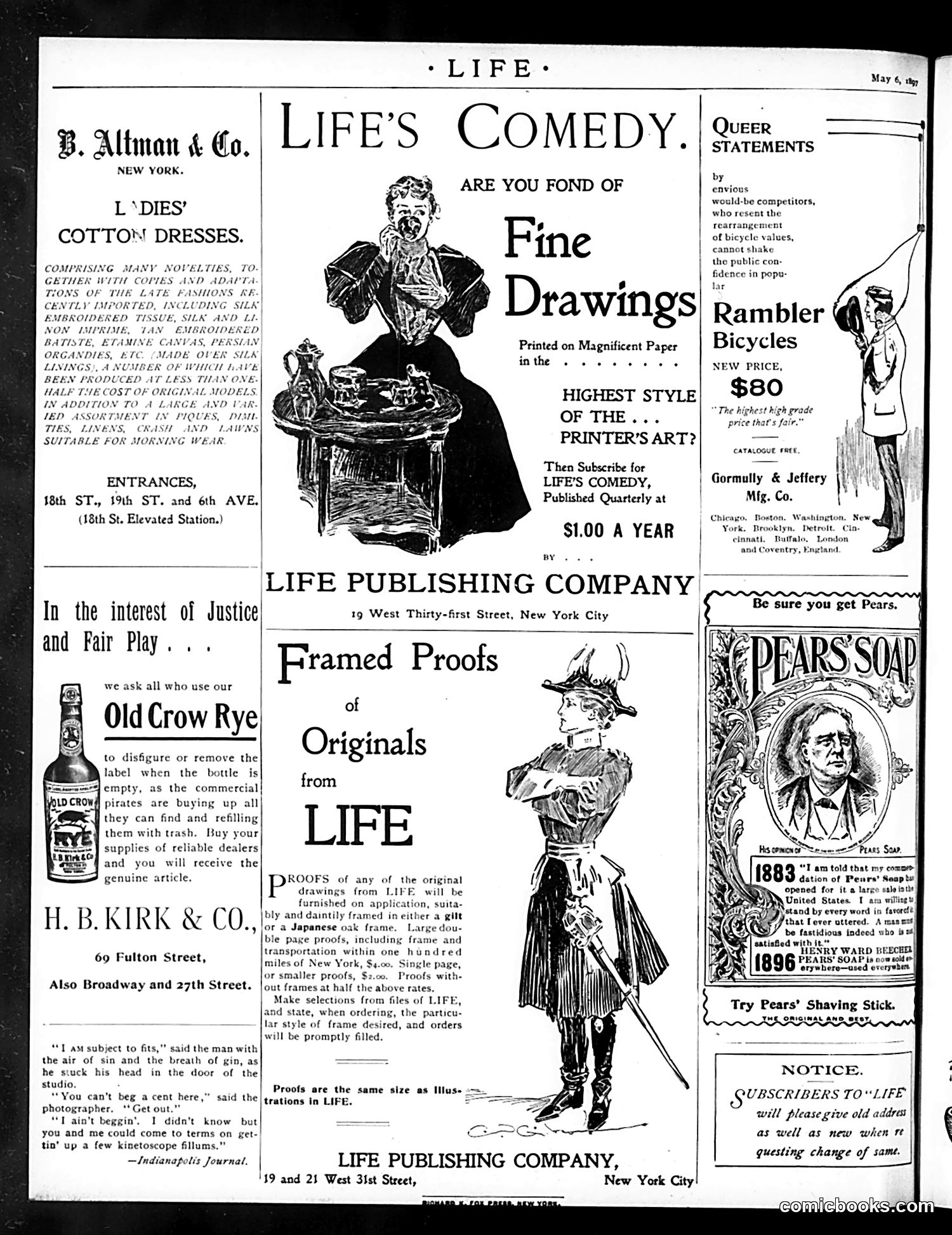
This page is primarily **advertisements and business notices** for Life magazine and various products, with minimal editorial content. The main cartoon appears at bottom center: a humorous exchange between a drunk man and a photographer. The drunk (identifiable by "the breath of gin") attempts to proposition the photographer about making "kinetoscope fillums"—early motion pictures. The joke satirizes both the man's intoxicated state and the nascent film industry's desperation for content and funding. The credited source (Indianapolis Journal) suggests this was reprinted humor. The page otherwise advertises Life's services: framed reproductions of cartoons ($2-4), subscriptions ($1/year), and merchandise including Rambler bicycles, Pears' soap, and Old Crow Rye whiskey. A note warns counterfeiters of whiskey—suggesting commercial fraud was common enough to warrant public service announcements. The content reflects 1890s consumer culture and Life's role as both satirical publication and business enterprise.