
Life, 1897-05-06 · page 13 of 20
Life — May 6, 1897 — page 13: what you’re looking at
What you’re looking at
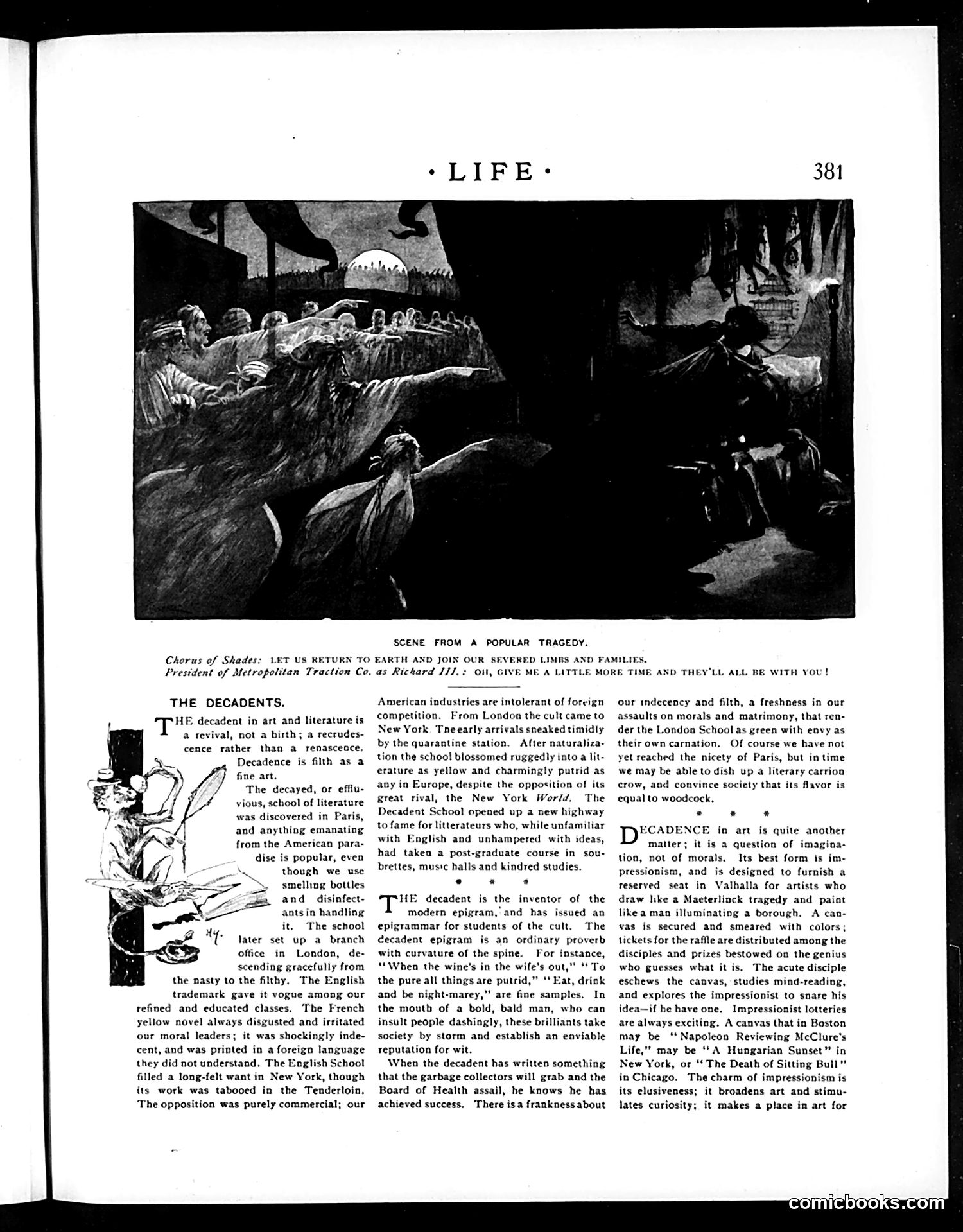
This article satirizes the "Decadent" artistic movement that had migrated from Paris to London and then to New York. The text argues that this school of art and literature deliberately embraces obscenity and moral corruption as aesthetic virtue. The satire targets: 1. **Foreign artistic snobbery**: Americans blindly adopt European (especially French and English) cultural trends without understanding them, including morally questionable work. 2. **Artistic pretension**: Decadents create deliberately obscure, "putrid" work and claim genius status. The epigrams quoted are intentionally absurd ("When the wine's in the wife's out"). 3. **Impressionism's vagueness**: The final section mocks Impressionist painting as so unclear that the same canvas receives different titles in different cities—suggesting the movement relies on viewer projection rather than artistic skill. The accompanying illustration shows a theatrical tragedy scene, possibly Shakespeare, contrasting classical dramatic art with modern decadence. The overall tone is one of moral outrage mixed with ridicule at pretentious avant-garde fashionability.
📄 Transcribed text from this page (OCR, searchable)
Machine-transcribed from the original scan — historical spelling and the odd misread are preserved.
Chorus of Shades: President of Metropolitan Traction Co. LET US RETU THE DECADENTS. HE decadent in art and literature is a revival, not a birth; a recrudes- cence rather than a renasceace. Decadence is filth as a fine art. y The decayed, or efflu- vious, school of literature was discovered in Paris, and anything emanating from the American para- dise is popular, even though we use smelling bottles and disinfect- antsin handling it, The school later up a branch office in London, de- scending gracefully from the nasty to the filthy. The English trademark gave it vogue among our refined and educated classes. The French yellow novel always disgusted and irritated our moral leaders; it was shockingly inde- cent, and was printed in a foreign language they did not understand. The English School filled a long-felt want in New York, though its work was tabooed in the Tenderloin, The opposition was purely commercial; our set ‘ TO EARTH AND Jo! SCENE FROM A POPULAR TRAGEDY. OUR SEVERED LIMBS as Richard /11. American industries are intolerant of forcign competition. From London the cult came to New York Theearly arrivals sneaked timidly by the quarantine station. After naturaliza- tion the schoo! blossomed ruggedly into a lit- erature as yellow and charmingly putrid as any in Europe, despite the opposition of its great rival, the New York World. The Decadent School opened up a new highway to fame for litterateurs who, while unfamiliar with English and unhampered with ideas, had takea a post-graduate course in sou- brettes, music halls and kindred studies. eo #8 HE decadent is the inventor of the modern epigram,’ and has issued an epigrammar for students of the cult. The €ecadent epigram is an ordinary proverb with curvature of the spine. For instance, “When the wine's in the wife's out," To the pure all things are putrid,” ‘Eat, drink and be night-marey,” are fine samples. In the mouth of a bold, bald man, who can insult people dashingly, these brilliants take society by storm and establish an enviable reputation for wit. When the decadent has written something that the garbage collectors will grab and the Board of Health assail, he knows he has achieved success. There isa frankness about \D FAMILIES, ON, GIVE ME A LITTLE MORE TIME AND THE LAL WITH YoU! our indecency and filth, a freshness in our assaults on morals and matrimony, that ren- der the London School as green with envy as their own carnation. Of course we have not yet reached the nicety of Paris, but in time we may be able to dish up a literary carrion crow, and convince society that its flavor is equal to woodcock, * * * CADENCE in art is quite another matter; it a question of imagina- tion, not of morals, Its best form is im- pressionism, and is designed to furnish a reserved seat in Valhalla for artists who draw like a Maeterlinck tragedy and paiot like a man illuminating a borough. A can- vas is secured and smeared with colors; tickets for the raffle are distributed among the disciples and prizes bestowed on the genius who guesses what it is. The acute disciple eschews the canvas, studies mind-reading, and explores the impressionist to snare his idea—if he have one. Impressionist lotteries are always exciting. A canvas that in Boston may be ‘Napoleon Reviewing McClure’s Life," may be ‘A Hungarian Sunset” in New York, or ‘* The Death of Sitting Bull” in Chicago. The charm of impressionism is its elusiveness; it broadens art and stimu- lates curiosity; it makes a place in art for