
Life, 1897-05-06 · page 9 of 20
Life — May 6, 1897 — page 9: what you’re looking at
What you’re looking at
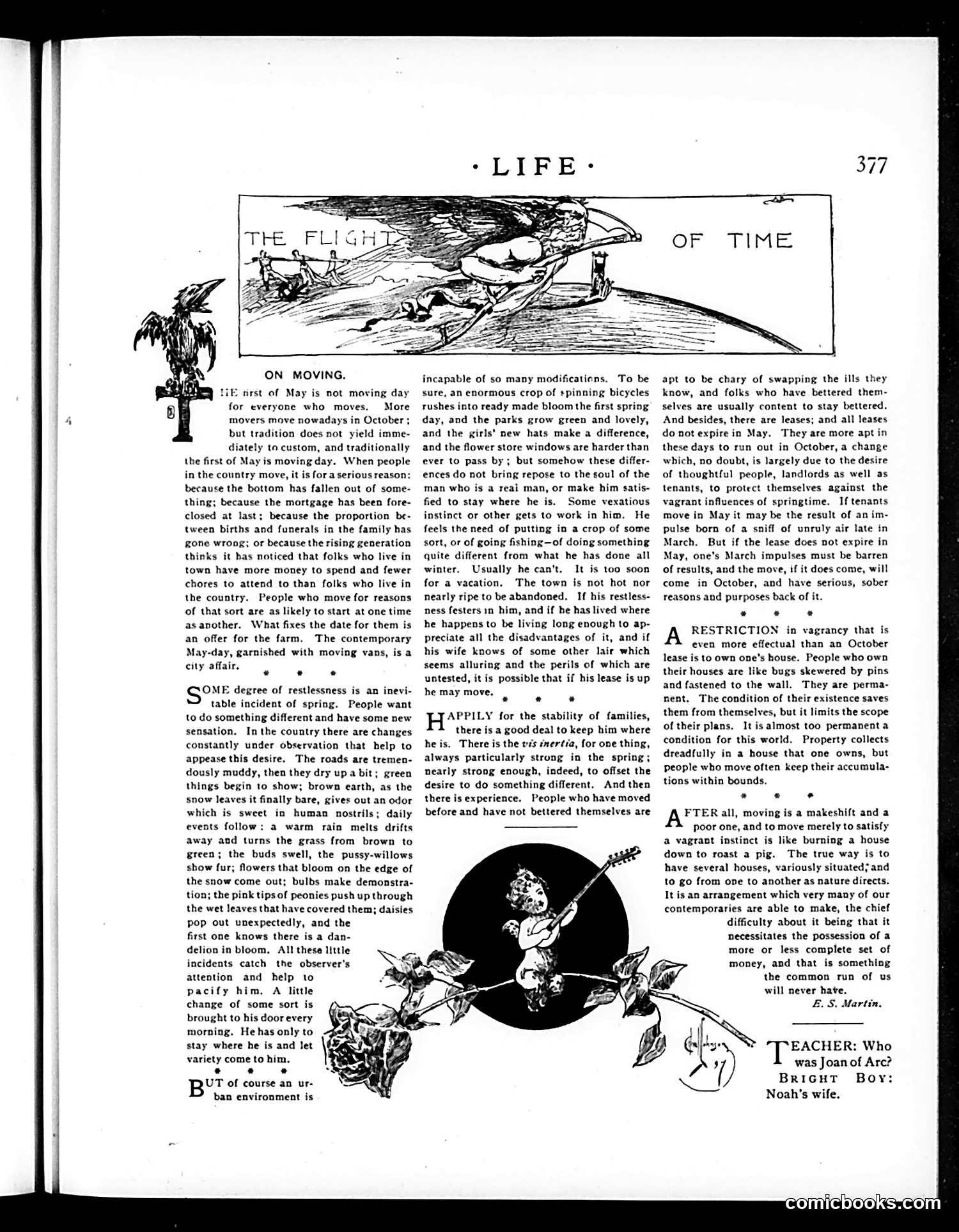
This page contains a humorous essay titled "The Flight of Time" discussing spring moving season in America. The central cartoon depicts Cupid with a violin surrounded by spring flowers and foliage, symbolizing the romantic associations of May and the season's influence on people's decisions to relocate. The text satirizes the American practice of moving house in May, arguing that urban residents flee the city during spring driven by "vagrant instinct" rather than rational planning. The author (E.S. Martin) mocks those who abandon homes yearly, comparing it to "burning a house down to roast a pig." The small footer quiz asks "Who was Joan of Arc?" with the answer "Noah's wife"—a simple joke rather than political commentary.
📄 Transcribed text from this page (OCR, searchable)
Machine-transcribed from the original scan — historical spelling and the odd misread are preserved.
ON MOVING. LiE mrst of May is not moving day for everyone who moves. More movers move nowadays in October ; but tradition does not yield imme- diately to custom, and traditionally the first of May is moving day. When people in the country move, it is for a serious reason: because the bottom has fallen out of some- thing; because the mortgage has been fore- closed at last; because the proportion be- tween births and funerals in the family has gone wrong; or because the rising generation thinks it has noticed that folks who live in town have more money to spend and fewer chores to attend to than folks who live in the country. People who move for reasons of that sort are as likely to start at one time as another. What fixes the date for them is an offer for the farm. The contemporary May-day, garnished with moving vans, isa city affair. * * OME degree of restlessness is an inevi- table incident of spring. People want to do something different and have some new sensation. Inthe country there are changes constantly under observation that help to appease this desire. The roads are tremen- dously muddy, then they dry upa bit; green things begin to show; brown earth, as the snow leaves it finally bare, gives out an odor which is sweet in human nostrils; daily events follow: a warm rain melts drifts away aod turns the grass from brown to green; the buds swell, the pussy-willows show fur; flowers that bloom on the edge of the snow come out; bulbs make demonstra- tion; the pink tips of peonies push up through the wet leaves that have covered them; daisies pop out unexpectedly, and the first one knows there is a dan- delion in bloom, All these little incidents catch the observer's attention and help to pacify him. A little change of some sort is brought to his doorevery morning. He has only to stay where he is and let variety come to him. e ° UT of course an ur- ban environment is incapable of so many modifications. To be sure, an enormous crop of spinning bicycles rushes into ready made bloom the first spring day, and the parks grow green and lovely, and the girls’ new hats make a difference, and the flower store windows are harder than ever to pass by ; but somehow these differ- ences do not bring repose to the soul of the man who is a reai man, or make him satis- fied to stay where he is. Some vexatious instinct or other gets to work in him. He feels the need of putting in a crop of some sort, or of going fishing—of doing something quite different from what he has done all Usually he can’t. It is too soon for a vacation, The town is not hot nor nearly ripe to be abandoned. If his restless- ness festers in him, and if he has lived where he happens to be living long enough to ap- preciate all the disadvantages of it, and if his wife knows of some other lair which seems alluring and the perils of which are untested, it is possible that if his lease is up he may move. winter. Pyseetey for the stability of families, there is a good deal to keep him where he is. There is the vis snertia, for one thing, always particularly strong in the spring; nearly strong enough, indeed, to offset the desire to do something different. And then there isexperience. People who have moved before and have not bettered themselves are apt to be chary of swapping the ills they know, and folks who have bettered them- selves are usually content to stay bettered. And besides, there are leases; and all leases do not expire in May. They are more apt in these days to run out in October, a change which, no doubt, is largely due to the desire of thoughtful people, landlords as well as tenants, to protect themselves against the vagrant influences of springtime. If tenants move in May it may be the result of an im- pulse born of a sniff of unruly air late in March. But if the lease does not expire in May, one’s March impulses must be barren of results, and the move, if it does come, will come in October, and have serious, sober reasons and purposes back of it. . * * RESTRICTION in vagrancy that is even more effectual than an October lease is to own one's house. People who own their houses are like bugs skewered by pins and fastened to the wall. They are perma- nent. The condition of their existence saves them from themselves, but it limits the scope of their plans. It is almost too permanenta condition for this world. Property collects dreadfully in a house that one owns, but people who move often keep their accumula- tions within bounds. * e * FTER all, moving is a makeshift and a poor one, and to move merely to satisfy a vagrant instinct is like burning a house down to roast a pig. The true way is to have several houses, variously situated; and to go from one to another as nature directs. It is an arrangement which very many of our contemporaries are able to make, the chief difficulty about it being that it necessitates the possession of a more or less complete set of money, and that is something the common run of us will never hate. &. S. Martin, EACHER: Who was Joan of Arc? BRIGHT Boy: Noah's