
Life, 1897-05-06 · page 4 of 20
Life — May 6, 1897 — page 4: what you’re looking at
What you’re looking at
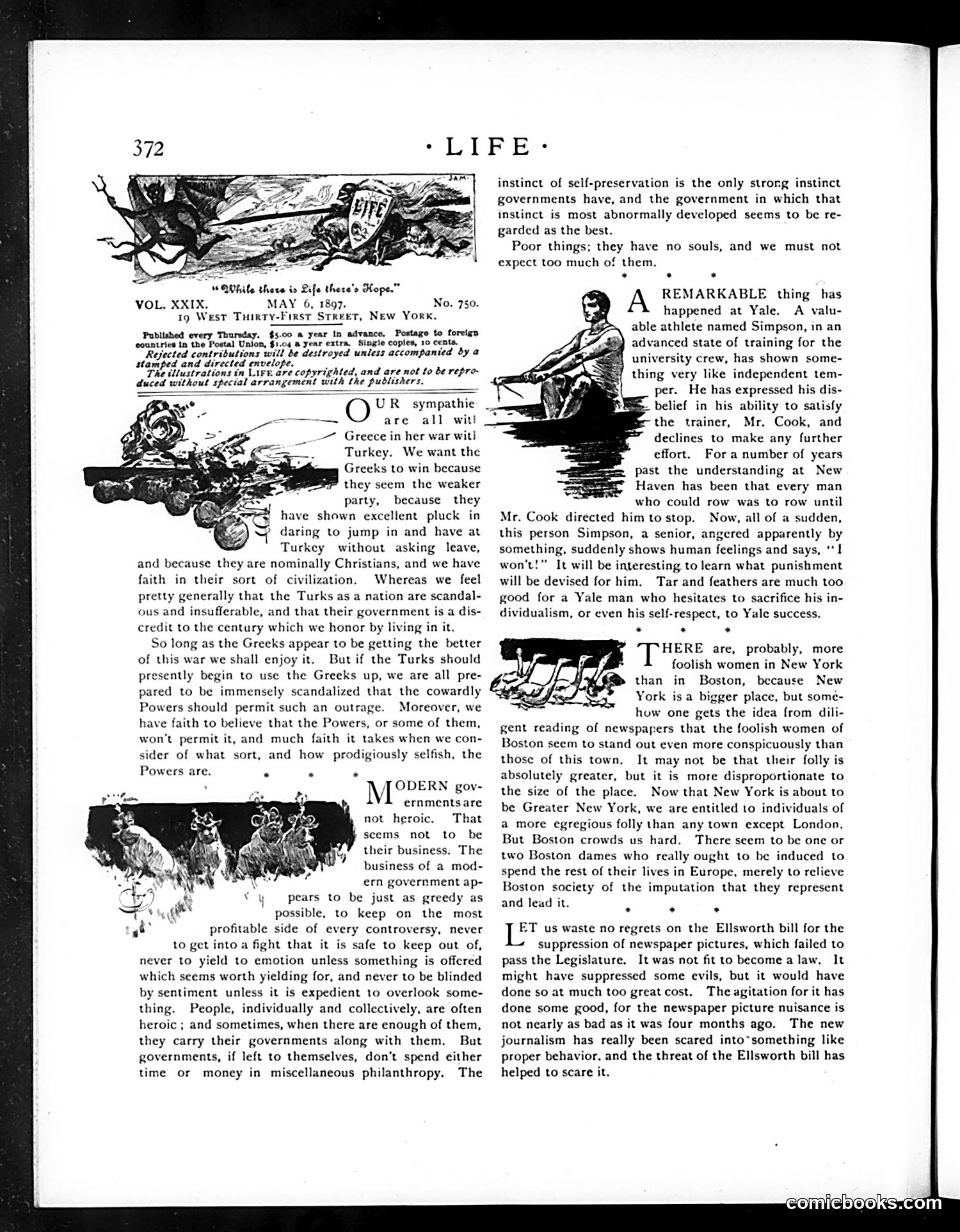
The top cartoon depicts a figure labeled "Life" shielding themselves, commenting on Greek-Turkish conflict. The accompanying article expresses sympathy for Greeks in their war with Turkey, criticizing Turkey's government as scandalous and arguing the Powers should support Greece militarily. The middle illustration shows fashionable women, relating to text mocking "foolish women in New York" for their frivolity compared to Boston women. The satire suggests New York's larger size enables greater foolishness. The bottom section discusses the failed Ellsworth bill—legislation to suppress newspaper picture supplements. The text argues the threat of the bill itself scared journalism into better behavior, making actual passage unnecessary. These pieces collectively target government inefficiency, urban vanity, and press accountability—typical Life magazine concerns of the era.
📄 Transcribed text from this page (OCR, searchable)
Machine-transcribed from the original scan — historical spelling and the odd misread are preserved.
VOL. XXIX. MAY 6, 1897. No. 750. 19 West Tuirty-First STREET, New York. Published every Thi . $5.00 a year in advance. Postage to foreign yureday, countries in the Postal Union, $1.04 a year extra. Single copies, 10 cents. Rejected contributions will be destroyed unless accompanied by a stamped and directed envelope. é The illustrations in Lire. are copyrighted, and are not to be repro- duced without special arrangement with the publishers, UR _ sympathie are all wit! — Greece in her war wit) Turkey. We want the Greeks to win because they seem the weaker part because they ? daring to jump in and have at Turkey without asking leave, and because they are nominally Christians, and we have faith in their sort of civilization, Whereas we feel pretty generally that the Turks as a nation are scandal- ous and insufferable, and that their government is a dis- credit to the century which we honor by living in it. So long as the Greeks appear to be getting the better of this war we shall enjoy it. But if the Turks should presently begin to use the Greeks up, we are all pre- pared to be immensely scandalized that the cowardly Powers should permit such an outrage. Moreover, we have faith to believe that the Powers, or some of them, won't permit it, and much faith it takes when we con- sider of what sort, and how prodigiously selfish, the Powers are. . WiSRERS gov- ernmentsare not heroic. That scems not to be their business, The business of a mod- ern government ap- pears to be just as greedy as possible, to keep on the most profitable side of every controversy, never to get into a fight that it is safe to keep out of, never to yield to emotion unless something is offcred which seems worth yielding for, and never to be blinded by sentiment unless it is expedient 10 overlook some- thing. People, individually and collectively, are often heroic ; and sometimes, when there are enough of them, they carry their governments along with them, But governments, if left to themselves, don’t spend either time or money in miscellaneous philanthropy. The instinct of self-preservation is the only strong instinct governments have, and the government in which that instinct is most abnormally developed seems to be re- garded as the best. Poor things; they have no souls, and we must not expect too much of them, . . . REMARKABLE thing has happened at Yale. A valu- able athlete named Simpson, in an advanced state of training for the university crew, has shown some- thing very like independent tem- per. He has expressed his dis- - belief in his ability to satisfy the trainer, Mr. Cook, and declines to make any further effort. Fora number of years past the understanding at New Haven has been that every man who could row was to row until Mr. Cook directed him to stop. Now, all of a sudden, this person Simpson, a senior, angered apparently by something, suddenly shows human feelings and says, ‘1 won't!” It will be interesting to learn what punishment will be devised for him, Tar and feathers are much too good for a Yale man who hesitates to sacrifice his in- dividualism, or even his self-respect, to Yale success. . . * HERE are, probably, more foolish women in New York than in Boston, because New York is a bigger place, but some- how one gets the idea from dili- gent reading of newspapers that the foolish women of Boston seem to stand out even more conspicuously than those of this town, It may not be that their folly is absolutely greater, but it is more disproportionate to the size of the place. Now that New York is about to be Greater New York, we are entitled to individuals of a more egregious folly than any town except London. But Boston crowds us hard. There seem to be one or two Boston dames who really ought to be induced to spend the rest of their lives in Europe, merely to relieve Boston society of the imputation that they represent and lead it. . . . ET us waste no regrets on the Ellsworth bill for the suppression of newspaper pictures, which failed to pass the Legislature. It was not fit to become a law. It might have suppressed some evils, but it would have done so at much too great cost. The agitation for it has done some good, for the newspaper picture nuisance is not nearly as bad as it was four months ago. The new journalism has really been scared into*something like proper behavior, and the threat of the Ellsworth bill has helped to scare it.