
Life, 1897-05-06 · page 12 of 20
Life — May 6, 1897 — page 12: what you’re looking at
What you’re looking at
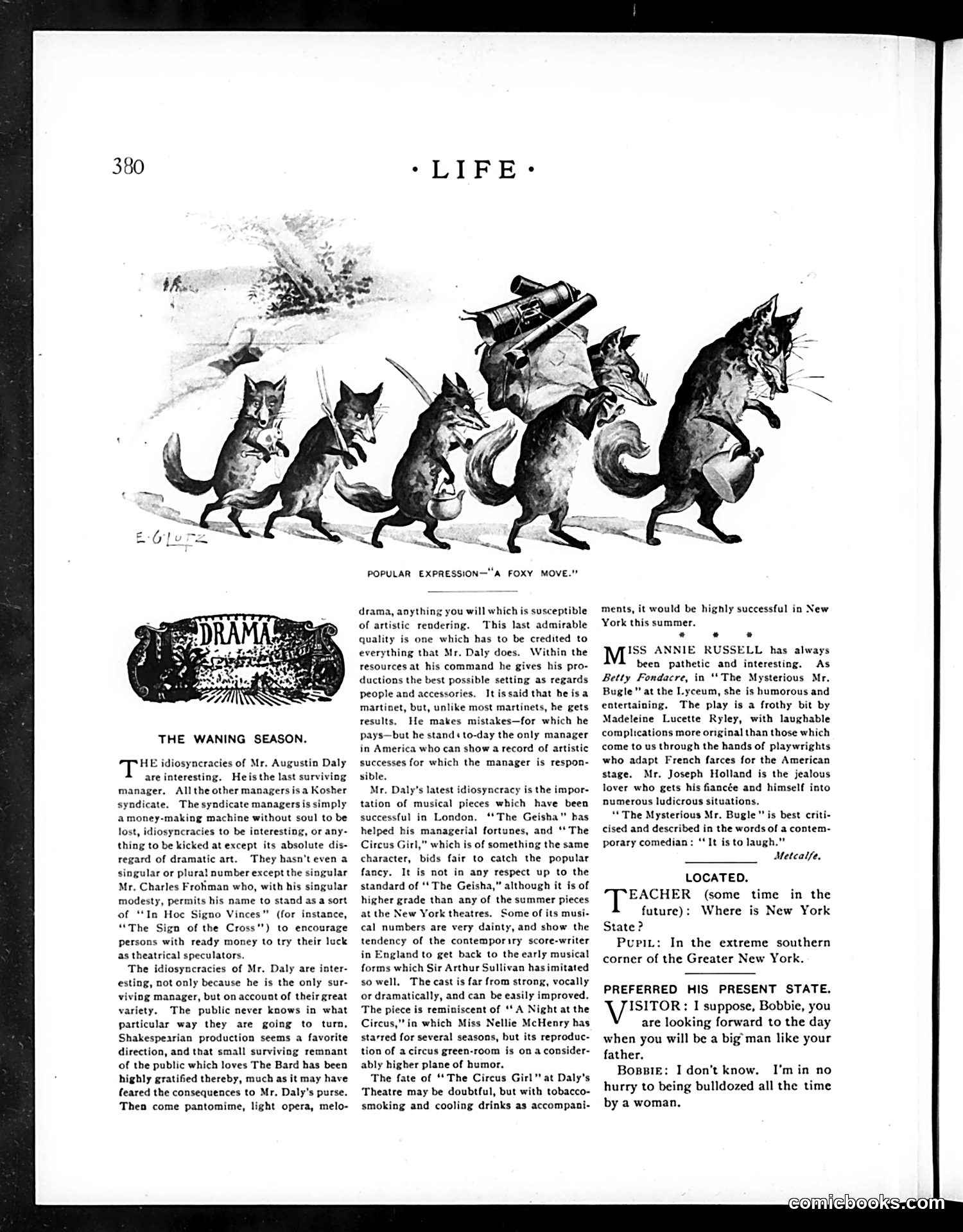
This satirical cartoon depicts five anthropomorphic foxes in a line, with the lead fox carrying what appears to be binoculars or a telescope. The caption "POPULAR EXPRESSION—'A FOXY MOVE'" suggests the image is a visual pun playing on the word "foxy," meaning cunning or clever. The cartoon illustrates the idiomatic expression literally—actual foxes executing what humans would call a "foxy" (shrewd, deceptive) maneuver. The progression of foxes and their coordinated positioning suggest they're engaged in some form of cunning scheme or heist, with the telescope-like object suggesting surveillance or reconnaissance. This is a straightforward visual joke exploiting the double meaning of "foxy" in early 20th-century American slang.
📄 Transcribed text from this page (OCR, searchable)
Machine-transcribed from the original scan — historical spelling and the odd misread are preserved.
THE WANING SEASON. Te idiosyncracies of Mr. Augustin Daly are interesting. He isthe last surviving manager. All the other managers isa Kosher syndicate. The syndicate managers is simply a money-making machine without soul to be lost, idiosyncracies to be interesting, or any- thing to be kicked at except its absolute dis- regard of dramatic art. They hasn't even a singular or plural number except the singular Mr. Charles Froiman who, with his singular modesty, permits his name to stand asa sort of ‘In Hoc Signo Vinces” (for instance, “The Sign of the Cros: to encourage persons with ready money to try their luck as theatrical speculators. The idiosyncracies of Mr. Daly are inter- esting, not only because he is the only sur- viving manager, but on account of their great variety. The public never knows in what particular way they are going to turn, Shakespearian production seems a favorite direction, and that small surviving remnant of the public which loves The Bard has been highly gratified thereby, much as it may have feared the consequences to Mr. Daly's purse. Then come pantomime, light opera, melo- POPULAR EXPRESSION—"A FOXY MOVE.'” drama, anything you will which is susceptible of artistic rendering. This last admirable quality is one which has to be credited to everything that Mr. Daly does. Within the resources at his command he gives his pro- ductions the best possible setting as regards people and accessories. It issaid that he isa martinet, but, unlike most martinets, he gets results, He makes mistakes—for which he pays—but he stand« to-day the only manager in America who can show a record of artistic successes for which the manager is respon- sible. Mr. Daly’s latest idiosyncracy is the impor- tation of musical pieces which have been successful in London. ‘The Geisha" bas helped his managerial fortunes, and ‘* The Circus Girl,” which is of something the same character, bids fair to catch the popular fancy. It is not in any respect up to the standard of ‘The Geisha,” although it is of higher grade than any of the summer pieces at the New York theatres. Some of its musi- cal numbers are very dainty, and show the tendency of the contemporiry score-writer in England to get back to the early musical forms which Sir Arthur Sullivan hasimitated so well, The cast is far from strong, vocally or dramatically, and can be easily improved. The piece is reminiscent of ‘* A Night at the Circus," in which Miss Nellie McHenry has starred for several seasons, but its reproduc- tion of acircus green-room is on aconsider- ably higher plane of humor. The fate of ‘The Circus Girl” at Daly's Theatre may be doubtful, but with tobacco- smoking and cooling drinks as accompani- ments, it would be highly successful in New York this summer. * * * ISS ANNIE RUSSELL has always been pathetic and interesting. As Betty Fondacre, in ‘‘The Mysterious Mr. Bugle” at the Lyceum, she is humorous and entertaining. The play is a frothy bit by Madeleine Lucette Ryley, with laughable complications more orginal than those which come to us through the hands of playwrights who adapt French farces for the American stage. Mr. Joseph Holland is the jealous lover who gets his fiancée and himself into numerous ludicrous situations. “The Mysterious Mr. Bugle” is best criti- cised and described in the words of a contem- porary comedian: ‘‘It isto laugh.” Metcalfe, LOCATED. EACHER (some time in the future): Where is New York State? PupiL: In the extreme southern corner of the Greater New York. PREFERRED HIS PRESENT STATE. ISITOR: I suppose, Bobbie, you are looking forward to the day when you will be a big man like your father. BossieE: I don't know. I'min no hurry to being bulldozed all the time by a woman,