
A complete issue · 34 pages · 1897
Life — April 15, 1897
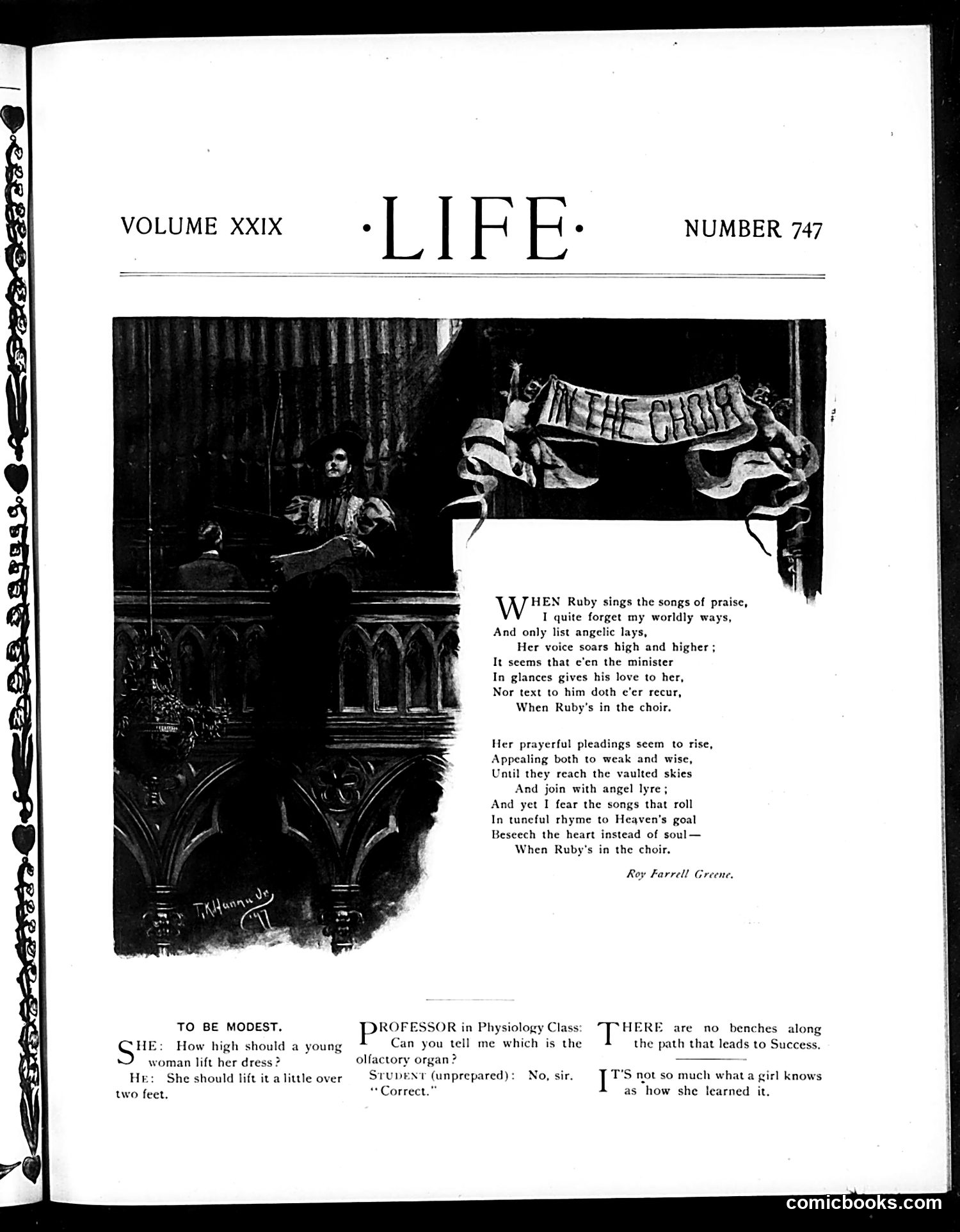
This page contains a poem titled "When Ruby's in the Choir" by Roy Farrell Greene, accompanied by an illustration of a church choir scene. The poem celebrates a singer named Ruby whose voice during choir performance moves the narrator spiritually—her singing makes him forget worldly concerns and focus on heavenly matters. Below are two brief humor pieces: "To Be Modest" presents a joke about appropriate dress hemlines for young women, and a "Professor in Physiology Class" joke plays on a double entendre about the "olfactory organ" (nose), with a student's innocent misinterpretation creating the humor. The page reflects early 20th-century magazine humor and genteel sensibilities.
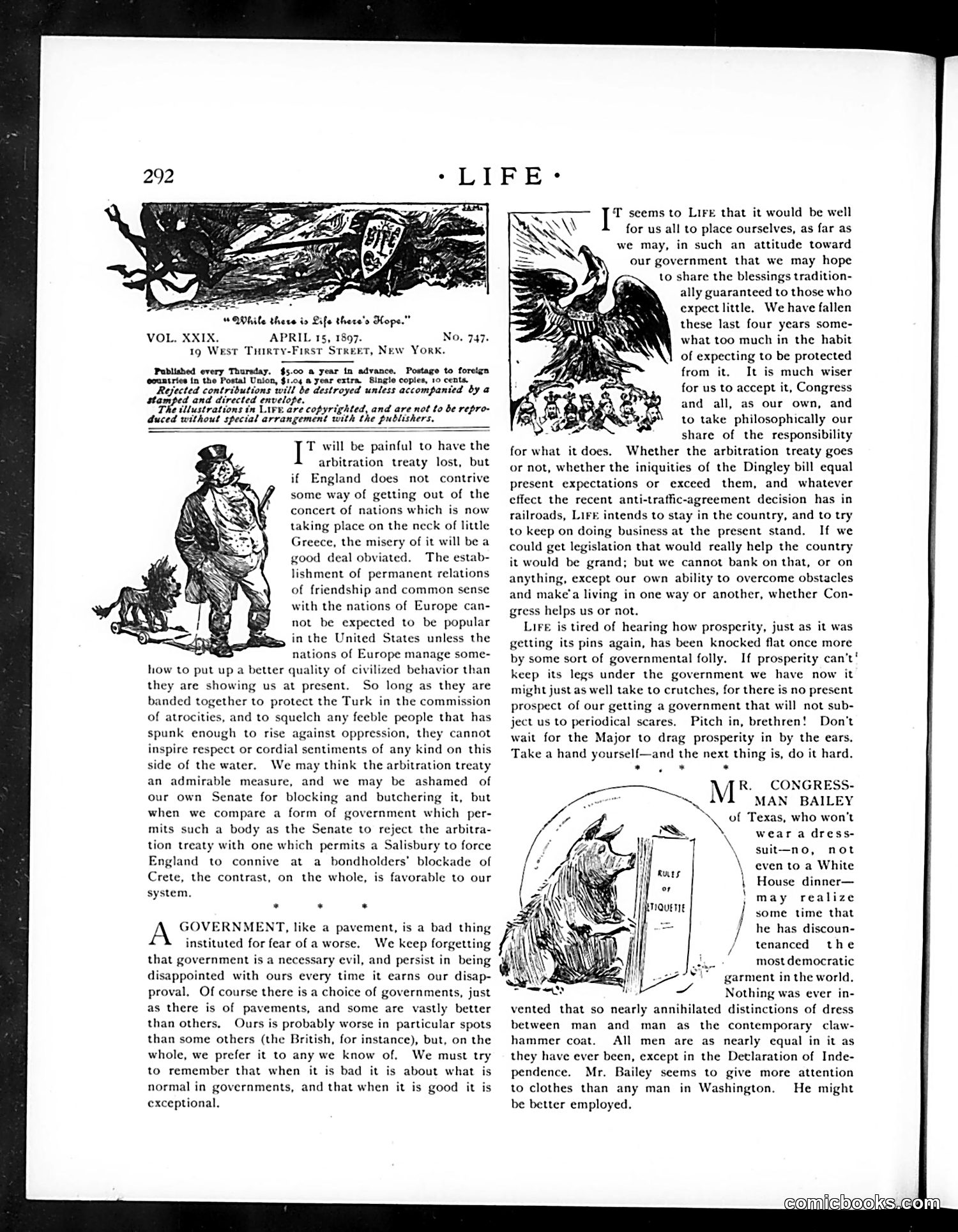
**Main Cartoon (left):** Depicts a figure labeled "LIFE" offering hope—shown as a bird or dove—to a distressed, kneeling person. The satire critiques how Life magazine itself promises optimism while addressing social/political hardship. **Central Text Discussion:** Addresses the arbitration treaty between the U.S. and Britain regarding disputes over Venezuela and other matters. The author argues Americans should accept realistic government limitations rather than expect excessive protection or prosperity from government intervention. **Bottom Cartoon:** Mocks Congressman Bailey of Texas for refusing to wear formal dress (even to White House dinners), celebrating his democratic rejection of class distinctions. The satire suggests this anti-fashion stance, while democratically principled, may be impractical for political effectiveness in Washington.
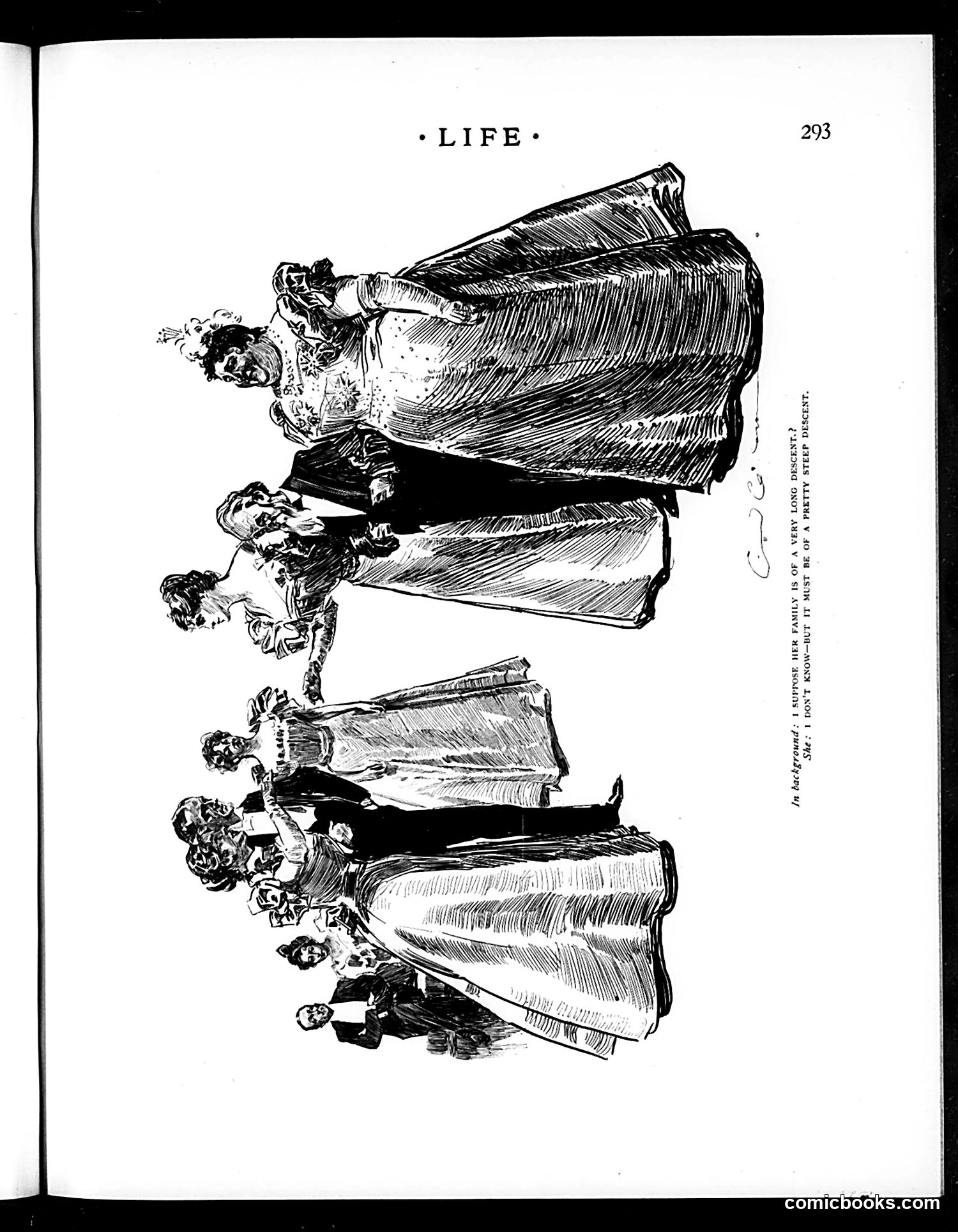
This page presents a satirical illustration showing four figures in Victorian-era clothing arranged vertically. The figures appear to be caricatured society women or characters, drawn in an exaggerated style typical of late 19th/early 20th-century American satire. The image likely satirizes fashion, social pretension, or women's behavior of the era, though the specific historical context isn't entirely clear from the visible text. The OCR text provided is too fragmentary to identify the exact social commentary or which public figures these caricatures represent. To accurately explain the satire's target and meaning, we would need either: legible caption text identifying the figures, or knowledge of which issue of Life this appeared in, as context is essential for interpreting period political/social cartoons.
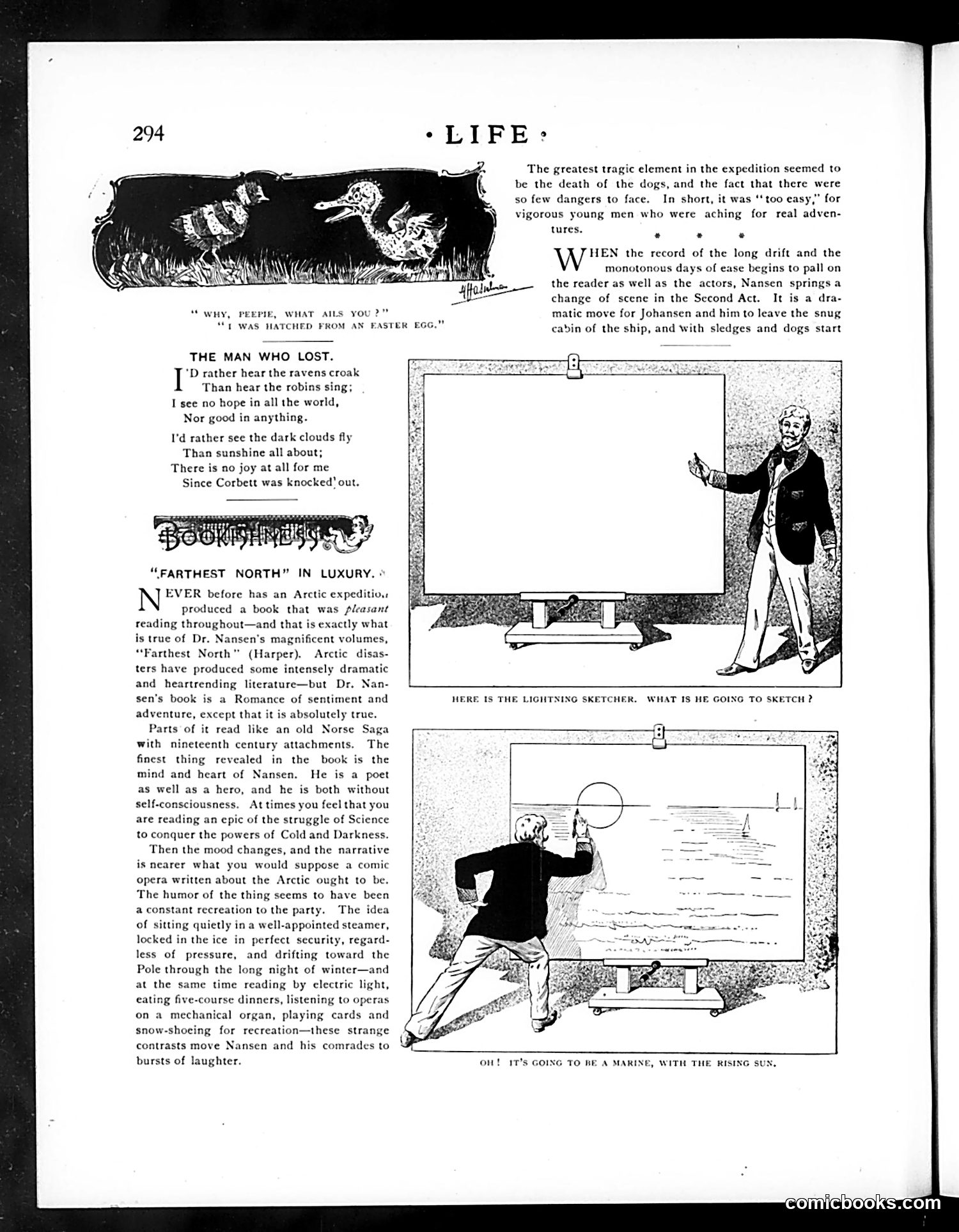
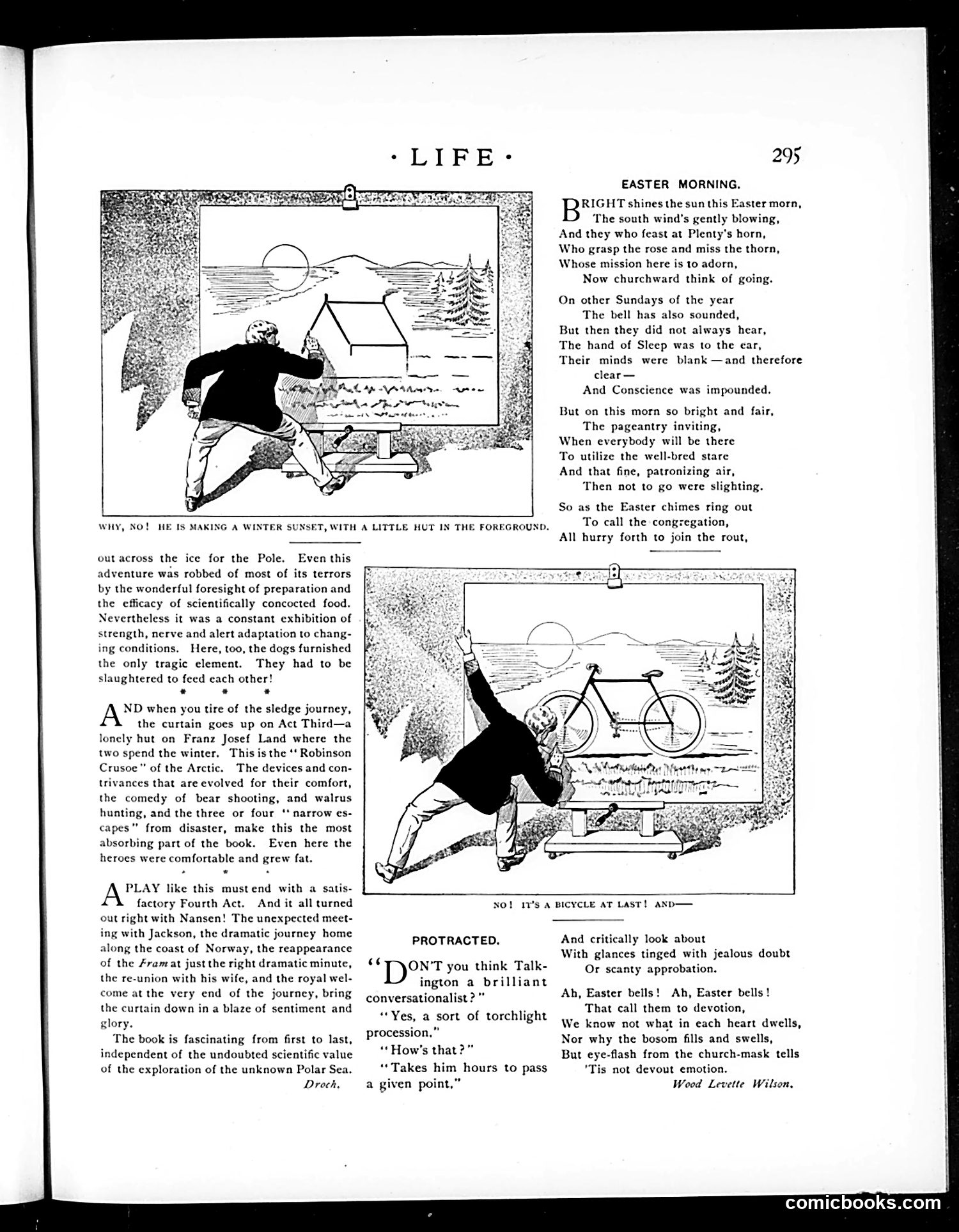
This page discusses Dr. Nansen's Arctic expedition book "Farthest North," praising it as a romance combining scientific achievement with personal drama. The text emphasizes Nansen's heroism and the book's appeal—contrasting the hardships of Arctic exploration with the comfort of reading about them. The two cartoons satirize the contrast between adventure and luxury. The first shows a man sketching arctic scenes. The second depicts someone enthusiastically drawing a marine scene while comfortably seated indoors, captioned "It's going to be a marine, with the rising sun." The satire mocks armchair adventurism—the comfortable contemplation of danger from safety, a recurring theme in Life's commentary on how modern readers consume tales of exploration without experiencing actual hardship.
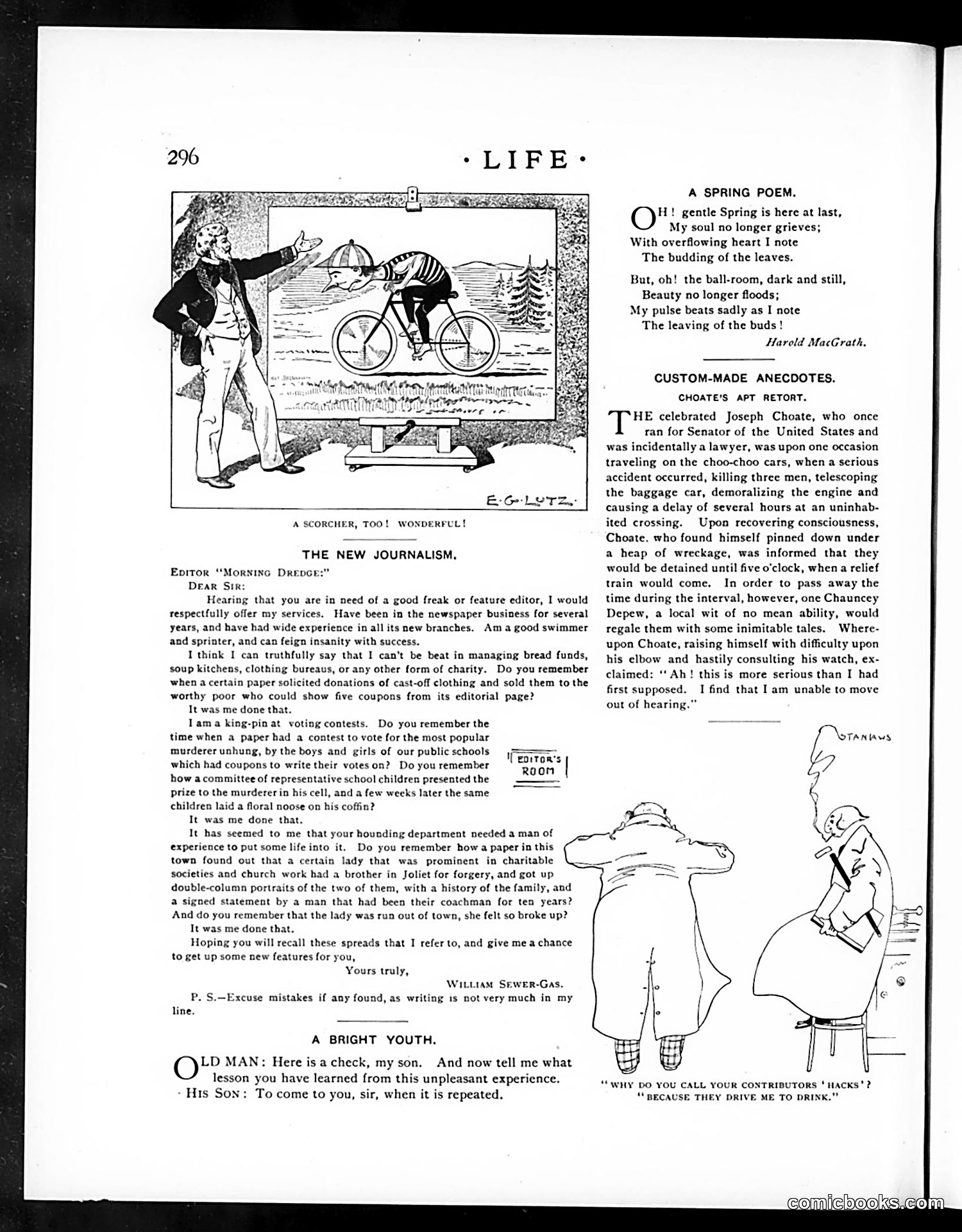
**Top Cartoon ("A Scorcher, Too! Wonderful!"):** A man points at a movie screen showing two cyclists. The joke appears to mock early cinema as entertainment—the man's theatrical gesture suggests he's overselling a mundane scene (people riding bikes) as thrilling spectacle. This satirizes how novelty films were promoted to audiences unfamiliar with moving pictures. **"The New Journalism" Section:** Editor "Morning Dredge" defends sensationalism in newspapers, listing ethically questionable practices: promoting "freaks," staging contests (including one awarding prizes for voting on "the most popular murderer"), manufacturing human interest stories, and fabricating charitable narratives. The satire criticizes yellow journalism's manipulation and invention of news for circulation.
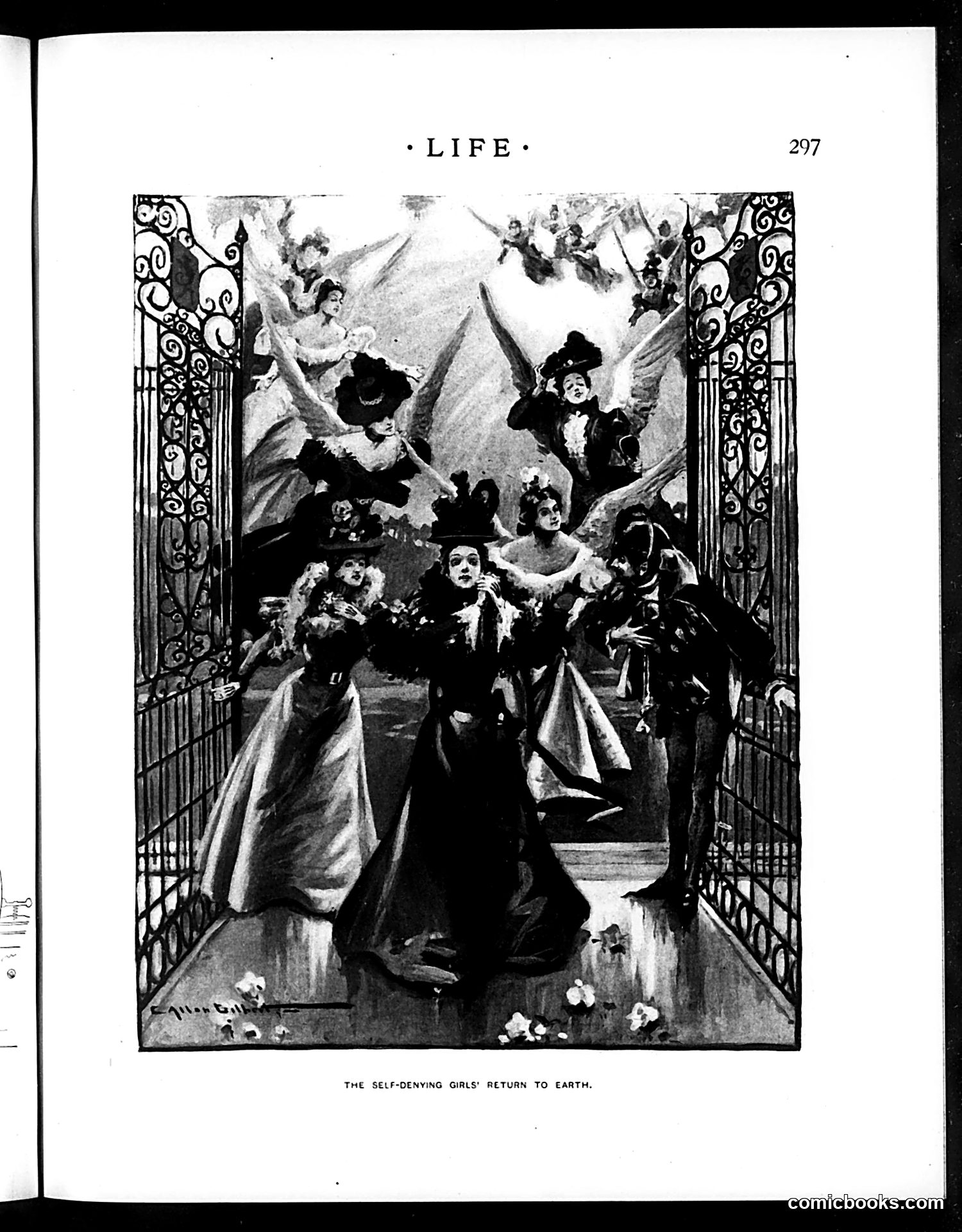
This satirical illustration depicts young women in elaborate, fashionable clothing and large hats entering through ornate gates, with angels and heavenly figures visible above. The caption "The Self-Denying Girls' Return to Earth" presents the joke through ironic contrast. The satire targets wealthy or privileged young women of the era who claimed to practice self-denial or asceticism—likely a social trend among some upper-class females. The illustration mocks this pretense by showing them descending to Earth in extravagant dress and accessories, suggesting their supposed self-denial is merely superficial performance rather than genuine sacrifice. The heavenly imagery emphasizes the disconnect between their spiritual pretensions and their obvious material indulgence, creating the satirical point that such claims of self-denial were hypocritical.
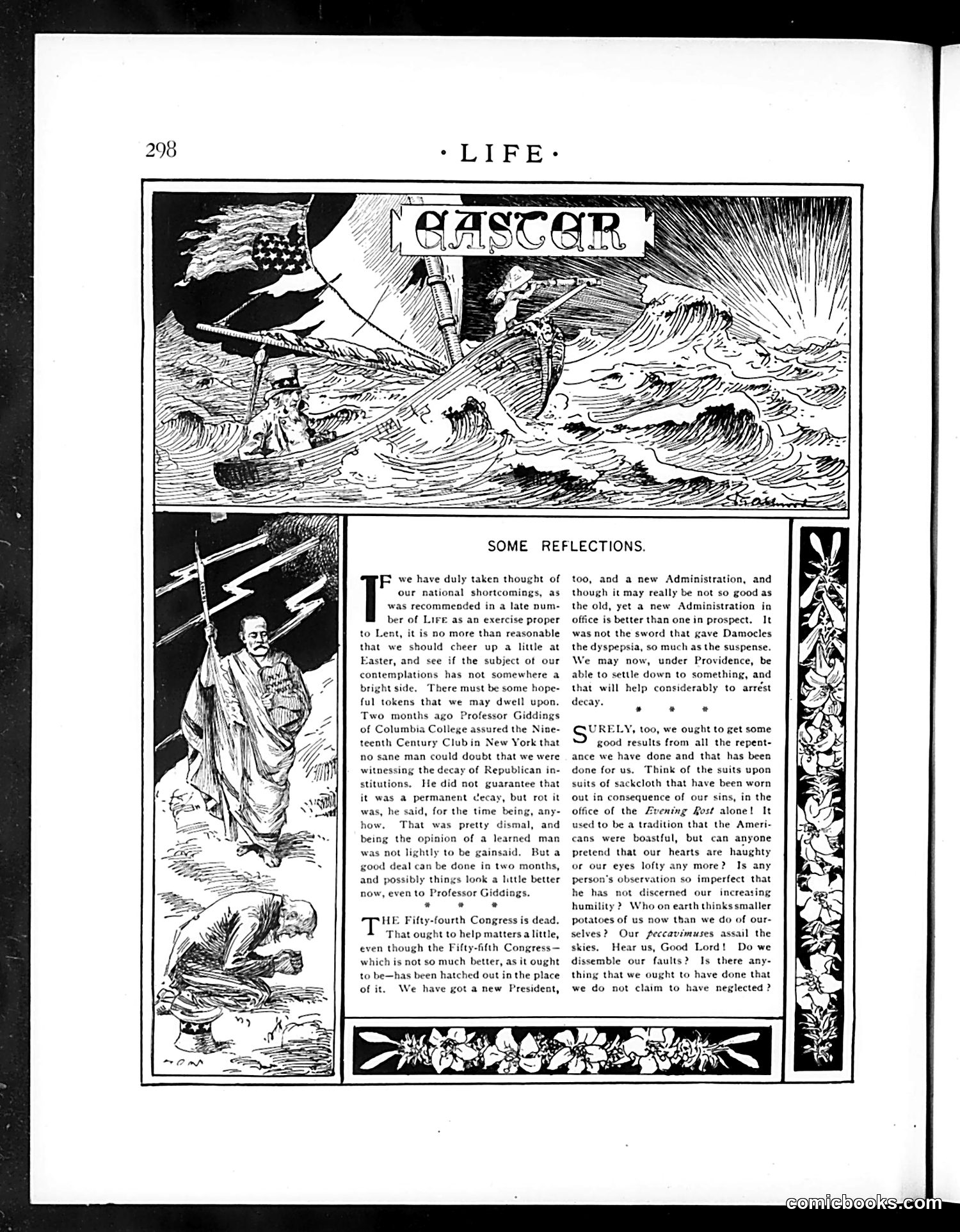
This satirical page uses allegorical imagery to critique American political decay. The top cartoon depicts "CASPER" (likely representing the U.S. or Republican party) as a drowning figure amid turbulent waters beneath an American flag—symbolizing national crisis or collapse. The essay below discusses the "decay of Republican institutions" and the recent election of a new President (appears to reference early 1900s). It sarcastically suggests that while the old administration was bad, a new one offers little genuine improvement. The text mocks national complacency, asking whether Americans have "discerned our faults" or learned from failures. The left illustrations show figures in distress, reinforcing themes of national suffering and moral reckoning. The overall message: political change alone cannot fix systemic problems.
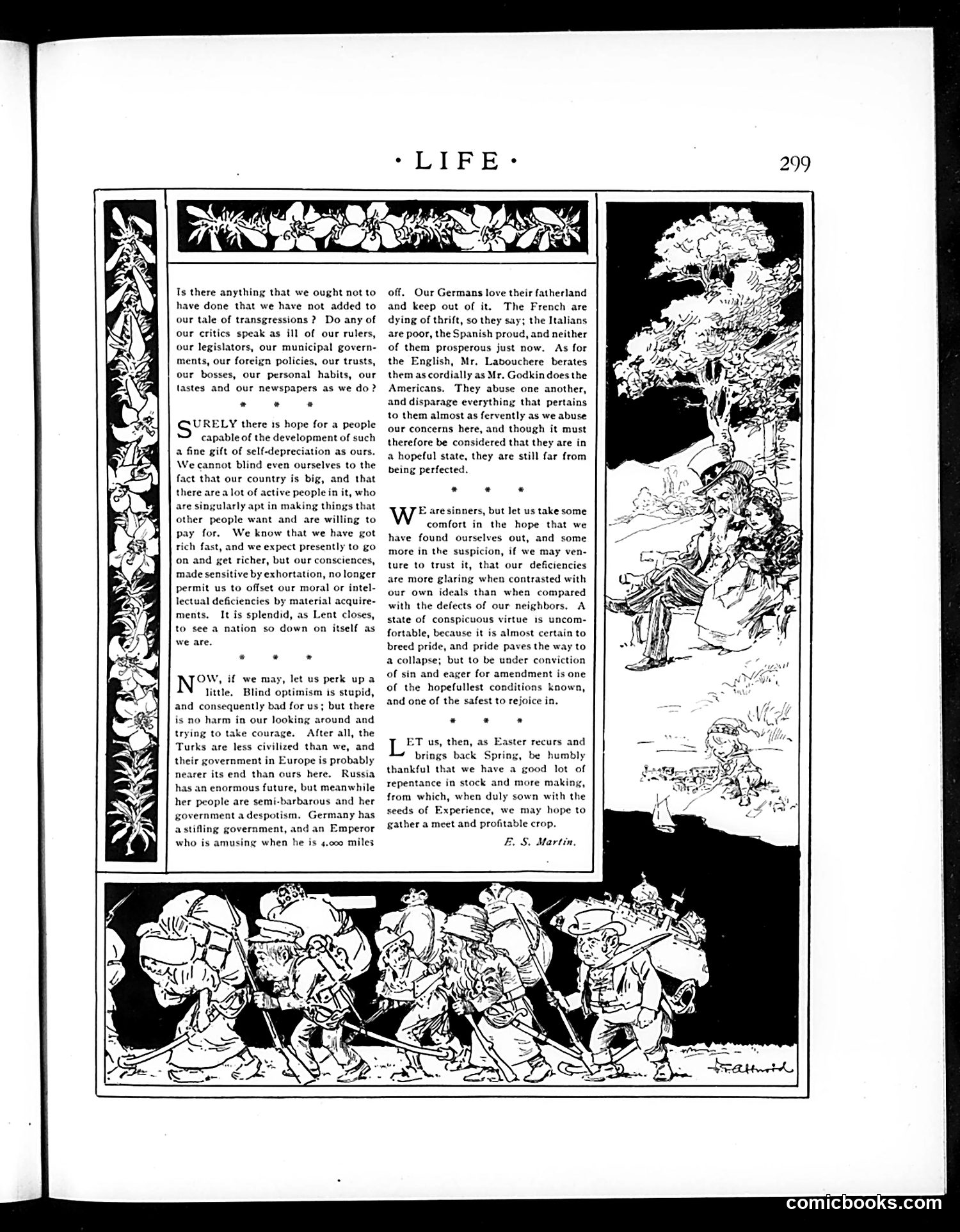
This page presents an essay by E.S. Martin reflecting on national character and self-improvement. The text discusses how Americans, despite flaws, possess "self-declaration" and capacity for reform—contrasting their optimism with criticisms of other nations (Germans, French, Italians, Spanish, English). The **bottom cartoon** (signed, appears to be by Cesare Maccari) depicts caricatured soldiers in combat, likely satirizing military leadership or the absurdity of war—a common Life magazine theme during this period. The **right-side illustration** shows a pastoral landscape, possibly accompanying the essay's hopeful tone about renewal and improvement. The decorative left border features ornamental botanical designs typical of early 20th-century magazine layouts. The overall thrust celebrates American self-awareness and capacity for moral progress.
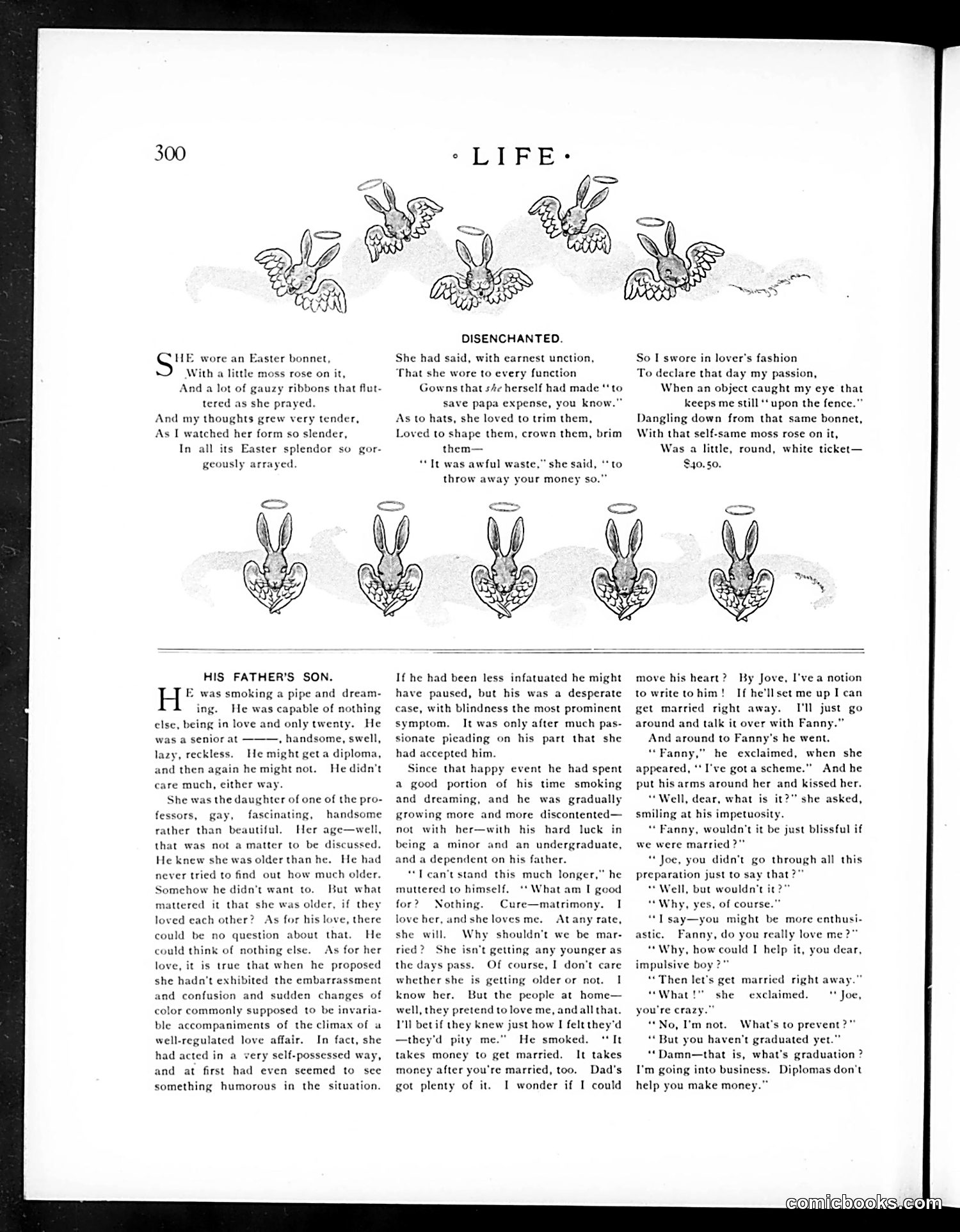
This page contains two short stories with illustrations rather than political cartoons. **"Disenchanted"** features winged cherubs/angels at the top and satirizes romantic idealization. A woman wears an Easter bonnet to economize on hats, and her suitor mistakes this thriftiness for special affection. The joke: he romantically interprets her practical behavior as passion, when she's actually just being frugal. **"His Father's Son"** depicts a young man who loves a woman but struggles with commitment due to financial concerns about marriage costs. It satirizes the tension between romantic desire and practical economic worries—a common early 20th-century theme about whether young men could afford marriage. Both stories are gentle social satire about courtship, economics, and misread intentions rather than political commentary.
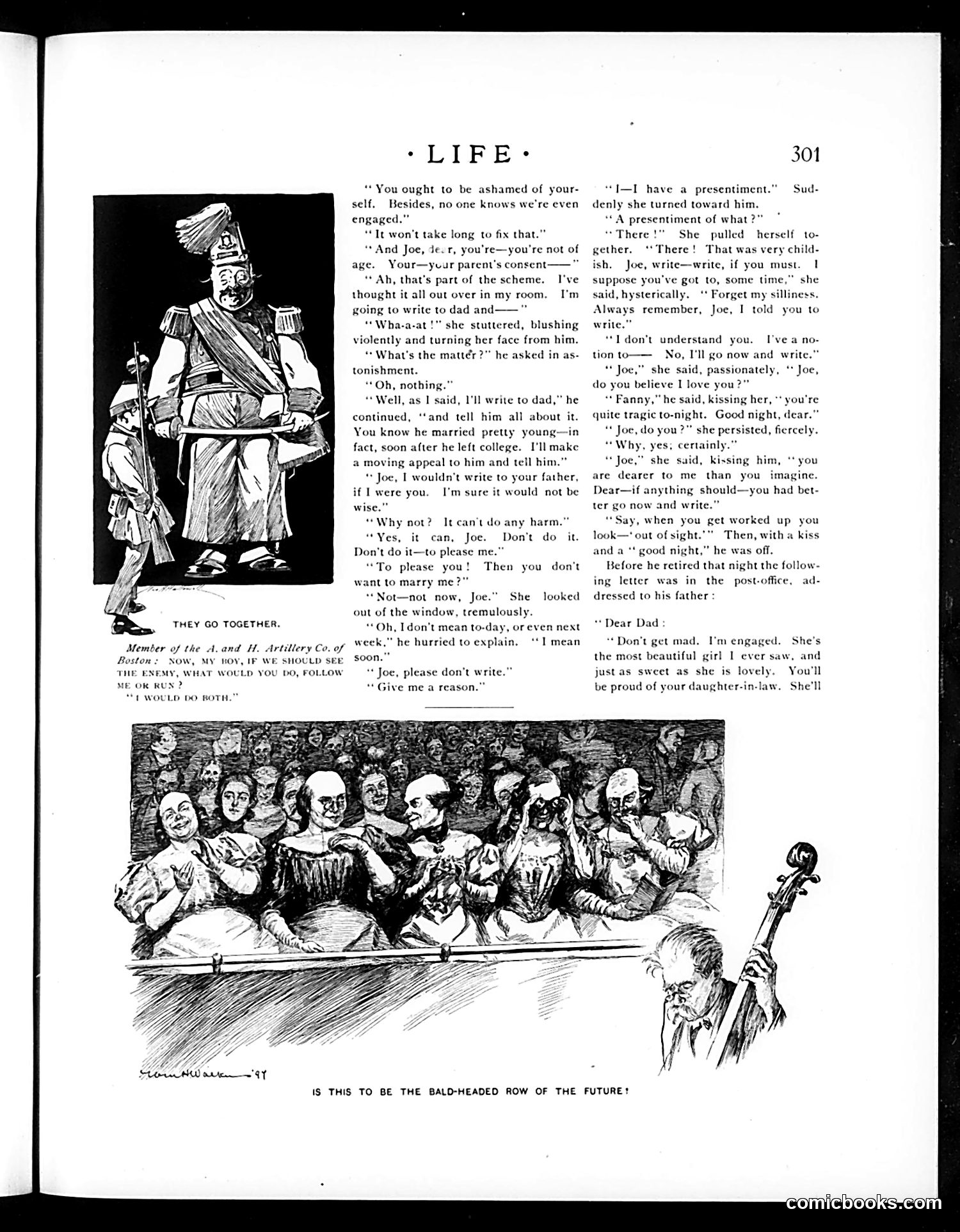
This page from *Life* magazine contains two editorial cartoons addressing early 20th-century social concerns. **Top cartoon:** Shows a military officer (likely representing military leadership or warmongers) with the caption "THEY GO TOGETHER," paired with text suggesting the military and wealthy interests are aligned in pushing citizens toward conflict—a common anti-war sentiment of the era. **Bottom cartoon:** Depicts a conductor leading an orchestra of bald-headed figures with the caption "IS THIS TO BE THE BALD-HEADED ROW OF THE FUTURE?" This appears to satirize concerns about either declining birth rates, aging leadership, or societal degeneration—possibly referencing eugenics anxieties or generational decline debates popular in early 1900s discourse. The narrative text involves a romantic subplot about engagement and marriage, typical of *Life's* mixed editorial and lifestyle content.
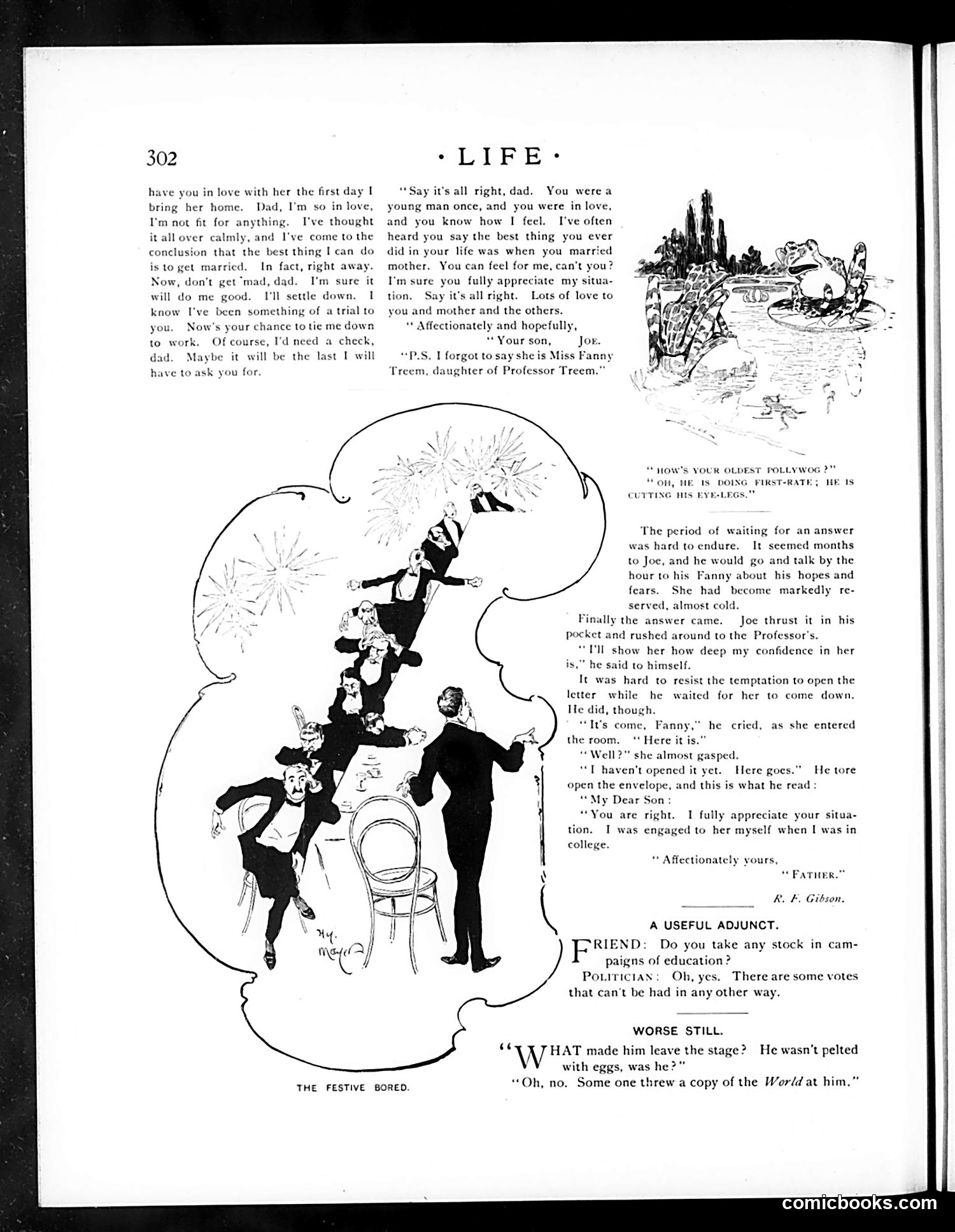
The main cartoon, titled "The Festive Bored," depicts a man in formal attire surrounded by dancing, celebrating figures erupting from his head like fireworks. This satirizes the disconnect between external festivity and internal ennui—a wealthy or socially obligated person mechanically attending parties while mentally disengaged. The surrounding text consists of humorous letters and anecdotes, including a father's supportive response to his son's romantic engagement, a brief joke about educational campaigns and votes, and a quip about an actor leaving the stage after being struck by a newspaper. The overall page reflects early 20th-century satirical humor targeting social pretense, generational expectations, and society's superficial gaiety—common themes in Life magazine's social commentary.
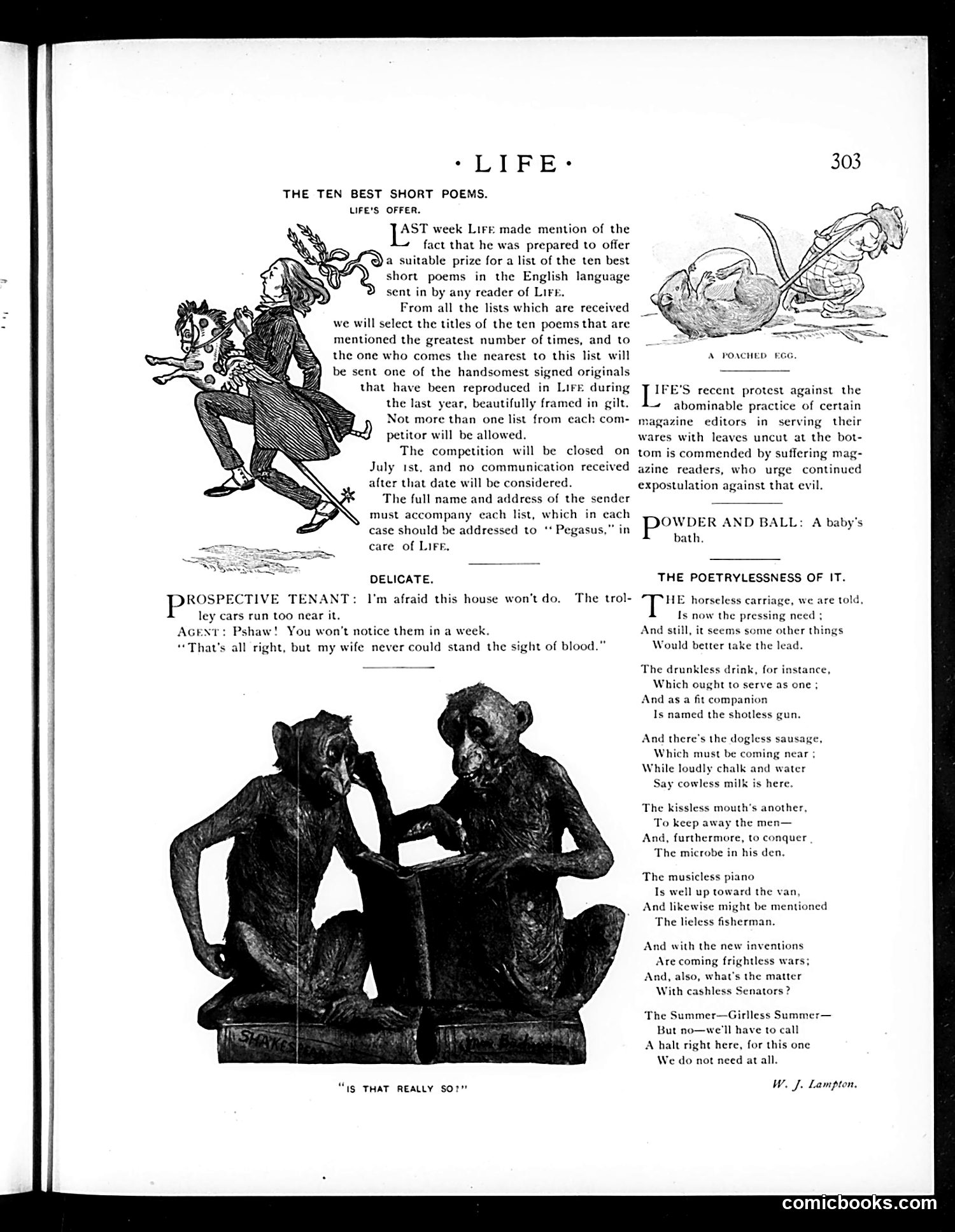
This page contains satirical content from Life magazine (likely early 1900s based on style). The main elements: **"The Ten Best Short Poems" Contest**: Life announces a competition where readers submit lists of the ten best English-language short poems. The winning list—closest to those mentioned most frequently—earns a signed, gilt-framed original artwork. **Two Brief Comic Dialogues**: - "Delicate": A prospective tenant rejects a house because trolley cars run nearby. The agent assures him he won't notice the noise, but the tenant worries his wife "never could stand the sight of blood"—darkly implying trolley accidents. - "Powder and Ball": A crude joke equating a baby's bath with ammunition. **"The Poetrylessness of It"** (by W.J. Lampton): A satirical poem mocking the era's obsession with new "horseless" inventions. It catalogs absurd "-less" things (drunkless drinks, shotless guns, dogless sausage, girlless summer, cashless senators), suggesting society pursues pointless novelties while ignoring real problems. The humor lies in the ridiculous combinations and social commentary on misplaced priorities.
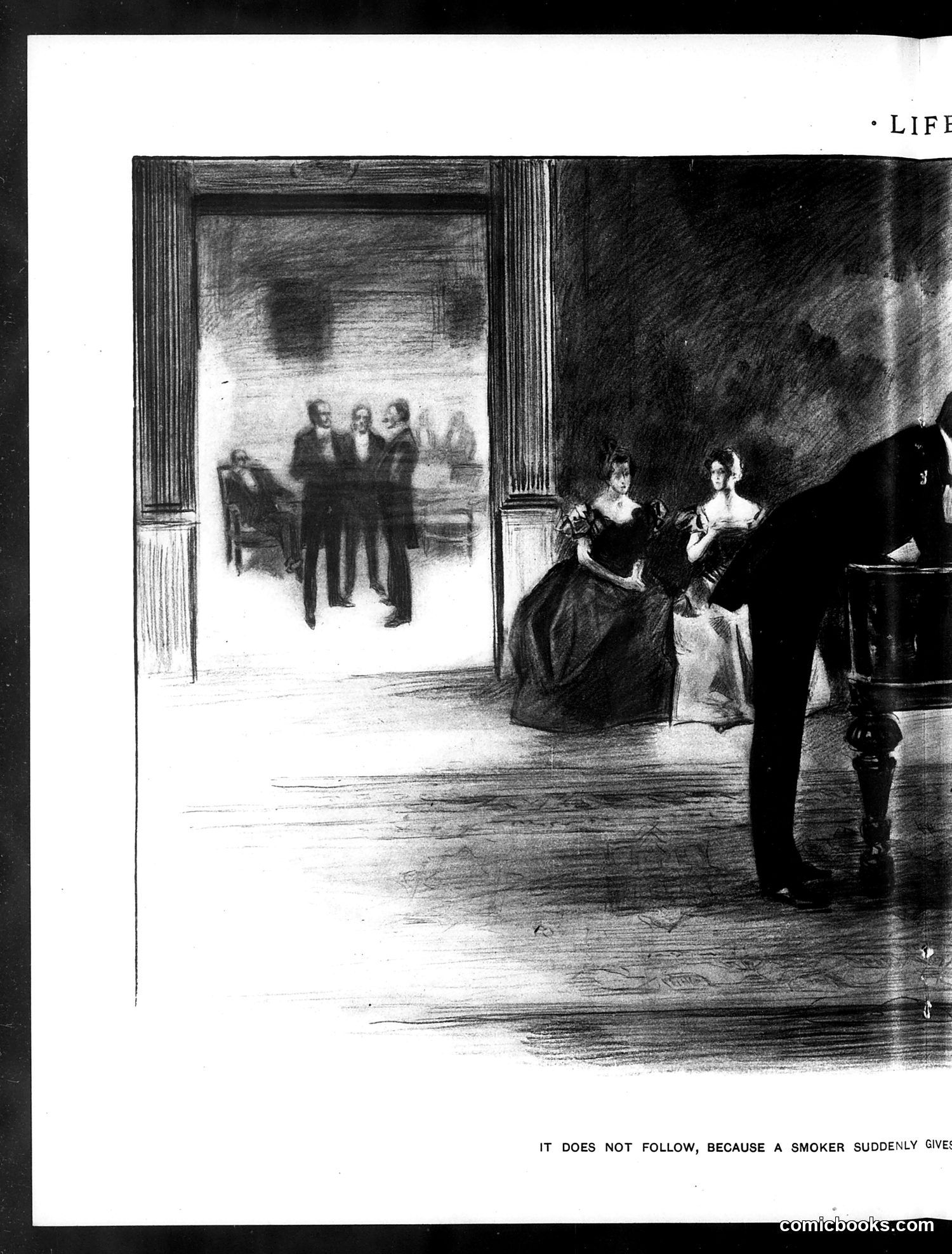
This cartoon satirizes social hypocrisy among the upper classes. The image shows elegantly dressed women in a drawing room while men conduct business in an adjacent room visible through open doors. The caption reads: "IT DOES NOT FOLLOW, BECAUSE A SMOKER SUDDENLY GIVES..." The satire appears to critique the Victorian-era social convention separating men and women after formal gatherings. While gentlemen retire to smoke cigars and conduct private affairs, the ladies remain in polite society. The incomplete caption suggests the joke concerns assumptions about behavior or character based on a single action—likely mocking how people judge propriety selectively based on gender or social position. The cartoon ridicules the rigid gender segregation and the arbitrary moral standards applied differently to men versus women in high society.
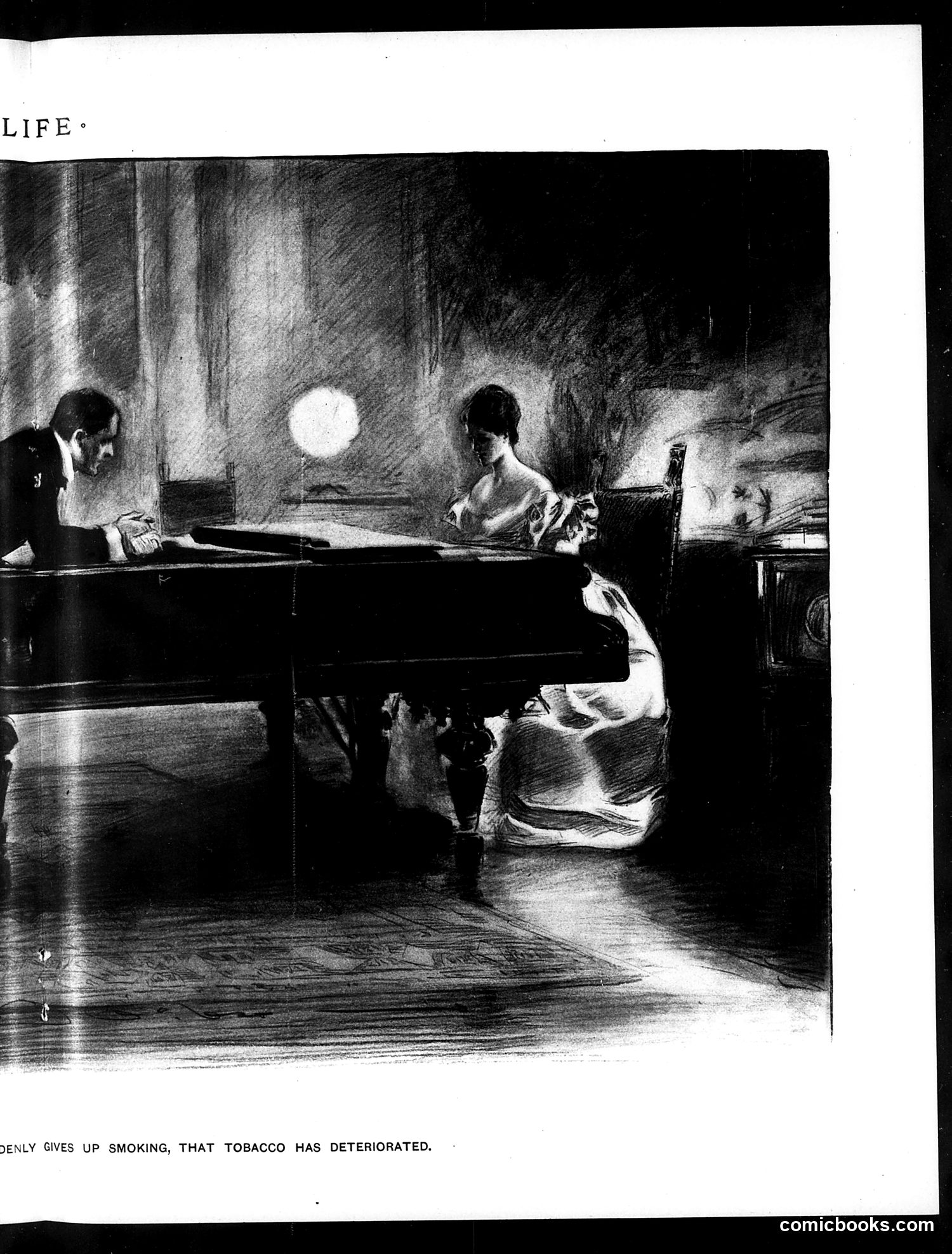
This appears to be a satirical illustration from *Life* magazine showing a social scene with multiple figures in what looks like an elegant interior space with a piano. The visible caption fragment reads: "...DENLY GIVES UP SMOKING, THAT TOBACCO HAS DETERIORATED." The satire seems to concern someone's sudden decision to quit smoking, with the joke being that they attribute this decision to tobacco quality declining rather than admitting health concerns or personal choice. This reflects early-to-mid 20th century attitudes where smoking was socially normalized, and quitting required social justification that placed blame externally (on the product) rather than on personal health concerns. The illustration's theatrical lighting and composition emphasize the social performance aspect of the scene.
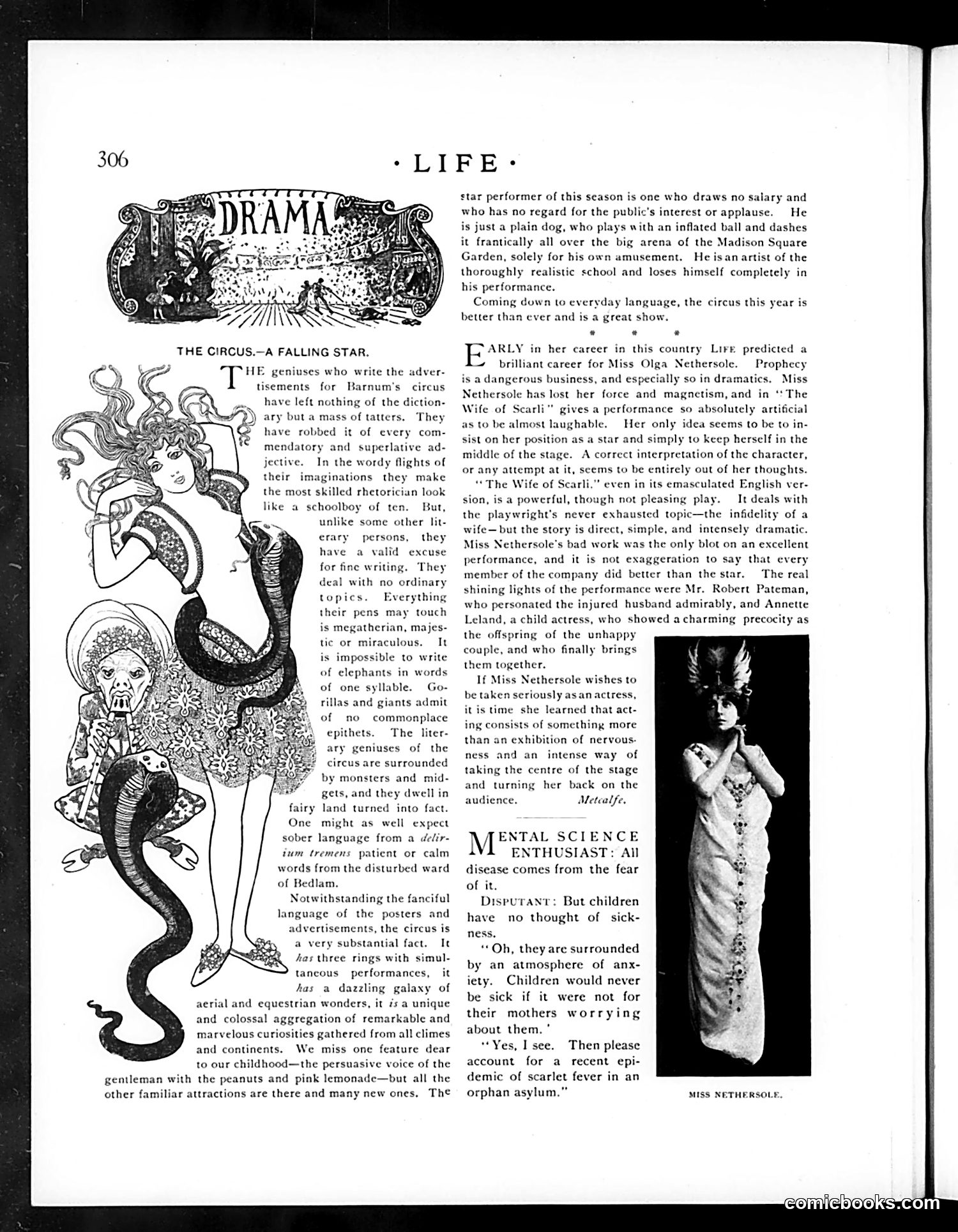
This page contains two distinct pieces. The first celebrates Barnum's circus as genuinely spectacular entertainment, noting its ornate advertising language is justified by actual marvels—three simultaneous rings, aerial acts, exotic animals. The humor centers on a dog performing with a ball in Madison Square Garden as the season's "star," working purely for self-amusement without salary, satirizing how even unremarkable acts gain prominence in circus publicity. The second piece harshly critiques actress **Olga Nethersole's** performance in *The Wife of Scarli*. The writer claims she has lost her talent and gives an "absolutely artificial" performance, focused only on maintaining center-stage prominence rather than authentic character work. Supporting players—Robert Pateman and child actress Annette Leland—reportedly outshone her. The critique suggests Nethersole mistakes nervous energy and turned-away posture for genuine acting.
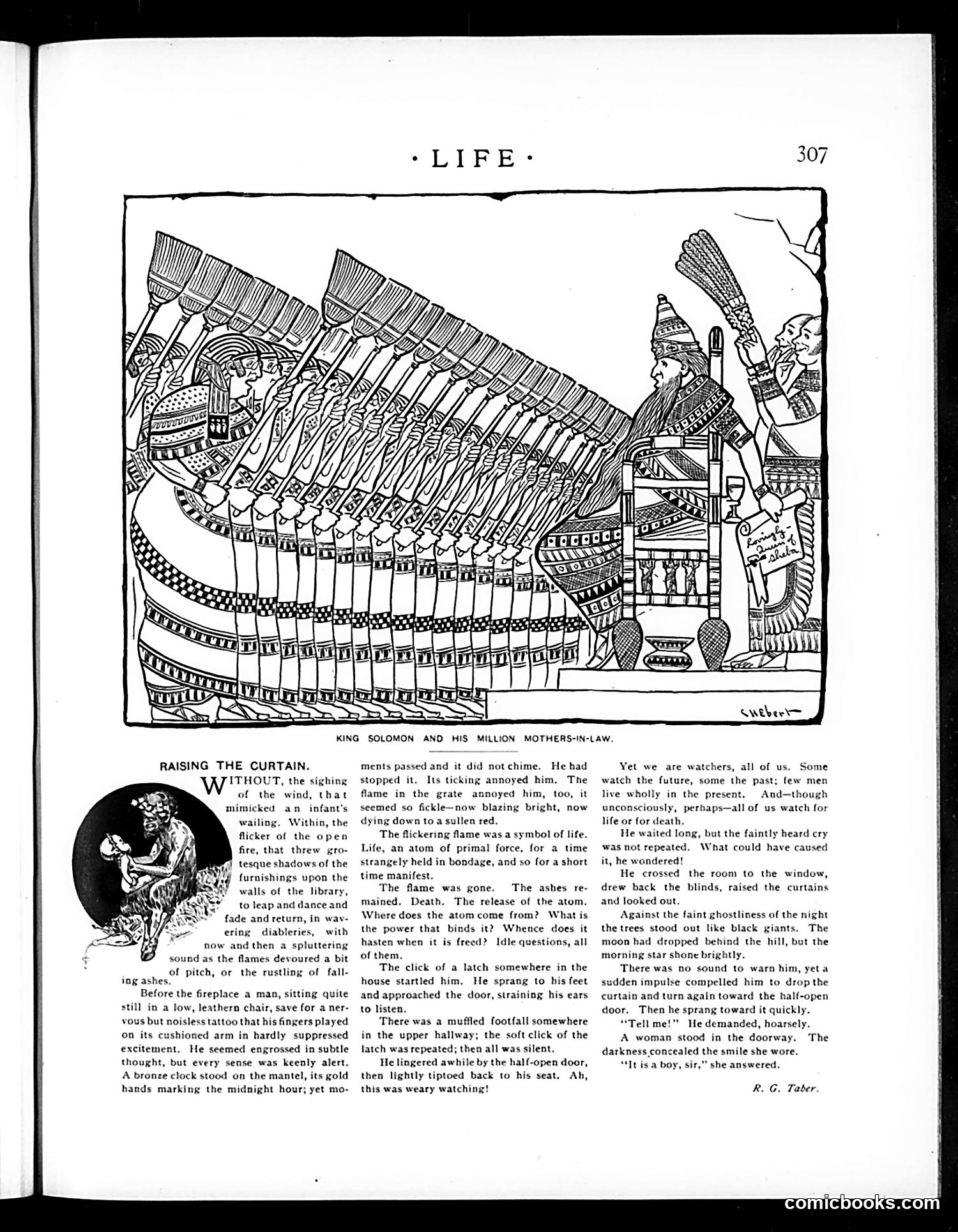
This page contains two distinct elements: a classical illustration captioned "King Solomon and His Million Mothers-in-Law" (likely a biblical reference to Solomon's legendary numerous wives), and a short story titled "Raising the Curtain" by R.G. Taber. The story itself is not satirical but rather a philosophical drama. A man sits alone at midnight, contemplating life and death while watching a dying fire—the flames serving as a metaphor for vitality itself. He's anxiously waiting for something, starting at sounds. The twist ending reveals he was awaiting news of a birth: a woman announces "It is a boy, sir." The narrative contrasts philosophical meditation on mortality with the arrival of new life, creating ironic juxtaposition. There's no political satire here—this is literary fiction exploring existential themes typical of early-20th-century magazine storytelling, not commentary on current events or public figures.
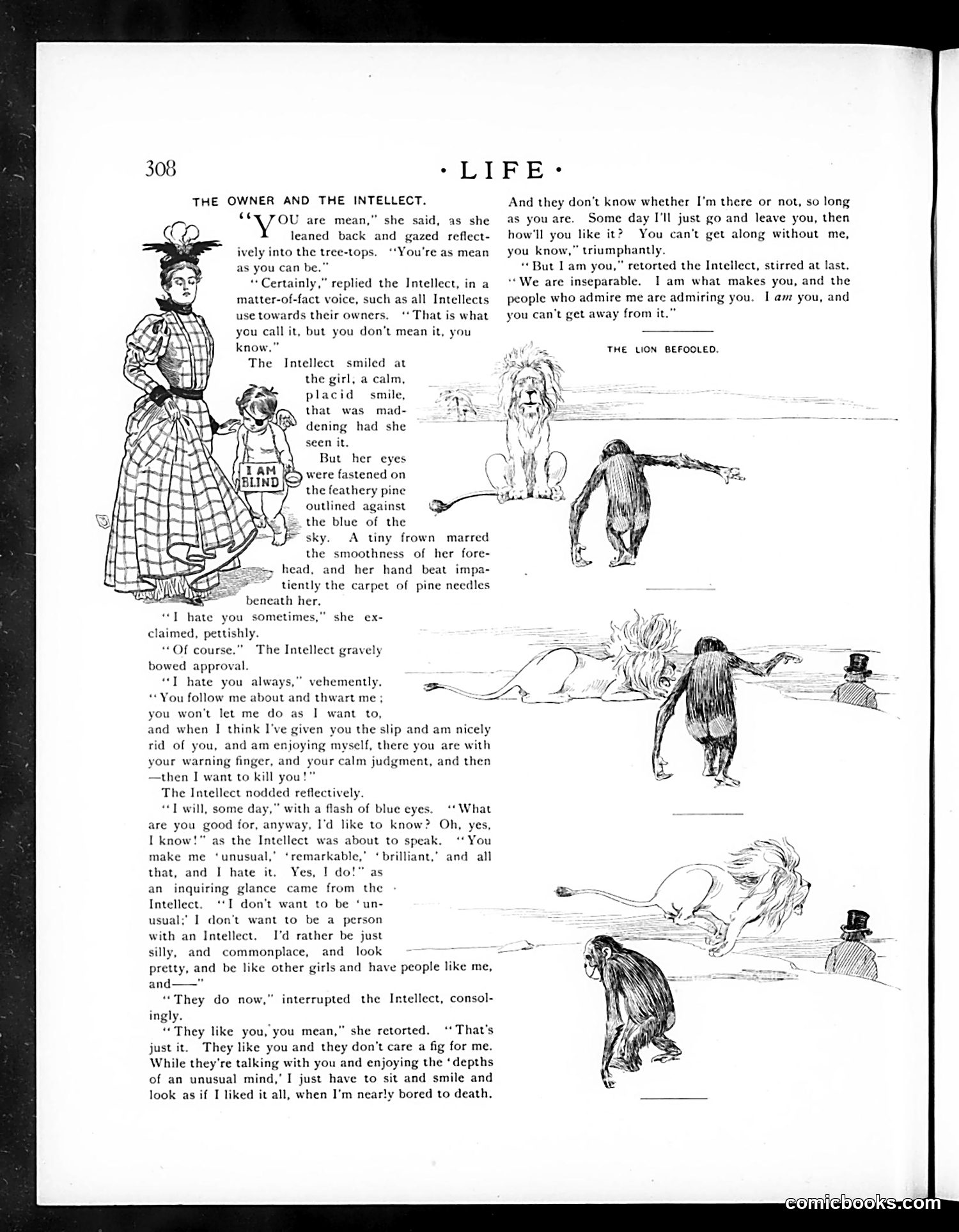
This page contains two distinct pieces: **"The Owner and the Intellect"** is an allegorical dialogue between a young woman and her personified Intellect. The satire critiques the tension between intellectual identity and social desirability. The woman resents that her intelligence makes her "unusual" and "remarkable"—qualities that alienate her from ordinary social acceptance and romantic attention. People admire her *mind*, not *her*. The Intellect represents the burden of being educated or intellectually gifted, particularly for women who faced social pressure to be decorative rather than thoughtful. The satire's point: intellectual women couldn't escape their own minds and were simultaneously punished socially for having them—admired abstractly but isolated personally. **"The Lion Befooled"** (right side) shows a series of illustrations depicting what appears to be a lion being tricked or outwitted by a monkey or ape. The narrative details aren't provided, but the images suggest a fable-like moral tale about cleverness defeating strength.
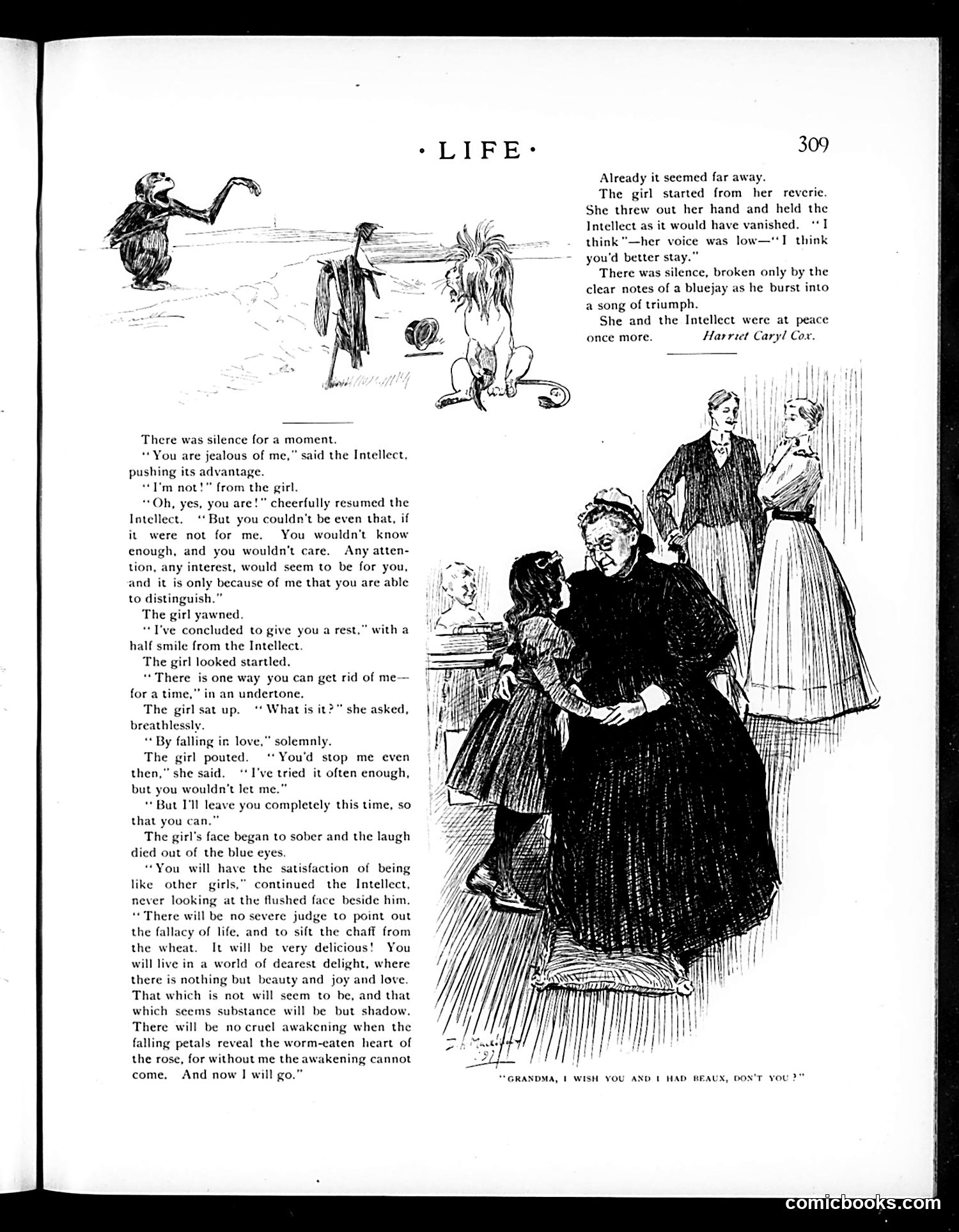
This is a philosophical allegory about reason versus emotion in women's lives. The two main characters are personified abstractions: "the Intellect" (a male figure) and "the Girl" (representing feminine emotion or intuition). **The Satire's Point:** The Intellect tempts the Girl by offering to abandon her if she falls in love—promising blissful ignorance where she can be "like other girls" without critical judgment. He argues that love creates a beautiful delusion, hiding life's harsh realities beneath romantic fantasy. **The Joke:** The Girl almost accepts this offer (tempted by the promise of uncomplicated happiness), but ultimately chooses to keep her Intellect. The bluejay's triumphant song and their restored "peace" suggest she's rejected the seductive notion that women should abandon reason for romantic sentiment. **Social Context:** This reflects late 19th/early 20th-century debates about women's education and intellect—whether educated women should subordinate reason to traditional feminine roles and romantic fulfillment. The story argues for retaining intellectual capacity despite social pressure.
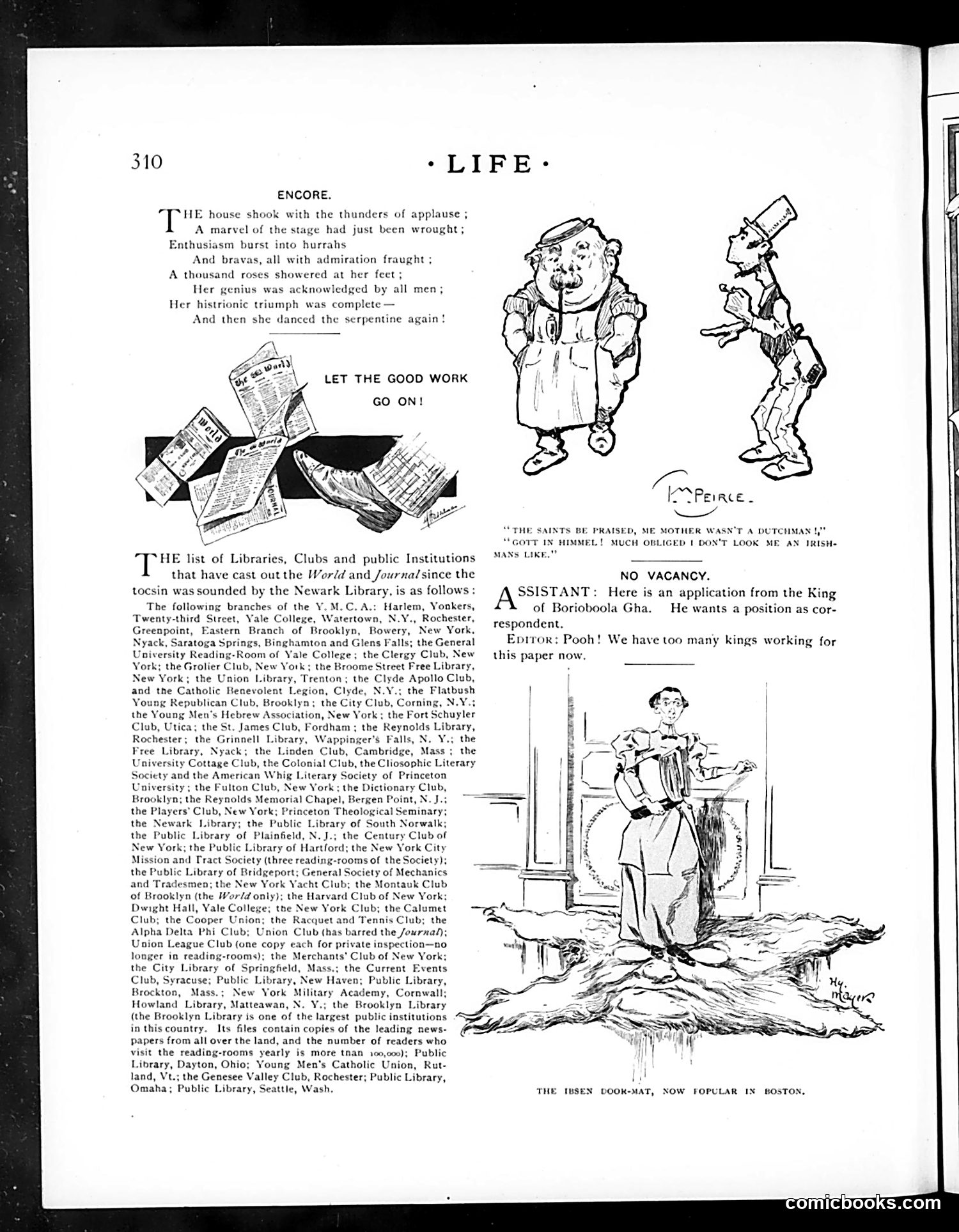
This page satirizes the **banning of *World* and *Journal* newspapers** from American libraries and institutions—a censorship campaign apparently initiated by Newark Library. The extensive list documents which organizations have expelled these publications. The top poem mocks theatrical **encore performances**, likely as a metaphor for this censorship campaign's repetitive nature—the "good work" continuing endlessly. The cartoons are lighter social humor: one depicts **Irish and German immigrants** (indicated by their accents: "dutchman," "Gott in Himmel"), relieved these newspapers weren't banned by their ethnic groups. Another shows an editor rejecting a job application from "the King of Borioboola Gha" (a fictional African location, possibly referencing colonial-era stereotypes), claiming too many kings already work there—satirizing perhaps overstaffing or absurd hiring. The bottom illustration references **Henrik Ibsen**, the controversial Norwegian playwright popular in Boston, shown as a doormat—suggesting his works were also subject to social disapproval. The page reflects turn-of-century tensions between *morality crusaders* and *press freedom*.
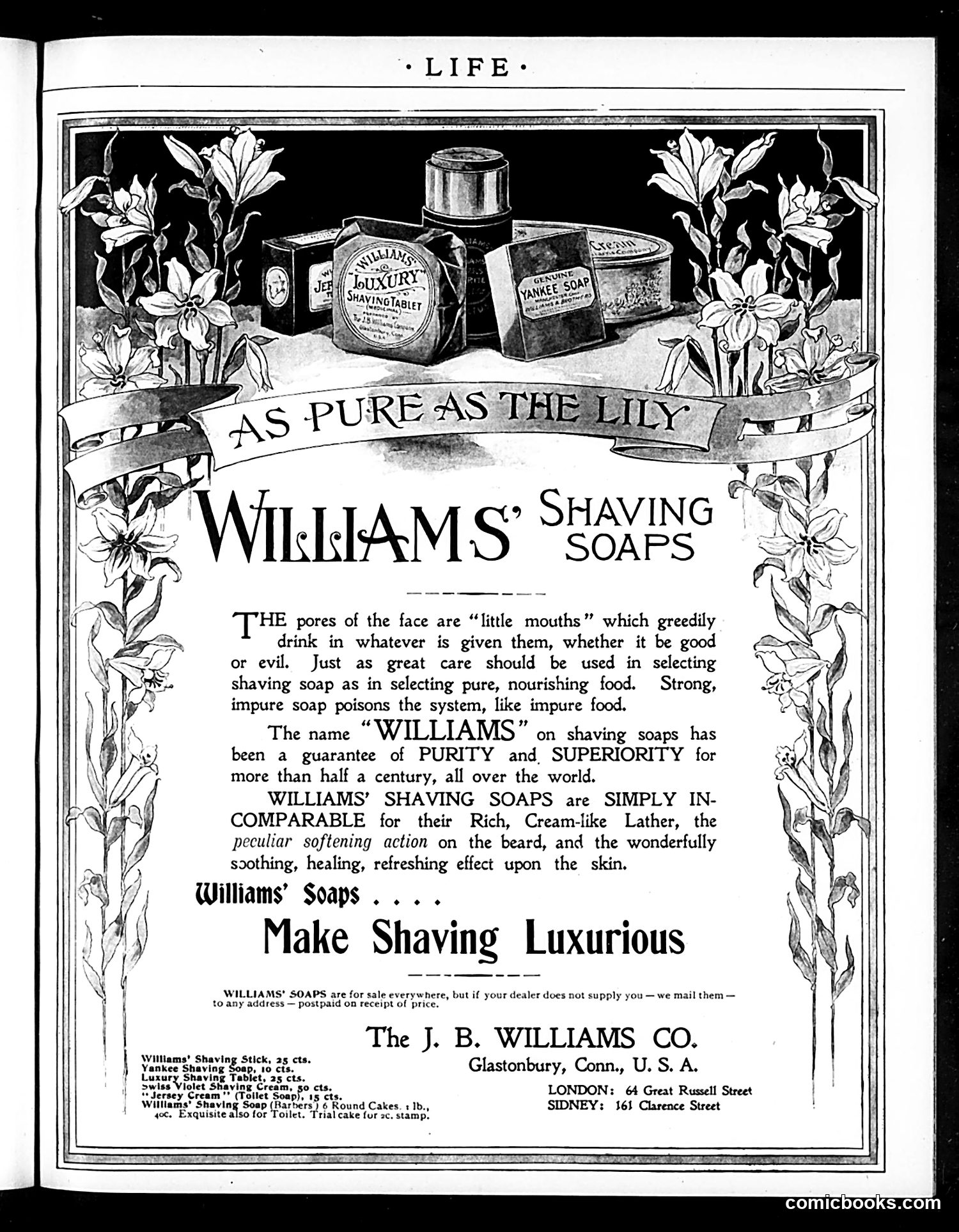
This is a **pure advertisement**, not a cartoon or satire. It's a full-page ad for Williams' Shaving Soaps, appearing in *Life* magazine (which published both satirical content and paid advertising). The ad uses pseudo-scientific language typical of early 20th-century marketing—comparing facial pores to "little mouths" that absorb substances, and equating soap quality to food purity. This reflects genuine health anxieties of the era about product contamination. The decorative lily flowers and ornate border frame the product bottles at top center, establishing an upscale, luxurious brand image. The company emphasizes over 50 years of reputation for "PURITY and SUPERIORITY." The ad lists multiple product variants (stick, tablet, cakes) and provides international addresses (Glastonbury, Connecticut; London; Sydney), indicating this was a established multinational brand. **No satire or political reference is present**—this is straightforward period advertising using contemporary health-consciousness appeals.
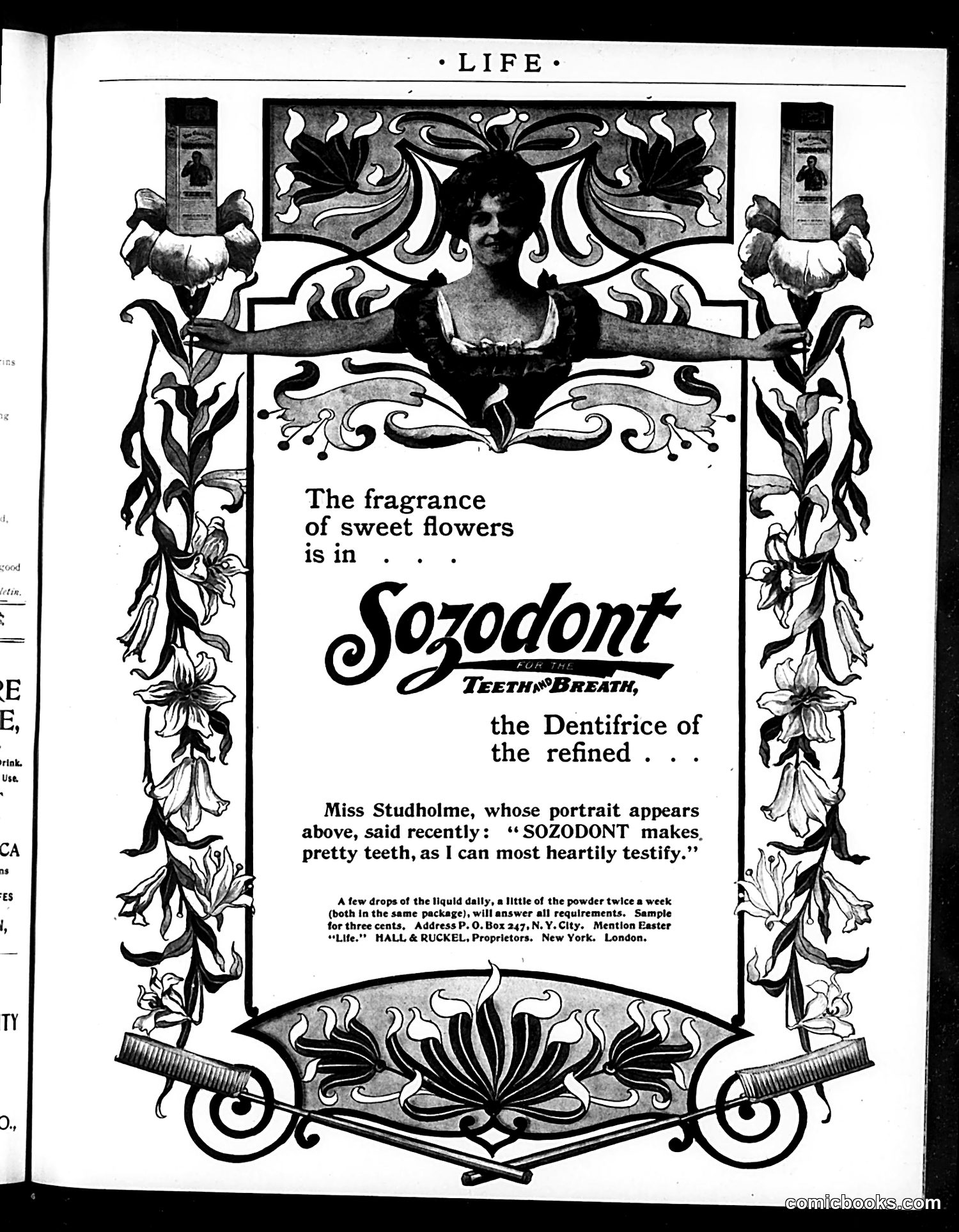
This is a **product advertisement**, not political satire. It promotes Sozodont toothpaste, a real 19th-century dental product. The page features an ornate, Art Nouveau-style border with floral designs framing a portrait of **Miss Studholme**, apparently a performer or public figure of the era whose endorsement lends credibility to the product. The advertisement plays on period values: the "refined" person uses Sozodont for "pretty teeth," linking dental hygiene to social respectability and elegance. The decorative language—"fragrance of sweet flowers"—emphasizes the product's pleasant scent. The advertisement notes it's inexpensive (samples cost three cents), making refinement and good teeth accessible to ordinary consumers. This represents early **celebrity endorsement marketing**, a common advertising strategy in Life magazine during this period.
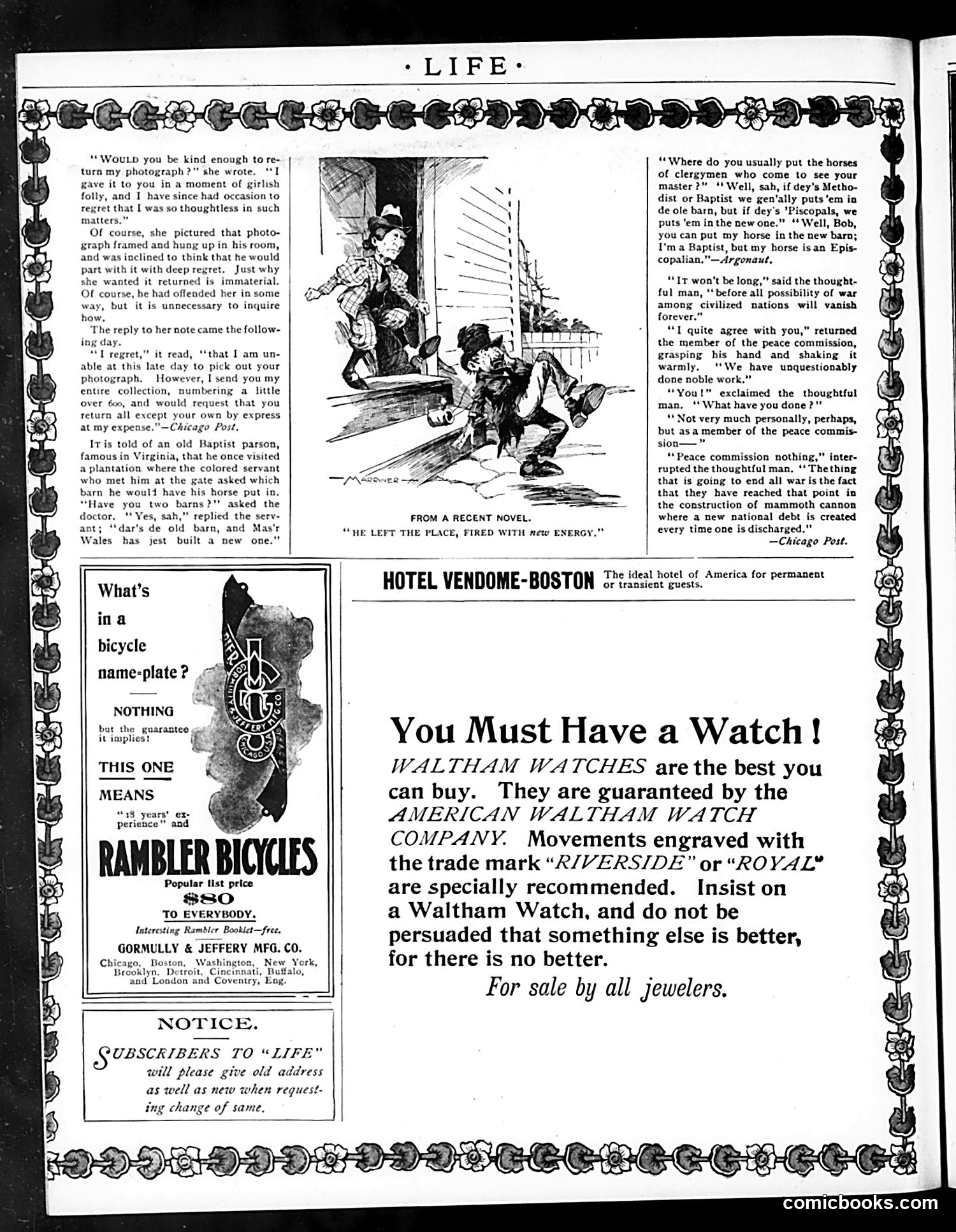
This page contains three separate humorous anecdotes typical of early 20th-century satirical magazines: 1. **The Photograph Story**: A woman asks an ex-suitor to return her picture. He claims he can't identify it among his collection of 600+ photographs and sends them all back—a joke about his romantic conquests and her inflated self-importance. 2. **The Baptist Parson**: A Virginia plantation servant explains his system for stabling horses: Baptist and Methodist clergy get the old barn, but Episcopalians get the new one. The parson claims his horse is Episcopalian despite being Baptist himself—satirizing class pretension and the perceived superiority of different denominations. 3. **The Peace Commission**: A thoughtful man mocks a peace commissioner's claim to have "ended war," revealing the real cause will be bankruptcy from building massive cannons—post-WWI satire on military spending and the futility of peace efforts. The page is primarily **advertising** (Rambler bicycles, Hotel Vendôme, Waltham watches), with humor serving to entertain readers while promoting products.
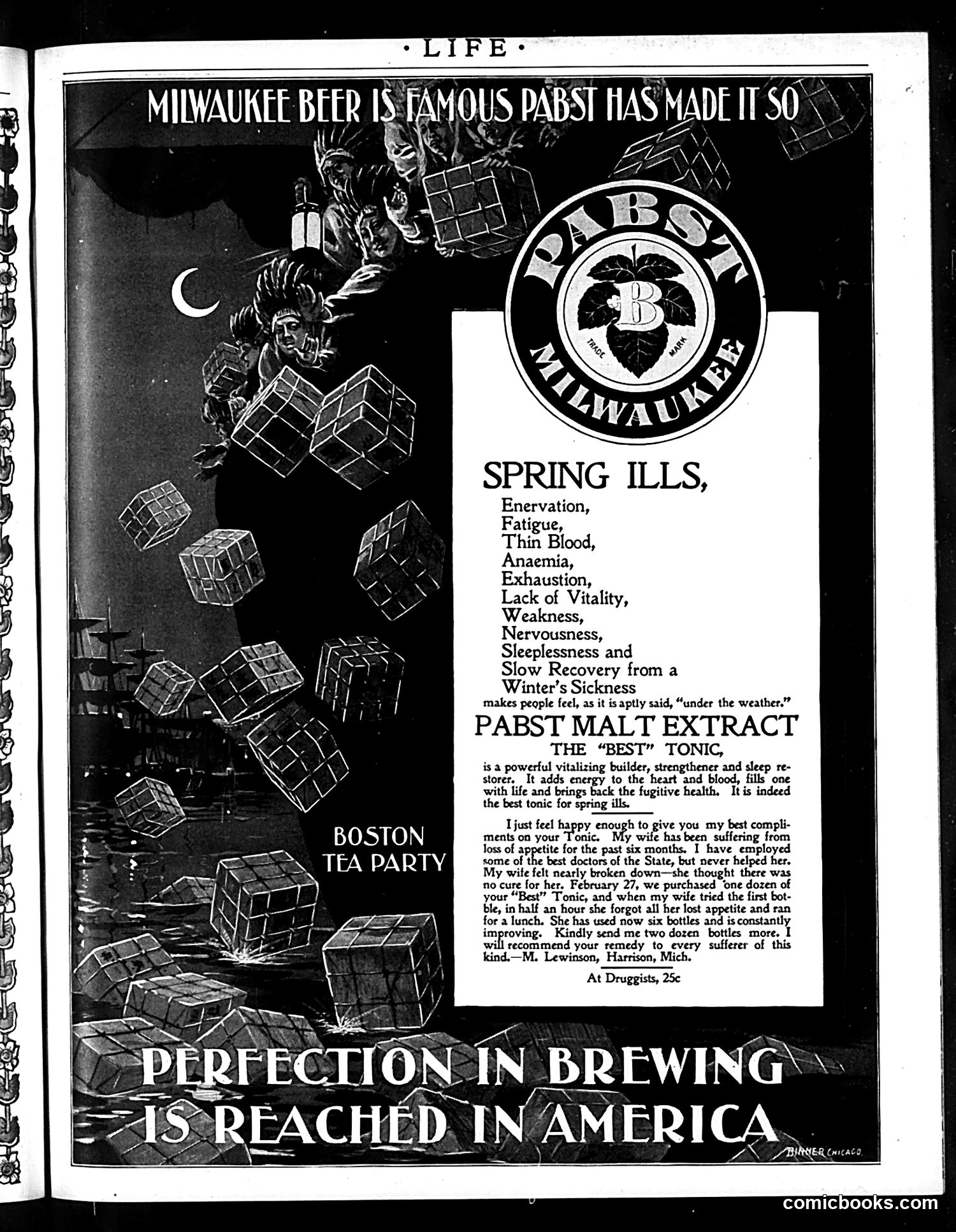
This is primarily a **Pabst Beer advertisement**, not political satire. The page uses a fantastical illustration of the Boston Tea Party (left side) as a historical reference point, recontextualizing American rebellion as a celebration of beer rather than political protest. The "spring ills" listed—fatigue, weakness, nervousness, anemia—reflect genuine 19th/early-20th century medical concerns. Pabst's "Malt Extract" tonic claims to cure these conditions, positioning beer as medicinal rather than recreational. The testimonial from "M. Lewinson" of Harrison, Michigan describing his wife's dramatic recovery lends false credibility. The headline "Perfection in Brewing is Reached in America" asserts American brewing superiority, likely responding to competition from imported German beers. The juxtaposition of revolutionary iconography with commercial product promotion represents typical early-1900s advertising strategy: wrapping consumer goods in patriotic symbolism to boost sales.
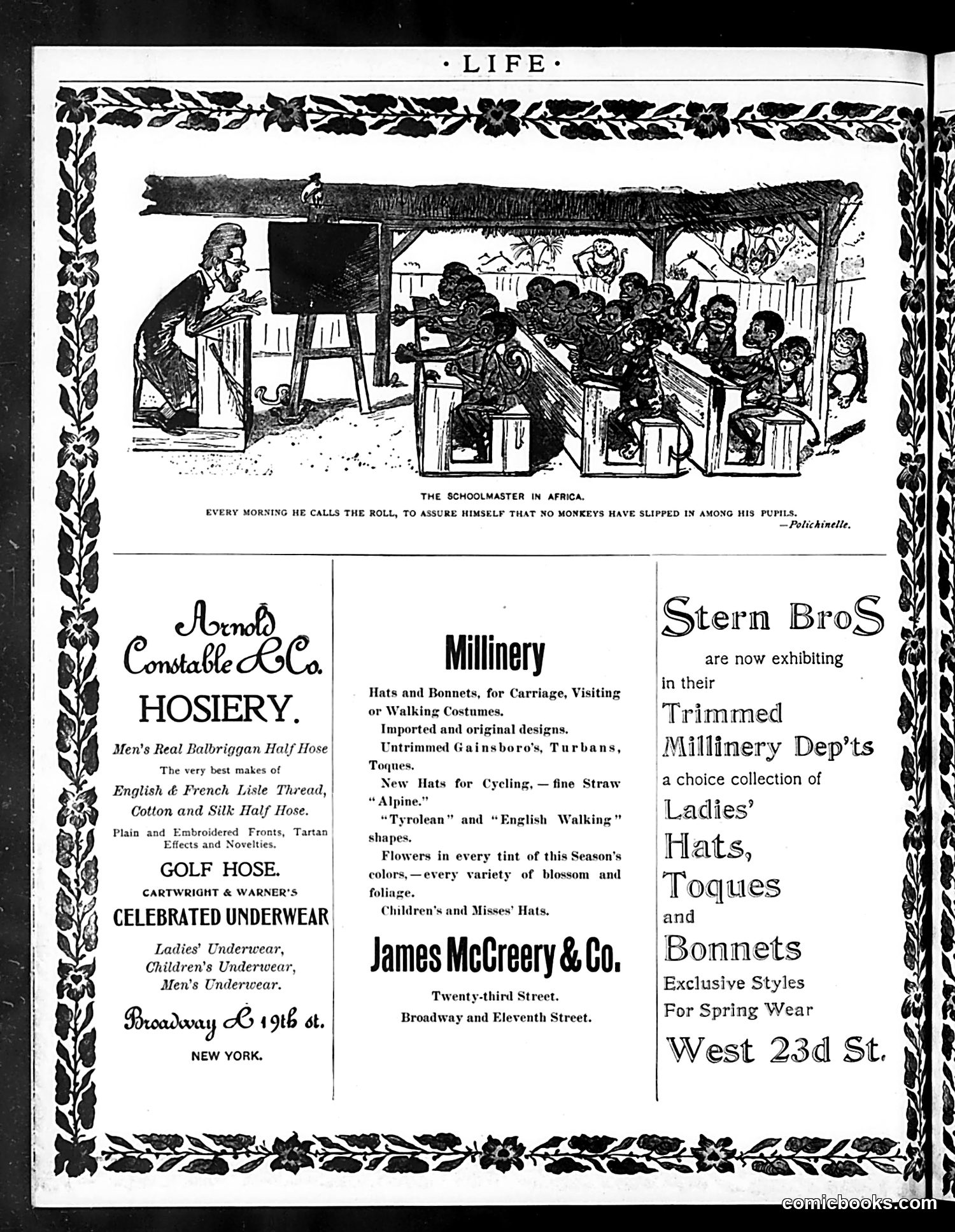
This cartoon presents a racist satire typical of early 20th-century Life magazine. It depicts a schoolmaster conducting a roll call of African students, with the caption joking that he must check attendance to ensure no monkeys have infiltrated the classroom. The humor relies on a dehumanizing comparison between African people and primates—a persistent racist trope of the era used to suggest African inferiority. The cartoon presents education in Africa as inherently absurd, implying both that Africans are animal-like and that educating them is a comical endeavor. The byline credits "Polichinelle," a stock comic character from commedia dell'arte, suggesting this represents supposedly universal humor rather than targeted bigotry. The page is primarily advertisements for American retailers (hosiery, millinery, underwear), with the cartoon serving as editorial content typical of Life's satirical approach during this period.
This is **not a cartoon or satirical content**—it's a full-page advertisement placed in *Life* magazine. The Gorham Manufacturing Company, a prominent American silverware maker, invites patrons to view their winter workshop productions at their New York showroom. The ad promotes both reproductions of historical silver styles (Old English, 18th Century French, and Colonial American) and innovative new techniques combining silver with enamel. The decorative floral border and formal typography reflect the refined aesthetic the company wanted to project for luxury goods aimed at wealthy customers. This represents typical early 20th-century upscale advertising in *Life*, which targeted educated, affluent readers interested in fine decorative arts.
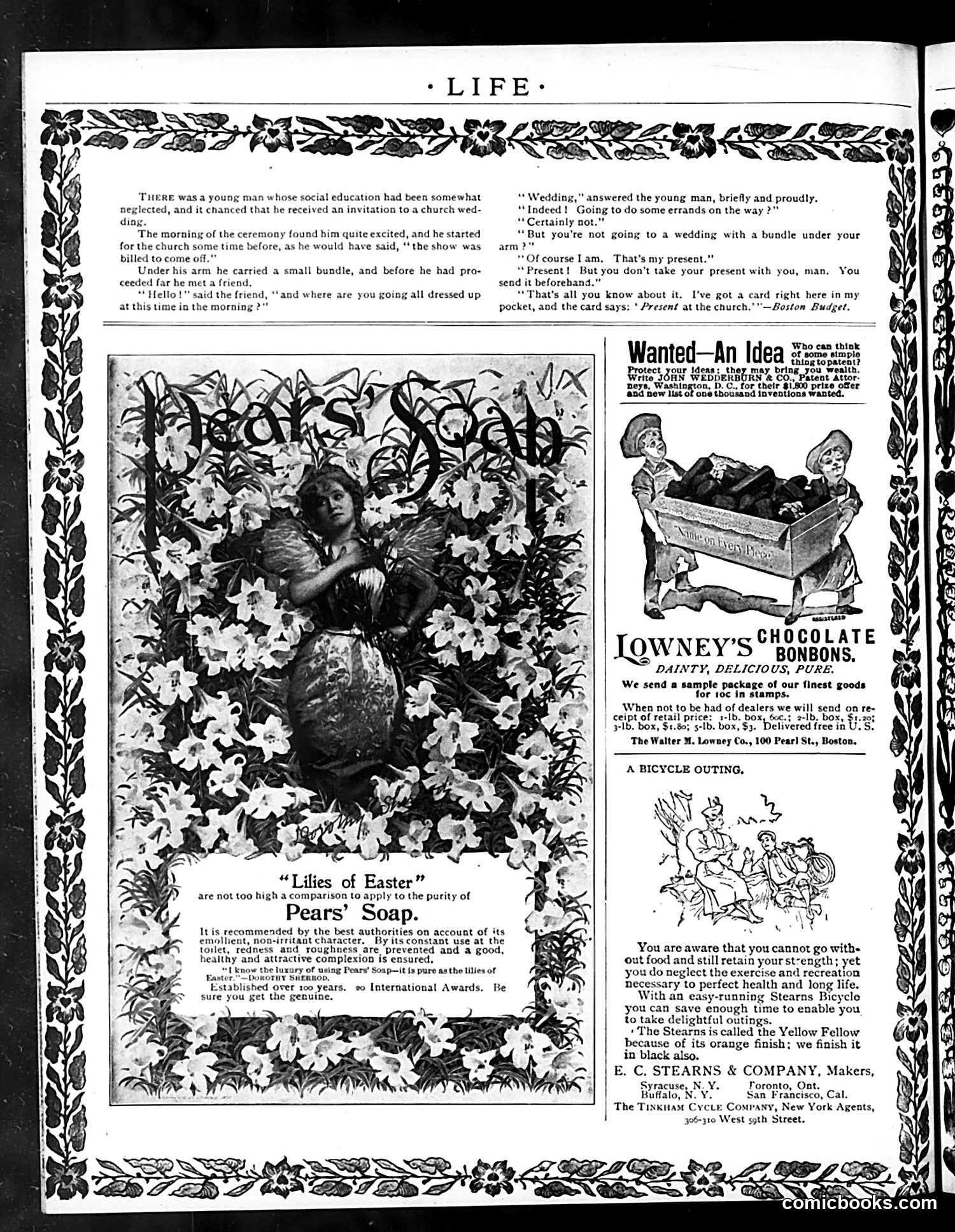
This page contains a humorous anecdote and period advertisements rather than political cartoons. **The Story ("Hello!"):** A socially unsophisticated young man attends a wedding carrying a physical gift under his arm. When questioned, he defends this breach of etiquette by showing a card reading "Present at the church"—a pun on the phrase "present at the church" (attending the ceremony). The joke mocks his misunderstanding of upper-class wedding customs: gifts were to be sent beforehand, not carried to the event itself. **The Advertisements:** The page features three ads typical of the era: Pears' Soap (emphasizing purity and complexion care), Lowney's Chocolate Bonbons (soliciting mail orders), and Stearns Bicycles (promoting exercise and outdoor leisure). These ads reflect early 20th-century consumer culture and the bicycle craze. The content satirizes working-class unfamiliarity with formal social conventions—a recurring theme in *Life* magazine's gentle humor.
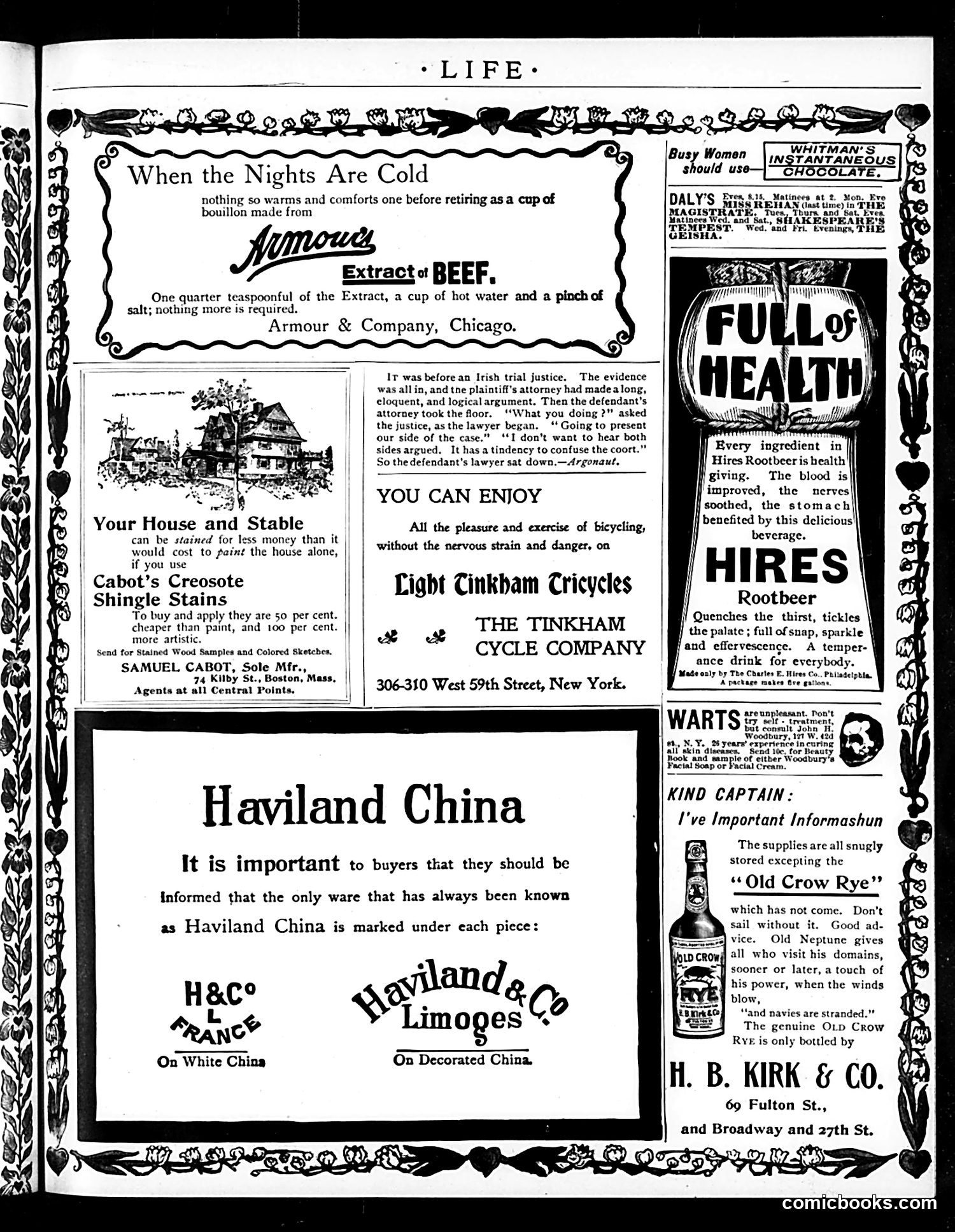
This is primarily an **advertising page** from an early 20th-century American magazine, with minimal editorial content. The page contains **one brief satirical anecdote** about an Irish trial judge who interrupts a defendant's lawyer, saying he doesn't want to hear both sides of an argument because "it has a tendency to confuse the court." The joke mocks Irish legal incompetence—a common stereotype in period American humor. The rest consists of **product advertisements**: Armour beef extract, Cabot's wood stain, Tinkham bicycles, Hires root beer, Haviland china, Old Crow whiskey, and treatments for warts and skin conditions. These ads reflect turn-of-the-century consumer culture and patent medicine marketing. The page demonstrates how Life magazine (founded 1883) balanced satirical humor with commercial revenue through advertising. The Irish judge joke represents the magazine's characteristic light, prejudicial humor typical of that era.
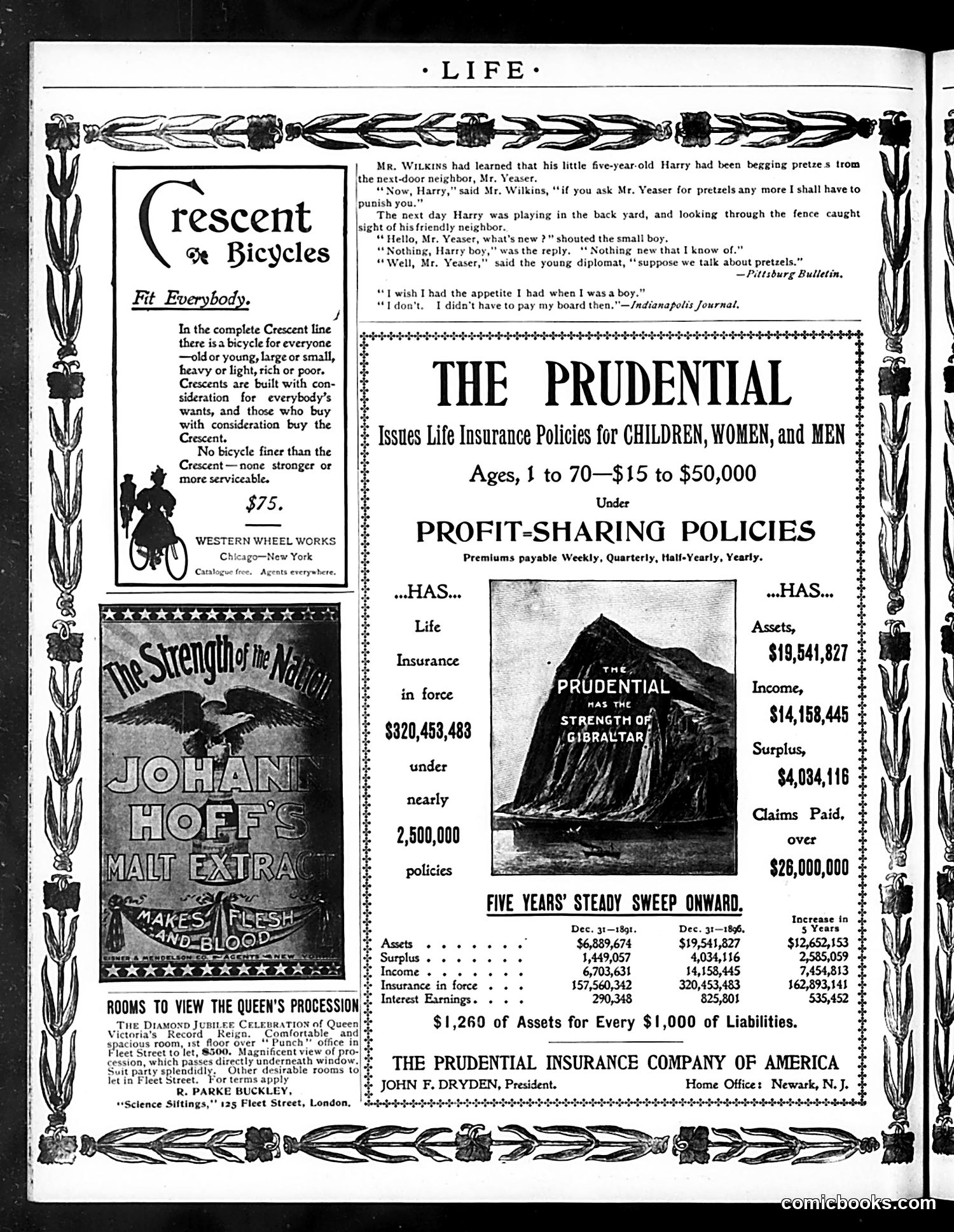
This page is primarily **advertising**, not satire or editorial cartooning. It contains three distinct advertisements: 1. **Crescent Bicycles** ($75): A standard product ad emphasizing affordability and variety for all social classes. 2. **Room Rental**: Londoners could rent viewing space over the "Punch" office to watch Queen Victoria's Diamond Jubilee procession (1897), a major British celebration. 3. **The Prudential Insurance Company**: The dominant ad showcases the company's financial strength using the "Rock of Gibraltar" metaphor—a common marketing image suggesting stability and permanence. The page also includes two **humorous anecdotes** about children and appetite, typical of Life magazine's light humor. The historical context: these ads reflect late-1890s consumer culture, imperial British celebrations, and the growth of life insurance as a middle-class financial product. The Prudential's emphasis on insuring "children, women, and men" at various ages shows expanding insurance markets.
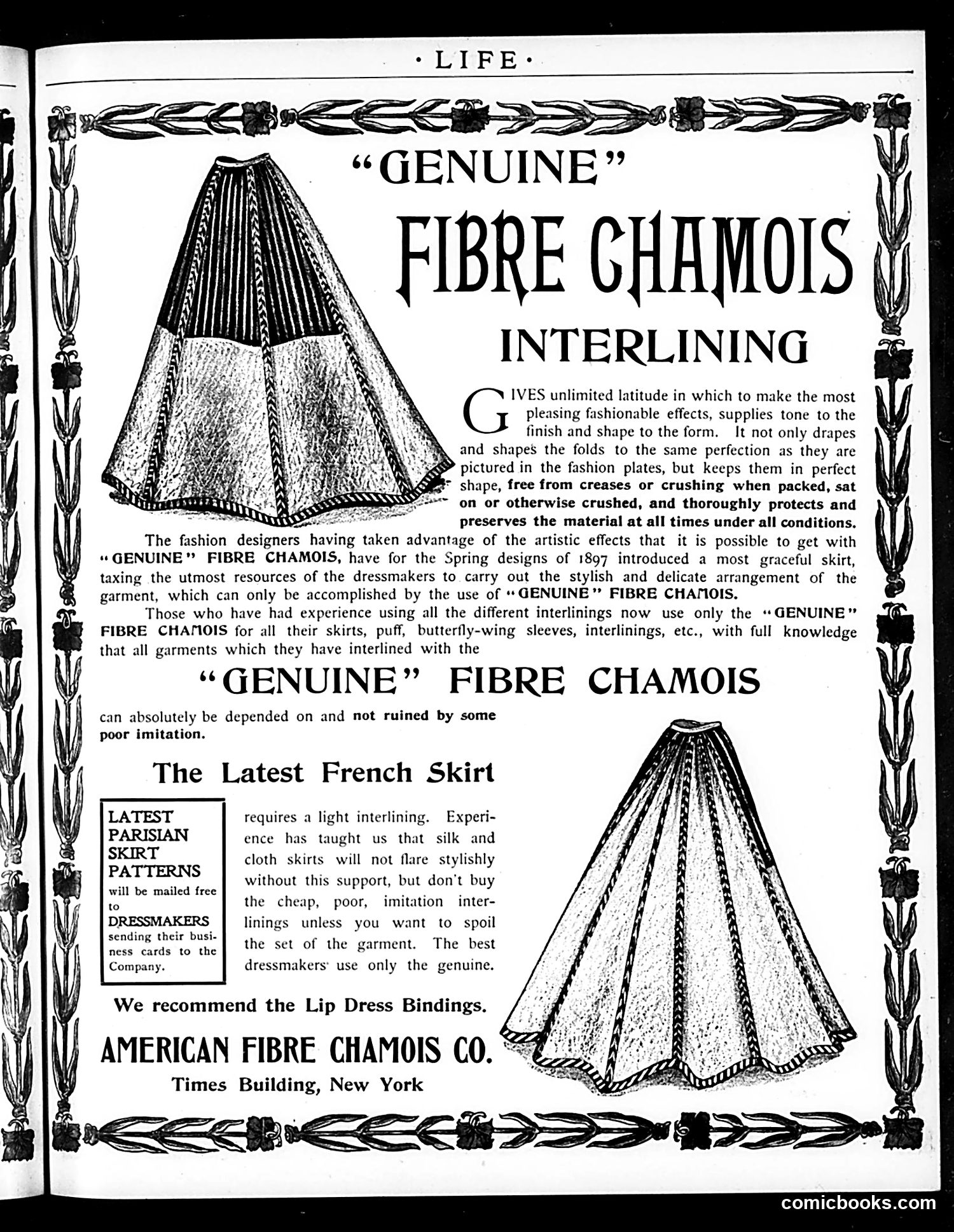
This is not a cartoon or satire—it's a straightforward **advertisement** for "Genuine Fibre Chamois" interlining, a fabric stiffening material used in dressmaking. The page promotes the American Fibre Chamois Co.'s product for use in fashionable 1897 skirts, particularly the popular French designs of that season. The two illustrated skirts show the full, graceful silhouettes achievable with proper interlining. The ad's repeated emphasis on "GENUINE" and warnings against "poor imitation" interlinings suggests the company faced competition from cheaper substitutes. The text appeals to dressmakers and fashion-conscious consumers by claiming only genuine fibre chamois prevents creasing, maintains shape, and produces the elegant draping shown in fashion plates. This is a period trade advertisement typical of Life magazine's content—not satire or political commentary.
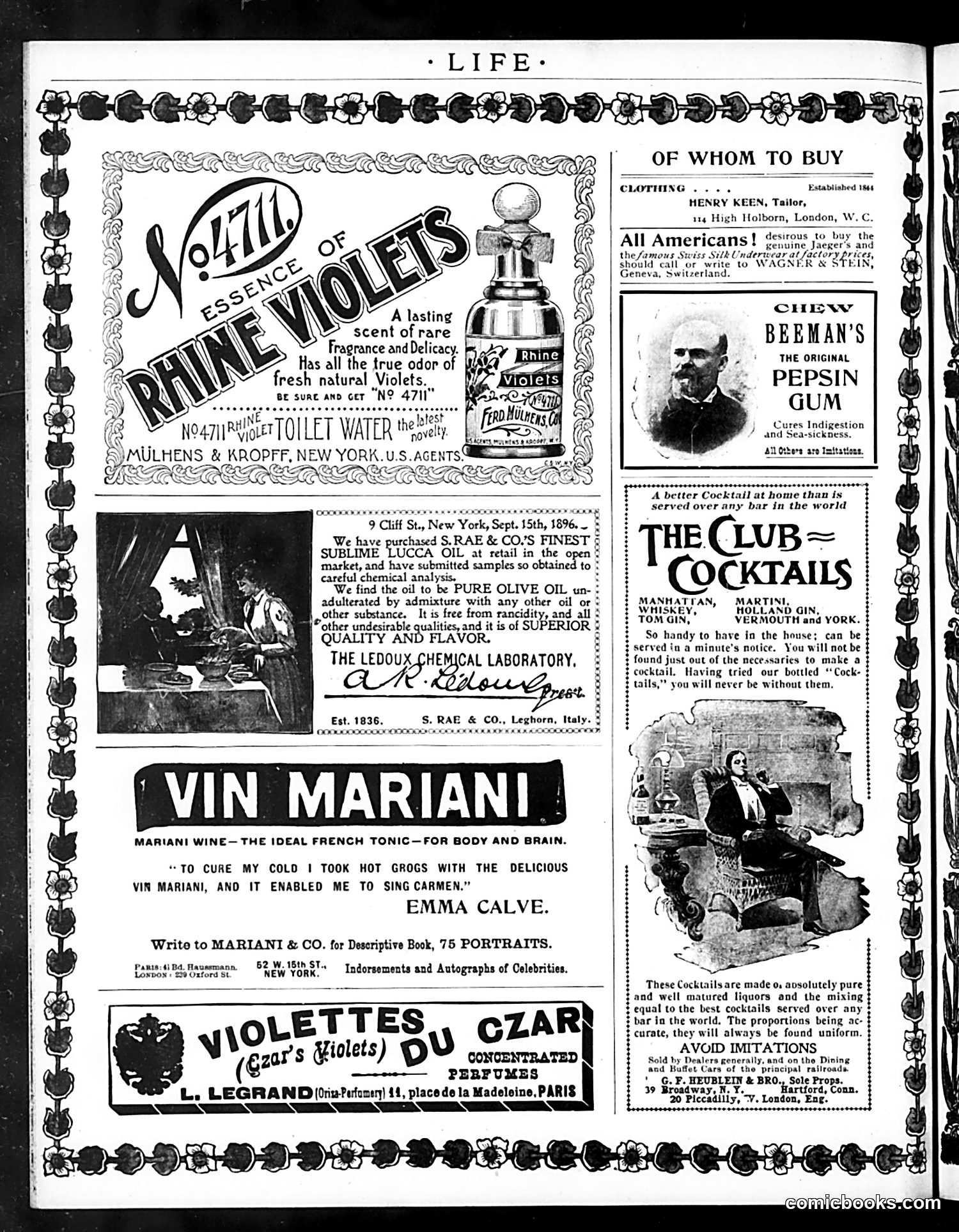
This is primarily an **advertising page** from Life magazine (circa 1896, based on the date visible). It contains no political cartoons or satire—just commercial advertisements typical of the era. The ads promote various products: Rhine Violets perfume and toilet water, olive oil, Vin Mariani (a wine tonic endorsed by opera singer Emma Calvé), Beeman's Pepsin Gum, and Club Cocktails. One ad features a chemical laboratory's certification of olive oil purity—a marketing technique reassuring consumers of product authenticity. **Historical context for modern readers:** These advertisements reflect the late-Victorian era's attitudes: celebrity endorsements for medicinal wines (Vin Mariani actually contained cocaine), the emerging concern with food purity (the oil certification), and mail-order shopping from international suppliers. The "Avoid Imitations" warning suggests counterfeit products were common commercial problems. The overall tone emphasizes luxury goods and scientific validation—appeals designed to persuade affluent readers.
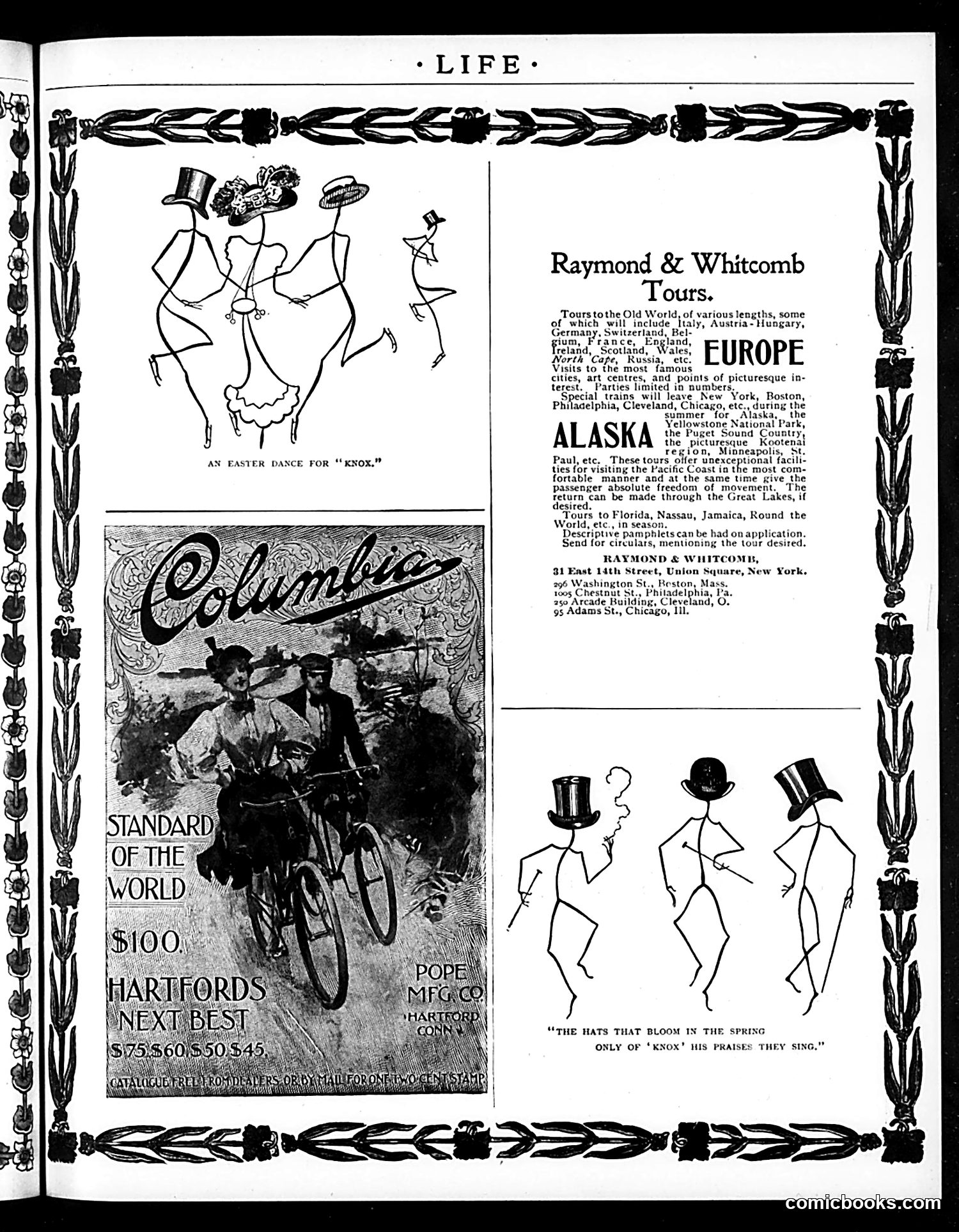
This page is primarily **advertising**, with two main commercial messages: 1. **Raymond & Whitcomb Tours** (right): A travel agency advertisement listing European and American destinations (Italy, Austria-Hungary, Alaska, Yellowstone, Florida, etc.), emphasizing luxury group travel with "absolute freedom of movement." 2. **Columbia Bicycle** (left): An advertisement for the "Standard of the World" bicycle at various price points ($100, $75, $60, $50, $45). 3. **Knox Hats** (bottom): A hat manufacturer's ad using a humorous quatrain about spring fashions. The satirical content is minimal. The top illustration ("An Easter Dance for Knox") shows stick figures in festive dress, likely satirizing Easter fashion culture. The bottom cartoon features three stylized male figures in hats with the caption mocking the "praises" of Knox hats during spring season. Overall, this represents **turn-of-century consumer culture** advertising dressed in playful illustrations typical of Life magazine's format.
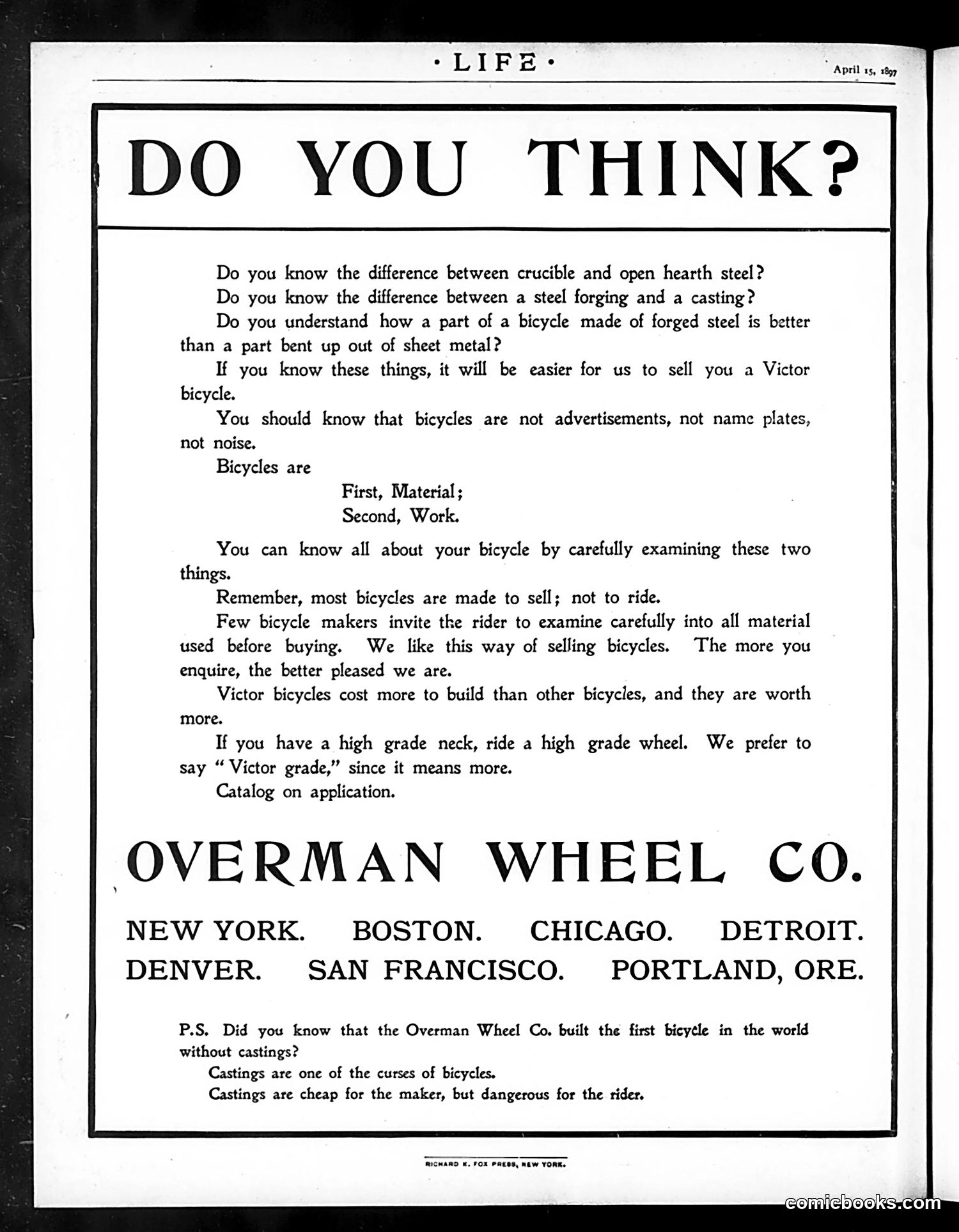
This is a **bicycle advertisement**, not a political cartoon. The Overman Wheel Company (Victor brand) ran this in *Life* magazine on April 15, 1899. The ad uses a rhetorical "DO YOU THINK?" header to position Victor bicycles as superior through technical knowledge rather than marketing hype. It appeals to educated consumers by asking whether they understand metallurgy—the difference between crucible steel, open-hearth steel, forging versus casting, and sheet metal. The key sales pitch: Victor bicycles cost more because they use better materials (forged steel parts rather than cheaper castings) and superior workmanship. The postscript explicitly claims Overman built the first bicycle without castings, positioning castings as inherently dangerous to riders despite being cheaper for manufacturers. For modern readers: this reflects late 1890s bicycle manufacturing debates and assumes consumers would recognize technical material distinctions as markers of quality. The tone is smugly paternalistic—essentially: "If you're smart enough to understand engineering, you'll buy our expensive product."