
Life, 1897-04-15 · page 17 of 34
Life — April 15, 1897 — page 17: what you’re looking at
What you’re looking at
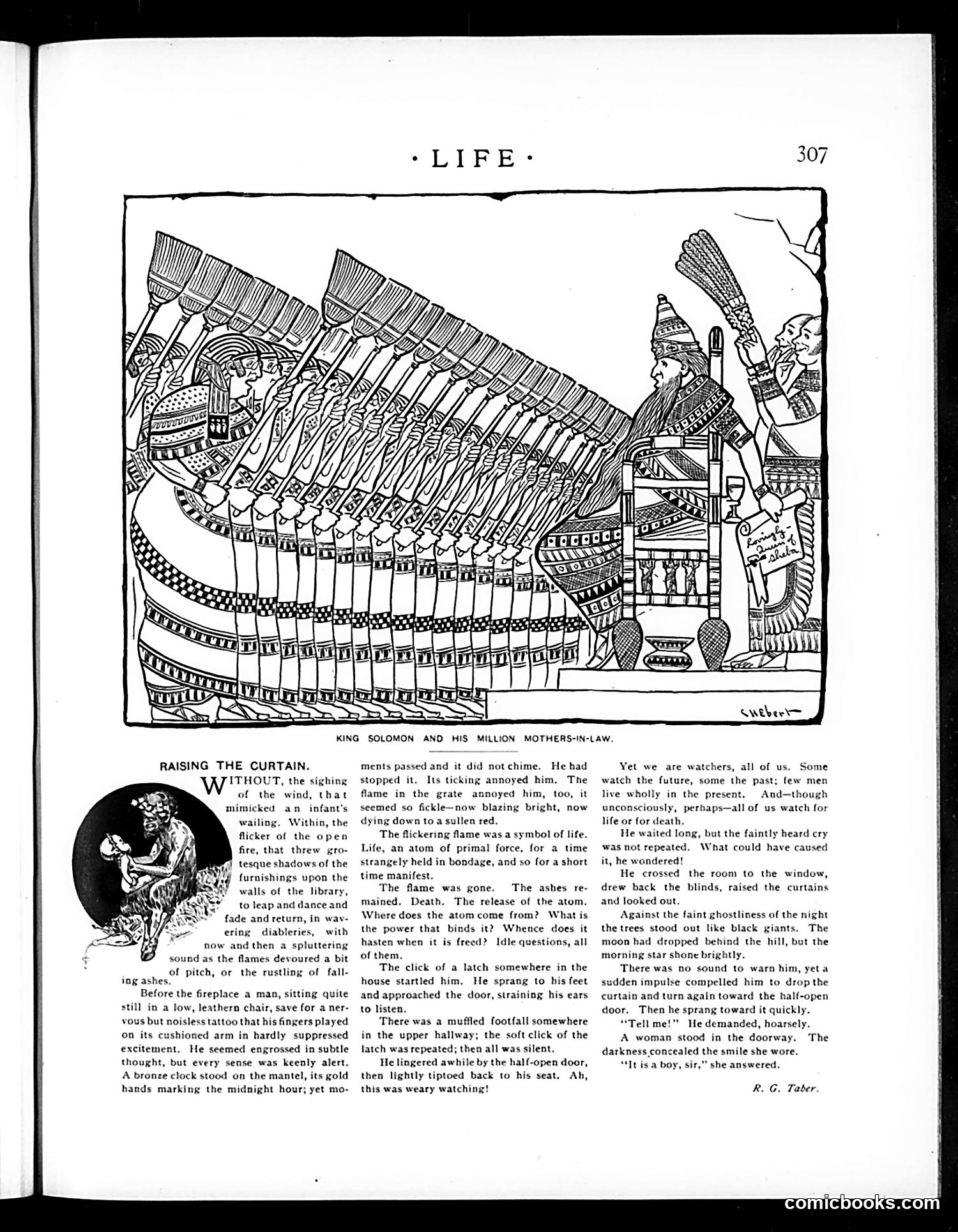
This page contains two distinct elements: a classical illustration captioned "King Solomon and His Million Mothers-in-Law" (likely a biblical reference to Solomon's legendary numerous wives), and a short story titled "Raising the Curtain" by R.G. Taber. The story itself is not satirical but rather a philosophical drama. A man sits alone at midnight, contemplating life and death while watching a dying fire—the flames serving as a metaphor for vitality itself. He's anxiously waiting for something, starting at sounds. The twist ending reveals he was awaiting news of a birth: a woman announces "It is a boy, sir." The narrative contrasts philosophical meditation on mortality with the arrival of new life, creating ironic juxtaposition. There's no political satire here—this is literary fiction exploring existential themes typical of early-20th-century magazine storytelling, not commentary on current events or public figures.
📄 Transcribed text from this page (OCR, searchable)
Machine-transcribed from the original scan — historical spelling and the odd misread are preserved.
RAISING THE CURTAIN. ITHOUT, the sighing of the wind, that mimicked an infant's wailing, Within, the flicker of the open fire, that threw gro- tesque shadows of the furnishings upon the walls of the library, to leap and dance and fade and return, in wav- ering diableries, with bis now and then a spluttering @ sound as the flames devoured a bit of pitch, or the rustling of fall- ing ashes, Before the fireplace a man, sitting quite still in a low, leathern chair, save for a ner- vous but noisless tattoo that his fingers played on its cushioned arm in hardly suppressed excitement, He seemed engrossed in subtle thought, but every sense was keenly alert. A bronze clock stood on the mantel, its gold hands marking the midnight hour; yet mo- KING SOLOMON AND HIS MILLION MOTHERS-IN-LAW. ments passed and it did notchime. He bad stopped it, Its ticking annoyed him. The flame in the grate annoyed him, too, it seemed so fickle—now blazing bright, now dying down toa sullen red. The flickering flame was a symbol of life. Life, an atom of primal force, for a time strangely held in bondage, and so for a short time manifest. The flame was gone. The ashes re- mained, Death. The release of the atom. Where does the atom come from? What is the power that binds it? Whence does it hasten when it is freed? Idle questions, all of them. The click of a latch somewhere in the house startled him. He sprang to bis feet and approached the door, straining his ears to listen, There was a muffled footfall somewhere in the upper hallway; the soft click of the latch was repeated; then all was silent. He lingered awhile by the half-open door, then lightly tiptoed back to his seat. Ah, this was weary watching! Yet we are watchers, all of us. Some watch the future, some the past; few men live wholly in the present. And—though unconsciously, perhaps—all of us watch for life or for death. He waited long, but the faintly heard cry was not repeated. What could have caused it, he wondered! He crossed the room to the window, drew back the blinds, raised the curtains and looked out. Against the faint ghostliness of the night the trees stood out like black giants. The moon had dropped behind the hill, but the morning star shone brightly. There was no sound to warn him, yet a sudden impulse compelled him to drop the curtain and turn again toward the half-open door. Then he sprang toward it quickly. “Tell me!” He demanded, hoarsely. A woman stood in the doorway. The darkness concealed the smile she wore. “It is a boy, sir,” she answered. R. G. Taber.