
Life, 1897-04-15 · page 4 of 34
Life — April 15, 1897 — page 4: what you’re looking at
What you’re looking at
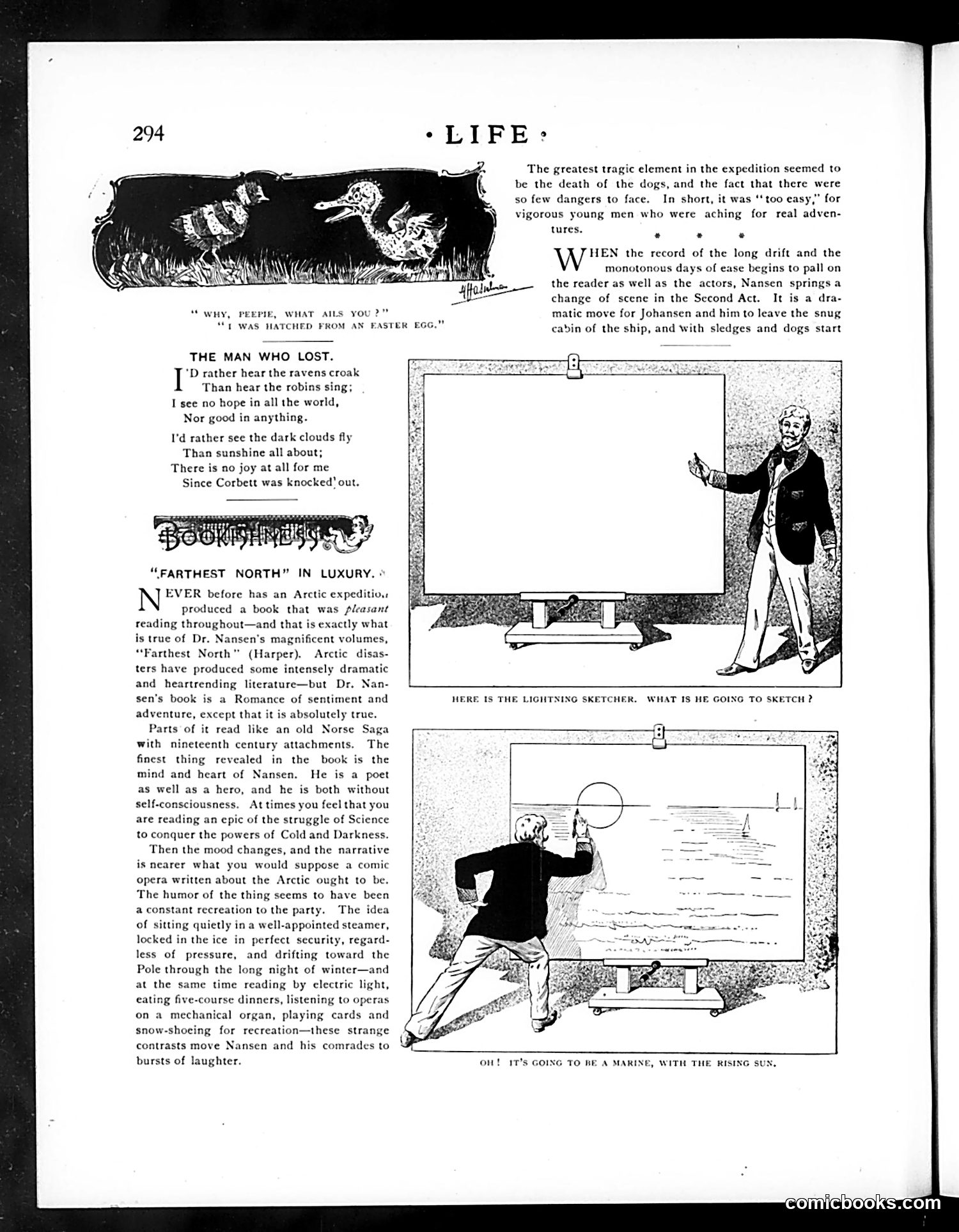
This page discusses Dr. Nansen's Arctic expedition book "Farthest North," praising it as a romance combining scientific achievement with personal drama. The text emphasizes Nansen's heroism and the book's appeal—contrasting the hardships of Arctic exploration with the comfort of reading about them. The two cartoons satirize the contrast between adventure and luxury. The first shows a man sketching arctic scenes. The second depicts someone enthusiastically drawing a marine scene while comfortably seated indoors, captioned "It's going to be a marine, with the rising sun." The satire mocks armchair adventurism—the comfortable contemplation of danger from safety, a recurring theme in Life's commentary on how modern readers consume tales of exploration without experiencing actual hardship.
📄 Transcribed text from this page (OCR, searchable)
Machine-transcribed from the original scan — historical spelling and the odd misread are preserved.
The greatest tragic element in the expedition seemed to be the death of the dogs, and the fact that there were so few dangers to face. In short, it was ‘‘ too easy,” for vigorous young men who were aching for real adven- tures. * . * HEN the record of the long drift and the monotonous days of ease begins to pall on the reader as well as the actors, Nansen springs a change of scene in the Sccond Act. It is a dra- “WHY, PEEPIE, WHAT AILS you?” matic move for Johansen and him to leave the snug “1 WAS MATCHED FROM AN EASTER EGG. cabin of the ship, and with sledges and dogs start THE MAN WHO LOST. D rather hear the ravens croak Than hear the robins sing; I see no hope in all the world, Nor good in anything. I'd rather see the dark clouds fly Than sunshine all about; There is no joy at all for me Since Corbett was knocked’ out. “FARTHEST NORTH” IN LUXURY. ° VER before has an Arctic expedition produced a book that was pleasant reading throughout—and that is exactly what is true of Dr. Nansen’s magnificent volumes, ‘arthest North” (Harper). Arctic disas- ters have produced some intensely dramatic and heartrending literature—but Dr. Nan- sen’s book is a Romance of sentiment and MERE IS THE LIGHTNING SKETCHER. adventure, except that it is absolutely true. Parts of it read like an old Norse Saga with nineteenth century attachments. The finest thing revealed in the book is the mind and heart of Nansen. He is a poet as well as a hero, and he is both without self-consciousness. At times you feel that you are reading an epic of the struggle of Science to conquer the powers of Cold and Darkness. Then the mood changes, and the narrative is nearer what you would suppose a comic opera written about the Arctic ought to be. The humor of the thing seems to have been a constant recreation to the party. The idea of sitting quietly in a well-appointed steamer, locked in the ice in perfect security, regard- less of pressure, and drifting toward the Pole through the long night of winter—and at the same time reading by electric light, eating five-course dinners, listening to operas on a mechanical organ, playing cards and snow-shocing for recreation—these strange contrasts move Nansen and his comrades to bursts of laughter. OU! IT'S GOING TO RE A MARINE, WITH THE RISING SUN,