
Life, 1897-04-15 · page 2 of 34
Life — April 15, 1897 — page 2: what you’re looking at
What you’re looking at
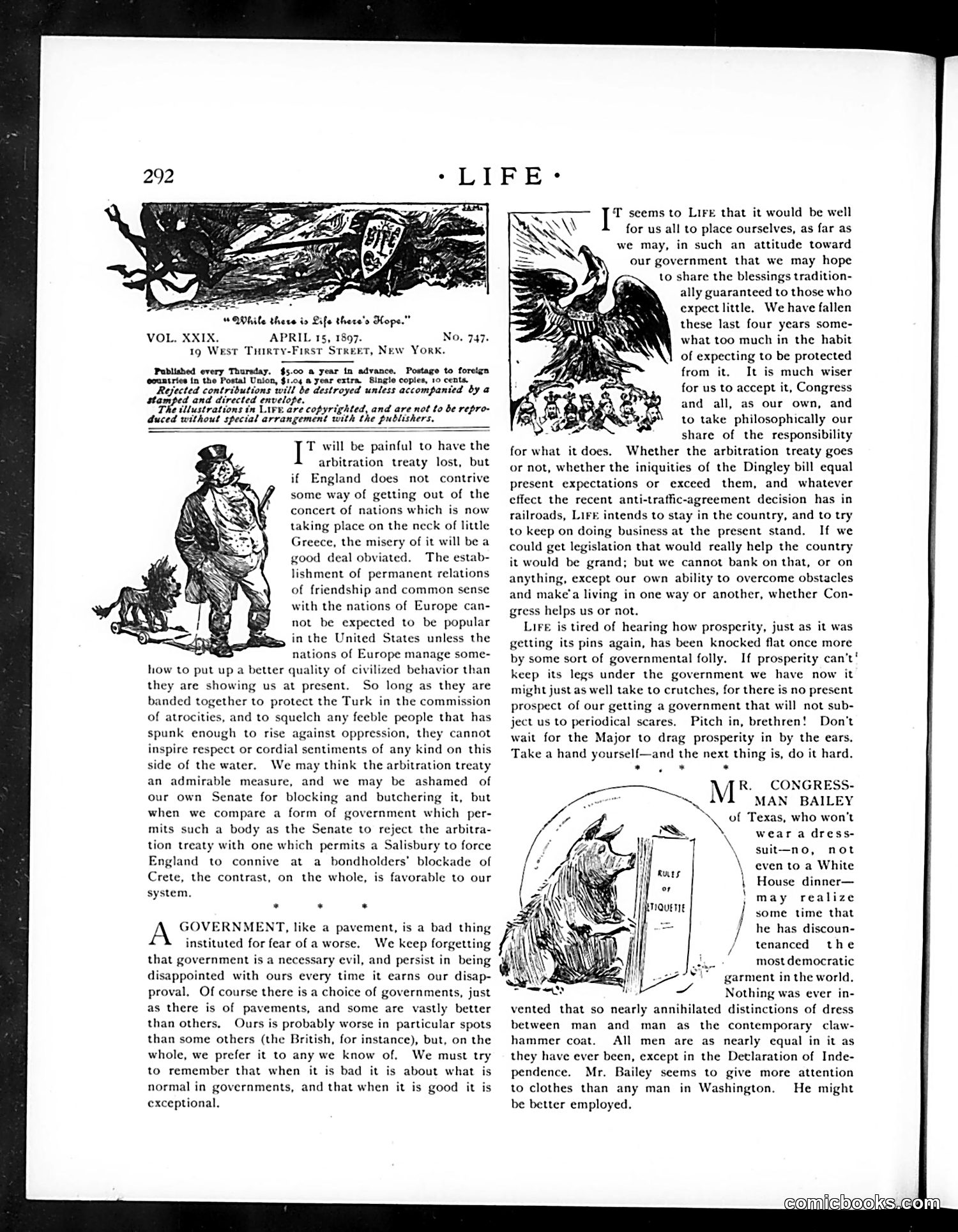
**Main Cartoon (left):** Depicts a figure labeled "LIFE" offering hope—shown as a bird or dove—to a distressed, kneeling person. The satire critiques how Life magazine itself promises optimism while addressing social/political hardship. **Central Text Discussion:** Addresses the arbitration treaty between the U.S. and Britain regarding disputes over Venezuela and other matters. The author argues Americans should accept realistic government limitations rather than expect excessive protection or prosperity from government intervention. **Bottom Cartoon:** Mocks Congressman Bailey of Texas for refusing to wear formal dress (even to White House dinners), celebrating his democratic rejection of class distinctions. The satire suggests this anti-fashion stance, while democratically principled, may be impractical for political effectiveness in Washington.
📄 Transcribed text from this page (OCR, searchable)
Machine-transcribed from the original scan — historical spelling and the odd misread are preserved.
“OWMhile there is Life there's Hope.” APRIL 15, 1897. est Tuirty-First Street, New York. Published every Thursday. $5.00 a year in advance. Postage to foreign countries in the Postal Union, $1.04 a year extra. Single copies, 10 cents, Rejected contributions will be destroyed unless accompanied by a stamped and directed envelope. . The illustrations in Live. are copyrighted, and are not to be repro- duced without special arrangement with the publishers. T will be painful to have the arbitration treaty lost, but if England does not contrive some way of getting out of the concert of nations which is now taking place on the ni of litt Greece, the misery of it will be good deal obviated. The estab- lishment of permanent relations of friendship and common sense with the nations of Europe can- not be expected to be popular in the United States unless the nations of Europe manage some- how to put up a better quality of civilized behavior than they are showing us at present. So long as they banded together to protect the Turk in the commi of atrocities, and to squelch any feeble people that has spunk enough to rise against oppression, they cannot inspire respect or cordial sentiments of any kind on this side of the water. We may think the arbitration treaty an admirable measure, and we may be ashamed of our own Senate for blocking and butchering it, but when we compare a form of government which per- mits such a body as the Senate to reject the arbitra- tion treaty with one which permits a Salisbury to force England to connive at a bondholders’ blockade of Crete, the contrast, on the whole, is favorable to our system, . . . GOVERNMENT, like a pavement, is a bad thing instituted for fear of a worse. We keep forgetting that government is a necessary evil, and persist in being disappointed with ours every time it earns our disap- proval. Of course there is a choice of governments, just as there is of pavements, and some are vastly better than others, Ours is probably worse in particular spots than some others (the British, for instance), but, on the whole, we prefer it to any we know of. We must try to remember that when it is bad it is about what is normal in governments, and that when it is good it is exceptional, T scems to Lire that it would be well for us all to place ourselves, as far as we may, in such an attitude toward our government that we may hope to share the blessings tradition- ally guaranteed to those who expect little. We have fallen these last four years some- what too much in the habit of expecting to be protected from it. It is much wiser for us to accept it, Congress and all, as our own, and to take philosophically our share of the responsibility for what it does. Whether the arbitration treaty goes or not, whether the iniquities of the Dingley bill equal present expectations or exceed them, and whatever effect the recent anti-traffic-agreement decision has in railroads, Lire intends to y in the country, and to try to keep on doing business at the present stand, If we could get legislation that would really help the country it would be grand; but we cannot bank on that, or on anything, except our own ability to overcome obstacles and make'a living in one way or another, whether Con- gress helps us or not. Lire is tired of hearing how prosperity, just as it was getting its pins again, has been knocked flat once more by some sort of governmental folly. If prosperity can’t! keep its legs under the government we now it might just as well take to crutches, for there is no present prospect of our getting a government that will not sub- ject us to periodical scares, Pitch in, brethren! Don't wait for the Major to drag prosperity in by the ears. Take a hand yourself—and the next thing is, do it hard. * . ———__ M R. CONGRESS Aa ~ IVI OMAN BAILEY 3 \ : of Texas, who won't \ wear a dress- \ suit—no, not even to a White House dinner— may realize some time that he has discoun- tenanced the most democratic garment in the world, Nothing was ever in- vented that so nearly annihilated distinctions of dress between man and man as the contemporary claw- hammer coat. All men are as nearly equal in it as they have ever been, except in the Detlaration of Inde- pendence. Mr. Bailey seems to give more attention to clothes than any man in Washington. He might be better employed. (| 7 Ahi i7 |! ‘\ \ ei \ Ke yr = i}